Overview
Understanding the purpose of a paragraph is a fundamental skill tested extensively on the SAT Reading and Writing section. This concept requires students to analyze why an author includes a specific paragraph within a larger passage—whether to introduce a new idea, provide supporting evidence, offer a contrasting viewpoint, or transition between concepts. The SAT purpose of a paragraph questions assess a student's ability to comprehend not just what a paragraph says, but why it exists in its particular location and how it functions within the passage's overall structure.
Mastering this topic is essential for SAT success because these questions appear regularly throughout the RW (Reading and Writing) section, often accounting for multiple points per test. Unlike simple comprehension questions that ask "what does the passage say," purpose questions demand higher-order thinking: students must step back from the details and evaluate the paragraph's rhetorical function. This skill connects directly to understanding authorial intent, passage structure, and argumentative development—all critical competencies for achieving a competitive score.
The ability to identify paragraph purpose also strengthens performance on related question types, including main idea questions, transition questions, and questions about passage organization. When students understand why each paragraph exists, they develop a more sophisticated comprehension of how authors build arguments, present evidence, and guide readers through complex ideas. This metacognitive awareness transforms passive reading into active analysis, which is precisely what the SAT rewards.
Learning Objectives
- [ ] Identify key features of purpose of a paragraph
- [ ] Explain how purpose of a paragraph appears on the SAT
- [ ] Apply purpose of a paragraph to answer SAT-style questions
- [ ] Distinguish between different types of paragraph purposes (introductory, supporting, contrasting, transitional, concluding)
- [ ] Analyze the relationship between a paragraph's purpose and its position within a passage
- [ ] Evaluate answer choices by eliminating options that describe content rather than function
Prerequisites
- Basic reading comprehension: Understanding literal meaning is necessary before analyzing rhetorical function; students must grasp what a paragraph says before determining why it's included.
- Familiarity with passage structure: Recognizing that passages have introductions, body paragraphs, and conclusions helps predict likely paragraph purposes based on location.
- Understanding of main ideas vs. details: Distinguishing between central claims and supporting information enables students to identify whether a paragraph introduces new concepts or elaborates on existing ones.
- Knowledge of transition words and phrases: Recognizing signal words like "however," "furthermore," and "for example" provides clues about a paragraph's function within the larger argument.
Why This Topic Matters
In real-world contexts, understanding paragraph purpose is essential for effective communication across all disciplines. Academic papers, professional reports, legal documents, and persuasive essays all rely on strategic paragraph placement to guide readers through complex arguments. Professionals in every field must analyze how written arguments are constructed, making this skill valuable far beyond standardized testing.
On the SAT, paragraph purpose questions appear with high frequency—typically 2-4 questions per test administration. These questions appear in both the literature and informational text passages, making them unavoidable. The College Board specifically tests this skill because it correlates strongly with college readiness: students who can analyze rhetorical structure are better prepared for university-level reading across disciplines.
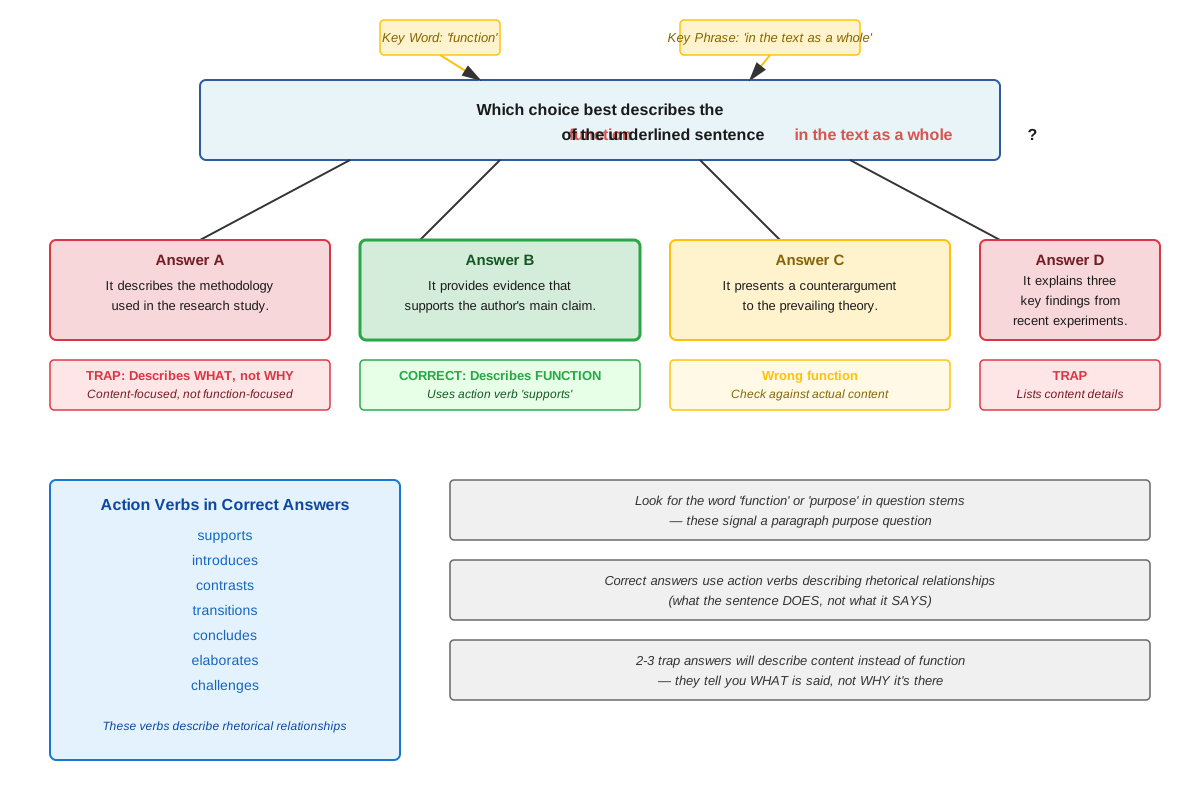
Common manifestations on the exam include questions asking what function a specific paragraph serves, why the author includes a particular paragraph, or how a paragraph relates to surrounding paragraphs. These questions often reference paragraphs by number (e.g., "The primary purpose of the third paragraph is to...") or by location (e.g., "The author includes the final paragraph in order to..."). The answer choices typically describe functions rather than content, using phrases like "introduce a counterargument," "provide supporting evidence," or "qualify a previous claim."
Core Concepts
Understanding Paragraph Purpose vs. Paragraph Content
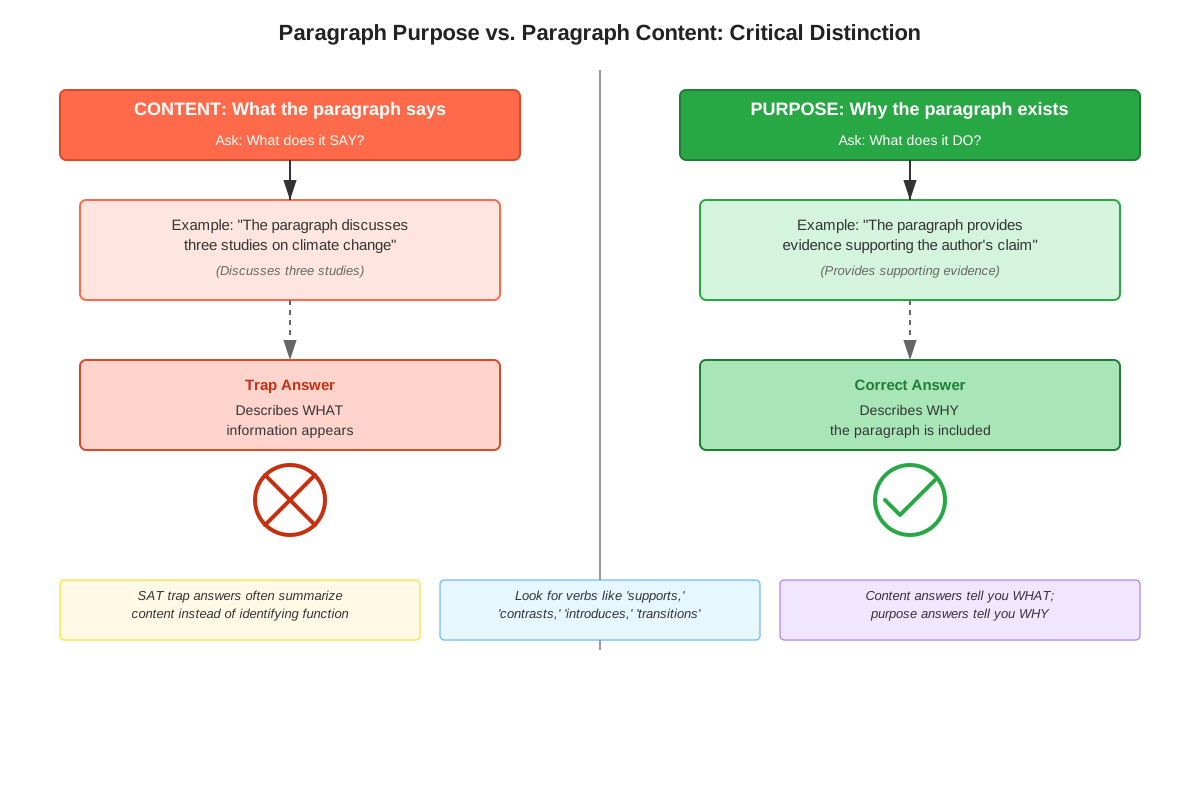
The purpose of a paragraph refers to its rhetorical function—the reason the author included it and the role it plays in developing the passage's overall argument or narrative. This differs fundamentally from paragraph content, which describes what the paragraph literally says. On the SAT, incorrect answer choices frequently describe content accurately while misidentifying purpose, making this distinction crucial.
For example, a paragraph might describe a scientific experiment (content), but its purpose could be to provide evidence supporting a hypothesis mentioned earlier, to introduce a methodology that will be critiqued later, or to illustrate a concept through concrete example. The same content can serve different purposes depending on context and placement within the passage.
Common Paragraph Purposes
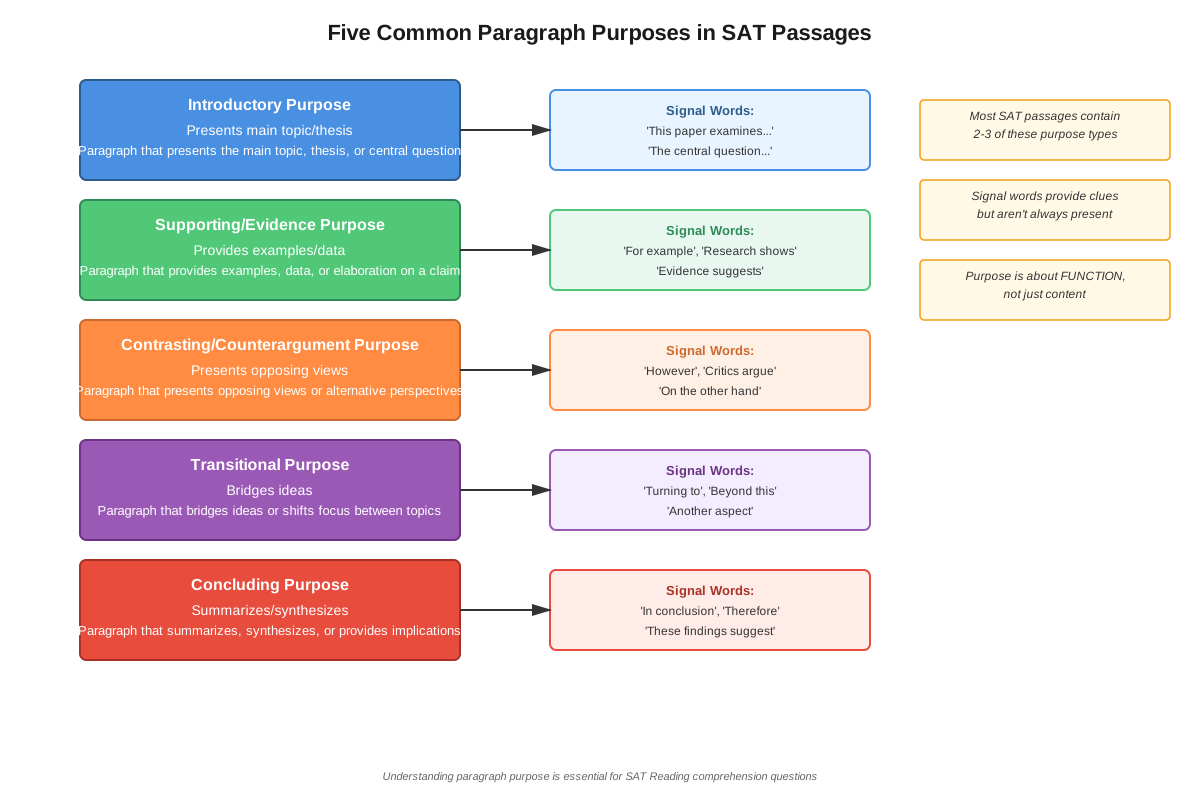
Different paragraphs serve distinct functions within passages. Understanding these categories helps students quickly identify purpose:
| Purpose Type | Function | Common Locations | Signal Words/Phrases |
|---|---|---|---|
| Introductory | Presents main topic, thesis, or central question | First paragraph | "This essay examines," "Consider," "Recently" |
| Supporting/Elaborating | Provides evidence, examples, or details for a claim | Body paragraphs | "For example," "Additionally," "Research shows" |
| Contrasting/Qualifying | Presents opposing views or limitations | Middle paragraphs | "However," "On the other hand," "Despite" |
| Transitional | Bridges between ideas or shifts focus | Between major sections | "Turning to," "Beyond," "This raises" |
| Concluding | Summarizes, synthesizes, or suggests implications | Final paragraph | "Thus," "Ultimately," "These findings suggest" |
Analyzing Purpose Through Position
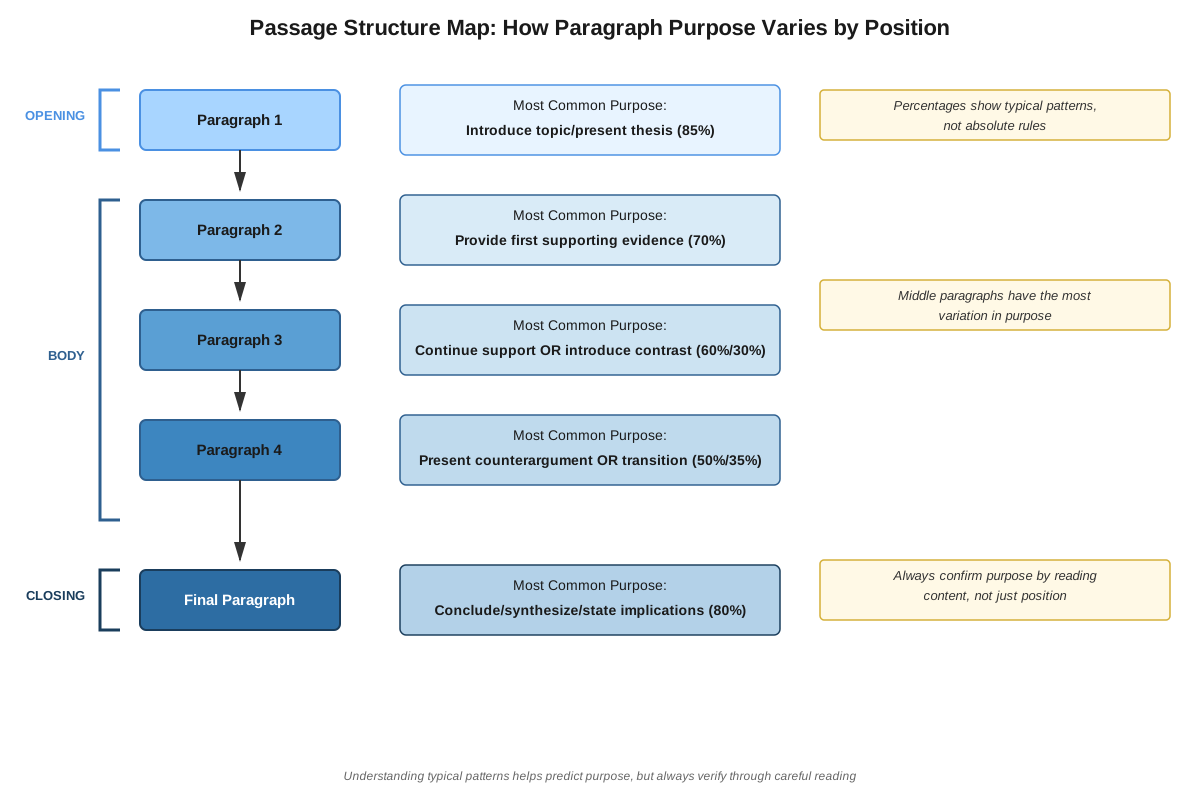
A paragraph's location within a passage provides critical clues about its likely purpose. Early paragraphs typically introduce topics, establish context, or present thesis statements. Middle paragraphs usually develop arguments through evidence, examples, or analysis. Later paragraphs often address counterarguments, acknowledge limitations, or draw conclusions.
However, the SAT tests whether students can identify purpose based on actual function rather than simply assuming based on position. A paragraph near the end might introduce a new consideration rather than conclude, or a middle paragraph might present a contrasting viewpoint rather than additional support. Students must read carefully to determine actual purpose rather than relying solely on location.
The Relationship Between Purpose and Passage Structure
Understanding how paragraphs work together reveals individual paragraph purposes. In argumentative passages, paragraphs typically follow a claim-evidence-analysis pattern, where some paragraphs state positions while others support or challenge them. In narrative passages, paragraphs might establish setting, develop character, create conflict, or resolve tension. In informational passages, paragraphs often present problems and solutions, causes and effects, or chronological developments.
The sat purpose of a paragraph questions frequently test whether students recognize these structural patterns. A paragraph that seems to simply describe a phenomenon might actually function to establish a problem that subsequent paragraphs will address, or to provide background necessary for understanding a later argument.
Identifying Purpose Through Rhetorical Markers
Authors use specific linguistic signals to indicate paragraph purpose. Phrases like "To understand this phenomenon" signal explanatory purpose, while "Critics argue" indicates presentation of opposing views. "This evidence suggests" marks analytical purpose, and "The implications extend beyond" signals expansion or application of ideas.
Paying attention to the paragraph's opening and closing sentences proves particularly valuable, as these often explicitly state or strongly suggest purpose. The first sentence frequently establishes what the paragraph will do, while the final sentence often connects back to the larger argument or transitions to the next idea.
Concept Relationships
The concepts within paragraph purpose analysis form an interconnected system. Understanding the distinction between content and purpose enables students to avoid the most common trap answers. Recognizing common purpose types provides a framework for quickly categorizing paragraphs. Analyzing position within passage structure helps predict likely purposes while avoiding assumptions. Identifying rhetorical markers confirms or refines initial purpose assessments.
These concepts connect to prerequisite knowledge of passage structure and main ideas: students must first understand what a passage argues overall before determining how individual paragraphs contribute to that argument. The skill also builds toward more advanced topics like analyzing authorial technique and evaluating argumentative effectiveness.
The relationship map flows as follows: Passage Main Idea → establishes context for → Individual Paragraph Purpose → which is revealed through → Rhetorical Markers and Position → leading to → Accurate Purpose Identification → enabling → Correct Answer Selection.
High-Yield Facts
- ⭐ Paragraph purpose describes function (why it's included), not content (what it says)
- ⭐ The most common trap answers accurately describe content but misidentify purpose
- ⭐ Opening and closing sentences of paragraphs most clearly signal purpose
- ⭐ Transition words and phrases provide crucial clues about paragraph function
- ⭐ A paragraph's purpose must be evaluated in context of the entire passage, not in isolation
- Supporting paragraphs provide evidence, examples, or elaboration for claims made elsewhere
- Contrasting paragraphs introduce opposing viewpoints, limitations, or complications
- Transitional paragraphs bridge between major ideas or shift the passage's focus
- The same content can serve different purposes depending on passage context
- Purpose questions often use phrases like "primarily serves to," "functions to," or "is included in order to"
- Paragraphs near passage beginnings often establish context, introduce topics, or present thesis statements
- Paragraphs near passage endings frequently draw conclusions, suggest implications, or synthesize information
- Middle paragraphs typically develop arguments through evidence or address counterarguments
- Qualifying paragraphs acknowledge limitations or exceptions to previous claims
- Illustrative paragraphs provide concrete examples of abstract concepts discussed elsewhere
Quick check — test yourself on Purpose of a paragraph so far.
Try Flashcards →Common Misconceptions
Misconception: A paragraph's purpose is the same as its main idea.
Correction: Main idea describes what the paragraph is about (its topic and central point), while purpose describes why the author included it and what function it serves in the larger passage. A paragraph about climate data might have the purpose of providing evidence for a claim made earlier, introducing a problem to be solved, or illustrating a concept through example.
Misconception: The first paragraph always introduces the main topic, and the last always concludes.
Correction: While this pattern is common, the SAT tests passages with varied structures. Some passages begin with anecdotes or questions before introducing the main topic in the second paragraph. Others end with new considerations or implications rather than traditional conclusions. Always determine purpose based on actual function, not assumed position.
Misconception: If an answer choice accurately describes something in the paragraph, it must be correct.
Correction: The most tempting wrong answers describe content that actually appears in the paragraph but misidentify why that content is included. A paragraph might mention a scientist's experiment, but if the answer says "to describe an experiment" when the actual purpose is "to provide evidence supporting a hypothesis," the answer is wrong despite being factually accurate about content.
Misconception: Longer paragraphs have more complex purposes than shorter ones.
Correction: Paragraph length doesn't determine purpose complexity. A brief paragraph might serve the sophisticated purpose of qualifying an entire argument, while a lengthy paragraph might simply provide multiple examples serving a single supporting function.
Misconception: Each paragraph serves only one purpose.
Correction: While SAT questions ask for the "primary" or "main" purpose, paragraphs often serve multiple functions simultaneously. A paragraph might both provide supporting evidence and introduce a transition to a new aspect of the topic. Students should identify the most significant or overarching function when multiple purposes exist.
Worked Examples
Example 1: Scientific Passage
Passage Context: A passage discusses how coral reefs respond to climate change. The first two paragraphs explain that rising ocean temperatures cause coral bleaching. The third paragraph reads:
"Not all coral species respond identically to temperature stress, however. Research by marine biologist Dr. Sarah Chen has identified several coral varieties in the Western Pacific that demonstrate remarkable heat tolerance, surviving temperature increases that would devastate most coral populations. These resilient species maintain their symbiotic algae even when surrounding corals expel theirs, suggesting genetic adaptations that could prove crucial for reef survival."
Question: The primary purpose of the third paragraph is to:
A) Describe Dr. Sarah Chen's research methodology
B) Introduce a qualification to the general pattern described earlier
C) Argue that coral bleaching is not caused by temperature increases
D) Explain the symbiotic relationship between coral and algae
Analysis:
- Step 1: Identify what the paragraph says (content): It discusses coral species with heat tolerance, mentions Dr. Chen's research, and describes how these corals maintain algae.
- Step 2: Determine the paragraph's function in context: The first two paragraphs established a general pattern (temperature causes bleaching). This paragraph introduces exceptions to that pattern.
- Step 3: Evaluate each answer:
- A describes content (Chen's research is mentioned) but not purpose—the paragraph doesn't explain her methodology
- B correctly identifies the rhetorical function: qualifying the previous general claim by introducing exceptions
- C misrepresents the argument—the paragraph doesn't deny temperature's role, just shows some corals resist it
- D describes content mentioned in the paragraph but not why this content is included
Answer: B. The paragraph's purpose is to qualify or complicate the general pattern by introducing exceptions, signaled by the transition word "however."
Example 2: Historical Passage
Passage Context: A passage examines the development of voting rights in the United States. Earlier paragraphs discuss the gradual expansion of suffrage through the 19th and early 20th centuries. A middle paragraph reads:
"Despite these legislative victories, actual voting access remained severely restricted for many citizens. Poll taxes, literacy tests, and grandfather clauses effectively disenfranchised millions of African Americans in Southern states. In some counties, fewer than 5% of eligible Black voters could register, revealing the gap between legal rights and practical reality."
Question: The author includes this paragraph primarily to:
A) Provide statistical evidence about voter registration rates
B) Explain the mechanisms of poll taxes and literacy tests
C) Contrast legal progress with continued practical barriers
D) Argue that legislative victories were meaningless
Analysis:
- Step 1: Identify content: The paragraph describes barriers to voting and provides registration statistics.
- Step 2: Determine function: The transition "Despite these legislative victories" signals contrast. The paragraph shows that legal changes didn't immediately translate to actual access.
- Step 3: Evaluate answers:
- A describes content (statistics are mentioned) but not the rhetorical purpose of including them
- B describes content but not function—the paragraph mentions these mechanisms as examples, not to explain how they work
- C correctly identifies the contrasting function: showing the gap between legal rights (discussed earlier) and practical reality
- D overstates the argument—the paragraph complicates rather than dismisses the significance of legal changes
Answer: C. The paragraph's purpose is to present a contrasting reality that qualifies the progress described in earlier paragraphs, creating a more nuanced understanding.
Exam Strategy
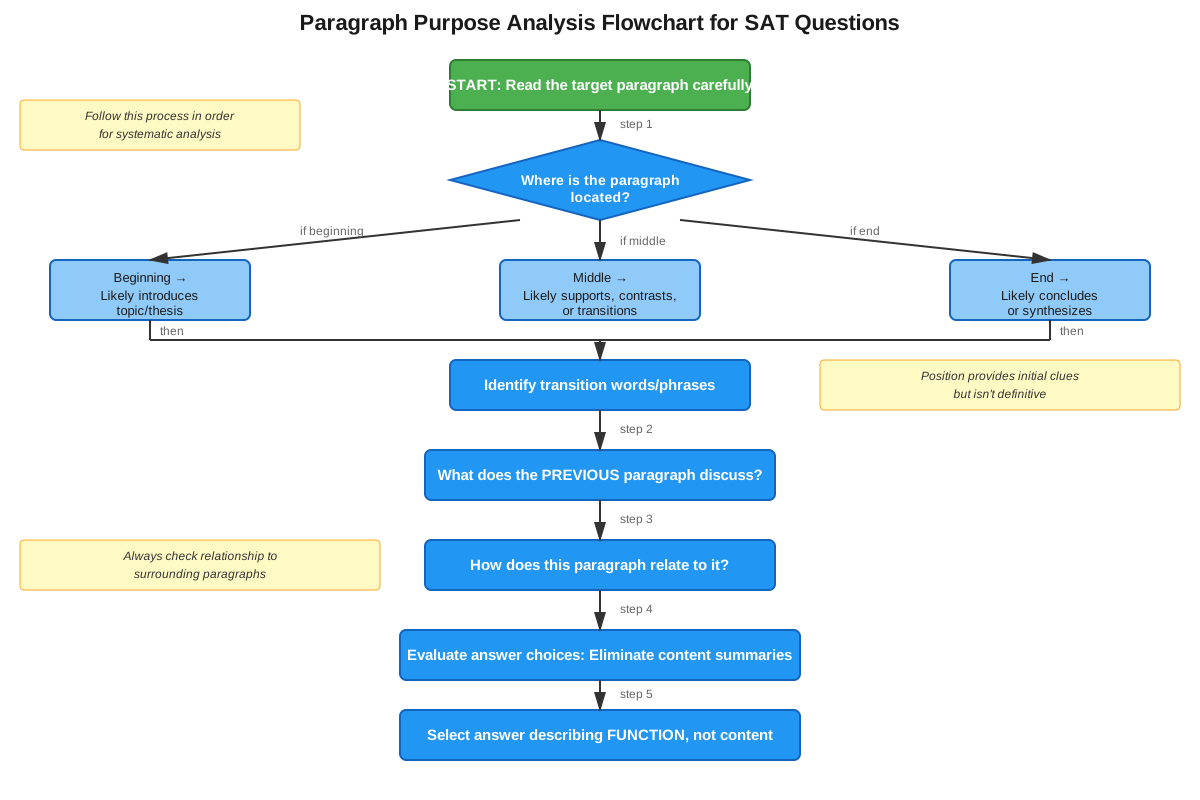
When approaching sat purpose of a paragraph questions, follow this systematic process:
- Read the referenced paragraph carefully, but also skim the paragraphs immediately before and after to understand context
- Identify transition words at the paragraph's beginning—these often signal purpose directly (however = contrast; furthermore = additional support; for example = illustration)
- Ask yourself: "Why did the author include this paragraph here? What would be missing if this paragraph were removed?"
- Predict the answer before looking at choices—formulate your own description of the purpose
- Eliminate answers that describe content without identifying function—if an answer could be a title for the paragraph rather than a description of its role, it's likely wrong
Exam Tip: Watch for these trigger phrases in questions: "primarily serves to," "functions to," "is included in order to," "the main purpose of," "the author discusses X primarily to." These signal purpose questions requiring functional analysis rather than content summary.
Process of elimination strategies specific to this topic:
- Eliminate answers that are too narrow, focusing on a single detail rather than the paragraph's overall function
- Eliminate answers that are too broad, describing the entire passage's purpose rather than the specific paragraph's role
- Eliminate answers that accurately describe content but use the wrong functional verb (e.g., "describe" when the purpose is actually "support" or "contrast")
- Eliminate answers that misrepresent the author's stance or argument
Time allocation: Spend 30-45 seconds re-reading the referenced paragraph and surrounding context, then 30-45 seconds evaluating answer choices. Purpose questions reward careful analysis over speed, so invest the time to understand context fully.
Memory Techniques
PACES Mnemonic for common paragraph purposes:
- Provide evidence/support
- Address counterarguments
- Contrast with previous ideas
- Expand or elaborate on concepts
- Shift focus or transition
The "Function, Not Fashion" Rule: Remember that purpose questions ask about function (what the paragraph does), not fashion (what the paragraph wears/contains). Visualize paragraphs as tools in a toolbox—each serves a specific function in building the passage's argument.
The "Because" Test: After reading a paragraph, complete this sentence: "The author included this paragraph because..." Your completion should describe function, not content. If you find yourself describing what the paragraph says rather than why it's there, refocus on purpose.
Position Predictions (but verify!):
- Beginning paragraphs often Introduce or Establish context
- Middle paragraphs often Support, Contrast, or Elaborate
- Ending paragraphs often Conclude, Synthesize, or Imply
Remember: These are tendencies, not rules. Always confirm purpose through actual analysis.
Summary
Understanding paragraph purpose requires distinguishing between what a paragraph says (content) and why it exists (function). On the SAT Reading and Writing section, purpose questions test whether students can analyze how individual paragraphs contribute to a passage's overall structure and argument. The most common paragraph purposes include introducing topics, providing supporting evidence, presenting contrasting viewpoints, transitioning between ideas, and drawing conclusions. Success on these questions depends on reading paragraphs in context, identifying rhetorical markers like transition words, and avoiding trap answers that accurately describe content while misidentifying function. Students must evaluate each paragraph's role within the larger passage rather than analyzing it in isolation. The key to mastering this topic is practicing the distinction between content and purpose until it becomes automatic, enabling quick and accurate identification of paragraph function even under test conditions.
Key Takeaways
- Paragraph purpose describes rhetorical function (why included), not content (what it says)
- The most dangerous wrong answers accurately describe content but misidentify purpose
- Transition words and opening/closing sentences provide the strongest clues to purpose
- Always evaluate paragraph purpose in the context of the entire passage, not in isolation
- Common purposes include supporting claims, contrasting ideas, qualifying arguments, transitioning between topics, and introducing or concluding discussions
- Use the "Because" test: "The author included this paragraph because..." should yield a functional answer
- Eliminate answers that could serve as paragraph titles rather than descriptions of paragraph function
Related Topics
Main Idea Questions: Understanding paragraph purpose builds directly toward identifying main ideas, as recognizing why paragraphs exist helps determine what they're fundamentally about. Mastering purpose analysis makes main idea questions significantly easier.
Passage Structure and Organization: Analyzing how individual paragraphs function reveals overall passage structure. Students who understand paragraph purpose can better predict passage organization and answer questions about how passages are constructed.
Transition and Flow Questions: Many SAT questions ask which sentence or phrase best connects ideas between paragraphs. Understanding paragraph purpose enables students to identify what kind of transition is needed based on how adjacent paragraphs function.
Author's Technique and Rhetorical Strategy: Advanced analysis of how authors build arguments depends on understanding why they include specific paragraphs. This topic provides foundation for more sophisticated rhetorical analysis.
Practice CTA
Now that you've mastered the core concepts of paragraph purpose, it's time to apply this knowledge! Work through the practice questions to test your ability to distinguish content from function, identify common paragraph purposes, and eliminate trap answers. The flashcards will help reinforce key distinctions and common purpose types. Remember: every practice question you complete strengthens your pattern recognition, making purpose identification faster and more automatic on test day. You've built the foundation—now build the skill through deliberate practice!
Sign up free to keep reading
Create a free AnvayaPrep account to finish this SAT guide on Purpose of a paragraph — plus flashcards and practice questions.