Overview
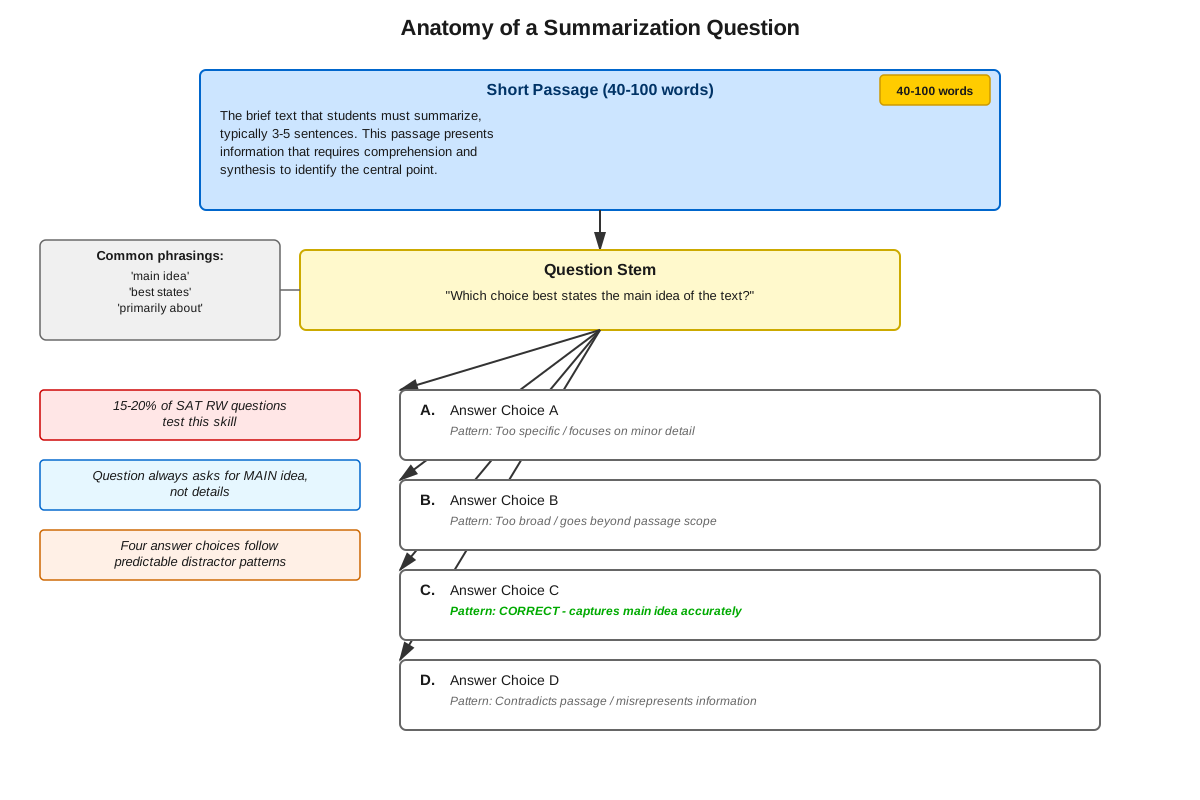
Summarizing short passages is one of the most fundamental and frequently tested skills in the SAT Reading and Writing (RW) section. This skill requires students to distill the main point or central claim of a brief text—typically 40 to 100 words—into a concise statement that captures the author's primary message without including extraneous details or misrepresenting the passage's scope. Unlike questions that ask about specific details or rhetorical devices, summarizing questions test a student's ability to distinguish between main ideas and supporting information, recognize the author's purpose, and synthesize information efficiently.
The ability to summarize effectively is essential for SAT success because it appears in multiple question formats throughout the exam. Students encounter direct summarization questions that explicitly ask "Which choice best states the main idea of the text?" as well as implicit summarization tasks embedded in questions about author's purpose, passage structure, and comparative analysis. Mastering this skill not only improves performance on dedicated summarization questions but also enhances overall reading comprehension, enabling students to navigate complex passages more efficiently and answer a broader range of question types with greater accuracy.
Within the broader context of the SAT Reading and Writing curriculum, summarizing short passages serves as a foundational skill that connects to virtually every other competency tested in the Central Ideas and Details unit. Strong summarization abilities support understanding of text structure, recognition of supporting evidence, identification of authorial claims, and analysis of how ideas develop across a passage. Students who excel at summarization demonstrate the critical thinking and analytical reading skills that underpin success across all SAT reading comprehension tasks.
Learning Objectives
- [ ] Identify key features of summarizing short passages
- [ ] Explain how summarizing short passages appears on the SAT
- [ ] Apply summarizing short passages to answer SAT-style questions
- [ ] Distinguish between main ideas and supporting details in brief texts
- [ ] Evaluate answer choices to identify those that accurately capture scope and emphasis
- [ ] Recognize common distractor patterns in summarization questions
- [ ] Synthesize information from multiple sentences to formulate comprehensive summaries
Prerequisites
- Basic reading comprehension: Understanding literal meaning of sentences is necessary before identifying main ideas versus details
- Vocabulary knowledge: Recognizing common academic and domain-specific terms enables accurate interpretation of passage content
- Sentence structure analysis: Identifying subjects, verbs, and objects helps determine what the author emphasizes as most important
- Paragraph organization awareness: Understanding how sentences relate to each other aids in recognizing topic sentences and supporting evidence
Why This Topic Matters
Summarizing short passages represents a critical real-world skill that extends far beyond standardized testing. In academic settings, students must regularly distill complex readings into concise notes, identify thesis statements in scholarly articles, and synthesize information from multiple sources. Professional contexts demand similar abilities: executives summarize reports for stakeholders, researchers condense findings for abstracts, and journalists extract key points from interviews. The cognitive skill of distinguishing essential information from peripheral details enhances efficiency in virtually any field requiring information processing.
On the SAT specifically, summarization questions appear with remarkable frequency. Approximately 15-20% of all Reading and Writing questions directly test summarization skills, making this one of the highest-yield topics for focused study. These questions typically appear in the "Central Ideas and Details" category, which comprises roughly one-third of the entire RW section. Students can expect to encounter 3-5 explicit summarization questions per test, with many additional questions requiring implicit summarization as part of answering correctly.
Summarization questions on the SAT most commonly appear in several distinct formats. The most straightforward asks students to identify which statement best captures the main idea of a passage about scientific research, historical events, literary analysis, or social science topics. Passages may present a single unified argument, describe a phenomenon and its causes, compare contrasting viewpoints, or trace the development of an idea. The Digital SAT format presents these passages as self-contained units of 40-100 words, requiring students to process information quickly and accurately within the adaptive testing structure.
Core Concepts
What Constitutes an Effective Summary
An effective summary captures the central claim or main point of a passage while maintaining appropriate scope and emphasis. The central claim represents the author's primary assertion, argument, or observation—the single most important idea the passage communicates. Scope refers to the breadth of the summary: it should neither be too narrow (focusing on a single detail) nor too broad (making claims beyond what the passage addresses). Emphasis concerns which aspects of the passage receive prominence in the summary, mirroring the author's own priorities rather than highlighting peripheral information.
A quality summary possesses four essential characteristics:
- Accuracy: Every element of the summary must be supported by the passage text
- Completeness: The summary must address the passage's primary purpose, not just one component
- Conciseness: The summary should be economical, avoiding unnecessary elaboration
- Neutrality: The summary should reflect the author's perspective without adding external interpretation
Main Ideas Versus Supporting Details
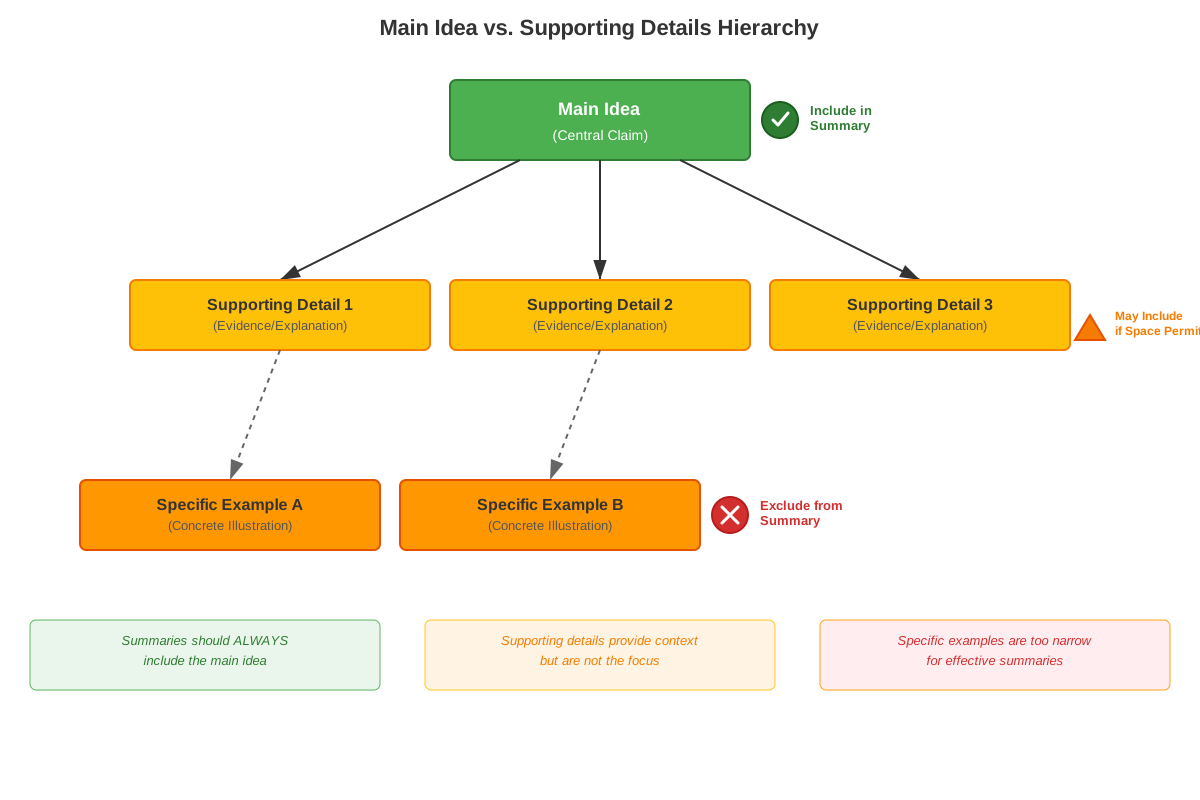
The distinction between main ideas and supporting details forms the foundation of effective summarization. The main idea represents the overarching point or thesis that the passage exists to communicate. Supporting details include examples, evidence, explanations, descriptions, and elaborations that develop, illustrate, or substantiate the main idea. On the SAT, incorrect answer choices frequently present supporting details as if they were main ideas, testing whether students can maintain focus on the passage's primary purpose.
Consider this hierarchy:
| Level | Function | Example Indicators |
|---|---|---|
| Main Idea | States the passage's central purpose | "argues that," "demonstrates," "reveals," "suggests" |
| Major Supporting Detail | Directly develops the main idea | "for example," "specifically," "evidence shows" |
| Minor Supporting Detail | Elaborates on major details | "such as," "including," "in particular" |
Identifying Topic Sentences and Thesis Statements
Topic sentences and thesis statements serve as explicit markers of main ideas within passages. A topic sentence introduces the primary focus of a paragraph, while a thesis statement presents the central argument of an entire passage. On the SAT, these elements frequently appear in predictable locations: the first or second sentence of a passage often contains the main idea, though some passages reserve the thesis for the concluding sentence as a summary statement.
However, not all passages contain explicit topic sentences. Some passages develop their main ideas implicitly through accumulated details, requiring students to infer the central point from the overall pattern of information. This implicit structure appears particularly often in descriptive passages about scientific phenomena or historical events, where the author presents observations without stating an overarching claim directly.
Recognizing Passage Structures
Understanding common passage structures enables more efficient identification of main ideas. The SAT employs several recurring organizational patterns:
Argument Structure: The author presents a claim and supports it with evidence or reasoning. The main idea is the claim itself.
Problem-Solution Structure: The passage describes a challenge and proposes a resolution. The main idea encompasses both the problem and the solution.
Cause-Effect Structure: The text explains why something occurs or what results from a particular phenomenon. The main idea identifies the causal relationship.
Compare-Contrast Structure: The passage examines similarities and differences between two subjects. The main idea concerns the relationship between the subjects, not the subjects themselves.
Descriptive Structure: The author characterizes a person, place, concept, or phenomenon. The main idea captures the essential nature or significance of what is described.
Scope Management in Summaries
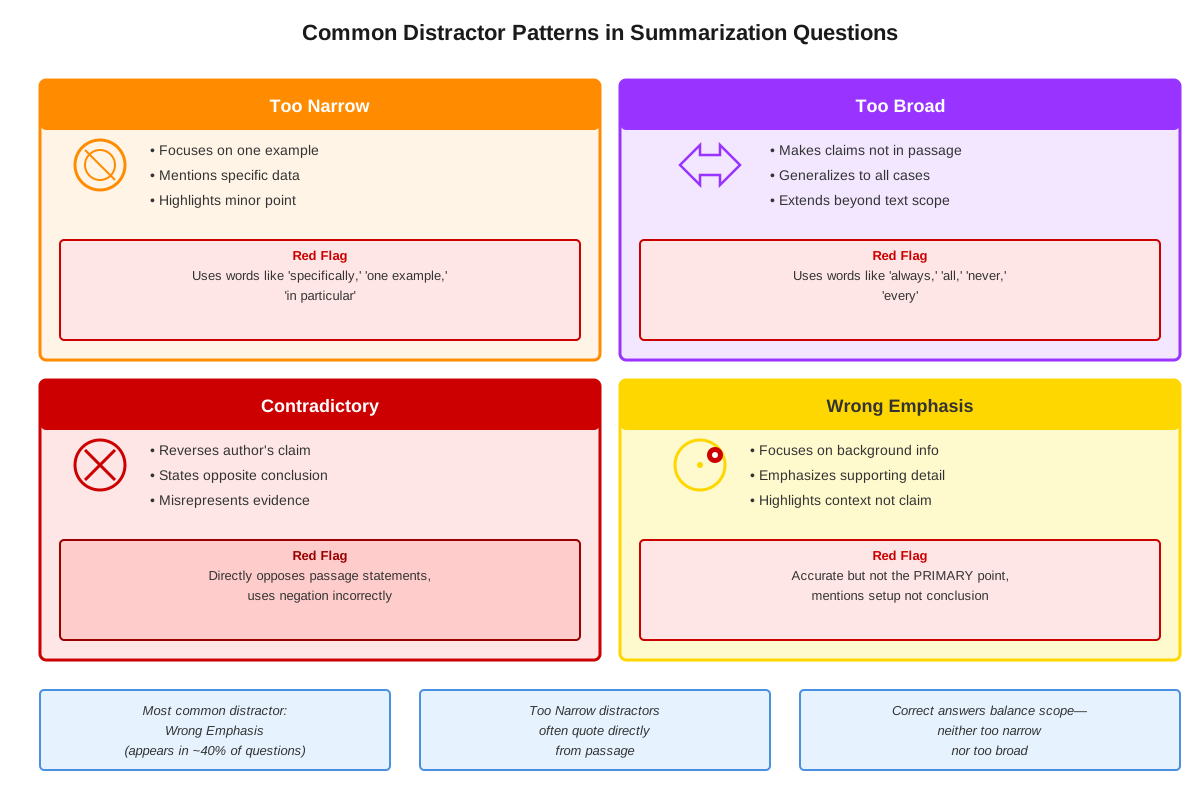
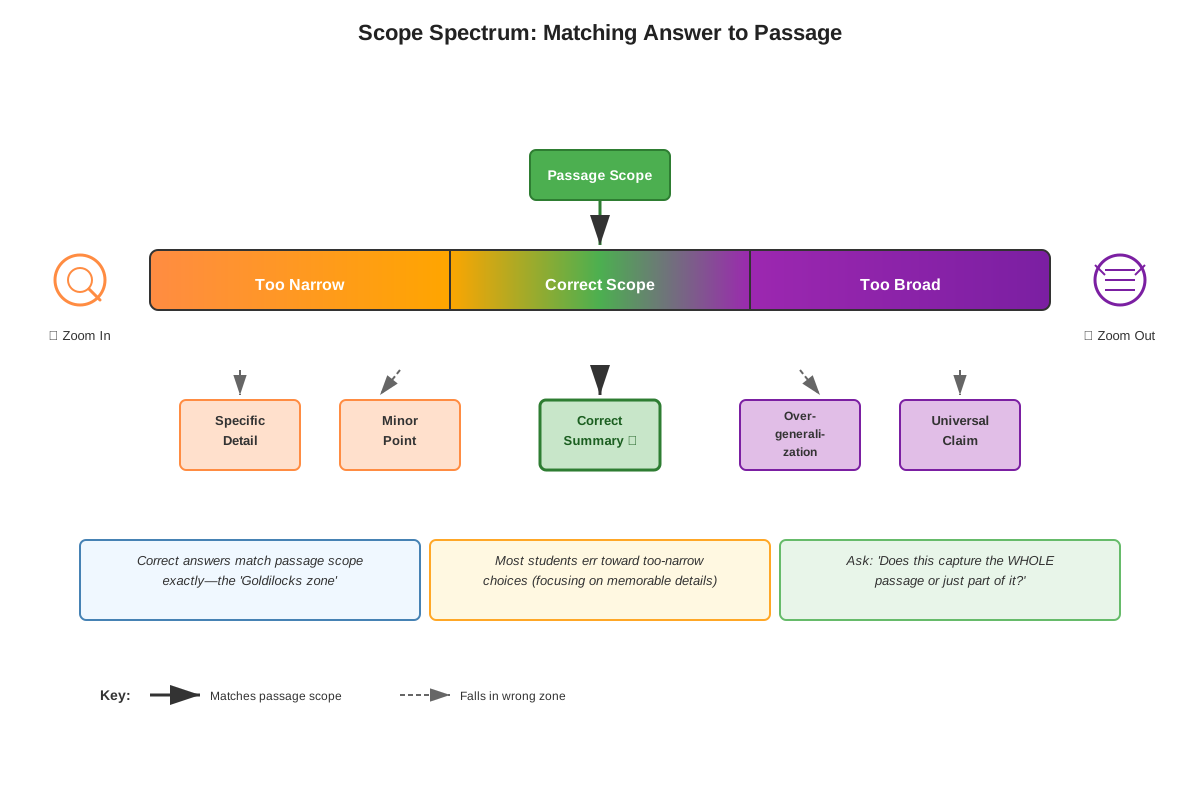
Scope management represents one of the most challenging aspects of summarization. Incorrect answer choices often fail by being either too specific or too general. A too-specific answer focuses on a single example or detail rather than the overarching point. A too-general answer makes claims that extend beyond what the passage actually addresses, often by using vague language that could apply to many different passages.
Effective scope management requires attention to:
- Quantifiers: Words like "all," "some," "many," "most" significantly affect scope
- Qualifiers: Terms like "suggests," "proves," "demonstrates," "hints" indicate different levels of certainty
- Domain boundaries: The specific subject matter the passage addresses versus related topics it doesn't discuss
Author's Purpose and Tone
The author's purpose—whether to inform, persuade, describe, or analyze—shapes what constitutes an appropriate summary. A passage written to persuade readers of a particular viewpoint requires a summary that captures the author's argument and stance. A passage written to inform readers about a phenomenon needs a summary that identifies what is being explained and the key insight provided. Misidentifying the author's purpose leads to summaries that emphasize the wrong elements.
Similarly, tone—the author's attitude toward the subject—must be reflected accurately in summaries. A passage presenting a critical analysis requires a summary that acknowledges the critical perspective, while a passage offering neutral description needs a summary that maintains that objectivity. SAT answer choices sometimes introduce inappropriate tone, presenting neutral information as if the author were arguing for or against something.
Concept Relationships
The concepts within summarizing short passages form an interconnected system where each element supports and reinforces the others. Identifying main ideas versus supporting details serves as the foundational skill that enables all other summarization competencies. This distinction directly feeds into scope management, as recognizing which details are subordinate helps determine whether a potential summary is too narrow (focused on details) or appropriately comprehensive (focused on the main idea).
Passage structure recognition acts as a strategic tool that accelerates main idea identification. Understanding that a passage follows an argument structure, for example, directs attention toward the claim being made rather than the evidence supporting it. This structural awareness connects to topic sentence identification, as different structures position thesis statements in different locations—argument passages often lead with claims, while problem-solution passages may reserve the main idea for the conclusion.
Author's purpose and tone function as filtering mechanisms that help evaluate potential summaries. Once the purpose is identified (e.g., to argue for a particular interpretation), summaries can be assessed based on whether they capture that argumentative stance. This connects back to scope management, as understanding purpose helps determine whether a summary's breadth appropriately matches the passage's ambitions.
The relationship map flows as follows:
Passage Structure Recognition → enables → Topic Sentence Identification → reveals → Main Idea vs. Supporting Details → informs → Scope Management → filtered by → Author's Purpose and Tone → produces → Effective Summary
These concepts also connect to prerequisite knowledge: sentence structure analysis supports topic sentence identification, while vocabulary knowledge enables accurate tone recognition. The entire summarization skill set builds toward broader SAT competencies in the Central Ideas and Details unit, particularly understanding text structure, identifying supporting evidence, and analyzing authorial claims.
High-Yield Facts
⭐ Approximately 15-20% of SAT Reading and Writing questions directly test summarization skills, making this one of the highest-yield topics for focused preparation.
⭐ The main idea most frequently appears in the first or last sentence of SAT short passages, though students must check the entire passage to confirm.
⭐ Incorrect answer choices typically fail due to being too specific (focusing on details), too broad (exceeding passage scope), or inaccurate (misrepresenting content).
⭐ Effective summaries must capture both WHAT the passage discusses and the author's primary POINT about that subject, not merely the topic.
⭐ Words like "all," "always," "never," and "only" in answer choices often signal scope problems, as passages rarely make absolute claims.
- Supporting details include examples, statistics, quotes, descriptions, and explanations that develop the main idea but are not themselves the central point.
- Passages with implicit main ideas require students to synthesize information across multiple sentences to infer the overarching point.
- The author's purpose (inform, persuade, describe, analyze) determines what elements must appear in an accurate summary.
- Comparative passages require summaries that address the relationship between subjects, not just describe each subject independently.
- Neutral, objective language in summaries is generally safer than emotionally charged language unless the passage itself takes a clear stance.
- Time-efficient summarization involves reading the first sentence, last sentence, and scanning for transition words that signal main ideas.
- Answer choices that introduce information not mentioned in the passage are always incorrect, even if the information seems related or plausible.
Quick check — test yourself on Summarizing short passages so far.
Try Flashcards →Common Misconceptions
Misconception: The main idea is always stated explicitly in a single sentence within the passage.
Correction: While topic sentences often contain main ideas, some passages develop their central point implicitly across multiple sentences, requiring readers to synthesize information and infer the overarching message.
Misconception: A good summary should include specific examples and details from the passage to be complete.
Correction: Effective summaries focus on the general point or claim, omitting specific examples unless those examples ARE the main point. Supporting details should be excluded in favor of the overarching idea they support.
Misconception: If an answer choice contains accurate information from the passage, it must be correct.
Correction: All answer choices in summarization questions typically contain accurate information from the passage. The correct answer is the one that captures the MAIN idea with appropriate scope, not just any true statement from the text.
Misconception: Longer, more detailed answer choices are more likely to be correct because they're more comprehensive.
Correction: Correct summaries are concise and focused. Longer answer choices often include unnecessary details or exceed the passage's scope, making them incorrect despite containing more information.
Misconception: The summary should focus on the most interesting or surprising information in the passage.
Correction: Summaries must reflect the author's emphasis and purpose, not the reader's personal interest. What seems most interesting may be a supporting detail rather than the main point the author intended to communicate.
Misconception: If the passage discusses multiple topics, the summary should mention all of them equally.
Correction: Passages often mention multiple topics with different levels of emphasis. The summary should reflect the author's primary focus and the relationships between topics, not treat all mentioned subjects as equally important.
Worked Examples
Example 1: Scientific Research Passage
Passage: "Recent studies of octopus behavior have revealed surprising cognitive abilities previously thought to be exclusive to vertebrates. Researchers observed octopuses solving complex puzzles, using tools to obtain food, and even appearing to play with objects in their environment without any apparent survival benefit. These findings challenge traditional assumptions about the relationship between brain structure and intelligence, as octopus brains are organized fundamentally differently from mammalian brains. The research suggests that intelligence may have evolved independently in multiple lineages through different neural architectures."
Question: Which choice best states the main idea of the text?
A) Octopuses can solve puzzles and use tools to obtain food in laboratory settings.
B) Traditional assumptions about brain structure and intelligence may need revision based on octopus cognitive abilities.
C) Octopus brains are organized fundamentally differently from mammalian brains.
D) Intelligence has evolved independently in multiple animal lineages throughout evolutionary history.
Analysis:
Step 1: Identify the passage structure. This passage follows a claim-evidence structure—it presents findings (octopus cognitive abilities) and then explains their significance (challenging assumptions about intelligence).
Step 2: Distinguish main idea from supporting details. The specific behaviors (solving puzzles, using tools, playing) are supporting details that illustrate the broader point. The fundamental difference in brain organization is also a supporting detail that explains why the findings are significant.
Step 3: Identify the author's primary claim. The passage exists to communicate that octopus research challenges traditional views about intelligence and brain structure. The final sentence reinforces this by discussing the broader implication.
Step 4: Evaluate each answer choice:
- Choice A: Too specific—focuses only on the behavioral examples, which are supporting details, not the main point.
- Choice B: Captures both the evidence (octopus abilities) and the significance (challenging assumptions). Appropriate scope.
- Choice C: Too narrow—this is one supporting detail explaining why the findings matter, not the overarching point.
- Choice D: Too broad—the passage focuses specifically on octopuses and what they reveal, not intelligence evolution generally across all lineages.
Correct Answer: B
Connection to Learning Objectives: This example demonstrates how to distinguish main ideas from supporting details (behavioral examples), manage scope (avoiding too-narrow and too-broad choices), and recognize passage structure (claim-evidence) to identify the central point efficiently.
Example 2: Historical Analysis Passage
Passage: "Historians have long debated the primary causes of the French Revolution, with some emphasizing economic factors like food shortages and taxation, while others focus on Enlightenment ideas about individual rights and democratic governance. Recent scholarship, however, suggests that these explanations are not mutually exclusive. Economic hardship created conditions that made revolutionary ideas appealing to broader segments of society, while Enlightenment philosophy provided the intellectual framework for articulating grievances and imagining alternative political systems. Understanding the revolution requires examining how material conditions and ideological developments reinforced each other."
Question: Which choice best states the main idea of the text?
A) Economic hardship and Enlightenment philosophy both contributed to the French Revolution by reinforcing each other.
B) Historians have debated whether economic factors or Enlightenment ideas primarily caused the French Revolution.
C) Food shortages and taxation created economic conditions that led to the French Revolution.
D) Enlightenment philosophy provided the intellectual framework for revolutionary political systems.
Analysis:
Step 1: Identify passage structure. This is a synthesis structure—the passage presents competing explanations and then argues for an integrated understanding.
Step 2: Track the development of ideas. The first sentence introduces the debate (economic vs. ideological causes). The second sentence signals a shift with "however," indicating the author's own position. The third sentence elaborates on how the factors interact. The final sentence explicitly states the main point.
Step 3: Identify the author's purpose. The author isn't merely describing a debate but arguing for a particular resolution: that both factors matter and interact.
Step 4: Evaluate answer choices:
- Choice A: Captures the synthesis argument—both factors matter AND they reinforced each other. This matches the author's explicit statement in the final sentence.
- Choice B: Describes the debate but stops there, missing the author's resolution and main point about how to understand the revolution.
- Choice C: Too narrow—focuses only on economic factors, ignoring the ideological dimension and the interaction between factors.
- Choice D: Too narrow—focuses only on ideological factors, missing the economic dimension and the interaction.
Correct Answer: A
Connection to Learning Objectives: This example illustrates how to recognize when a passage moves beyond describing competing views to arguing for a particular synthesis, how to use structural signals like "however" to identify the author's main claim, and how to avoid answer choices that capture only part of a multi-faceted main idea.
Exam Strategy
Systematic Approach to Summarization Questions
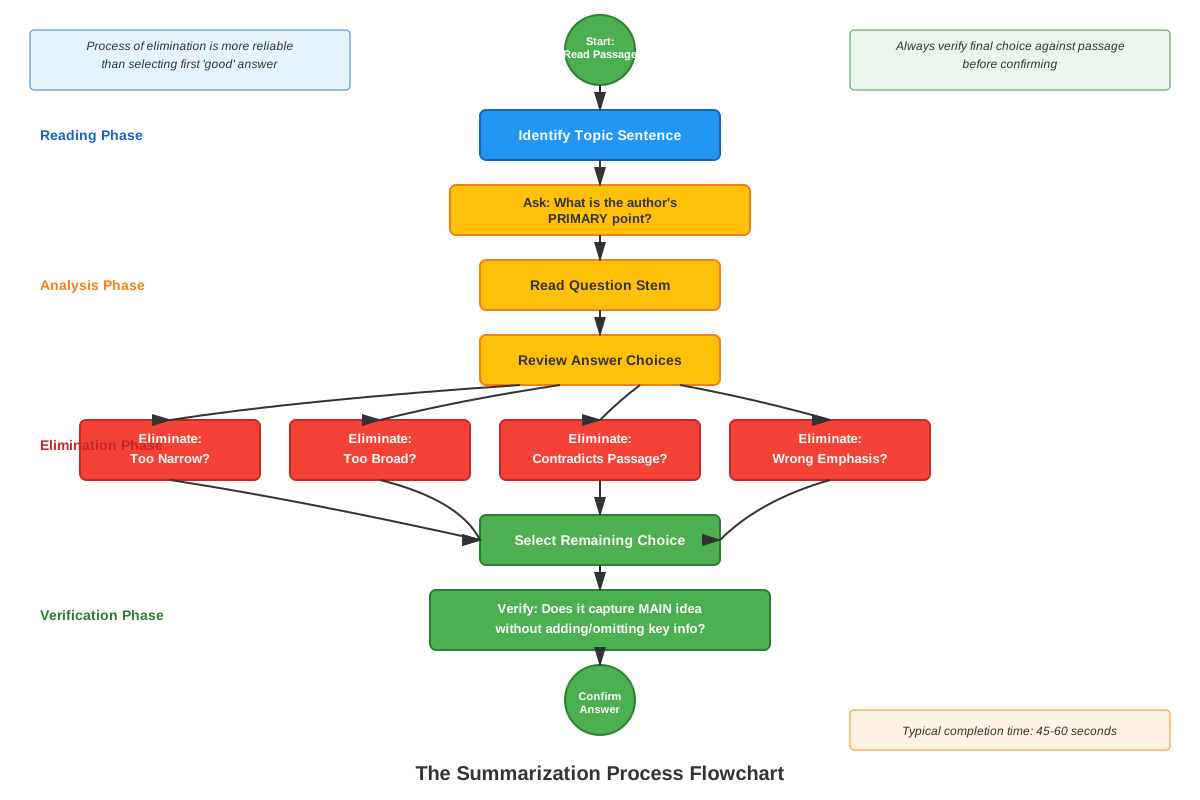
Develop a consistent process for approaching every summarization question:
- Read the passage completely before looking at answer choices to form an independent understanding of the main idea
- Identify the passage structure (argument, problem-solution, cause-effect, etc.) to predict where the main idea likely appears
- Mentally formulate your own one-sentence summary before evaluating options
- Eliminate answer choices systematically based on scope, accuracy, and completeness
- Verify the remaining choice by checking that it captures the passage's primary purpose
Trigger Words and Phrases
Certain words and phrases in passages signal main ideas:
Claim indicators: "argues that," "demonstrates," "reveals," "suggests," "indicates," "shows that," "proposes"
Synthesis signals: "however," "nevertheless," "in fact," "actually," "importantly," "significantly"
Conclusion markers: "thus," "therefore," "consequently," "as a result," "this suggests"
Emphasis indicators: "primarily," "mainly," "chiefly," "most importantly," "above all"
In answer choices, watch for scope problems signaled by:
- Absolute language: "all," "always," "never," "only," "exclusively"
- Vague generalities: "things," "aspects," "factors," "elements" without specificity
- Introduced concepts: terms or ideas not mentioned in the passage
Process of Elimination Strategies
Eliminate too-specific choices first: If an answer choice focuses on a single example, statistic, or detail from the passage, it's likely incorrect. Ask: "Does this capture the WHOLE point or just one piece of evidence?"
Eliminate too-broad choices second: If an answer choice makes claims that extend beyond what the passage actually discusses, eliminate it. Ask: "Does the passage really address this entire scope?"
Check remaining choices for accuracy: Verify that every element of the answer choice is supported by the passage. Even one inaccurate word can make an otherwise good summary incorrect.
Prefer neutral language over charged language: Unless the passage takes a clear argumentative stance, summaries with objective, neutral language are typically safer than those with strong evaluative terms.
Time Allocation
Summarization questions should take approximately 45-60 seconds each:
- 15 seconds: Read and comprehend the passage
- 10 seconds: Formulate mental summary
- 20 seconds: Evaluate answer choices
- 10 seconds: Verify selection
If a question exceeds 90 seconds, mark it for review and move forward. Summarization questions don't vary dramatically in difficulty, so spending excessive time rarely improves accuracy.
Exam Tip: If you're torn between two answer choices, the one that more closely matches the passage's scope and emphasis is typically correct. Avoid overthinking—the SAT rewards straightforward reading comprehension, not complex interpretation.
Memory Techniques
The SCOPE Acronym
Use SCOPE to evaluate potential summaries:
- Specific enough to capture the passage's actual content (not vague generalities)
- Complete coverage of the main idea (not just one component)
- Objective representation of the author's point (not your interpretation)
- Passage-supported entirely (no introduced information)
- Emphasis matching the author's priorities (not peripheral details)
The Main Idea Formula
Visualize every main idea as answering two questions:
TOPIC + POINT = MAIN IDEA
- Topic: What is the passage about? (subject matter)
- Point: What does the author say about that topic? (claim, insight, argument)
A summary that only identifies the topic without the point is incomplete. For example, "This passage is about octopuses" identifies the topic but misses the point about what octopus research reveals about intelligence.
The Detail Test
When evaluating whether something is a main idea or supporting detail, apply this test:
"If I removed this from the passage, would the passage still make sense and serve its purpose?"
- If YES → it's a supporting detail
- If NO → it's likely the main idea or a crucial component
Visualization Strategy
Picture the passage as a tree structure:
- Trunk = Main idea (supports everything else)
- Major branches = Key supporting points
- Leaves = Specific examples and details
The correct summary describes the trunk, not individual leaves or even major branches.
Summary
Summarizing short passages on the SAT requires distinguishing between main ideas and supporting details while maintaining appropriate scope and emphasis. The central skill involves identifying the author's primary claim or purpose—what the passage exists to communicate—rather than focusing on specific examples, evidence, or peripheral information. Effective summarization depends on recognizing common passage structures (argument, problem-solution, cause-effect, compare-contrast, descriptive) that signal where main ideas typically appear and how they function within the text. Students must evaluate answer choices systematically, eliminating options that are too specific (focusing on details), too broad (exceeding passage scope), or inaccurate (misrepresenting content). The most reliable approach involves reading the complete passage before examining choices, mentally formulating an independent summary, and then selecting the answer that best matches that understanding while reflecting the author's emphasis and purpose. Mastering this skill requires practice distinguishing between what a passage mentions and what it's actually about, recognizing that all answer choices may contain accurate information but only one captures the central point with appropriate scope.
Key Takeaways
- Main ideas represent the passage's central purpose or claim, while supporting details provide examples, evidence, and elaboration that develop that main idea
- Approximately 15-20% of SAT RW questions test summarization directly, making this one of the highest-yield topics for focused preparation
- Effective summaries capture both the topic (what the passage discusses) and the point (what the author says about it) with appropriate scope and emphasis
- The main idea most frequently appears in the first or last sentence, though implicit main ideas require synthesis across multiple sentences
- Incorrect answer choices typically fail by being too specific, too broad, or inaccurate, requiring systematic elimination based on scope and accuracy
- Passage structure recognition (argument, problem-solution, cause-effect) accelerates main idea identification by predicting where and how the central claim appears
- Time-efficient summarization involves reading completely, formulating an independent summary, and then evaluating choices systematically rather than reading choices first
Related Topics
Text Structure and Purpose: Building on summarization skills, this topic explores how authors organize information to achieve specific purposes, examining how structure supports meaning and how to identify organizational patterns in longer passages.
Supporting Evidence and Claims: This topic deepens understanding of the relationship between main ideas and supporting details, focusing on how authors use evidence to develop arguments and how to evaluate the strength and relevance of that evidence.
Comparative Reading: Mastering single-passage summarization enables progression to comparing and contrasting main ideas across paired passages, identifying points of agreement and disagreement between authors.
Inference and Implication: Strong summarization skills provide the foundation for making valid inferences, as understanding explicit main ideas is prerequisite to drawing conclusions about implicit meanings and authorial implications.
Practice CTA
Now that you've mastered the core concepts of summarizing short passages, it's time to apply these strategies to authentic SAT-style questions. The practice questions and flashcards will reinforce your ability to distinguish main ideas from supporting details, manage scope effectively, and eliminate incorrect answer choices systematically. Remember: summarization is one of the highest-yield skills on the SAT, and consistent practice with these question types will significantly improve your overall Reading and Writing score. Approach each practice question methodically, using the SCOPE framework and the strategies outlined in this guide. You've built a strong foundation—now strengthen it through deliberate practice!
Sign up free to keep reading
Create a free AnvayaPrep account to finish this SAT guide on Summarizing short passages — plus flashcards and practice questions.