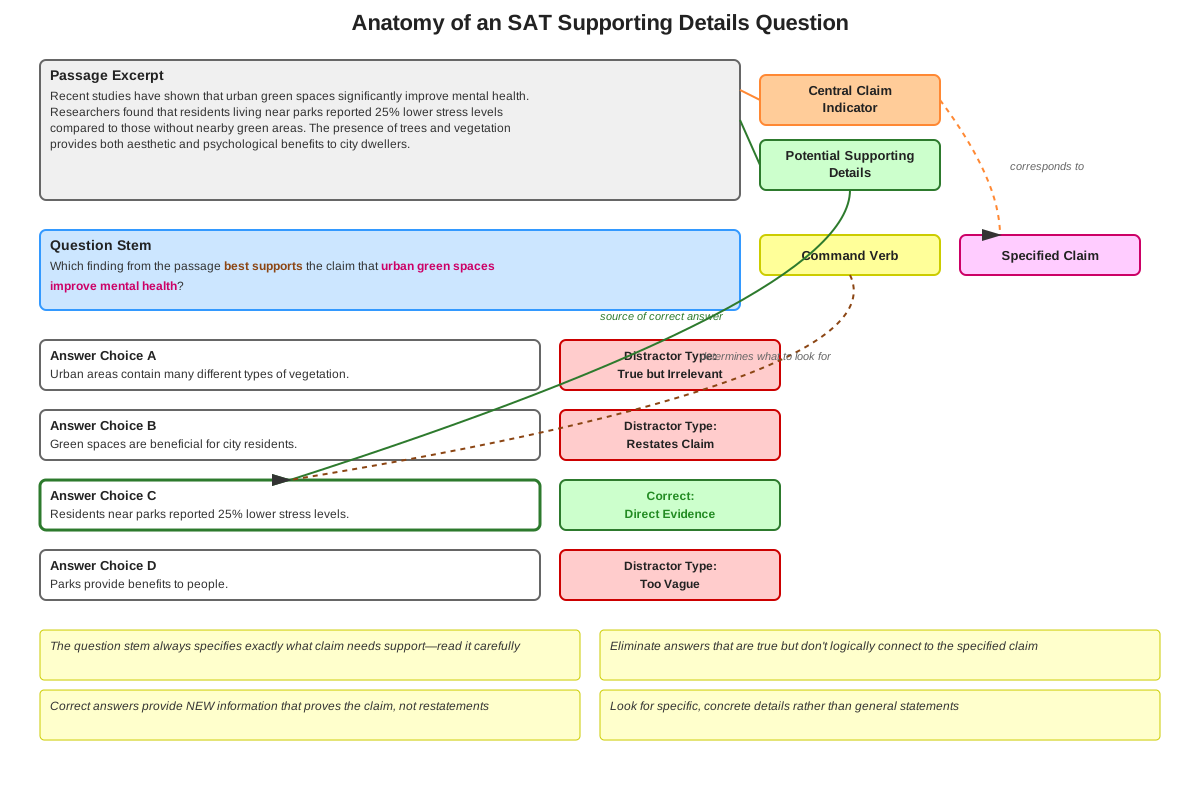
Overview
Supporting details are the specific pieces of evidence, examples, explanations, and facts that authors use to develop, illustrate, and reinforce their central ideas. On the SAT Reading and Writing section (RW), the ability to identify and analyze supporting details is fundamental to comprehension and represents one of the most frequently tested skills. These details function as the building blocks of any passage, providing the substance that makes abstract claims concrete and general statements specific.
Understanding supporting details is essential for SAT success because approximately 20-25% of Reading and Writing questions directly or indirectly assess this skill. Questions may ask students to identify which detail best supports a claim, determine what evidence an author uses to develop an idea, or recognize which statement from a passage serves as support rather than a main point. Beyond explicit supporting detail questions, this skill underpins success on inference questions, purpose questions, and structure questions—making it a cornerstone competency for the entire Reading and Writing section.
The relationship between supporting details and other Reading and Writing concepts is hierarchical and interconnected. Central ideas represent the "what" of a passage—the main point or thesis—while supporting details provide the "how" and "why"—the evidence and reasoning that make the central idea credible and compelling. Mastery of supporting details enables students to distinguish between primary claims and secondary evidence, a critical skill for analyzing argument structure, evaluating rhetorical choices, and synthesizing information across multiple texts. This foundational understanding directly supports success in more complex tasks like analyzing authorial purpose, evaluating evidence quality, and comparing perspectives across paired passages.
Learning Objectives
- [ ] Identify key features of supporting details in SAT passages
- [ ] Explain how supporting details appears on the SAT Reading and Writing section
- [ ] Apply supporting details recognition to answer SAT-style questions accurately
- [ ] Distinguish between central ideas and supporting details in complex passages
- [ ] Evaluate the relevance and strength of supporting details in relation to claims
- [ ] Synthesize multiple supporting details to understand how they collectively develop a central idea
- [ ] Recognize different types of supporting details (examples, statistics, quotations, explanations)
Prerequisites
- Basic reading comprehension: The ability to understand literal meaning in grade-level texts is necessary to identify what information a passage contains before analyzing how that information functions as support.
- Understanding of main ideas: Recognizing central ideas allows students to distinguish primary claims from the evidence that supports them, creating the foundation for identifying supporting details.
- Familiarity with paragraph structure: Knowledge of how paragraphs organize information (topic sentences, supporting sentences, concluding sentences) helps students locate where supporting details typically appear.
- Vocabulary at grade level: Adequate vocabulary ensures students can understand the content of details without being hindered by unfamiliar words.
Why This Topic Matters
Supporting details questions appear in virtually every SAT Reading and Writing section, making this one of the highest-yield topics for test preparation. Research on SAT question distribution indicates that "Command of Evidence" questions—which primarily test supporting detail recognition—constitute approximately 13-15% of all Reading and Writing questions. Additionally, supporting detail comprehension is prerequisite knowledge for successfully answering inference questions, structure questions, and synthesis questions, effectively making this skill relevant to 40-50% of the entire section.
In real-world contexts, the ability to identify and evaluate supporting details is fundamental to critical thinking and information literacy. Whether reading news articles, research papers, professional communications, or persuasive essays, distinguishing between claims and evidence prevents manipulation, enables informed decision-making, and supports effective argumentation. Students who master this skill become better consumers of information and more persuasive communicators in their own writing.
On the SAT, supporting details questions typically appear in several formats: direct identification questions that ask which sentence provides support for a claim; function questions that ask what role a detail plays in a passage; and evidence-based questions that require selecting the quotation that best supports an answer to a previous question. Passages span diverse subjects including literature, history, science, and social studies, requiring students to recognize supporting details across different rhetorical contexts and writing styles. The digital SAT format presents these questions in shorter, more focused passages (25-150 words), making efficient detail recognition even more critical for time management.
Core Concepts
Definition and Function of Supporting Details
Supporting details are specific pieces of information that authors use to explain, prove, illustrate, or elaborate on their central ideas and claims. Unlike main ideas, which present the overarching point or thesis, supporting details provide the substance that makes ideas credible, understandable, and persuasive. These details answer questions like "How do we know this?" "What evidence supports this claim?" and "Can you give an example?"
The primary function of supporting details is to develop and substantiate claims. In argumentative writing, details serve as evidence that proves a thesis. In informative writing, details explain concepts and provide necessary background. In narrative writing, details create vivid imagery and develop characters or settings. Regardless of genre, supporting details transform abstract statements into concrete, verifiable information that readers can understand and evaluate.
Types of Supporting Details
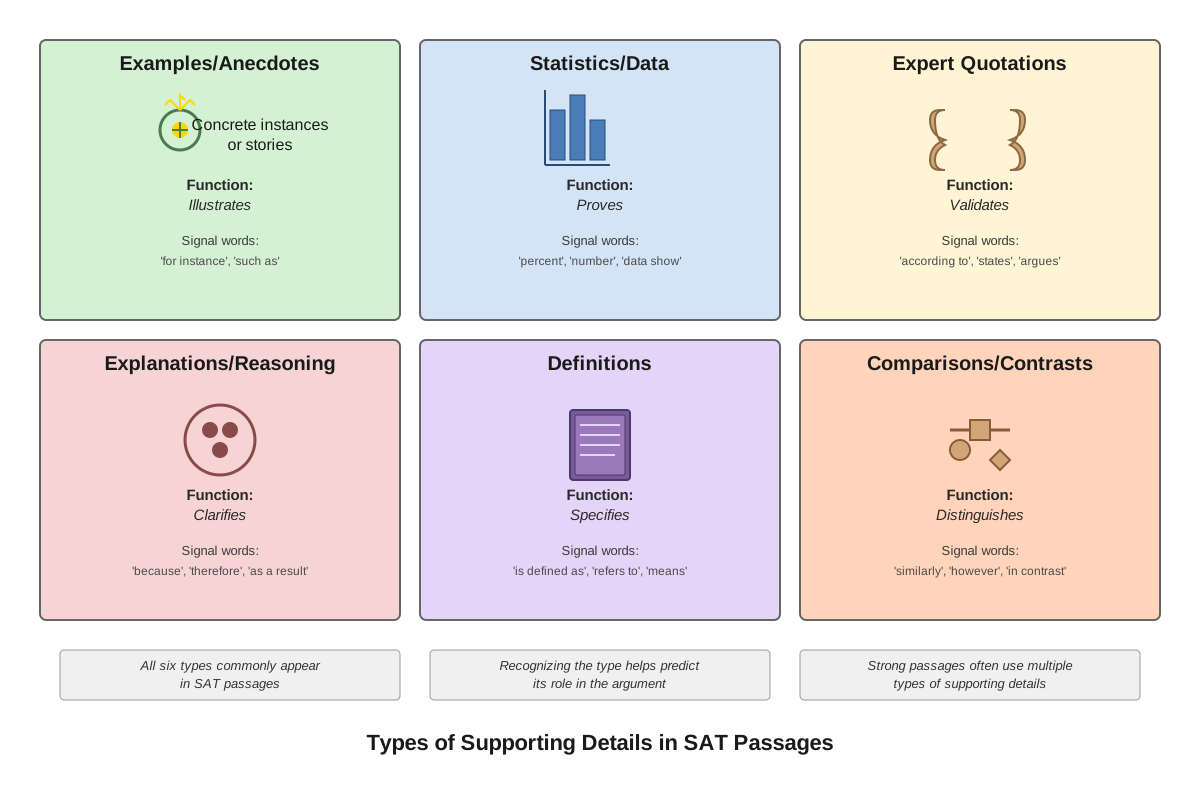
Supporting details appear in various forms, each serving distinct rhetorical purposes:
| Type of Detail | Function | Example Context |
|---|---|---|
| Examples | Illustrate general statements with specific instances | "Many animals use camouflage; for instance, the Arctic fox changes its coat color seasonally" |
| Statistics and Data | Provide quantitative evidence for claims | "The study found that 73% of participants showed improvement" |
| Expert Quotations | Lend authority and credibility through specialist knowledge | "As Dr. Martinez explains, 'The mechanism operates through cellular signaling'" |
| Anecdotes | Make abstract ideas relatable through personal stories | "One patient described experiencing symptoms within hours" |
| Definitions | Clarify technical terms or concepts | "Photosynthesis—the process by which plants convert light to energy—requires chlorophyll" |
| Comparisons/Contrasts | Explain by showing similarities or differences | "Unlike traditional methods, this approach reduces processing time by half" |
| Descriptions | Provide sensory or factual details about subjects | "The manuscript, written on vellum in iron gall ink, dates to 1450" |
Identifying Supporting Details in Passages
Recognizing supporting details requires understanding their relationship to main ideas. Supporting details typically appear after a claim or topic sentence and provide the "proof" or "explanation" for that claim. Key indicators include:
Transition words and phrases that signal evidence or examples: "for example," "for instance," "specifically," "in particular," "such as," "including," "to illustrate," "evidence shows," "research indicates," "according to," and "as demonstrated by."
Structural position: Supporting details usually follow topic sentences within paragraphs. In well-organized writing, the first sentence often states the main point, while subsequent sentences provide supporting information.
Level of specificity: Supporting details are more specific than main ideas. If a sentence makes a broad claim, the sentences that provide names, numbers, dates, or specific examples are likely supporting details.
Purpose indicators: Sentences that explain "how," "why," or "in what way" something occurs typically contain supporting details rather than main ideas.
Distinguishing Supporting Details from Central Ideas
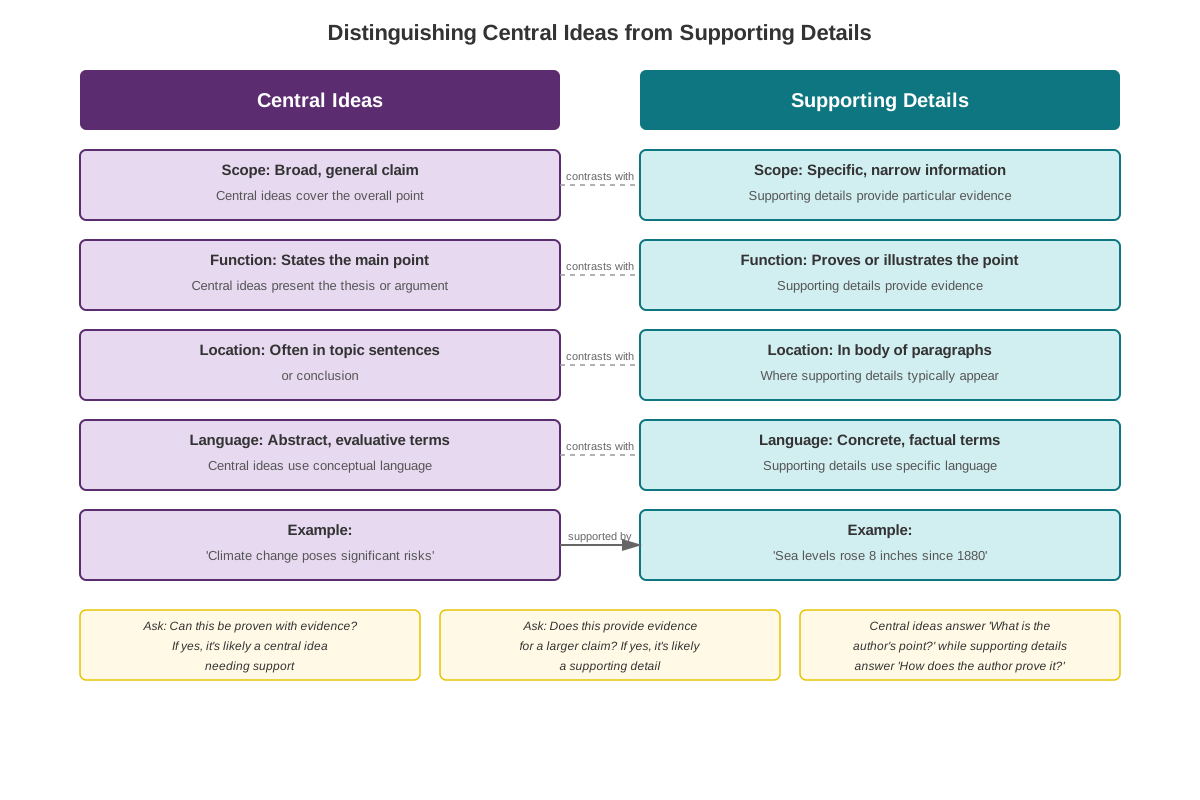
The most critical skill for SAT success is differentiating between what is being claimed (central idea) and what proves or explains that claim (supporting details). Consider this distinction:
Central Idea: "Urban green spaces provide significant mental health benefits to city residents."
Supporting Details:
- "A 2019 study of 10,000 participants found that those living within 300 meters of parks reported 15% lower stress levels"
- "Psychologist Dr. Chen notes that 'natural environments trigger parasympathetic nervous system activation'"
- "Cities like Singapore have invested $2 billion in park development based on this research"
The central idea makes a general claim about a relationship (green spaces → mental health benefits), while supporting details provide the specific evidence (study results, expert opinion, real-world application) that substantiates this claim.
Evaluating Supporting Detail Relevance
Not all details in a passage equally support the main idea. Strong supporting details are:
Directly relevant: They clearly connect to the specific claim being made rather than tangentially related information.
Sufficient: They provide adequate evidence in quantity and quality to support the claim convincingly.
Credible: They come from reliable sources, use sound methodology, or represent verifiable facts.
Representative: They accurately represent the broader phenomenon rather than cherry-picked outliers.
On the SAT, questions may ask students to identify which detail "most strongly supports" a claim, requiring evaluation of relevance and strength rather than simple identification.
Supporting Details in Different Passage Types
The nature and presentation of supporting details varies by passage type:
Literary passages use supporting details like character actions, dialogue, imagery, and narrative events to develop themes and characterization. Details may be symbolic or require interpretation.
Historical/Social Science passages employ supporting details such as historical events, statistical data, expert testimony, and documented trends to support arguments about social phenomena or historical interpretations.
Science passages utilize supporting details including experimental data, observations, measurements, theoretical explanations, and comparative analyses to support scientific claims and hypotheses.
Understanding these genre-specific conventions helps students quickly identify relevant supporting details in unfamiliar passages.
Concept Relationships
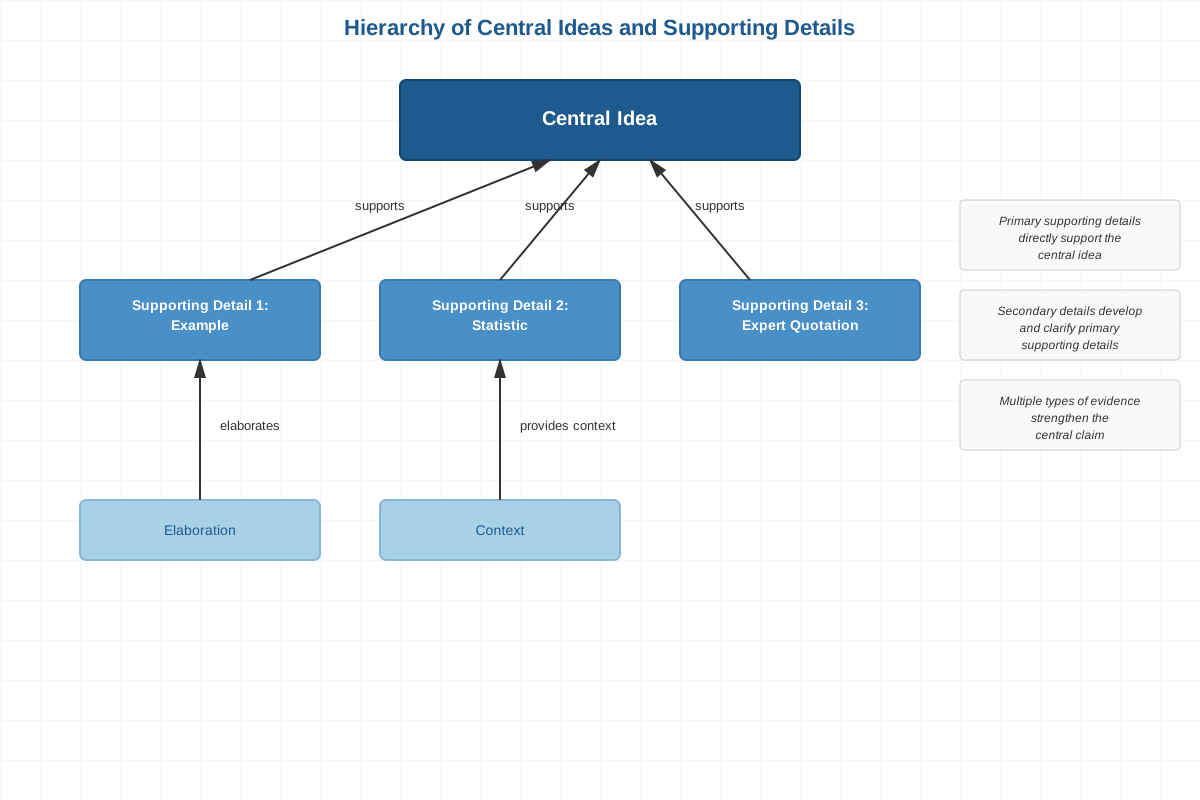
Supporting details exist in a hierarchical relationship with central ideas: Central Ideas (top level) → are developed by → Supporting Details (subordinate level) → which may include → Sub-details or Examples (most specific level).
This hierarchy connects to prerequisite knowledge of main ideas—students must first identify what claim is being made before they can recognize what evidence supports it. The relationship flows in both directions: supporting details point upward to the claims they substantiate, while central ideas point downward to the evidence that proves them.
Supporting details also connect laterally to other Reading and Writing skills. Purpose and Function questions require understanding how supporting details serve authorial goals. Structure questions examine how supporting details are organized to build arguments. Inference questions often require synthesizing multiple supporting details to draw conclusions. Synthesis questions in paired passages demand comparing how different authors use supporting details to develop similar or contrasting ideas.
The relationship map for this topic: Passage Structure → contains → Central Ideas → developed through → Supporting Details → which enable → Evidence-Based Reasoning → leading to → Inference and Synthesis.
High-Yield Facts
⭐ Supporting details are more specific than main ideas and provide evidence, examples, or explanations for claims.
⭐ Transition words like "for example," "specifically," and "such as" frequently introduce supporting details.
⭐ On the SAT, approximately 13-15% of questions directly test supporting detail recognition through "Command of Evidence" questions.
⭐ Supporting details typically appear after topic sentences or claims within paragraph structure.
⭐ The strongest supporting details are directly relevant, credible, sufficient, and representative of the claim they support.
- Supporting details can take multiple forms including statistics, quotations, examples, anecdotes, definitions, and descriptions.
- Literary passages use narrative details (actions, dialogue, imagery) as supporting details for thematic claims.
- Science passages rely heavily on experimental data and observations as supporting details for hypotheses.
- Historical passages use documented events, dates, and primary source quotations as supporting details.
- Questions may ask which detail "best supports" a claim, requiring evaluation of relevance and strength, not just identification.
⭐ Supporting details answer the questions "How?" "Why?" "What evidence?" and "Can you give an example?" in relation to main ideas.
- Multiple supporting details often work together cumulatively to develop a single central idea.
- Irrelevant details may appear in passages as distractors; not every detail in a passage supports the main claim.
- The digital SAT presents shorter passages (25-150 words), making efficient supporting detail recognition critical for time management.
- Supporting detail mastery enables success on inference, structure, purpose, and synthesis questions beyond direct evidence questions.
Quick check — test yourself on Supporting details so far.
Try Flashcards →Common Misconceptions
Misconception: All information in a passage serves as supporting details for the main idea.
Correction: Passages often contain background information, transitions, counterarguments, or tangential details that don't directly support the central claim. Students must evaluate relevance, not assume every sentence functions as support.
Misconception: Supporting details are always factual statements, while opinions are main ideas.
Correction: Supporting details can include expert opinions, quotations, and interpretive statements when these serve to develop or prove a claim. Conversely, main ideas can be factual statements. The distinction is functional (what supports what) rather than based on fact versus opinion.
Misconception: The longest or most complex sentence in a paragraph contains the supporting details.
Correction: Supporting details vary in length and complexity. Sometimes a brief statistic or short example provides crucial support, while a complex sentence might state the main claim. Focus on function and relationship to the main idea, not sentence length.
Misconception: Supporting details only appear in body paragraphs, not in introductions or conclusions.
Correction: While body paragraphs typically contain the most supporting details, introductions may include background details or motivating examples, and conclusions may reference key evidence. Supporting details can appear anywhere they serve to develop or prove a claim.
Misconception: If a detail is interesting or memorable, it must be a supporting detail for the main idea.
Correction: Authors sometimes include vivid or engaging details that serve rhetorical purposes (capturing attention, providing context) without directly supporting the central claim. Evaluate whether the detail actually proves or explains the main point.
Misconception: Supporting details questions always use the phrase "supporting detail" in the question stem.
Correction: The SAT uses varied language including "Which quotation best supports," "Which finding, if true, would strengthen," "The author uses [detail] primarily to," and "Which choice provides the best evidence." Students must recognize supporting detail questions across different phrasings.
Worked Examples
Example 1: Identifying Supporting Details in a Science Passage
Passage:
"Recent research suggests that octopuses possess remarkable problem-solving abilities that rival those of many vertebrates. In laboratory experiments, octopuses have demonstrated the capacity to open childproof containers to access food rewards. Dr. Jennifer Mather's studies show that octopuses can learn through observation, watching other octopuses solve puzzles and then replicating the solution. Additionally, octopuses in aquarium settings have been observed unscrewing jar lids, navigating mazes, and even turning off lights by squirting water at bulbs—behaviors that suggest both memory and planning capabilities."
Question: Which detail from the passage most strongly supports the claim that octopuses have advanced cognitive abilities?
Answer Choices:
A) Octopuses are invertebrates that live in marine environments.
B) Dr. Jennifer Mather has conducted studies on octopus behavior.
C) Octopuses can learn through observation by watching other octopuses solve puzzles.
D) Laboratory experiments have been conducted on octopuses.
Solution Process:
Step 1: Identify the central claim. The passage claims that "octopuses possess remarkable problem-solving abilities that rival those of many vertebrates."
Step 2: Evaluate each choice for relevance and strength.
Choice A provides factual information about octopuses but doesn't address cognitive abilities—this is background information, not supporting evidence for the claim.
Choice B mentions the researcher but doesn't specify what the research found—this is a citation without the actual evidence.
Choice C provides specific evidence of a cognitive ability (observational learning) with concrete detail about what octopuses can do—this directly supports the claim about problem-solving abilities.
Choice D mentions that experiments occurred but doesn't specify results—this is methodological information without findings.
Step 3: Select the most direct and specific support. Choice C is correct because it provides concrete evidence of a specific cognitive ability (observational learning and puzzle replication) that directly demonstrates the "remarkable problem-solving abilities" mentioned in the claim.
Connection to Learning Objectives: This example demonstrates identifying supporting details (Objective 1), distinguishing them from background information and citations (Objective 4), and evaluating which detail most strongly supports a specific claim (Objective 5).
Example 2: Analyzing Multiple Supporting Details
Passage:
"The introduction of the printing press in 15th-century Europe fundamentally transformed access to knowledge. Before Johannes Gutenberg's innovation around 1440, books were copied by hand, a process so labor-intensive that a single Bible might take a scribe over a year to complete. The printing press reduced production time dramatically: a printer could produce hundreds of pages in the time a scribe needed for one. By 1500, an estimated 20 million books had been printed in Europe, compared to perhaps 100,000 hand-copied manuscripts produced in the previous century. This explosion in availability made texts affordable for middle-class readers, not just wealthy elites. Literacy rates in urban areas increased from approximately 10% in 1450 to over 30% by 1550, as more people gained both access to books and motivation to learn reading."
Question: The passage uses multiple supporting details to develop its central idea. How do these details work together?
Analysis:
Central Idea: The printing press fundamentally transformed access to knowledge in 15th-century Europe.
Supporting Details and Their Functions:
- "A single Bible might take a scribe over a year to complete" - Establishes the baseline (pre-printing press) to show the magnitude of change.
- "A printer could produce hundreds of pages in the time a scribe needed for one" - Provides direct comparison showing efficiency gains.
- "20 million books printed by 1500, compared to 100,000 manuscripts in the previous century" - Quantifies the production increase with specific statistics (200x increase).
- "Made texts affordable for middle-class readers, not just wealthy elites" - Shows the social/economic impact on access.
- "Literacy rates increased from 10% to 30% between 1450-1550" - Demonstrates the ultimate outcome: more people could actually access knowledge through reading.
Synthesis: These details work cumulatively and sequentially. They establish the problem (slow hand-copying), demonstrate the solution (faster printing), quantify the impact (production numbers), explain the mechanism of transformation (affordability), and prove the ultimate result (increased literacy). Together, they create a comprehensive argument that the printing press didn't just change book production—it fundamentally transformed who could access knowledge.
Connection to Learning Objectives: This example demonstrates synthesizing multiple supporting details (Objective 6), recognizing different types of details (Objective 7), and understanding how details collectively develop a central idea (Objective 3).
Exam Strategy
Approaching Supporting Detail Questions
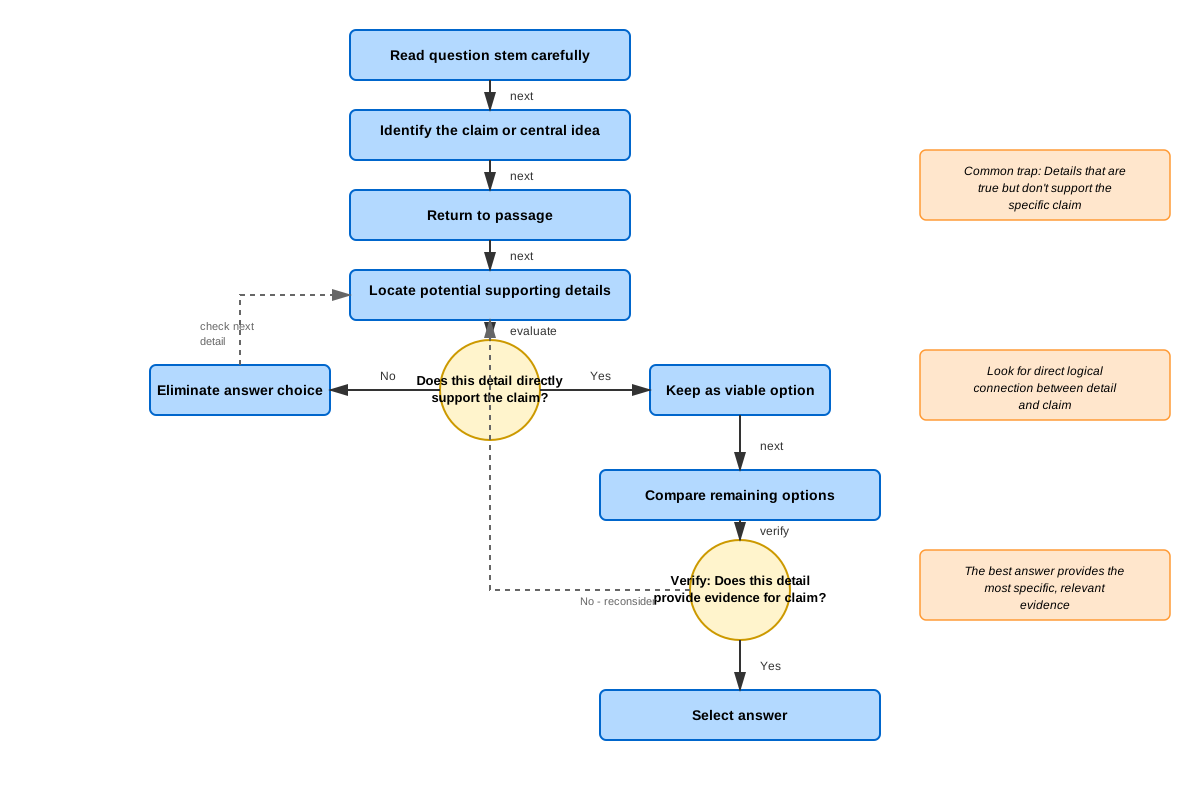
Step 1: Identify the claim or main idea first. Before evaluating supporting details, determine what point is being made. Ask: "What is the author trying to prove or explain?"
Step 2: Look for specificity. Supporting details are more specific than claims. They contain names, numbers, dates, examples, or concrete descriptions rather than general statements.
Step 3: Apply the "How do we know?" test. If a sentence answers "How do we know the claim is true?" or "What evidence supports this?" it's likely a supporting detail.
Trigger Words and Phrases
Watch for these signals that often introduce supporting details:
Evidence indicators: "research shows," "studies indicate," "data reveals," "findings suggest," "evidence demonstrates"
Example markers: "for example," "for instance," "such as," "including," "like," "to illustrate"
Specification signals: "specifically," "in particular," "namely," "especially"
Authority citations: "according to," "as [expert] notes," "Dr./Professor [name] found"
Quantitative markers: Specific numbers, percentages, dates, measurements
Process of Elimination Tips
Eliminate choices that:
- Restate the main idea rather than support it
- Provide background information unrelated to the specific claim
- Mention methodology without results ("A study was conducted" vs. "The study found that...")
- Are too general or vague to serve as concrete evidence
- Address a different aspect of the topic than the claim being supported
Favor choices that:
- Contain specific examples, data, or quotations
- Directly address the "how" or "why" of the claim
- Provide concrete evidence rather than abstract statements
- Use the trigger words and phrases listed above
Time Allocation
Supporting detail questions typically require 30-45 seconds when approached efficiently:
- 10-15 seconds: Identify the claim/main idea
- 15-20 seconds: Scan for relevant details using trigger words
- 10-15 seconds: Eliminate wrong answers and confirm the correct choice
Exam Tip: In paired passages or questions with two parts (first asking for an answer, second asking for supporting evidence), always answer the first question before looking at evidence choices. This prevents the evidence options from biasing your interpretation of the passage.
Memory Techniques
The SPECIFIC Acronym
Remember that strong supporting details are SPECIFIC:
- Statistics and data
- Personal anecdotes or examples
- Expert quotations
- Comparisons and contrasts
- Illustrations and descriptions
- Facts and findings
- Instances (specific cases)
- Citations and sources
The Support Hierarchy Visualization
Visualize passage structure as a building:
- Roof = Title/Main Idea (covers everything)
- Pillars = Major supporting details (hold up the main idea)
- Bricks = Specific examples, data, quotations (build the pillars)
- Foundation = Background information (provides context)
When answering questions, ask: "Is this a pillar holding up the main idea, or just a brick in one pillar?"
The "Prove It!" Method
When reading passages, mentally challenge each claim by saying "Prove it!" The sentences that answer this challenge are supporting details. This active reading technique trains recognition of the claim-evidence relationship.
The Three-Question Filter
For any sentence, ask:
- Is it specific? (Names, numbers, examples = likely support)
- Does it explain or prove? (Answers "how" or "why" = likely support)
- Does it follow a claim? (Comes after a general statement = likely support)
If yes to 2-3 questions, it's probably a supporting detail.
Summary
Supporting details are the specific evidence, examples, explanations, and facts that authors use to develop and substantiate their central ideas. On the SAT Reading and Writing section, recognizing and analyzing supporting details is a high-yield skill tested directly through Command of Evidence questions and indirectly through inference, structure, and synthesis questions. Supporting details differ from main ideas in their specificity and function: while main ideas present claims, supporting details prove or explain those claims through concrete information. These details take various forms including statistics, expert quotations, examples, anecdotes, definitions, and descriptions, with the specific types varying by passage genre. Successful identification requires understanding the hierarchical relationship between claims and evidence, recognizing transition words that signal support, and evaluating relevance and strength. Students must distinguish supporting details from background information, tangential content, and restatements of main ideas. Mastery of this skill enables efficient passage comprehension, accurate question answering, and success on approximately 40-50% of Reading and Writing questions that require understanding how evidence develops ideas.
Key Takeaways
- Supporting details are specific pieces of evidence that prove, explain, or illustrate central ideas—they answer "How do we know?" and "What's the evidence?"
- Approximately 13-15% of SAT Reading and Writing questions directly test supporting detail recognition, with the skill relevant to 40-50% of all questions
- Strong supporting details are directly relevant, credible, sufficient, and representative—not all details in a passage equally support the main idea
- Transition words like "for example," "specifically," "research shows," and "according to" frequently signal supporting details
- Supporting details are more specific than main ideas and typically appear after claims or topic sentences in well-organized passages
- Different passage types use different supporting detail forms: literary passages use narrative details, science passages use data and observations, historical passages use documented events and quotations
- Effective strategy involves identifying the claim first, then evaluating which details directly support that specific claim through the "How do we know?" test
Related Topics
Central Ideas and Thesis Statements: Understanding how to identify main ideas is the complementary skill to recognizing supporting details. Mastering supporting details enables students to distinguish primary claims from evidence, which is essential for central idea questions.
Inference and Implicit Meaning: Supporting details provide the textual evidence from which inferences are drawn. Students who can identify relevant supporting details are better equipped to make valid inferences and avoid unsupported conclusions.
Argument Structure and Reasoning: Analyzing how authors construct arguments requires understanding the relationship between claims and supporting evidence. This topic builds directly on supporting detail recognition.
Synthesis Across Texts: Paired passage questions often require comparing how different authors use supporting details to develop similar or contrasting ideas, making supporting detail mastery prerequisite knowledge.
Purpose and Function: Understanding why authors include specific details and how those details serve rhetorical goals extends supporting detail analysis to authorial intent.
Practice CTA
Now that you've mastered the core concepts of supporting details, it's time to apply this knowledge! Complete the practice questions to test your ability to identify supporting details, distinguish them from main ideas, and evaluate their relevance and strength. The flashcards will help reinforce key concepts and trigger words. Remember: supporting detail questions are among the most frequent and predictable on the SAT—consistent practice with this skill will directly improve your score. Every passage you read is an opportunity to practice identifying the claim-evidence relationship. You've got this!
Sign up free to keep reading
Create a free AnvayaPrep account to finish this SAT guide on Supporting details — plus flashcards and practice questions.