Overview
Topic sentences form the backbone of paragraph structure in both reading comprehension and writing tasks. On the SAT Reading and Writing section (RW), understanding topic sentences is crucial because they serve as signposts that reveal the main idea of a paragraph and guide readers through complex passages. A topic sentence typically appears at or near the beginning of a paragraph and announces what that paragraph will discuss, establishing both the subject and the controlling idea that the rest of the paragraph develops.
The SAT frequently tests students' ability to identify, analyze, and work with topic sentences in multiple question formats. Students may be asked to select the most effective topic sentence for a paragraph, identify which sentence best introduces a passage, or determine how a topic sentence relates to supporting details. These questions assess not just reading comprehension but also rhetorical awareness—the ability to understand how writers structure arguments and organize information to achieve specific purposes.
Mastering topic sentences connects directly to broader SAT topic sentences skills within the Central Ideas and Details unit. Topic sentences function as mini-thesis statements for individual paragraphs, making them essential for understanding main ideas, following logical progression, and recognizing organizational patterns. Strong topic sentence recognition enables students to quickly grasp passage structure, predict content, and efficiently locate relevant information—skills that improve performance across all Reading and Writing question types, from vocabulary in context to rhetorical synthesis questions.
Learning Objectives
- [ ] Identify key features of topic sentences
- [ ] Explain how topic sentences appears on the SAT
- [ ] Apply topic sentences to answer SAT-style questions
- [ ] Distinguish between effective and ineffective topic sentences in various contexts
- [ ] Analyze the relationship between topic sentences and supporting details within paragraphs
- [ ] Evaluate how topic sentences contribute to overall passage coherence and organization
- [ ] Synthesize information from multiple paragraphs by tracking topic sentence progression
Prerequisites
- Basic paragraph structure: Understanding that paragraphs contain main ideas and supporting details is essential because topic sentences function as the main idea statement
- Reading comprehension fundamentals: The ability to identify what a passage is "about" provides the foundation for recognizing how topic sentences encapsulate paragraph focus
- Sentence structure awareness: Recognizing subjects, predicates, and modifying phrases helps students parse topic sentences to extract their controlling ideas
- Transition word knowledge: Familiarity with logical connectors aids in understanding how topic sentences relate to preceding and following content
Why This Topic Matters
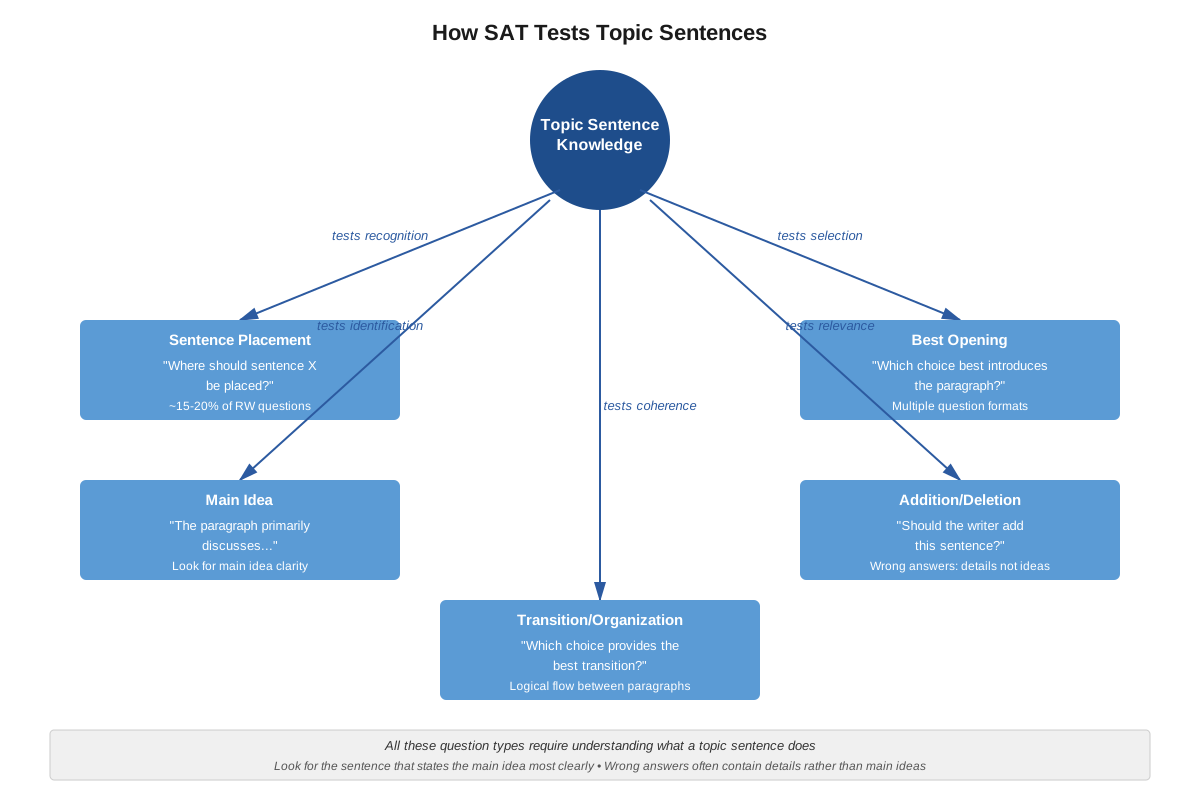
Topic sentences appear in virtually every SAT Reading and Writing passage, making them one of the most frequently tested structural elements. Approximately 15-20% of questions in the Reading and Writing section directly or indirectly assess understanding of topic sentences, paragraph organization, and main idea identification. Questions may ask students to choose the best opening sentence for a paragraph, identify which sentence should be added or removed, or determine the most logical placement for a sentence—all tasks that require strong topic sentence recognition skills.
Beyond the exam, topic sentence mastery translates to real-world reading efficiency. In academic texts, professional documents, and informational articles, topic sentences allow readers to skim effectively, locate specific information quickly, and grasp complex arguments without reading every word. Writers use topic sentences to guide readers through their reasoning, making these structural elements essential for both comprehension and composition.
On the SAT, topic sentences commonly appear in several question formats: sentence placement questions (where students determine the most logical location for a sentence), transition questions (selecting appropriate opening sentences), and main idea questions (identifying what a paragraph primarily discusses). Passages across all content domains—literature, history, social studies, and science—employ topic sentences, making this skill universally applicable across the test.
Core Concepts
Definition and Function of Topic Sentences
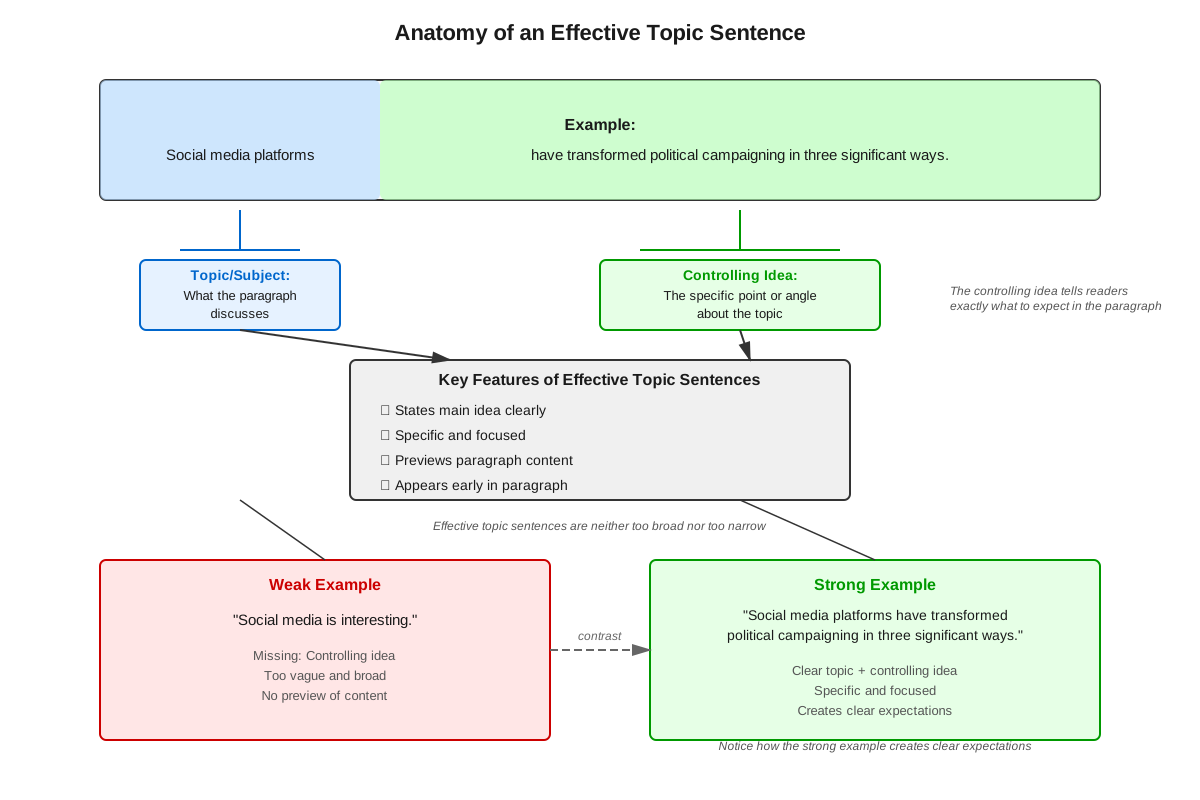
A topic sentence is a statement that expresses the main idea of a paragraph and typically appears at or near the beginning. It serves two critical functions: announcing the subject (what the paragraph is about) and presenting the controlling idea (what specific aspect or claim about that subject the paragraph will develop). For example, "Renewable energy sources offer significant environmental advantages over fossil fuels" identifies both a subject (renewable energy sources) and a controlling idea (environmental advantages compared to fossil fuels).
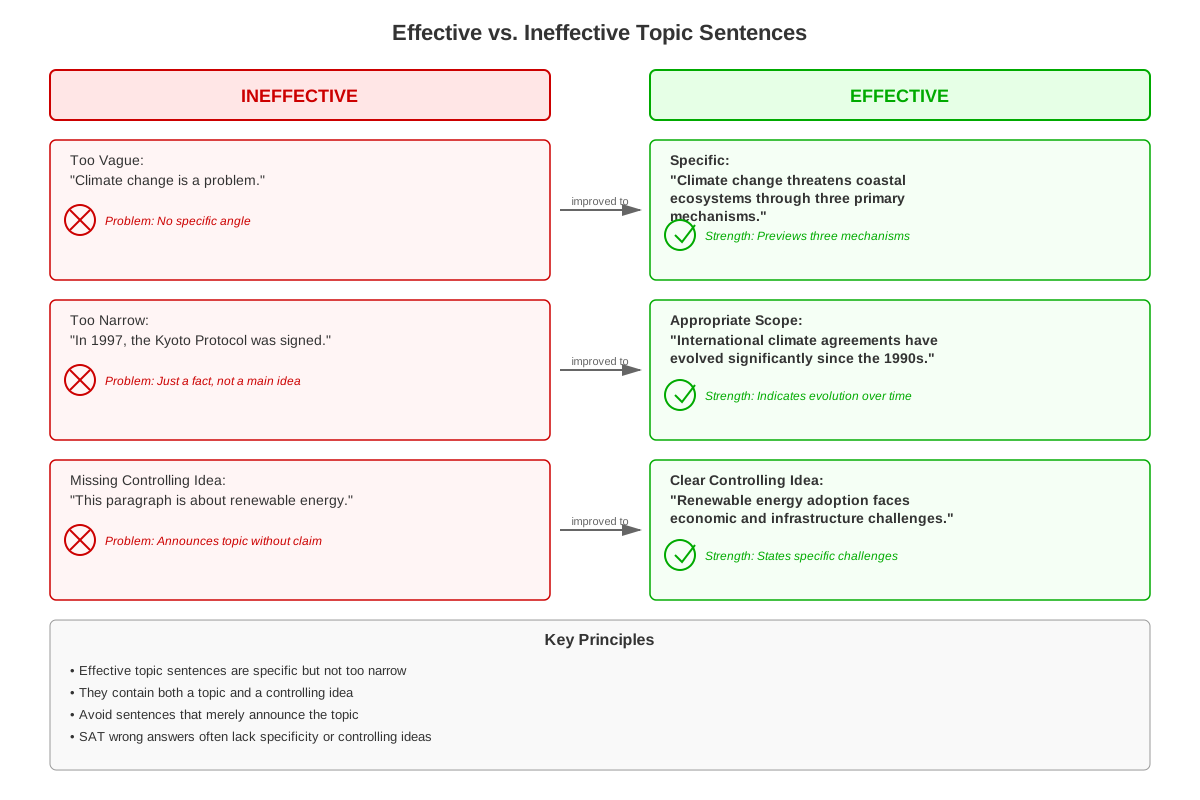
The controlling idea distinguishes topic sentences from mere announcements. While "This paragraph is about renewable energy" identifies a subject, it lacks direction. An effective topic sentence provides a specific angle, claim, or focus that the paragraph will explore through evidence, examples, or explanation. This specificity helps readers anticipate what information will follow and understand how details connect to the larger point.
Structural Positions and Variations
While topic sentences most commonly appear as the first sentence of a paragraph, they can occupy other positions depending on rhetorical strategy. Initial position (first sentence) is most frequent on the SAT because it provides immediate clarity and follows conventional academic writing patterns. This placement allows readers to establish a mental framework before encountering supporting details.
Delayed topic sentences appear after one or more introductory sentences that provide context, background, or a transitional bridge from the previous paragraph. For instance, a paragraph might open with a question or anecdote before stating its main point in the second or third sentence. On the SAT, recognizing delayed topic sentences requires distinguishing between contextual setup and the actual claim being developed.
Implied topic sentences occur when the main idea emerges from the collective meaning of supporting details rather than being explicitly stated. While less common in SAT passages (which favor clarity), students should recognize that some paragraphs develop a clear focus without a single sentence that encapsulates it. However, most SAT questions assume explicit topic sentences exist or should be added.
Characteristics of Effective Topic Sentences
Effective topic sentences share several key qualities that SAT questions frequently test:
| Characteristic | Description | Example |
|---|---|---|
| Specificity | Provides clear, focused direction rather than vague generalization | Strong: "Urban gardens reduce food insecurity in low-income neighborhoods" vs. Weak: "Gardens are good for cities" |
| Scope appropriateness | Matches the breadth of content the paragraph can reasonably develop | Appropriate for one paragraph: "Photosynthesis occurs in three stages" vs. Too broad: "Plants are essential to life on Earth" |
| Claim or assertion | Makes a point that requires support rather than stating obvious fact | Arguable: "Social media has fundamentally altered political discourse" vs. Factual: "Social media exists" |
| Connection to thesis | Relates to and advances the overall passage argument or purpose | Connects: "This economic shift explains the rise of suburban development" |
| Transitional quality | Links to previous content while introducing new focus | "Despite these challenges, alternative approaches have emerged" |
Relationship Between Topic Sentences and Supporting Details
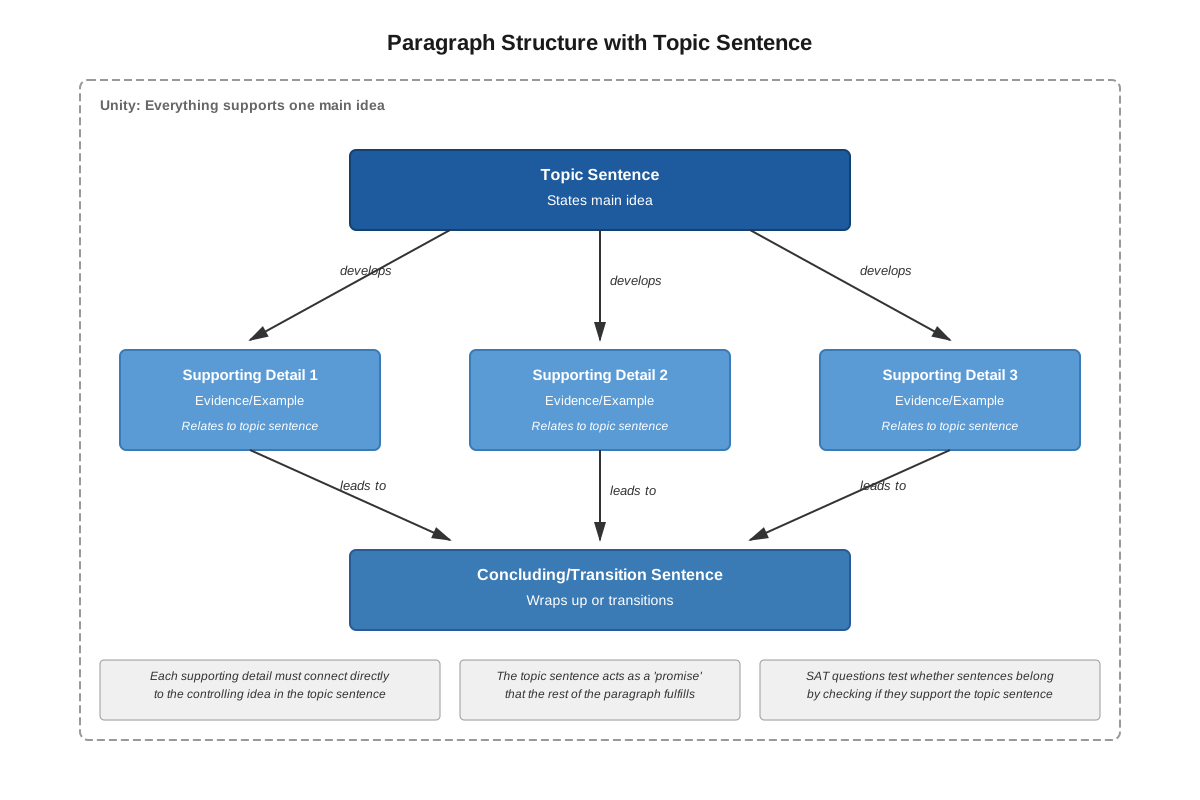
The connection between topic sentences and supporting details follows a hierarchical structure. The topic sentence makes a general claim or introduces a focus, while supporting sentences provide evidence, examples, explanations, or elaboration that develops that claim. On the SAT, questions often test whether students can identify which details are relevant to a given topic sentence or which topic sentence best encompasses a set of details.
Unity requires that all sentences in a paragraph relate to the topic sentence. If a sentence introduces information unrelated to the controlling idea, it disrupts paragraph coherence. SAT questions may ask students to identify sentences that should be removed because they don't support the topic sentence, or to select a topic sentence that accurately reflects all the paragraph's content.
Development patterns vary based on the topic sentence's nature. A topic sentence making a causal claim ("Climate change has accelerated glacier melting") will be followed by evidence of that acceleration and explanation of the causal mechanism. A topic sentence introducing a comparison ("Traditional and digital photography differ in several key aspects") will be developed through point-by-point or block comparison. Recognizing these patterns helps students predict what information should follow a topic sentence.
Topic Sentences in Passage Organization
At the passage level, topic sentences create a roadmap of the argument or exposition. Reading just the topic sentences of each paragraph should provide a coherent outline of the passage's progression. This technique, called topic sentence scanning, is a powerful SAT strategy for quickly understanding passage structure and locating information.
Logical progression between topic sentences reveals the passage's organizational pattern. Sequential topic sentences might show chronological development, cause-and-effect chains, problem-solution structures, or claim-evidence-conclusion patterns. SAT questions about passage organization or the most logical placement for a paragraph often hinge on understanding how topic sentences connect.
Transitional topic sentences explicitly link paragraphs by referencing previous content while introducing new material. Phrases like "This evidence suggests," "However, alternative explanations exist," or "Building on this foundation" signal relationships between ideas. The SAT frequently tests whether students can identify appropriate transitional topic sentences that maintain coherence between paragraphs.
Concept Relationships
Topic sentences function as the bridge between macro-level passage structure and micro-level sentence details. At the highest level, the thesis statement or main idea of an entire passage governs what each paragraph will discuss. Each paragraph's topic sentence then serves as a mini-thesis that advances one aspect of that overall argument. Within the paragraph, supporting sentences provide the evidence, examples, and explanation that develop the topic sentence's claim.
This hierarchical relationship flows: Passage Main Idea → Topic Sentences (one per paragraph) → Supporting Details (multiple per paragraph). Understanding this structure enables students to navigate passages efficiently and answer questions about both specific details and overall organization.
Topic sentences also connect to transition words and phrases, which often appear within or immediately before topic sentences to signal logical relationships. A topic sentence beginning with "Furthermore" indicates addition to previous content, while "Nevertheless" signals contrast. These connections help students understand not just what each paragraph discusses but how paragraphs relate to each other.
The relationship between topic sentences and paragraph unity is reciprocal: effective topic sentences promote unity by establishing clear focus, while unified paragraphs make topic sentences easier to identify. When answering SAT questions about sentence placement or relevance, students should evaluate whether sentences support the topic sentence's controlling idea.
Finally, topic sentence mastery connects forward to more advanced skills like rhetorical analysis and argument evaluation. Recognizing how writers use topic sentences to structure arguments prepares students for questions about author's purpose, passage organization, and effectiveness of evidence—all higher-order skills tested on the SAT.
High-Yield Facts
⭐ Topic sentences typically appear as the first or second sentence of a paragraph in SAT passages
⭐ An effective topic sentence contains both a subject and a controlling idea that the paragraph develops
⭐ All supporting sentences in a paragraph should directly relate to and develop the topic sentence
⭐ Reading only the topic sentences of each paragraph should provide a coherent outline of the passage's main argument
⭐ SAT questions frequently ask students to select the most effective opening sentence for a paragraph based on the content that follows
- Topic sentences that are too broad cannot be adequately developed in a single paragraph
- Topic sentences that are too narrow (mere facts) don't require development and make weak paragraph openers
- Transitional topic sentences connect to previous paragraphs while introducing new focus
- The absence of a clear topic sentence often indicates a paragraph lacks unity or focus
- Topic sentences in argumentative passages typically make claims that require evidence, while those in informational passages often introduce categories or aspects to be explained
- Effective topic sentences match the tone and style of the overall passage
- Questions about paragraph organization often hinge on identifying which sentence functions as the topic sentence
Quick check — test yourself on Topic sentences so far.
Try Flashcards →Common Misconceptions
Misconception: The topic sentence is always the first sentence of a paragraph.
Correction: While topic sentences most frequently appear first, they can be delayed until the second or third sentence after contextual setup, or occasionally appear at the end as a concluding statement that synthesizes the paragraph's point. On the SAT, students must identify the sentence that expresses the main idea regardless of position.
Misconception: A topic sentence just announces what the paragraph is about without making a point.
Correction: Effective topic sentences do more than announce a subject—they present a controlling idea or claim about that subject. "This paragraph discusses photosynthesis" is an announcement, while "Photosynthesis enables plants to convert light energy into chemical energy through a complex series of reactions" is a true topic sentence with a controlling idea.
Misconception: Every sentence in a paragraph is equally important to the main idea.
Correction: Paragraphs have a hierarchical structure where the topic sentence states the main point and supporting sentences provide subordinate details, evidence, or explanation. Recognizing this hierarchy helps students distinguish between main ideas and supporting details—a critical SAT skill.
Misconception: Topic sentences and thesis statements are the same thing.
Correction: A thesis statement presents the main argument or purpose of an entire passage, while topic sentences present the main idea of individual paragraphs. Each topic sentence should support and develop one aspect of the thesis. Understanding this distinction helps students navigate passage structure and answer questions about overall purpose versus paragraph-specific content.
Misconception: If a paragraph has a clear topic sentence, any related information can be included.
Correction: Supporting sentences must specifically develop the controlling idea in the topic sentence, not just relate to the general subject. A paragraph with the topic sentence "Urban gardens reduce food insecurity in low-income neighborhoods" should focus on that specific benefit, not discuss other advantages of urban gardens like community building or environmental benefits, even though those topics are related.
Misconception: Topic sentences should always be complex, sophisticated sentences.
Correction: Effective topic sentences prioritize clarity and specificity over complexity. A straightforward sentence that clearly states the paragraph's focus is superior to a convoluted sentence that obscures the main point. The SAT values clear communication over stylistic complexity.
Worked Examples
Example 1: Identifying the Most Effective Topic Sentence
Question: Which sentence would most effectively introduce a paragraph that discusses how bioluminescent organisms produce light through chemical reactions, describes the role of luciferin and luciferase, and explains why this ability evolved in deep-sea creatures?
A) Bioluminescence is a fascinating natural phenomenon.
B) Many organisms can produce light through biological processes.
C) The biochemical mechanism of bioluminescence involves specific molecules and serves important evolutionary functions in marine environments.
D) Scientists have studied bioluminescent organisms for decades.
Solution Process:
First, identify what the paragraph will contain: (1) the chemical mechanism of bioluminescence, (2) specific molecules involved, and (3) evolutionary purpose in deep-sea environments. The topic sentence must encompass all three elements while providing a clear controlling idea.
Evaluate each option:
Option A is too vague—"fascinating" is subjective and doesn't indicate what specific aspect will be discussed. It's an announcement without a controlling idea.
Option B is too broad—it could introduce a paragraph about any aspect of bioluminescence in any organisms, not specifically the chemical mechanism and evolutionary function in marine life.
Option C specifically mentions "biochemical mechanism" (covering the chemical reactions and molecules), "specific molecules" (luciferin and luciferase), and "evolutionary functions in marine environments" (the deep-sea adaptation). This sentence has appropriate scope and a clear controlling idea that encompasses all paragraph content.
Option D focuses on the history of scientific study rather than the content the paragraph will present. This would be appropriate for a paragraph about research history, not biochemical mechanisms.
Answer: C
This example demonstrates how effective topic sentences must match the scope and content of their paragraphs. The correct answer contains both sufficient specificity (biochemical mechanism, molecules) and appropriate breadth (evolutionary functions) to encompass all supporting details without being too narrow or too broad.
Example 2: Determining Paragraph Unity Based on Topic Sentence
Question: The following paragraph begins with a topic sentence. Which numbered sentence should be removed because it does not support the topic sentence?
[1] The invention of the printing press in the 15th century revolutionized information dissemination in Europe. [2] Before Gutenberg's innovation, books were painstakingly copied by hand, making them expensive and rare. [3] The printing press enabled rapid, affordable book production, expanding literacy beyond the wealthy elite. [4] Johannes Gutenberg was born in Mainz, Germany, around 1400. [5] This technological breakthrough facilitated the spread of Renaissance ideas and contributed to the Protestant Reformation by making religious texts widely accessible.
Solution Process:
The topic sentence [1] establishes the controlling idea: the printing press "revolutionized information dissemination in Europe." Every supporting sentence should explain how or why this revolution occurred.
Evaluate each sentence's relationship to the topic sentence:
Sentence [2] provides context by explaining the pre-printing press situation, establishing why the invention was revolutionary (contrast between hand-copying and mechanical printing). This supports the topic sentence by showing what changed.
Sentence [3] directly explains how the revolution occurred: rapid, affordable production expanded literacy. This is core supporting evidence for the "revolutionized information dissemination" claim.
Sentence [4] provides biographical information about Gutenberg but doesn't explain how the printing press revolutionized information dissemination. While related to the general subject, it doesn't develop the controlling idea about the impact on information spread.
Sentence [5] provides specific examples of the revolution's effects (Renaissance ideas, Protestant Reformation), directly supporting the claim that information dissemination was transformed.
Answer: Sentence [4] should be removed
This example illustrates the principle of paragraph unity: every sentence must develop the topic sentence's controlling idea. Biographical details about Gutenberg, while related to the printing press, don't explain the revolution in information dissemination. SAT questions frequently test whether students can identify sentences that violate unity by introducing tangentially related but ultimately irrelevant information.
Exam Strategy
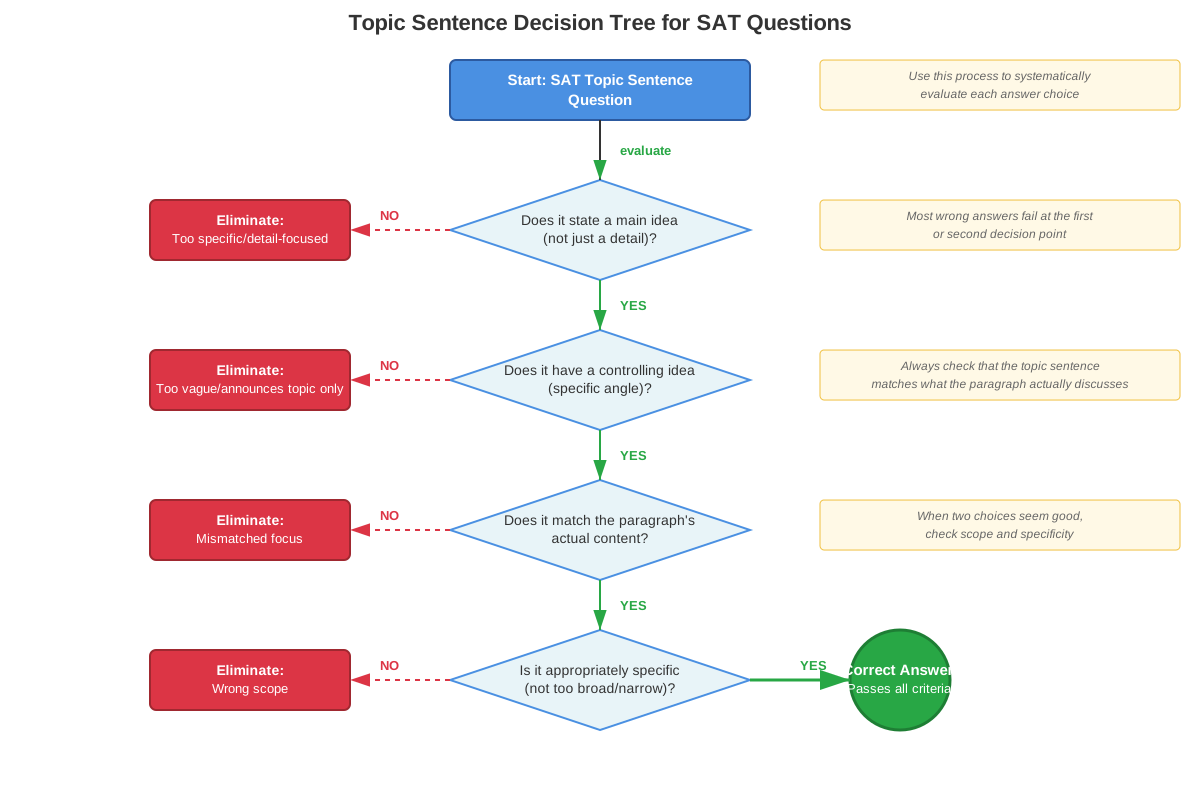
When approaching SAT questions about topic sentences, employ a systematic process. First, read the entire paragraph or passage context before selecting or evaluating a topic sentence. Understanding what information follows helps determine which sentence best introduces or encompasses that content. Many students make errors by selecting topic sentences that sound sophisticated but don't actually match the paragraph's scope or focus.
Trigger phrases that signal topic sentence questions include: "Which sentence most effectively introduces the paragraph?", "Which choice best establishes the main idea?", "Which sentence should be added to the beginning of the paragraph?", and "Which choice provides the most logical introduction?" When encountering these phrases, immediately identify the paragraph's controlling idea by analyzing what the supporting sentences discuss.
For process of elimination, systematically reject options that are:
- Too broad (could apply to multiple paragraphs or an entire essay)
- Too narrow (state a single detail rather than the overarching point)
- Off-topic (introduce subjects not developed in the paragraph)
- Vague or generic (lack specific controlling ideas)
- Stylistically inconsistent (formal tone in an informal passage, or vice versa)
Time allocation for topic sentence questions should be approximately 45-60 seconds. These questions require careful reading of context but don't demand complex analysis. If spending more than a minute, mark the question and return to it after completing faster questions.
Use the topic sentence scanning strategy when first approaching a passage: quickly read the first sentence of each paragraph to grasp overall structure before diving into questions. This 15-20 second investment provides a mental map that accelerates answering questions about passage organization, main ideas, and logical flow.
For questions asking where to place a sentence, identify the sentence's topic and controlling idea, then determine which paragraph discusses that subject. The sentence should typically follow the paragraph's topic sentence and precede or follow sentences with related content. Look for transitional words in the sentence that indicate its logical relationship to surrounding content.
Memory Techniques
TOPIC Acronym for evaluating topic sentences:
- Thesis connection: Does it relate to the passage's main argument?
- One main idea: Does it focus on a single, clear point?
- Paragraph scope: Can it be developed in one paragraph?
- Introduces content: Does it match what follows?
- Controlling idea: Does it make a claim or present a specific angle?
The Umbrella Visualization: Picture the topic sentence as an umbrella that covers all the supporting details beneath it. If a detail "sticks out" beyond the umbrella's coverage, either the topic sentence is too narrow or the detail doesn't belong. This mental image helps assess whether topic sentences have appropriate scope.
First Sentence First Rule: When uncertain, remember that SAT passages overwhelmingly place topic sentences first. If a paragraph's opening sentence states a clear claim or introduces a focused subject, it's likely the topic sentence. This heuristic works in approximately 80% of cases.
The "What's the Point?" Test: After reading a paragraph, ask "What's the point of this paragraph in one sentence?" Your answer is likely the topic sentence or what the topic sentence should be. This technique helps identify implied topic sentences or evaluate whether a given sentence effectively captures the paragraph's purpose.
Color-Coding Mental Strategy: When reading, mentally "highlight" the first sentence of each paragraph in one color and the last sentence in another. This trains the brain to pay special attention to positions where topic sentences typically appear, improving recognition speed.
Summary
Topic sentences serve as the structural foundation of paragraphs, expressing main ideas through a combination of subject and controlling idea. On the SAT Reading and Writing section, mastering topic sentences enables students to quickly grasp passage organization, identify main ideas, evaluate paragraph unity, and answer questions about logical flow and sentence placement. Effective topic sentences possess specificity, appropriate scope, clear claims, and connections to the broader passage argument. They typically appear at the beginning of paragraphs but can be delayed or occasionally implied. The relationship between topic sentences and supporting details is hierarchical: topic sentences make general claims that supporting sentences develop through evidence, examples, and explanation. Understanding this structure allows students to employ strategic reading techniques like topic sentence scanning and to systematically evaluate answer choices by assessing whether sentences match paragraph content, maintain appropriate scope, and provide clear direction. Success with topic sentence questions requires recognizing that these structural elements function as mini-thesis statements that advance the passage's overall purpose while maintaining paragraph unity.
Key Takeaways
- Topic sentences combine a subject with a controlling idea that the paragraph develops through supporting details
- Effective topic sentences match the scope of content that can be reasonably developed in a single paragraph—neither too broad nor too narrow
- Reading only the topic sentences of each paragraph should provide a coherent outline of the passage's main argument and organization
- All supporting sentences in a unified paragraph must directly relate to and develop the topic sentence's controlling idea
- SAT questions about topic sentences test the ability to match opening sentences to paragraph content, identify sentences that maintain unity, and recognize logical organizational patterns
- Topic sentences typically appear first but can be delayed after contextual setup or transitional material
- Systematic evaluation using the TOPIC acronym (Thesis connection, One main idea, Paragraph scope, Introduces content, Controlling idea) improves accuracy on topic sentence questions
Related Topics
Main Idea and Central Claims: Building on topic sentence mastery, this topic explores how to identify the thesis or central argument of entire passages, not just individual paragraphs. Understanding topic sentences provides the foundation for synthesizing multiple paragraph-level ideas into passage-level comprehension.
Paragraph Organization and Unity: This advanced topic examines how sentences within paragraphs relate to each other, including the use of supporting details, examples, and explanations. Mastering topic sentences is prerequisite to analyzing whether paragraphs maintain focus and develop ideas logically.
Transitions and Logical Flow: Topic sentences often contain or immediately follow transitional words and phrases. This related topic explores how writers signal relationships between ideas, building on the understanding of how topic sentences connect paragraphs.
Rhetorical Synthesis: Advanced questions ask students to evaluate how effectively passages are organized and whether information is presented logically. Topic sentence mastery enables analysis of whether writers have structured arguments effectively and whether paragraphs advance the overall purpose.
Practice CTA
Now that you understand the essential features and functions of topic sentences, it's time to apply this knowledge! Complete the practice questions to test your ability to identify effective topic sentences, evaluate paragraph unity, and determine logical sentence placement. The flashcards will help reinforce key concepts and characteristics of topic sentences. Remember: topic sentence mastery is one of the highest-yield skills for the SAT Reading and Writing section, appearing in multiple question types across every test. Your investment in practicing this skill will pay dividends across the entire exam. Approach each practice question systematically, using the TOPIC acronym and elimination strategies you've learned. You've got this!
Sign up free to keep reading
Create a free AnvayaPrep account to finish this SAT guide on Topic sentences — plus flashcards and practice questions.