Overview
Agreement between texts is a critical skill tested in the SAT Reading and Writing section that requires students to synthesize information from two related passages and determine how they relate to one another. This question type challenges test-takers to move beyond comprehension of individual texts and instead evaluate how multiple sources interact—whether they support, contradict, complement, or qualify each other's claims. On the digital SAT, these questions typically present two short passages (Text 1 and Text 2) followed by a prompt asking students to identify which statement best describes the relationship between them.
Mastering sat agreement between texts questions is essential because they appear consistently throughout the exam and test higher-order thinking skills that colleges value. Unlike single-passage questions that assess basic comprehension, cross-text questions evaluate analytical reasoning, evidence synthesis, and the ability to recognize nuanced relationships between sources—skills fundamental to college-level research and academic writing. These questions bridge the gap between simple reading comprehension and critical analysis, making them a cornerstone of the rw (Reading and Writing) section's assessment of college readiness.
Within the broader SAT Reading and Writing curriculum, agreement between texts falls under Cross-Text Connections, which also includes questions about comparing arguments, evaluating evidence across sources, and understanding how different authors approach similar topics. This topic builds upon foundational skills like identifying main ideas, understanding author's purpose, and recognizing supporting evidence, while preparing students for more complex analytical tasks they'll encounter in college coursework and professional contexts.
Learning Objectives
- [ ] Identify key features of Agreement between texts
- [ ] Explain how Agreement between texts appears on the SAT
- [ ] Apply Agreement between texts to answer SAT-style questions
- [ ] Distinguish between different types of text relationships (support, contradiction, qualification, complementation)
- [ ] Evaluate answer choices by systematically comparing claims in both texts
- [ ] Recognize common patterns in how the SAT structures cross-text comparison questions
Prerequisites
- Main idea identification: Understanding the central claim or purpose of a passage is essential before comparing it to another text
- Evidence recognition: Students must identify which details support or illustrate key points to evaluate how texts relate
- Author's purpose and tone: Recognizing whether an author is arguing, explaining, describing, or questioning helps determine text relationships
- Inference skills: Many agreement questions require reading between the lines to understand implicit connections between passages
- Vocabulary in context: Precise understanding of terms like "support," "contradict," "qualify," and "challenge" is necessary for selecting correct answers
Why This Topic Matters
In academic and professional settings, the ability to synthesize multiple sources is indispensable. Researchers must compare studies to identify consensus or controversy; journalists must reconcile conflicting accounts; and professionals across fields must evaluate competing claims to make informed decisions. The SAT tests this skill because it predicts success in college, where students regularly write research papers requiring them to navigate multiple perspectives and sources.
On the digital SAT, agreement between texts questions appear with high frequency—typically 2-4 questions per test administration in the Reading and Writing section. These questions carry significant weight because they assess multiple competencies simultaneously: reading comprehension, analytical reasoning, and synthesis. According to College Board data, students who excel at cross-text questions tend to score in higher percentile ranges overall, as these questions effectively differentiate between proficient and advanced readers.
These questions commonly appear in several formats: scientific passages presenting different research findings, historical texts offering varying interpretations of events, literary criticism comparing analytical approaches, or informational texts addressing the same topic from different angles. The passages are typically 50-100 words each, making them manageable in length but dense in content. The key challenge isn't reading speed but analytical precision—students must accurately characterize nuanced relationships rather than simply noting surface-level similarities or differences.
Core Concepts
Understanding Text Relationships
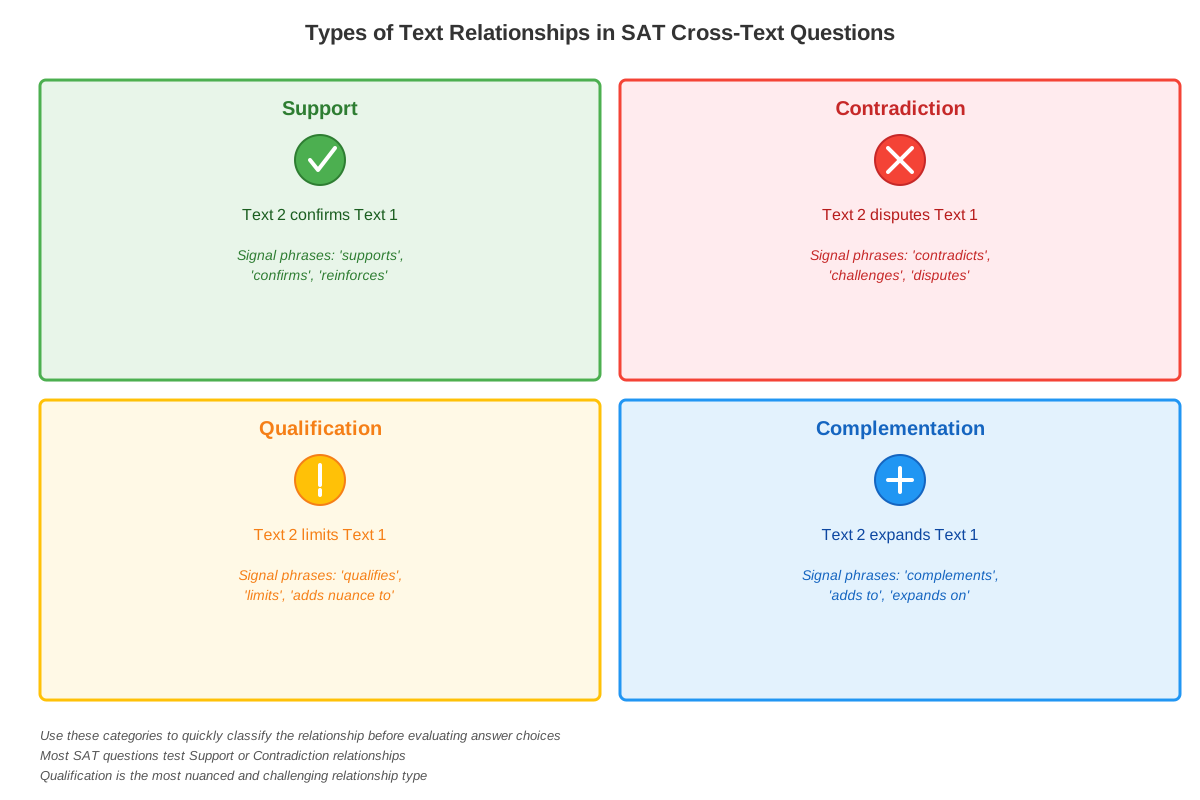
The foundation of agreement between texts questions lies in recognizing the four primary ways texts can relate to one another. Supporting relationships occur when Text 2 provides evidence, examples, or reasoning that strengthens or confirms claims made in Text 1. For instance, if Text 1 argues that urban green spaces improve mental health, and Text 2 presents research data showing reduced anxiety in cities with more parks, Text 2 supports Text 1.
Contradictory relationships exist when texts present incompatible claims or evidence. This doesn't merely mean discussing different topics—the texts must make opposing assertions about the same subject. If Text 1 claims that a historical figure acted primarily from economic motives while Text 2 argues the same figure was driven by ideological beliefs, they contradict each other.
Qualifying relationships are more nuanced: Text 2 doesn't fully contradict Text 1 but adds conditions, limitations, or exceptions that modify the original claim. If Text 1 states that exercise improves cognitive function, and Text 2 notes this effect only occurs with moderate exercise while excessive exercise may impair cognition, Text 2 qualifies Text 1.
Complementary relationships occur when texts address related but distinct aspects of a topic without directly supporting or contradicting each other. Both texts contribute to a fuller understanding, but neither validates nor challenges the other's specific claims. If Text 1 discusses the chemical composition of a substance and Text 2 describes its industrial applications, they complement each other by providing different types of relevant information.
Identifying Key Claims and Evidence
To determine text relationships accurately, students must first isolate the central claim of each passage—the main point the author wants readers to accept. This differs from the topic (what the text is about) or supporting details (evidence provided). In scientific passages, the central claim often appears as a conclusion or interpretation of data. In argumentative texts, it's the position the author advocates. In informational passages, it's the key insight or explanation offered.
After identifying central claims, students must map the supporting evidence each text provides. This evidence might include statistical data, expert testimony, historical examples, logical reasoning, or experimental results. Understanding what evidence each text relies upon is crucial because agreement questions often hinge on whether one text's evidence supports, contradicts, or qualifies another text's claims.
Analyzing Question Stems and Answer Choices
SAT agreement between texts questions follow predictable patterns in their construction. The question stem typically reads: "Based on the texts, how would the author of Text 2 most likely respond to the claim in Text 1?" or "Which choice best describes the relationship between the two texts?" Understanding these stem variations helps students focus their analysis appropriately.
Answer choices in these questions often use specific relationship verbs that signal different types of connections:
| Relationship Type | Common Verbs/Phrases | What It Means |
|---|---|---|
| Support | supports, confirms, provides evidence for, strengthens | Text 2 validates Text 1's claims |
| Contradiction | contradicts, challenges, disputes, undermines | Text 2 opposes Text 1's claims |
| Qualification | qualifies, limits, adds nuance to, specifies conditions for | Text 2 modifies Text 1's claims |
| Complementation | expands on, provides additional context, addresses a different aspect | Text 2 adds related information |
The Comparison Process
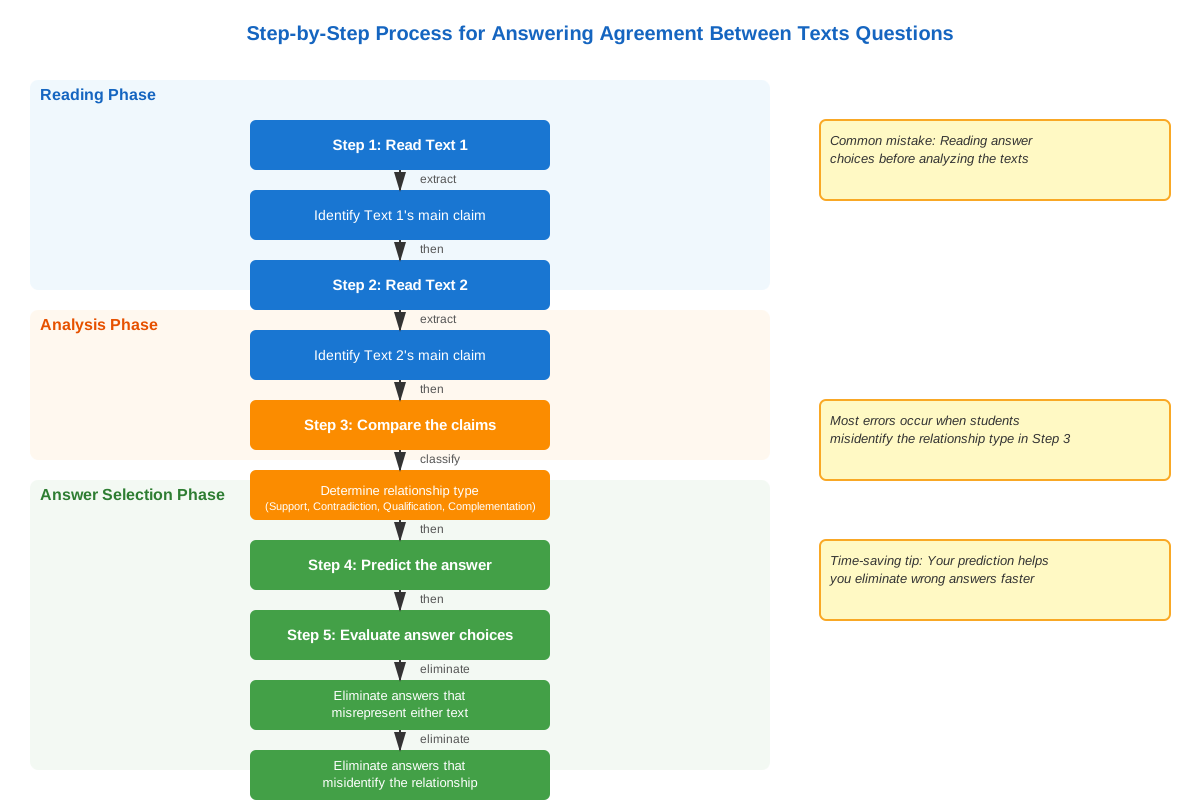
Effective analysis of text agreement requires a systematic approach. First, read Text 1 and identify its central claim in your own words. Second, read Text 2 and identify its central claim. Third, determine the relationship by asking: "Does Text 2 make Text 1 more believable, less believable, more limited in scope, or simply add different information?" Fourth, predict the answer before reading choices. Finally, eliminate answer choices that mischaracterize either text's claims or their relationship.
This process prevents common errors like selecting answers based on superficial similarities (both texts mention the same topic) rather than actual logical relationships (how their claims interact). Students must resist the temptation to skim; these questions reward careful, deliberate analysis over speed.
Recognizing Scope and Specificity
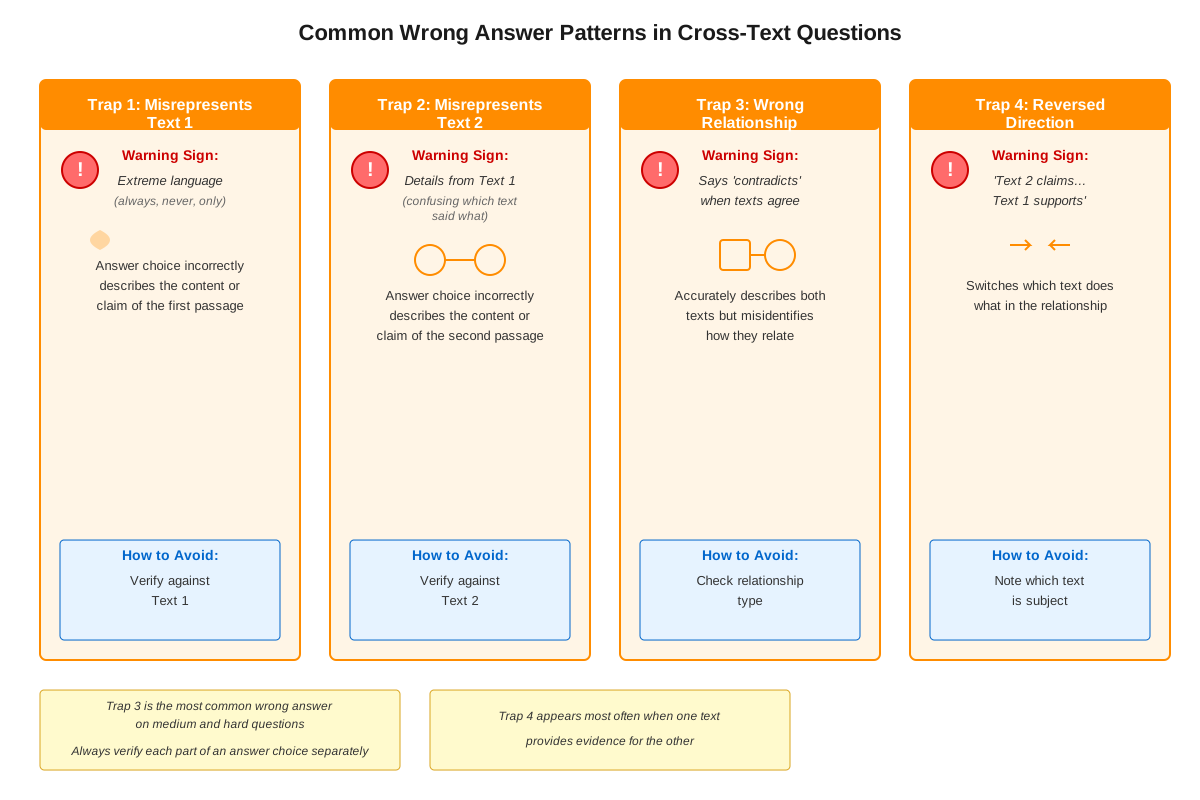
Many incorrect answer choices in agreement questions fail because they misrepresent the scope of a text's claims. If Text 1 makes a broad generalization ("renewable energy is becoming more cost-effective") and Text 2 provides a specific example ("solar panel costs decreased 40% in California"), an answer choice claiming Text 2 "proves" or "fully supports" Text 1 overstates the relationship. Text 2 provides one supporting example but doesn't comprehensively validate the broader claim.
Similarly, students must attend to specificity in both texts and answer choices. If Text 1 discusses "some species" and an answer choice claims it discusses "all species," that choice is incorrect regardless of how Text 2 relates to it. Precision in characterizing what each text actually says is non-negotiable for success on these questions.
Concept Relationships
The concepts within agreement between texts build upon each other hierarchically. Understanding text relationships (support, contradiction, qualification, complementation) serves as the foundation. This understanding enables students to identify key claims and evidence, which in turn allows them to analyze question stems and answer choices effectively. The comparison process integrates all previous concepts into a systematic approach, while attention to scope and specificity refines that process to avoid common pitfalls.
These concepts connect directly to prerequisite skills: main idea identification provides the foundation for isolating central claims; evidence recognition enables mapping of supporting details; and inference skills allow students to understand implicit relationships between texts. The topic also connects forward to other Cross-Text Connections questions, such as those asking students to evaluate which text provides stronger evidence or how an author would respond to another's argument.
The relationship map flows as follows: Text Relationship Types → Claim Identification → Evidence Mapping → Question Stem Analysis → Systematic Comparison Process → Scope/Specificity Verification → Correct Answer Selection
High-Yield Facts
- ⭐ Agreement between texts questions always require analyzing the relationship between two passages, not comprehending a single text
- ⭐ The four primary text relationships are support, contradiction, qualification, and complementation
- ⭐ Supporting relationships require Text 2 to provide evidence or reasoning that strengthens Text 1's claims
- ⭐ Contradictory relationships involve incompatible claims about the same subject, not merely different topics
- ⭐ Qualifying relationships add conditions or limitations without fully contradicting the original claim
- Complementary relationships provide related information without directly validating or challenging specific claims
- Question stems typically ask how texts relate or how one author would respond to another's claim
- Answer choices often use specific relationship verbs (supports, contradicts, qualifies, expands on) that signal different connections
- Incorrect answers frequently misrepresent the scope of claims (overgeneralizing or being too specific)
- Students should identify central claims in both texts before reading answer choices
- The comparison process should be systematic: read Text 1, read Text 2, determine relationship, predict answer, eliminate wrong choices
- These questions appear 2-4 times per SAT administration with high predictive value for overall scores
- Superficial similarities (both texts mention the same topic) don't indicate agreement; logical relationships between claims do
- Time investment in careful reading pays off more than rushing through these questions
Quick check — test yourself on Agreement between texts so far.
Try Flashcards →Common Misconceptions
Misconception: If both texts discuss the same topic, they agree with each other. → Correction: Agreement requires texts to make compatible claims about a topic, not merely address the same subject. Two texts about climate change could completely contradict each other.
Misconception: A contradictory relationship means the texts have nothing in common. → Correction: Contradictory texts must address the same specific issue to contradict each other; they share a common subject but make incompatible claims about it.
Misconception: If Text 2 provides any example related to Text 1's topic, it supports Text 1. → Correction: Support requires Text 2's evidence to actually strengthen Text 1's specific claims. A tangentially related example doesn't constitute support.
Misconception: Qualifying a claim is the same as contradicting it. → Correction: Qualification adds nuance, conditions, or limitations while accepting the basic validity of the original claim. Contradiction rejects the claim entirely.
Misconception: The longer or more detailed text contains the correct answer's perspective. → Correction: Text length is irrelevant to determining relationships. Both texts carry equal weight in analysis regardless of their length.
Misconception: Agreement questions test whether you personally agree with either text. → Correction: These questions assess your ability to objectively analyze how texts relate to each other, not your personal opinions about their content.
Misconception: If you understand both texts individually, you'll automatically see their relationship. → Correction: Understanding individual texts is necessary but insufficient; you must actively compare their claims and evidence to determine relationships.
Worked Examples
Example 1: Scientific Research Comparison
Text 1
A recent study suggests that intermittent fasting may improve metabolic health by reducing insulin resistance. Researchers found that participants who fasted for 16 hours daily showed significant improvements in blood sugar regulation compared to control groups following standard eating patterns.
Text 2
While some research indicates benefits from intermittent fasting, a comprehensive review of multiple studies reveals that these benefits primarily occur in individuals who are overweight or have pre-existing metabolic conditions. In healthy individuals with normal weight, intermittent fasting showed no significant metabolic advantages over regular eating patterns.
Question: Based on the texts, how would the author of Text 2 most likely respond to the research findings in Text 1?
Step 1 - Identify Text 1's central claim: Intermittent fasting improves metabolic health by reducing insulin resistance.
Step 2 - Identify Text 2's central claim: Intermittent fasting's metabolic benefits are limited to specific populations (overweight or metabolically compromised individuals), not universal.
Step 3 - Determine the relationship: Text 2 doesn't contradict Text 1 entirely but adds important limitations. It qualifies Text 1's claim by specifying conditions under which the benefits occur.
Step 4 - Predict the answer: The correct answer should indicate that Text 2 qualifies or limits Text 1's findings by specifying that benefits depend on the participant population.
Step 5 - Evaluate answer choices:
- A) "Text 2 contradicts Text 1 by showing intermittent fasting has no benefits" - INCORRECT: Text 2 acknowledges benefits exist for some groups
- B) "Text 2 supports Text 1 by confirming intermittent fasting improves metabolic health" - INCORRECT: Text 2 limits rather than broadly confirms this claim
- C) "Text 2 qualifies Text 1 by indicating the metabolic benefits may be limited to certain populations" - CORRECT: This accurately captures the qualifying relationship
- D) "Text 2 expands on Text 1 by discussing additional benefits of intermittent fasting" - INCORRECT: Text 2 limits rather than expands the claimed benefits
Answer: C - This question demonstrates how qualifying relationships work: Text 2 doesn't reject Text 1's findings but adds crucial conditions that limit their applicability.
Example 2: Historical Interpretation Comparison
Text 1
The construction of the transcontinental railroad in the 1860s represented a triumph of American engineering and determination. This massive infrastructure project connected the nation from coast to coast, facilitating westward expansion and economic growth that transformed the United States into an industrial power.
Text 2
Recent historical scholarship has highlighted the severe human costs of transcontinental railroad construction. Chinese immigrant workers faced dangerous conditions, discrimination, and exploitation, with hundreds dying during the project. Additionally, the railroad's completion accelerated the displacement of Native American populations from their ancestral lands.
Question: Which choice best describes the relationship between Text 1 and Text 2?
Step 1 - Identify Text 1's central claim: The transcontinental railroad was a positive achievement that benefited the nation.
Step 2 - Identify Text 2's central claim: The transcontinental railroad involved significant human suffering and injustice that historical accounts often overlook.
Step 3 - Determine the relationship: Text 2 doesn't deny the railroad's completion or its economic impact, but it presents a contrasting perspective that emphasizes negative consequences Text 1 ignores. This is complementary rather than contradictory—both perspectives can be true simultaneously. Text 2 addresses aspects (human costs, ethical dimensions) that Text 1 doesn't discuss.
Step 4 - Predict the answer: The correct answer should indicate that Text 2 provides a different perspective or addresses aspects Text 1 doesn't consider, without claiming direct contradiction.
Step 5 - Evaluate answer choices:
- A) "Text 2 contradicts Text 1 by denying the railroad's economic importance" - INCORRECT: Text 2 doesn't dispute economic impacts
- B) "Text 2 supports Text 1 by providing additional evidence of the railroad's benefits" - INCORRECT: Text 2 discusses costs, not benefits
- C) "Text 2 presents a perspective on the railroad's construction that emphasizes aspects not addressed in Text 1" - CORRECT: This accurately describes the complementary relationship
- D) "Text 2 qualifies Text 1 by showing the railroad's benefits were temporary" - INCORRECT: Text 2 doesn't discuss whether benefits were temporary
Answer: C - This example illustrates how texts can address the same topic from different angles without directly contradicting each other, creating a complementary relationship.
Exam Strategy
When approaching agreement between texts questions on the SAT, begin by reading Text 1 carefully and articulating its main claim in your own words before moving to Text 2. This prevents confusion and ensures you understand each text independently before comparing them. Resist the urge to read both texts simultaneously or to jump immediately to answer choices.
Trigger words to watch for in question stems include: "relationship between," "how would the author respond," "best describes the connection," and "based on both texts." These phrases signal that you must synthesize information rather than simply comprehend individual passages. In answer choices, pay special attention to relationship verbs: "supports," "contradicts," "challenges," "qualifies," "limits," "expands on," "provides evidence for," and "undermines." Each verb indicates a specific type of relationship.
For process of elimination, first eliminate any answer choice that mischaracterizes what either text actually says, regardless of the relationship it proposes. If an answer claims Text 1 argues X when it actually argues Y, eliminate it immediately. Second, eliminate choices that use relationship verbs inconsistent with how the texts interact. If Text 2 clearly provides supporting evidence, eliminate answers claiming it "contradicts" or "challenges" Text 1.
Time allocation for these questions should be approximately 60-75 seconds. Spend 20 seconds reading Text 1, 20 seconds reading Text 2, 15 seconds determining their relationship, and 20 seconds evaluating answer choices. If you find yourself exceeding 90 seconds, make your best educated guess and move on—these questions are worth the same points as easier ones, so time management matters.
Exam Tip: Before reading answer choices, mentally complete this sentence: "Text 2 [supports/contradicts/qualifies/complements] Text 1 by [specific way it does so]." This prediction strategy dramatically improves accuracy.
Memory Techniques
Use the acronym SCQC to remember the four primary text relationships: Support, Contradict, Qualify, Complement. Visualize these as four directions on a compass—each represents a different way texts can relate.
For remembering the comparison process, use the mnemonic "Read, Read, Relate, Predict, Pick": Read Text 1, Read Text 2, determine their Relationship, Predict the answer, Pick the correct choice.
To distinguish between contradiction and qualification, visualize a traffic light: Contradiction is a red light (complete stop/rejection), qualification is a yellow light (proceed with caution/conditions apply), and support is a green light (go ahead/validated).
For remembering to check scope and specificity, think "SCOPE": Some vs. all, Conditions stated, Overgeneralization avoided, Precise language, Exact claims matched.
Summary
Agreement between texts questions assess the critical skill of synthesizing information from multiple sources by determining how two passages relate to one another. Success requires identifying the central claim of each text, mapping their supporting evidence, and accurately characterizing their relationship as supporting, contradictory, qualifying, or complementary. These questions appear consistently on the SAT Reading and Writing section and test higher-order analytical skills essential for college success. The key to mastering this topic lies in systematic comparison: understanding each text independently before analyzing their interaction, attending carefully to scope and specificity in both texts and answer choices, and recognizing the precise meaning of relationship verbs. Students must move beyond surface-level observations (both texts mention the same topic) to evaluate logical connections between claims (how their assertions interact). With practice applying the systematic comparison process and attention to common pitfalls like misrepresenting scope or confusing complementary relationships with supporting ones, students can consistently answer these high-value questions correctly.
Key Takeaways
- Agreement between texts questions require synthesizing two passages to determine how they relate: support, contradict, qualify, or complement
- Always identify each text's central claim independently before comparing them
- Supporting relationships require Text 2 to provide evidence that strengthens Text 1's specific claims
- Qualifying relationships add conditions or limitations without completely rejecting the original claim
- Pay careful attention to scope (some vs. all) and specificity in both texts and answer choices
- Use a systematic process: read Text 1, read Text 2, determine relationship, predict answer, eliminate wrong choices
- Relationship verbs in answer choices (supports, contradicts, qualifies, expands on) signal different types of connections
Related Topics
Evaluating Evidence Across Texts: Building on agreement between texts, this topic focuses on determining which passage provides stronger or more relevant evidence for a particular claim, requiring deeper analysis of evidence quality and relevance.
Comparing Arguments: This advanced topic examines how different authors construct arguments about the same issue, analyzing not just whether they agree but how their reasoning strategies differ.
Synthesis in Research Writing: Understanding text relationships prepares students for college research papers where they must integrate multiple sources, positioning them in conversation with each other.
Critical Reading of Scientific Literature: The skills developed in agreement between texts questions directly transfer to evaluating scientific studies, where researchers must compare findings across multiple experiments.
Practice CTA
Now that you've mastered the core concepts of agreement between texts, it's time to put your knowledge into action! Complete the practice questions to reinforce your understanding and build confidence with SAT-style cross-text comparison questions. Use the flashcards to memorize key relationship types and trigger words. Remember: these questions reward careful, systematic analysis—take your time, apply the comparison process, and watch your accuracy improve. You're building skills that will serve you not just on test day but throughout your academic career!
Sign up free to keep reading
Create a free AnvayaPrep account to finish this SAT guide on Agreement between texts — plus flashcards and practice questions.