Overview
Author response questions represent a distinctive and increasingly common question type on the SAT Reading and Writing section. These questions present students with two separate texts—typically short passages of 1-3 sentences each—and ask how the author of one text would likely respond to, evaluate, or comment on a claim, finding, or argument presented in the other text. This question format tests a student's ability to synthesize information across multiple sources, understand authorial perspective and tone, and make logical inferences about how different viewpoints interact.
Mastering SAT author response questions is essential because they appear regularly in the Cross-Text Connections domain of the RW (Reading and Writing) section. Unlike single-passage questions that test comprehension of one text in isolation, these questions require students to hold two distinct perspectives in mind simultaneously, identify points of agreement or disagreement, and predict how one author would engage with another's ideas. This skill mirrors real-world academic discourse, where scholars respond to, critique, and build upon each other's work. The SAT uses this question type to assess higher-order thinking skills including analysis, synthesis, and evaluation.
Within the broader landscape of SAT Reading and Writing concepts, author response questions build upon foundational skills in reading comprehension, inference-making, and rhetorical analysis. They connect directly to understanding authorial purpose, identifying claims and evidence, recognizing logical relationships, and interpreting tone. Students who excel at these questions demonstrate not only strong reading skills but also the ability to think critically about how ideas interact across different texts—a crucial skill for college-level academic work.
Learning Objectives
- [ ] Identify key features of author response questions
- [ ] Explain how author response questions appear on the SAT
- [ ] Apply author response questions to answer SAT-style questions
- [ ] Distinguish between different types of author responses (agreement, disagreement, qualification, extension)
- [ ] Analyze the relationship between claims in Text 1 and potential responses from the author of Text 2
- [ ] Evaluate answer choices by identifying textual evidence that supports or contradicts each option
Prerequisites
- Basic reading comprehension: Understanding main ideas, supporting details, and explicit information in short passages is fundamental to processing both texts accurately
- Inference skills: The ability to draw logical conclusions from textual evidence is necessary because author response questions require predicting unstated reactions
- Understanding of claims and evidence: Recognizing the difference between assertions and supporting information helps identify what one author would respond to in another's text
- Tone and purpose recognition: Identifying an author's attitude and intent provides the foundation for predicting how they would engage with opposing or related viewpoints
Why This Topic Matters
Author response questions assess critical thinking skills that extend far beyond standardized testing. In academic settings, students constantly engage with multiple sources, comparing methodologies, evaluating competing claims, and synthesizing diverse perspectives. In professional contexts, the ability to understand how different stakeholders might respond to proposals, findings, or arguments is invaluable for effective communication and decision-making. These questions prepare students for the intellectual work of college, where they'll write research papers that position their arguments within scholarly conversations.
On the SAT, author response questions appear with significant frequency in the Reading and Writing section. Students can expect to encounter approximately 2-4 of these questions per test, making them a high-yield topic for focused preparation. These questions typically appear in the Cross-Text Connections category, which comprises roughly 10-15% of the total Reading and Writing questions. Because each question is worth the same number of points regardless of difficulty, mastering this medium-difficulty question type provides an efficient path to score improvement.
These questions commonly appear with passages drawn from natural sciences, social sciences, humanities, and occasionally literature. Text 1 might present a research finding, historical claim, or theoretical position, while Text 2 offers a related but distinct perspective. The question stem typically asks: "Based on Text 2, how would [Author 2] most likely respond to the claim in Text 1?" or similar variations. Understanding the predictable structure of these questions allows students to develop systematic approaches that improve both accuracy and speed.
Core Concepts
Structure of Author Response Questions
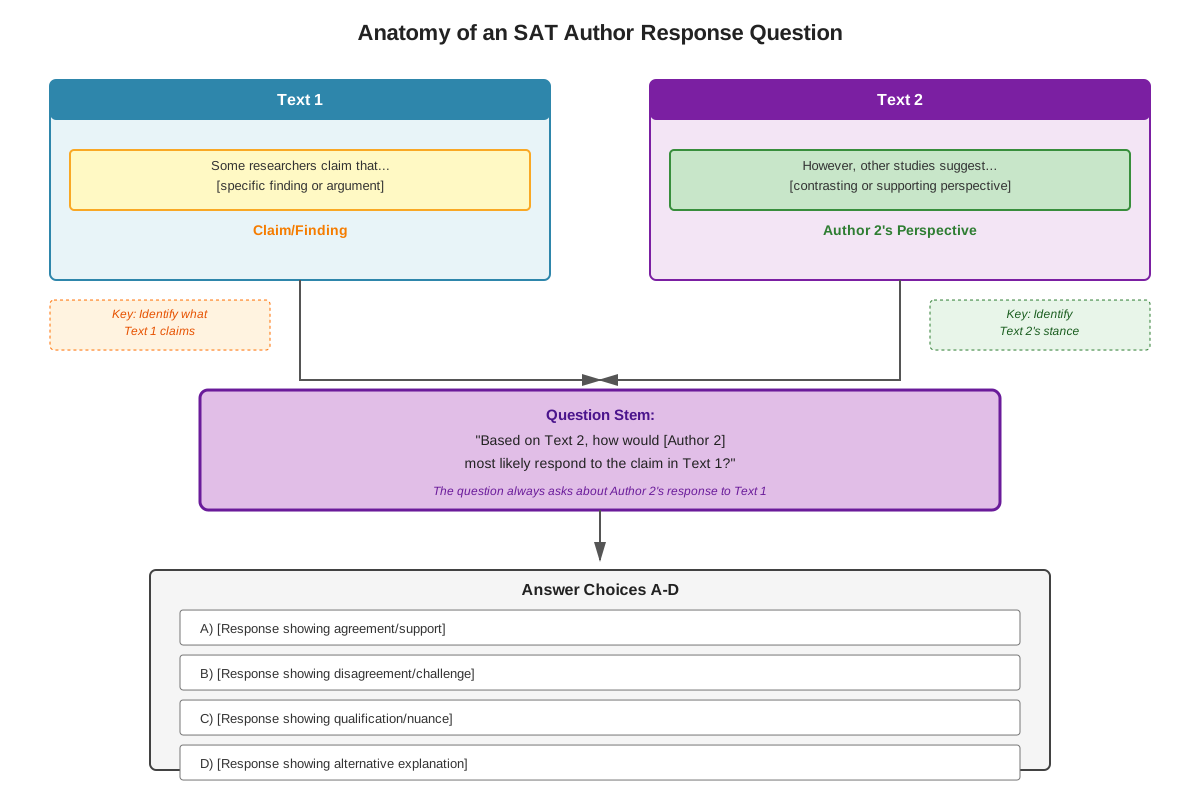
Author response questions follow a consistent format that students can learn to recognize immediately. The question presents Text 1, which contains a specific claim, finding, argument, or observation. This is followed by Text 2, which provides information, evidence, or a perspective from a different author. The question stem then asks students to determine how the author of Text 2 would likely respond to, evaluate, or characterize something stated in Text 1.
The texts are intentionally brief—typically 1-3 sentences each—but densely packed with information. Text 1 establishes a position that serves as the reference point. Text 2 provides the lens through which students must view Text 1. The relationship between the texts is never explicitly stated; students must infer it by carefully analyzing the content, tone, and implications of both passages.
Types of Author Responses
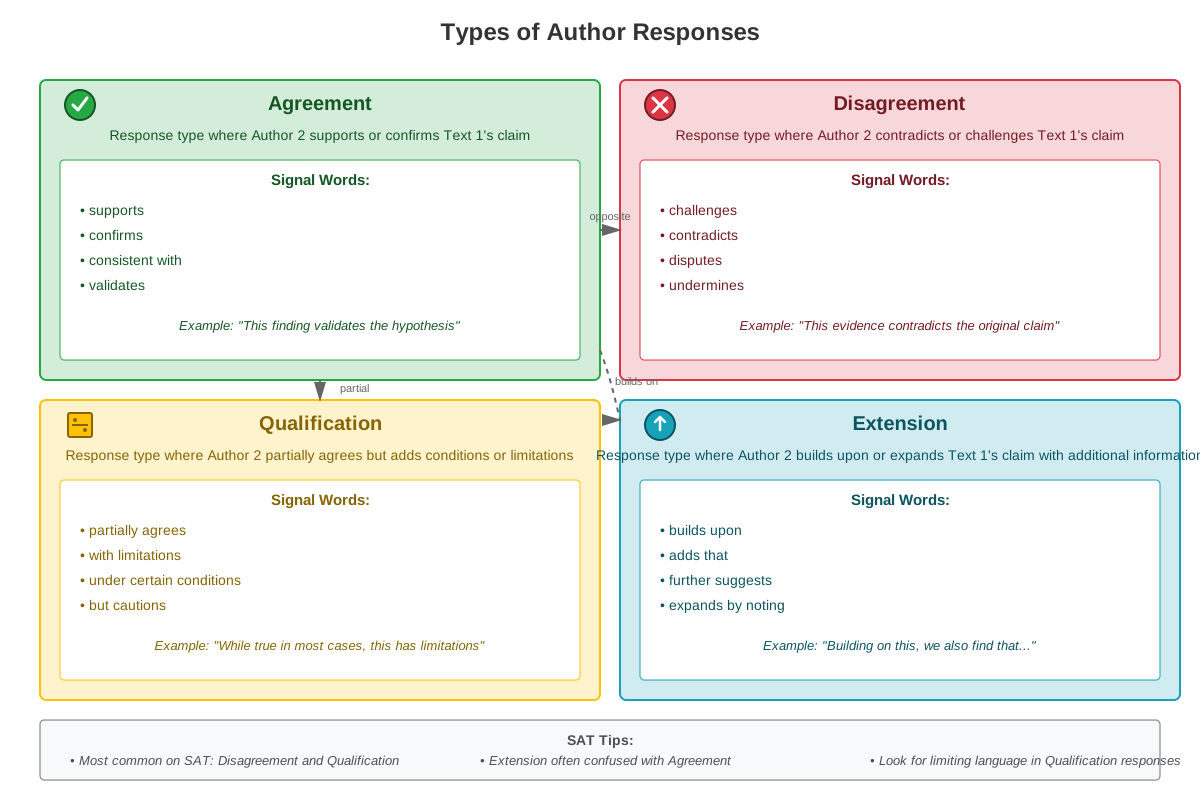
Understanding the range of possible responses helps students predict answer choices and eliminate incorrect options. Author responses generally fall into several categories:
Agreement/Support: The author of Text 2 would affirm, corroborate, or provide additional evidence for the claim in Text 1. This occurs when both texts align in their perspectives, even if they approach the topic from different angles or use different evidence.
Disagreement/Challenge: The author of Text 2 would dispute, contradict, or present evidence that undermines the claim in Text 1. This relationship exists when the texts present incompatible positions or when Text 2's evidence directly contradicts Text 1's assertions.
Qualification/Nuance: The author of Text 2 would partially agree but add important limitations, conditions, or exceptions to the claim in Text 1. This sophisticated response acknowledges validity while introducing complexity.
Extension/Elaboration: The author of Text 2 would build upon, expand, or provide additional context for the claim in Text 1 without necessarily agreeing or disagreeing. This response adds depth rather than taking a clear stance.
Alternative Explanation: The author of Text 2 would offer a different interpretation, mechanism, or cause for the phenomenon described in Text 1, suggesting the original claim is incomplete or misdirected.
Identifying the Key Claim in Text 1
Success on author response questions begins with precisely identifying what claim, finding, or position in Text 1 the question asks about. Sometimes the entire Text 1 presents a single unified claim. Other times, Text 1 contains multiple statements, and the question stem specifies which one matters: "Based on Text 2, how would the author most likely respond to the underlined claim in Text 1?"
Students must distinguish between the main claim and supporting details. The claim is the assertion the author makes—what they believe to be true. Supporting details are the evidence, examples, or reasoning provided. Author response questions typically focus on how Text 2's author would evaluate the main claim, not peripheral details.
Analyzing Text 2's Perspective
After identifying the relevant claim in Text 1, students must thoroughly analyze Text 2 to understand its author's perspective, evidence, and implications. This requires attention to:
Explicit statements: What does Text 2 directly say? What facts, findings, or observations does it present?
Implicit positions: What does Text 2 suggest or imply? What must be true for Text 2's statements to make sense?
Tone and emphasis: Does Text 2 use language that suggests certainty, caution, criticism, or enthusiasm? Words like "however," "surprisingly," "merely," or "actually" signal the author's attitude.
Scope and limitations: Does Text 2 address the same phenomenon as Text 1, or a related but distinct issue? Does it apply to the same context, time period, or population?
Matching Response to Evidence
The correct answer to an author response question must be fully supported by Text 2. Students should be able to point to specific words, phrases, or logical implications in Text 2 that justify the predicted response. Incorrect answers often:
- Overstate the strength of agreement or disagreement
- Introduce ideas not present in either text
- Confuse the direction of the relationship (e.g., suggesting agreement when the texts conflict)
- Focus on peripheral details rather than the central claim
- Make logical leaps not supported by the evidence
Question Stem Variations
While the core task remains consistent, author response questions use varied phrasing:
- "Based on Text 2, how would [Author 2] most likely respond to the claim in Text 1?"
- "How would the author of Text 2 most likely characterize the finding presented in Text 1?"
- "The author of Text 2 would most likely describe the hypothesis in Text 1 as..."
- "Based on Text 2, what would [Author 2] most likely say about the conclusion in Text 1?"
Recognizing these variations helps students quickly identify the question type and activate their strategic approach.
Concept Relationships
The concepts within author response questions form an interconnected system. Identifying the structure of these questions enables students to locate the key claim in Text 1, which then directs their analysis of Text 2's perspective. Understanding the types of possible responses provides a framework for matching the response to textual evidence, which ultimately leads to selecting the correct answer.
Author response questions build directly on prerequisite skills. Reading comprehension provides the foundation for understanding both texts accurately. Inference skills enable students to recognize implicit positions and predict unstated responses. Claim and evidence recognition helps distinguish what one author would respond to versus supporting details. Tone analysis reveals the attitude that shapes how an author would engage with another's ideas.
These questions also connect to other SAT Reading and Writing topics. They share analytical approaches with rhetorical synthesis questions, which also require integrating information across texts. They employ similar inference skills as purpose and function questions. They demand the same careful attention to textual evidence as command of evidence questions. Mastering author response questions thus strengthens performance across multiple question types.
Relationship Map: Reading Comprehension → Claim Identification → Text 2 Analysis → Response Type Recognition → Evidence Matching → Answer Selection
High-Yield Facts
- ⭐ Author response questions always present exactly two texts, with the question asking how the author of Text 2 would respond to something in Text 1
- ⭐ The correct answer must be fully supported by explicit statements or clear implications in Text 2—no outside knowledge required
- ⭐ Text 1 establishes the reference claim; Text 2 provides the perspective for evaluating that claim
- ⭐ Common response types include agreement, disagreement, qualification, extension, and alternative explanation
- ⭐ Question stems typically use phrases like "most likely respond," "would characterize," or "would describe"
- The texts are intentionally brief (1-3 sentences each) but information-dense
- Incorrect answers often overstate the strength of agreement/disagreement or introduce unsupported ideas
- Tone words in Text 2 (however, surprisingly, merely, actually) signal the author's attitude toward related claims
- Students should identify the specific claim in Text 1 before analyzing Text 2
- The relationship between texts is never explicitly stated—it must be inferred
- Both texts typically address related topics but from different angles, time periods, or with different evidence
- Answer choices often differ in subtle but important ways regarding strength, scope, or direction of response
- These questions appear 2-4 times per SAT test in the Cross-Text Connections category
- Processing both texts efficiently requires active reading with attention to claims, evidence, and tone
- The correct answer represents what the author would "most likely" say—the best-supported option, not necessarily the only possible response
Quick check — test yourself on Author response questions so far.
Try Flashcards →Common Misconceptions
Misconception: The author of Text 2 must explicitly mention or reference Text 1's claim for a response to be valid.
Correction: Author response questions test inference skills. Text 2 never directly references Text 1. Students must infer how Text 2's author would respond based on the perspective, evidence, and implications present in Text 2.
Misconception: If both texts discuss the same general topic, the authors must agree with each other.
Correction: Texts can address the same phenomenon while presenting contradictory claims, different interpretations, or incompatible evidence. Topical similarity does not guarantee agreement.
Misconception: The correct answer should use the same vocabulary or phrasing as Text 2.
Correction: While the answer must be supported by Text 2, it often paraphrases or synthesizes ideas rather than quoting directly. Students should focus on conceptual alignment, not word matching.
Misconception: Stronger language in answer choices (e.g., "completely wrong" vs. "somewhat inaccurate") is more likely to be correct because it's more definitive.
Correction: The correct answer matches the strength of the evidence in Text 2. Extreme language is often incorrect because Text 2 rarely provides absolute proof for or against Text 1's claims.
Misconception: Author response questions test knowledge of the subject matter discussed in the passages.
Correction: These questions test reading comprehension and inference skills, not content knowledge. All information needed to answer correctly appears in the two texts provided.
Misconception: If Text 2 presents evidence related to Text 1's topic, the author of Text 2 would automatically support Text 1's claim.
Correction: Related evidence can support, contradict, or complicate a claim. Students must carefully analyze whether Text 2's evidence actually confirms Text 1's specific assertion or suggests a different conclusion.
Worked Examples
Example 1
Text 1
Historian Maria Chen argues that the decline of the Roman Empire was primarily caused by economic factors, particularly the devaluation of currency and unsustainable military spending that depleted the treasury.
Text 2
Recent archaeological evidence analyzed by historian James Park reveals that climate change in the 4th and 5th centuries led to widespread crop failures across the Roman Empire, forcing mass migrations and destabilizing the social order that had sustained Roman power.
Question: Based on Text 2, how would Park most likely respond to Chen's argument in Text 1?
Answer Choices:
A) He would agree that economic factors were the primary cause of Rome's decline
B) He would suggest that environmental factors played a more significant role than Chen acknowledges
C) He would argue that military spending had no impact on the empire's stability
D) He would claim that currency devaluation was actually beneficial to the empire
Step 1: Identify the key claim in Text 1
Chen's claim is that Rome's decline was "primarily caused by economic factors"—specifically currency devaluation and military spending.
Step 2: Analyze Text 2's perspective
Park presents evidence that "climate change led to widespread crop failures" which "forced mass migrations and destabilized the social order." This focuses on environmental/climate factors, not economic ones.
Step 3: Determine the relationship
Park's evidence suggests an alternative explanation for Rome's decline—environmental factors rather than economic ones. He doesn't directly contradict Chen's evidence about economic problems, but his emphasis on climate change implies he sees different primary causes.
Step 4: Evaluate answer choices
- A) Incorrect—Park focuses on environmental factors, not economic ones
- B) Correct—Park's evidence about climate change suggests environmental factors were significant, which Chen doesn't address
- C) Incorrect—Park doesn't discuss military spending at all; this overstates disagreement
- D) Incorrect—Park doesn't mention currency; this introduces an unsupported claim
Correct Answer: B
The answer is supported by Park's presentation of climate evidence as causing major disruptions. The phrase "more significant role than Chen acknowledges" accurately captures that Park offers an alternative explanation without claiming Chen is completely wrong.
Example 2
Text 1
Psychologist Dr. Sarah Williams claims that social media use directly causes increased anxiety in teenagers, citing studies showing that teens who spend more than three hours daily on social platforms report higher anxiety levels than those who spend less time online.
Text 2
Dr. Robert Martinez's research indicates that teenagers with pre-existing anxiety disorders are significantly more likely to spend extended time on social media as a coping mechanism, suggesting that the relationship between social media use and anxiety may be more complex than a simple cause-and-effect pattern.
Question: Based on Text 2, how would Martinez most likely describe Williams's claim in Text 1?
Answer Choices:
A) As an accurate description of how social media affects all teenagers
B) As overlooking the possibility that anxiety might lead to increased social media use rather than result from it
C) As correctly identifying social media as the only factor influencing teenage anxiety
D) As completely incorrect because social media has no relationship to anxiety
Step 1: Identify the key claim in Text 1
Williams claims social media use "directly causes" increased anxiety, based on correlation between time spent online and anxiety levels.
Step 2: Analyze Text 2's perspective
Martinez presents evidence that "teenagers with pre-existing anxiety disorders are significantly more likely to spend extended time on social media." He explicitly states the relationship "may be more complex than a simple cause-and-effect pattern."
Step 3: Determine the relationship
Martinez doesn't deny a relationship between social media and anxiety, but he questions the direction of causation. His evidence suggests anxiety might cause increased social media use (reverse causation) rather than social media causing anxiety.
Step 4: Evaluate answer choices
- A) Incorrect—Martinez suggests the relationship is "more complex," not that Williams is accurate
- B) Correct—This captures Martinez's point about reverse causation and complexity
- C) Incorrect—Williams doesn't claim social media is the "only" factor, and Martinez doesn't address this
- D) Incorrect—Martinez acknowledges a relationship exists; he questions its direction, not its existence
Correct Answer: B
This answer accurately reflects Martinez's qualification of Williams's claim. He doesn't completely disagree but suggests Williams may have the causal direction wrong—a sophisticated form of disagreement that acknowledges complexity.
Exam Strategy
When approaching author response questions on the SAT, follow this systematic process:
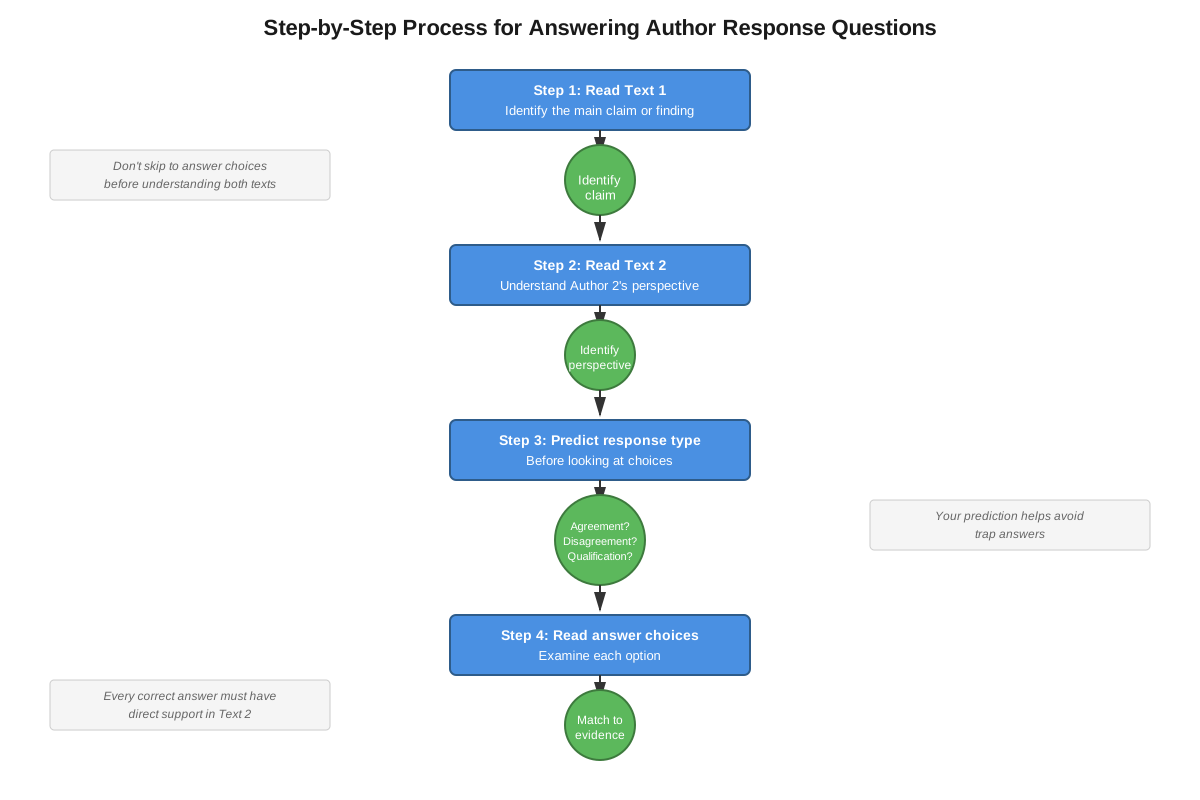
Step 1: Identify the question type immediately. Look for phrases like "how would [Author 2] respond," "would most likely characterize," or "would describe." This triggers your author response strategy.
Step 2: Read Text 1 carefully and identify the specific claim. Underline or mentally note the main assertion. If the question stem specifies "the underlined claim" or "the conclusion," focus exclusively on that portion.
Step 3: Before reading Text 2, predict possible responses. Would another author likely agree, disagree, qualify, or offer an alternative? This primes your mind for the relationship.
Step 4: Read Text 2 actively, noting evidence and tone. Pay special attention to transition words (however, although, surprisingly) that signal the author's attitude. Ask yourself: "What does this author believe? What evidence do they present?"
Step 5: Determine the relationship before looking at answer choices. Decide whether Text 2's author would support, challenge, qualify, or complicate Text 1's claim. Formulate your own answer in simple terms.
Step 6: Evaluate each answer choice against Text 2's evidence. The correct answer must be fully supported by Text 2. Eliminate choices that:
- Overstate agreement or disagreement
- Introduce ideas not in either text
- Misrepresent the scope or strength of Text 2's position
- Focus on irrelevant details
Trigger words to watch for: "primarily," "directly causes," "only," "completely," "suggests," "indicates," "reveals," "however," "although," "surprisingly," "actually." These words signal the strength and direction of claims.
Process of elimination tips:
- Eliminate extreme answers unless Text 2 provides extreme evidence
- Eliminate answers that require outside knowledge
- Eliminate answers that confuse which text contains which information
- Keep answers that use qualifying language ("may suggest," "could indicate") when Text 2's evidence is suggestive rather than definitive
Time allocation: Spend approximately 60-75 seconds per author response question. These questions require careful reading of both texts but reward systematic analysis. Don't rush through the texts to save time—misreading either passage guarantees an incorrect answer.
Memory Techniques
CLAIM Acronym for Analysis:
- Claim: Identify the specific claim in Text 1
- Lens: Understand Text 2's perspective as the lens for evaluation
- Attitude: Note tone words that reveal Text 2 author's attitude
- Implications: Consider what Text 2 implies, not just what it states explicitly
- Match: Match the response to specific evidence in Text 2
The "Two Voices" Visualization: Picture two scholars having a conversation. Text 1's author makes a statement. Pause and imagine Text 2's author responding. What would they say? Would they nod in agreement, shake their head, or raise a finger to add nuance? This mental image helps predict responses.
Response Type Spectrum: Visualize a spectrum from "Strong Agreement" on the left to "Strong Disagreement" on the right, with "Qualification/Nuance" in the middle. After reading both texts, mentally place the relationship on this spectrum. This prevents choosing answers that are too extreme or too mild.
Evidence Anchor Technique: For each answer choice you're considering, identify the specific phrase in Text 2 that supports it. If you can't find a clear "anchor" in the text, eliminate that choice. This prevents selecting answers that "sound good" but lack textual support.
Summary
Author response questions on the SAT Reading and Writing section present two brief texts and ask students to predict how the author of Text 2 would respond to a claim in Text 1. These questions assess synthesis, inference, and analytical skills by requiring students to understand two distinct perspectives and determine their relationship. Success depends on identifying the specific claim in Text 1, thoroughly analyzing Text 2's evidence and perspective, recognizing the type of response (agreement, disagreement, qualification, extension, or alternative explanation), and selecting an answer fully supported by Text 2's content. These questions appear regularly on the SAT, making them high-yield for focused preparation. The systematic approach of claim identification, perspective analysis, relationship determination, and evidence-based answer selection enables students to tackle these questions efficiently and accurately, building skills essential for college-level academic work.
Key Takeaways
- Author response questions present two texts and ask how Text 2's author would respond to a claim in Text 1
- The correct answer must be fully supported by explicit statements or clear implications in Text 2
- Success requires identifying the specific claim in Text 1, analyzing Text 2's perspective, and matching the response to textual evidence
- Common response types include agreement, disagreement, qualification, extension, and alternative explanation
- Incorrect answers often overstate the strength of agreement/disagreement or introduce unsupported ideas
- These questions appear 2-4 times per SAT test and reward systematic analysis over rushed reading
- Tone words and transition phrases in Text 2 provide crucial clues about the author's attitude toward related claims
Related Topics
Rhetorical Synthesis Questions: These questions also require integrating information across multiple texts but focus on how texts work together to support a broader argument rather than how authors would respond to each other. Mastering author response questions builds the cross-text analysis skills needed for synthesis questions.
Purpose and Function Questions: Understanding why an author includes specific information or uses particular rhetorical strategies connects to predicting how that author would respond to other claims. Both question types require inference about authorial intent.
Command of Evidence Questions: These questions ask students to identify which evidence best supports a claim. Author response questions build on this skill by requiring students to evaluate whether Text 2's evidence would support, contradict, or complicate Text 1's claim.
Inference Questions: Both question types require drawing logical conclusions not explicitly stated in the text. Author response questions specifically apply inference skills to predict how perspectives interact.
Practice CTA
Now that you understand the structure, strategy, and key concepts for author response questions, it's time to apply this knowledge. Complete the practice questions to test your ability to identify claims, analyze perspectives, and predict author responses. Use the flashcards to reinforce the response types and strategic approaches. Remember: these questions reward careful, systematic analysis. Take your time with each text, identify specific evidence, and trust the process. With focused practice, you'll develop the confidence and skills to excel on this high-yield question type. Your investment in mastering author response questions will pay dividends across the entire Reading and Writing section!
Sign up free to keep reading
Create a free AnvayaPrep account to finish this SAT guide on Author response questions — plus flashcards and practice questions.