Overview
Comparing conclusions is a critical skill tested in the SAT Reading and Writing (RW) section, specifically within the Cross-Text Connections domain. This question type requires students to analyze two separate passages and determine how the conclusions, findings, or claims presented in each text relate to one another. Unlike single-passage questions that test comprehension in isolation, comparing conclusions demands synthesis across multiple sources—a higher-order thinking skill that mirrors real-world academic and professional reading tasks.
On the SAT, sat comparing conclusions questions typically present two brief passages (Text 1 and Text 2) that discuss related topics from different perspectives, present contrasting research findings, or offer complementary evidence. Students must identify whether the conclusions support, contradict, qualify, or extend each other. These questions assess not just reading comprehension but also analytical reasoning and the ability to recognize logical relationships between arguments. Mastery of this skill is essential because it appears consistently on every SAT administration and carries significant weight in the overall Reading and Writing score.
Understanding how to compare conclusions connects to broader RW competencies including identifying main ideas, recognizing evidence-claim relationships, and evaluating argumentative structures. This topic builds upon foundational skills in reading comprehension while preparing students for the analytical demands of college-level coursework, where synthesizing multiple sources is routine. The ability to quickly and accurately compare conclusions across texts is not merely an exam skill—it represents a fundamental literacy competency for academic success.
Learning Objectives
- [ ] Identify key features of comparing conclusions questions on the SAT
- [ ] Explain how comparing conclusions appears on the SAT and recognize question formats
- [ ] Apply comparing conclusions strategies to answer SAT-style questions accurately
- [ ] Distinguish between different types of relationships between conclusions (supporting, contradicting, qualifying, extending)
- [ ] Analyze the logical structure of arguments to extract accurate conclusions from each passage
- [ ] Evaluate answer choices by identifying subtle differences in how relationships are characterized
Prerequisites
- Reading comprehension fundamentals: Understanding main ideas, supporting details, and author's purpose is essential because comparing conclusions requires first accurately identifying what each passage concludes before comparing them.
- Argument structure recognition: Familiarity with claims, evidence, and reasoning helps students distinguish between a passage's supporting details and its actual conclusion.
- Vocabulary in context: Understanding academic and transitional language enables students to recognize relationship indicators and nuanced differences in how conclusions relate.
- Single-passage analysis skills: Proficiency with analyzing individual texts provides the foundation for the more complex task of synthesizing information across multiple passages.
Why This Topic Matters
In academic and professional contexts, synthesizing information from multiple sources is indispensable. Researchers compare study findings, journalists evaluate conflicting reports, and students write research papers that integrate diverse perspectives. The SAT's emphasis on comparing conclusions reflects this real-world necessity, testing whether students can move beyond passive reading to active analysis and synthesis.
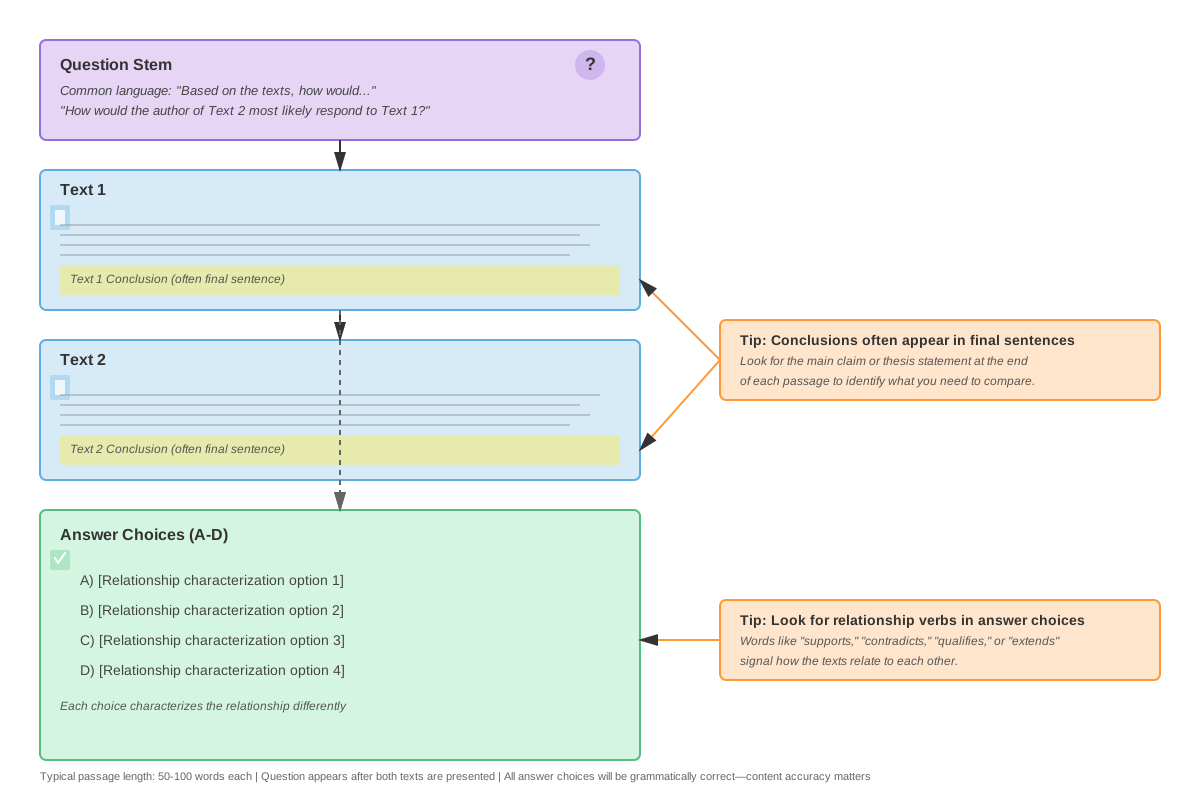
On the SAT, comparing conclusions questions appear with high frequency—typically 2-4 questions per test administration in the Reading and Writing section. These questions are classified as medium-to-high difficulty and often differentiate between students scoring in the mid-600s versus those achieving scores above 700. The question format is standardized: two labeled passages (Text 1 and Text 2) followed by a question asking how one text relates to the other, with four answer choices describing different possible relationships.
Common passage pairings include: scientific studies with contrasting findings, historical interpretations offering different perspectives, literary analyses with complementary insights, or social science research that builds upon or challenges previous work. The passages are typically 40-80 words each, making them brief enough to read quickly but dense enough to require careful analysis. Understanding this format and practicing the specific skills needed to compare conclusions efficiently can significantly boost a student's Reading and Writing score.
Core Concepts
Understanding Conclusions vs. Supporting Details
The foundation of comparing conclusions lies in accurately identifying what each passage actually concludes. A conclusion is the main claim, finding, or interpretation that the passage presents—the "so what" of the text. This differs from supporting details, which are the evidence, examples, or background information used to establish the conclusion.
Many students struggle because they confuse a passage's evidence with its conclusion. For example, if Text 1 states, "Researchers observed increased plant growth in nitrogen-rich soil. This suggests nitrogen is essential for optimal plant development," the conclusion is the interpretation about nitrogen's essentiality, not merely the observation about growth. Identifying conclusions requires asking: "What is this passage trying to prove or demonstrate?"
Types of Relationships Between Conclusions
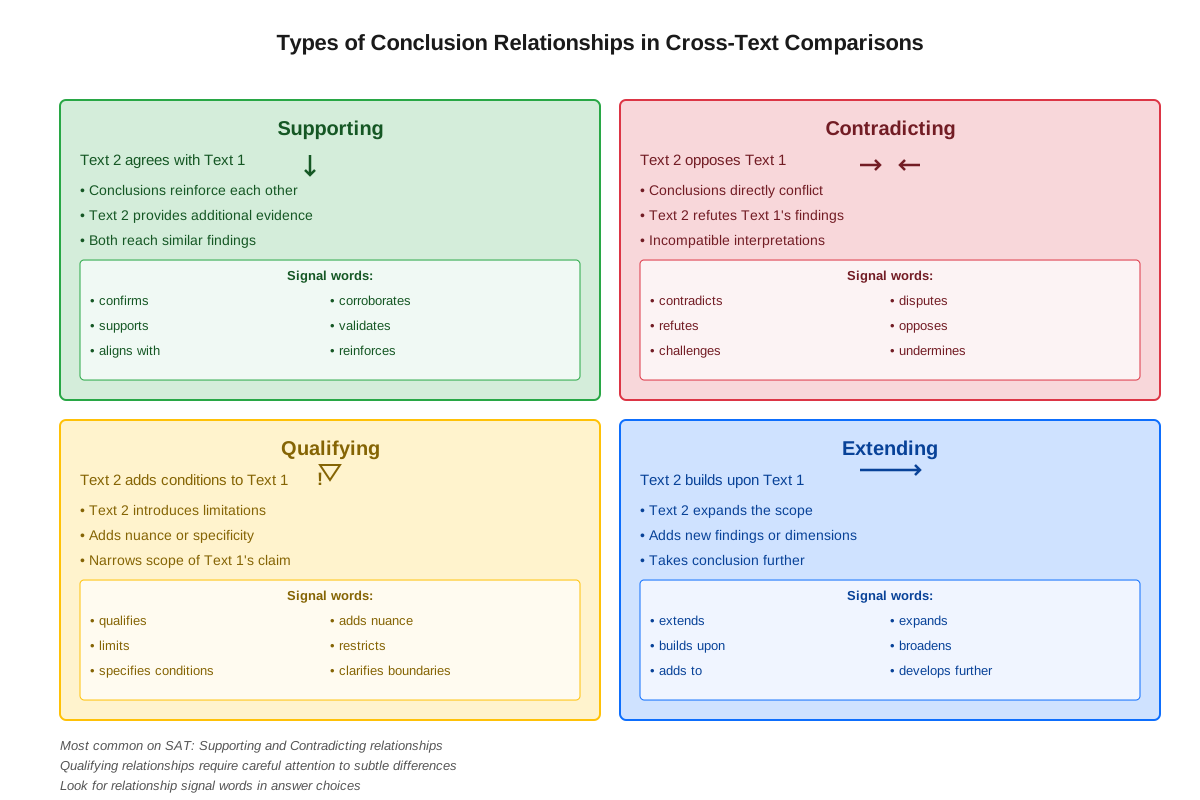
When comparing conclusions across two texts, several relationship types commonly appear on the SAT:
| Relationship Type | Description | Example Signal |
|---|---|---|
| Supporting | Text 2's conclusion reinforces or provides additional evidence for Text 1's conclusion | "Similarly," "This finding confirms," "Additional evidence shows" |
| Contradicting | Text 2's conclusion directly opposes or challenges Text 1's conclusion | "However," "In contrast," "Contradicting this view" |
| Qualifying | Text 2's conclusion adds nuance, limitations, or conditions to Text 1's conclusion | "Under certain conditions," "With the exception of," "More specifically" |
| Extending | Text 2's conclusion builds upon Text 1's conclusion by adding new dimensions or applications | "Furthermore," "Building on this," "This principle also applies to" |
Understanding these categories helps students predict answer choices and eliminate options that mischaracterize the relationship.
Analyzing Logical Structure
To compare conclusions effectively, students must analyze each passage's logical structure. This involves three steps:
- Identify the topic: What subject matter does each passage address?
- Extract the conclusion: What specific claim or finding does each passage present about this topic?
- Determine the relationship: How does the second conclusion relate to the first—does it agree, disagree, modify, or expand?
Consider this example:
Text 1: "Archaeological evidence from coastal settlements shows extensive fish consumption. This indicates that ancient populations relied heavily on marine resources."
Text 2: "Inland archaeological sites from the same period reveal primarily terrestrial animal remains. This suggests dietary patterns varied significantly based on geographic location."
The logical structure analysis reveals: Both texts address ancient diets (topic), Text 1 concludes coastal populations relied on marine resources, Text 2 concludes dietary patterns varied by location. The relationship is qualifying—Text 2 doesn't contradict Text 1 but adds geographic nuance to the broader picture of ancient diets.
Recognizing Scope and Specificity
A critical but often overlooked aspect of comparing conclusions involves recognizing differences in scope and specificity. One passage might make a broad, general claim while another focuses on a specific case or subset. The relationship between these conclusions requires careful characterization.
For instance, if Text 1 concludes "Exercise improves cardiovascular health" (broad) and Text 2 concludes "High-intensity interval training reduces blood pressure in adults over 50" (specific), Text 2 provides a specific example that supports the broader claim in Text 1. Students must recognize that Text 2 doesn't merely repeat Text 1—it offers concrete evidence for a particular type of exercise and population.
Evaluating Evidence Quality and Strength
While the primary task is comparing conclusions, understanding how evidence quality affects conclusions helps students make finer distinctions. A passage presenting preliminary findings might be characterized as "suggesting" or "indicating," while one with robust evidence might "demonstrate" or "confirm." These subtle differences in certainty level affect how conclusions relate.
When Text 1 presents tentative findings and Text 2 offers stronger evidence for a similar conclusion, the relationship might be described as Text 2 "providing stronger support for" or "confirming" the idea introduced in Text 1. Recognizing these gradations in certainty helps students select the most accurate answer choice.
Concept Relationships
The concepts within comparing conclusions form an interconnected analytical framework. Identifying conclusions serves as the foundational skill that enables all subsequent analysis—without accurately extracting what each passage concludes, comparison becomes impossible. This identification skill connects directly to understanding logical structure, as recognizing how evidence supports conclusions helps distinguish between supporting details and main claims.
Once conclusions are identified, recognizing relationship types (supporting, contradicting, qualifying, extending) provides the categorical framework for comparison. This categorization skill interacts with evaluating scope and specificity because the breadth of each conclusion affects how they relate—a specific finding might support a general principle, or a qualified claim might add nuance to an absolute statement.
Evidence quality evaluation overlays all other concepts, influencing how confidently conclusions can be stated and therefore how they relate to each other. A tentative conclusion in Text 1 might be strengthened by robust evidence in Text 2, creating a "confirming" relationship.
The relationship map flows as follows:
Reading Comprehension → Identifying Conclusions → Analyzing Logical Structure → Recognizing Relationship Types → Evaluating Scope/Specificity → Selecting Accurate Answer Choice
This progression connects to prerequisite topics like argument structure recognition (which enables conclusion identification) and extends toward more advanced skills like evaluating multiple sources in research contexts.
High-Yield Facts
⭐ Comparing conclusions questions always present exactly two passages labeled Text 1 and Text 2, each typically 40-80 words long.
⭐ The question stem usually asks how Text 2 relates to Text 1, not the reverse, so focus on Text 2's conclusion as the active element.
⭐ The four main relationship types are: supporting, contradicting, qualifying, and extending—memorize these categories.
⭐ A conclusion is the main claim or finding, not the evidence; look for interpretive language like "suggests," "indicates," "demonstrates," or "shows that."
⭐ Wrong answer choices often confuse the direction of the relationship (Text 1 to Text 2 vs. Text 2 to Text 1) or mischaracterize the type of relationship.
- Qualifying relationships add conditions, limitations, or nuance rather than outright contradicting or supporting.
- Passages may share the same topic but reach different conclusions about different aspects of that topic—this often creates a qualifying or extending relationship.
- Supporting relationships don't require identical conclusions; Text 2 can support Text 1 by providing a specific example of a general principle.
- Contradicting relationships require direct opposition on the same specific point, not merely different focuses within a topic.
- Time-efficient students read Text 1 completely, identify its conclusion, then read Text 2 while actively thinking about how it relates to Text 1's conclusion.
Quick check — test yourself on Comparing conclusions so far.
Try Flashcards →Common Misconceptions
Misconception: If two passages discuss the same topic, their conclusions must be related in a simple supporting or contradicting way.
Correction: Passages can discuss the same broad topic while addressing different aspects, time periods, or populations, creating more nuanced relationships like qualifying or extending. The relationship depends on the specific conclusions, not just the shared topic.
Misconception: A contradicting relationship exists whenever the two passages present different information.
Correction: Contradiction requires direct opposition on the same specific claim. Passages presenting different information about different aspects of a topic (e.g., one about coastal populations, another about inland populations) typically qualify or extend rather than contradict each other.
Misconception: The longest or most detailed passage contains the conclusion.
Correction: Conclusions are often stated concisely, sometimes in a single sentence. Length indicates the amount of supporting evidence, not the presence or importance of the conclusion. Focus on interpretive statements that make claims about what the evidence means.
Misconception: Supporting relationships require Text 2 to use similar wording or examples as Text 1.
Correction: Text 2 can support Text 1's conclusion through entirely different evidence, examples, or approaches. The key is whether Text 2's conclusion reinforces the validity of Text 1's conclusion, regardless of the specific evidence used.
Misconception: The answer choice that sounds most academic or uses the most sophisticated vocabulary is correct.
Correction: SAT answer choices are evaluated on accuracy, not complexity. The correct answer precisely describes the relationship between conclusions, which may be stated simply. Overly complex answer choices are often distractors that mischaracterize the relationship.
Misconception: Students should read both passages completely before looking at the question.
Correction: While reading both passages is necessary, reading the question stem first helps focus attention on the specific relationship being asked about, making the analysis more efficient and targeted.
Worked Examples
Example 1: Supporting Relationship
Text 1: Recent studies of urban heat islands have shown that cities with extensive tree canopy coverage experience temperatures 3-5 degrees Fahrenheit lower than those with minimal vegetation. This demonstrates that urban forestry initiatives can effectively mitigate heat-related health risks in metropolitan areas.
Text 2: A five-year analysis of emergency room visits in Phoenix found that neighborhoods with tree-planting programs saw a 12% reduction in heat-related medical emergencies compared to neighborhoods without such programs. This provides concrete evidence of the health benefits associated with urban greening efforts.
Question: Based on the texts, how would the author of Text 2 most likely respond to the conclusion in Text 1?
Answer Choices:
A) By arguing that temperature reduction alone cannot explain health outcomes
B) By providing specific evidence that supports the health benefits claim
C) By suggesting that urban forestry is less effective than other interventions
D) By questioning whether the temperature differences are significant enough to matter
Step-by-step reasoning:
- Identify Text 1's conclusion: Urban forestry initiatives can effectively mitigate heat-related health risks (this is the interpretive claim, not just the temperature data).
- Identify Text 2's conclusion: Tree-planting programs provide concrete evidence of health benefits (specifically through reduced emergency room visits).
- Determine the relationship: Text 2 offers specific, measurable health outcome data (12% reduction in emergencies) that directly supports Text 1's claim about mitigating health risks. This is a supporting relationship with Text 2 providing concrete evidence for Text 1's more general claim.
- Evaluate answer choices:
- A) Incorrect—Text 2 doesn't argue against temperature as an explanation; it provides health data consistent with that explanation
- B) Correct—Text 2 provides specific evidence (emergency room data) supporting the health benefits claim in Text 1
- C) Incorrect—Text 2 doesn't compare urban forestry to other interventions
- D) Incorrect—Text 2 affirms significance through measurable health improvements
Connection to learning objectives: This example demonstrates identifying conclusions (both texts make claims about health benefits), recognizing relationship types (supporting), and applying elimination strategies (removing choices that mischaracterize the relationship).
Example 2: Qualifying Relationship
Text 1: Linguistic research has established that children who grow up bilingual demonstrate enhanced cognitive flexibility and problem-solving abilities compared to monolingual peers. These findings suggest that bilingualism provides significant cognitive advantages throughout life.
Text 2: A longitudinal study tracking bilingual and monolingual adults found that cognitive advantages associated with bilingualism were most pronounced in individuals who actively used both languages daily. Participants who learned a second language in childhood but rarely used it as adults showed cognitive profiles similar to monolingual participants.
Question: Based on the texts, how does Text 2 relate to Text 1?
Answer Choices:
A) It contradicts Text 1 by showing bilingualism provides no cognitive benefits
B) It supports Text 1 by confirming cognitive advantages in all bilingual individuals
C) It qualifies Text 1 by identifying a condition necessary for cognitive advantages to persist
D) It extends Text 1 by examining a completely different population
Step-by-step reasoning:
- Identify Text 1's conclusion: Bilingualism provides significant cognitive advantages throughout life (note the broad, unqualified claim).
- Identify Text 2's conclusion: Cognitive advantages are most pronounced when both languages are actively used; without active use, advantages diminish (this adds a condition).
- Determine the relationship: Text 2 doesn't contradict Text 1 (it doesn't say bilingualism provides no benefits) but adds an important qualification—the benefits depend on continued active use. This is a qualifying relationship.
- Evaluate answer choices:
- A) Incorrect—Text 2 acknowledges cognitive benefits exist under certain conditions
- B) Incorrect—Text 2 specifically shows benefits don't persist in all bilingual individuals (only those with active use)
- C) Correct—Text 2 adds the condition of "active daily use" as necessary for advantages to persist, qualifying Text 1's broader claim
- D) Incorrect—Text 2 examines the same population (bilinguals) but at a different life stage and with attention to usage patterns
Connection to learning objectives: This example illustrates recognizing qualifying relationships (adding conditions rather than contradicting), analyzing scope differences (Text 1's broad claim vs. Text 2's conditional finding), and distinguishing between similar answer choices.
Exam Strategy
Systematic Approach to Comparing Conclusions Questions
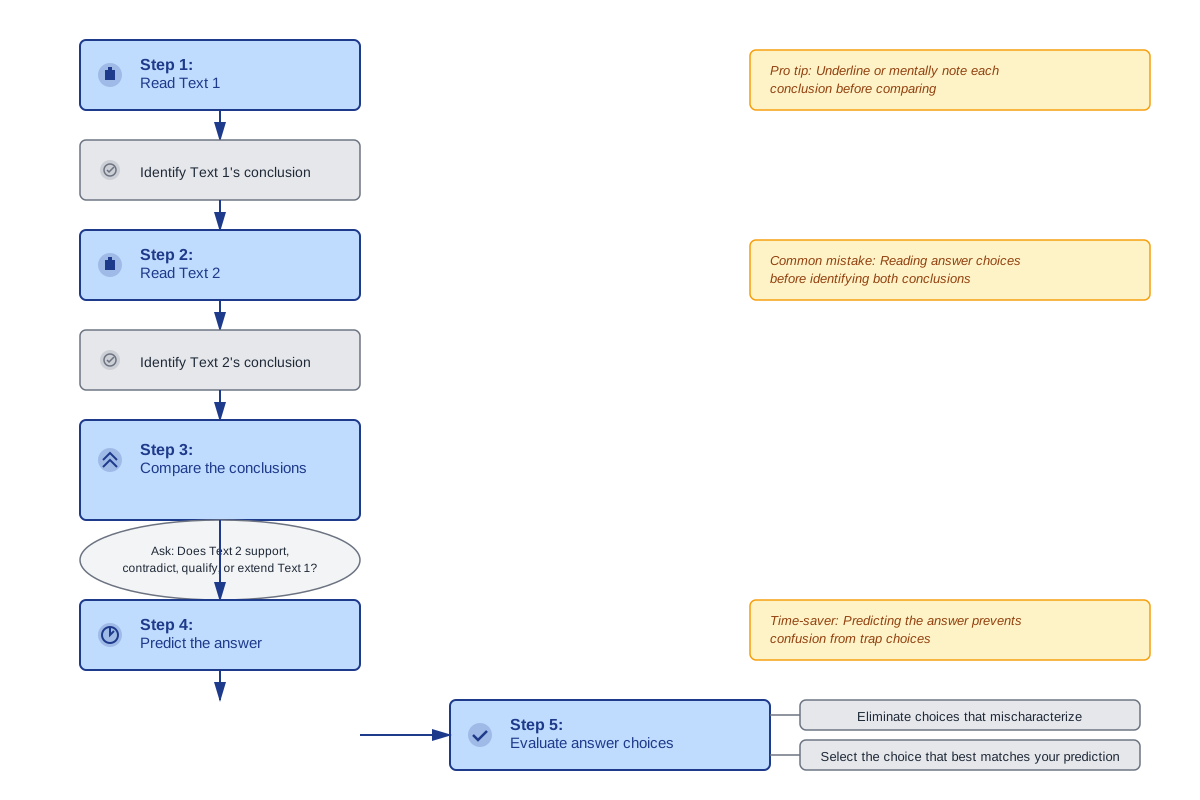
Follow this five-step process for maximum accuracy and efficiency:
- Read the question stem first to understand what relationship you're looking for
- Read Text 1 completely and identify its conclusion in your own words
- Read Text 2 completely while actively thinking about how it relates to Text 1's conclusion
- Predict the relationship type (supporting, contradicting, qualifying, extending) before looking at answer choices
- Eliminate wrong answers systematically by checking whether each accurately describes the relationship
Trigger Words and Phrases
In the passages, watch for these conclusion indicators:
- "This suggests/indicates/demonstrates that..."
- "Therefore," "Thus," "Consequently"
- "The findings show/reveal that..."
- "This evidence supports the view that..."
In answer choices, recognize these relationship descriptors:
- Supporting: "provides evidence for," "confirms," "supports," "reinforces"
- Contradicting: "challenges," "contradicts," "undermines," "disputes"
- Qualifying: "adds nuance to," "identifies a condition for," "specifies when," "limits the scope of"
- Extending: "builds upon," "applies the principle to," "expands," "takes further"
Process of Elimination Tips
Eliminate answer choices that:
- Reverse the direction of the relationship (describing how Text 1 relates to Text 2 when asked about Text 2 to Text 1)
- Overstate the relationship (claiming "complete contradiction" when there's partial disagreement)
- Understate the relationship (claiming "no connection" when there's clear relevance)
- Introduce topics or claims not present in either passage
- Confuse evidence with conclusions (describing how evidence relates rather than how conclusions relate)
Time Allocation
Spend approximately 60-75 seconds on comparing conclusions questions:
- 15 seconds: Read question stem and Text 1
- 15 seconds: Read Text 2
- 10 seconds: Identify both conclusions and predict relationship
- 20-35 seconds: Evaluate answer choices and select
If you're uncertain after 75 seconds, make your best educated guess and move on—these questions rarely yield to extended deliberation, and time is better spent on questions where additional thinking helps.
Memory Techniques
SCQE Mnemonic for Relationship Types
Remember the four main relationship types with SCQE:
- Supporting (reinforces the conclusion)
- Contradicting (opposes the conclusion)
- Qualifying (adds conditions or nuance)
- Extending (builds upon or expands)
The "Two-Sentence Summary" Technique
For each passage, mentally create a two-sentence summary:
- "This passage is about [topic]."
- "It concludes that [conclusion]."
Then compare the second sentences to determine the relationship. This forces you to distinguish topic from conclusion and makes the comparison explicit.
Visualization Strategy: The Relationship Spectrum
Visualize conclusions on a spectrum:
CONTRADICTS ←→ QUALIFIES ←→ SUPPORTS ←→ EXTENDS
(opposes)      (adds nuance)  (reinforces)  (builds upon)
When reading Text 2, mentally place its conclusion on this spectrum relative to Text 1. This spatial representation helps clarify the relationship type.
The "Same, Different, or Nuanced" Quick Check
Ask three quick questions:
- Same direction? (Both positive about the topic, or both negative?) → Likely supporting or extending
- Different direction? (One positive, one negative?) → Likely contradicting
- Same direction but with conditions? → Likely qualifying
This rapid categorization narrows answer choices immediately.
Summary
Comparing conclusions is a high-yield SAT Reading and Writing skill that requires students to analyze two brief passages and determine how their main claims relate to each other. Success depends on accurately identifying each passage's conclusion (the interpretive claim, not merely the evidence), then categorizing the relationship as supporting, contradicting, qualifying, or extending. Supporting relationships occur when Text 2 reinforces Text 1's conclusion through additional evidence or examples. Contradicting relationships involve direct opposition on the same specific claim. Qualifying relationships add conditions, limitations, or nuance without outright contradiction. Extending relationships build upon Text 1's conclusion by applying it to new contexts or adding new dimensions. The most common errors involve confusing evidence with conclusions, mischaracterizing the relationship type, or selecting answers that reverse the direction of comparison. Efficient test-takers read strategically, identify conclusions explicitly, predict the relationship before viewing answer choices, and eliminate systematically. Mastering this skill requires practice with authentic SAT-style passage pairs and deliberate attention to the precise language used in both passages and answer choices.
Key Takeaways
- Comparing conclusions questions present two labeled passages and ask how Text 2 relates to Text 1's conclusion—focus on extracting the main claim from each passage, not just understanding the topic.
- The four primary relationship types are supporting (reinforces), contradicting (opposes), qualifying (adds conditions/nuance), and extending (builds upon)—memorize these categories and their characteristics.
- Conclusions are interpretive claims about what evidence means, often signaled by words like "suggests," "demonstrates," or "indicates"—distinguish these from the supporting details and evidence.
- Wrong answers frequently reverse the relationship direction, overstate or understate the connection, or confuse different aspects of the same topic with actual contradiction.
- Efficient strategy involves reading Text 1, identifying its conclusion, reading Text 2 while actively comparing, predicting the relationship type, then eliminating wrong answers systematically.
- Qualifying relationships are particularly common and often missed—they occur when Text 2 adds conditions or specifies circumstances rather than fully supporting or contradicting Text 1.
- Time management is crucial: spend no more than 75 seconds per question, as extended deliberation rarely improves accuracy on these questions.
Related Topics
Single-Text Analysis and Main Ideas: Before comparing conclusions across texts, students must master identifying main ideas and conclusions within individual passages. This foundational skill directly enables the more complex synthesis required for comparing conclusions.
Argument Structure and Reasoning: Understanding how authors construct arguments—including claims, evidence, warrants, and counterarguments—provides the analytical framework necessary to extract conclusions and evaluate how they relate across texts.
Evidence Evaluation and Source Analysis: As students advance, they'll encounter questions requiring evaluation of evidence quality and source credibility, building on the conclusion-comparison skills by adding layers of critical analysis.
Synthesis and Research Writing: The academic skill of comparing conclusions across sources is fundamental to college-level research writing, where students must integrate multiple perspectives and findings into coherent arguments.
Practice CTA
Now that you've mastered the core concepts and strategies for comparing conclusions, it's time to apply this knowledge! Work through the practice questions to reinforce your understanding and build the speed and accuracy needed for test day. Each practice question is designed to mirror authentic SAT formats and difficulty levels. Review the flashcards to cement key terminology and relationship types in your memory. Remember: comparing conclusions is a high-frequency, high-value question type—your investment in mastering this skill will directly impact your Reading and Writing score. Approach each practice question systematically, using the five-step strategy outlined above, and track which relationship types give you the most difficulty so you can focus your review. You've got this!
Sign up free to keep reading
Create a free AnvayaPrep account to finish this SAT guide on Comparing conclusions — plus flashcards and practice questions.