Overview
Comparing evidence is a critical skill tested in the SAT Reading and Writing (RW) section, specifically within the Cross-Text Connections question type. This skill requires students to analyze two related passages and determine how the evidence, findings, or claims in one text relate to those in another. Unlike single-passage questions that test comprehension of isolated texts, comparing evidence questions assess the ability to synthesize information across multiple sources—a fundamental academic and real-world literacy skill.
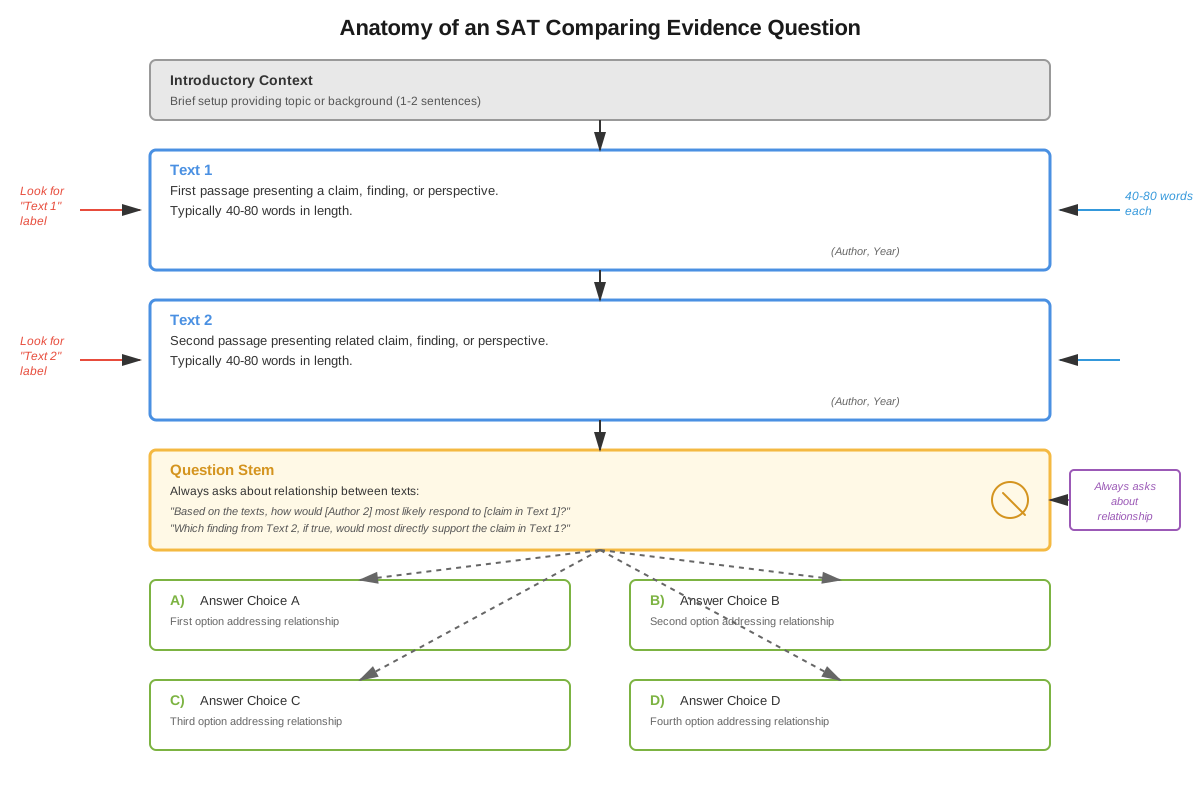
On the SAT, sat comparing evidence questions typically present two short passages (Text 1 and Text 2) that discuss related topics from different perspectives, present contrasting findings, or offer complementary information. Students must identify whether one text supports, contradicts, elaborates on, or provides context for the other. These questions appear consistently throughout the digital SAT, making them high-yield content that directly impacts scores. Mastering this topic is essential because it combines multiple reading skills: identifying main claims, recognizing supporting evidence, understanding logical relationships, and synthesizing information—all within strict time constraints.
Within the broader RW curriculum, comparing evidence builds upon foundational reading comprehension skills while preparing students for more complex analytical tasks. This topic connects directly to understanding authorial purpose, evaluating argument strength, and recognizing how different sources contribute to knowledge on a subject. Success with these questions demonstrates college-readiness in handling multiple sources, a skill central to academic research and critical thinking across all disciplines.
Learning Objectives
- [ ] Identify key features of comparing evidence questions on the SAT
- [ ] Explain how comparing evidence appears on the SAT and recognize question formats
- [ ] Apply comparing evidence strategies to answer SAT-style questions accurately
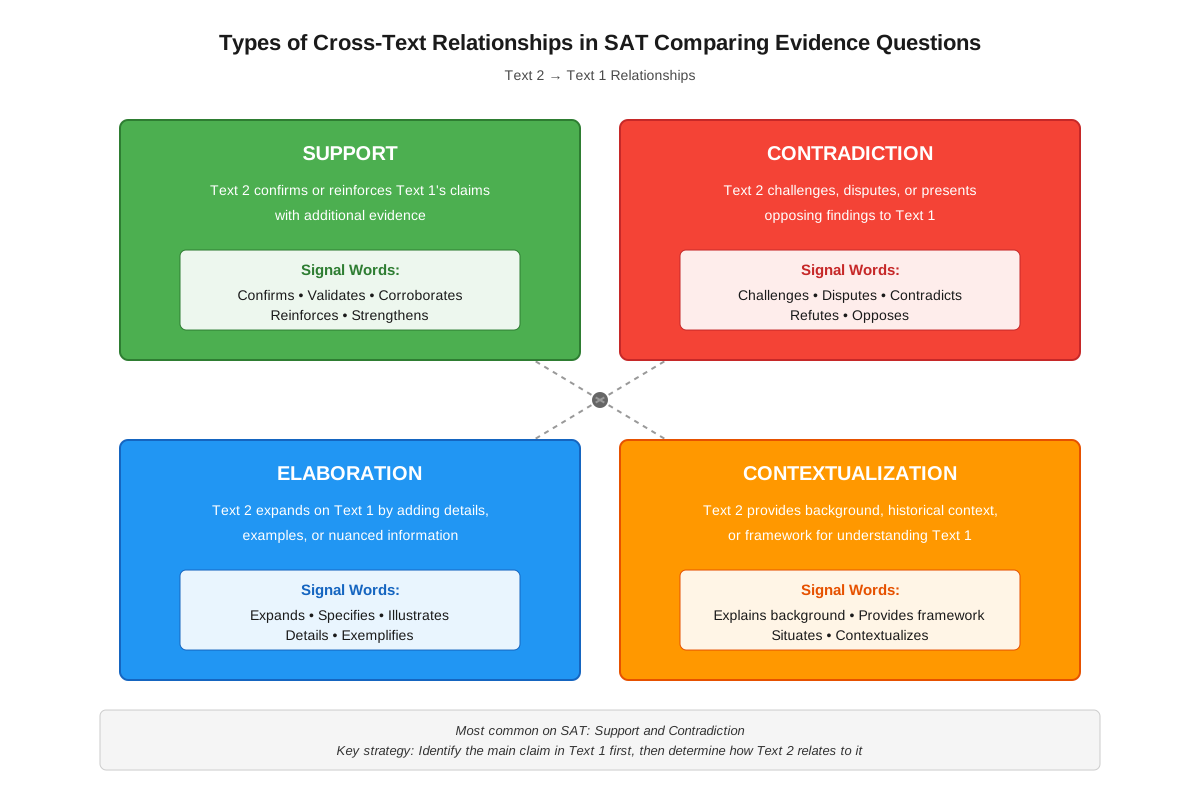
- [ ] Distinguish between different types of relationships between paired texts (support, contradiction, elaboration, contextualization)
- [ ] Evaluate the strength and relevance of evidence presented in each text
- [ ] Synthesize information from two sources to draw accurate conclusions about their relationship
Prerequisites
- Basic reading comprehension: Understanding main ideas, supporting details, and authorial claims in single passages is essential before comparing multiple texts
- Identifying evidence and claims: Distinguishing between factual evidence and interpretive claims allows students to recognize what each text contributes to a discussion
- Understanding logical relationships: Recognizing cause-effect, comparison-contrast, and other logical structures helps identify how texts relate to each other
- Vocabulary in context: Comprehending academic and domain-specific vocabulary ensures accurate interpretation of both passages
Why This Topic Matters
Comparing evidence represents a fundamental academic literacy skill that extends far beyond standardized testing. In college coursework, students regularly encounter assignments requiring synthesis of multiple sources—from literature reviews to research papers to seminar discussions. Professional contexts demand similar skills: evaluating competing research findings, reconciling different stakeholder perspectives, or integrating data from multiple reports. The ability to quickly identify how sources relate to each other is essential for informed decision-making in any field.
On the SAT specifically, comparing evidence questions appear with high frequency in the Reading and Writing section. Students can expect to encounter 3-5 cross-text connection questions per test, making this question type responsible for approximately 8-12% of the total RW score. These questions typically appear in the latter portions of each module, often testing more complex reasoning than single-passage questions. The digital SAT format presents these as discrete items, each with two short passages (typically 50-150 words each) followed by a multiple-choice question.
Common manifestations include: scientific studies with different findings on the same phenomenon, historical accounts offering different perspectives on events, literary criticism presenting contrasting interpretations, or social science research examining related aspects of a topic. The passages may come from any content domain—literature, history, science, or social studies—requiring flexible analytical skills rather than specialized content knowledge.
Core Concepts
Understanding Text Relationships
The foundation of comparing evidence lies in recognizing the four primary relationships between paired texts. Each relationship type requires different analytical approaches and appears with roughly equal frequency on the SAT.
Support/Confirmation: Text 2 provides evidence that strengthens, validates, or confirms the claims made in Text 1. This relationship often appears when Text 1 presents a hypothesis or theory, and Text 2 offers empirical data, additional examples, or corroborating findings. For instance, Text 1 might discuss the theoretical benefits of a teaching method, while Text 2 presents research data showing improved student outcomes using that method.
Contradiction/Challenge: Text 2 presents evidence or claims that conflict with, undermine, or call into question the information in Text 1. This relationship frequently appears in scientific contexts where different studies yield different results, or in historical/social contexts where different perspectives lead to different conclusions. The contradiction may be direct (opposite findings) or indirect (evidence that weakens the logical foundation of Text 1's claims).
Elaboration/Extension: Text 2 builds upon Text 1 by providing additional details, exploring related aspects, or extending the discussion to new contexts. Rather than simply repeating information, Text 2 adds depth or breadth to the topic. This might involve examining a different time period, exploring mechanisms behind observed phenomena, or investigating related variables.
Contextualization/Qualification: Text 2 provides background information, limitations, or conditions that help readers better understand or appropriately interpret Text 1. This relationship often involves Text 2 explaining why Text 1's findings might be limited to specific circumstances, providing historical context that illuminates Text 1's significance, or identifying factors that influence Text 1's conclusions.
Identifying Evidence vs. Claims
A crucial distinction in comparing evidence questions involves separating evidence (factual observations, data, examples) from claims (interpretations, conclusions, arguments). Text 1 typically presents a claim or finding, while the question asks how Text 2's evidence relates to that claim.
Evidence includes: empirical data from studies, specific examples or cases, direct observations, measurements, quotations from primary sources, and documented facts. Claims include: interpretations of data, theoretical explanations, predictions, generalizations from specific cases, and argumentative positions. Recognizing this distinction helps students identify what each text contributes and how they interact.
Analyzing Question Stems
SAT comparing evidence questions follow predictable patterns in their wording. Common question stems include:
- "Based on the texts, how would the author of Text 2 most likely respond to the claim in Text 1?"
- "Which finding from Text 2, if true, would most directly support/challenge the hypothesis in Text 1?"
- "Text 2 provides the most support for which claim from Text 1?"
- "How does the information in Text 2 relate to the discussion in Text 1?"
Each stem type signals a specific analytical task. "Respond to" questions require understanding authorial perspective and predicting reactions. "Support/challenge" questions demand identifying logical relationships between evidence and claims. "Relate to" questions assess broader understanding of how texts connect thematically or argumentatively.
The Comparison Process
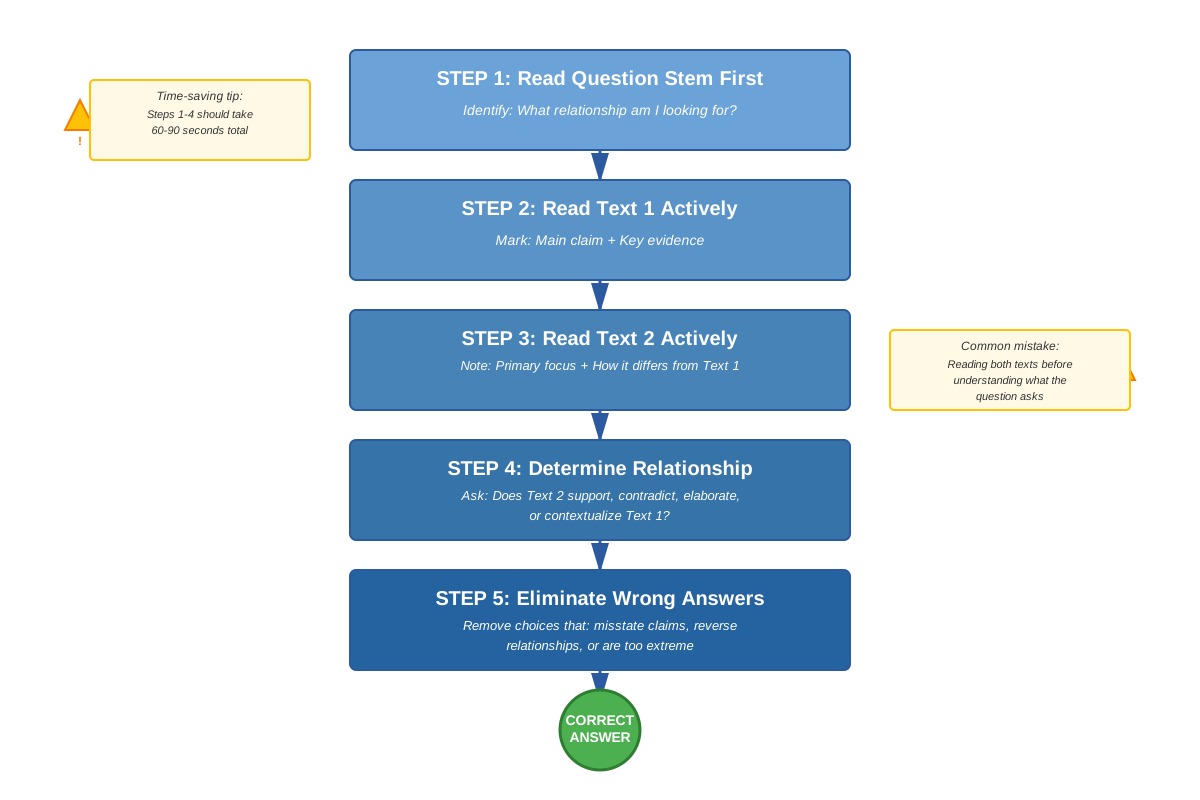
Effective comparison follows a systematic approach:
- Read Text 1 actively: Identify the main claim, key evidence, and authorial purpose
- Anticipate relationships: Before reading Text 2, consider what would support, challenge, or extend Text 1
- Read Text 2 strategically: Focus on how its content relates to Text 1's main points
- Identify the relationship type: Determine whether Text 2 supports, contradicts, elaborates, or contextualizes
- Match to answer choices: Eliminate options that mischaracterize the relationship or misrepresent either text
| Relationship Type | Text 1 Content | Text 2 Content | Key Indicators |
|---|---|---|---|
| Support | Claim or hypothesis | Confirming evidence or examples | "consistent with," "validates," "confirms" |
| Contradiction | Finding or position | Conflicting evidence or alternative explanation | "challenges," "undermines," "contradicts" |
| Elaboration | General discussion | Specific details or related aspects | "provides additional," "explores further," "examines" |
| Contextualization | Specific finding | Background or limiting factors | "explains why," "provides context," "qualifies" |
Common Content Domains
While comparing evidence questions can draw from any subject area, certain domains appear frequently:
Scientific research: Paired studies on the same phenomenon with different methodologies or findings; theoretical predictions versus experimental results; laboratory findings versus field observations.
Historical analysis: Different historians' interpretations of events; primary sources versus secondary analysis; accounts from different time periods or perspectives.
Literary criticism: Contrasting interpretations of texts; different critical approaches to the same work; author's stated intentions versus critical reception.
Social science: Studies examining related variables; different populations or contexts; quantitative versus qualitative approaches to the same question.
Concept Relationships
The concepts within comparing evidence form an interconnected analytical framework. Understanding text relationships (support, contradiction, elaboration, contextualization) depends on accurately identifying evidence versus claims in each passage. This distinction enables students to determine what each text asserts and what it proves, which is essential for recognizing how they interact.
The comparison process integrates all other concepts: it requires recognizing relationship types, distinguishing evidence from claims, and interpreting question stems correctly. Each step in the process builds on the previous one—active reading of Text 1 creates a framework for understanding Text 2, anticipating relationships focuses attention on relevant information, and strategic reading of Text 2 enables accurate relationship identification.
Question stem analysis connects directly to relationship types because different stems signal different analytical tasks. A "support" question directs attention to confirming relationships, while a "respond to" question requires understanding both texts' perspectives and predicting how they would interact.
Content domain knowledge influences but doesn't determine success. While familiarity with scientific method helps interpret research studies, the SAT tests analytical skills rather than content expertise. Understanding how historians use evidence differs from understanding specific historical events—the former is testable, the latter is assumed background.
Relationship map: Active Reading of Text 1 → Anticipation of Possible Relationships → Strategic Reading of Text 2 → Identification of Relationship Type → Analysis of Question Stem → Elimination of Incorrect Answers → Selection of Best Answer
This progression shows how comparing evidence integrates multiple reading skills into a cohesive analytical process, with each step enabling the next.
High-Yield Facts
⭐ Comparing evidence questions always present exactly two texts that discuss related topics, with Text 2's relationship to Text 1 being the focus of the question.
⭐ The four primary relationship types are support, contradiction, elaboration, and contextualization—recognizing which applies is essential for correct answers.
⭐ Text 1 typically presents a claim, hypothesis, or finding, while Text 2 provides evidence, examples, or alternative perspectives that relate to Text 1.
⭐ Question stems use predictable language such as "support," "challenge," "respond to," and "relate to" that signals the type of relationship being tested.
⭐ Correct answers must accurately represent both texts—options that mischaracterize either passage are always incorrect, even if they correctly describe the relationship type.
- Evidence includes data, observations, and examples, while claims include interpretations, conclusions, and arguments—distinguishing these is crucial for analysis.
- The relationship between texts may be explicit (directly stated) or implicit (requiring inference from the evidence presented).
- Time management is critical: spending too long on Text 1 leaves insufficient time for Text 2 and the comparison process.
- Wrong answers often present plausible relationships that aren't supported by the actual text content or reverse the direction of the relationship.
- Scientific passages frequently test whether Text 2's findings support or challenge Text 1's hypothesis, making this the most common question type in science domains.
- Historical and literary passages often test elaboration and contextualization relationships more than support/contradiction.
- The correct answer will always be defensible by pointing to specific evidence in both texts—if you can't identify supporting text, reconsider your choice.
- Comparing evidence questions typically appear in the latter half of each RW module, after single-passage questions.
- These questions test synthesis skills that are fundamental to college-level academic work across all disciplines.
- Strong performance on comparing evidence questions correlates with higher overall RW scores because they test multiple reading skills simultaneously.
Quick check — test yourself on Comparing evidence so far.
Try Flashcards →Common Misconceptions
Misconception: Text 2 always disagrees with or contradicts Text 1 because they're presenting different information.
Correction: Texts can relate in multiple ways—support, elaboration, and contextualization are just as common as contradiction. Different information doesn't necessarily mean conflicting information; it may provide complementary perspectives or additional details.
Misconception: The correct answer must use the exact same words or phrases that appear in the passages.
Correction: Correct answers typically paraphrase passage content rather than quoting directly. Students must recognize when answer choices accurately represent passage ideas even when using different vocabulary.
Misconception: Longer, more detailed answer choices are more likely to be correct because they seem more thorough.
Correction: Answer length has no correlation with correctness. Wrong answers often include extra details to seem more comprehensive while actually misrepresenting the text relationship. Focus on accuracy, not length.
Misconception: Personal knowledge about the topic should influence answer selection when passages seem incomplete or unclear.
Correction: All comparing evidence questions are answerable based solely on passage content. Outside knowledge may actually lead to incorrect answers by introducing information not present in the texts. If an answer requires assuming facts not in the passages, it's wrong.
Misconception: If Text 2 doesn't explicitly mention Text 1's main claim, they must not be related.
Correction: Relationships are often implicit. Text 2 may provide evidence relevant to Text 1's claim without directly referencing it. The question asks students to recognize these implicit connections by analyzing how the evidence relates logically.
Misconception: "Respond to" questions require identifying emotional reactions or personal opinions.
Correction: "Respond to" in SAT context means "how would the author address or react to based on their text's evidence and perspective," not emotional responses. The answer should reflect what Text 2's content logically implies about Text 1's claims.
Misconception: Both texts must be equally important, so correct answers should reference both equally.
Correction: Questions typically focus on how Text 2 relates to Text 1, making Text 2's content more central to the answer. Correct answers may emphasize Text 2's contribution while only briefly referencing Text 1's claim.
Worked Examples
Example 1: Scientific Research Comparison
Text 1
Researchers have hypothesized that exposure to natural environments reduces stress levels in urban populations. The theory suggests that visual contact with green spaces triggers physiological relaxation responses, lowering cortisol production and heart rate. This "biophilia hypothesis" has influenced urban planning initiatives worldwide.
Text 2
A 2023 study monitored cortisol levels in 200 office workers over four weeks. Participants with windows overlooking parks showed 23% lower average cortisol levels than those with views of buildings or no windows. Heart rate measurements revealed similar patterns, with the park-view group averaging 8 beats per minute slower during work hours.
Question: Based on the texts, how does Text 2 relate to the hypothesis presented in Text 1?
Answer Choices:
A) It challenges the hypothesis by showing that urban workers experience high stress regardless of environmental exposure.
B) It provides supporting evidence by demonstrating physiological changes consistent with the hypothesis's predictions.
C) It elaborates on the hypothesis by explaining the biological mechanisms behind stress reduction.
D) It contextualizes the hypothesis by identifying limitations in how natural environments affect different populations.
Solution Process:
Step 1: Identify Text 1's main claim. The hypothesis states that natural environment exposure reduces stress through physiological mechanisms (lower cortisol, reduced heart rate).
Step 2: Identify Text 2's evidence. The study found lower cortisol (23% reduction) and lower heart rate (8 bpm slower) in workers with park views—exactly the physiological changes Text 1 predicted.
Step 3: Determine the relationship type. Text 2 provides empirical data that confirms Text 1's theoretical predictions. This is a support relationship.
Step 4: Eliminate incorrect answers.
- Choice A is wrong because Text 2 shows stress differences based on environmental exposure, not uniform high stress.
- Choice C is wrong because Text 2 doesn't explain mechanisms; it provides outcome data.
- Choice D is wrong because Text 2 doesn't identify limitations; it confirms the hypothesis in one population.
Step 5: Confirm the correct answer. Choice B accurately describes the relationship: Text 2 provides supporting evidence (the study data) that demonstrates physiological changes (cortisol and heart rate reductions) consistent with Text 1's predictions.
Correct Answer: B
Connection to Learning Objectives: This example demonstrates identifying the support relationship type, distinguishing between theoretical claims (Text 1) and empirical evidence (Text 2), and applying the comparison process to select the answer that accurately represents both texts.
Example 2: Historical Perspective Comparison
Text 1
Historian Maria Gonzalez argues that the 1920s Harlem Renaissance represented primarily an artistic movement, with writers, musicians, and visual artists creating works that celebrated African American culture. She emphasizes the literary output of figures like Langston Hughes and Zora Neale Hurston as the movement's defining achievements.
Text 2
Recent scholarship has examined the Harlem Renaissance's political dimensions, revealing extensive connections between artists and civil rights organizations. Many prominent Renaissance figures actively participated in NAACP campaigns, used their platforms to advocate for anti-lynching legislation, and deliberately crafted works intended to challenge racial stereotypes and advance social justice goals.
Question: Based on the texts, how would the author of Text 2 most likely respond to Gonzalez's characterization in Text 1?
Answer Choices:
A) By agreeing that artistic achievement was the movement's sole focus and political activism was incidental.
B) By suggesting that Gonzalez's emphasis on artistic output overlooks the movement's significant political dimensions.
C) By contradicting Gonzalez entirely and arguing the movement had no artistic merit.
D) By providing additional examples of literary figures to support Gonzalez's artistic focus.
Solution Process:
Step 1: Identify Text 1's position. Gonzalez characterizes the Harlem Renaissance as "primarily an artistic movement" focused on cultural celebration through creative works.
Step 2: Identify Text 2's perspective. Text 2 emphasizes political dimensions, civil rights connections, and social justice goals—aspects not mentioned in Gonzalez's characterization.
Step 3: Determine the relationship. Text 2 doesn't completely contradict Text 1 (it doesn't deny artistic achievement) but reveals additional dimensions that Gonzalez's "primarily artistic" characterization misses. This is a qualification/contextualization relationship that suggests Gonzalez's view is incomplete.
Step 4: Eliminate incorrect answers.
- Choice A contradicts Text 2's entire argument about political dimensions.
- Choice C overstates the disagreement; Text 2 doesn't deny artistic merit, just adds political context.
- Choice D misrepresents Text 2's purpose; it's not supporting Gonzalez's artistic focus but broadening the discussion.
Step 5: Confirm the correct answer. Choice B accurately captures how Text 2 would respond: acknowledging Gonzalez's focus while suggesting it "overlooks" important political dimensions that Text 2 reveals.
Correct Answer: B
Connection to Learning Objectives: This example demonstrates the elaboration/qualification relationship, shows how to predict authorial responses based on text content, and illustrates how texts can relate without complete agreement or disagreement.
Exam Strategy
Approaching Comparing Evidence Questions
Read strategically, not exhaustively. With limited time per question, avoid getting lost in details. Focus on identifying each text's main claim or finding first, then note key supporting evidence. The question will direct attention to what matters most.
Use Text 1 to predict Text 2's role. After reading Text 1, pause briefly to consider: "What would support this? What would challenge it? What additional information would be relevant?" This anticipation focuses reading of Text 2 and speeds relationship identification.
Watch for relationship trigger words in both passages and answer choices:
- Support indicators: "consistent with," "confirms," "validates," "demonstrates," "as predicted," "similarly"
- Contradiction indicators: "however," "in contrast," "challenges," "undermines," "different findings," "alternatively"
- Elaboration indicators: "additionally," "furthermore," "specifically," "for example," "in particular," "examining"
- Contextualization indicators: "explains why," "under certain conditions," "limited to," "depends on," "influenced by"
Apply the "both texts" test. Before selecting an answer, verify it accurately represents both passages. Ask: "Does this correctly describe Text 1's claim? Does this correctly describe Text 2's evidence? Does this correctly describe their relationship?" If any answer is no, eliminate that choice.
Eliminate answers that reverse the relationship. Wrong answers often flip the direction, suggesting Text 1 supports Text 2 when the question asks how Text 2 relates to Text 1. Pay careful attention to which text the question focuses on.
Beware of extreme language. Words like "proves," "completely contradicts," "only," or "entirely" in answer choices often signal incorrect options. SAT passages typically present nuanced relationships, and correct answers reflect this nuance.
Time allocation: Spend approximately 1 minute total on comparing evidence questions—30 seconds on Text 1, 20 seconds on Text 2, and 10 seconds on answer selection. If a question exceeds 90 seconds, make your best choice and move forward.
Process of Elimination Specific to This Topic
- Eliminate answers that misrepresent either text's content, even if they correctly name a relationship type
- Eliminate answers that describe relationships not supported by the actual evidence presented
- Eliminate answers that require outside knowledge or assumptions beyond what the passages state
- Eliminate answers that use trigger words inconsistent with the actual relationship (e.g., "challenges" when texts actually agree)
- Among remaining choices, select the one that most precisely describes the specific relationship between the texts' main points
Memory Techniques
The SCEC Framework
Remember the four relationship types with SCEC (pronounced "check"):
- Support: Text 2 confirms Text 1
- Contradict: Text 2 challenges Text 1
- Elaborate: Text 2 extends Text 1
- Contextualize: Text 2 qualifies Text 1
Visualize checking a paper: you might confirm information (support), find errors (contradict), add details (elaborate), or note limitations (contextualize).
The Two-Text Tango
Visualize comparing evidence as a dance between two partners (the texts). Ask: "Are they moving together (support)? Moving apart (contradict)? Is one leading the other somewhere new (elaborate)? Is one helping the other find their footing (contextualize)?"
Question Stem Keywords
Create a mental trigger list:
- "Support" or "consistent with" → Look for confirming evidence
- "Challenge" or "undermine" → Look for conflicting evidence
- "Respond to" → Consider Text 2's perspective on Text 1's claim
- "Relate to" → Identify the general relationship type
The Evidence-Claim Split
Remember: Evidence = Empirical (data, observations, examples)
Claims = Conclusions (interpretations, arguments, theories)
When comparing texts, identify which provides evidence and which makes claims—this often reveals their relationship.
Summary
Comparing evidence is a high-yield SAT skill that tests the ability to synthesize information across two related passages. Success requires identifying four primary relationship types—support, contradiction, elaboration, and contextualization—and recognizing which applies to each question. The systematic comparison process involves actively reading Text 1 to identify its main claim, anticipating possible relationships, strategically reading Text 2 to determine how its evidence relates, and selecting answers that accurately represent both texts. Critical distinctions include separating evidence from claims, recognizing implicit versus explicit relationships, and understanding that different information doesn't necessarily mean conflicting information. Question stems use predictable trigger words that signal the type of relationship being tested, and correct answers must be defensible by pointing to specific content in both passages. These questions appear frequently on the SAT (3-5 per test), making them essential for score optimization. Mastery requires practice with the systematic approach, attention to relationship indicators, and disciplined elimination of answers that misrepresent either text or their connection.
Key Takeaways
- Comparing evidence questions present two related texts and ask how Text 2's content relates to Text 1's claims, testing synthesis skills essential for college-level work
- Four relationship types dominate: support (confirming), contradiction (challenging), elaboration (extending), and contextualization (qualifying)—recognizing which applies is the key analytical task
- Systematic process ensures accuracy: actively read Text 1, anticipate relationships, strategically read Text 2, identify the relationship type, and verify answers represent both texts correctly
- Distinguish evidence from claims to understand what each text contributes and how they interact logically
- Question stems use trigger words like "support," "challenge," "respond to," and "relate to" that signal the expected relationship type
- Correct answers must accurately represent both passages—any mischaracterization of either text makes an answer wrong regardless of other factors
- Time management is critical: allocate approximately 1 minute per question, focusing on main claims rather than minor details
Related Topics
Single-Text Evidence Questions: Understanding how to identify and evaluate evidence within individual passages provides the foundation for comparing evidence across texts. Mastering single-text analysis makes cross-text comparison more efficient.
Authorial Purpose and Perspective: Recognizing why authors present certain information and from what viewpoint helps predict how different texts on the same topic might relate, especially in "respond to" questions.
Argument Analysis: Understanding how claims and evidence function within arguments enables more sophisticated comparison of how different texts build or challenge positions on shared topics.
Synthesis Writing: The analytical skills developed through comparing evidence questions directly support synthesis essay writing, where students must integrate multiple sources into coherent arguments.
Research Literacy: Beyond the SAT, comparing evidence skills are fundamental to evaluating academic sources, conducting literature reviews, and making informed decisions based on multiple information sources.
Practice CTA
Now that you've mastered the core concepts of comparing evidence, it's time to apply these strategies to authentic SAT-style questions. The practice questions and flashcards will reinforce your ability to quickly identify relationship types, distinguish evidence from claims, and select answers that accurately represent both texts. Each practice attempt strengthens the neural pathways that enable rapid, accurate analysis under test conditions. Remember: comparing evidence questions are high-yield opportunities to demonstrate college-ready analytical skills—approach them with confidence using your systematic process, and watch your Reading and Writing scores improve. You've got this!
Sign up free to keep reading
Create a free AnvayaPrep account to finish this SAT guide on Comparing evidence — plus flashcards and practice questions.