Overview
Cross-text author attitude questions represent one of the most sophisticated question types in the SAT Reading and Writing (RW) section. These questions require students to analyze and compare the perspectives, tones, and viewpoints of two different authors writing about related subjects. Unlike single-passage questions that focus on comprehension within one text, cross-text author attitude questions demand that students identify subtle differences in how authors approach their topics, whether they agree or disagree, and what underlying assumptions or biases shape their writing.
The SAT frequently tests this skill because it mirrors real-world critical thinking: evaluating multiple sources, recognizing bias, and synthesizing different perspectives. Students must move beyond simple comprehension to engage in comparative analysis, distinguishing between an author's explicit claims and their implicit attitudes. This skill is foundational for college-level research and academic discourse, where students regularly encounter competing viewpoints and must assess the credibility and perspective of various sources.
Within the broader SAT cross-text author attitude framework, this topic connects directly to other Reading and Writing concepts including tone analysis, rhetorical purpose, and evidence evaluation. Mastering cross-text comparisons strengthens overall reading comprehension by training students to read actively and critically, always asking not just "what does this author say?" but "how does this author feel about what they're saying, and how does that compare to other perspectives?" This analytical approach is essential for achieving top scores in the RW section.
Learning Objectives
- [ ] Identify key features of cross-text author attitude
- [ ] Explain how cross-text author attitude appears on the SAT
- [ ] Apply cross-text author attitude to answer SAT-style questions
- [ ] Distinguish between explicit statements and implicit attitudes in paired passages
- [ ] Recognize common patterns of agreement and disagreement between authors
- [ ] Evaluate the strength and nature of authorial tone across multiple texts
- [ ] Synthesize information from two texts to draw accurate conclusions about comparative perspectives
Prerequisites
- Basic tone and mood identification: Understanding how word choice reveals an author's feelings is essential before comparing attitudes across texts
- Reading comprehension fundamentals: Students must accurately understand individual passages before attempting cross-text comparisons
- Vocabulary knowledge: Recognizing nuanced attitude words (skeptical, enthusiastic, ambivalent) is necessary for identifying subtle differences in perspective
- Understanding of rhetorical purpose: Knowing why authors write (to persuade, inform, critique) helps identify their underlying attitudes
Why This Topic Matters
Cross-text author attitude questions appear with high frequency on the SAT, typically comprising 2-4 questions per test administration. These questions carry significant weight because they assess higher-order thinking skills that colleges value: synthesis, comparison, and critical analysis. Students who master this skill demonstrate readiness for college-level academic work where evaluating multiple sources is routine.
In real-world applications, the ability to compare author attitudes is crucial for informed citizenship and professional success. Whether evaluating news articles with different political leanings, comparing product reviews, or analyzing competing scientific studies, the skill of identifying and comparing authorial perspective enables better decision-making. Students who excel at recognizing author attitude can more effectively navigate the information-rich modern world, distinguishing between objective reporting and opinion-driven content.
On the SAT, cross-text author attitude questions most commonly appear in formats where students must identify how Author 2 would respond to Author 1's claim, determine whether authors agree or disagree on a specific point, or characterize the relationship between two perspectives. These questions often use paired short passages (50-150 words each) from different time periods, disciplines, or viewpoints. The passages might present scientific findings, historical interpretations, literary criticism, or social commentary. The key challenge is that the SAT rarely presents obvious, direct disagreements; instead, the test favors subtle differences in emphasis, tone, or underlying assumptions.
Core Concepts
Understanding Author Attitude
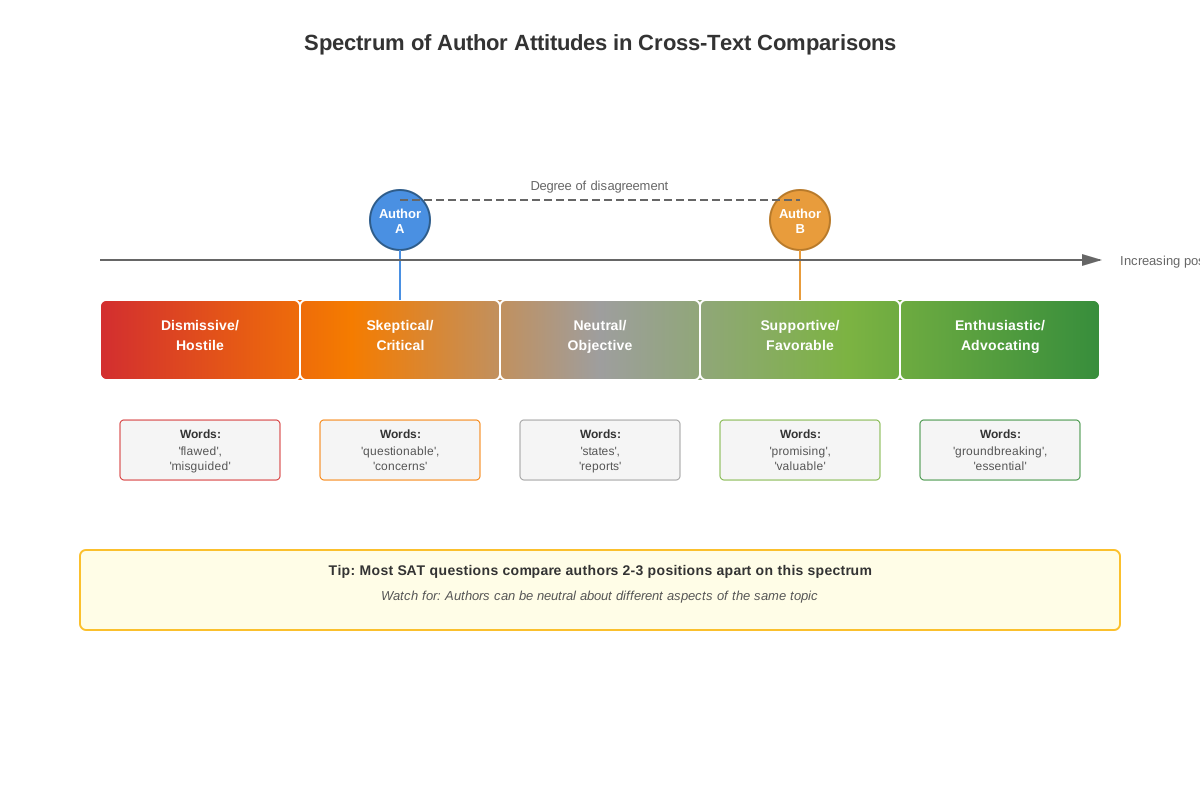
Author attitude refers to the writer's feelings, opinions, and perspective toward their subject matter. This attitude manifests through word choice (diction), sentence structure, evidence selection, and rhetorical strategies. In cross-text questions, students must identify not just what each author says, but how they feel about what they're discussing. An author might be enthusiastic, skeptical, cautious, dismissive, neutral, or conflicted. The SAT tests whether students can detect these nuances and compare them accurately.
Attitude differs from the author's explicit argument. An author might argue that "renewable energy is growing" (explicit claim) while conveying skepticism about its effectiveness through phrases like "despite optimistic projections" or "limited practical applications" (implicit attitude). Recognizing this distinction is crucial for cross-text comparisons.
Types of Cross-Text Relationships
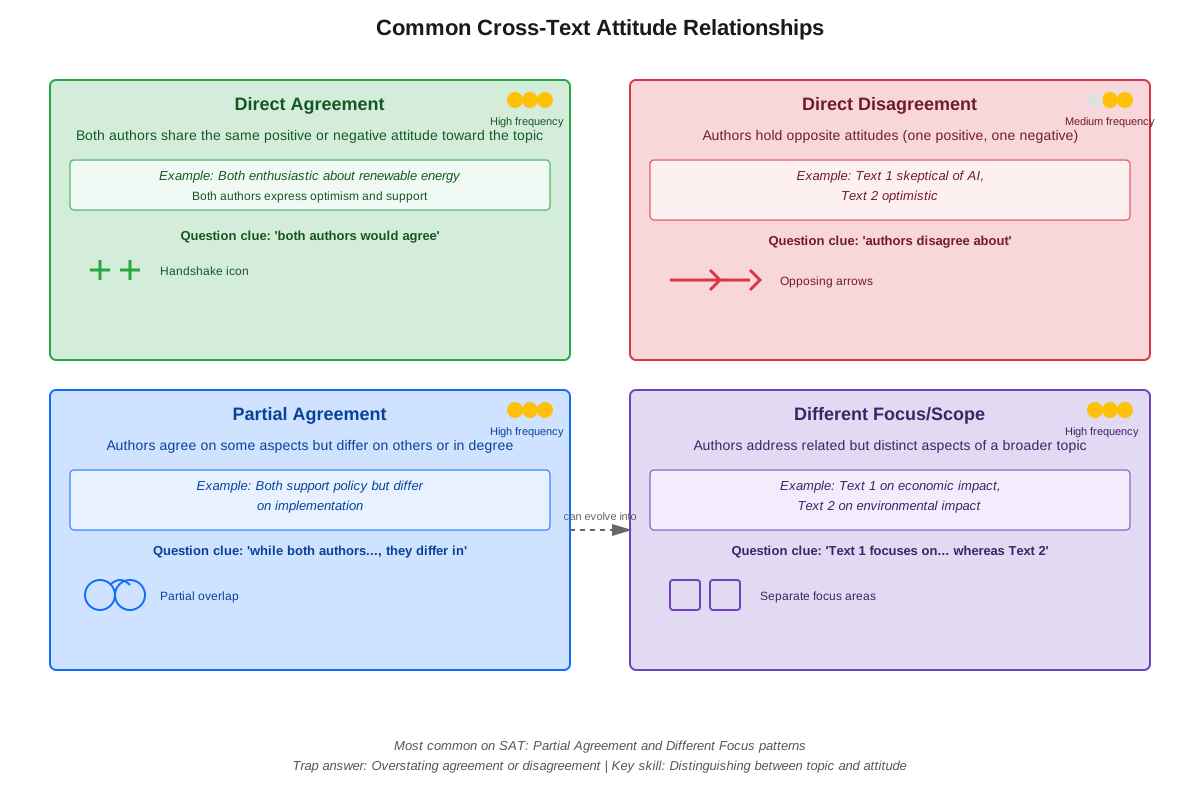
When comparing author attitudes, several relationship patterns emerge frequently on the SAT:
| Relationship Type | Description | Key Indicators |
|---|---|---|
| Direct Agreement | Both authors support the same position with similar enthusiasm | Parallel positive/negative language, similar evidence types |
| Direct Disagreement | Authors take opposing stances on the same issue | Contrasting claims, contradictory evidence, opposing conclusions |
| Qualified Agreement | Authors agree on main point but differ in degree or scope | Words like "however," "although," "limited," "primarily" |
| Different Focus | Authors discuss related topics but emphasize different aspects | Different subject emphasis despite topical overlap |
| Methodological Difference | Authors agree on conclusions but differ in approach or evidence | Different types of evidence, contrasting methodologies |
Identifying Implicit vs. Explicit Attitude
The SAT frequently tests whether students can distinguish between what an author directly states and what their word choice implies. Explicit attitude appears in direct statements: "This theory is flawed" or "The results are promising." Implicit attitude emerges through subtler linguistic choices: describing a theory as "popular among some researchers" (suggesting limited acceptance) or results as "preliminary findings" (suggesting caution).
Common implicit attitude markers include:
- Hedging language: "may," "might," "could suggest," "appears to"
- Intensifiers: "clearly," "undoubtedly," "certainly," "obviously"
- Qualifying phrases: "despite," "although," "while acknowledging"
- Evaluative adjectives: "remarkable," "questionable," "significant," "trivial"
Tone Analysis in Cross-Text Contexts
Tone represents the emotional quality of the author's attitude. In cross-text questions, students must compare tones accurately. The SAT commonly tests these tone distinctions:
Enthusiastic vs. Measured: One author might celebrate a discovery with words like "breakthrough" and "revolutionary," while another describes the same development as "noteworthy" or "an incremental advance."
Skeptical vs. Accepting: One author might question claims using phrases like "allegedly," "purportedly," or "so-called," while another presents the same information as established fact.
Urgent vs. Detached: One author might use imperative language and emotional appeals, while another maintains academic distance and neutral description.
Comparative Analysis Strategies
When approaching cross-text author attitude questions, students should employ systematic comparison:
- Read Text 1 actively: Identify the author's main claim and note attitude markers (word choice, tone, qualifiers)
- Predict the relationship: Before reading Text 2, consider possible relationships (agreement, disagreement, different focus)
- Read Text 2 with comparison in mind: Actively look for points of convergence and divergence
- Map specific points of comparison: Identify whether authors discuss the same aspects or different facets of the topic
- Evaluate degree of difference: Determine if differences are fundamental or matters of emphasis
Common Question Formats
The SAT presents cross-text author attitude questions in predictable formats:
"Based on the texts, how would Author 2 most likely respond to the claim in Text 1 that [specific claim]?" This format requires students to understand both the specific claim and Author 2's overall perspective, then infer how that perspective would apply to the claim.
"Which statement best describes the relationship between the two texts?" This format tests whether students can accurately characterize the overall relationship (agreement, disagreement, complementary focus, etc.).
"Both authors would most likely agree with which statement?" This format requires identifying common ground even when authors emphasize different aspects or reach different conclusions.
Concept Relationships
The concepts within cross-text author attitude analysis build upon each other hierarchically. Understanding individual author attitude forms the foundation—students must first identify tone and perspective in a single text before comparing across texts. This skill leads to recognizing relationship types, which enables students to categorize how authors relate to each other. The ability to distinguish implicit from explicit attitude operates throughout this process, refining both individual and comparative analysis.
These concepts connect directly to prerequisite knowledge of tone identification and rhetorical purpose. The skill of identifying author attitude in a single passage (prerequisite) expands into comparing attitudes across passages (current topic). This comparison skill then enables more advanced analysis of argumentative strategies and evidence evaluation in longer passages.
The relationship map flows as follows:
Basic Tone Recognition → Individual Author Attitude Analysis → Identifying Relationship Types → Distinguishing Implicit/Explicit Markers → Comparative Synthesis → Accurate Question Response
Cross-text author attitude also connects laterally to other RW skills: understanding rhetorical purpose helps predict attitude, vocabulary knowledge enables recognition of subtle tone markers, and evidence evaluation skills help students identify what information authors emphasize or downplay, revealing their perspectives.
High-Yield Facts
⭐ Cross-text author attitude questions always require understanding both passages individually before comparing them
⭐ The SAT rarely presents obvious, direct disagreements; most questions test subtle differences in emphasis, tone, or degree
⭐ Implicit attitude markers (hedging language, qualifiers, intensifiers) are more commonly tested than explicit statements of opinion
⭐ Authors can agree on facts while disagreeing on interpretation, significance, or implications
⭐ The most common wrong answers mischaracterize the degree of agreement or disagreement (too strong or too weak)
- Word choice revealing attitude is more reliable than sentence structure or passage organization
- Authors discussing different aspects of the same topic may not actually disagree, even if they reach different conclusions
- Temporal context matters: older texts paired with newer texts often show evolving perspectives on the same issue
- Questions asking "how would Author 2 respond" require inference based on Author 2's demonstrated attitude, not speculation
- Neutral or objective tone is itself an attitude that can be compared to more evaluative tones
Quick check — test yourself on Cross-text author attitude so far.
Try Flashcards →Common Misconceptions
Misconception: If two authors discuss the same topic, they must either completely agree or completely disagree.
Correction: Authors frequently occupy middle ground—agreeing on some points while disagreeing on others, or emphasizing different aspects without direct contradiction. The SAT often tests these nuanced relationships.
Misconception: The author's attitude is always explicitly stated in the passage.
Correction: Author attitude is frequently implicit, revealed through word choice, qualifiers, and tone rather than direct statements. Phrases like "merely," "actually," or "surprisingly" reveal attitude without explicit opinion statements.
Misconception: Longer passages or more complex vocabulary indicate stronger author conviction.
Correction: Passage length and vocabulary complexity don't correlate with attitude strength. A brief passage with intensifiers like "clearly" or "undoubtedly" shows stronger conviction than a longer passage filled with hedging language.
Misconception: If Author 2 doesn't mention Author 1's specific claim, they can't have an attitude about it.
Correction: Students can infer how Author 2 would respond to Author 1's claim based on Author 2's overall perspective, evidence, and tone, even when Author 2 doesn't address that specific point directly.
Misconception: Scientific or academic passages are always neutral and objective.
Correction: Even academic writing reveals author attitude through evidence selection, emphasis, and subtle word choices. Describing research as "promising" versus "preliminary" reveals different attitudes despite both being academic terms.
Misconception: The correct answer will use the same words as the passages.
Correction: The SAT often paraphrases attitudes using different vocabulary. An author who writes "limited applications" might be described in the answer choice as "skeptical about widespread implementation."
Worked Examples
Example 1: Scientific Discovery
Text 1
Recent advances in quantum computing have generated considerable excitement in the technology sector. Researchers have achieved quantum supremacy, demonstrating that quantum computers can solve certain problems exponentially faster than classical computers. These breakthroughs suggest that quantum computing will revolutionize fields from cryptography to drug discovery within the next decade.
Text 2
While quantum computing has made notable progress, practical applications remain distant. Current quantum computers require extreme cooling and are prone to errors, limiting their usefulness outside laboratory settings. The technology shows promise for specific computational tasks, but claims of imminent revolution overlook significant engineering challenges that may take decades to resolve.
Question: Based on the texts, how would the author of Text 2 most likely respond to the underlined claim in Text 1?
Analysis:
First, identify Text 1's attitude: The author uses enthusiastic language ("considerable excitement," "revolutionize") and makes confident predictions ("within the next decade"). The tone is optimistic and the attitude is strongly positive.
Next, identify Text 2's attitude: The author uses qualifying language ("notable progress," "shows promise") but emphasizes limitations ("remain distant," "limiting their usefulness"). The phrase "claims of imminent revolution overlook significant engineering challenges" directly addresses overly optimistic predictions. The tone is measured and cautious, the attitude is skeptical about near-term applications.
The specific claim in Text 1 is that quantum computing "will revolutionize fields...within the next decade." Text 2's author would likely view this timeline as unrealistic given their emphasis on "significant engineering challenges that may take decades to resolve."
Answer: The author of Text 2 would likely argue that Text 1's timeline is overly optimistic and underestimates the practical obstacles that must be overcome before quantum computing achieves widespread impact.
Connection to Learning Objectives: This example demonstrates identifying key features (enthusiastic vs. cautious tone), explaining how the question appears (response prediction format), and applying the skill to reach the correct answer.
Example 2: Historical Interpretation
Text 1
The Industrial Revolution fundamentally transformed human society, creating unprecedented economic growth and technological progress. While working conditions in early factories were harsh, industrialization ultimately improved living standards, increased life expectancy, and expanded opportunities for social mobility. The benefits of this transformation far outweighed its temporary costs.
Text 2
Industrialization's human costs are often minimized in traditional historical accounts. Factory workers, including children, endured dangerous conditions, long hours, and poverty wages. The concentration of wealth among factory owners exacerbated inequality, and environmental degradation from industrial processes created lasting harm. These consequences deserve equal consideration alongside economic metrics.
Question: Which statement best describes the relationship between the two texts?
Analysis:
Text 1 acknowledges negative aspects ("working conditions...were harsh") but frames them as temporary and outweighed by benefits. The attitude is ultimately positive toward industrialization, emphasizing progress and improvement. Key phrases: "fundamentally transformed," "unprecedented," "ultimately improved," "benefits...far outweighed."
Text 2 focuses on negative consequences and criticizes how these are "often minimized." The attitude is more critical, emphasizing human costs and lasting harm. The author doesn't deny economic growth but argues for balanced consideration. Key phrases: "costs are often minimized," "endured dangerous conditions," "exacerbated inequality," "lasting harm."
The relationship is not complete disagreement—both acknowledge both positive and negative aspects. However, they differ significantly in emphasis and evaluation. Text 1 sees industrialization as net positive despite costs; Text 2 argues costs deserve more attention than typically given.
Answer: The texts present different evaluations of industrialization's impact, with Text 1 emphasizing overall benefits and Text 2 highlighting underappreciated costs and harms.
Connection to Learning Objectives: This example shows how to distinguish between complete disagreement and different emphasis, recognize implicit attitudes through word choice, and synthesize information to characterize the relationship accurately.
Exam Strategy
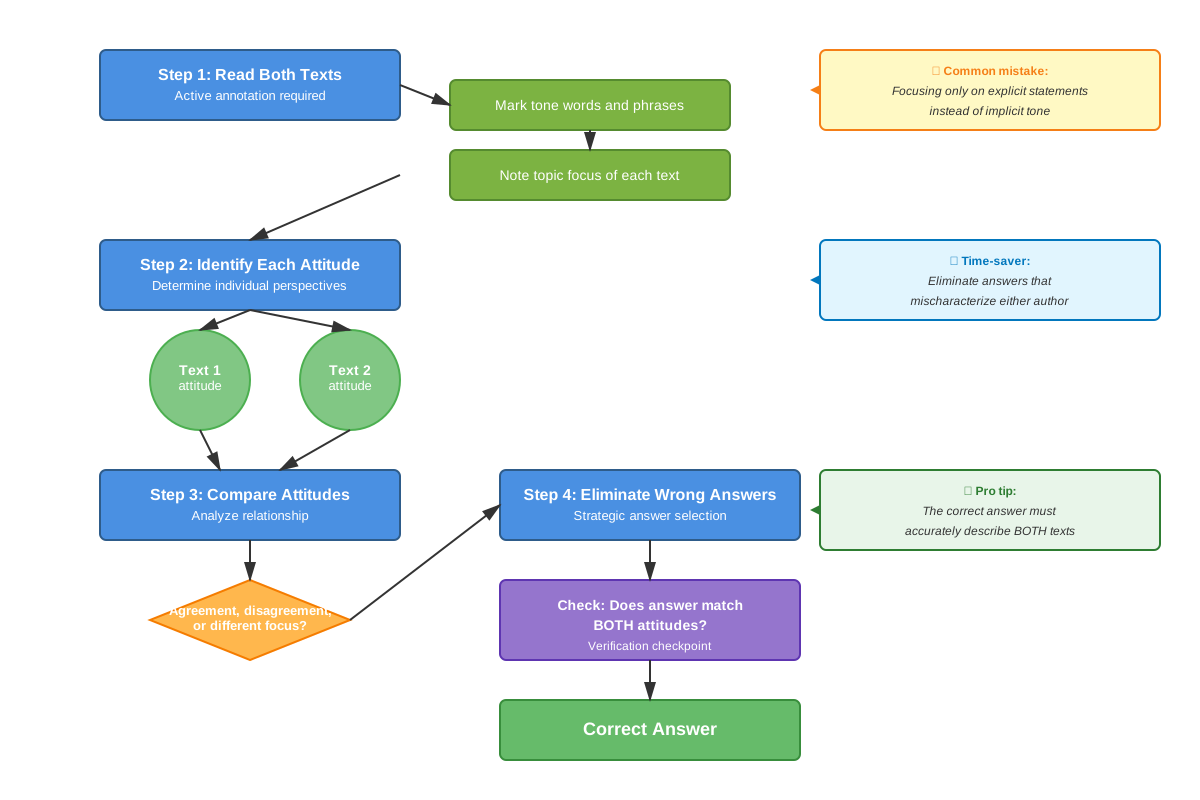
When approaching cross-text author attitude questions on the SAT, follow this systematic process:
Step 1: Read Text 1 actively and annotate attitude markers. Circle or mentally note words that reveal tone: intensifiers, qualifiers, evaluative adjectives. Ask yourself: "How does this author feel about their subject?"
Step 2: Formulate a brief summary of Text 1's attitude before moving to Text 2. This prevents confusion and helps you maintain clear comparison points.
Step 3: Read Text 2 with comparison in mind. Actively look for similarities and differences in tone, emphasis, and perspective. Note whether Text 2 addresses the same specific points as Text 1 or focuses on different aspects.
Step 4: Identify the specific comparison point the question asks about. Many questions reference a specific claim or aspect rather than asking about overall relationship.
Exam Tip: Watch for trigger words in answer choices that indicate degree of agreement or disagreement: "completely," "partially," "fundamentally," "primarily," "somewhat." These words often distinguish correct from incorrect answers.
Process of elimination strategies:
- Eliminate answers that are too extreme (complete agreement/disagreement) when passages show nuanced positions
- Eliminate answers that confuse explicit statements with implicit attitudes
- Eliminate answers that accurately describe one text but mischaracterize the other
- Eliminate answers that describe a relationship not supported by specific textual evidence
Time allocation: Spend approximately 90 seconds reading both passages and 30-45 seconds answering the question. Don't rush the reading phase—accurate comprehension of both attitudes is essential for correct answers.
Trigger phrases to watch for:
- "How would Author 2 respond..." (requires inference based on demonstrated attitude)
- "Both authors would agree..." (requires finding common ground)
- "Unlike Author 1, Author 2..." (requires identifying specific difference)
- "The relationship between the texts..." (requires overall characterization)
Memory Techniques
ATTITUDE Acronym for analyzing author perspective:
- Adjectives: What evaluative words does the author use?
- Tone: What's the emotional quality (enthusiastic, skeptical, neutral)?
- Timing: Does the author use urgent or measured language?
- Intensifiers: Does the author use words like "clearly," "obviously," "undoubtedly"?
- Topic emphasis: What aspects does the author focus on?
- Underlying assumptions: What does the author take for granted?
- Degree: How strong is the author's position?
- Evidence selection: What types of support does the author choose?
COMPARE Strategy for cross-text questions:
- Claim: Identify each author's main claim
- Opinion markers: Note words revealing attitude
- Main difference: What's the key point of divergence?
- Points of agreement: Where do authors align?
- Attitude strength: How strongly does each author feel?
- Relationship type: Agreement, disagreement, different focus?
- Eliminate extremes: Remove answers that overstate differences or similarities
Visualization: Picture a spectrum from "strongly negative" to "strongly positive." Place each author on this spectrum based on their attitude markers. The distance between them represents the degree of difference.
Mnemonic for common attitude words:
SCENE for skeptical attitudes: Supposedly, Claims, Allegedly, Purportedly, Reportedly
CHAMP for enthusiastic attitudes: Clearly, Undoubtedly, Obviously, Definitely, Certainly
Summary
Cross-text author attitude questions assess students' ability to identify, compare, and synthesize the perspectives of multiple authors writing about related topics. Success requires moving beyond basic comprehension to analyze how authors feel about their subjects through implicit and explicit attitude markers. The SAT tests this skill through paired passages where students must recognize whether authors agree, disagree, or emphasize different aspects of an issue. Key to mastery is understanding that most cross-text relationships involve nuanced differences rather than complete opposition, and that attitude emerges through word choice, tone, qualifiers, and emphasis rather than only explicit statements. Students must systematically analyze each text individually, identify specific comparison points, and accurately characterize relationships using textual evidence. This skill connects directly to college readiness by developing critical thinking abilities essential for evaluating multiple sources and synthesizing competing perspectives.
Key Takeaways
- Cross-text author attitude questions require analyzing and comparing perspectives across two passages, focusing on how authors feel about their subjects rather than just what they say
- Implicit attitude markers (qualifiers, intensifiers, evaluative language) are more commonly tested than explicit opinion statements
- Most SAT cross-text relationships involve nuanced differences in emphasis, tone, or degree rather than complete agreement or disagreement
- Systematic analysis—understanding each text individually before comparing—prevents confusion and leads to accurate answers
- The most common wrong answers mischaracterize the degree of agreement or disagreement between authors
- Success requires distinguishing between what authors explicitly state and what their word choices imply about their attitudes
- Trigger words in questions and answer choices (completely, partially, primarily, somewhat) often distinguish correct from incorrect responses
Related Topics
Single-Text Tone and Purpose: Mastering cross-text author attitude builds directly on the ability to identify tone and rhetorical purpose in individual passages. Students who excel at cross-text comparisons should deepen their understanding of how authors use rhetorical devices to convey attitude.
Evidence and Support Analysis: Understanding how authors select and present evidence reveals their attitudes and biases. This topic extends cross-text attitude analysis by examining how different types of evidence reflect different perspectives.
Argumentative Structure: Analyzing how authors construct arguments across multiple texts helps students understand not just what positions authors take, but why they structure their cases differently based on their attitudes and purposes.
Historical and Scientific Reasoning: Many cross-text questions pair passages from different time periods or scientific perspectives. Understanding how historical context and scientific methodology influence author attitude deepens cross-text analysis skills.
Practice CTA
Now that you've mastered the core concepts of cross-text author attitude analysis, it's time to apply these skills! Work through the practice questions to test your ability to identify attitude markers, compare perspectives, and synthesize information across passages. The flashcards will help reinforce key vocabulary and concepts for quick recall during the exam. Remember: cross-text questions reward careful, systematic analysis—take your time to understand each author's perspective before comparing them. With practice, you'll develop the critical thinking skills that not only boost your SAT score but also prepare you for college-level academic work. You've got this!
Sign up free to keep reading
Create a free AnvayaPrep account to finish this SAT guide on Cross-text author attitude — plus flashcards and practice questions.