Overview
Cross-text claims represent a critical question type on the SAT Reading and Writing section that requires students to synthesize information from two related passages. Unlike traditional single-passage questions that test comprehension of one text, cross-text claims questions assess the ability to identify relationships, compare perspectives, and evaluate how information from one passage relates to another. These questions typically present two short texts (Text 1 and Text 2) followed by a question asking students to determine which statement best describes the relationship between them or how one text responds to the other.
This question type is essential for SAT success because it mirrors the analytical thinking required in college-level coursework, where students must regularly compare sources, evaluate competing claims, and synthesize information from multiple texts. SAT cross-text claims questions appear consistently throughout the Reading and Writing section, making them a high-frequency item type that can significantly impact overall scores. Students who master this skill demonstrate advanced critical reading abilities that extend beyond simple comprehension to analytical comparison.
Within the broader RW (Reading and Writing) framework, cross-text claims questions build upon foundational skills like identifying main ideas, understanding authorial purpose, and recognizing textual evidence. They represent a higher-order thinking skill that integrates multiple competencies: students must comprehend each passage independently, identify the core claim or perspective in each, and then determine the precise relationship between them. This topic connects directly to other Cross-Text Connections concepts and prepares students for the analytical demands of college-level reading across disciplines.
Learning Objectives
- [ ] Identify key features of cross-text claims questions on the SAT
- [ ] Explain how cross-text claims appears on the SAT and what makes these questions distinct
- [ ] Apply cross-text claims strategies to answer SAT-style questions accurately
- [ ] Distinguish between different types of relationships between paired texts (supporting, contradicting, qualifying, extending)
- [ ] Evaluate answer choices by checking them against both texts simultaneously
- [ ] Recognize common patterns in how the SAT structures cross-text claims questions
Prerequisites
- Main idea identification: Understanding the central claim or thesis of a passage is essential because cross-text questions require identifying the core argument in each text before comparing them.
- Textual evidence recognition: The ability to locate specific support for claims helps verify which answer choice accurately represents both passages.
- Author's purpose and tone: Recognizing why an author presents information and their attitude toward the subject enables accurate comparison of perspectives.
- Inference skills: Many cross-text relationships are implicit rather than explicit, requiring students to draw logical conclusions about how texts relate.
Why This Topic Matters
Cross-text claims questions appear in every SAT Reading and Writing section, typically comprising 3-5 questions per test. This frequency makes them a high-impact topic that can substantially affect overall scores. According to College Board data, these questions assess skills that strongly predict college readiness, as academic work consistently requires comparing sources, evaluating competing perspectives, and synthesizing information from multiple texts.
In real-world applications, the ability to compare and synthesize information from multiple sources is fundamental to research, professional writing, academic discourse, and informed decision-making. Students use these skills when writing research papers, evaluating news sources, comparing product reviews, or analyzing competing scientific studies. The critical thinking required for cross-text claims extends far beyond test-taking into essential life skills.
On the SAT, cross-text claims questions most commonly appear with paired passages from various disciplines: scientific research findings, historical perspectives, literary criticism, social science studies, and humanities arguments. The passages are typically 50-150 words each, making them manageable in length but dense in content. Questions often ask students to identify how Text 2 relates to Text 1, which claim is supported by both texts, or how one researcher would respond to another's findings.
Core Concepts
Understanding Cross-Text Claims Structure
Cross-text claims questions present two distinct but related passages, labeled Text 1 and Text 2, followed by a question that requires synthesizing information from both. The texts typically share a common topic but may present different perspectives, findings, or levels of specificity. The fundamental structure remains consistent: students must read both passages, understand each independently, and then determine their relationship.
The passages are deliberately chosen to have a meaningful relationship. They are never completely unrelated, nor are they simply repetitive. The SAT designs these pairs to test whether students can identify nuanced relationships between sources—a skill central to academic work. The question stem typically includes phrases like "Based on the texts," "Which statement best describes," or "How would the author of Text 2 most likely respond to Text 1?"
Types of Cross-Text Relationships
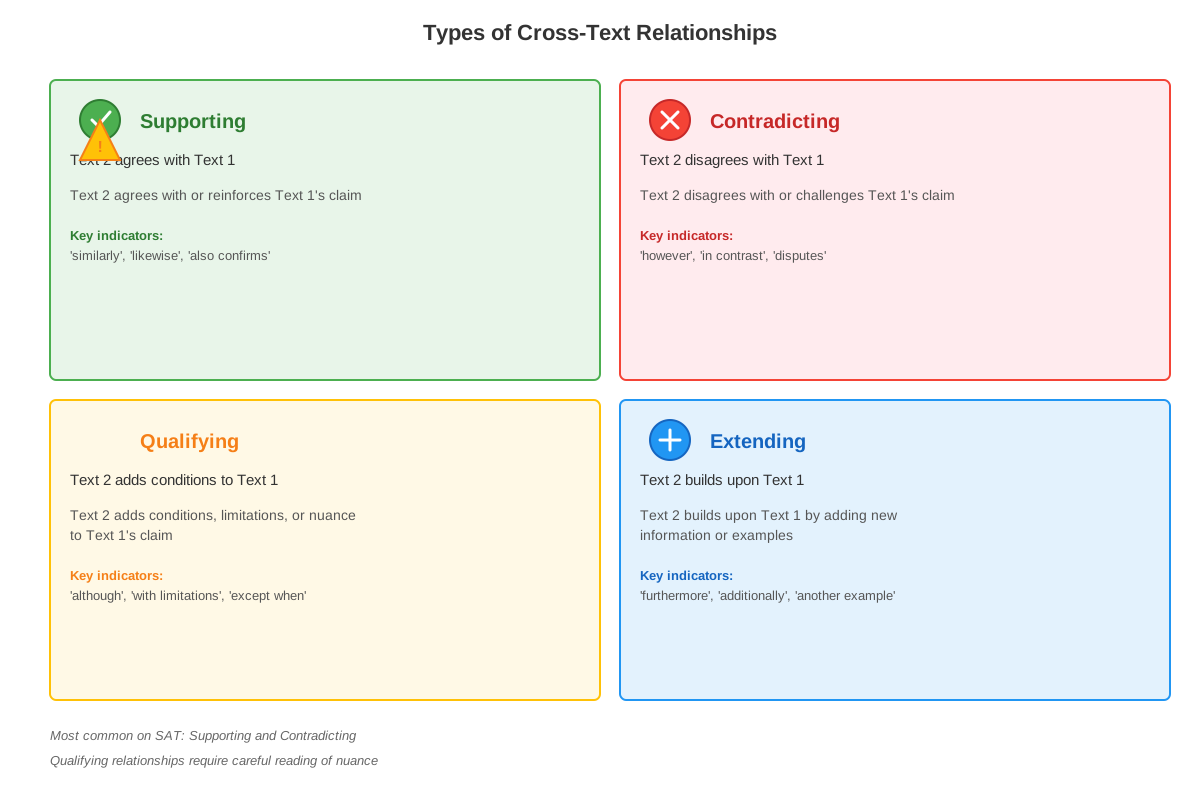
Understanding the common relationship patterns helps students approach these questions strategically. The SAT employs several recurring relationship types:
| Relationship Type | Description | Example Scenario |
|---|---|---|
| Supporting/Confirming | Text 2 provides evidence that strengthens or confirms Text 1's claim | Text 1 proposes a theory; Text 2 presents research findings that support it |
| Contradicting/Challenging | Text 2 presents information that disputes or undermines Text 1 | Text 1 states a common belief; Text 2 provides evidence against it |
| Qualifying/Nuancing | Text 2 adds conditions, limitations, or complexity to Text 1's claim | Text 1 makes a broad claim; Text 2 specifies when it does/doesn't apply |
| Extending/Elaborating | Text 2 builds upon Text 1 by adding detail, examples, or related information | Text 1 introduces a concept; Text 2 provides specific applications |
| Comparing/Contrasting | Texts present different but not necessarily opposing perspectives | Text 1 discusses one approach; Text 2 discusses an alternative approach |
Identifying the Core Claim in Each Text
Before determining relationships, students must identify the core claim or main point of each passage. This requires distinguishing between the central argument and supporting details. The core claim is typically:
- The statement that the rest of the passage supports or explains
- The author's primary conclusion or position
- The most general statement that encompasses the passage's content
- Often (but not always) located in the first or last sentence
For scientific passages, the core claim is usually the research finding or conclusion. For argumentative passages, it's the author's position on an issue. For descriptive passages, it's the main characteristic or phenomenon being described.
Evaluating Answer Choices Against Both Texts
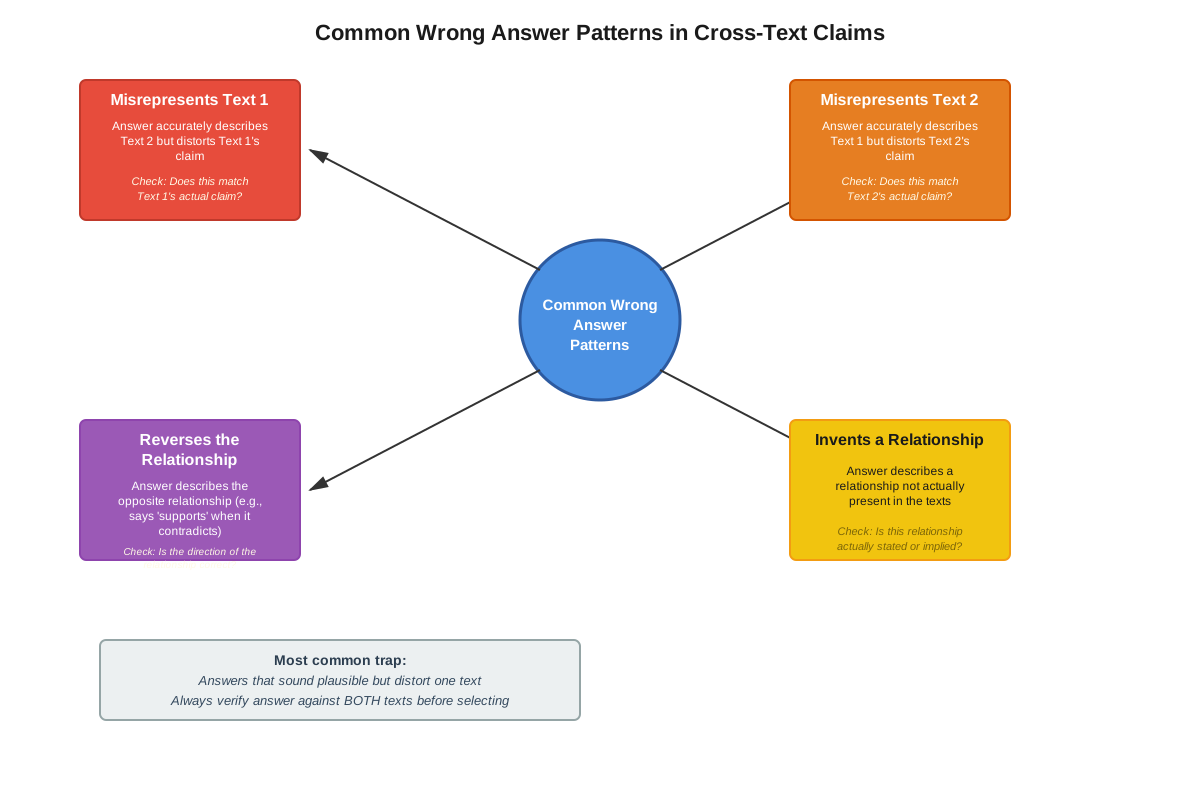
The critical skill in cross-text claims questions is simultaneous verification: checking each answer choice against both passages. An answer is only correct if it accurately represents the relationship between the texts. Common errors occur when students:
- Select an answer that's true for one text but doesn't address the relationship
- Choose an answer that describes a relationship that doesn't actually exist
- Pick an answer that reverses the relationship (e.g., saying Text 1 challenges Text 2 when it's the opposite)
- Select an answer that overstates or understates the relationship
The correct answer must be supported by specific content from both texts. If an answer choice claims Text 2 "contradicts" Text 1, there must be clear opposing information. If it claims Text 2 "provides evidence for" Text 1, Text 2 must contain concrete support for Text 1's claim.
Common Question Formats
Cross-text claims questions appear in several standard formats:
- Relationship description: "Based on the texts, how would the researcher in Text 2 most likely respond to the hypothesis in Text 1?"
- Shared support: "Which finding, if true, would support both researchers' claims?"
- Difference identification: "What is the main difference between the perspectives presented in Text 1 and Text 2?"
- Response prediction: "How would the author of Text 2 most likely respond to the claim in Text 1?"
- Synthesis statement: "Which statement best describes the relationship between Text 1 and Text 2?"
Each format requires the same fundamental skill—understanding both texts and their relationship—but frames the question differently.
Concept Relationships
Cross-text claims questions integrate multiple reading comprehension skills into a single assessment. The skill hierarchy flows as follows:
Basic Comprehension → Main Idea Identification → Evidence Recognition → Cross-Text Synthesis
Students must first comprehend each passage individually (basic comprehension), then identify the core claim in each (main idea identification), locate specific supporting details (evidence recognition), and finally determine how the passages relate (cross-text synthesis).
This topic connects to Command of Evidence questions, which also require identifying textual support for claims, but extends the skill to multiple sources. It relates to Rhetorical Synthesis by requiring students to understand authorial purpose and perspective. The analytical thinking developed through cross-text claims questions also supports Inference questions and Purpose and Function questions.
Within the Cross-Text Connections unit, this topic serves as the foundation for more complex synthesis tasks. Mastering cross-text claims enables students to handle paired passages in any context and prepares them for college-level research and writing that requires source comparison.
High-Yield Facts
⭐ Cross-text claims questions always require information from BOTH passages; an answer based on only one text is automatically incorrect.
⭐ The most common relationship types are: supporting, contradicting, qualifying, and extending.
⭐ The correct answer must be directly supported by specific content in both texts, not general knowledge or assumptions.
⭐ Question stems typically include phrases like "Based on the texts," "How would [author/researcher] respond," or "Which statement best describes the relationship."
⭐ Text 2 is usually written in response to or in relation to Text 1, so focus on how Text 2 relates to Text 1's main claim.
- Cross-text questions appear 3-5 times per SAT Reading and Writing section, making them high-frequency items.
- The passages are typically 50-150 words each, short enough to reread quickly if needed.
- Wrong answers often describe relationships that are too strong (e.g., "completely disproves" when it only "raises questions about") or too weak (e.g., "mentions" when it actually "provides strong evidence for").
- When texts seem to agree, look for subtle differences in scope, certainty, or emphasis that distinguish their perspectives.
- Scientific cross-text pairs often present a hypothesis in Text 1 and research findings in Text 2.
Quick check — test yourself on Cross-text claims so far.
Try Flashcards →Common Misconceptions
Misconception: Cross-text claims questions can be answered by reading only one passage carefully. → Correction: These questions specifically test the ability to synthesize information from both texts. The correct answer must accurately represent content and relationships from both passages. Reading only one text will lead to incorrect answers that may seem plausible but don't capture the actual relationship.
Misconception: If both texts discuss the same topic, they must be supporting each other. → Correction: Texts can discuss the same topic while presenting contradictory findings, different perspectives, or qualifying conditions. The relationship depends on the specific claims made, not just the shared subject matter. Always identify what each text claims about the topic, not just what topic they share.
Misconception: The correct answer will use the same vocabulary as the passages. → Correction: Correct answers often paraphrase or synthesize ideas using different language. Students must understand concepts, not just match words. The SAT tests comprehension, not word-matching ability.
Misconception: Longer, more detailed answer choices are more likely to be correct. → Correction: Answer length has no correlation with correctness. In fact, longer answers sometimes include extra details that make them incorrect by overstating or adding unsupported claims. Evaluate each answer based solely on accuracy, not length or complexity.
Misconception: If Text 1 makes a claim and Text 2 doesn't mention it, Text 2 contradicts Text 1. → Correction: Contradiction requires opposing information, not mere absence of confirmation. If Text 2 simply doesn't address Text 1's claim, the relationship is neither supporting nor contradicting—it may be extending to a different aspect or discussing a related but distinct point.
Worked Examples
Example 1: Scientific Research Relationship
Text 1
Researchers have long believed that the decline in bee populations is primarily caused by pesticide exposure. Studies have shown that certain neonicotinoid pesticides impair bees' navigation abilities, making it difficult for them to return to their hives.
Text 2
A recent comprehensive study examined bee colonies in both agricultural and urban environments. The researchers found that colonies in pesticide-free urban areas showed similar decline rates to those in agricultural areas with pesticide exposure, suggesting that other factors, such as habitat loss and disease, may play equally significant roles in bee population decline.
Question: Based on the texts, how would the researchers in Text 2 most likely respond to the belief described in Text 1?
Answer Choices:
A) They would argue that pesticides have no effect on bee populations.
B) They would suggest that pesticide exposure is one factor among several contributing to bee decline.
C) They would confirm that pesticides are the primary cause of bee population decline.
D) They would propose that urban environments are safer for bees than agricultural areas.
Step-by-step solution:
- Identify Text 1's core claim: Pesticide exposure is the primary cause of bee population decline.
- Identify Text 2's core claim: Bee decline occurs in both pesticide-exposed and pesticide-free areas at similar rates, suggesting multiple factors contribute.
- Determine the relationship: Text 2 doesn't completely reject pesticides as a factor (eliminating A), but it challenges the idea that pesticides are the PRIMARY cause by showing decline happens without them too.
- Evaluate each answer:
- A: Too extreme—Text 2 doesn't say pesticides have NO effect
- B: Accurate—Text 2 suggests pesticides are ONE factor among several (habitat loss, disease)
- C: Contradicts Text 2's findings
- D: Not supported—Text 2 shows similar decline rates in both environments
Correct Answer: B
This question demonstrates a qualifying relationship: Text 2 doesn't completely contradict Text 1 but adds nuance by suggesting the cause is multifactorial rather than singular.
Example 2: Historical Perspective Comparison
Text 1
The Industrial Revolution fundamentally transformed human society by enabling mass production and urbanization. Historians emphasize that this period marked humanity's transition from agrarian economies to industrial powerhouses, creating unprecedented economic growth and technological advancement.
Text 2
While the Industrial Revolution certainly brought technological progress, recent historical scholarship has highlighted its devastating social costs. Factory workers, including children, endured dangerous conditions, long hours, and minimal wages. The environmental degradation and wealth inequality that emerged during this period continue to affect societies today.
Question: Which statement best describes the relationship between Text 1 and Text 2?
Answer Choices:
A) Text 2 disputes the claim in Text 1 that the Industrial Revolution involved technological advancement.
B) Text 2 provides additional examples that support Text 1's emphasis on economic growth.
C) Text 2 acknowledges Text 1's point about progress while emphasizing negative consequences that Text 1 doesn't address.
D) Text 2 argues that the Industrial Revolution had no significant impact on human society.
Step-by-step solution:
- Identify Text 1's core claim: The Industrial Revolution fundamentally transformed society through positive changes (mass production, urbanization, economic growth, technological advancement).
- Identify Text 2's core claim: While acknowledging technological progress, the Industrial Revolution had significant negative social and environmental costs.
- Determine the relationship: Text 2 begins with "While...certainly brought technological progress," acknowledging Text 1's point, then shifts to "but" and emphasizes negative aspects. This is a qualifying/nuancing relationship.
- Evaluate each answer:
- A: Incorrect—Text 2 explicitly acknowledges "technological progress"
- B: Incorrect—Text 2 emphasizes negative consequences, not additional support
- C: Accurate—Text 2 acknowledges progress ("while...certainly") then emphasizes costs ("devastating social costs," "environmental degradation")
- D: Too extreme—Text 2 doesn't deny significant impact
Correct Answer: C
This example shows how the SAT tests the ability to recognize nuanced relationships where texts partially agree but emphasize different aspects or add important qualifications.
Exam Strategy
Step-by-Step Approach
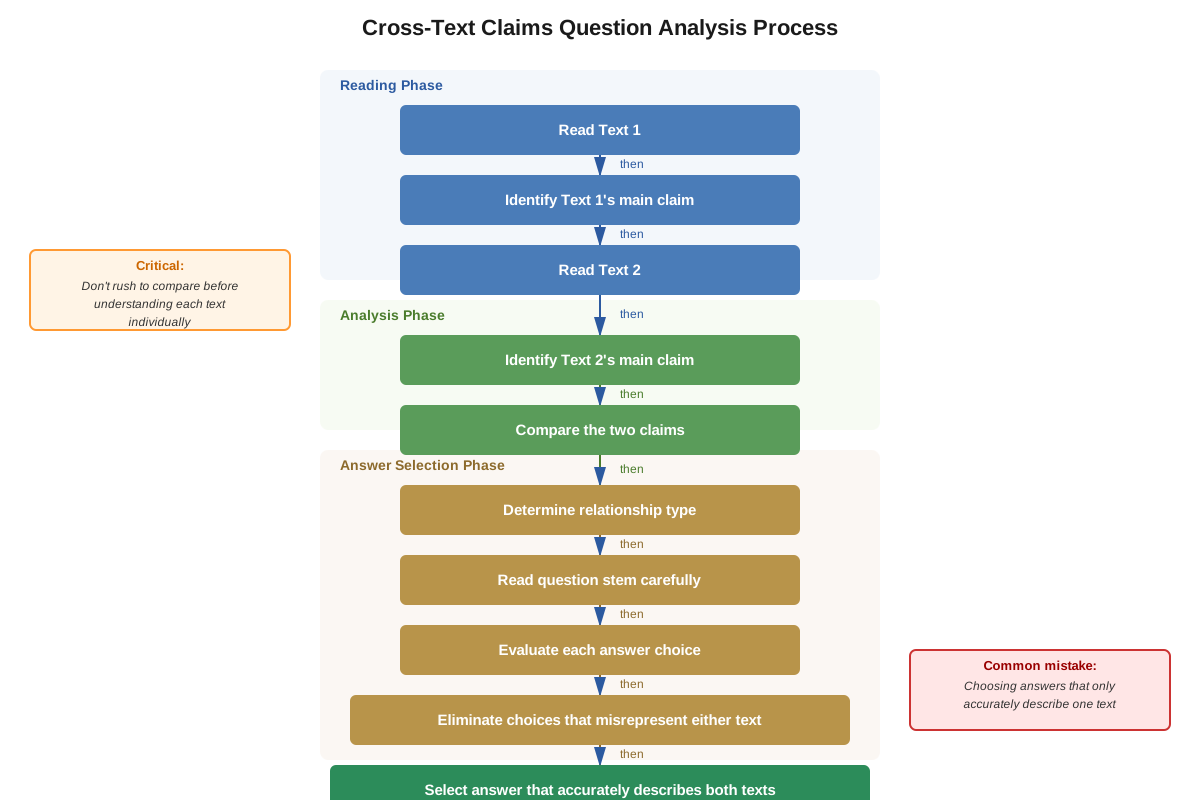
- Read Text 1 completely and identify its core claim in your own words
- Read Text 2 completely and identify its core claim in your own words
- Before looking at answer choices, determine the relationship: Does Text 2 support, contradict, qualify, or extend Text 1?
- Read the question stem carefully to understand exactly what relationship you're being asked to identify
- Evaluate each answer choice by checking it against both texts
- Eliminate answers that are only true for one text or that mischaracterize the relationship
- Verify your selected answer by finding specific evidence in both texts
Trigger Words and Phrases
Watch for these words in question stems:
- "Based on the texts" (requires both passages)
- "How would [Text 2 author] respond to" (requires understanding Text 2's perspective on Text 1's claim)
- "Which statement best describes the relationship" (requires identifying the connection type)
- "Both texts support" (requires finding common ground)
- "The main difference between" (requires identifying contrasting elements)
Watch for these relationship indicators in the passages themselves:
- Supporting: "similarly," "likewise," "this confirms," "evidence shows"
- Contradicting: "however," "in contrast," "but," "actually," "contrary to"
- Qualifying: "while," "although," "except," "under certain conditions"
- Extending: "furthermore," "additionally," "building on this," "another aspect"
Process of Elimination Tips
Eliminate answers that:
- Describe only one text without addressing the relationship
- Use extreme language ("completely," "never," "always," "only") unless the texts genuinely support such extremes
- Reverse the relationship (saying Text 1 responds to Text 2 when the question asks how Text 2 relates to Text 1)
- Introduce information not present in either text
- Overstate or understate the strength of the relationship
Time Allocation
Cross-text claims questions typically require 60-90 seconds:
- 20-30 seconds: Read Text 1
- 20-30 seconds: Read Text 2
- 10-15 seconds: Determine relationship
- 15-20 seconds: Evaluate answer choices
If a question takes longer than 90 seconds, mark it and return if time permits. Don't let one difficult cross-text question consume time needed for other questions.
Memory Techniques
SCQE Method for Cross-Text Analysis
Subject: What topic do both texts address?
Claims: What does each text claim about that topic?
Quality: What's the relationship quality (support, contradict, qualify, extend)?
Evidence: What specific evidence supports this relationship?
Relationship Acronym: SCQE
Supporting - Text 2 confirms or provides evidence for Text 1
Contradicting - Text 2 opposes or disputes Text 1
Qualifying - Text 2 adds conditions or nuances to Text 1
Extending - Text 2 builds upon or elaborates Text 1
Visualization Strategy
Picture the two texts as two people in conversation:
- Supporting: Person 2 nods and says "Yes, and here's proof"
- Contradicting: Person 2 shakes head and says "Actually, no"
- Qualifying: Person 2 says "Yes, but only when..."
- Extending: Person 2 says "Right, and also consider..."
This personification helps students intuitively grasp the relationship between texts.
The "Both Test"
For any answer choice, mentally insert "BOTH texts show that..." before it. If the statement doesn't accurately represent both texts, eliminate it. This simple test catches answers that only describe one passage.
Summary
Cross-text claims questions assess the critical skill of synthesizing information from multiple sources, a fundamental competency for college-level work. These questions present two related passages and ask students to identify the relationship between them—whether supporting, contradicting, qualifying, or extending. Success requires reading both texts carefully, identifying each text's core claim, determining how they relate, and selecting an answer that accurately represents that relationship based on specific textual evidence. The most common error is selecting an answer that describes only one text or mischaracterizes the relationship's strength or nature. Students should approach these questions systematically: read both texts, identify core claims, determine the relationship type, and verify answer choices against both passages. With consistent practice and strategic application of the SCQE method, students can master this high-frequency question type that appears 3-5 times per SAT Reading and Writing section.
Key Takeaways
- Cross-text claims questions require synthesizing information from two passages to identify their relationship
- The four main relationship types are supporting, contradicting, qualifying, and extending
- Always identify the core claim in each text before determining their relationship
- Correct answers must be supported by specific evidence from BOTH texts, not just one
- Use the SCQE method (Subject, Claims, Quality, Evidence) to systematically analyze paired passages
- Watch for qualifying language in texts ("while," "although," "however") that signals nuanced relationships
- These questions appear 3-5 times per test, making them high-impact for overall scores
Related Topics
Command of Evidence: This topic extends cross-text skills by requiring students to select specific textual evidence that supports claims, building on the evidence-evaluation skills developed in cross-text claims questions.
Rhetorical Synthesis: Understanding how authors construct arguments and use rhetorical strategies helps students better identify the purpose and perspective in each text, enabling more accurate relationship identification.
Inference Questions: The analytical thinking required for cross-text claims—drawing conclusions from textual evidence—directly supports inference skills needed throughout the Reading and Writing section.
Paired Passage Analysis: In longer reading sections, students encounter extended paired passages where cross-text claims skills apply to more complex, sustained arguments across multiple paragraphs.
Practice CTA
Now that you've mastered the core concepts of cross-text claims, it's time to put your knowledge into action! Complete the practice questions to reinforce these strategies and build confidence with this high-frequency question type. Use the flashcards to memorize key relationship types and trigger words. Remember: cross-text claims questions appear on every SAT, and mastering them can significantly boost your Reading and Writing score. Each practice question you complete strengthens your ability to synthesize information quickly and accurately—a skill that will serve you well beyond test day!
Sign up free to keep reading
Create a free AnvayaPrep account to finish this SAT guide on Cross-text claims — plus flashcards and practice questions.