Overview
Cross-text inference is a critical skill tested in the SAT Reading and Writing section that requires students to synthesize information from two related passages and draw logical conclusions about how they connect. Unlike single-passage questions that test comprehension within one text, cross-text inference questions present two short passages (Text 1 and Text 2) and ask students to identify relationships, contrasts, agreements, or extensions between them. This skill mirrors real-world academic reading, where scholars must evaluate multiple sources, compare perspectives, and build comprehensive understanding across documents.
The SAT places significant emphasis on cross-text questions, with multiple items appearing in every test administration. These questions assess higher-order thinking skills beyond basic comprehension—students must actively compare, contrast, synthesize, and evaluate how ideas in one text relate to ideas in another. Success requires careful reading of both passages, identification of key claims and evidence in each, and logical reasoning about their relationship. Students who master sat cross-text inference gain a substantial advantage, as these questions often separate high scorers from average performers.
Within the broader RW (Reading and Writing) section architecture, cross-text inference represents an advanced application of fundamental reading skills. It builds upon single-text comprehension, evidence evaluation, and logical reasoning while adding the complexity of managing multiple sources simultaneously. This topic connects directly to academic and professional contexts where synthesizing multiple perspectives is essential—from research papers to policy analysis to everyday decision-making based on multiple information sources.
Learning Objectives
- [ ] Identify key features of Cross-text inference
- [ ] Explain how Cross-text inference appears on the SAT
- [ ] Apply Cross-text inference to answer SAT-style questions
- [ ] Distinguish between different types of cross-text relationships (agreement, disagreement, extension, qualification)
- [ ] Evaluate answer choices by systematically checking claims against both texts
- [ ] Recognize common distractor patterns in cross-text inference questions
Prerequisites
- Single-passage reading comprehension: Understanding main ideas, supporting details, and author's purpose within individual texts is foundational before comparing multiple texts
- Evidence identification: Locating and interpreting specific textual evidence is necessary to support cross-text inferences
- Logical reasoning: Basic skills in drawing valid conclusions from premises enable the synthesis required for cross-text analysis
- Vocabulary in context: Understanding how words function in different passages helps identify subtle relationships between texts
Why This Topic Matters
Cross-text inference questions appear consistently throughout the SAT Reading and Writing section, typically comprising 3-5 questions per test. These questions carry the same weight as other question types but often prove more challenging because they require managing information from multiple sources simultaneously. Students who develop systematic approaches to these questions gain measurable score improvements.
Beyond test performance, cross-text inference skills translate directly to college-level academic work. Research papers require synthesizing multiple scholarly sources, comparing methodologies, and identifying where studies agree or diverge. Critical thinking in any discipline demands evaluating multiple perspectives before forming conclusions. Professional contexts—from legal analysis to medical diagnosis to business strategy—require comparing information from various sources to make informed decisions.
On the SAT, cross-text inference questions typically follow a predictable format: two passages of 50-150 words each, labeled Text 1 and Text 2, followed by a question asking how the texts relate. Common question stems include: "Based on the texts, how would the author of Text 2 most likely respond to the claim in Text 1?" or "Which finding from Text 2, if true, would most directly support the hypothesis presented in Text 1?" The passages may discuss the same topic from different angles, present contrasting research findings, offer complementary perspectives, or show one text building upon ideas in another.
Core Concepts
Understanding Cross-Text Inference
Cross-text inference is the cognitive process of drawing logical conclusions about relationships between two separate passages. Unlike simple comparison, which identifies surface-level similarities and differences, inference requires deeper analysis of how ideas, claims, evidence, and arguments in one text connect to those in another. Students must read both passages carefully, identify the central claim or purpose of each, and then reason about their relationship.
The inference component is crucial: the relationship between texts is rarely stated explicitly. Instead, students must use textual evidence to support a logical conclusion about how the passages connect. This mirrors authentic academic reading, where scholars must determine whether new research supports, contradicts, extends, or qualifies existing findings.
Types of Cross-Text Relationships
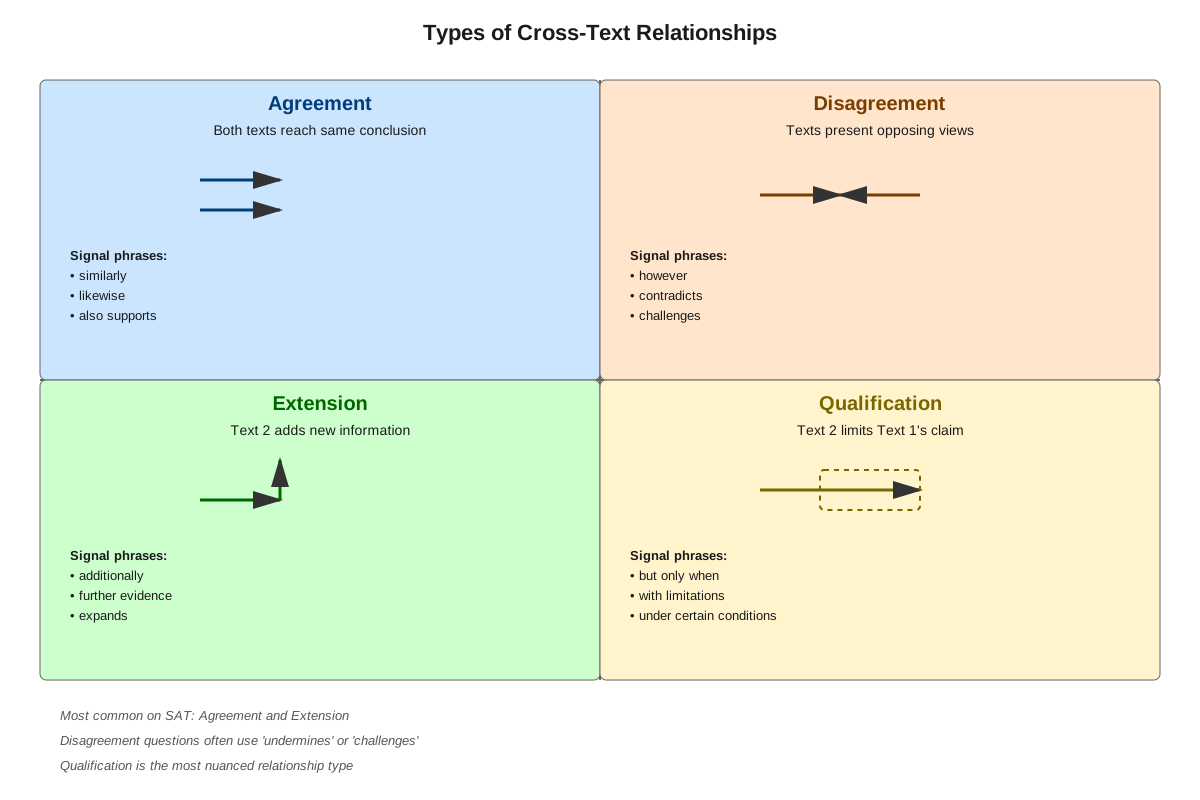
Cross-text inference questions on the SAT typically involve one of several relationship patterns:
| Relationship Type | Description | Example Scenario |
|---|---|---|
| Agreement/Support | Text 2 provides evidence, examples, or reasoning that strengthens claims in Text 1 | Text 1 proposes a theory; Text 2 presents experimental data confirming it |
| Disagreement/Contradiction | Text 2 challenges, refutes, or presents alternative explanations to Text 1 | Text 1 claims X causes Y; Text 2 shows Y occurs without X |
| Extension/Development | Text 2 builds upon, expands, or applies ideas introduced in Text 1 | Text 1 describes a phenomenon; Text 2 explores its implications |
| Qualification/Nuance | Text 2 adds conditions, limitations, or complexity to claims in Text 1 | Text 1 makes a broad claim; Text 2 identifies exceptions |
| Complementary Perspectives | Both texts address the same topic from different but compatible angles | Text 1 discusses historical context; Text 2 examines current applications |
The Cross-Text Inference Process
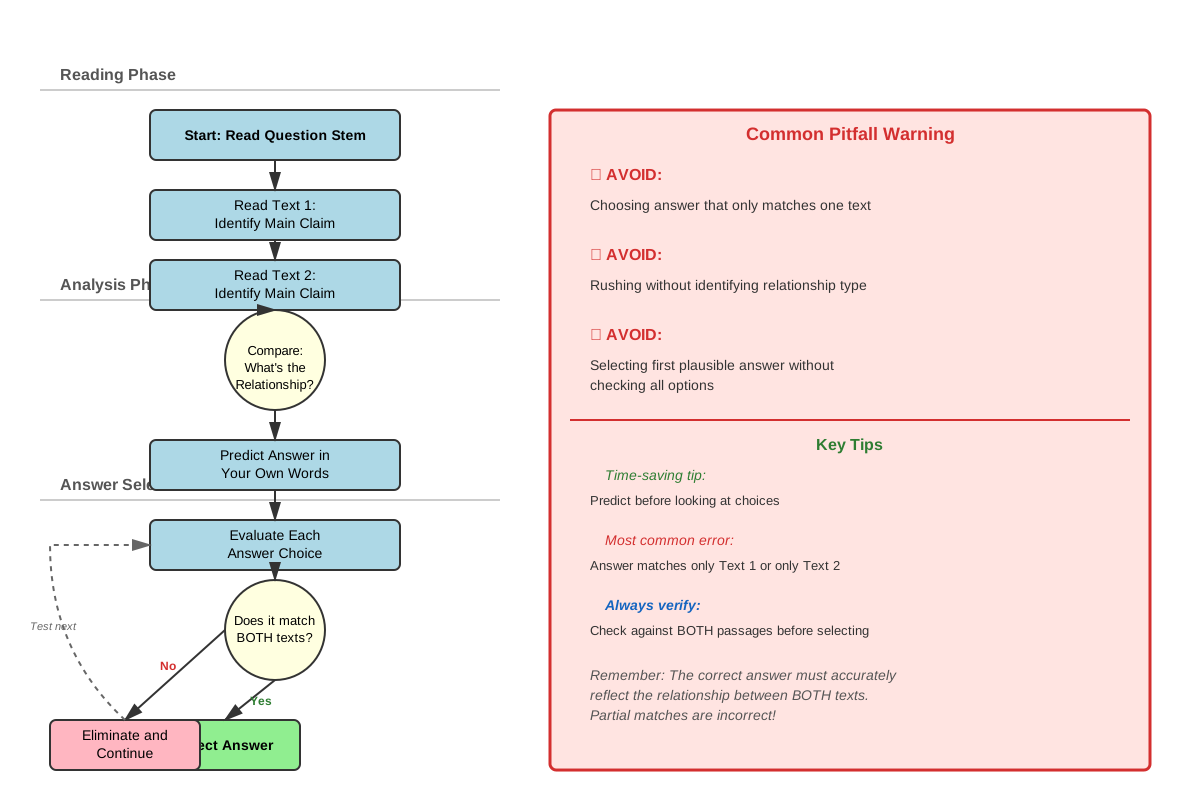
Successful cross-text inference follows a systematic approach:
- Read Text 1 actively: Identify the main claim, purpose, or central idea. Note key evidence or reasoning.
- Read Text 2 actively: Identify its main claim, purpose, or central idea. Note key evidence or reasoning.
- Identify the relationship: Determine how Text 2 relates to Text 1. Does it support, challenge, extend, qualify, or complement?
- Locate specific evidence: Find concrete details in both texts that establish the relationship.
- Evaluate answer choices: Test each option against both texts. Eliminate choices that misrepresent either text or incorrectly characterize their relationship.
Key Features of SAT Cross-Text Questions
SAT cross-text inference questions share several distinctive characteristics that students should recognize:
Paired passage format: Questions always present exactly two texts, clearly labeled. Each text is self-contained and comprehensible independently, but the question requires considering both together.
Relationship-focused questions: Rather than asking about content within a single text, questions explicitly ask about connections between texts. Question stems typically include phrases like "Based on the texts," "How would the author of Text 2 respond," or "Which finding would support/challenge."
Evidence-based reasoning: Correct answers must be supportable with specific evidence from both texts. Vague or general responses that could apply to many text pairs are typically incorrect.
Precision in relationships: Answer choices often present subtle variations in how texts relate. One choice might say Text 2 "contradicts" Text 1, while another says it "qualifies" or "provides an exception to" Text 1. These distinctions matter.
Common Question Formats
The SAT employs several recurring question formats for cross-text inference:
Response questions: "Based on Text 2, how would [author/researcher] most likely respond to the claim in Text 1?" These require understanding both the claim in Text 1 and the perspective in Text 2, then inferring how that perspective would address the claim.
Support/Challenge questions: "Which finding from Text 2, if true, would most directly support/challenge the hypothesis in Text 1?" These test whether students can identify which specific evidence strengthens or weakens a claim.
Relationship characterization questions: "Which choice best describes the relationship between Text 1 and Text 2?" These require identifying the overall connection pattern between passages.
Extension questions: "Text 2 most directly addresses which question raised by Text 1?" These assess whether students recognize how one text develops ideas introduced in another.
Concept Relationships
Cross-text inference builds directly upon foundational reading comprehension skills. Students must first master identifying main ideas, supporting details, and author's purpose within single texts before successfully comparing multiple texts. The ability to locate and interpret evidence—a prerequisite skill—becomes essential when supporting inferences about text relationships.
Within cross-text inference itself, the concepts form a logical progression: Understanding what cross-text inference means → Recognizing different relationship types → Applying the systematic process → Identifying question formats → Evaluating answer choices. Each step depends on the previous ones.
The relationship map flows as follows:
Single-text comprehension → enables → Identifying claims in each text → enables → Comparing claims across texts → enables → Inferring relationships → enables → Selecting correct answers
Additionally, Evidence evaluation skills support every stage of this process, while Logical reasoning enables the inference component specifically.
Cross-text inference also connects forward to more advanced academic skills. Mastering this topic prepares students for college-level synthesis essays, literature reviews, and any analytical writing that requires integrating multiple sources. The systematic approach to comparing texts transfers directly to research methodologies across disciplines.
High-Yield Facts
⭐ Cross-text inference questions always present exactly two passages and ask about their relationship, not about content within a single passage.
⭐ The correct answer must be supported by specific evidence from BOTH texts—if an answer choice only relates to one text, it's wrong.
⭐ Common relationship types include agreement/support, disagreement/contradiction, extension/development, and qualification/nuance.
⭐ Question stems typically include phrases like "Based on the texts," "How would the author respond," or "Which finding would support/challenge."
⭐ The relationship between texts is rarely stated explicitly—students must infer it from evidence.
- Text 1 and Text 2 are always clearly labeled in cross-text questions.
- Each passage in a cross-text pair is typically 50-150 words long.
- Cross-text questions appear 3-5 times per SAT administration.
- Answer choices often present subtle distinctions in how texts relate (e.g., "contradicts" vs. "qualifies").
- Reading both texts completely before attempting the question improves accuracy.
- Incorrect answer choices frequently misrepresent the claim in one or both texts.
- Time management is crucial—spending too long on cross-text questions can compromise performance elsewhere.
Quick check — test yourself on Cross-text inference so far.
Try Flashcards →Common Misconceptions
Misconception: Cross-text inference questions can be answered by reading only one of the two passages. → Correction: These questions specifically test the relationship between texts, requiring careful reading of both passages and identification of how they connect. Attempting to answer based on one text alone leads to incorrect responses.
Misconception: If Text 2 discusses the same topic as Text 1, they must agree with each other. → Correction: Texts can discuss the same topic while presenting contradictory claims, alternative explanations, or qualifying conditions. The relationship must be determined from specific evidence, not assumed from shared subject matter.
Misconception: The correct answer will use the same vocabulary and phrasing as the passages. → Correction: Correct answers often paraphrase or synthesize ideas from the texts rather than quoting directly. Students must recognize conceptual matches, not just word matches.
Misconception: Longer or more complex answer choices are more likely to be correct. → Correction: Answer length and complexity don't correlate with correctness. The SAT deliberately creates plausible-sounding incorrect answers that may be longer or use sophisticated language.
Misconception: Personal opinion about which text is more convincing should guide answer selection. → Correction: Cross-text inference questions test objective relationships between texts based on evidence, not subjective judgments about quality or persuasiveness. The correct answer reflects what the texts actually say, regardless of personal views.
Misconception: If Text 2 provides an example related to Text 1's topic, it automatically "supports" Text 1. → Correction: An example only supports a claim if it actually demonstrates or confirms that specific claim. Text 2 might provide an example that contradicts Text 1's claim or illustrates an exception to it.
Worked Examples
Example 1: Agreement/Support Relationship
Text 1
Researchers have long hypothesized that regular physical exercise improves cognitive function in older adults. The proposed mechanism involves increased blood flow to the brain, which delivers more oxygen and nutrients to neural tissue. However, direct evidence linking exercise-induced blood flow changes to measurable cognitive improvements has been limited.
Text 2
A recent study tracked 120 adults aged 60-75 over six months. Participants who engaged in moderate aerobic exercise three times weekly showed both increased cerebral blood flow (measured via MRI) and significant improvements on memory tests compared to sedentary controls. The magnitude of blood flow increase correlated positively with the degree of memory improvement.
Question: Based on the texts, how does Text 2 relate to the hypothesis discussed in Text 1?
Answer choices:
A) It presents an alternative mechanism for the relationship between exercise and cognition
B) It provides direct evidence supporting the proposed mechanism
C) It challenges the assumption that exercise benefits cognitive function
D) It suggests the hypothesis applies only to certain age groups
Solution:
Step 1: Identify Text 1's main point: Researchers hypothesize exercise improves cognition through increased brain blood flow, but direct evidence is limited.
Step 2: Identify Text 2's main point: A study found exercise increased brain blood flow AND improved memory, with correlation between the two.
Step 3: Determine the relationship: Text 2 provides the "direct evidence" that Text 1 noted was "limited." It confirms both parts of the hypothesis—exercise increases blood flow AND improves cognition—and shows they're correlated.
Step 4: Evaluate choices:
- A is incorrect: Text 2 uses the SAME mechanism (blood flow), not an alternative
- B is correct: Text 2 provides direct evidence (the study) supporting the mechanism (blood flow → cognition)
- C is incorrect: Text 2 supports, not challenges, the exercise-cognition link
- D is incorrect: While Text 2 studies one age group, it doesn't suggest the hypothesis is limited to that group
Answer: B
This example demonstrates an agreement/support relationship where Text 2 provides empirical evidence confirming a hypothesis presented in Text 1.
Example 2: Qualification/Nuance Relationship
Text 1
The introduction of wolves to Yellowstone National Park in 1995 triggered a trophic cascade that transformed the ecosystem. By preying on elk, wolves reduced overgrazing along riverbanks, allowing willow and aspen trees to recover. This vegetation regrowth stabilized riverbanks, changed river courses, and created habitat for numerous species. The Yellowstone case demonstrates how apex predators can reshape entire landscapes.
Text 2
While wolf reintroduction clearly affected Yellowstone's ecosystem, recent analysis suggests the changes were more complex than initially reported. Vegetation recovery began in some areas before wolf populations reached significant levels, coinciding with drought conditions that reduced elk populations independently. Additionally, beaver reintroduction and active habitat restoration efforts contributed to riverbank stabilization. The wolf effect, though real, was one factor among several.
Question: Based on the texts, how would the author of Text 2 most likely respond to the claim in Text 1 about wolves reshaping landscapes?
Answer choices:
A) By arguing that wolves had no significant impact on the Yellowstone ecosystem
B) By suggesting that the impact was real but occurred alongside other important factors
C) By proposing that vegetation recovery actually preceded wolf reintroduction entirely
D) By claiming that the trophic cascade concept has been disproven
Solution:
Step 1: Identify Text 1's claim: Wolves triggered a trophic cascade that transformed Yellowstone's ecosystem, demonstrating apex predators can reshape landscapes.
Step 2: Identify Text 2's perspective: The changes were "more complex" than reported; wolves had an effect ("real") but other factors (drought, beavers, restoration) also contributed.
Step 3: Determine the relationship: Text 2 qualifies or adds nuance to Text 1's claim. It doesn't reject the wolf effect but contextualizes it within multiple contributing factors.
Step 4: Evaluate choices:
- A is incorrect: Text 2 explicitly states the wolf effect was "real"
- B is correct: This captures Text 2's position—acknowledging the impact while identifying other factors
- C is incorrect: Text 2 says vegetation recovery began in "some areas" before wolves, not everywhere
- D is incorrect: Text 2 doesn't reject trophic cascades, just adds complexity
Answer: B
This example illustrates a qualification relationship where Text 2 doesn't contradict Text 1 but adds important conditions and complexity to its claims.
Exam Strategy
Systematic Approach
Always read both texts completely before looking at answer choices. Attempting to answer based on partial information leads to errors. As you read, actively identify the main claim or purpose of each text.
After reading both passages, pause to articulate the relationship in your own words before examining answer choices. Ask yourself: "Does Text 2 support, challenge, extend, or qualify Text 1?" This mental prediction helps you recognize the correct answer and avoid distractors.
Trigger Words and Phrases
Watch for these question stem patterns that signal cross-text inference:
- "Based on the texts" (requires using both passages)
- "How would the author of Text 2 respond to" (requires understanding Text 2's perspective and Text 1's claim)
- "Which finding would support/challenge" (requires identifying evidence relationships)
- "Best describes the relationship between" (requires characterizing the overall connection)
In the passages themselves, note transition words and qualifying language:
- Agreement indicators: "similarly," "likewise," "confirming," "consistent with"
- Disagreement indicators: "however," "in contrast," "contradicting," "alternatively"
- Qualification indicators: "although," "while," "nevertheless," "one factor among"
- Extension indicators: "furthermore," "building on," "additionally," "implications include"
Process of Elimination
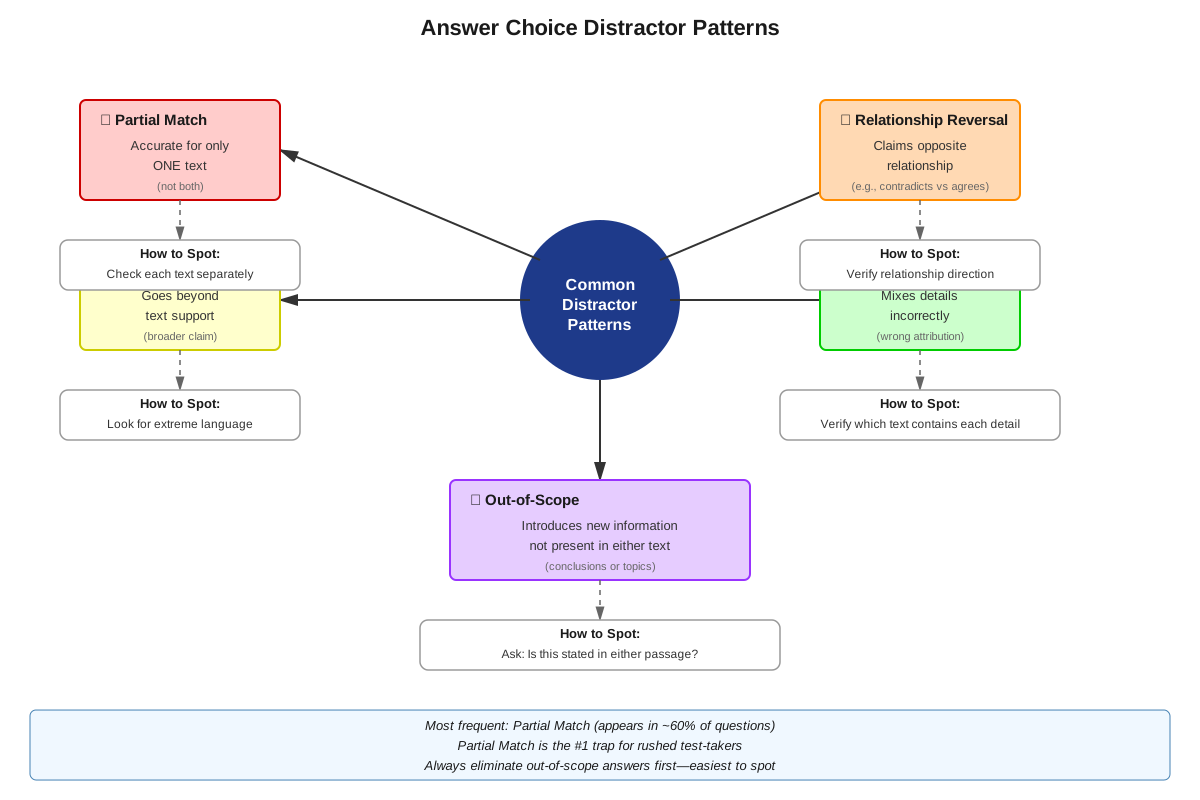
Eliminate answer choices that:
- Misrepresent either text: If a choice claims Text 1 says something it doesn't, eliminate it immediately
- Only address one text: Correct answers must relate to both passages
- Use extreme language: Words like "always," "never," "completely," or "only" are often too strong
- Confuse the direction of relationship: If Text 2 challenges Text 1, an answer saying Text 2 "supports" Text 1 is wrong
- Introduce outside information: Correct answers are based solely on what's in the passages
Time Management
Cross-text questions typically require 60-90 seconds each. If you're spending more than two minutes, mark the question and move on. These questions are worth the same as simpler ones, so don't sacrifice easier points by getting stuck.
Exam Tip: If you're unsure between two answer choices, check each against BOTH texts. The correct answer will accurately represent both passages and their relationship; incorrect answers usually misrepresent at least one text.
Memory Techniques
The RACE Acronym
Read both texts completely
Articulate the relationship in your own words
Check answer choices against both texts
Eliminate options that misrepresent either passage
Relationship Categories Mnemonic: "ADEQ"
Agreement/Support
Disagreement/Contradiction
Extension/Development
Qualification/Nuance
Visualization Strategy
Picture Text 1 and Text 2 as two people having a conversation. Text 2 is responding to what Text 1 said. Is Text 2:
- Agreeing and providing evidence? (nodding, showing proof)
- Disagreeing and arguing? (shaking head, presenting counterevidence)
- Building on the idea? (adding to a structure)
- Adding conditions? (raising a finger, saying "but...")
This personification helps students intuitively grasp relationships between abstract texts.
The "Both Texts" Reminder
Before selecting any answer, physically point to evidence in Text 1, then point to evidence in Text 2. This kinesthetic reminder ensures you're using both passages, preventing the common error of answering based on only one text.
Summary
Cross-text inference is a high-yield SAT Reading and Writing skill that requires synthesizing information from two related passages to draw logical conclusions about their relationship. These questions consistently appear on every SAT administration and test higher-order thinking beyond basic comprehension. Success requires reading both texts carefully, identifying the central claim or purpose of each, determining how they relate (agreement, disagreement, extension, or qualification), and selecting answers supported by specific evidence from both passages. The systematic approach—read both texts, articulate the relationship, check answers against both passages, and eliminate misrepresentations—provides a reliable framework for accuracy. Common pitfalls include attempting to answer based on only one text, assuming texts on the same topic must agree, and selecting answers that sound sophisticated but misrepresent the actual relationship. Mastering cross-text inference not only improves SAT scores but develops essential academic skills for college-level research and analysis.
Key Takeaways
- Cross-text inference questions always present two passages and ask about their relationship, requiring evidence from both texts
- The four main relationship types are agreement/support, disagreement/contradiction, extension/development, and qualification/nuance
- Always read both texts completely before attempting to answer, then articulate the relationship in your own words
- Correct answers must accurately represent both passages and their connection; eliminate choices that misrepresent either text
- Watch for question stems containing "Based on the texts," "How would the author respond," or "Which finding would support/challenge"
- The relationship between texts must be inferred from evidence, not assumed from shared subject matter
- Systematic approach and process of elimination are more reliable than intuition for these questions
Related Topics
Single-Text Evidence Questions: Understanding how to locate and interpret evidence within individual passages provides the foundation for comparing evidence across texts. Mastering cross-text inference makes single-text evidence questions feel simpler by comparison.
Rhetorical Synthesis: This advanced skill involves combining information from multiple sources to support a claim, building directly on cross-text inference abilities. Students who excel at identifying relationships between texts are well-prepared for synthesis tasks.
Argument Analysis: Evaluating how evidence supports claims within and across texts connects closely to cross-text inference. Both skills require logical reasoning about relationships between ideas and evidence.
Comparative Reading in Literature: While cross-text inference on the SAT focuses on informational texts, the same skills apply to comparing literary passages, themes, and authorial perspectives across fiction and poetry.
Practice CTA
Now that you understand the key concepts and strategies for cross-text inference, it's time to apply this knowledge! Work through the practice questions to reinforce your systematic approach and build confidence with different relationship types. The flashcards will help you internalize the key features and common patterns you'll encounter on test day. Remember: cross-text inference is a learnable skill that improves with deliberate practice. Each question you work through strengthens your ability to quickly identify relationships and select evidence-based answers. You've got this!
Sign up free to keep reading
Create a free AnvayaPrep account to finish this SAT guide on Cross-text inference — plus flashcards and practice questions.