Overview
Cross-text synthesis is a critical skill tested in the SAT Reading and Writing (RW) section that requires students to analyze, compare, and integrate information from two related passages. Unlike traditional single-passage questions that test comprehension of one text, cross-text synthesis questions assess the ability to identify relationships between ideas, recognize agreements and disagreements, and understand how multiple perspectives contribute to a broader understanding of a topic. This skill mirrors real-world academic and professional tasks where individuals must evaluate multiple sources, identify patterns across texts, and draw informed conclusions based on varied evidence.
On the SAT, sat cross-text synthesis questions typically present two short passages (Text 1 and Text 2) that discuss related subjects from different angles, time periods, or perspectives. Students must read both texts carefully, understand each author's main point or purpose, and then determine how the texts relate to one another. These questions might ask students to identify how one text responds to the other, what claim is supported by both texts, or how findings in one text would affect the argument in another. The ability to synthesize information across texts is fundamental to college-level reading and research, making this one of the most practically relevant skills tested on the SAT.
Within the broader rw curriculum, cross-text synthesis builds upon foundational reading comprehension skills while adding a layer of comparative analysis. Students must not only understand what each passage says independently but also recognize the dialogue between texts—whether they complement, contradict, or extend each other's ideas. This topic connects to other SAT skills such as identifying main ideas, understanding rhetorical purpose, and analyzing evidence, but it uniquely emphasizes the integration of multiple sources, a hallmark of sophisticated academic thinking.
Learning Objectives
- [ ] Identify key features of cross-text synthesis questions on the SAT
- [ ] Explain how cross-text synthesis appears on the SAT and what question formats to expect
- [ ] Apply cross-text synthesis strategies to answer SAT-style questions accurately
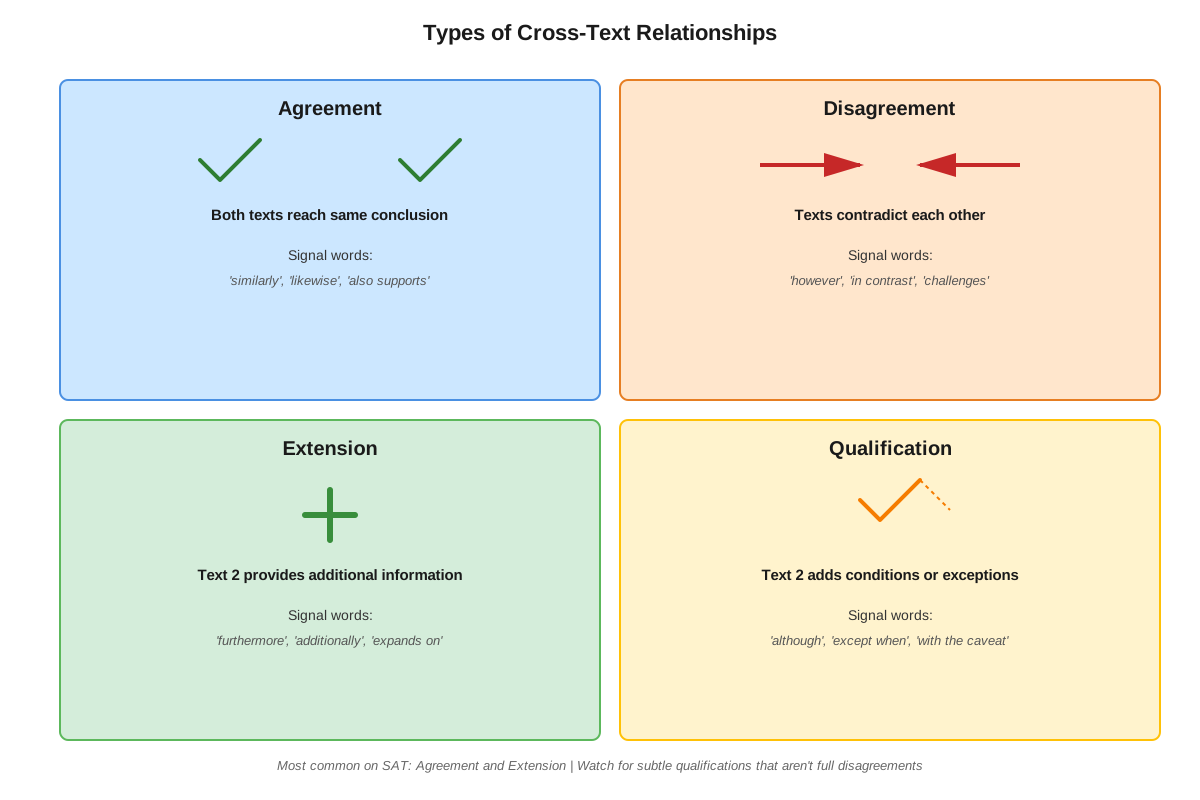
- [ ] Distinguish between different types of relationships between paired texts (agreement, disagreement, extension, qualification)
- [ ] Evaluate answer choices by checking them against both texts rather than just one
- [ ] Synthesize information from multiple sources to form a unified understanding of a topic
Prerequisites
- Basic reading comprehension: Understanding main ideas, supporting details, and author's purpose in single passages is essential because cross-text synthesis builds on these foundational skills by applying them to multiple texts simultaneously.
- Vocabulary in context: Recognizing how words function within passages helps students accurately interpret each text's meaning before comparing them.
- Identifying claims and evidence: Students must recognize what arguments each passage makes and what support is provided, as synthesis questions often focus on how claims relate across texts.
- Understanding text structure: Recognizing how passages are organized (cause-effect, comparison, chronological) aids in quickly identifying the relationship between paired texts.
Why This Topic Matters
Cross-text synthesis reflects authentic academic work that students will encounter throughout college and professional careers. Researchers regularly review multiple studies to identify consensus, contradictions, or gaps in knowledge. Writers synthesize sources to build arguments. Professionals evaluate competing reports to make informed decisions. The SAT tests this skill because it predicts success in higher education, where students must navigate complex information landscapes and integrate diverse perspectives.
On the SAT, cross-text synthesis questions appear consistently in the Reading and Writing section, typically comprising 2-3 questions per test. These questions are considered medium to high difficulty and carry the same weight as other question types, making them significant contributors to overall scores. Students who master this skill gain a strategic advantage because these questions follow predictable patterns once the underlying relationships are understood.
Common manifestations in exam passages include: scientific studies with different findings on the same phenomenon, historical texts from different time periods discussing the same event, literary criticism offering contrasting interpretations, or contemporary debates presenting opposing viewpoints. The passages are usually brief (40-80 words each), allowing the test to focus on synthesis rather than stamina. Questions typically ask students to identify what both texts support, how one text relates to the other, or what claim would be consistent with both passages.
Core Concepts
Understanding Cross-Text Synthesis
Cross-text synthesis is the process of reading two or more related texts and determining how they connect, compare, or contrast with one another. On the SAT, this skill is tested through paired passages that share a common topic but may present different perspectives, time periods, methodologies, or conclusions. The fundamental challenge is moving beyond comprehending each text individually to understanding the relationship between them.
The synthesis process involves three key stages:
- Comprehension: Understanding what each text says independently
- Comparison: Identifying similarities and differences between the texts
- Integration: Determining the overall relationship and what conclusions can be drawn from both texts together
Types of Text Relationships
Cross-text synthesis questions revolve around several common relationship patterns. Recognizing these patterns quickly helps students anticipate what the question will ask and where to look for answers.
| Relationship Type | Description | Example Scenario |
|---|---|---|
| Agreement/Support | Both texts make similar claims or support the same conclusion | Two studies both finding that a particular teaching method improves outcomes |
| Disagreement/Contradiction | Texts present opposing viewpoints or conflicting evidence | One historian arguing an event was economically motivated, another claiming political causes |
| Extension/Elaboration | One text builds upon or provides additional detail to the other | Text 1 introduces a concept; Text 2 provides a specific example or application |
| Qualification/Nuance | One text adds conditions, limitations, or complexity to the other's claims | Text 1 makes a broad claim; Text 2 identifies exceptions or boundary conditions |
| Question-Answer | One text poses a question or problem that the other addresses | Text 1 describes a mystery; Text 2 proposes an explanation |
| General-Specific | One text discusses a broad principle while the other provides a concrete instance | Text 1 explains a scientific law; Text 2 describes an experiment demonstrating it |
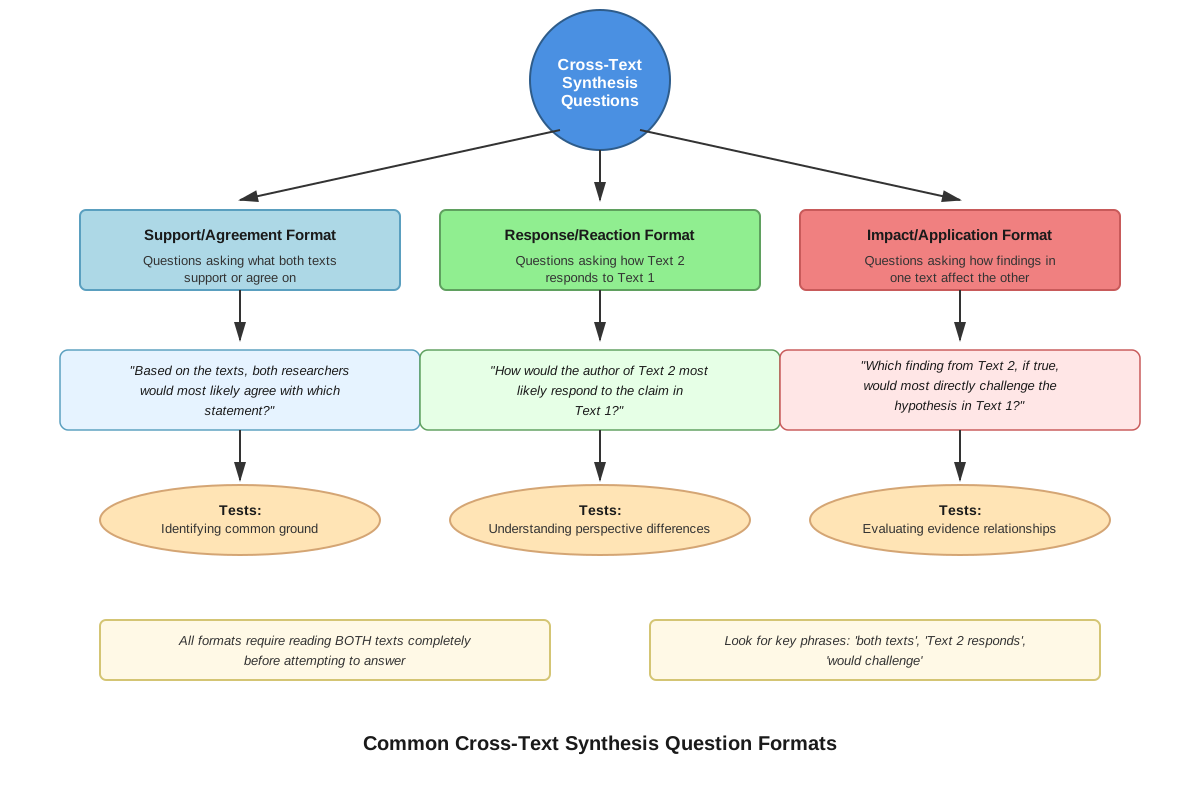
Question Formats in SAT Cross-Text Synthesis
SAT cross-text synthesis questions follow several predictable formats. Understanding these patterns enables students to approach questions strategically:
Format 1: "Based on the texts, how would the author of Text 2 most likely respond to the claim in Text 1?"
This format tests whether students understand each author's perspective and can predict how one would react to the other's argument.
Format 2: "Which finding from Text 2, if true, would most directly support the claim in Text 1?"
This format requires identifying which specific piece of information from one text provides evidence for a claim in the other.
Format 3: "Both texts support which of the following claims?"
This format tests the ability to identify common ground—what both authors would agree upon despite potential differences in other areas.
Format 4: "Text 1 presents [concept], while Text 2 [relationship to that concept]."
This format explicitly asks students to characterize the relationship between the texts, often using verbs like "challenges," "supports," "extends," or "qualifies."
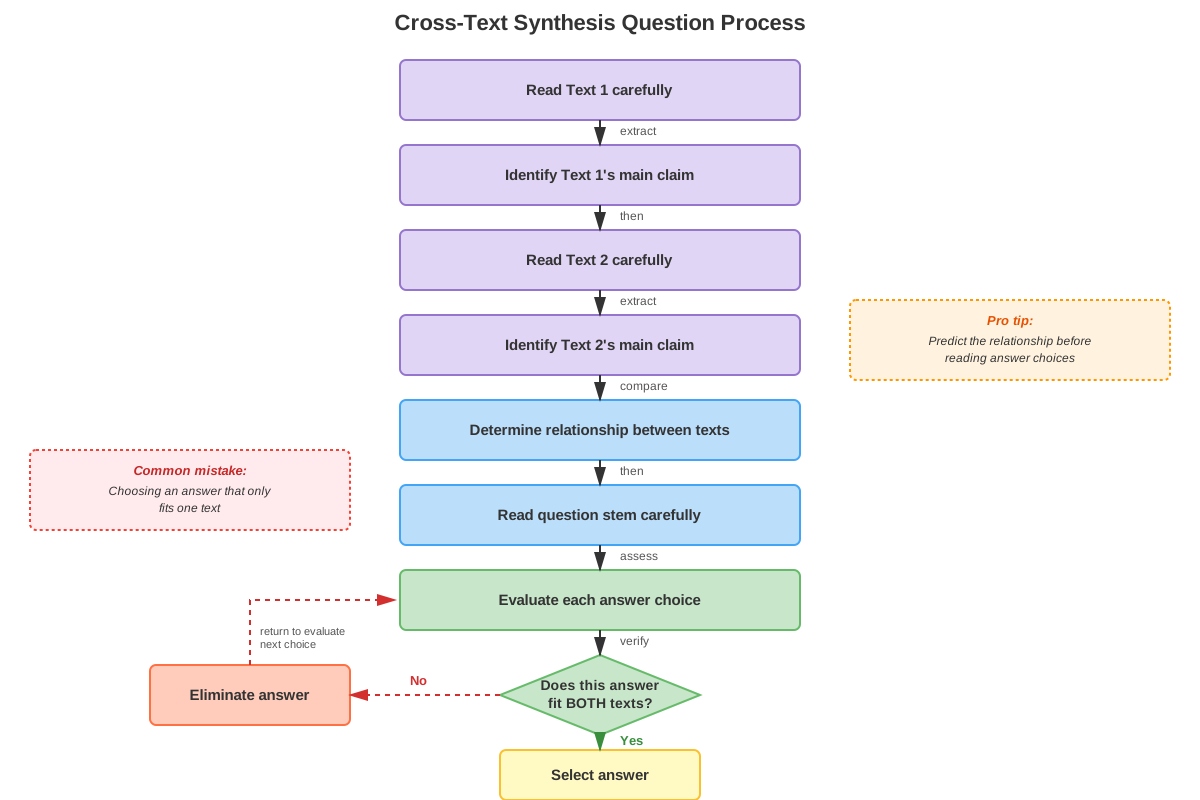
The Synthesis Process: Step-by-Step
Effective cross-text synthesis follows a systematic approach:
- Read Text 1 actively: Identify the main claim, key evidence, and author's purpose. Mentally summarize in one sentence.
- Read Text 2 with Text 1 in mind: As you read the second passage, actively compare it to the first. Ask: Does this agree or disagree? Does it add new information? Does it address the same aspect of the topic?
- Identify the relationship: Before looking at the question, determine how the texts relate using the categories above.
- Read the question carefully: Note whether it asks about both texts, one text's response to the other, or specific claims.
- Eliminate answers that contradict either text: An answer must be consistent with both passages unless the question specifically asks about disagreement.
- Verify the correct answer against both texts: The right answer will have clear support in the relevant passage(s).
Common Text Pairings on the SAT
The SAT draws from diverse content areas for cross-text synthesis questions:
- Scientific research: Two studies investigating the same phenomenon with different methodologies or findings
- Historical analysis: Different interpretations of historical events or figures
- Literary criticism: Varying perspectives on an author's work or literary movement
- Social science: Different theories explaining human behavior or social phenomena
- Contemporary issues: Contrasting viewpoints on current debates or policies
Regardless of content area, the underlying synthesis skills remain constant. Students need not be experts in the subject matter; all necessary information appears in the passages.
Concept Relationships
Cross-text synthesis integrates multiple foundational reading skills into a higher-order cognitive task. Reading comprehension serves as the base—students cannot synthesize what they don't understand. From there, identifying main ideas becomes crucial because synthesis questions focus on the central claims of each text rather than minor details. Understanding author's purpose connects directly to synthesis because recognizing why an author wrote something helps predict how they might respond to alternative viewpoints.
The relationship flow works as follows:
Reading Comprehension → Main Idea Identification → Author's Purpose Recognition → Cross-Text Comparison → Synthesis
Within cross-text synthesis itself, concepts build progressively. Students must first recognize that two texts discuss related topics before they can identify the specific relationship type (agreement, disagreement, etc.). Once the relationship is clear, students can predict what questions will ask and eliminate incorrect answers that mischaracterize the relationship. Finally, verifying answers against both texts ensures accuracy.
Cross-text synthesis also connects forward to college-level skills. It prepares students for research paper writing, where synthesizing multiple sources is essential, and critical thinking courses, where evaluating competing arguments is central. The skill transfers beyond English classes to any field requiring evidence-based reasoning—from scientific literature reviews to legal brief analysis.
High-Yield Facts
⭐ Cross-text synthesis questions always involve two related passages that must be read together to answer correctly.
⭐ The correct answer to a synthesis question must be supported by or consistent with both texts unless the question specifically asks about disagreement.
⭐ Common relationship types include agreement, disagreement, extension, qualification, and question-answer patterns.
⭐ Synthesis questions typically appear 2-3 times per SAT Reading and Writing section.
⭐ The passages in synthesis questions are brief (usually 40-80 words each), allowing focus on relationships rather than lengthy comprehension.
- Text 1 is always presented first and Text 2 second; questions may ask about either text's relationship to the other.
- Wrong answers often accurately describe one text but fail to account for information in the other text.
- Synthesis questions test higher-order thinking and are generally considered medium to high difficulty.
- The topic of paired texts is always related, but the specific angle, time period, or perspective may differ.
- Effective synthesis requires active reading—mentally comparing texts as you read rather than treating them as separate passages.
Quick check — test yourself on Cross-text synthesis so far.
Try Flashcards →Common Misconceptions
Misconception: Cross-text synthesis questions can be answered by reading only one of the two passages.
Correction: Both passages must be read and understood because the question specifically tests the relationship between them. Even if an answer choice seems supported by one text, it must be verified against the other text to be correct.
Misconception: If two texts discuss the same topic, they must agree with each other.
Correction: Texts can discuss the same topic while presenting contradictory claims, different perspectives, or varying levels of detail. The relationship must be determined by careful reading, not assumed based on shared subject matter.
Misconception: The correct answer will use the same words as the passages.
Correction: Correct answers often paraphrase or synthesize ideas from the passages using different vocabulary. Students must focus on meaning rather than exact word matching.
Misconception: Longer or more complex answer choices are more likely to be correct in synthesis questions.
Correction: Answer length and complexity do not correlate with correctness. The right answer is simply the one that accurately reflects the relationship between the texts, whether stated simply or elaborately.
Misconception: Personal opinion or outside knowledge should influence answer selection in synthesis questions.
Correction: Answers must be based solely on what the passages state or imply. Even if a student knows additional information about the topic, only evidence from the provided texts is relevant.
Misconception: Text 2 always responds to or comments on Text 1.
Correction: While some questions frame the relationship this way, texts may simply present parallel information, complementary evidence, or independent perspectives that happen to relate. The relationship varies by question.
Worked Examples
Example 1: Agreement Between Texts
Text 1
Recent archaeological findings in coastal Peru have revealed sophisticated irrigation systems dating to 3500 BCE. These systems demonstrate that early Andean societies possessed advanced engineering knowledge, challenging previous assumptions that such technology emerged much later in the region's history.
Text 2
Analysis of agricultural terraces in the Peruvian highlands has shown that pre-Columbian farmers implemented complex water management techniques as early as 3000 BCE. This evidence indicates that ancient Andean civilizations developed agricultural innovations earlier than scholars previously believed.
Question: Based on the texts, what claim would both authors most likely agree with?
Answer Choices:
A) Coastal and highland Peruvian societies developed independently without technological exchange.
B) Previous scholarly timelines for technological development in ancient Peru require revision.
C) Irrigation systems were more advanced in coastal regions than in highland areas.
D) Archaeological evidence from Peru is more reliable than evidence from other South American regions.
Solution Process:
Step 1: Identify the main claim of Text 1.
Text 1 argues that new findings show advanced engineering earlier than previously thought, challenging old assumptions.
Step 2: Identify the main claim of Text 2.
Text 2 argues that evidence shows agricultural innovations earlier than scholars previously believed.
Step 3: Identify the relationship.
Both texts present evidence that pushes back the timeline for technological sophistication in ancient Peru. They agree that previous scholarly understanding underestimated how early these developments occurred.
Step 4: Evaluate each answer choice.
- Choice A: Neither text discusses whether coastal and highland societies developed independently. This introduces information not present in either passage. Eliminate.
- Choice B: Both texts explicitly state that new evidence challenges or revises previous scholarly beliefs about when technology developed ("challenging previous assumptions" in Text 1; "earlier than scholars previously believed" in Text 2). This directly reflects the common ground between the texts. Strong candidate.
- Choice C: Text 1 discusses coastal systems and Text 2 discusses highland systems, but neither compares their relative advancement. Eliminate.
- Choice D: Neither text makes claims about the reliability of Peruvian evidence compared to other regions. Eliminate.
Answer: B
This question demonstrates the "agreement" relationship type. Both texts support the same overarching claim despite discussing different specific evidence (irrigation vs. terraces, coastal vs. highland).
Example 2: Extension/Elaboration Relationship
Text 1
Photosynthesis in plants converts light energy into chemical energy stored in glucose molecules. This process is fundamental to nearly all life on Earth, as it provides the energy foundation for most food chains and produces the oxygen that many organisms require for respiration.
Text 2
In a recent study, researchers found that certain deep-sea bacteria perform chemosynthesis, converting chemical energy from hydrothermal vents into usable energy without any light. These bacteria support entire ecosystems in complete darkness, demonstrating that life can thrive through alternative energy conversion processes.
Question: How does Text 2 relate to the claim in Text 1 that photosynthesis is "fundamental to nearly all life on Earth"?
Answer Choices:
A) It contradicts the claim by showing that photosynthesis is not necessary for any life forms.
B) It supports the claim by providing an additional example of photosynthesis.
C) It qualifies the claim by presenting an exception to photosynthesis-based life.
D) It extends the claim by explaining the chemical process of photosynthesis in detail.
Solution Process:
Step 1: Identify what Text 1 claims.
Text 1 states that photosynthesis is fundamental to "nearly all" life on Earth.
Step 2: Identify what Text 2 presents.
Text 2 describes chemosynthesis, a different process that supports life without light or photosynthesis.
Step 3: Determine the relationship.
Text 2 doesn't contradict Text 1 because Text 1 says "nearly all," not "all." Text 2 provides an example of the exception implied by "nearly all."
Step 4: Evaluate answer choices.
- Choice A: Text 2 shows that some life doesn't require photosynthesis, but it doesn't claim photosynthesis is unnecessary for all life. Text 1 already acknowledged exceptions with "nearly all." Too extreme. Eliminate.
- Choice B: Chemosynthesis is explicitly described as different from photosynthesis ("without any light"), not an example of it. Eliminate.
- Choice C: Text 2 presents chemosynthesis-based ecosystems as an exception to the photosynthesis-dependent life described in Text 1. This qualifies (adds nuance to) the "nearly all" claim by showing what falls outside that category. Strong candidate.
- Choice D: Text 2 doesn't explain photosynthesis; it describes a completely different process. Eliminate.
Answer: C
This question illustrates the "qualification" relationship. Text 1 makes a broad claim with a built-in acknowledgment of exceptions ("nearly all"), and Text 2 provides a specific example of those exceptions, adding nuance without contradicting the original claim.
Exam Strategy
Approaching Cross-Text Synthesis Questions
Read strategically, not passively. As you read Text 1, mentally summarize its main point in 5-10 words. When you begin Text 2, actively ask yourself: "How does this relate to Text 1? Does it agree, disagree, add information, or provide an example?"
Identify the relationship before reading the question. Spending 5-10 seconds determining whether the texts agree, disagree, or have another relationship saves time and reduces errors. Once you know the relationship, you can predict what the question will ask.
Watch for qualifying language. Words like "nearly all," "most," "some," "often," and "typically" signal that exceptions exist. Texts that seem to disagree may actually be presenting the exception to a qualified claim.
Trigger Words and Phrases
Questions that include these phrases signal specific relationship types:
- "Both texts support..." → Look for common ground or agreement
- "How would the author of Text 2 respond to..." → Determine if Text 2 agrees, disagrees, or qualifies Text 1
- "Which finding would support/challenge..." → Identify evidence relationships
- "Text 1 presents X, while Text 2..." → Characterize the relationship type
- "Based on both texts..." → Synthesize information from both passages
Process of Elimination Tips
- Eliminate answers that contradict either text unless the question specifically asks about disagreement. If an answer is inconsistent with Text 1 OR Text 2, it's wrong.
- Eliminate answers that only address one text when the question asks about both. The correct answer must account for information from both passages.
- Eliminate extreme language ("always," "never," "only," "all") unless both texts support such absolute claims. Synthesis answers typically reflect the nuance present in the passages.
- Eliminate answers that introduce outside information not present in either text. Stick to what the passages actually say.
Time Allocation
Cross-text synthesis questions typically require 60-90 seconds each:
- 30-40 seconds: Reading both passages
- 10-15 seconds: Identifying the relationship
- 10-15 seconds: Reading the question
- 15-25 seconds: Evaluating answer choices
Don't rush the reading phase. Understanding the texts thoroughly makes answering faster and more accurate.
Memory Techniques
The RACE Acronym for Synthesis
Read both texts actively
Analyze the relationship
Compare claims and evidence
Eliminate answers that ignore either text
Relationship Type Mnemonic: "ADEQG"
Agreement - texts support the same conclusion
Disagreement - texts present opposing views
Extension - one text builds on the other
Qualification - one text adds nuance or exceptions
General-Specific - one text provides examples of the other's principle
Visualization Strategy
Picture the two texts as two people having a conversation. Are they nodding in agreement? Shaking their heads in disagreement? Is one person adding "Yes, and furthermore..."? Is one saying "Yes, but..."? This personification helps clarify relationships.
The "Both Box" Technique
For questions asking what both texts support, mentally create a box labeled "BOTH." Only place claims in this box if you can point to support in Text 1 AND Text 2. If you can only find support in one text, it doesn't go in the box and can't be the answer.
Summary
Cross-text synthesis is a high-value SAT skill that requires students to read two related passages, understand each independently, and determine how they relate to one another. The most common relationships include agreement (both texts support similar claims), disagreement (texts present opposing views), extension (one text builds upon the other), and qualification (one text adds nuance or exceptions to the other's claims). Success on these questions depends on active reading that compares texts as you read, identifying the relationship before examining answer choices, and eliminating options that fail to account for both passages. The key principle is that correct answers must be consistent with both texts unless the question specifically asks about disagreement. Students should watch for qualifying language like "nearly all" or "most," which signals that exceptions exist and may be addressed in the paired text. By systematically reading both passages, analyzing their relationship, and verifying answers against both texts, students can consistently answer these medium-to-high difficulty questions correctly.
Key Takeaways
- Cross-text synthesis questions present two related passages and test the ability to identify relationships between them
- Common relationship types include agreement, disagreement, extension, qualification, and general-specific patterns
- Correct answers must be supported by or consistent with both texts unless the question asks specifically about disagreement
- Active reading that compares texts while reading (not after) improves speed and accuracy
- Eliminating answers that contradict either text or introduce outside information is the most effective strategy
- These questions appear 2-3 times per SAT section and are considered medium to high difficulty
- The passages are brief (40-80 words each), allowing focus on synthesis rather than lengthy comprehension
Related Topics
Main Idea and Purpose: Understanding what each passage is primarily about and why the author wrote it provides the foundation for comparing texts in synthesis questions. Mastering main idea identification makes recognizing agreement or disagreement between texts much faster.
Claims and Evidence: Recognizing how authors support their arguments helps students identify which specific pieces of information from one text might support or challenge claims in another text.
Rhetorical Analysis: Understanding how authors use language, tone, and structure to achieve their purposes enables deeper comprehension of how texts relate, especially when they present similar content with different rhetorical approaches.
Inference Questions: Both inference and synthesis require reading beyond literal statements to understand implications and relationships, making these skills mutually reinforcing.
Practice CTA
Now that you understand the key concepts and strategies for cross-text synthesis, it's time to apply this knowledge! Work through the practice questions to reinforce your ability to identify text relationships, compare claims across passages, and select answers that accurately reflect both texts. Each practice question you complete strengthens your synthesis skills and builds the confidence you need for test day. Remember: synthesis is a skill that improves rapidly with focused practice—you're building the exact type of analytical thinking that leads to score improvements and college success!
Sign up free to keep reading
Create a free AnvayaPrep account to finish this SAT guide on Cross-text synthesis — plus flashcards and practice questions.