Overview
The best introduction question type is one of the most frequently tested skills in the SAT Reading and Writing section, appearing in the Expression of Ideas domain. These questions assess a student's ability to select the most effective opening sentence for a passage or paragraph based on the content that follows. Success on these questions requires understanding rhetorical purpose, logical flow, and how introductory sentences establish context, tone, and direction for readers.
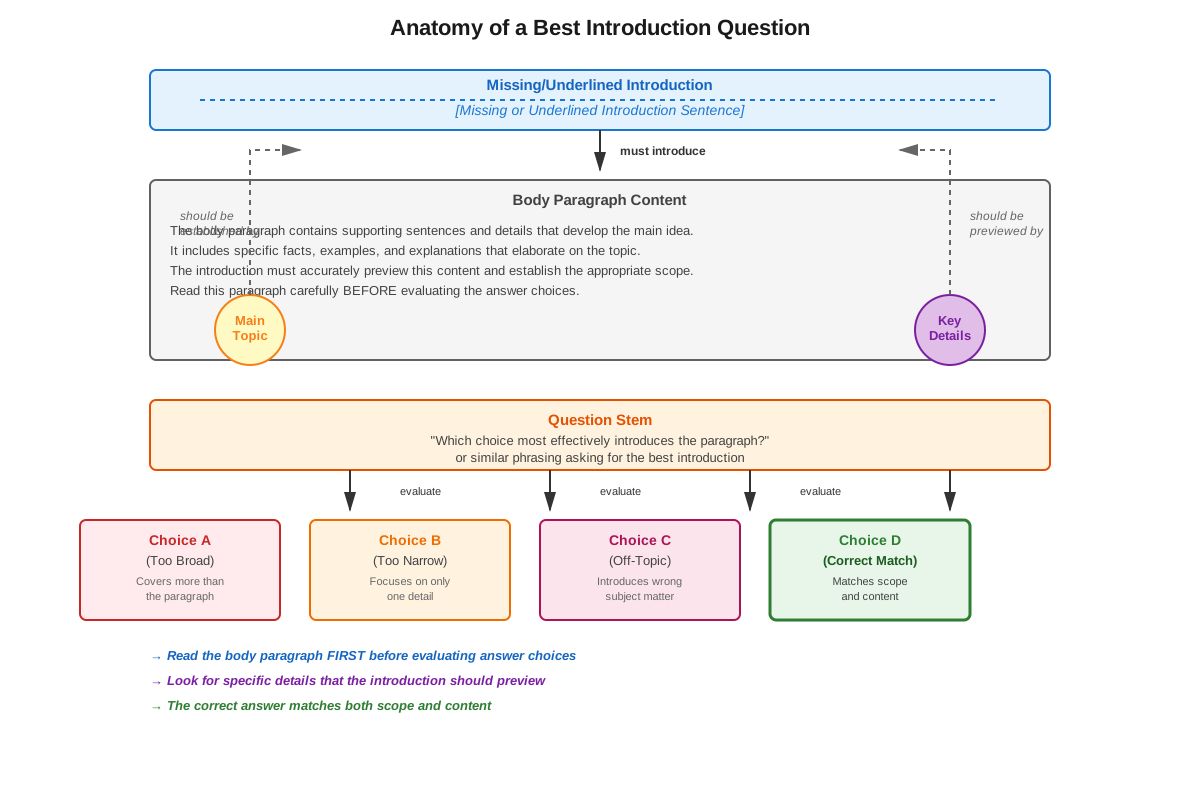
On the SAT, sat best introduction questions typically present a complete paragraph or passage with the opening sentence missing or marked for revision. Students must evaluate four options and determine which introduction most effectively prepares readers for the information that follows. These questions test critical thinking about organizational structure, thematic coherence, and the relationship between general statements and specific details. Unlike simple comprehension questions, best introduction items require students to analyze how writers establish expectations and guide reader understanding from the very first sentence.
Mastering this topic is essential because it connects to broader rw (reading and writing) skills including main idea identification, logical transitions, and rhetorical analysis. The ability to recognize effective introductions strengthens overall passage comprehension and helps students understand how professional writers structure arguments and explanations. This skill appears across multiple question types and directly impacts performance on approximately 5-8% of all Reading and Writing questions on the SAT.
Learning Objectives
- [ ] Identify key features of best introduction questions on the SAT
- [ ] Explain how best introduction questions appear on the SAT and what they assess
- [ ] Apply best introduction strategies to answer SAT-style questions accurately
- [ ] Evaluate multiple introduction options based on specificity, relevance, and scope
- [ ] Analyze the relationship between introductory sentences and supporting details
- [ ] Distinguish between effective and ineffective opening strategies for different passage types
- [ ] Synthesize information from a complete passage to determine the most appropriate introduction
Prerequisites
- Main idea identification: Understanding how to determine the central point of a paragraph or passage is essential because effective introductions must align with and preview the main idea
- Topic sentences: Recognizing how topic sentences function helps students understand that introductions serve a similar but broader purpose at the passage level
- Logical flow and coherence: Basic understanding of how ideas connect sequentially enables students to evaluate whether an introduction appropriately sets up what follows
- Reading comprehension fundamentals: The ability to understand passage content at a literal level is necessary before evaluating which introduction best fits that content
Why This Topic Matters
Best introduction questions matter because they assess a fundamental writing skill that extends far beyond standardized testing. In academic writing, professional communication, and everyday expression, the ability to craft effective openings determines whether audiences engage with content or lose interest immediately. Strong introductions establish credibility, provide necessary context, and create a roadmap for readers—skills essential for college essays, research papers, and professional documents.
On the SAT, best introduction questions appear with high frequency, typically 2-3 times per test administration across the two Reading and Writing modules. These questions carry the same weight as other Expression of Ideas items, making them significant contributors to the overall score. The College Board specifically tests this skill because it reflects authentic revision decisions that writers make when crafting coherent, purposeful texts.
These questions commonly appear in passages discussing scientific discoveries, historical events, biographical information, or explanatory texts about processes and phenomena. The passages are typically 25-150 words long, and students must read the entire text before evaluating which introduction option best serves the passage's purpose. Unlike some question types that can be answered by reading only a portion of the passage, best introduction questions require holistic comprehension and strategic thinking about organizational structure.
Core Concepts
Understanding Introduction Functions
An effective best introduction serves multiple critical functions that distinguish it from other sentences in a passage. First, it establishes the topic by clearly indicating what the passage will discuss. Second, it provides appropriate context that helps readers understand why the topic matters or how it fits into a larger framework. Third, it sets the scope by signaling whether the passage will be broad or narrow in focus. Fourth, it establishes tone and purpose, indicating whether the passage will inform, persuade, analyze, or narrate.
The most effective introductions balance specificity and generality. They must be specific enough to accurately preview the passage content without being so detailed that they duplicate information better suited for body sentences. They must be general enough to encompass all major points in the passage without being so vague that they could introduce almost any topic.
The Specificity Spectrum
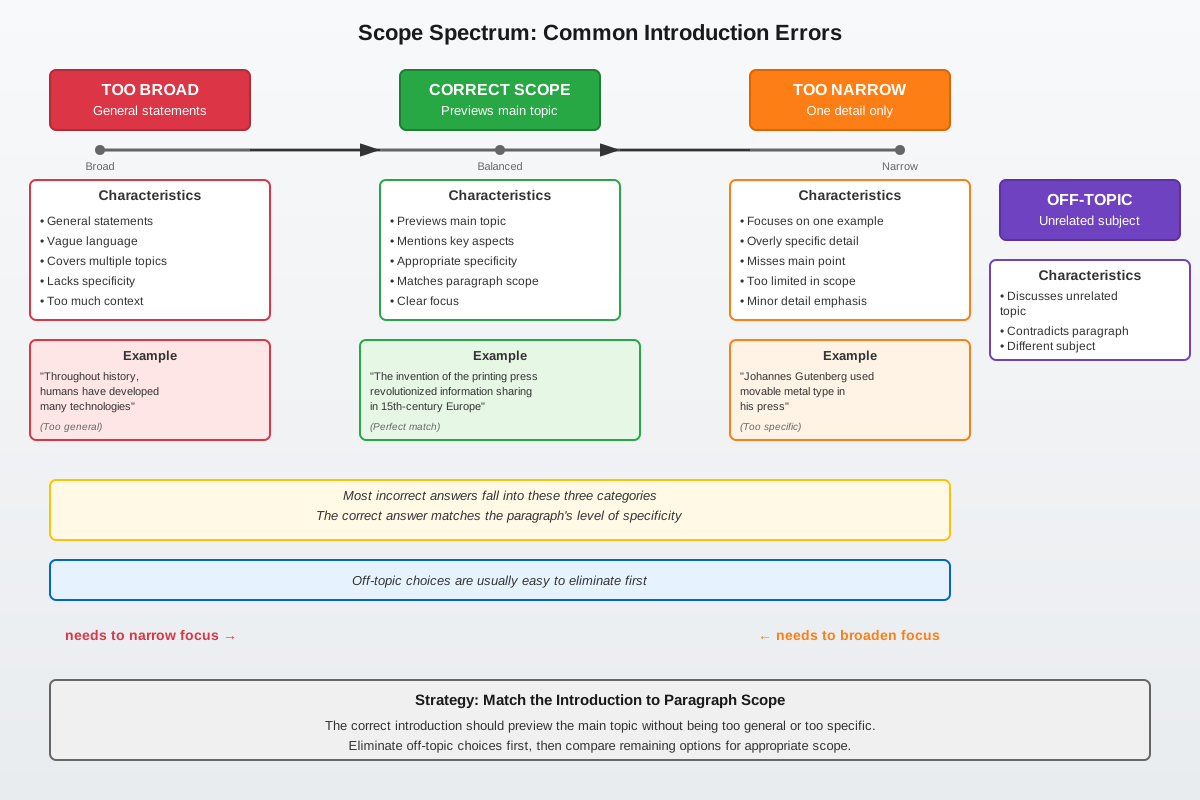
Best introduction questions fundamentally test understanding of the specificity spectrum—the range from extremely general statements to highly specific details. Consider this hierarchy:
| Level | Example | Appropriateness as Introduction |
|---|---|---|
| Too General | "Nature is interesting." | Poor—could introduce any nature topic |
| Appropriately General | "Octopuses demonstrate remarkable problem-solving abilities." | Good—specific topic, room for details |
| Appropriately Specific | "The common octopus can open childproof containers and navigate mazes." | Good—concrete preview of passage content |
| Too Specific | "In a 2019 study, octopuses opened 23 of 25 tested containers in under 4 minutes." | Poor—belongs in body, too detailed for opening |
The ideal introduction occupies the middle ground, providing enough specificity to orient readers while reserving detailed evidence and examples for supporting sentences. On the SAT, incorrect answer choices often fail by being either too vague (could introduce multiple different passages) or too specific (essentially functioning as a supporting detail rather than an introduction).
Alignment with Passage Content
The principle of content alignment requires that introductions accurately reflect what the passage actually discusses. This seems obvious, but SAT answer choices deliberately include options that sound sophisticated or interesting but don't match the passage's actual focus.
To evaluate alignment, students must:
- Read the entire passage first before examining answer choices
- Identify the main idea and major supporting points
- Note the passage's scope—does it discuss one aspect of a topic or multiple aspects?
- Recognize the passage's purpose—is it explaining a phenomenon, arguing a position, describing a process, or narrating events?
- Eliminate options that introduce topics not discussed in the passage
For example, if a passage discusses how climate change affects coral reefs specifically, an introduction about "environmental challenges facing marine ecosystems" would be too broad, while an introduction about "coral bleaching in the Great Barrier Reef" might be too narrow if the passage discusses coral reefs globally.
Logical Flow and Coherence
Effective introductions create logical flow by establishing expectations that the passage fulfills. The relationship between introduction and body content should feel natural and inevitable. When students read an introduction followed by the passage, they should think "yes, this makes sense" rather than "where did that come from?"
The coherence test involves checking whether the introduction's key terms, concepts, and focus appear in the passage body. If an introduction mentions "three revolutionary techniques," the passage should discuss three techniques. If an introduction emphasizes "surprising discoveries," the passage should present information framed as unexpected or counterintuitive.
Common Introduction Patterns
SAT passages employ several recurring introduction patterns:
The Definition Pattern: Introduces a term or concept and provides a brief definition or characterization. Example: "Biomimicry, the practice of learning from and mimicking natural strategies, has inspired numerous technological innovations."
The Context-Setting Pattern: Provides background information that makes the main topic comprehensible. Example: "While most people associate the 1960s with social upheaval, the decade also witnessed remarkable advances in space exploration."
The Problem-Solution Pattern: Introduces a challenge or question that the passage will address. Example: "For decades, researchers struggled to explain why certain bird species migrate thousands of miles while closely related species remain sedentary."
The Significance Pattern: Opens by establishing why the topic matters or why readers should care. Example: "Understanding how viruses evolve has become crucial for developing effective vaccines and treatments."
Recognizing these patterns helps students quickly identify which introduction type best matches a given passage's organizational structure.
Concept Relationships
The concepts within best introduction questions form an interconnected system. Specificity directly influences scope—more specific introductions naturally narrow the scope, while general introductions broaden it. Both specificity and scope must align with passage content to create coherence. The introduction pattern employed (definition, context-setting, etc.) determines what type of logical flow readers will expect.
These concepts connect to prerequisite knowledge about main ideas because the introduction essentially functions as a preview of the main idea. Understanding topic sentences helps because introductions serve a similar purpose at the passage level that topic sentences serve at the paragraph level. The skill of identifying logical transitions relates because introductions must transition smoothly into the first body sentence.
Best introduction skills also connect to other Expression of Ideas topics, particularly transitions (both require understanding logical relationships between sentences), concluding sentences (the bookend to introductions), and relevance (both require evaluating whether content fits the passage's purpose). Mastering introductions strengthens performance on organization questions more broadly.
Relationship Map:
Main Idea Identification → Determines Appropriate Scope → Guides Specificity Level → Ensures Content Alignment → Creates Logical Flow → Results in Effective Introduction
High-Yield Facts
- ⭐ The best introduction must accurately reflect ALL major points discussed in the passage, not just the first point mentioned
- ⭐ Introductions that are too specific (containing detailed examples or data) are almost always incorrect on the SAT
- ⭐ Introductions that are too general (could apply to dozens of different passages) are almost always incorrect
- ⭐ The correct introduction will contain key terms or concepts that appear throughout the passage, not just in one sentence
- ⭐ Students must read the ENTIRE passage before evaluating answer choices—the last sentence often contains crucial information
- If an introduction mentions multiple items (e.g., "three factors"), the passage must discuss all those items
- The tone of the introduction (formal, enthusiastic, neutral) should match the passage's overall tone
- Effective introductions avoid unnecessary qualifiers like "some people think" or "it is interesting that" unless the passage specifically discusses opinions or interesting aspects
- An introduction that focuses on a person's background is only appropriate if the passage discusses that background, not just the person's work
- The best introduction typically appears in the middle of the specificity spectrum—neither the most general nor most specific option
- Time period references in introductions (e.g., "In recent years") must match the passage's temporal focus
Quick check — test yourself on Best introduction so far.
Try Flashcards →Common Misconceptions
Misconception: The longest or most detailed introduction is usually correct because it provides more information.
Correction: Effective introductions are appropriately concise and avoid details better suited for body sentences. Length does not indicate quality; relevance and appropriate scope do.
Misconception: The introduction should only relate to the first sentence or two of the passage.
Correction: The best introduction must encompass the entire passage's content. Students must read through to the end before selecting an answer, as passages often develop or shift focus.
Misconception: Sophisticated vocabulary or complex sentence structure makes an introduction better.
Correction: Clarity and accuracy matter more than complexity. A simple, direct introduction that accurately previews the passage is superior to an eloquent introduction that misrepresents the content.
Misconception: If an introduction mentions something discussed anywhere in the passage, it's correct.
Correction: The introduction must reflect the passage's main focus and scope, not just mention a detail that appears briefly. An introduction emphasizing a minor point is incorrect even if that point exists in the passage.
Misconception: The introduction with the most general statement is safest because it can't be wrong.
Correction: Overly general introductions fail to provide meaningful orientation for readers. The SAT specifically tests whether students can distinguish between appropriately general (good) and vaguely general (poor) introductions.
Misconception: Personal opinion phrases like "many people believe" or "it is fascinating that" make introductions more engaging.
Correction: Unless the passage specifically discusses beliefs, opinions, or what makes something fascinating, these phrases add unnecessary words without adding value. Effective introductions get directly to the topic.
Worked Examples
Example 1: Scientific Discovery Passage
Passage:
[Missing Introduction] The researchers observed that crows in New Caledonia fashion hooks from twigs to extract insects from tree bark. These birds select specific plant species for their tools, preferring those with the right combination of flexibility and strength. Even more remarkably, young crows learn these tool-making techniques by watching adult birds, suggesting that this knowledge is culturally transmitted rather than purely instinctive. The discovery has prompted scientists to reconsider the cognitive abilities of birds and the definition of culture in non-human species.
Answer Choices:
A) Birds have long fascinated scientists studying animal behavior.
B) New Caledonian crows exhibit sophisticated tool-making abilities that challenge traditional assumptions about animal intelligence.
C) In a recent study, researchers documented 47 instances of crows using tools over a three-month period.
D) Many animals use tools, but few demonstrate the complexity seen in primates.
Analysis:
Step 1: Read the entire passage and identify the main idea. The passage focuses specifically on New Caledonian crows' tool-making abilities and what this reveals about bird cognition and culture.
Step 2: Evaluate each option's specificity and scope.
- Option A is too general—could introduce any passage about birds
- Option B is appropriately specific (names the species and key behavior) while encompassing all passage content
- Option C is too specific—sounds like a supporting detail with exact data
- Option D is too general and doesn't specifically mention crows
Step 3: Check content alignment.
- Option A doesn't mention tool-making or crows specifically
- Option B mentions tool-making (discussed throughout), sophistication (supported by examples), and intelligence (the passage's ultimate point)
- Option C focuses on a single study with specific numbers—the passage doesn't emphasize one study or provide these statistics
- Option D mentions primates, which the passage doesn't discuss
Step 4: Verify logical flow. Option B flows naturally into the first body sentence ("The researchers observed...") because it establishes that crows have tool-making abilities, and the body then provides specific examples of those abilities.
Answer: B is correct because it accurately previews the passage's focus (New Caledonian crows' tool-making), encompasses all major points (sophistication, learning, implications for understanding intelligence), and maintains appropriate specificity.
Example 2: Historical Biography Passage
Passage:
[Missing Introduction] Born in 1867 to formerly enslaved parents, she learned to read despite laws prohibiting African American education. Walker developed a line of hair care products specifically designed for Black women, building a business empire that made her one of the wealthiest self-made women in America. Beyond her commercial success, she employed thousands of Black women as sales agents, providing economic opportunities during an era of severe discrimination. Walker also became a philanthropist and activist, donating to educational institutions and advocating for anti-lynching legislation.
Answer Choices:
A) Madam C.J. Walker overcame significant obstacles to become a successful entrepreneur and advocate for African American rights.
B) The early 20th century presented numerous challenges for African American businesspeople.
C) Madam C.J. Walker invented a revolutionary hair care formula in 1905.
D) Many women in American history have made important contributions to business and social justice.
Analysis:
Step 1: Identify the passage's scope. The passage discusses Walker's business achievements, her impact on employment opportunities for Black women, and her activism—three distinct but related aspects of her life.
Step 2: Evaluate specificity.
- Option A names the specific person, mentions both entrepreneurship and advocacy (both discussed in the passage), and indicates obstacles (referenced in the passage)
- Option B doesn't mention Walker at all—too general
- Option C is too narrow, focusing only on one product invention and a specific date not mentioned in the passage
- Option D is too general—could introduce many different people
Step 3: Check whether the introduction encompasses all passage content.
- Option A covers business success ("successful entrepreneur") and activism ("advocate for African American rights")—both major passage themes
- Option B might seem relevant but doesn't introduce Walker specifically or her achievements
- Option C only addresses the hair care business, ignoring her employment of others and activism
- Option D doesn't specifically introduce Walker
Step 4: Assess tone and emphasis. The passage emphasizes Walker's accomplishments despite challenges. Option A captures this emphasis with "overcame significant obstacles," which aligns with the passage's opening about her birth to formerly enslaved parents and learning to read despite prohibitions.
Answer: A is correct because it names the specific subject, encompasses both major themes (business and activism), acknowledges the challenging context, and maintains appropriate generality that allows the passage to provide specific details.
Exam Strategy
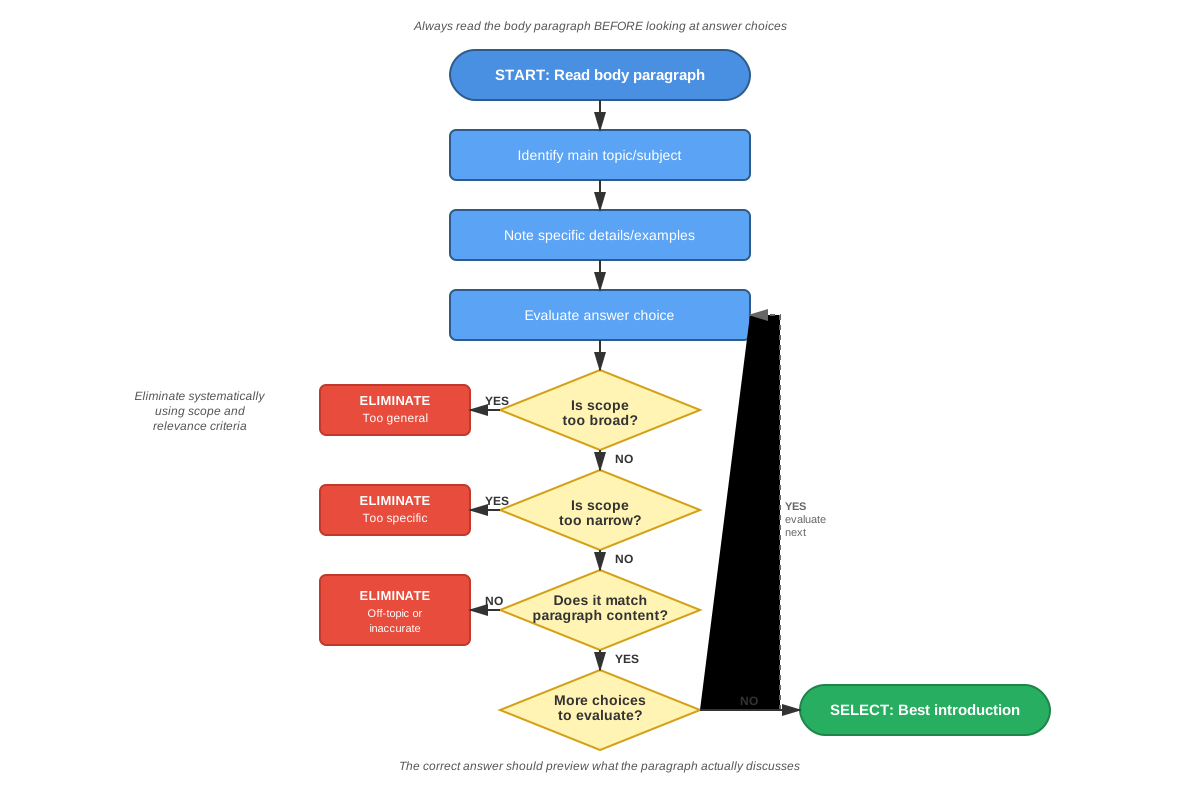
When approaching sat best introduction questions, follow this systematic process:
Step 1: Identify the question type by looking for phrases like "Which choice most effectively introduces the passage?" or "Which choice provides the best introduction to the topic?"
Step 2: Read the entire passage BEFORE looking at answer choices. This is crucial—many students make the mistake of reading one sentence and then checking options. The passage's conclusion often contains information essential for determining the correct introduction.
Step 3: Summarize the passage's main idea and scope in your own words. Ask yourself: "What is this passage really about? What are the major points it makes?"
Step 4: Predict what an effective introduction might include before reading the options. This prevents you from being swayed by attractive but incorrect choices.
Step 5: Eliminate options systematically:
- First, eliminate options that are too general (could introduce many different passages)
- Second, eliminate options that are too specific (sound like supporting details with exact data or examples)
- Third, eliminate options that mention topics not discussed in the passage
- Fourth, eliminate options that emphasize minor points rather than main ideas
Step 6: Verify the remaining option(s) by checking:
- Does it mention the passage's main subject?
- Does it encompass all major points, not just the first one?
- Does it flow logically into the first body sentence?
- Do key terms from the introduction appear throughout the passage?
Exam Tip: If an introduction mentions a number (e.g., "three reasons," "several factors"), count whether the passage actually discusses that many items. Mismatched quantities indicate an incorrect answer.
Trigger words to watch for:
- "Most effectively introduces" = focus on scope and comprehensiveness
- "Best sets up the information that follows" = focus on logical flow
- "Most appropriate introduction" = focus on tone and content alignment
Time allocation: Spend 45-60 seconds on these questions. They require reading the full passage but don't involve complex analysis once you understand the strategy.
Memory Techniques
SCARF Mnemonic for evaluating introductions:
- Scope: Does it match the passage's breadth?
- Content: Does it align with what's actually discussed?
- All points: Does it encompass all major ideas, not just the first?
- Relevance: Does it avoid mentioning undiscussed topics?
- Flow: Does it transition smoothly into the body?
The Goldilocks Principle: Remember that the best introduction is like Goldilocks' porridge—not too general (cold), not too specific (hot), but just right (appropriate specificity).
The Preview Test: An effective introduction is like a movie preview—it shows you what to expect without giving away all the details. If an introduction contains information that feels like it belongs in the middle of the passage, it's too specific.
The Umbrella Visualization: Picture the introduction as an umbrella that must cover all the major points in the passage. If major points stick out from under the umbrella, the introduction is too narrow. If the umbrella is so large it could cover many different passages, it's too broad.
RED FLAG Acronym for wrong answers:
- Random details (specific data, dates, or examples)
- Extraneous topics (mentions things not in the passage)
- Dull generality (so vague it means almost nothing)
Summary
Best introduction questions assess the ability to select opening sentences that effectively preview passage content while maintaining appropriate specificity and scope. Success requires reading the entire passage before evaluating options, identifying the main idea and all major supporting points, and eliminating choices that are too general, too specific, or misaligned with passage content. The correct introduction occupies the middle ground of the specificity spectrum—specific enough to meaningfully orient readers but general enough to encompass all passage content without duplicating body details. These questions appear frequently on the SAT and test authentic revision skills essential for academic and professional writing. Mastery involves understanding that introductions must align with the passage's topic, scope, tone, and purpose while creating logical flow into supporting sentences.
Key Takeaways
- Always read the complete passage before evaluating introduction options—the ending often contains crucial information
- The best introduction balances specificity and generality, avoiding both vague statements and detailed examples
- Correct introductions encompass ALL major passage points, not just the first idea mentioned
- Eliminate options that mention topics not discussed in the passage or that emphasize minor details
- Check that key terms from the introduction appear throughout the passage, indicating proper alignment
- Introduction questions test authentic writing skills about how to effectively open texts and establish reader expectations
- Use the SCARF method (Scope, Content, All points, Relevance, Flow) to systematically evaluate options
Related Topics
Transitions and Logical Flow: After mastering introductions, students should study how transitions connect ideas between sentences and paragraphs, building on the logical flow principles used in introduction questions.
Concluding Sentences: The bookend to introductions, conclusion questions test similar skills about scope and alignment but require synthesizing passage content into effective endings.
Relevance and Purpose: These questions ask whether specific sentences belong in a passage, requiring similar evaluation of content alignment and scope that introduction questions demand.
Organization and Structure: Broader questions about sentence order and paragraph arrangement build on introduction skills by requiring understanding of how entire passages should be structured.
Main Idea and Summary: Strengthening main idea identification skills directly improves performance on introduction questions since effective introductions preview main ideas.
Practice CTA
Now that you understand the key principles of identifying and evaluating best introductions, it's time to apply these strategies to real SAT-style questions. The practice questions will challenge you to distinguish between appropriately specific and overly general or specific introductions, evaluate content alignment, and select options that effectively preview complete passages. Remember to read each passage entirely before examining answer choices, and use the SCARF method to systematically evaluate your options. The flashcards will help you internalize the key concepts and common patterns. With focused practice, you'll develop the instinct to quickly identify effective introductions—a skill that will serve you well beyond the SAT in all your academic writing. You've got this!
Sign up free to keep reading
Create a free AnvayaPrep account to finish this SAT guide on Best introduction — plus flashcards and practice questions.