Overview
Cohesion is a fundamental principle in writing that ensures ideas flow logically and smoothly from one sentence to the next and from one paragraph to another. On the SAT Reading and Writing section, cohesion questions test a student's ability to recognize how sentences connect within a passage and to select transitions, sentence placements, or organizational structures that create the most logical flow of ideas. These questions require students to understand not just individual sentences in isolation, but how they function as building blocks in a larger argument or narrative.
The importance of cohesion on the SAT cannot be overstated. SAT cohesion questions appear regularly throughout the Reading and Writing section, typically comprising 10-15% of all questions. These questions assess whether students can identify logical relationships between ideas, recognize when information is presented in the wrong order, and select appropriate transitional words or phrases that accurately reflect the relationship between sentences. Mastering cohesion is essential because it directly impacts a student's ability to score well on Expression of Ideas questions, which constitute roughly half of the RW section.
Within the broader context of SAT Reading and Writing, cohesion serves as a bridge between understanding individual sentence structure and comprehending entire passages. While grammar and usage questions focus on correctness at the sentence level, cohesion questions require students to step back and evaluate how multiple sentences work together to develop an idea, present evidence, or construct an argument. This skill connects directly to rhetorical synthesis, transitions, and logical sequence—all critical components of effective communication that the SAT assesses.
Learning Objectives
- [ ] Identify key features of Cohesion
- [ ] Explain how Cohesion appears on the SAT
- [ ] Apply Cohesion to answer SAT-style questions
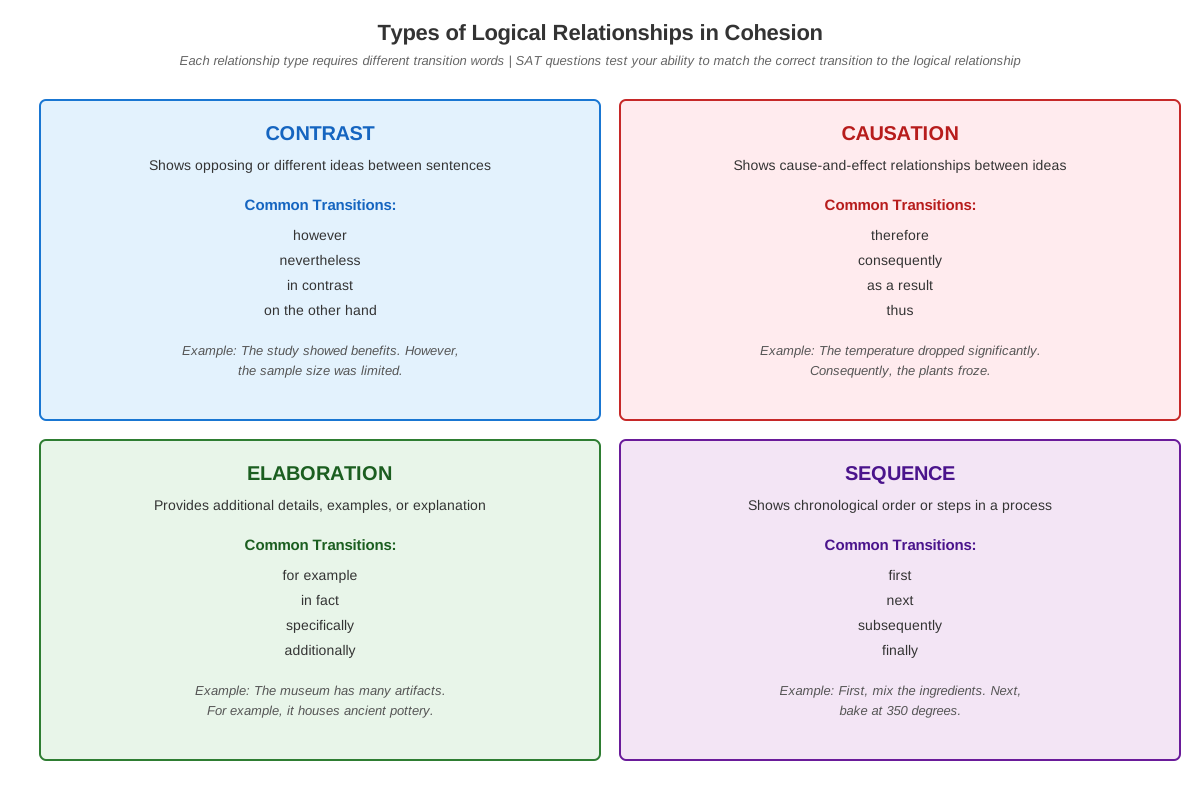
- [ ] Distinguish between different types of logical relationships that cohesion establishes (contrast, causation, elaboration, sequence)
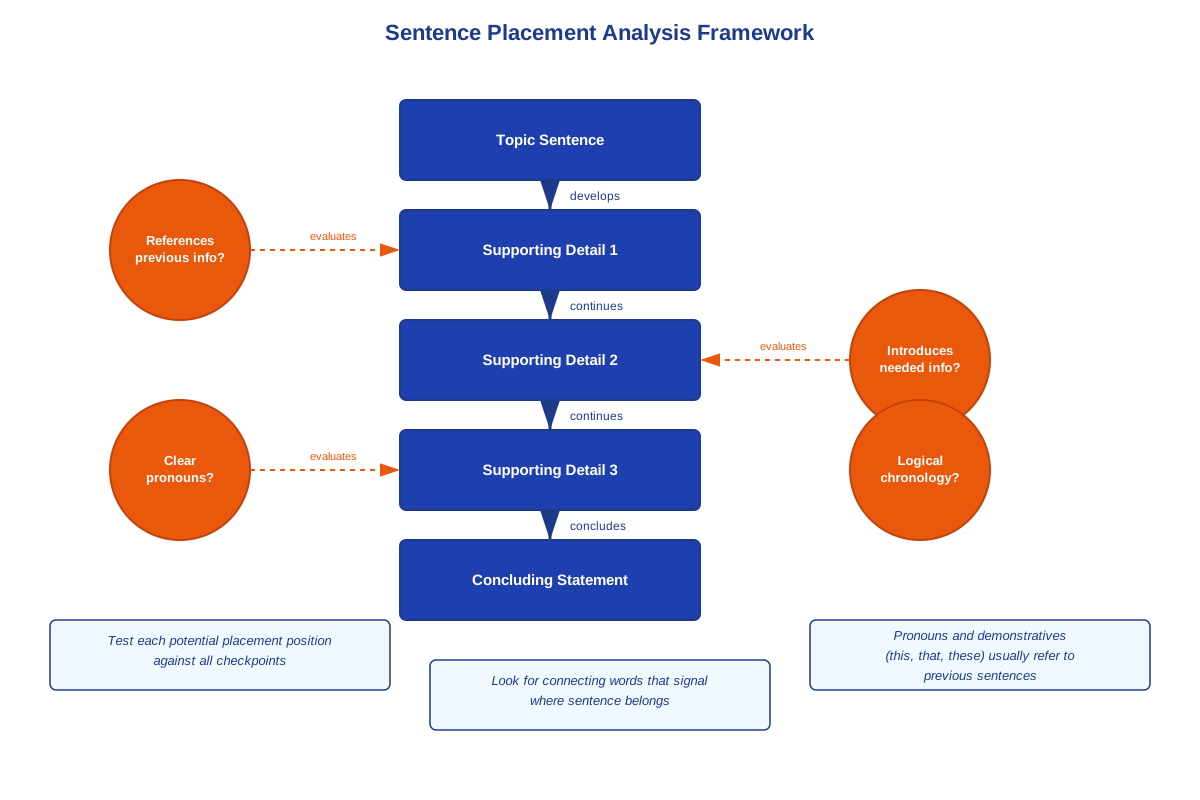
- [ ] Evaluate sentence placement within paragraphs to maximize logical flow
- [ ] Analyze transitional words and phrases to determine which best reflects the relationship between ideas
Prerequisites
- Basic sentence structure understanding: Students must recognize subjects, verbs, and objects to understand what each sentence communicates before evaluating how sentences connect.
- Reading comprehension skills: The ability to understand the main idea and supporting details of a passage is essential for determining logical flow.
- Familiarity with common transitional words: Knowing words like "however," "therefore," "additionally," and "for example" helps students recognize existing transitions and select appropriate ones.
- Understanding of paragraph structure: Recognizing topic sentences, supporting details, and concluding statements enables students to evaluate whether sentences are positioned logically.
Why This Topic Matters
Cohesion represents a critical real-world writing skill that extends far beyond standardized testing. In academic writing, professional communication, and everyday correspondence, the ability to connect ideas logically determines whether a message is understood or causes confusion. College essays, research papers, business proposals, and even email communications all depend on cohesive structure to guide readers through complex information. Students who master cohesion develop stronger analytical reading skills and become more effective writers across all contexts.
On the SAT specifically, cohesion questions appear with high frequency and predictability. Approximately 13-15% of all Reading and Writing questions directly test cohesion, which translates to roughly 6-7 questions per exam. These questions typically present in two main formats: transition questions (asking students to select the most appropriate transitional word or phrase) and sentence placement questions (requiring students to determine where a sentence should be positioned within a paragraph). Both question types appear across all difficulty levels, from straightforward contrast relationships to complex multi-layered logical connections.
Cohesion questions commonly appear in passages discussing scientific research, historical analysis, literary criticism, and social science topics. The SAT frequently embeds cohesion questions in passages where multiple pieces of evidence support a claim, where cause-and-effect relationships must be clearly established, or where contrasting viewpoints need to be distinguished. Recognizing these patterns helps students anticipate when cohesion will be tested and approach passages with the appropriate analytical mindset.
Core Concepts
What Is Cohesion?
Cohesion refers to the quality of writing where sentences and ideas connect logically and smoothly, creating a unified whole rather than a collection of disconnected statements. Cohesive writing guides readers through information in a way that feels natural and inevitable, where each sentence builds upon or relates clearly to what came before. The opposite of cohesive writing is disjointed or fragmented writing, where readers must work to understand how ideas relate or why information appears in a particular order.
Cohesion operates at multiple levels simultaneously. At the sentence level, cohesion involves using pronouns that clearly refer to previously mentioned nouns, repeating key terms to maintain focus, and employing parallel structure to show equivalent relationships. At the paragraph level, cohesion requires organizing sentences in a logical sequence, using transitional words to signal relationships, and ensuring that each sentence contributes to the paragraph's main idea. At the passage level, cohesion means structuring paragraphs so they build toward a conclusion or develop an argument systematically.
Types of Logical Relationships
Understanding the specific types of logical relationships that cohesion establishes is crucial for SAT success. These relationships fall into several distinct categories:
| Relationship Type | Function | Common Transitions | Example Context |
|---|---|---|---|
| Addition/Continuation | Adds similar or supporting information | moreover, furthermore, additionally, also | Presenting multiple pieces of evidence for a claim |
| Contrast/Opposition | Introduces conflicting or different information | however, nevertheless, conversely, on the other hand | Comparing two theories or presenting counterarguments |
| Cause and Effect | Shows that one event or idea results from another | therefore, consequently, thus, as a result | Explaining scientific processes or historical outcomes |
| Example/Illustration | Provides specific instances of a general statement | for example, for instance, specifically, namely | Supporting abstract claims with concrete evidence |
| Sequence/Time | Indicates chronological or procedural order | first, next, subsequently, finally | Describing historical events or experimental procedures |
| Emphasis/Clarification | Reinforces or explains a previous point | indeed, in fact, that is, in other words | Strengthening an argument or preventing misunderstanding |
Transitional Words and Phrases
Transitional words and phrases serve as the explicit signals of cohesion, telling readers exactly how one idea relates to another. On the SAT, transition questions present a sentence with a blank where a transitional word or phrase should appear, followed by four options that represent different logical relationships. The key to answering these questions correctly lies in carefully reading the sentences before and after the blank to determine the actual relationship between ideas.
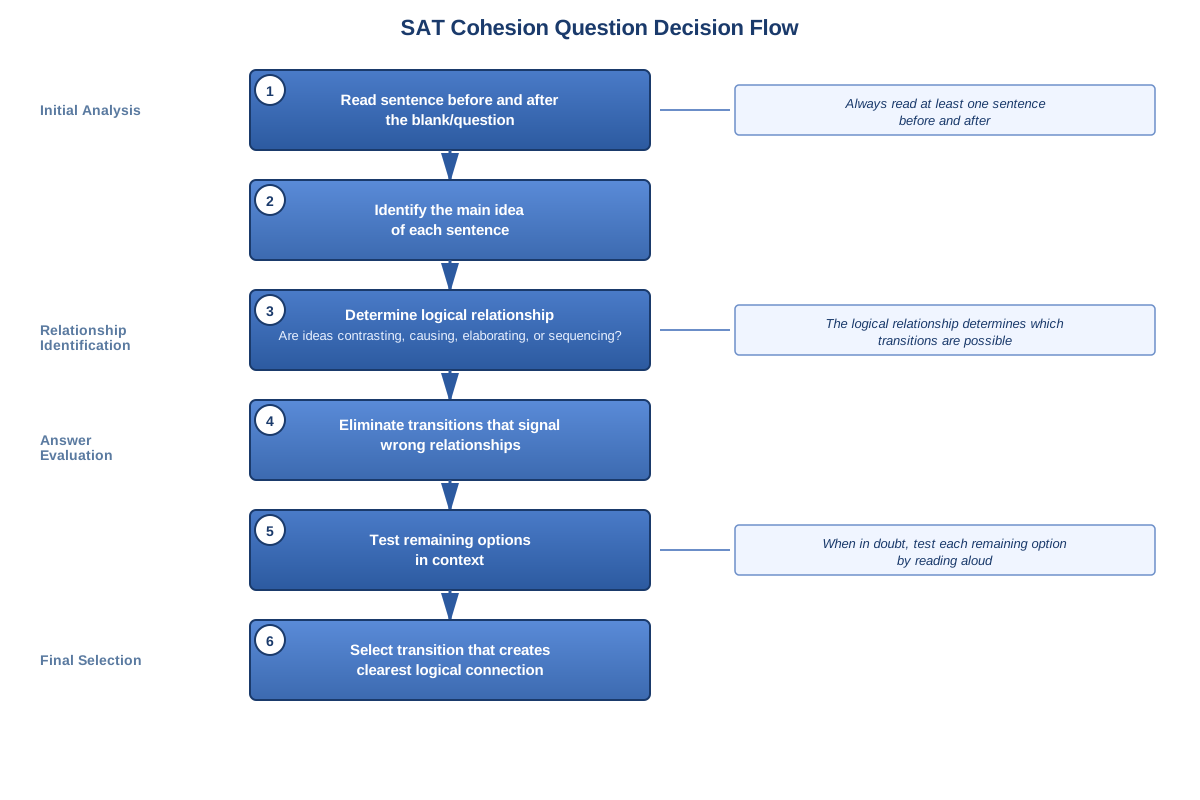
Effective transition selection requires a two-step process:
- Identify the relationship: Read the sentence before the blank and the sentence containing or following the blank. Determine whether the second sentence agrees with, contradicts, explains, exemplifies, or results from the first sentence.
- Match the transition to the relationship: Select the transition that accurately signals the identified relationship. Avoid choosing transitions based on how they "sound" or their frequency in writing; instead, focus exclusively on logical accuracy.
Common errors in transition selection occur when students confuse similar-seeming relationships. For example, "therefore" and "for example" might both seem to "continue" an idea, but "therefore" signals that the second sentence is a logical consequence of the first, while "for example" signals that the second sentence provides a specific instance of a general claim made in the first. This distinction is precisely what the SAT tests.
Sentence Placement and Logical Sequence
Beyond transitional words, cohesion depends on presenting information in a logical order. Sentence placement questions on the SAT provide a paragraph with one sentence numbered and ask where that sentence should be positioned to create the most logical flow. These questions test whether students can recognize the proper sequence for introducing concepts, presenting evidence, and drawing conclusions.
Several principles govern effective sentence placement:
- Topic sentences typically appear first: Sentences that introduce the main idea of a paragraph usually belong at the beginning, providing a framework for what follows.
- Evidence follows claims: Specific examples, data, or quotations should appear after the general statements they support.
- Chronological order for narratives: When describing events or processes, earlier events should precede later ones unless there's a specific rhetorical reason for non-chronological presentation.
- Logical progression from general to specific: Paragraphs often move from broad statements to particular details, or from abstract principles to concrete applications.
- Concluding statements appear last: Sentences that summarize, draw conclusions, or transition to a new topic typically belong at the end of a paragraph.
Cohesive Devices Beyond Transitions
While transitional words are the most obvious markers of cohesion, several other linguistic devices create connections between sentences:
Pronoun reference creates cohesion by using pronouns (he, she, it, they, this, these) to refer back to nouns in previous sentences, avoiding repetitive naming while maintaining focus on the same subject.
Repetition of key terms reinforces the topic and creates unity. Strategic repetition of important nouns or concepts helps readers track the main subject across multiple sentences.
Synonyms and related terms provide variety while maintaining focus. Using different words that refer to the same concept (e.g., "the scientist," "the researcher," "Darwin") keeps writing interesting while preserving cohesion.
Parallel structure creates cohesion by presenting similar ideas in similar grammatical forms, helping readers recognize equivalent relationships.
Concept Relationships
The concepts within cohesion form an interconnected system where each element supports the others. Logical relationships serve as the foundation—understanding that ideas can relate through addition, contrast, causation, or exemplification is prerequisite to everything else. These relationships then manifest through transitional words and phrases, which explicitly signal to readers which relationship exists between sentences. Meanwhile, sentence placement depends on recognizing these same logical relationships to determine the proper sequence for presenting information. Finally, cohesive devices like pronoun reference and key term repetition work alongside transitions to reinforce the connections that logical relationships establish.
This topic connects to prerequisite knowledge in several ways. Understanding basic sentence structure enables students to identify what each sentence communicates, which is necessary before evaluating how sentences relate. Reading comprehension skills allow students to grasp the main idea and supporting details, providing the context needed to assess whether sentences are arranged logically. Familiarity with transitional words gives students the vocabulary to recognize and select appropriate connectors.
Cohesion also connects forward to more advanced writing concepts. Mastering cohesion prepares students for rhetorical synthesis, where they must combine information from multiple sources into a unified argument. It supports understanding of paragraph structure and development, where cohesion operates at a larger scale. The skill also underpins effective revision strategies, as recognizing cohesion problems is essential for improving draft writing.
Relationship Map: Logical Relationships → manifest through → Transitional Words → which guide → Sentence Placement → reinforced by → Cohesive Devices → all contributing to → Overall Passage Cohesion → which enables → Effective Communication
High-Yield Facts
⭐ Cohesion questions constitute approximately 13-15% of SAT Reading and Writing questions, making them one of the most frequently tested Expression of Ideas concepts.
⭐ Transition questions require identifying the logical relationship between sentences before selecting a transitional word; the relationship determines the correct answer, not the "sound" of the transition.
⭐ Sentence placement questions are solved by identifying what information the sentence contains and determining where that information fits logically in the paragraph's progression of ideas.
⭐ Contrast transitions (however, nevertheless, conversely) should only be used when the second sentence contradicts or presents an opposing view to the first sentence, not merely when it introduces different information.
⭐ Cause-and-effect transitions (therefore, consequently, thus) require that the second sentence be a direct logical result of the first sentence, not just a related idea.
- Addition transitions (moreover, furthermore, additionally) indicate that the second sentence provides similar or supporting information that strengthens the same point.
- Example transitions (for example, for instance) signal that the second sentence provides a specific case that illustrates a general claim made in the first sentence.
- Sentence placement questions often include sentences with pronouns or demonstrative adjectives (this, these, that, those) that must refer to nouns in preceding sentences, providing clues about correct placement.
- The most logical sentence order typically follows a pattern: introduce concept → provide evidence → explain significance or draw conclusion.
- Cohesion questions never have "correct" answers based solely on grammar; all options will be grammatically acceptable, and the correct answer depends entirely on logical relationships and context.
- Reading the full paragraph (not just the immediate surrounding sentences) is often necessary to determine the correct answer for both transition and sentence placement questions.
- Time sequence transitions (first, next, then, finally) should only be used when describing events or steps that occur in chronological or procedural order.
Quick check — test yourself on Cohesion so far.
Try Flashcards →Common Misconceptions
Misconception: Any transition that seems to "continue" the paragraph is acceptable. → Correction: Transitions must precisely match the specific logical relationship between sentences. "Moreover" (addition), "therefore" (causation), and "for example" (illustration) all "continue" ideas but signal completely different relationships. Selecting the wrong type of continuation creates logical incoherence.
Misconception: Longer or more sophisticated-sounding transitions are better choices. → Correction: The SAT rewards logical accuracy, not complexity. A simple "but" is correct if the relationship is contrast, while an elaborate "nevertheless" is wrong if the relationship is actually causation. Always prioritize the match between transition and relationship over perceived sophistication.
Misconception: Sentence placement questions can be answered by finding where the sentence "sounds best." → Correction: Correct placement depends on logical sequence and information flow. A sentence introducing a new concept must come before sentences that elaborate on that concept. A sentence with a pronoun must follow a sentence containing the noun it references. Sound and rhythm are irrelevant to these questions.
Misconception: If two sentences discuss related topics, they are cohesive. → Correction: Cohesion requires explicit logical connection, not merely topical similarity. Two sentences about climate change might be topically related but lack cohesion if one discusses causes and the other discusses solutions without a transition indicating the shift in focus.
Misconception: The sentence immediately before the blank is the only context needed for transition questions. → Correction: While the immediately preceding sentence is crucial, the sentence following the blank and sometimes the broader paragraph context are equally important. The transition must accurately reflect the relationship between both surrounding sentences and fit the paragraph's overall logical flow.
Worked Examples
Example 1: Transition Selection
Passage: Scientists have long debated the cause of the dinosaurs' extinction. The asteroid impact theory has gained widespread acceptance due to geological evidence of a massive crater in Mexico. _____ some researchers argue that volcanic activity in India's Deccan Traps contributed significantly to the extinction event.
Options:
A) Therefore,
B) For example,
C) However,
D) Additionally,
Solution Process:
Step 1: Identify what the sentence before the blank communicates. The sentence states that the asteroid impact theory has gained widespread acceptance, suggesting this is the dominant or favored explanation.
Step 2: Identify what the sentence with the blank communicates. This sentence introduces researchers who argue for a different cause (volcanic activity), presenting an alternative explanation.
Step 3: Determine the relationship. The second sentence presents a view that differs from or challenges the dominant view mentioned in the first sentence. This is a contrast relationship.
Step 4: Evaluate each option:
- A) "Therefore" signals causation—that the second sentence is a result of the first. This doesn't fit because researchers arguing for volcanic activity is not a result of the asteroid theory gaining acceptance.
- B) "For example" signals that the second sentence provides a specific instance of the first. This doesn't fit because volcanic activity is not an example of asteroid impact.
- C) "However" signals contrast—that the second sentence presents opposing or different information. This fits perfectly because the volcanic theory contrasts with the asteroid theory.
- D) "Additionally" signals addition—that the second sentence provides similar supporting information. This doesn't fit because the volcanic theory is an alternative, not additional support for the asteroid theory.
Answer: C) However,
Connection to Learning Objectives: This example demonstrates how to identify the logical relationship between sentences (contrast) and select the transition that accurately signals that relationship, directly applying cohesion principles to SAT-style questions.
Example 2: Sentence Placement
Passage: [1] Marie Curie's groundbreaking research on radioactivity transformed modern physics. [2] She discovered two new elements, polonium and radium, through painstaking laboratory work. [3] Her achievements earned her two Nobel Prizes, making her the first person to win the award in two different scientific fields. [4] She remains an inspiration to scientists worldwide.
Question: Where should the following sentence be placed? "This dedication to scientific inquiry came at great personal cost, as prolonged exposure to radioactive materials ultimately damaged her health."
Options:
A) Before sentence 1
B) Between sentences 1 and 2
C) Between sentences 2 and 3
D) Between sentences 3 and 4
Solution Process:
Step 1: Analyze what information the sentence to be placed contains. The sentence discusses the personal cost of Curie's dedication to scientific inquiry, specifically health damage from radiation exposure.
Step 2: Identify key cohesive elements. The sentence begins with "This dedication," using a demonstrative adjective that must refer to dedication mentioned in a previous sentence. It also discusses consequences of her work, suggesting it should follow description of that work.
Step 3: Evaluate each position:
- Before sentence 1: This position doesn't work because "This dedication" would have no antecedent—no previous sentence has mentioned dedication to scientific inquiry.
- Between sentences 1 and 2: Sentence 1 mentions "groundbreaking research," which could be the antecedent for "This dedication." However, placing the sentence here would interrupt the logical flow from introducing her research (sentence 1) to describing specific discoveries (sentence 2). The health cost information would be better placed after establishing her achievements.
- Between sentences 2 and 3: Sentence 2 describes her laboratory work discovering elements, and sentence 3 discusses her Nobel Prizes. Placing the sentence here would interrupt the progression from describing her work to recognizing her achievements. The health cost information doesn't logically fit between these two closely connected ideas.
- Between sentences 3 and 4: Sentence 3 completes the description of her achievements (two Nobel Prizes), and sentence 4 provides a concluding statement about her legacy. The sentence about personal cost fits logically here because it adds a sobering counterpoint to the achievements before the final inspirational statement. "This dedication" can refer back to the dedication implied by her extensive research and achievements described in sentences 1-3.
Step 4: Confirm the choice. Position D creates the most logical flow: introduce her impact → describe discoveries → recognize achievements → acknowledge personal cost → conclude with lasting inspiration. This sequence presents a complete picture of Curie's career, including both triumphs and sacrifices, before the concluding statement.
Answer: D) Between sentences 3 and 4
Connection to Learning Objectives: This example demonstrates how to evaluate sentence placement by analyzing cohesive devices (demonstrative adjectives requiring antecedents), logical sequence (achievements before consequences), and overall paragraph structure (building to a conclusion).
Exam Strategy
When approaching SAT cohesion questions, employ a systematic process that prioritizes logical relationships over intuition or "sound." For transition questions, always follow this sequence:
- Read the full sentence before the blank to understand what claim, evidence, or idea it presents.
- Read the full sentence containing the blank to understand what it adds to the discussion.
- Identify the specific relationship between these sentences using the categories: addition, contrast, causation, example, sequence, or emphasis.
- Eliminate options that signal different relationships than the one you identified.
- Verify your choice by reading the sentences with your selected transition to ensure logical coherence.
For sentence placement questions, use this approach:
- Analyze the sentence to be placed for key information: What is its main point? Does it contain pronouns or demonstrative adjectives requiring antecedents? Does it introduce new information or elaborate on existing information?
- Read the entire paragraph to understand its overall structure and progression of ideas.
- Test each position by considering what would come before and after the sentence in that location.
- Look for cohesive clues: pronouns that need antecedents, transitional words within the sentence, logical sequence requirements.
- Eliminate positions that create logical problems: pronouns without antecedents, disrupted sequences, or awkward information flow.
Trigger words to watch for:
- Contrast indicators: "different," "opposing," "alternative," "challenge," "dispute" → suggest contrast transitions needed
- Result indicators: "outcome," "consequence," "effect," "led to," "caused" → suggest causation transitions needed
- Support indicators: "evidence," "data," "study," "research shows" → suggest addition or example transitions needed
- Sequence indicators: "process," "steps," "stages," "development," "history" → suggest time/sequence transitions needed
Process-of-elimination tips:
- Immediately eliminate transitions that signal the opposite relationship (e.g., eliminate contrast transitions if sentences agree).
- Eliminate transitions that require conditions not present in the text (e.g., "for example" requires a general statement followed by a specific instance).
- For sentence placement, eliminate positions that would place pronouns before their antecedents or effects before causes.
Time allocation: Cohesion questions should take 30-45 seconds each. If you find yourself spending more than one minute, you're likely overthinking. Return to the basic question: What is the logical relationship between these ideas? The answer is always present in the text itself.
Memory Techniques
CAFE Transitions Mnemonic: Remember the four most common transition types with CAFE:
- Contrast: however, nevertheless, conversely
- Addition: moreover, furthermore, additionally
- For example: for instance, specifically, namely
- Effect/Cause: therefore, consequently, thus
The Pronoun Placement Rule: "Pronouns need parents" — any sentence with pronouns (especially "this," "these," "such," "it") must be placed after a sentence containing the noun it references. Visualize pronouns as children who must follow their parent nouns.
The Evidence Sandwich: Visualize paragraph structure as a sandwich:
- Top bun = Topic sentence (introduces the main idea)
- Filling = Evidence and examples (supports the main idea)
- Bottom bun = Conclusion or transition (wraps up or connects forward)
A sentence to be placed is an ingredient that must go in the right layer of the sandwich.
Contrast vs. Addition Quick Check: Ask yourself: "Could I use 'and' between these sentences?" If yes, it's addition. "Could I use 'but'?" If yes, it's contrast. This simple test quickly distinguishes the two most commonly confused relationships.
The Sequence Story: For time-based transitions, visualize the events as scenes in a movie. Scenes must play in order unless there's a flashback. If sentence A describes 1950 and sentence B describes 1960, B must follow A (or use a flashback transition like "previously").
Summary
Cohesion represents the logical flow and connection between ideas in writing, ensuring that sentences and paragraphs work together as a unified whole rather than disconnected fragments. On the SAT Reading and Writing section, cohesion questions test students' ability to select appropriate transitional words that accurately signal logical relationships and to determine optimal sentence placement within paragraphs. Success requires identifying specific relationship types—addition, contrast, causation, example, sequence, and emphasis—and matching them with appropriate transitions. Sentence placement questions demand analysis of cohesive devices like pronoun reference, recognition of logical sequence requirements, and understanding of paragraph structure. The key to mastering cohesion lies in focusing on logical relationships rather than intuition, systematically analyzing context before and after transitions or placement positions, and recognizing that correct answers depend entirely on how ideas connect rather than how options "sound."
Key Takeaways
- Cohesion questions constitute 13-15% of SAT Reading and Writing questions, making them high-yield for score improvement
- Transition selection depends entirely on identifying the logical relationship between sentences: addition, contrast, causation, example, sequence, or emphasis
- Sentence placement requires analyzing cohesive devices (pronouns, demonstrative adjectives) and logical sequence (general to specific, cause to effect, chronological order)
- Contrast transitions should only be used when sentences present opposing or contradictory information, not merely different topics
- Cause-and-effect transitions require that the second sentence be a direct logical consequence of the first sentence
- Reading full context (entire paragraph, not just adjacent sentences) is often necessary for correct answers
- All answer choices will be grammatically correct; the right answer is determined by logical coherence and contextual fit
Related Topics
Transitions and Logical Flow: Building on cohesion fundamentals, this topic explores more sophisticated transitional strategies, including paragraph-level transitions and transitions between major sections of longer passages. Mastering cohesion provides the foundation for understanding these more complex connective structures.
Rhetorical Synthesis: This advanced skill requires combining information from multiple sources into a cohesive argument. The cohesion principles learned here—logical relationships, appropriate transitions, and effective sequencing—are essential tools for successful synthesis.
Paragraph Structure and Development: Understanding how individual sentences connect (cohesion) naturally extends to understanding how sentences work together to develop a paragraph's main idea through topic sentences, supporting details, and concluding statements.
Effective Revision Strategies: Recognizing cohesion problems is a crucial revision skill. Students who master identifying and correcting cohesion issues on the SAT develop transferable skills for improving their own writing.
Practice CTA
Now that you've mastered the core concepts of cohesion, it's time to put your knowledge into action! Work through the practice questions to reinforce your understanding of logical relationships, transition selection, and sentence placement. Use the flashcards to memorize key transition types and their functions. Remember: cohesion questions are highly predictable and follow consistent patterns. With focused practice, you can master this high-yield topic and significantly boost your SAT Reading and Writing score. Every cohesion question you answer correctly brings you closer to your target score—so dive into the practice materials with confidence!
Sign up free to keep reading
Create a free AnvayaPrep account to finish this SAT guide on Cohesion — plus flashcards and practice questions.