Overview
Formal style is a critical component of the SAT Reading and Writing (RW) section, appearing consistently in questions that test a student's ability to recognize and apply appropriate tone, diction, and register in academic and professional contexts. The College Board expects test-takers to distinguish between formal and informal language, identify stylistic inconsistencies, and select revisions that maintain a consistent, sophisticated tone throughout a passage. This skill extends beyond mere vocabulary recognition—it requires understanding the conventions of academic discourse, including sentence structure, word choice, and the avoidance of colloquialisms or overly casual expressions.
Mastering sat formal style questions is essential because they represent a significant portion of Expression of Ideas questions, which account for approximately 25-30% of the Reading and Writing section. These questions assess whether students can evaluate how effectively a writer communicates ideas to an intended audience using appropriate language conventions. Unlike grammar-focused questions, formal style questions require contextual judgment: students must consider the passage's overall tone, purpose, and audience before selecting the most appropriate revision.
Understanding formal style connects directly to broader Reading and Writing competencies, including rhetorical synthesis, transitions, and effective language use. Students who master formal style develop a sophisticated awareness of register—the ability to adjust language based on context—which enhances their performance across multiple question types. This skill also prepares students for college-level writing, where maintaining academic tone is fundamental to success in essays, research papers, and professional communication.
Learning Objectives
- [ ] Identify key features of formal style in academic and professional writing
- [ ] Explain how formal style appears on the SAT and what question formats to expect
- [ ] Apply formal style principles to answer SAT-style questions accurately
- [ ] Distinguish between formal and informal language elements in context
- [ ] Evaluate stylistic consistency across sentences and paragraphs
- [ ] Recognize common violations of formal style including slang, colloquialisms, and inappropriate register shifts
- [ ] Select revisions that enhance formality while maintaining clarity and precision
Prerequisites
- Basic grammar and sentence structure: Understanding subject-verb agreement, proper punctuation, and sentence construction provides the foundation for recognizing how formal style operates within grammatically correct sentences.
- Vocabulary knowledge: Familiarity with academic vocabulary helps students distinguish between formal and informal word choices and understand connotation differences.
- Reading comprehension skills: The ability to understand passage context, purpose, and audience is essential for determining what level of formality is appropriate.
- Awareness of tone and purpose: Recognizing whether a passage is informative, persuasive, or narrative helps students select stylistically appropriate language.
Why This Topic Matters
Formal style questions appear in approximately 3-5 questions per SAT Reading and Writing section, making them a high-yield topic for score improvement. These questions typically present a passage with an underlined portion that contains stylistically inappropriate language, asking students to select the revision that best maintains formal academic tone. The College Board uses these questions to assess college readiness, as academic writing at the university level demands consistent formality, precision, and professionalism.
In real-world applications, mastering formal style prepares students for college essays, scholarship applications, professional emails, research papers, and workplace communication. The ability to code-switch between formal and informal registers is a valuable professional skill that extends far beyond standardized testing. Employers and academic institutions value individuals who can communicate effectively in formal contexts, making this skill essential for long-term success.
On the SAT, formal style questions commonly appear in passages about scientific research, historical analysis, social science studies, and academic arguments. The College Board frequently tests students' ability to replace colloquial expressions ("a lot of," "kind of," "pretty much"), eliminate redundancy while maintaining formality, avoid overly casual constructions (contractions, slang, conversational phrases), and select precise academic vocabulary over vague or informal alternatives. These questions reward students who can recognize subtle differences in register and select revisions that enhance sophistication without introducing wordiness or pretension.
Core Concepts
Defining Formal Style
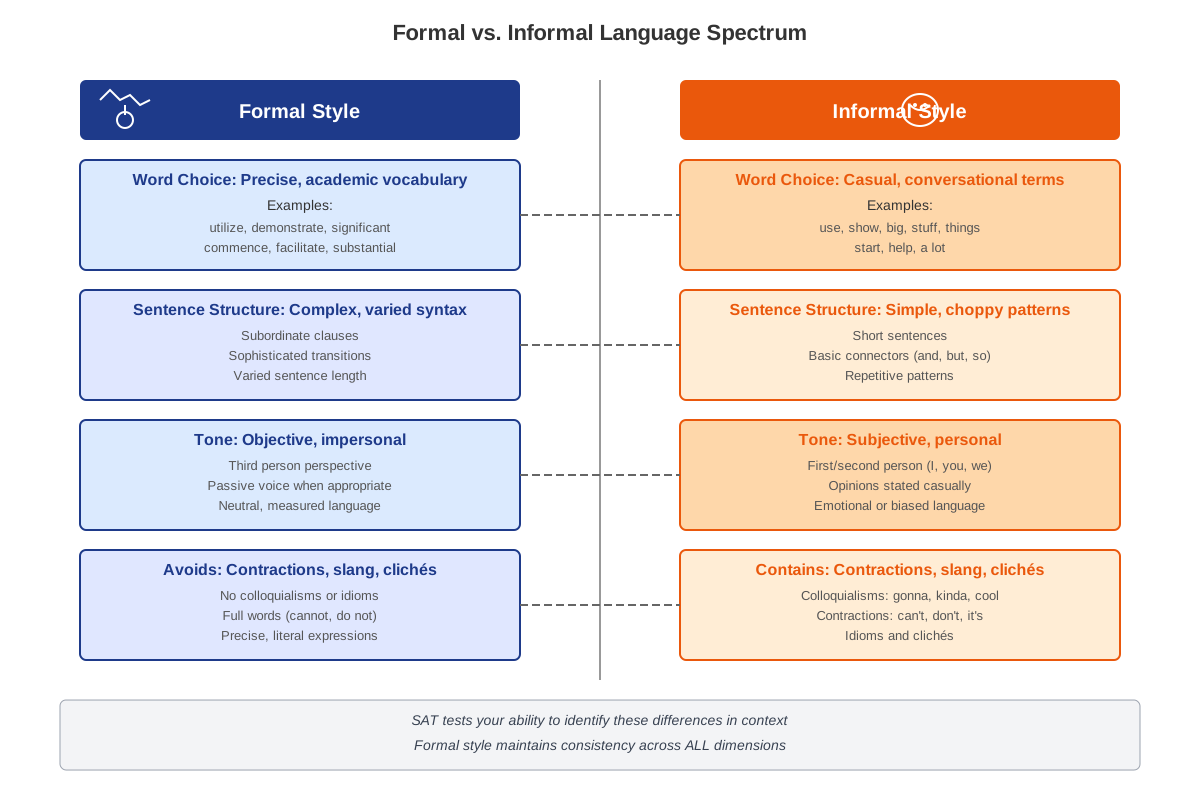
Formal style refers to the language register used in academic, professional, and official contexts where precision, objectivity, and sophistication are expected. This register avoids casual expressions, maintains grammatical correctness, uses specific rather than vague language, and employs a serious, respectful tone. Formal writing typically appears in research papers, scholarly articles, business reports, legal documents, and standardized test passages.
The key characteristics of formal style include:
- Precise, specific vocabulary rather than general or vague terms
- Complete sentences without fragments or run-ons
- Third-person perspective (avoiding "I," "you," "we" in most academic contexts)
- Objective tone without emotional language or personal opinions stated informally
- Standard grammar without contractions, slang, or colloquialisms
- Complex sentence structures that show relationships between ideas
- Technical or academic terminology appropriate to the subject matter
Informal vs. Formal Language Elements
Understanding the distinction between informal and formal language is fundamental to SAT success. The following table illustrates common contrasts:
| Informal Element | Formal Alternative | Context |
|---|---|---|
| "a lot of" | "numerous," "many," "substantial" | Quantifying |
| "kids" | "children," "adolescents," "youth" | Referring to young people |
| "get" | "obtain," "acquire," "receive," "achieve" | Obtaining something |
| "show" | "demonstrate," "illustrate," "reveal" | Presenting evidence |
| "thing" | Specific noun (device, phenomenon, factor) | Naming objects/concepts |
| Contractions (can't, won't) | Full forms (cannot, will not) | Negation |
| "pretty much" | "essentially," "largely," "approximately" | Approximating |
| "kind of/sort of" | "somewhat," "rather," "to some extent" | Qualifying |
| "figure out" | "determine," "ascertain," "conclude" | Problem-solving |
| "really" | "significantly," "considerably," "notably" | Intensifying |
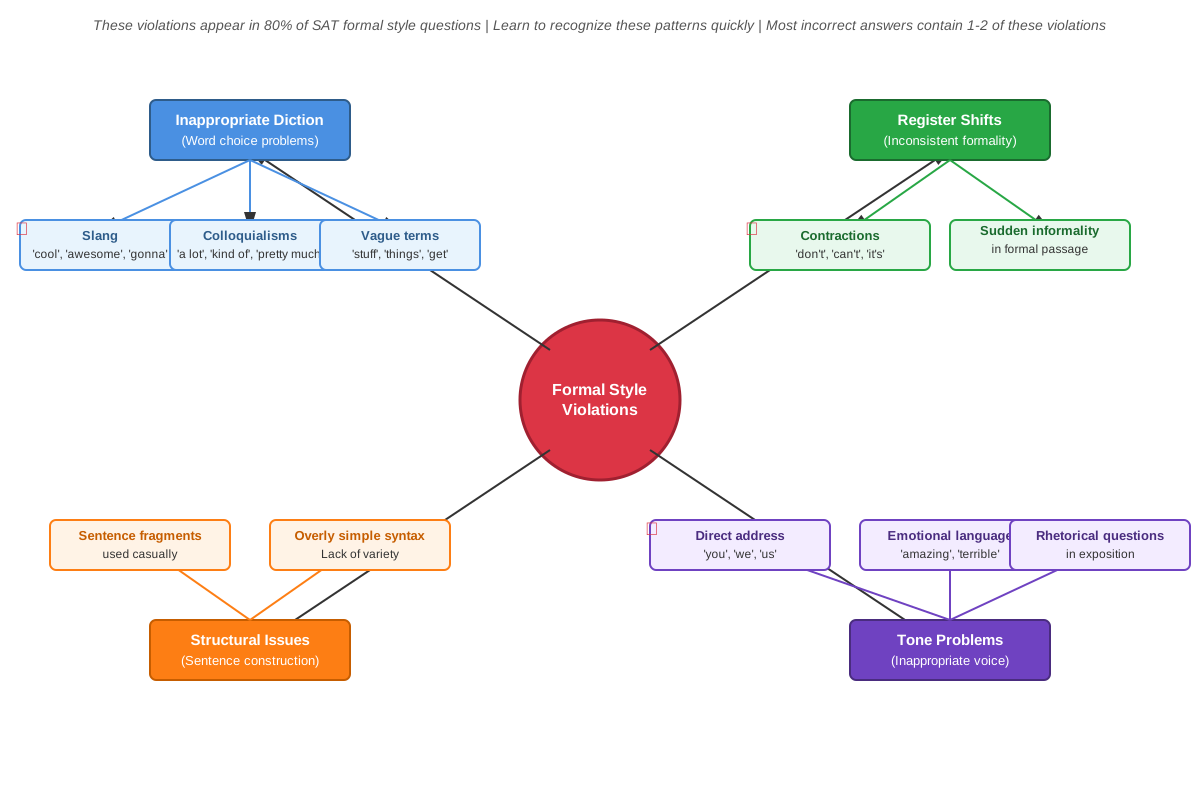
Colloquialisms and Slang
Colloquialisms are informal expressions used in everyday conversation but inappropriate for academic writing. These include phrases like "at the end of the day," "when all is said and done," "in a nutshell," and "the bottom line is." While these expressions communicate meaning effectively in casual contexts, they undermine the professional tone expected in formal writing.
Slang represents the most informal register, including terms like "cool," "awesome," "totally," "gonna," and "wanna." Slang is never appropriate in SAT passages and represents the most obvious formal style violations. The SAT rarely tests obvious slang, instead focusing on subtler colloquialisms that students might not immediately recognize as informal.
Vague Language and Imprecision
Formal style demands precision. Vague terms like "stuff," "things," "a lot," "very," and "really" weaken academic writing by failing to provide specific information. The SAT frequently tests whether students can replace these imprecise terms with more specific alternatives that convey exact meaning.
For example:
- Weak: "The experiment showed a lot of interesting things about cell behavior."
- Strong: "The experiment revealed significant patterns in cellular response to environmental stimuli."
Redundancy and Wordiness in Formal Contexts
While formal style values sophistication, it does not reward unnecessary wordiness. Phrases like "due to the fact that" (instead of "because"), "in spite of the fact that" (instead of "although"), and "at this point in time" (instead of "now") add length without adding meaning. The SAT tests whether students can maintain formality while eliminating redundancy.
Register Consistency
Register consistency means maintaining the same level of formality throughout a passage. The SAT frequently presents passages where most sentences maintain formal academic tone, but one sentence contains an informal expression that disrupts the register. Students must identify these inconsistencies and select revisions that match the surrounding context.
Contractions in Formal Writing
Contractions (can't, won't, shouldn't, it's) are characteristic of informal speech and casual writing. Academic and professional contexts require full forms (cannot, will not, should not, it is). While some modern style guides accept contractions in certain formal contexts, the SAT consistently treats contractions as informal and expects students to recognize full forms as more appropriate for academic passages.
Emotional Language and Objectivity
Formal academic writing maintains objectivity by avoiding overtly emotional language, exclamations, and subjective judgments presented without evidence. Phrases like "it's obvious that," "clearly," "everyone knows," and "without a doubt" can undermine objectivity by asserting claims as self-evident rather than supporting them with evidence.
Concept Relationships
Formal style serves as the foundation for effective academic communication, connecting directly to other Expression of Ideas concepts. Register consistency → ensures that → rhetorical effectiveness by maintaining appropriate tone for the intended audience. When writers shift unexpectedly between formal and informal registers, they undermine their credibility and distract readers from their message.
Precise vocabulary (formal style) → enhances → clarity and concision by eliminating vague language that requires readers to infer meaning. This connection explains why the SAT often combines formal style with concision questions, testing whether students can select revisions that are both appropriately formal and economically expressed.
Formal style → supports → transitions and logical flow because academic discourse requires explicit connection words and phrases that show relationships between ideas. Informal writing often relies on implied connections that formal writing must make explicit through transitional expressions.
The relationship between formal style and rhetorical synthesis is particularly important: understanding audience and purpose determines appropriate register. A passage written for academic experts requires different vocabulary and sentence complexity than one written for general readers, even when both maintain formal tone.
High-Yield Facts
⭐ Contractions are always considered informal on the SAT and should be replaced with full forms in academic passages.
⭐ Colloquial phrases like "a lot of," "kind of," and "pretty much" are consistently tested as violations of formal style.
⭐ Formal style questions require considering the entire passage context, not just the underlined sentence in isolation.
⭐ Vague terms like "things," "stuff," and "get" should be replaced with specific, precise vocabulary.
⭐ The most formal option is not always correct—the answer must match the passage's established register and maintain clarity.
- Formal style questions typically appear 3-5 times per Reading and Writing section, making them high-yield for score improvement.
- Academic passages on the SAT maintain consistent formal register throughout, making stylistic inconsistencies easy to identify once you recognize the pattern.
- Slang and obvious informal language rarely appear as distractors; the SAT tests subtler distinctions between moderately formal and highly formal language.
- Emotional language, exclamations, and subjective assertions without evidence violate formal academic tone.
- Technical vocabulary appropriate to the subject matter enhances formality, but unnecessarily complex words that obscure meaning are incorrect.
- First-person pronouns ("I," "we") and second-person address ("you") are generally informal in academic contexts, though some disciplines accept first-person in specific situations.
- Formal style does not mean wordy style—concision and formality work together in effective academic writing.
- The SAT rewards precision: specific nouns, exact verbs, and concrete details are more formal than general, vague language.
Quick check — test yourself on Formal style so far.
Try Flashcards →Common Misconceptions
Misconception: Formal style means using the longest, most complex words available. → Correction: Formal style prioritizes precision and clarity over complexity. The correct answer uses appropriately sophisticated vocabulary that conveys exact meaning without unnecessary obscurity. "Utilize" is not automatically better than "use" if both convey the same meaning with equal precision.
Misconception: Any answer without contractions or slang is sufficiently formal. → Correction: Formal style encompasses multiple elements including precision, objectivity, and register consistency. An answer might avoid contractions but still be too casual if it uses colloquialisms like "a lot of" or vague terms like "things."
Misconception: The most formal-sounding option is always correct. → Correction: The correct answer must match the passage's established register. If a passage uses moderately formal language accessible to general readers, an extremely technical or pretentious revision would be stylistically inconsistent.
Misconception: Formal writing should avoid all simple words and short sentences. → Correction: Formal style values clarity and directness. Simple, precise language is often more effective than unnecessarily complex constructions. Short sentences can be perfectly formal if they maintain appropriate vocabulary and tone.
Misconception: Eliminating all personal pronouns automatically makes writing formal. → Correction: While formal academic writing often uses third person, the appropriateness of personal pronouns depends on context and discipline. Some scientific writing uses "we" to describe research procedures. The key is consistency with the passage's established conventions.
Misconception: Formal style questions are purely subjective matters of personal preference. → Correction: While some stylistic choices involve judgment, the SAT tests widely accepted conventions of academic English. Contractions, colloquialisms, and vague language are objectively informal according to standard academic writing guidelines.
Misconception: Adding more words makes writing more formal. → Correction: Wordiness often undermines formality by obscuring meaning. Phrases like "due to the fact that" are less formal than "because" despite being longer, because they represent inflated, bureaucratic language rather than clear academic prose.
Worked Examples
Example 1: Identifying and Correcting Colloquialisms
Passage Context: A scientific article discusses research on climate change impacts.
Original Sentence: "The researchers found that rising temperatures are causing a lot of problems for Arctic ecosystems, which is pretty concerning for future biodiversity."
Question: Which choice best maintains the formal style established in the passage?
A) NO CHANGE
B) are causing numerous problems for Arctic ecosystems, a development that raises significant concerns for future biodiversity.
C) are causing tons of problems for Arctic ecosystems, which is really worrying for future biodiversity.
D) are causing problems for Arctic ecosystems, and this is kind of a big deal for future biodiversity.
Analysis:
Step 1: Identify the passage context and established register. This is a scientific article, which requires formal academic tone with precise vocabulary and objective presentation.
Step 2: Identify informal elements in the original sentence:
- "a lot of" is a colloquial quantifier
- "pretty concerning" uses "pretty" as an informal intensifier
- The overall construction is somewhat casual for scientific writing
Step 3: Evaluate each option:
Option A (NO CHANGE): Contains two clear violations of formal style ("a lot of" and "pretty"), making it incorrect for an academic science passage.
Option B: Replaces "a lot of" with "numerous" (precise, formal), eliminates "pretty" and restructures to "raises significant concerns" (formal, objective), and uses "development" to create a more sophisticated sentence structure. This maintains consistent formality.
Option C: "Tons of" is even more informal than "a lot of," and "really worrying" maintains casual tone. This is worse than the original.
Option D: "Kind of a big deal" is extremely colloquial and inappropriate for scientific writing. This is clearly incorrect.
Correct Answer: B
Connection to Learning Objectives: This example demonstrates how to identify colloquialisms ("a lot of," "pretty"), recognize register inconsistency with the passage's academic context, and select a revision that maintains formal style through precise vocabulary and objective tone.
Example 2: Maintaining Register Consistency
Passage Context: A historical analysis discusses economic policies during the Great Depression.
Original Sentence: "President Roosevelt's New Deal programs were designed to get the economy back on track by creating jobs and providing financial support to struggling Americans."
Question: Which choice best maintains the style and tone of the passage?
A) NO CHANGE
B) were designed to revive the economy by creating employment opportunities and providing financial assistance to economically distressed citizens.
C) were designed to fix the economy by giving people jobs and helping out Americans who were having a tough time.
D) were designed to stimulate economic recovery through job creation initiatives and financial relief programs for economically vulnerable populations.
Analysis:
Step 1: Assess the passage's established register. This is a historical analysis, requiring formal academic tone appropriate for scholarly discussion.
Step 2: Identify potentially informal elements:
- "get the economy back on track" is a colloquial expression
- "struggling Americans" is acceptable but could be more precise
Step 3: Evaluate options:
Option A (NO CHANGE): "Get back on track" is too colloquial for formal historical analysis. While not extremely informal, it's inconsistent with academic writing conventions.
Option B: Replaces "get back on track" with "revive" (more formal, though still accessible), uses "employment opportunities" instead of "jobs" (more formal), and "economically distressed citizens" (precise and formal). However, this might be slightly less sophisticated than the best option.
Option C: "Fix the economy," "giving people jobs," and "helping out Americans who were having a tough time" are all too casual for academic historical writing. This is clearly incorrect.
Option D: Uses "stimulate economic recovery" (formal, precise economic terminology), "job creation initiatives" (formal, specific), and "economically vulnerable populations" (formal, precise). This maintains the highest level of academic formality while remaining clear.
Correct Answer: D
Connection to Learning Objectives: This example shows how to evaluate register consistency, distinguish between moderately formal (Option B) and highly formal (Option D) alternatives, and select the revision that best matches academic historical writing conventions. It also demonstrates that formal style includes using discipline-specific terminology ("economic recovery," "initiatives," "relief programs") appropriate to the subject matter.
Exam Strategy
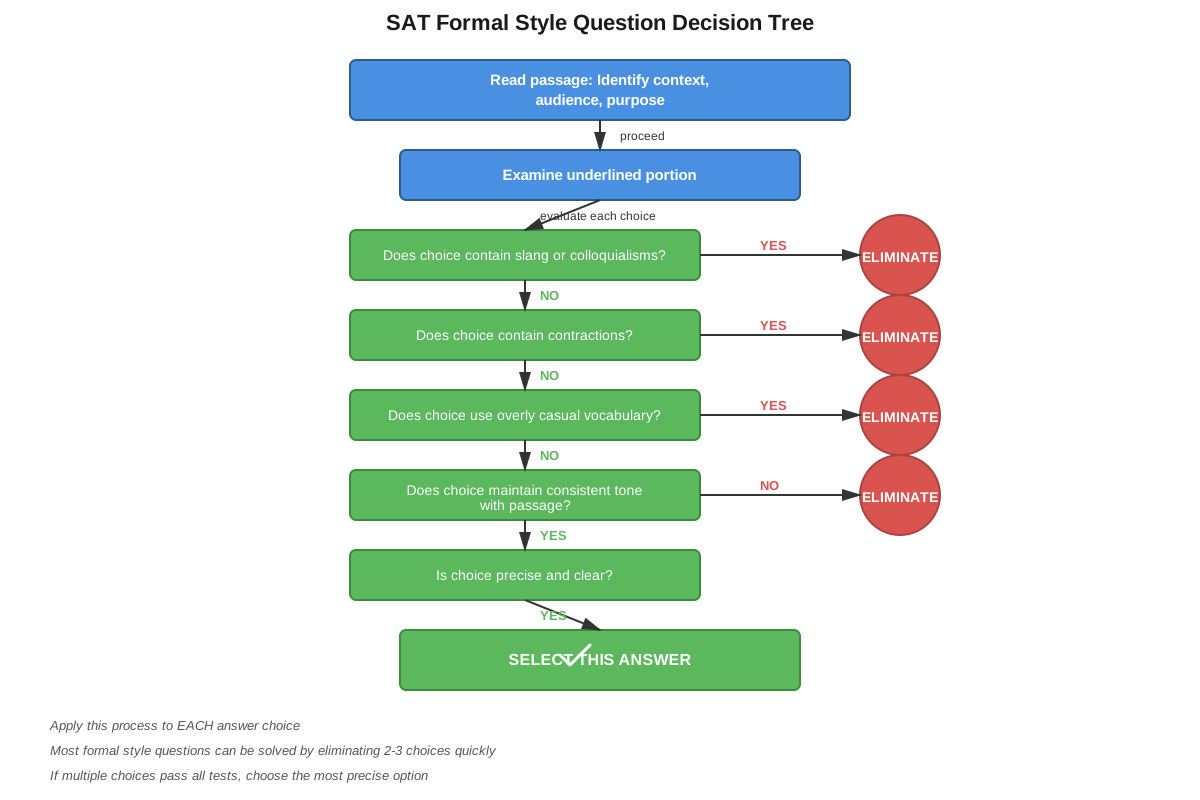
When approaching formal style questions on the SAT, follow this systematic process:
Step 1: Read the entire passage or paragraph before focusing on the underlined portion. Understanding the overall tone, purpose, and audience is essential for determining appropriate register. A passage written for academic experts requires different formality than one written for general readers.
Step 2: Identify the established register by examining word choice, sentence structure, and tone in surrounding sentences. Look for patterns: Does the passage use technical vocabulary? Are sentences complex or simple? Is the tone objective or somewhat conversational?
Step 3: Scan the underlined portion for common informal elements:
- Contractions (can't, won't, it's)
- Colloquialisms (a lot of, kind of, pretty much)
- Vague language (things, stuff, get)
- Casual intensifiers (really, very, pretty)
- Conversational phrases (at the end of the day, when all is said and done)
Step 4: Eliminate obviously incorrect answers first. Options containing slang, extreme colloquialisms, or register shifts that clearly don't match the passage can be eliminated immediately.
Step 5: Compare remaining options for precision and appropriateness. The correct answer will:
- Match the passage's established register
- Use precise, specific vocabulary
- Maintain clarity while enhancing formality
- Avoid unnecessary wordiness
Exam Tip: If two options seem equally formal, choose the one that is more concise and precise. The SAT rewards economy of expression when formality is equal.
Trigger words and phrases to watch for:
- Questions asking about "maintaining the style/tone of the passage"
- Questions asking which choice is "most consistent with the conventions of Standard English"
- Questions referencing "formal academic writing"
Time allocation: Formal style questions should take 30-45 seconds each. If you're spending more than a minute, you're overthinking. Trust your ear for register consistency and move forward.
Process of elimination strategy:
- Eliminate options with obvious informal elements (contractions, slang, colloquialisms)
- Eliminate options that shift register dramatically from the passage
- Between remaining options, choose the more precise and concise alternative
Memory Techniques
FORMAL Acronym for identifying violations:
- Fragments and contractions (avoid both)
- Overly casual expressions (colloquialisms)
- Redundant or wordy phrases
- Mismatched register (inconsistent with passage)
- Ambiguous or vague terms (things, stuff, get)
- Language that's emotional or subjective
The Precision Principle: When choosing between formal alternatives, remember "Specific beats general, precise beats vague." Visualize a target: formal writing hits the bullseye with exact vocabulary rather than scattering shots with general terms.
The Consistency Check: Before selecting an answer, mentally read it in context with the surrounding sentences. Does it sound like it belongs? If it stands out as noticeably different in tone, it's probably wrong.
Common Colloquialism List (memorize these informal expressions to avoid):
- a lot of → numerous, many, substantial
- kind of/sort of → somewhat, rather
- pretty (as intensifier) → significantly, considerably
- get → obtain, acquire, achieve
- show → demonstrate, reveal
- figure out → determine, ascertain
- at the end of the day → ultimately, finally
- when all is said and done → in conclusion, ultimately
The "Would My Professor Accept This?" Test: When uncertain about formality, imagine submitting the sentence in a college research paper. Would a professor mark it as too casual? This mental check helps calibrate your sense of academic register.
Summary
Formal style on the SAT tests students' ability to recognize and apply appropriate academic register in writing. This skill requires identifying informal elements including contractions, colloquialisms, vague language, and casual expressions, then selecting revisions that maintain consistent formality throughout a passage. The key to success is understanding that formal style encompasses multiple dimensions: precise vocabulary, objective tone, complete grammatical structures, and register consistency. Students must avoid the misconception that formal means unnecessarily complex or wordy; instead, effective formal writing combines sophistication with clarity and concision. By recognizing common informal triggers (a lot of, kind of, pretty, get, things) and understanding how to evaluate register consistency within passage context, students can confidently approach the 3-5 formal style questions that appear on each SAT Reading and Writing section. Mastering this topic requires practice identifying subtle distinctions between moderately formal and highly formal language, always selecting the option that best matches the passage's established academic tone while maintaining precision and clarity.
Key Takeaways
- Formal style questions test register consistency, requiring students to match the passage's established academic tone through appropriate vocabulary and sentence structure.
- Common informal violations include contractions, colloquialisms (a lot of, kind of, pretty much), vague terms (things, stuff, get), and casual intensifiers (really, very).
- The correct answer maintains formality while preserving clarity and concision—formal does not mean unnecessarily complex or wordy.
- Context is crucial: always read surrounding sentences to understand the passage's register before selecting a revision.
- Precision is a hallmark of formal style: specific nouns, exact verbs, and concrete details are more formal than general, vague language.
- Eliminate obviously informal options first, then compare remaining choices for precision, appropriateness, and consistency with the passage.
- Formal style appears 3-5 times per Reading and Writing section, making it a high-yield topic that significantly impacts scores when mastered.
Related Topics
Concision and Redundancy: Formal style often overlaps with concision questions, as both test effective language use. Mastering formal style helps students recognize that academic writing values economy of expression, eliminating unnecessary words while maintaining sophistication.
Rhetorical Synthesis: Understanding audience and purpose determines appropriate register. Students who master formal style develop the judgment needed to evaluate whether language choices match intended readers and communicative goals.
Transitions and Logical Flow: Formal academic writing requires explicit transitional expressions to show relationships between ideas. The precision valued in formal style extends to selecting exact transition words that clarify logical connections.
Effective Language Use: This broader category encompasses formal style along with precision, concision, and clarity. Mastering formal style provides a foundation for all effective language use questions on the SAT.
Practice CTA
Now that you understand the principles of formal style and how to apply them on the SAT, it's time to reinforce your learning through practice. Complete the practice questions to test your ability to identify informal elements, evaluate register consistency, and select appropriately formal revisions. Use the flashcards to memorize common colloquialisms and their formal alternatives, building the vocabulary recognition that leads to automatic, confident responses on test day. Remember: formal style questions are highly predictable once you recognize the patterns, making them an excellent opportunity to boost your score through focused practice. Every question you practice strengthens your ear for academic register and increases your speed on test day!
Sign up free to keep reading
Create a free AnvayaPrep account to finish this SAT guide on Formal style — plus flashcards and practice questions.