Overview
Precision in SAT Reading and Writing refers to the ability to select the most accurate, specific, and contextually appropriate word or phrase to convey meaning. On the SAT, sat precision questions test whether students can identify which word choice best fits the context, tone, and intended meaning of a passage. These questions require careful attention to subtle differences in meaning between similar words and an understanding of how context shapes word choice.
Precision questions are among the most frequently tested question types in the rw (Reading and Writing) section of the digital SAT, appearing in approximately 13-15% of all questions. Unlike grammar or structure questions, precision questions focus exclusively on meaning and word choice, making them a critical component of the Expression of Ideas domain. Students who master precision gain a significant advantage because these questions reward careful reading and vocabulary knowledge rather than complex grammatical analysis.
Understanding precision connects directly to broader reading comprehension skills and vocabulary development. Strong precision skills enhance a student's ability to analyze author's purpose, understand tone and style, and recognize how specific word choices create particular effects in writing. This topic serves as a bridge between vocabulary knowledge and contextual reading comprehension, requiring students to synthesize both skills simultaneously.
Learning Objectives
- [ ] Identify key features of Precision questions on the SAT
- [ ] Explain how Precision appears on the SAT and what makes these questions distinctive
- [ ] Apply Precision strategies to answer SAT-style questions accurately
- [ ] Distinguish between words with similar meanings based on subtle contextual differences
- [ ] Evaluate answer choices by eliminating options that are too vague, too extreme, or contextually inappropriate
- [ ] Recognize common precision question formats and trigger phrases in question stems
Prerequisites
- Basic vocabulary knowledge: Understanding common SAT-level words is essential because precision questions require distinguishing between similar terms
- Reading comprehension skills: Students must understand passage context to determine which word fits best
- Understanding of connotation vs. denotation: Recognizing that words carry emotional associations beyond their dictionary definitions helps identify the most precise choice
- Familiarity with parts of speech: Knowing whether a word functions as a noun, verb, adjective, or adverb helps eliminate grammatically incorrect options
Why This Topic Matters
Precision questions assess a fundamental writing skill that extends far beyond standardized testing. In academic writing, professional communication, and everyday expression, choosing the right word ensures clarity and prevents misunderstanding. Writers who master precision communicate more effectively, persuasively, and professionally. This skill becomes increasingly important in college-level writing, where professors expect students to use discipline-specific terminology accurately and to distinguish between closely related concepts.
On the SAT, precision questions appear in approximately 4-5 questions per test, making them one of the most reliable question types students will encounter. These questions typically appear in the Expression of Ideas category and are considered medium difficulty, though they can range from easy to challenging depending on the vocabulary involved and the subtlety of the distinctions between answer choices.
Precision questions most commonly appear in informational and argumentative passages, where specific word choice affects the accuracy of claims and the strength of arguments. Students might encounter precision questions in passages about science, history, social studies, or humanities topics. The questions typically ask students to replace an underlined word or phrase with the most appropriate alternative, requiring them to consider context, tone, specificity, and logical consistency.
Core Concepts
What Makes a Word Choice Precise
Precision in word choice means selecting the word that most accurately and specifically conveys the intended meaning within a given context. A precise word choice is neither too broad nor too narrow, neither too formal nor too informal, and carries the appropriate connotations for the situation. Precision requires three key elements: accuracy (the word must be factually correct), specificity (the word should be as detailed as the context requires), and appropriateness (the word must fit the tone and style of the passage).
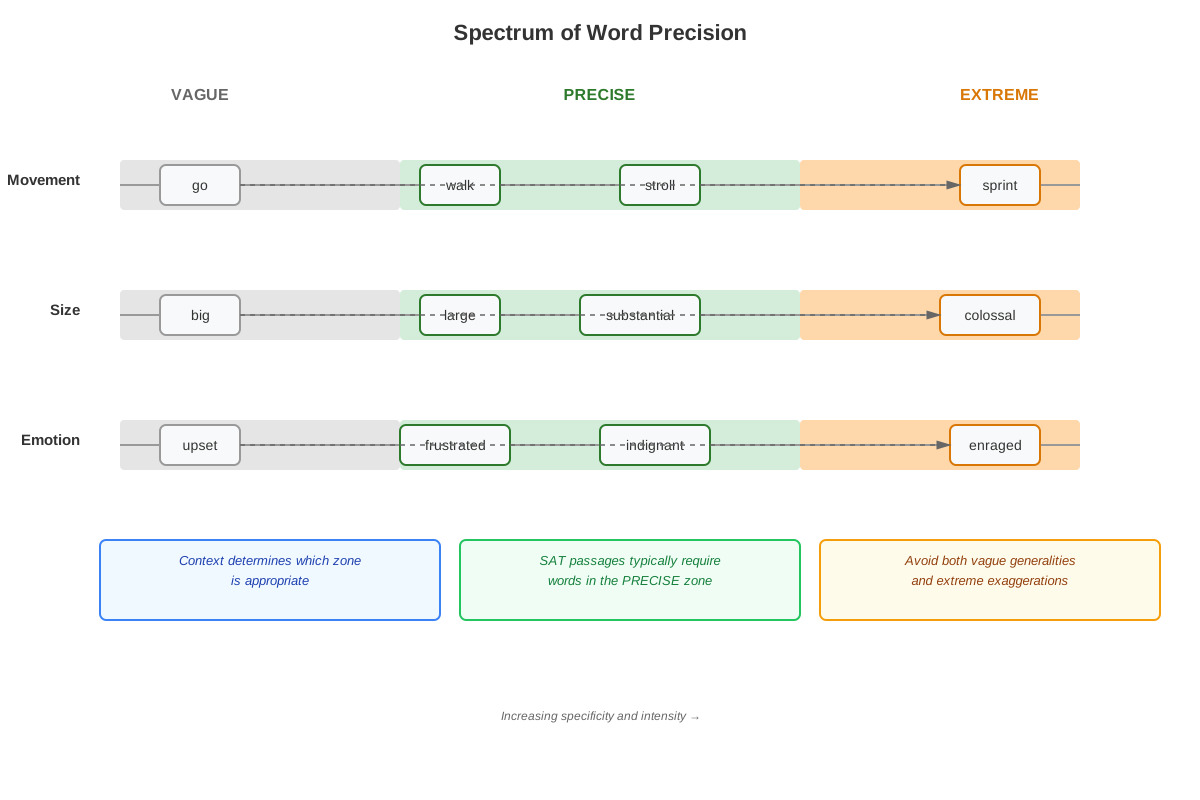
Consider the difference between "walk," "stroll," "march," and "trudge." All describe forward movement on foot, but each carries distinct connotations and implies different circumstances. A precise writer chooses "stroll" for leisurely movement, "march" for purposeful or military movement, and "trudge" for difficult movement through challenging conditions. On the SAT, precision questions test this exact skill—recognizing which synonym best fits the specific context.
Context Clues and Precision
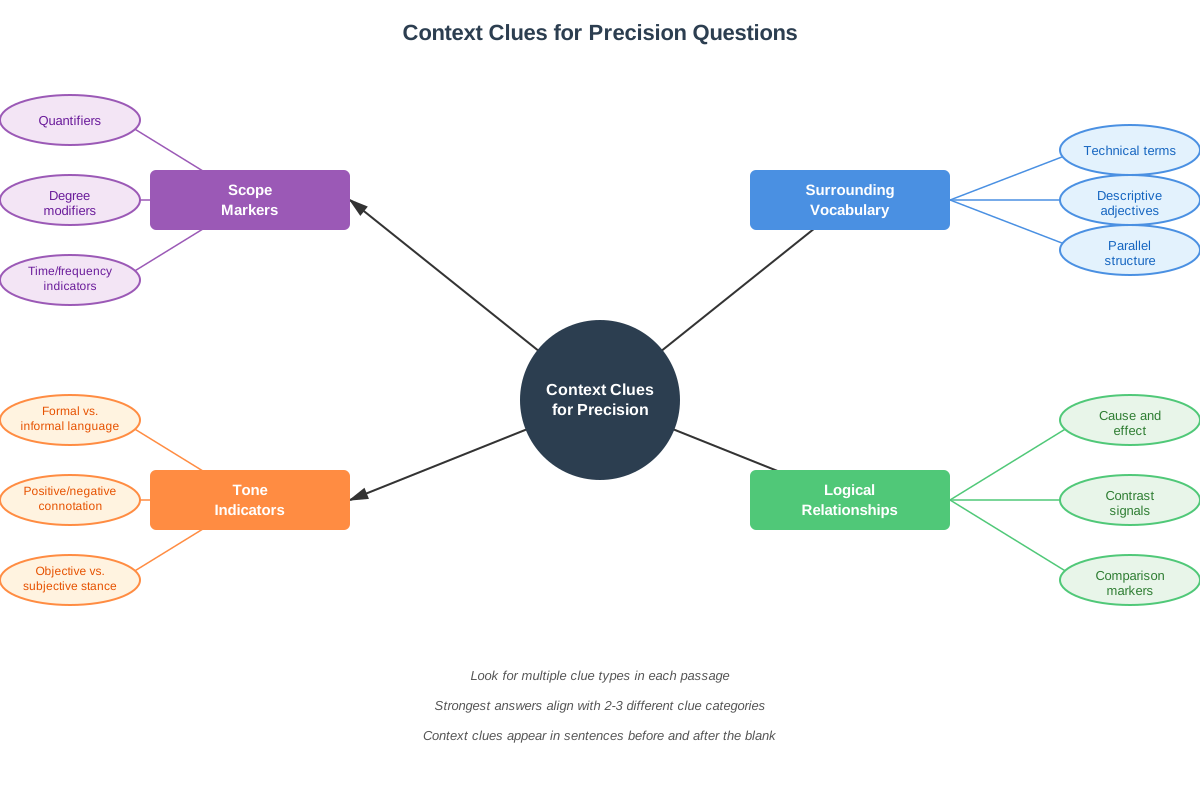
Context determines precision. The surrounding sentences, the passage's overall tone, and the logical flow of ideas all provide clues about which word choice is most precise. Students must read beyond the sentence containing the underlined word to understand the broader context. Key context clues include:
- Surrounding vocabulary: Formal passages require formal word choices; conversational passages allow more casual language
- Logical relationships: Words like "however," "therefore," and "additionally" signal how ideas connect, helping determine which word maintains logical consistency
- Specific details: If a passage provides specific information, the correct answer will align with those details rather than contradicting or oversimplifying them
- Tone indicators: Words expressing certainty, doubt, enthusiasm, or criticism help identify which answer choice matches the author's attitude
Levels of Specificity
Precision often involves choosing the appropriate level of specificity. Some contexts require general terms, while others demand specific ones. Consider this hierarchy:
| General | More Specific | Most Specific |
|---|---|---|
| animal | mammal | dolphin |
| building | residence | apartment |
| communicate | speak | whisper |
| change | improve | optimize |
SAT precision questions frequently test whether students can identify when a passage requires more or less specificity. If a passage discusses a particular type of change with specific positive outcomes, "improve" would be more precise than "change," and "optimize" might be even better if the context emphasizes achieving the best possible result.
Connotation and Precision
Connotation refers to the emotional associations and implied meanings a word carries beyond its literal definition. Precision requires selecting words with appropriate connotations. For example, "inexpensive," "cheap," and "economical" all denote low cost, but their connotations differ significantly:
- "Inexpensive" is neutral, simply indicating low price
- "Cheap" often carries negative connotations of poor quality
- "Economical" has positive connotations of wise spending and efficiency
On the SAT, students must recognize these subtle differences and select the word whose connotations align with the passage's tone and purpose. A passage praising a product would use "economical" or "inexpensive," never "cheap."
Redundancy and Precision
Precise writing avoids redundancy—saying the same thing twice unnecessarily. Precision questions sometimes test whether students can identify and eliminate redundant phrasing. For example, "completely eliminate" is redundant because "eliminate" already means to remove completely. Similarly, "past history" is redundant because history is inherently about the past.
However, students must distinguish between true redundancy and intentional emphasis. Some repetition serves rhetorical purposes, and the SAT will not penalize effective emphasis. The key is whether the repetition adds meaning or merely repeats information already conveyed.
Intensity and Precision
Words exist on intensity scales, and precision requires matching the word's intensity to the context. Consider these intensity scales:
Positive emotion: pleased → happy → delighted → ecstatic
Negative emotion: annoyed → angry → furious → enraged
Certainty: possible → probable → likely → certain
If a passage describes a moderately positive outcome, "pleased" or "happy" would be precise, while "ecstatic" would be too intense. SAT precision questions often include answer choices that are technically accurate but too extreme or too mild for the context.
Concept Relationships
Precision connects directly to vocabulary knowledge—students cannot select the most precise word without understanding what each option means. However, vocabulary alone is insufficient; precision requires applying vocabulary knowledge within specific contexts, making it dependent on reading comprehension skills.
The relationship flows as follows: Reading Comprehension → provides context → enables Vocabulary Application → which allows for Precision → resulting in Effective Communication. Within the Expression of Ideas domain, precision relates closely to style and tone questions, as word choice directly affects both. Precision also connects to transitions and logical relationships, since precise word choice maintains the logical flow of ideas.
Precision differs from grammar and usage questions in that it focuses exclusively on meaning rather than correctness. A sentence might be grammatically perfect with any of four answer choices, but only one choice will be most precise. This distinguishes precision questions from other SAT question types and requires a different analytical approach.
High-Yield Facts
⭐ Precision questions ask which word or phrase most accurately and specifically fits the context, not which is grammatically correct
⭐ All answer choices in precision questions are typically grammatically correct; the distinction lies in meaning and appropriateness
⭐ Context clues appear in surrounding sentences, not just the sentence containing the underlined portion
⭐ Precision requires matching both denotation (literal meaning) and connotation (emotional associations)
⭐ Words that are too general, too specific, too intense, or too mild are imprecise for a given context
- Precision questions typically appear 4-5 times per SAT test
- The question stem often includes phrases like "most precisely" or "most effectively"
- Eliminating obviously wrong answers first increases accuracy on precision questions
- Formal passages require formal word choices; informal passages allow conversational language
- Redundant phrasing is always imprecise and should be eliminated
- Technical or scientific passages require precise technical terminology
- Words with similar meanings often differ in intensity, formality, or connotation
- The correct answer will never contradict specific information provided in the passage
- Precision questions reward careful reading more than extensive vocabulary knowledge
- Understanding word roots, prefixes, and suffixes helps distinguish between similar words
Quick check — test yourself on Precision so far.
Try Flashcards →Common Misconceptions
Misconception: The longest or most sophisticated-sounding word is always the most precise choice.
Correction: Precision means appropriateness to context, not complexity. A simple word can be more precise than a complex one if it better fits the context and tone. The SAT rewards accuracy and appropriateness, not vocabulary showing-off.
Misconception: If a word is technically accurate, it's precise enough.
Correction: Precision requires more than accuracy—it requires specificity and appropriateness. "Animal" might be technically accurate when referring to a dolphin, but "mammal" or "dolphin" would be more precise depending on the context.
Misconception: Precision questions can be answered by reading only the sentence containing the underlined portion.
Correction: Context from surrounding sentences is essential for determining precision. The tone, style, and specific details in nearby sentences provide crucial information about which word choice is most appropriate.
Misconception: All synonyms are interchangeable in any context.
Correction: Synonyms have subtle differences in meaning, connotation, intensity, and formality. These differences make certain synonyms appropriate for specific contexts and inappropriate for others. "Stroll" and "trudge" both mean walking, but they're not interchangeable.
Misconception: The correct answer will always be a word the student has never seen before.
Correction: SAT precision questions test contextual application of vocabulary, not obscure words. The correct answer is often a common word that precisely fits the context, while incorrect answers might include more impressive-sounding words that don't fit as well.
Misconception: Precision is the same as conciseness—shorter is always better.
Correction: While avoiding redundancy is important, precision sometimes requires more words to convey specific meaning. "Economical" is more precise than "cheap" even though both are single words, and sometimes a two-word phrase is more precise than a single word if it better captures the intended meaning.
Worked Examples
Example 1: Scientific Context
Passage excerpt: "The researchers observed that the bacteria population _____ rapidly when exposed to the antibiotic, decreasing from millions to thousands within hours."
Question: Which choice most precisely describes what happened to the bacteria population?
A) changed
B) declined
C) plummeted
D) varied
Step 1: Identify what the context tells us
The passage provides specific information: the population decreased from millions to thousands within hours. This is a dramatic, rapid decrease.
Step 2: Evaluate each answer choice
- "Changed" (A) is too general—it could mean increase or decrease
- "Declined" (B) indicates decrease but doesn't capture the dramatic, rapid nature
- "Plummeted" (C) indicates a dramatic, rapid decrease—matches the context perfectly
- "Varied" (D) suggests fluctuation rather than consistent decrease
Step 3: Select the most precise choice
"Plummeted" (C) is most precise because it captures both the direction (downward) and the dramatic, rapid nature of the change described in the passage.
Connection to learning objectives: This example demonstrates how precision requires matching word intensity to context. The specific details (millions to thousands, within hours) indicate that a word suggesting dramatic change is more precise than a neutral word.
Example 2: Historical Context
Passage excerpt: "While some historians argue that the treaty was beneficial, others _____ this interpretation, pointing to evidence that it actually harmed both nations economically."
Question: Which choice most effectively establishes the relationship between the two groups of historians?
A) question
B) support
C) ignore
D) challenge
Step 1: Identify the logical relationship
The word "while" signals contrast. The second group of historians has an opposing view and provides evidence against the first group's interpretation.
Step 2: Evaluate each answer choice
- "Question" (A) suggests mild doubt but doesn't capture the active opposition
- "Support" (B) contradicts the contrast signaled by "while"
- "Ignore" (C) suggests dismissal without engagement, but the passage says they "point to evidence"
- "Challenge" (D) indicates active opposition with evidence—matches the context
Step 3: Consider connotation and intensity
"Challenge" is more precise than "question" because it captures the active, evidence-based nature of the opposition. The historians aren't merely expressing doubt; they're actively arguing against the interpretation with evidence.
Connection to learning objectives: This example shows how precision requires understanding logical relationships and transition words. The contrast signaled by "while" and the phrase "pointing to evidence" indicate that a word suggesting active, evidence-based opposition is most precise.
Exam Strategy
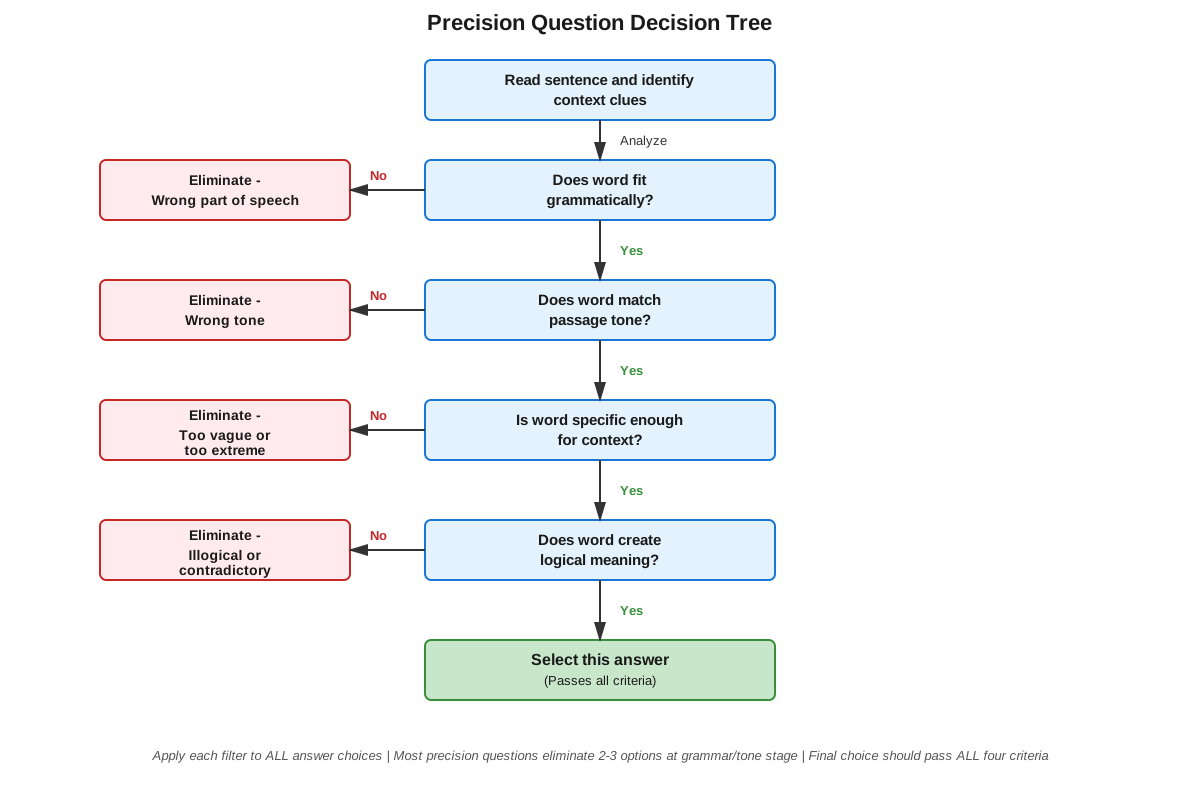
When approaching SAT precision questions, follow this systematic process:
Step 1: Read beyond the sentence
Always read at least one sentence before and after the sentence containing the underlined portion. Context clues often appear in surrounding sentences rather than the immediate sentence.
Step 2: Identify what the passage is saying
Before looking at answer choices, determine what meaning the passage is trying to convey. What is the tone? What specific details are provided? What logical relationship exists between ideas?
Step 3: Predict an answer
Based on context, predict what type of word would fit best. Don't worry about the exact word—focus on the general meaning, intensity, and connotation needed.
Step 4: Eliminate obviously wrong answers
Remove choices that contradict the passage, are too extreme or too mild, or don't fit the tone and style.
Step 5: Compare remaining choices
For the remaining options, identify the subtle differences in meaning, connotation, or intensity. Select the choice that most precisely matches the context.
Exam Tip: Trigger phrases in question stems include "most precisely," "most effectively," "most accurately," and "best maintains the style and tone." These phrases signal precision questions.
Time allocation: Spend 30-45 seconds on precision questions. They require careful reading but don't involve complex analysis. If you're spending more than a minute, you're overthinking—trust your understanding of context and word meanings.
Process of elimination tips specific to precision:
- Eliminate words that are too general if the passage provides specific details
- Eliminate words that are too specific if the passage discusses general concepts
- Eliminate words whose connotations contradict the passage's tone
- Eliminate redundant options that repeat information already stated
- Eliminate words that are too intense or too mild for the described situation
Memory Techniques
CAST mnemonic for evaluating precision:
- Context: Does the word fit the surrounding sentences?
- Appropriate: Does the word match the tone and style?
- Specific: Is the word as specific as the context requires?
- Tone: Do the word's connotations align with the passage's attitude?
Visualization strategy: Picture the situation described in the passage. If you can't visualize the underlined word fitting naturally into that mental image, it's probably not the most precise choice.
The "Replace and Read" technique: Mentally replace the underlined portion with each answer choice and read the entire sentence. The correct answer will sound most natural and maintain the passage's flow and meaning.
Intensity Scale Visualization: For words describing emotions, changes, or certainty, visualize a thermometer or scale. Place each answer choice on the scale and determine which matches the "temperature" of the passage.
Connotation Color Coding: Associate positive connotations with green, negative with red, and neutral with yellow. Quickly "color code" each answer choice and select the one matching the passage's overall color.
Summary
Precision on the SAT Reading and Writing section tests the ability to select the most accurate, specific, and contextually appropriate word or phrase. These questions require students to analyze context, understand subtle differences between similar words, and match word choice to tone, style, and meaning. Success on precision questions depends on reading beyond the immediate sentence to understand broader context, recognizing the differences between denotation and connotation, and matching word intensity to the situation described. Students must eliminate choices that are too general, too specific, too intense, too mild, or stylistically inappropriate. Precision questions appear regularly on the SAT and reward careful reading combined with strong vocabulary knowledge. Mastering precision requires understanding that all answer choices may be grammatically correct, but only one will be most precise for the given context. The key to success is systematic analysis: read for context, predict the needed meaning, eliminate obviously wrong choices, and select the option that most precisely fits the passage's meaning, tone, and style.
Key Takeaways
- Precision questions test word choice based on meaning and context, not grammar
- Context clues from surrounding sentences are essential for determining the most precise choice
- All answer choices are typically grammatically correct; distinctions lie in meaning, connotation, and appropriateness
- Precision requires matching word intensity, specificity, and formality to the passage
- Systematic elimination of too-general, too-specific, too-intense, or stylistically inappropriate choices increases accuracy
- Understanding both denotation (literal meaning) and connotation (emotional associations) is crucial
- Precision questions appear 4-5 times per test and are considered high-yield for score improvement
Related Topics
Transitions and Logical Relationships: Mastering precision enhances the ability to select appropriate transition words, as both skills require understanding how ideas connect and what words best express those connections.
Style and Tone: Precision directly affects style and tone, making these topics naturally complementary. Students who understand precision can better analyze how authors use word choice to create specific effects.
Vocabulary in Context: While precision focuses on selecting the best word, vocabulary in context questions test understanding of what a word means in a passage. Both require contextual analysis skills.
Rhetorical Synthesis: Advanced precision skills enable students to understand how authors combine multiple precise word choices to build arguments and achieve rhetorical purposes.
Practice CTA
Now that you've mastered the core concepts of precision, it's time to apply your knowledge! Work through the practice questions to test your ability to identify the most precise word choices in various contexts. Use the flashcards to reinforce your understanding of commonly confused words and their subtle differences. Remember, precision questions are highly predictable and reward systematic analysis—with practice, you can master this question type and consistently earn these points on test day. Every precision question you answer correctly brings you closer to your target score!
Sign up free to keep reading
Create a free AnvayaPrep account to finish this SAT guide on Precision — plus flashcards and practice questions.