Overview
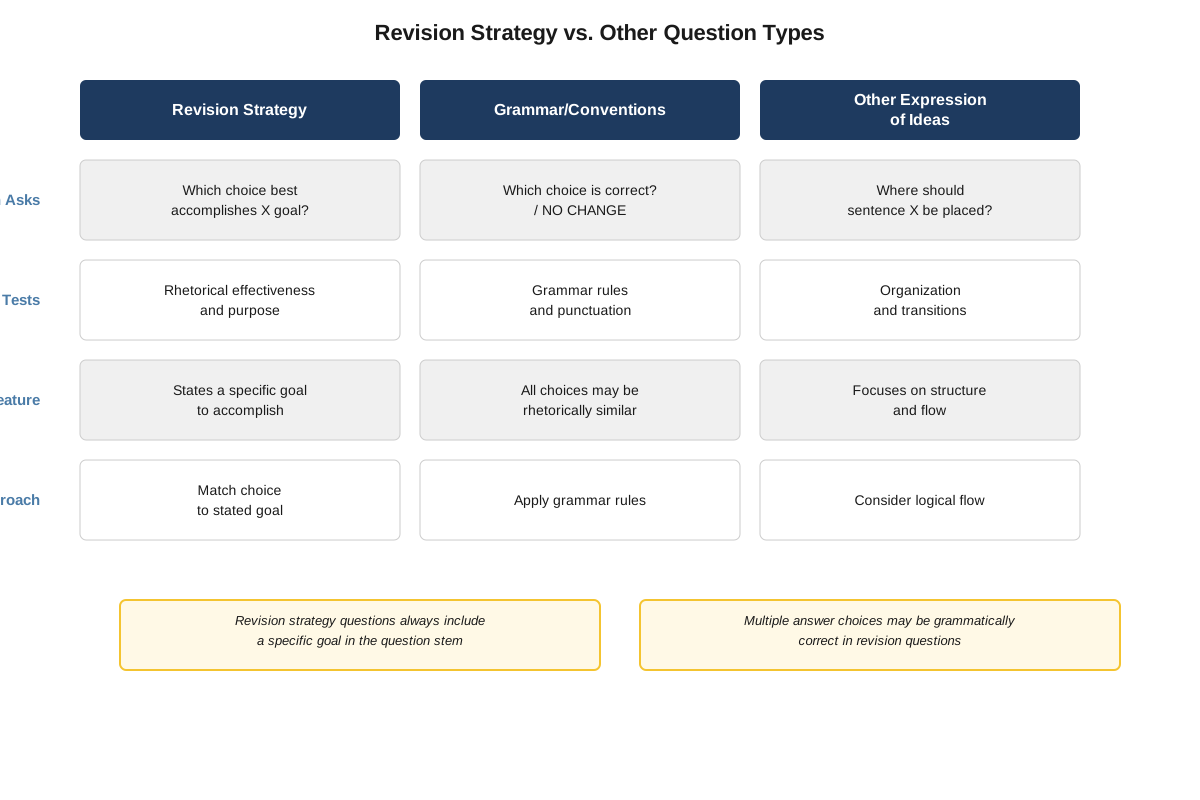
Revision strategy questions represent one of the most frequently tested question types in the SAT Reading and Writing (RW) section. These questions assess a student's ability to improve a draft text by selecting the most effective revision from four options. Unlike questions that test grammar rules or punctuation conventions, revision strategy questions evaluate higher-order thinking skills: understanding rhetorical purpose, maintaining logical flow, achieving clarity, and ensuring that writing accomplishes its intended goal.
On the SAT, sat revision strategy questions typically present a passage with an underlined portion or a numbered sentence, followed by a question asking which choice best accomplishes a specific goal. The goal might be to add supporting evidence, provide an effective transition, introduce a topic, conclude a paragraph, or emphasize a particular idea. Students must evaluate each option not just for grammatical correctness, but for how well it fulfills the stated rhetorical purpose within the context of the passage. These questions require careful reading of both the passage and the question stem, as the "best" answer depends entirely on what the question asks you to accomplish.
Mastering revision strategy is essential because these questions appear in approximately 15-20% of all rw questions on the SAT, making them one of the highest-yield topics for score improvement. Furthermore, the skills tested—understanding audience, purpose, and effective communication—connect directly to other Expression of Ideas concepts like transitions, organization, and supporting evidence. Success with revision strategy questions demonstrates college-readiness in written communication, which is precisely what the SAT aims to measure.
Learning Objectives
- [ ] Identify key features of Revision strategy questions on the SAT
- [ ] Explain how Revision strategy appears on the SAT and what makes it distinct from other question types
- [ ] Apply Revision strategy principles to answer SAT-style questions accurately and efficiently
- [ ] Analyze the rhetorical purpose stated in question stems and match it to answer choices
- [ ] Evaluate answer choices based on relevance, specificity, and alignment with passage context
- [ ] Distinguish between grammatically correct options to select the most rhetorically effective choice
- [ ] Recognize common revision goals (adding evidence, creating transitions, introducing topics, concluding effectively)
Prerequisites
- Basic reading comprehension: Understanding main ideas, supporting details, and passage structure is essential because revision strategy questions require analyzing how a sentence functions within a larger context
- Paragraph structure awareness: Recognizing topic sentences, supporting evidence, and concluding statements helps identify where and how revisions should function
- Understanding of rhetorical purpose: Familiarity with concepts like audience, tone, and purpose enables evaluation of whether a revision accomplishes its stated goal
- Vocabulary knowledge: Sufficient vocabulary to understand both passage content and answer choices ensures accurate evaluation of options
Why This Topic Matters
Revision strategy questions test skills that extend far beyond standardized testing. The ability to revise writing for clarity, purpose, and effectiveness is fundamental to academic success in college, where students must craft research papers, lab reports, and analytical essays. In professional contexts, clear and purposeful communication determines career advancement and project success. These questions assess whether students can think critically about writing choices rather than simply following mechanical rules.
On the SAT, revision strategy questions appear in approximately 4-6 questions per test, representing roughly 15-20% of the Reading and Writing section. This high frequency makes them one of the most important question types to master for score improvement. Unlike grammar questions that test specific rules, revision strategy questions offer significant opportunities for students who develop strong analytical reading skills, as these questions reward careful thinking over memorized formulas.
These questions commonly appear in passages across all content domains—literature, history/social studies, humanities, and science. They may ask students to add a sentence that provides relevant evidence, choose an effective transition between ideas, select an introduction that accurately previews content, or pick a conclusion that reinforces the main point. The questions always include a specific goal in the question stem, such as "Which choice most effectively introduces the topic of the paragraph?" or "Which choice provides the most relevant supporting detail?" This goal-oriented format means students must read strategically, always keeping the stated purpose in mind while evaluating options.
Core Concepts
Understanding Revision Strategy Questions
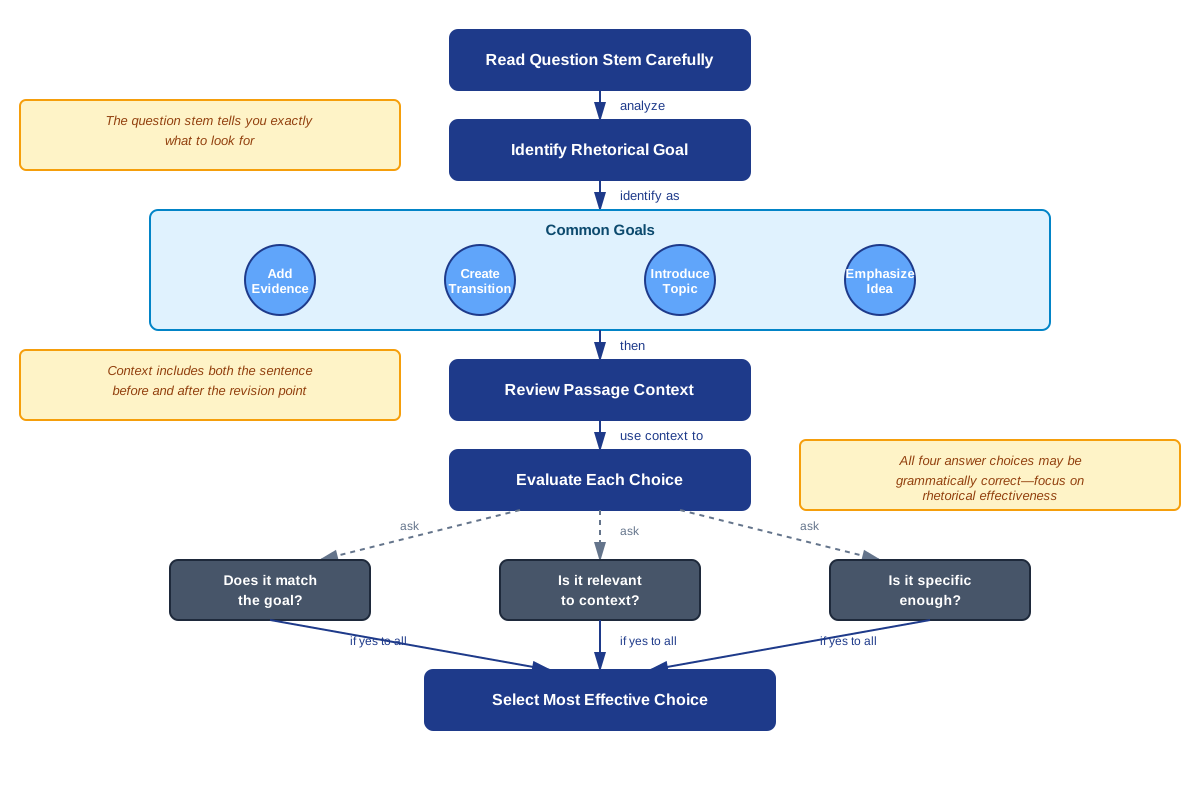
Revision strategy questions on the SAT ask students to improve a draft by selecting the most effective option from four choices. These questions always include a specific rhetorical goal in the question stem, distinguishing them from grammar questions that simply ask "which choice is correct?" The question stem typically begins with phrases like "Which choice most effectively..." or "Which choice best accomplishes the goal of..." This explicit statement of purpose is the most important element of the question—it tells you exactly what criteria to use when evaluating answer choices.
The key to success with revision strategy questions lies in understanding that all four answer choices might be grammatically correct. The SAT is not testing whether you can identify errors; instead, it's testing whether you can identify which correct option best serves the stated rhetorical purpose. This requires reading the passage carefully to understand context, identifying what the passage needs at that specific location, and then matching that need to the goal stated in the question.
Types of Revision Goals
Revision strategy questions test several distinct types of rhetorical goals, each requiring a different analytical approach:
Adding Supporting Evidence: These questions ask you to select a sentence that provides relevant support for a claim made in the passage. The correct answer must be directly related to the specific point being discussed, provide concrete details or examples, and strengthen the passage's argument. Wrong answers often provide information that is true but irrelevant to the immediate context, too general to be useful, or related to a different part of the passage.
Creating Effective Transitions: Transition questions require selecting a sentence or phrase that logically connects ideas between sentences or paragraphs. The correct answer must accurately reflect the relationship between the ideas being connected (cause-effect, contrast, continuation, example, etc.) and create smooth logical flow. Students must read both before and after the transition point to understand what relationship needs to be expressed.
Introducing Topics: Introduction questions ask for a sentence that effectively previews or sets up the content that follows. The correct answer must accurately represent what the paragraph or passage will discuss without being too specific (giving away all details) or too vague (failing to orient the reader). These questions test whether students can identify the main focus of a section.
Concluding Effectively: Conclusion questions require selecting a sentence that provides closure while reinforcing the main point. The correct answer typically synthesizes information presented earlier, emphasizes the significance of the topic, or provides a final insight. Wrong answers often introduce new information (inappropriate for a conclusion), contradict earlier points, or fail to provide meaningful closure.
Emphasizing Specific Ideas: Some questions ask which choice best emphasizes a particular aspect of the topic. These require identifying which option uses language, detail, or structure to highlight the specified element most effectively.
The Question Stem: Your Most Important Tool
The question stem in revision strategy questions provides explicit criteria for evaluation. Consider this example stem: "Which choice most effectively introduces the main topic of the paragraph?" This stem tells you three critical things:
- You're looking for an introduction (so it should come at or near the beginning)
- It should introduce the "main topic" (so it needs to be appropriately general, not overly specific)
- It should do so "effectively" (so it should be clear, relevant, and engaging)
Students who skip or skim the question stem often select answers that are well-written but don't accomplish the stated goal. Always read the question stem carefully and refer back to it while evaluating each answer choice.
Context Analysis: Reading Before and After
Revision strategy questions cannot be answered by looking at the sentence in isolation. Students must read the surrounding context—typically the entire paragraph, and sometimes adjacent paragraphs—to understand:
- What point is being made in this section?
- What information has already been provided?
- What information comes next?
- What logical relationship exists between ideas?
- What is the overall purpose of this passage?
The correct answer must fit seamlessly into this context, advancing the passage's purpose without creating redundancy, contradiction, or logical gaps.
Evaluating Answer Choices: The Three Rs
When evaluating answer choices for revision strategy questions, apply the "Three Rs" framework:
Relevance: Does this choice relate directly to the immediate context and the stated goal? Irrelevant information, no matter how interesting or well-written, is always wrong.
Relationship: Does this choice create the appropriate logical relationship with surrounding sentences? Check that transitions accurately reflect the connection between ideas and that additions support rather than contradict existing content.
Rhetorical Effectiveness: Does this choice accomplish the stated goal better than the other options? Consider specificity, clarity, emphasis, and tone. The correct answer typically provides the most precise, clear, and purposeful option.
Common Wrong Answer Patterns
Understanding why wrong answers are wrong helps eliminate them efficiently:
| Wrong Answer Type | Description | Why It's Wrong |
|---|---|---|
| Too Vague | Provides general information without specific details | Doesn't effectively support claims or introduce topics with sufficient clarity |
| Too Specific | Includes excessive detail inappropriate for the context | Disrupts flow, especially in introductions or transitions |
| Off-Topic | Discusses related but not directly relevant information | Fails the relevance test; doesn't serve the passage's immediate purpose |
| Redundant | Repeats information already stated in the passage | Adds no value; effective writing avoids unnecessary repetition |
| Wrong Relationship | Implies an incorrect logical connection (e.g., contrast instead of cause-effect) | Creates confusion about how ideas relate |
| Contradictory | Conflicts with information elsewhere in the passage | Undermines passage coherence |
Concept Relationships
Revision strategy questions integrate multiple reading and writing skills into a single assessment. At the foundation, reading comprehension enables understanding of passage content and context. This comprehension feeds into rhetorical analysis—identifying the purpose, audience, and structure of the passage. Rhetorical analysis then connects to evaluation skills, where students assess which option best serves the identified purpose.
Within revision strategy itself, different question types connect logically. Introduction questions → set up the need for → supporting evidence questions → which then lead to → transition questions → that ultimately connect to → conclusion questions. This sequence mirrors the natural structure of effective writing: introduce, support, connect, conclude.
Revision strategy also connects to other Expression of Ideas topics. Transitions questions are essentially a subset of revision strategy, focusing specifically on connecting ideas. Supporting evidence questions overlap with revision strategy when asking students to add relevant details. Organization questions share the analytical approach of considering how sentences function within larger structures.
The relationship to Standard English Conventions topics is one of hierarchy: grammar and punctuation questions test whether writing is correct, while revision strategy questions test whether correct writing is also effective. Students must first ensure correctness, then evaluate effectiveness—making revision strategy a higher-order skill.
High-Yield Facts
⭐ Revision strategy questions always include a specific goal in the question stem that determines which answer is correct
⭐ All four answer choices may be grammatically correct; the question tests rhetorical effectiveness, not grammar
⭐ The correct answer must be relevant to the immediate context, not just to the passage's general topic
⭐ Reading the entire paragraph (and sometimes adjacent paragraphs) is essential for understanding context
⭐ The question stem is more important than the answer choices—read it carefully and refer back to it
- Revision strategy questions appear in approximately 15-20% of SAT Reading and Writing questions
- Wrong answers often provide true but irrelevant information that doesn't serve the stated purpose
- Introduction sentences should preview content without being overly specific or vague
- Conclusion sentences should synthesize or emphasize without introducing entirely new information
- Transition questions require reading both before and after the transition point to identify the logical relationship
- Supporting evidence must directly relate to the specific claim being made, not just the general topic
- Redundant answers that repeat information already in the passage are always incorrect
- The most specific, concrete answer that remains relevant is typically correct for supporting evidence questions
- Effective transitions explicitly name the relationship between ideas (contrast, cause-effect, example, etc.)
- Time spent understanding the question stem and context saves time by making answer choice evaluation faster
Quick check — test yourself on Revision strategy so far.
Try Flashcards →Common Misconceptions
Misconception: The longest or most detailed answer is always best for revision strategy questions.
Correction: Length and detail are only valuable if they serve the stated purpose. For introductions, excessive detail is often wrong because it should preview, not explain everything. For conclusions, new detailed information is inappropriate. The correct answer provides the appropriate level of detail for its function.
Misconception: If an answer choice contains accurate information about the passage's topic, it must be correct.
Correction: Accuracy and relevance are different. An answer can be factually true and related to the general topic but still be wrong if it doesn't fit the immediate context or accomplish the stated goal. Always check that the information is relevant to the specific sentence location and rhetorical purpose.
Misconception: Revision strategy questions can be answered by reading only the underlined sentence or the sentence with the blank.
Correction: Context is essential. The correct answer must fit logically with surrounding sentences, maintain consistent focus, and advance the paragraph's purpose. Reading only the target sentence makes it impossible to evaluate relevance, logical relationships, or whether information is redundant.
Misconception: The most formal or sophisticated-sounding answer is correct.
Correction: The SAT values clarity and effectiveness over complexity. An answer that uses simpler language but more clearly accomplishes the goal is better than one that sounds impressive but is vague or off-topic. Match the tone of the passage rather than defaulting to formal language.
Misconception: Transition words like "however" or "therefore" automatically make an answer correct for transition questions.
Correction: The transition word must accurately reflect the logical relationship between ideas. Using "however" when the ideas don't actually contrast, or "therefore" when there isn't a cause-effect relationship, creates confusion. Evaluate whether the relationship expressed matches the content.
Misconception: Revision strategy questions are subjective and depend on personal preference.
Correction: These questions have objectively correct answers based on rhetorical principles. The question stem provides explicit criteria, and the correct answer demonstrably accomplishes the stated goal better than alternatives. While writing can involve stylistic choices, the SAT tests widely accepted principles of effective communication.
Worked Examples
Example 1: Adding Supporting Evidence
Passage Context:
"Urban gardens provide numerous benefits to city residents. [1] They create green spaces in concrete environments, offering visual relief and recreational areas. [2] Additionally, these gardens contribute to local food production, reducing transportation costs and environmental impact."
Question:
Which choice provides the most relevant supporting detail at point [2]?
A) Many cities have implemented urban planning initiatives in recent years.
B) For example, a single community garden can produce over 1,000 pounds of fresh vegetables annually.
C) Transportation systems in urban areas face numerous challenges.
D) Gardens have been part of human civilization for thousands of years.
Analysis:
First, identify the goal: provide "relevant supporting detail" at point [2]. This means we need specific information that directly supports the claim in the preceding sentence about gardens contributing to local food production.
Evaluate each choice:
Choice A: Discusses urban planning initiatives. While related to cities, this doesn't support the specific claim about food production. This is the "off-topic" wrong answer type—related to the general subject but not the immediate point. Eliminate.
Choice B: Provides a concrete example with specific data (1,000 pounds of vegetables) that directly illustrates how gardens contribute to local food production. This is specific, relevant, and directly supports the claim. Strong candidate.
Choice C: Discusses transportation challenges. While the previous sentence mentioned transportation costs, this choice discusses challenges rather than supporting the benefit of reduced costs. This is tangentially related but doesn't support the claim. Eliminate.
Choice D: Provides historical information about gardens. This is true but completely irrelevant to the specific point about food production benefits. This is the "true but irrelevant" wrong answer type. Eliminate.
Correct Answer: B
This choice provides specific, quantifiable evidence that directly supports the claim about food production, making it the most relevant supporting detail.
Example 2: Creating an Effective Introduction
Passage Context:
"[1] The process involves several stages, beginning with the collection of raw materials and ending with the finished product. First, manufacturers gather the necessary components from various suppliers. Next, these components undergo quality testing to ensure they meet specifications. Finally, assembly workers combine the components using specialized equipment."
Question:
Which choice most effectively introduces the topic of the paragraph at point [1]?
A) Manufacturing is an important part of the global economy.
B) The production of smartphones requires a complex, multi-stage manufacturing process.
C) Many products are manufactured in factories around the world.
D) Technology has changed significantly over the past decade.
Analysis:
The goal is to "effectively introduce the topic of the paragraph." An effective introduction should preview what the paragraph will discuss without being too vague or too specific. Read the rest of the paragraph to identify its focus: it describes a multi-stage manufacturing process with specific steps (collection, testing, assembly).
Evaluate each choice:
Choice A: States that manufacturing is important. This is extremely vague—it doesn't tell us what specific aspect of manufacturing the paragraph will discuss. The paragraph isn't about importance; it's about a process. This is the "too vague" wrong answer type. Eliminate.
Choice B: Identifies a specific product (smartphones) and previews that the paragraph will discuss a "complex, multi-stage manufacturing process." This accurately reflects the paragraph's content (describing stages of a process) while providing appropriate specificity. Strong candidate.
Choice C: Mentions that products are manufactured globally. This is vague and doesn't preview the paragraph's actual focus on process stages. The paragraph doesn't discuss global locations. Eliminate.
Choice D: Discusses technological change. This is off-topic—the paragraph doesn't discuss change or technology in general; it describes a manufacturing process. Eliminate.
Correct Answer: B
This choice effectively introduces the paragraph by identifying what will be discussed (a manufacturing process) and characterizing it appropriately (complex, multi-stage), which aligns with the detailed process description that follows.
Exam Strategy
Step-by-Step Approach
- Read the question stem first: Before looking at answer choices, read the question carefully to identify the specific goal. Underline or mentally note key phrases like "most effectively introduces," "provides relevant support," or "creates the best transition."
- Read the surrounding context: Read the entire paragraph containing the revision point, and often the sentences immediately before and after in adjacent paragraphs. Identify the main idea, the logical flow, and what function the revised sentence needs to serve.
- Predict what you need: Before looking at answer choices, think about what would accomplish the stated goal. For example, if you need supporting evidence, think "I need a specific example or detail about [topic]." This prediction helps you recognize the correct answer.
- Evaluate each choice against the goal: Go through each answer choice and explicitly ask, "Does this accomplish the stated goal?" Refer back to the question stem for each choice.
- Eliminate using the Three Rs: Remove choices that fail the Relevance, Relationship, or Rhetorical Effectiveness tests. Often you can eliminate 2-3 choices quickly, leaving a clear decision between the remaining options.
Trigger Words and Phrases
Watch for these phrases in question stems, as they indicate specific revision goals:
- "Most effectively introduces": Look for an answer that previews content without excessive detail
- "Provides relevant support": Need specific, concrete details directly related to the immediate claim
- "Best accomplishes the goal of": The goal will be explicitly stated; use it as your primary criterion
- "Most effectively emphasizes": Look for language, detail, or structure that highlights the specified element
- "Creates the best transition": Identify the logical relationship between ideas and find the choice that expresses it
- "Most effectively concludes": Look for synthesis, emphasis, or final insight—not new information
Process of Elimination Tips
- Eliminate off-topic choices first: If an answer discusses something not directly relevant to the immediate context, eliminate it immediately, even if it relates to the passage's general topic
- Remove redundant options: If an answer repeats information already stated in the passage, it's wrong
- Check for wrong relationships: For transition questions, eliminate any choice that implies an incorrect logical connection
- Beware of extreme specificity in introductions: Overly detailed answers rarely work for introduction questions
- Reject new information in conclusions: Conclusions should synthesize, not introduce new topics
Time Allocation
Revision strategy questions typically require more time than grammar questions because they demand careful reading of context. Allocate approximately 60-75 seconds per question:
- 15-20 seconds: Read question stem and surrounding context
- 10-15 seconds: Form a prediction of what's needed
- 30-40 seconds: Evaluate answer choices and eliminate
Exam Tip: If you're stuck between two choices, reread the question stem. Often one choice accomplishes the stated goal while the other is simply well-written but doesn't fulfill the specific purpose.
Memory Techniques
The GREAT Framework
Use GREAT to remember the evaluation process for revision strategy questions:
- Goal: What does the question stem ask you to accomplish?
- Read: Read the surrounding context carefully
- Evaluate: Assess each answer against the stated goal
- Analyze: Check for relevance, relationship, and rhetorical effectiveness
- Test: Reread with your chosen answer to confirm it works
The Three Rs Mnemonic
Remember "Relevant Relationships are Rhetorically effective" to recall the three criteria for evaluating answers: Relevance, Relationship, and Rhetorical effectiveness.
Question Type Memory Aid
Use "I SET C" to remember the five main types of revision goals:
- Introduce topics
- Support with evidence
- Emphasize specific ideas
- Transition between ideas
- Conclude effectively
Visualization Strategy
Picture a building under construction: the introduction is the foundation (sets up everything), supporting evidence is the framework (provides structure), transitions are the connections between floors (link sections), and the conclusion is the roof (completes and protects everything). This helps you remember that each element serves a specific structural purpose.
Summary
Revision strategy questions assess the ability to improve draft writing by selecting options that best accomplish specific rhetorical goals. These questions, appearing in 15-20% of SAT Reading and Writing questions, always include an explicit goal in the question stem that determines the correct answer. Success requires reading the question stem carefully, understanding the surrounding context, and evaluating answer choices based on relevance, logical relationships, and rhetorical effectiveness rather than just grammatical correctness. The five main revision goals—introducing topics, supporting with evidence, emphasizing ideas, creating transitions, and concluding effectively—each require different analytical approaches. Wrong answers typically fail by being too vague, too specific, off-topic, redundant, or expressing wrong relationships between ideas. The key to mastering these questions lies in recognizing that all choices may be grammatically correct, but only one accomplishes the stated purpose most effectively within the passage's context. Students who carefully analyze the question stem, read surrounding context, and systematically evaluate choices using the Three Rs framework (Relevance, Relationship, Rhetorical effectiveness) will consistently identify correct answers.
Key Takeaways
- Revision strategy questions test rhetorical effectiveness, not grammar—all choices may be grammatically correct
- The question stem provides explicit criteria; read it carefully and refer back to it when evaluating each answer choice
- Context is essential: always read the entire paragraph and often adjacent paragraphs to understand what the passage needs
- Apply the Three Rs: check that answers are Relevant, create appropriate Relationships, and are Rhetorically effective
- Common wrong answer types include too vague, too specific, off-topic, redundant, wrong relationship, and contradictory
- Different revision goals (introduce, support, transition, conclude, emphasize) require different evaluation approaches
- The most specific, concrete answer that remains relevant typically wins for supporting evidence questions
- Effective introductions preview without excessive detail; effective conclusions synthesize without introducing new information
Related Topics
Transitions: While revision strategy encompasses broad rhetorical goals, transitions specifically focus on connecting ideas between sentences and paragraphs. Mastering revision strategy provides the analytical framework for understanding how transitions function within larger contexts.
Supporting Evidence: This topic overlaps significantly with revision strategy questions that ask students to add relevant details. Understanding what makes evidence effective—specificity, relevance, and direct connection to claims—applies to both question types.
Organization and Structure: Revision strategy questions often test understanding of how sentences function within paragraph structure. Studying organization helps students recognize where introductions, supporting details, and conclusions should appear.
Rhetorical Synthesis: This advanced skill involves combining information from multiple sources to accomplish a rhetorical purpose. Revision strategy provides foundational practice in evaluating how well writing accomplishes specific goals.
Standard English Conventions: While revision strategy focuses on effectiveness rather than correctness, understanding grammar and punctuation ensures students can distinguish between choices that are grammatically correct, allowing them to focus on rhetorical evaluation.
Practice CTA
Now that you understand the principles of revision strategy, it's time to apply these skills to authentic SAT-style questions. The practice questions and flashcards will help you internalize the GREAT framework, recognize common wrong answer patterns, and build the confidence to tackle these high-yield questions efficiently. Remember: revision strategy questions reward careful analysis and systematic thinking. Each practice question you complete strengthens your ability to identify rhetorical purpose and select the most effective option. You've learned the strategies—now prove you can apply them. Start practicing, and watch your Reading and Writing score improve!
Sign up free to keep reading
Create a free AnvayaPrep account to finish this SAT guide on Revision strategy — plus flashcards and practice questions.