Overview
Specific language is a critical concept tested throughout the SAT Reading and Writing section, particularly within the Expression of Ideas domain. This topic focuses on the ability to recognize and select precise, concrete, and detailed word choices that effectively communicate meaning, rather than vague, general, or ambiguous language. On the SAT, students must evaluate whether a sentence or passage uses language that clearly and accurately conveys information, or whether it relies on imprecise terminology that weakens communication.
The SAT consistently tests sat specific language through questions that ask students to choose the most effective word or phrase to replace underlined portions of text. These questions assess whether students can distinguish between language that provides clear, concrete details versus language that remains abstract or unclear. Success on these questions requires understanding that effective writing uses precise nouns, vivid verbs, and exact modifiers rather than generic terms like "things," "stuff," "very," or "a lot." The ability to identify and apply specific language directly impacts a student's score on approximately 10-15% of Reading and Writing questions.
Within the broader RW (Reading and Writing) framework, specific language connects to multiple Expression of Ideas concepts, including word choice, style, and rhetorical effectiveness. While grammar and conventions questions focus on correctness, specific language questions emphasize clarity and precision. This topic also relates to the SAT's emphasis on evidence-based reading, as specific language provides the concrete details that support claims and help readers understand complex ideas. Mastering this concept strengthens overall writing quality and prepares students for the analytical demands of college-level communication.
Learning Objectives
- [ ] Identify key features of specific language
- [ ] Explain how specific language appears on the SAT
- [ ] Apply specific language to answer SAT-style questions
- [ ] Distinguish between specific and vague language in various contexts
- [ ] Evaluate the effectiveness of word choices based on precision and clarity
- [ ] Analyze how specific language enhances meaning and reader comprehension
Prerequisites
- Basic vocabulary knowledge: Understanding common words and their meanings enables recognition of precise versus general terms
- Sentence structure comprehension: Identifying how words function within sentences helps evaluate whether language choices effectively communicate intended meaning
- Reading comprehension skills: The ability to understand passage context is essential for determining which language choices best fit the author's purpose
Why This Topic Matters
Specific language represents a fundamental principle of effective communication that extends far beyond standardized testing. In academic writing, professional communication, and everyday interactions, the ability to choose precise words determines whether messages are understood clearly or misinterpreted. Scientists use specific terminology to describe exact phenomena; journalists employ concrete details to make stories vivid and credible; business professionals select precise language to avoid costly misunderstandings. The skill of recognizing and using specific language directly translates to success in college essays, research papers, and professional writing across all disciplines.
On the SAT, specific language questions appear with high frequency, typically comprising 2-4 questions per test administration. These questions most commonly appear in the Expression of Ideas category, where students must select words or phrases that best accomplish a rhetorical goal. The College Board consistently includes these questions because they assess a skill that predicts college readiness: the ability to communicate ideas with clarity and precision. Students who master this concept typically see measurable score improvements, as these questions follow predictable patterns and can be answered systematically.
Specific language questions appear in various passage types across the SAT, including scientific articles, historical documents, literary analyses, and argumentative essays. Common scenarios include: replacing vague descriptors with precise measurements or observations; substituting general nouns with specific examples; choosing vivid action verbs over weak linking verbs; and selecting concrete details over abstract generalizations. The SAT often presents passages where the original language is intentionally vague, requiring students to identify which revision provides the most specific, accurate information that enhances reader understanding.
Core Concepts
Defining Specific Language
Specific language refers to word choices that provide concrete, precise, and detailed information rather than vague, general, or abstract terms. Specific language answers the questions "exactly what?" "exactly how?" "exactly when?" and "exactly where?" with clarity and precision. This type of language uses concrete nouns (objects you can perceive with your senses), precise verbs (actions that convey exact meaning), and exact modifiers (descriptors that provide measurable or observable details).
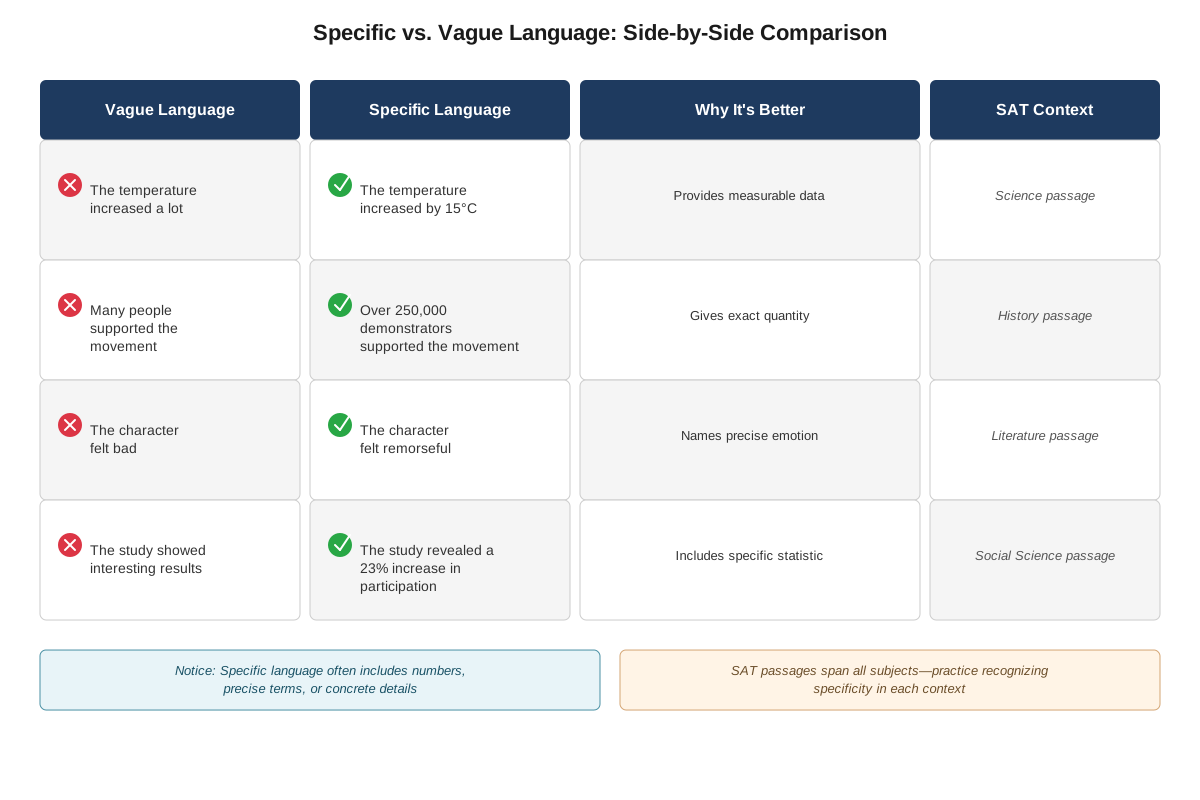
The contrast between specific and vague language becomes clear through comparison:
| Vague Language | Specific Language |
|---|---|
| The animal moved quickly. | The cheetah sprinted at 70 miles per hour. |
| She felt bad. | She experienced sharp, throbbing pain in her left temple. |
| The building was old. | The cathedral, constructed in 1163, displayed weathered limestone facades. |
| Many people attended. | Approximately 3,500 attendees filled the auditorium. |
| It happened recently. | The incident occurred on March 15, 2023, at 2:47 PM. |
Characteristics of Specific Language
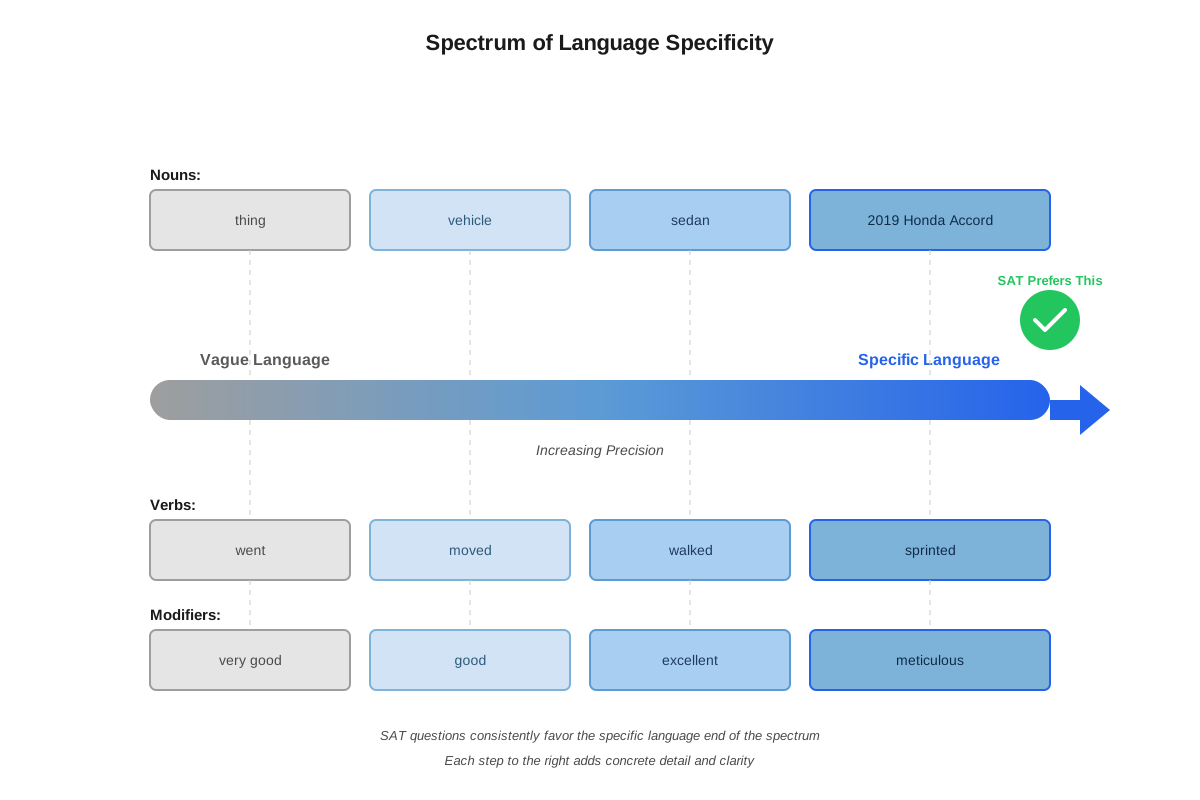
Specific language exhibits several identifiable features that distinguish it from vague alternatives. First, it employs concrete nouns rather than abstract or general terms. Instead of "vehicle," specific language uses "sedan," "pickup truck," or "minivan." Rather than "food," it specifies "grilled salmon," "Caesar salad," or "sourdough bread." These concrete nouns create mental images and convey precise meaning.
Second, specific language utilizes precise verbs that convey exact actions or states of being. Weak verbs like "go," "get," "do," and "make" often signal vague language, while strong verbs like "sprint," "acquire," "construct," and "fabricate" provide clarity. The verb choice "The CEO announced the merger" communicates more specifically than "The CEO talked about the merger."
Third, specific language includes quantifiable details whenever possible. Instead of "many," specific language provides "47" or "approximately three-quarters." Rather than "soon," it states "within 24 hours" or "by next Tuesday." These measurable details eliminate ambiguity and allow readers to understand exact magnitudes, frequencies, or timeframes.
Recognizing Vague Language Patterns
The SAT frequently tests the ability to identify common patterns of vague language that weaken communication. Generic pronouns and determiners like "things," "stuff," "something," "various," and "several" often signal imprecision. These words fail to specify what exactly is being discussed, leaving readers without clear understanding.
Intensifiers without substance represent another vague language pattern. Words like "very," "really," "quite," "extremely," and "incredibly" attempt to strengthen meaning but often mask the absence of specific details. "The experiment was very successful" communicates less than "The experiment yielded a 94% accuracy rate, exceeding the projected 85% threshold."
Abstract generalizations constitute a third pattern of vague language. Phrases like "in many ways," "for various reasons," "to some extent," and "in general" avoid committing to specific claims. While these phrases have legitimate uses in certain contexts, they often appear in SAT questions as inferior alternatives to more specific language.
Context-Dependent Specificity
Understanding specific language requires recognizing that appropriate specificity depends on context and purpose. The SAT tests whether students can identify the level of detail that best serves the passage's rhetorical goal. In a scientific passage explaining a technical process, highly specific terminology and precise measurements enhance clarity. In a narrative passage establishing mood, sensory details and concrete imagery provide appropriate specificity.
The key principle is that specific language should enhance reader understanding without introducing unnecessary complexity or irrelevant detail. If a passage discusses the economic impact of a policy, stating "unemployment decreased by 2.3 percentage points" provides useful specificity, while listing every affected industry might introduce excessive detail that obscures the main point. SAT questions test the ability to distinguish between helpful specificity and distracting over-specification.
Application in Different Passage Types
Specific language manifests differently across the various passage types students encounter on the SAT. In scientific and technical passages, specificity often involves precise terminology, numerical data, and exact descriptions of processes or phenomena. A passage about climate change benefits from specific language like "atmospheric carbon dioxide concentrations increased from 315 parts per million in 1958 to 415 parts per million in 2023" rather than "carbon dioxide levels rose significantly."
In historical and social science passages, specific language includes exact dates, proper names, specific locations, and concrete examples of abstract concepts. Rather than stating "a leader made important changes," specific language identifies "President Franklin D. Roosevelt implemented the Social Security Act in 1935, establishing a federal pension system for retired workers."
In literary and humanities passages, specific language emphasizes sensory details, precise emotional descriptors, and concrete imagery. Instead of "the character felt upset," specific language might state "the character's hands trembled as tears streamed down her face, and her voice cracked when she attempted to speak."
Concept Relationships
The concepts within specific language form an interconnected system where each element reinforces the others. Concrete nouns → provide the foundation for → precise verbs → which together enable → quantifiable details → all of which combine to eliminate → vague language patterns → resulting in → context-appropriate specificity.
Specific language connects directly to other Expression of Ideas concepts tested on the SAT. The relationship to word choice is fundamental, as selecting specific language represents a subset of effective word choice decisions. Specific language also relates to style and tone, since precise language often creates a more authoritative, credible tone than vague alternatives. Additionally, specific language supports rhetorical effectiveness, as concrete details make arguments more persuasive and explanations more comprehensible.
The prerequisite knowledge of vocabulary and sentence structure enables specific language mastery. Strong vocabulary allows students to recognize when a more precise synonym exists for a general term. Understanding sentence structure helps students evaluate whether a specific detail fits grammatically and logically within the surrounding context. These foundational skills combine with specific language principles to create comprehensive communication competence.
Quick check — test yourself on Specific language so far.
Try Flashcards →High-Yield Facts
⭐ Specific language uses concrete nouns, precise verbs, and exact modifiers rather than vague, general, or abstract terms.
⭐ The SAT tests specific language through questions asking students to replace underlined portions with more precise alternatives.
⭐ Quantifiable details (numbers, measurements, dates) almost always represent more specific language than general descriptors (many, some, recently).
⭐ Words like "things," "stuff," "various," "several," and "many" typically signal vague language that should be replaced with specific alternatives.
⭐ Context determines appropriate specificity—the best answer provides details that enhance understanding without introducing irrelevant information.
- Intensifiers like "very," "really," and "extremely" often mask the absence of specific details and weaken communication.
- Specific language creates mental images and allows readers to visualize exactly what is being described.
- Abstract generalizations ("in many ways," "for various reasons") usually represent inferior choices compared to concrete examples.
- Proper nouns (specific names of people, places, organizations) provide greater specificity than common nouns (person, location, group).
- The most specific answer choice is not always correct—it must also be relevant to the passage's purpose and context.
- Specific language appears across all SAT passage types but manifests differently in scientific, historical, and literary contexts.
- Strong verbs that convey exact actions eliminate the need for multiple modifiers and create more concise, specific sentences.
Common Misconceptions
Misconception: The longest or most complex answer choice is always the most specific. → Correction: Specific language emphasizes precision and clarity, not length or complexity. A concise phrase with exact details often provides greater specificity than a lengthy phrase with vague language. "The 1906 earthquake" is more specific than "the significant seismic event that occurred in the early twentieth century."
Misconception: Using technical jargon always makes language more specific. → Correction: Specific language must be appropriate for the audience and context. Unnecessary jargon can obscure meaning rather than clarify it. The SAT rewards language that is both specific and accessible to the intended audience.
Misconception: Specific language only involves adding more details to a sentence. → Correction: Specific language often involves replacing vague words with precise alternatives rather than adding information. Changing "moved quickly" to "sprinted" increases specificity through substitution, not addition.
Misconception: Abstract concepts cannot be expressed with specific language. → Correction: Even abstract ideas benefit from specific language through concrete examples, precise definitions, and measurable indicators. Instead of "the policy improved education," specific language states "the policy increased high school graduation rates from 78% to 86% over five years."
Misconception: All numbers and statistics automatically make language specific. → Correction: Numbers must be relevant and meaningful to provide true specificity. "The building has 47 windows" is specific but may be irrelevant, while "The building houses 47 employees" provides meaningful specificity if the passage discusses workplace capacity.
Misconception: Specific language always requires formal or academic vocabulary. → Correction: Specific language can be simple and straightforward. "The dog is a golden retriever" is more specific than "The dog is a canine," despite using simpler vocabulary. Precision matters more than sophistication.
Worked Examples
Example 1: Scientific Passage
Passage Context: A passage discusses the impact of a conservation program on wildlife populations.
Original Sentence: "The program helped animals in the area, and numbers went up significantly over time."
Question: Which choice provides the most specific information about the program's impact?
A) NO CHANGE
B) The program benefited various species, and populations increased considerably during the study period.
C) The program protected wildlife, and many animals showed positive trends in recent years.
D) The program increased the gray wolf population from 12 individuals in 2010 to 87 individuals in 2020.
Analysis:
- Choice A uses vague language: "helped" (imprecise verb), "animals" (general noun), "numbers" (unspecified), "significantly" (unmeasured), "over time" (indefinite period)
- Choice B improves slightly with "benefited" and "populations" but retains vague terms: "various species" (unspecified), "considerably" (unmeasured), "study period" (undefined timeframe)
- Choice C remains vague: "protected" (unclear action), "wildlife" (general), "many animals" (unquantified), "positive trends" (imprecise), "recent years" (indefinite)
- Choice D provides concrete specificity: "gray wolf" (specific species), "from 12 individuals" (exact starting number), "in 2010" (precise date), "to 87 individuals" (exact ending number), "in 2020" (precise date)
Answer: D
Connection to Learning Objectives: This example demonstrates how to identify key features of specific language (concrete nouns, quantifiable details, precise timeframes) and apply this knowledge to select the most effective answer choice on an SAT-style question.
Example 2: Historical Passage
Passage Context: A passage describes an inventor's contribution to technology.
Original Sentence: "The inventor created something important that changed how people did things in various ways."
Question: Which choice most effectively uses specific language to describe the inventor's contribution?
A) NO CHANGE
B) The inventor developed a significant innovation that transformed multiple aspects of daily life.
C) The inventor made an important device that altered numerous activities for many individuals.
D) The inventor patented the telephone in 1876, revolutionizing long-distance communication.
Analysis:
- Choice A contains multiple vague elements: "created something" (unspecified object and weak verb), "important" (subjective without explanation), "changed how people did things" (unclear actions), "in various ways" (unspecified methods)
- Choice B improves verb choice with "developed" but retains vagueness: "significant innovation" (unidentified), "transformed multiple aspects" (unspecified), "daily life" (general)
- Choice C attempts specificity with "device" but remains vague: "important" (unexplained), "altered numerous activities" (unspecified), "many individuals" (unquantified)
- Choice D provides concrete specificity: "patented" (precise action), "the telephone" (specific invention), "in 1876" (exact date), "revolutionizing long-distance communication" (specific impact)
Answer: D
Connection to Learning Objectives: This example illustrates how specific language appears on the SAT in historical contexts and demonstrates the process of evaluating answer choices by identifying concrete details versus vague generalizations. The correct answer replaces multiple vague elements with precise information that enhances reader understanding.
Exam Strategy
When approaching specific language questions on the SAT, begin by identifying the trigger words and phrases that signal these questions. Look for instructions like "most specifically," "most precisely," "provides the clearest information," or "best supports the claim with relevant details." These phrases indicate that the question tests specific language rather than grammar or style.
Read the surrounding context carefully before evaluating answer choices. The passage's purpose and focus determine which details are relevant and appropriately specific. A passage about economic policy requires different specificity than a passage about artistic technique. Understanding context prevents selecting answer choices that are specific but irrelevant.
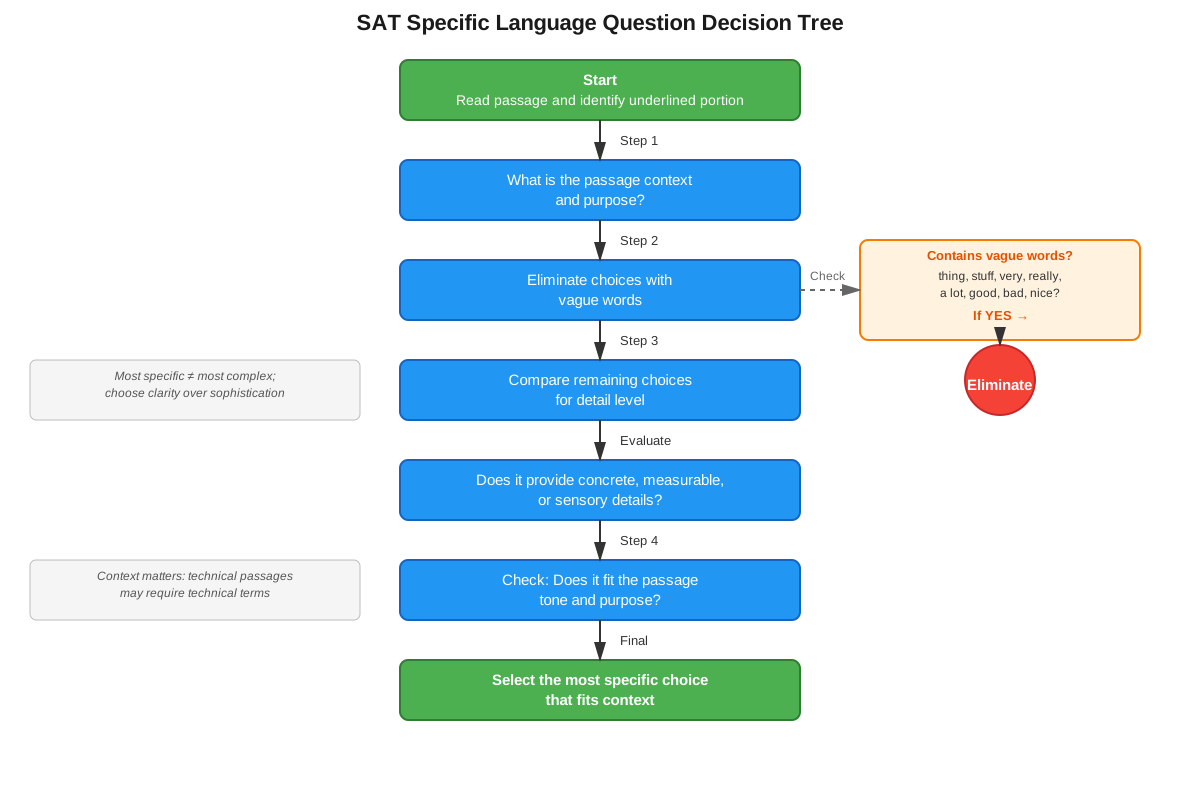
Apply a systematic elimination process by first removing choices with obvious vague language patterns. Eliminate options containing "things," "stuff," "various," "many," "some," "very," "really," or other generic terms. Then compare remaining choices, asking: "Which provides concrete nouns? Which uses precise verbs? Which includes quantifiable details?" The answer that best satisfies these criteria while remaining relevant to context is typically correct.
Watch for distractor patterns common in specific language questions. The SAT often includes answer choices that are specific but introduce information inconsistent with the passage or that provide excessive, irrelevant detail. Always verify that specific details align with the passage's established facts and purpose. Additionally, be cautious of choices that use complex vocabulary or technical jargon without actually providing greater precision—sophistication does not equal specificity.
Time allocation for specific language questions should be approximately 45-60 seconds per question. These questions require careful reading of context and comparison of answer choices but do not demand the extensive analysis required for some rhetorical synthesis questions. If a question requires more than 90 seconds, mark it for review and move forward to maintain pacing.
Memory Techniques
Use the acronym CONCRETE to remember the key features of specific language:
- Clear nouns (not vague terms)
- Observable details (sensory information)
- Numbers and measurements (quantifiable data)
- Certain verbs (precise actions)
- Relevant to context (appropriate specificity)
- Exact modifiers (precise descriptors)
- Timeframes specified (dates, durations)
- Eliminate vagueness (remove generic terms)
Visualize the "Zoom In" technique: Imagine starting with a blurry photograph that gradually comes into focus. Vague language is like the blurry image—you can see general shapes but lack detail. Specific language is like the focused photograph—you can see exact features, colors, and textures. When evaluating answer choices, ask which option "zooms in" to provide the clearest, most detailed picture.
Remember the "Five W's and H" principle: Specific language answers Who (exactly), What (precisely), When (exact time), Where (specific location), Why (clear reason), and How (exact method or measurement). When comparing answer choices, count how many of these questions each option answers with concrete details.
Create a mental "Red Flag List" of words that typically signal vague language: things, stuff, various, several, many, some, very, really, quite, extremely, significantly, considerably, recently, soon, often, sometimes. When you encounter these words in answer choices, recognize them as potential indicators of vague language that should be replaced with specific alternatives.
Summary
Specific language represents a fundamental principle of effective communication tested consistently throughout the SAT Reading and Writing section. This concept requires students to distinguish between vague, general language and precise, concrete language that clearly communicates exact meaning. Specific language employs concrete nouns rather than abstract terms, precise verbs rather than weak alternatives, and quantifiable details rather than unmeasured generalizations. The SAT tests this concept through Expression of Ideas questions that ask students to select the most effective word or phrase to accomplish a rhetorical goal. Success requires recognizing common patterns of vague language (generic terms like "things" and "various," intensifiers like "very" and "really," abstract generalizations like "in many ways") and understanding that appropriate specificity depends on context and purpose. The most effective answer choice provides concrete details that enhance reader understanding without introducing irrelevant information or unnecessary complexity, creating clear mental images and eliminating ambiguity.
Key Takeaways
- Specific language uses concrete nouns, precise verbs, exact modifiers, and quantifiable details to communicate clear, unambiguous meaning
- The SAT consistently tests specific language through Expression of Ideas questions asking students to select the most precise and effective word choices
- Common vague language patterns include generic terms ("things," "various"), weak intensifiers ("very," "really"), and abstract generalizations ("in many ways")
- Context determines appropriate specificity—the best answer provides relevant details that enhance understanding without introducing excessive or irrelevant information
- Systematic elimination of vague language patterns, followed by comparison of concrete details in remaining choices, leads to correct answers
- Specific language appears across all SAT passage types but manifests differently in scientific, historical, and literary contexts
- Mastering specific language improves not only SAT scores but also college writing, professional communication, and overall clarity of expression
Related Topics
Word Choice and Tone: Building on specific language skills, this topic explores how word selection creates particular tones (formal, informal, objective, passionate) and how to match vocabulary to rhetorical purpose. Mastering specific language provides the foundation for understanding nuanced word choice decisions.
Rhetorical Synthesis: This advanced topic requires students to combine information from multiple sources and express ideas with precision and clarity. Strong specific language skills enable effective synthesis by ensuring that combined information is expressed with concrete, unambiguous details.
Transitions and Logical Flow: While specific language focuses on individual word choices, transitions examine how sentences and ideas connect. Together, these skills create writing that is both precise in detail and clear in organization.
Style and Consistency: This topic addresses maintaining consistent voice, tone, and level of formality throughout a passage. Specific language contributes to style by establishing whether writing is technical and precise or general and accessible.
Practice CTA
Now that you understand the principles of specific language and how this concept appears on the SAT, you're ready to apply these skills to practice questions. The practice questions and flashcards will reinforce your ability to identify vague language patterns, recognize concrete details, and select the most precise and effective word choices. Each practice question provides an opportunity to apply the systematic approach outlined in this guide: identify context, eliminate vague options, compare concrete details, and verify relevance. Consistent practice with these materials will build the automatic recognition skills that lead to quick, confident answers on test day. Remember that specific language questions follow predictable patterns—the more you practice identifying these patterns, the more reliably you'll select correct answers and improve your overall SAT Reading and Writing score.
Sign up free to keep reading
Create a free AnvayaPrep account to finish this SAT guide on Specific language — plus flashcards and practice questions.