Overview
The distinction between its vs it's represents one of the most frequently tested grammar concepts in the SAT Reading and Writing section. This seemingly simple topic trips up countless students each year, not because the rule is complex, but because these two words sound identical when spoken and appear nearly identical when written. The SAT specifically targets this confusion because it tests a student's ability to recognize possessive forms versus contractions—a fundamental skill in standard written English.
Understanding its vs it's is essential for success on the SAT because questions testing this concept appear regularly in the Standard English Conventions domain. These questions assess whether students can identify and correct errors in pronoun usage and punctuation within authentic passages. The College Board includes these questions because they measure a student's command of conventions that matter in college-level writing and professional communication. A single apostrophe can completely change the meaning of a sentence, and the SAT rewards students who can spot these distinctions quickly and accurately.
This topic connects directly to broader concepts in the Form, Structure, and Sense unit, particularly pronoun-antecedent agreement, possessive forms, and contraction usage. Mastering its vs it's strengthens overall understanding of how apostrophes function in English, which extends to other possessive forms and contractions tested throughout the RW section. Students who confidently distinguish between these two forms demonstrate grammatical precision that carries over to essay writing and other language tasks.
Learning Objectives
- [ ] Identify key features of its vs it's
- [ ] Explain how its vs it's appears on the SAT
- [ ] Apply its vs it's to answer SAT-style questions
- [ ] Distinguish between possessive pronouns and contractions in context
- [ ] Recognize common sentence structures where its vs it's confusion occurs
- [ ] Evaluate answer choices by substituting the expanded form of contractions
- [ ] Construct grammatically correct sentences using both forms appropriately
Prerequisites
- Basic pronoun knowledge: Understanding what pronouns are and how they replace nouns is essential because "its" and "it's" both relate to the pronoun "it"
- Apostrophe function: Familiarity with how apostrophes indicate possession (John's book) and contractions (don't, can't) provides the foundation for understanding why these two forms differ
- Subject-verb agreement: Recognizing how subjects and verbs work together helps identify when "it's" (it is/it has) functions as a subject-verb combination
- Sentence structure basics: Understanding complete sentences enables students to test whether "it is" or "it has" makes sense when substituted for "it's"
Why This Topic Matters
In real-world writing, confusing its and it's is one of the most common errors that undermines credibility. Professional emails, academic papers, and business communications all require correct usage of these forms. Employers and professors consistently cite this error as a marker of careless writing or insufficient command of standard English conventions. Mastering this distinction signals attention to detail and grammatical competence.
On the SAT, its vs it's questions appear with remarkable frequency—students can expect to encounter at least one question directly testing this concept on most test administrations, and often more. These questions typically appear in the Standard English Conventions question type, where students must identify and correct grammatical errors or choose the most appropriate word form. The SAT presents these questions in authentic passage contexts, requiring students to read the surrounding sentence carefully to determine which form fits the intended meaning.
The exam commonly embeds its vs it's questions in passages about science, history, literature, or social studies. A typical question might present a sentence like "The company announced ___ new policy" with answer choices including "its," "it's," "its'," and "their." The SAT also tests this concept through error identification questions where students must recognize that an incorrect form has been used. Because these questions are considered medium difficulty, they represent accessible points that well-prepared students should answer correctly every time, making them high-yield targets for score improvement.
Core Concepts
The Possessive Form: Its
Its is the possessive form of the pronoun "it," indicating ownership or belonging. This word shows that something belongs to or is associated with the thing represented by "it." The critical feature that confuses many students is that its does NOT use an apostrophe, despite being possessive. This exception exists because possessive pronouns (his, hers, its, ours, yours, theirs) never take apostrophes in standard English.
The word its functions as a possessive determiner, appearing before a noun to show what belongs to the subject. Consider these examples:
- The dog wagged its tail. (The tail belongs to the dog)
- The company released its annual report. (The report belongs to the company)
- The tree lost its leaves in autumn. (The leaves belong to the tree)
In each case, its directly precedes a noun and indicates possession without any apostrophe. The absence of an apostrophe is the defining characteristic that distinguishes this form from the contraction.
The Contraction: It's
It's is a contraction that combines two separate words: "it is" or "it has." The apostrophe in it's replaces the missing letters from the second word, following the standard rule for contractions in English. This form never indicates possession; it always represents a shortened version of a two-word phrase.
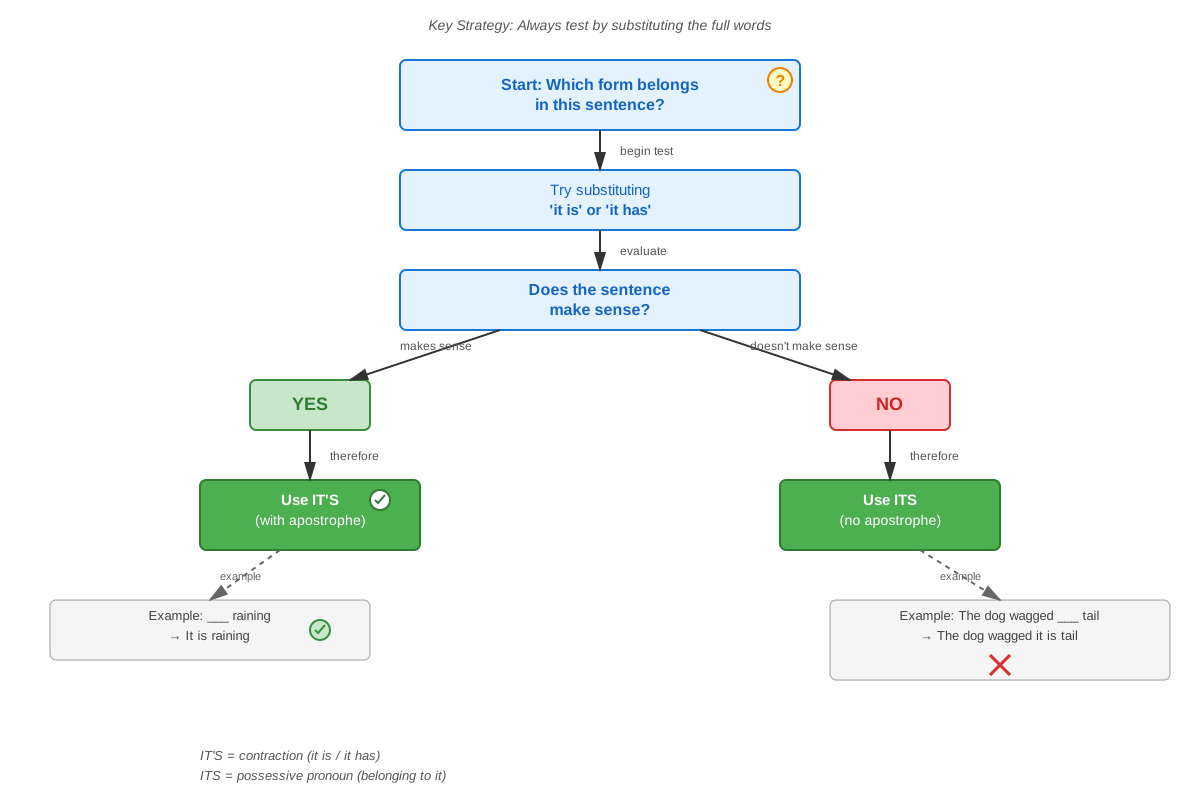
When encountering it's in a sentence, students can always substitute the full phrase "it is" or "it has" to verify correctness:
- It's raining outside. (It is raining outside)
- It's been three years since we met. (It has been three years since we met)
- It's important to study regularly. (It is important to study regularly)
The substitution test is the most reliable method for determining whether it's is correct. If the sentence makes sense with "it is" or "it has," then it's with an apostrophe is appropriate. If the substitution creates an awkward or nonsensical sentence, then the possessive its is needed instead.
The Comparison Table
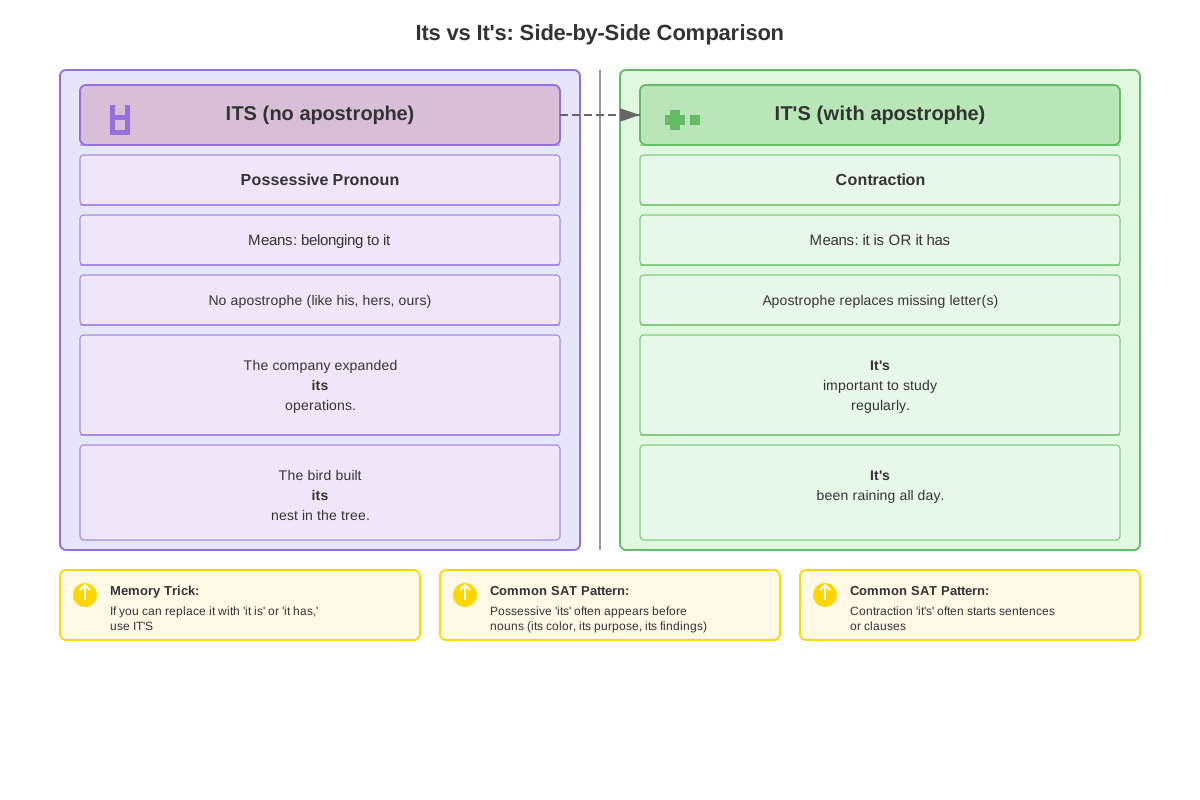
| Form | Function | Apostrophe | Substitution Test | Example |
|---|---|---|---|---|
| its | Possessive pronoun | NO | Cannot substitute "it is/has" | The bird built its nest. |
| it's | Contraction | YES | Can substitute "it is/has" | It's a beautiful day. |
Common Sentence Patterns
Understanding where each form typically appears helps students recognize correct usage quickly:
Patterns requiring "its" (possessive):
- [Subject] + verb + its + [noun]: "The museum expanded its collection."
- Its + [noun] + verb: "Its design impressed critics."
- Preposition + its + [noun]: "The company is known for its innovation."
Patterns requiring "it's" (contraction):
- It's + adjective: "It's difficult to explain."
- It's + verb + -ing: "It's raining heavily."
- It's + been + time expression: "It's been a long day."
The Apostrophe Exception Rule
The confusion surrounding its vs it's stems from a broader apostrophe rule that students must understand. In English, apostrophes typically indicate possession for nouns (the student's book, James's car, the teachers' lounge). However, possessive pronouns represent a major exception to this pattern. None of the possessive pronouns use apostrophes:
- his (not hi's)
- hers (not her's)
- its (not it's for possession)
- ours (not our's)
- yours (not your's)
- theirs (not their's)
This exception exists because these words are already inherently possessive—they don't need an apostrophe to show ownership. The apostrophe in it's serves an entirely different function: indicating contraction, not possession.
Concept Relationships
The its vs it's distinction connects directly to several fundamental grammar concepts. First, it relates to pronoun usage because both forms involve the pronoun "it," which refers back to a previously mentioned noun (the antecedent). Understanding pronoun-antecedent relationships helps students track what "it" refers to, making the possessive form its more logical in context.
Second, this topic connects to apostrophe rules more broadly. Students who master when apostrophes indicate possession (for nouns) versus contraction (for verbs) can apply this knowledge to other commonly confused pairs like "your/you're" and "their/they're/there." The relationship flows: Apostrophe Rules → Possessive vs. Contraction → Its vs It's → Related Homophones.
Third, its vs it's relates to sentence structure and completeness. When students test whether "it is" or "it has" can substitute for it's, they're actually analyzing whether the sentence contains a complete verb phrase. This connects to understanding subjects, verbs, and predicates. The relationship map looks like this:
Pronoun Knowledge → identifies what "it" refers to → Possessive Pronouns (its) → shows ownership without apostrophe
Contraction Rules → apostrophe replaces missing letters → It's (it is/has) → creates subject-verb combination
Substitution Test → verifies grammatical correctness → Correct Usage → leads to accurate SAT answers
Finally, this topic connects forward to more complex pronoun issues tested on the SAT, including pronoun case (subjective, objective, possessive) and pronoun clarity. Mastering its vs it's builds the foundation for recognizing when pronouns are used correctly in various grammatical roles.
High-Yield Facts
⭐ Its (no apostrophe) is always possessive, showing that something belongs to "it"
⭐ It's (with apostrophe) is always a contraction meaning "it is" or "it has"
⭐ The substitution test is foolproof: if you can replace the word with "it is" or "it has" and the sentence makes sense, use it's
⭐ Possessive pronouns (its, his, hers, ours, yours, theirs) never use apostrophes
⭐ On the SAT, its vs it's questions appear in Standard English Conventions questions within authentic passages
- The form "its'" (with apostrophe after the s) is never correct in standard English
- Its typically appears directly before a noun (its color, its purpose, its members)
- It's typically appears before an adjective, verb, or been (it's blue, it's raining, it's been)
- Context clues in the surrounding sentence always indicate which form is needed
- SAT questions may include "its'" as a distractor answer choice to test whether students know this form doesn't exist
- The error rate for its vs it's on the SAT is approximately 40-50% among unprepared students, making it a high-value topic for score improvement
- Questions testing this concept typically take 15-30 seconds to answer once the rule is mastered
Quick check — test yourself on Its vs it's so far.
Try Flashcards →Common Misconceptions
Misconception: "Its" needs an apostrophe because it shows possession, and possessive forms use apostrophes.
Correction: While most possessive nouns use apostrophes (the dog's bone), possessive pronouns never do. "Its" is a possessive pronoun, so it follows the same pattern as "his," "hers," and "theirs"—no apostrophe needed.
Misconception: "It's" can be possessive if the context clearly shows ownership.
Correction: "It's" can only mean "it is" or "it has"—never possession. The apostrophe in "it's" indicates contraction (missing letters), not ownership. Context doesn't change this grammatical rule.
Misconception: "Its'" (with apostrophe after the s) is the correct possessive form.
Correction: The form "its'" does not exist in standard English. This form is never correct on the SAT or in any formal writing. The possessive form is simply "its" with no apostrophe at all.
Misconception: You can use either form interchangeably if the sentence sounds correct when read aloud.
Correction: Because "its" and "it's" are homophones (sound identical), reading aloud doesn't help distinguish them. The substitution test (trying "it is" or "it has") is the only reliable method.
Misconception: If "it" refers to a company or organization, use "it's" because organizations are made up of people.
Correction: Whether "it" refers to an object, animal, concept, or organization doesn't affect the its/it's rule. The choice depends solely on whether you need the possessive form or the contraction "it is/has."
Misconception: The SAT accepts both forms as long as the meaning is clear from context.
Correction: The SAT has one correct answer based on standard English conventions. Using the wrong form is always marked incorrect, regardless of whether a reader might understand the intended meaning.
Worked Examples
Example 1: Identifying the Correct Form in Context
Question: The museum announced that ___ new exhibit would open in March, featuring artifacts from ancient civilizations.
A) its'
B) it's
C) its
D) their
Step 1: Identify what the blank needs to express
The sentence discusses something belonging to the museum—specifically, the museum's exhibit. This indicates we need a possessive form.
Step 2: Apply the substitution test
Try substituting "it is" or "it has": "The museum announced that it is new exhibit would open..." This creates a grammatically incorrect sentence, confirming we don't need the contraction.
Step 3: Eliminate incorrect answers
- Choice A ("its'") is never correct in standard English—eliminate
- Choice B ("it's") is the contraction, but we need possessive—eliminate
- Choice D ("their") could be possessive, but "museum" is singular and referred to as "it," not "they"—eliminate
Step 4: Confirm the correct answer
Choice C ("its") is the possessive form without an apostrophe, correctly showing that the exhibit belongs to the museum.
Answer: C
Connection to learning objectives: This example demonstrates how to identify key features of its vs it's (possessive vs. contraction), apply the substitution test, and eliminate incorrect answer choices—all essential skills for SAT success.
Example 2: Correcting an Error in a Passage
Question: The following sentence appears in a passage about climate change. Which choice corrects the error?
"The research team published it's findings after three years of data collection, revealing significant changes in ocean temperatures."
A) NO CHANGE
B) its findings
C) its' findings
D) their findings
Step 1: Identify the potential error
The sentence uses "it's" before "findings." We need to determine if this is correct.
Step 2: Apply the substitution test
Replace "it's" with "it is" or "it has": "The research team published it is findings..." or "The research team published it has findings..." Both versions are grammatically incorrect and nonsensical.
Step 3: Determine what the sentence needs
The sentence expresses that the findings belong to the research team. Since "team" is singular and referred to as "it," we need the possessive form of "it."
Step 4: Evaluate each answer choice
- Choice A (NO CHANGE) keeps "it's," which we've determined is incorrect
- Choice B ("its") provides the possessive form without an apostrophe—this is correct
- Choice C ("its'") uses a form that doesn't exist in standard English
- Choice D ("their") changes the pronoun, but "team" is singular and consistently referred to as "it" in the passage
Answer: B
Connection to learning objectives: This example shows how its vs it's appears on the SAT in error correction questions, demonstrates the application of the substitution test in authentic passage contexts, and illustrates how to evaluate all answer choices systematically.
Exam Strategy
When approaching SAT its vs it's questions, follow this systematic process:
Step 1: Identify the question type
Recognize that you're dealing with a Standard English Conventions question testing pronoun usage or apostrophe rules. The answer choices will typically include both "its" and "it's" along with distractors.
Step 2: Read the complete sentence
Never try to answer based on the blank alone. Read the entire sentence to understand the intended meaning and grammatical structure.
Step 3: Apply the substitution test immediately
Replace the blank or underlined portion with "it is" or "it has." If either substitution creates a grammatically correct, logical sentence, the answer must be "it's" (with apostrophe). If the substitution doesn't work, the answer must be "its" (without apostrophe).
Step 4: Look for trigger words and patterns
Exam Tip: If the word immediately following the blank is a noun (exhibit, purpose, color, members), you almost always need the possessive "its." If the following word is an adjective, verb, or "been," you likely need the contraction "it's."
Step 5: Eliminate impossible answers first
Always eliminate "its'" immediately—this form never exists. This quick elimination improves your odds if you need to guess.
Step 6: Watch for pronoun consistency
Check whether the passage consistently refers to the subject as "it" (singular) or "they" (plural). If the passage uses "they," then "their" might be correct instead of either "its" or "it's."
Time allocation: These questions should take 15-30 seconds once you've mastered the concept. Don't overthink—apply the substitution test and move forward confidently.
Common trigger phrases to watch for:
- "_____ important to..." (needs "it's" = it is)
- "_____ been..." (needs "it's" = it has)
- "_____ [noun]" (needs "its" = possessive)
- "known for _____ [noun]" (needs "its" = possessive)
Memory Techniques
The Substitution Mnemonic: "If It Is works, use It's with an apostrophe." The three I's remind you that if "it is" fits, you need the apostrophe form.
The Possession Visualization: Picture possessive pronouns as a family that never uses apostrophes: "His, Hers, Its, Ours, Yours, Theirs" (HIYOT). None of these family members ever take apostrophes because they're already possessive.
The Contraction Connection: Remember that it's belongs to the contraction family with don't, can't, won't, and you're. All contractions use apostrophes to show missing letters. If you're not combining two words, you don't need an apostrophe.
The "Two Words" Test: Before using it's, ask yourself: "Am I trying to say two words (it is OR it has)?" If yes, use the apostrophe. If no, don't.
The Noun Neighbor Rule: Visualize that its (no apostrophe) is always neighbors with a noun—they live right next door to each other in the sentence. "Its color," "its purpose," "its design"—the noun always follows.
The Apostrophe Replacement: Picture the apostrophe in it's as a tiny person standing in for the missing letters. The apostrophe is literally replacing the "i" in "is" or the "ha" in "has." No missing letters? No apostrophe needed.
Summary
The distinction between its and it's is a high-yield SAT topic that tests students' command of possessive pronouns versus contractions. The possessive form its (without apostrophe) shows ownership and follows the pattern of other possessive pronouns like "his" and "hers," which never use apostrophes. The contraction it's (with apostrophe) always means "it is" or "it has," with the apostrophe replacing missing letters. The most reliable strategy for SAT questions is the substitution test: if "it is" or "it has" can replace the word and the sentence remains grammatically correct, use it's; otherwise, use its. Students should watch for common patterns—its typically precedes nouns while it's typically precedes adjectives or verbs. The form "its'" never exists in standard English and should always be eliminated immediately. Mastering this distinction requires understanding that possessive pronouns represent an exception to the general rule that apostrophes indicate possession, and recognizing that context clues in the surrounding sentence always reveal which form is needed.
Key Takeaways
- Its (no apostrophe) = possessive, showing ownership; it's (with apostrophe) = contraction meaning "it is" or "it has"
- The substitution test is the most reliable method: if you can substitute "it is" or "it has" and the sentence works, use it's
- Possessive pronouns (its, his, hers, ours, yours, theirs) never use apostrophes—this is a major exception to general apostrophe rules
- The form "its'" does not exist in standard English and should always be eliminated on the SAT
- Its vs it's questions appear regularly on the SAT in Standard English Conventions questions, making them high-yield targets for score improvement
- Context clues matter: its typically precedes nouns, while it's typically precedes adjectives, verbs, or "been"
- These questions should take 15-30 seconds to answer—apply the substitution test quickly and move forward confidently
Related Topics
Possessive Pronouns and Determiners: Understanding the full range of possessive forms (my, your, his, her, its, our, their) and how they function in sentences builds on the foundation established by mastering its vs it's. This topic extends to possessive pronoun case and agreement.
Apostrophe Usage: Beyond its vs it's, the SAT tests apostrophes in possessive nouns (singular and plural), contractions, and special cases. Mastering this topic enables students to handle all apostrophe-related questions confidently.
Commonly Confused Homophones: The its vs it's distinction is part of a larger category including your/you're, their/they're/there, whose/who's, and affect/effect. Students who master one pair often find the others easier to learn.
Pronoun-Antecedent Agreement: Understanding what "it" refers to in a passage (its antecedent) helps students determine whether its or it's makes logical sense in context. This topic deepens comprehension of pronoun relationships.
Standard English Conventions: The broader category of grammar rules tested on the SAT includes subject-verb agreement, verb tense, parallel structure, and modifier placement. Mastering its vs it's contributes to overall command of conventions.
Practice CTA
Now that you've mastered the distinction between its and it's, it's time to reinforce your learning through practice. Complete the practice questions to apply the substitution test, identify correct usage in authentic SAT-style passages, and build the automaticity you need for test day. Use the flashcards to drill the key concepts until distinguishing these forms becomes second nature. Remember: this is a high-yield topic where consistent practice translates directly into points on test day. Every question you answer correctly on this concept is a question you can count on getting right when it matters most. You've got this!
Sign up free to keep reading
Create a free AnvayaPrep account to finish this SAT guide on Its vs it's — plus flashcards and practice questions.