Overview
The distinction between which vs that represents one of the most frequently tested grammar concepts in the SAT Reading and Writing section. This topic falls under the broader category of relative clauses and punctuation, requiring students to understand both grammatical function and meaning. While many native English speakers use these words interchangeably in casual conversation, the SAT demands precision in distinguishing between restrictive and non-restrictive clauses—a distinction that fundamentally changes sentence meaning and punctuation requirements.
Mastering which vs that is essential for SAT success because it appears in approximately 10-15% of all Standard English Conventions questions. These questions test whether students can identify when information is essential to a sentence's meaning (requiring "that" without commas) versus when information is supplementary (requiring "which" with commas). The College Board specifically targets this concept because it assesses both grammatical knowledge and reading comprehension—students must understand what the author intends to communicate before selecting the correct relative pronoun.
This topic connects directly to other critical RW concepts including comma usage, sentence structure, and clause identification. Understanding restrictive versus non-restrictive clauses provides the foundation for mastering appositive phrases, participial phrases, and complex sentence construction—all high-yield areas on the SAT. Students who confidently navigate which vs that questions demonstrate sophisticated command of English conventions, a skill that translates to higher scores across multiple question types in the Reading and Writing section.
Learning Objectives
- [ ] Identify key features of which vs that
- [ ] Explain how which vs that appears on the SAT
- [ ] Apply which vs that to answer SAT-style questions
- [ ] Distinguish between restrictive and non-restrictive clauses in complex sentences
- [ ] Determine correct punctuation patterns for clauses introduced by which and that
- [ ] Analyze sentence meaning to select the appropriate relative pronoun
- [ ] Recognize common SAT trap answers that exploit which vs that confusion
Prerequisites
- Basic sentence structure: Understanding subjects, verbs, and objects is necessary to identify where clauses begin and end within sentences.
- Comma rules fundamentals: Students must recognize that commas signal pauses and separate non-essential information from essential sentence elements.
- Clause identification: Distinguishing between independent and dependent clauses helps students understand how relative clauses function within larger sentence structures.
- Reading comprehension skills: Students need to grasp sentence meaning to determine whether information is essential or supplementary to the author's main point.
Why This Topic Matters
In real-world writing, the choice between which and that affects clarity and precision. Professional writers, journalists, and academics use these relative pronouns to control information flow and emphasize specific details. A sentence like "The policy that reduced emissions was successful" identifies one specific policy among many, while "The policy, which reduced emissions, was successful" provides additional information about an already-identified policy. This distinction prevents ambiguity in technical writing, legal documents, and academic papers.
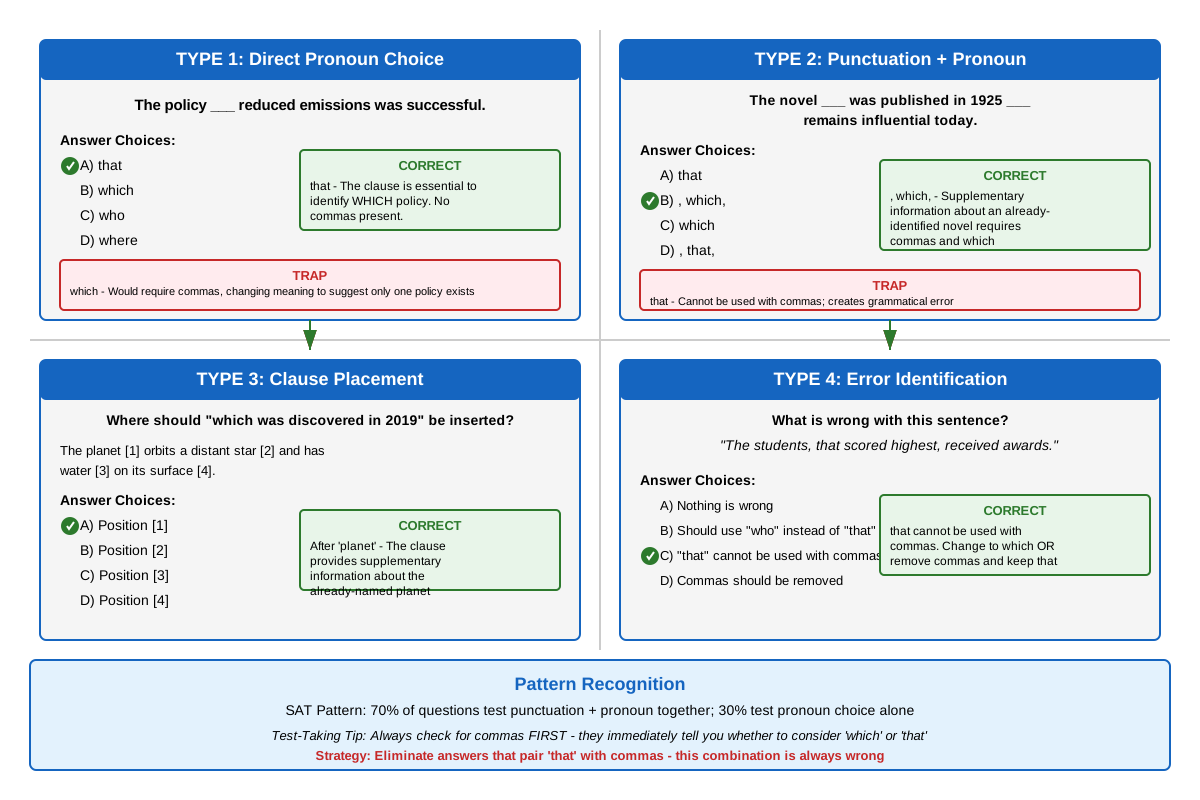
On the SAT, which vs that questions appear in 2-3 questions per test administration, making this a high-frequency topic. These questions typically appear as Standard English Conventions items where students must select the grammatically correct option from four choices. The College Board presents these questions in various formats: some require choosing between "that" and "which," others test whether commas should accompany the relative pronoun, and some combine both elements. Questions often embed this concept within complex scientific or historical passages, requiring students to process content while applying grammatical rules.
Common SAT passage contexts include scientific descriptions ("The experiment that/which tested the hypothesis"), historical narratives ("The treaty that/which ended the war"), and literary analysis ("The character that/which represents hope"). The test makers deliberately choose sentences where both options might sound acceptable to the untrained ear, making this topic an effective discriminator between high-scoring and average-scoring students.
Core Concepts
Restrictive Clauses and "That"
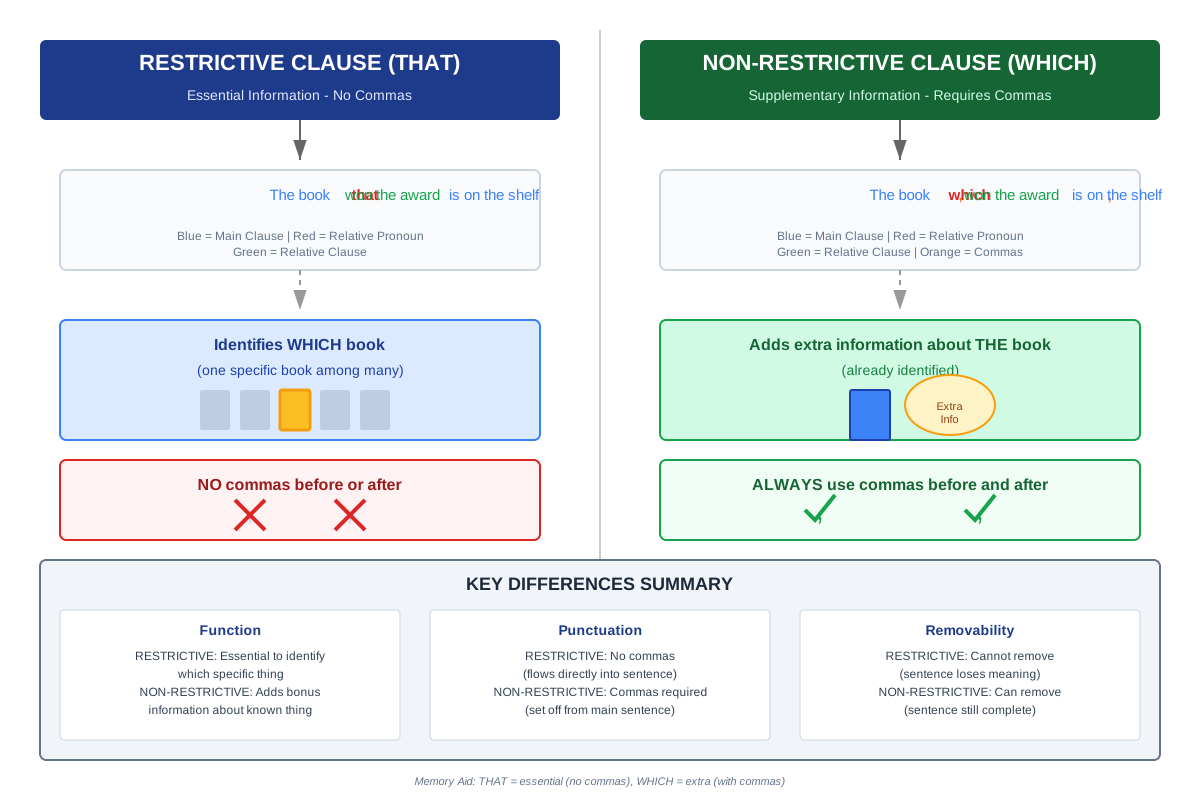
A restrictive clause (also called an essential clause) provides information that is necessary to identify the noun it modifies. Without this information, the sentence's meaning becomes unclear or changes entirely. That introduces restrictive clauses and never takes commas because the information cannot be removed without fundamentally altering the sentence.
Consider this example: "The laptop that has the blue case belongs to Maria." The clause "that has the blue case" is essential because it specifies which laptop among potentially many laptops. Removing this clause leaves "The laptop belongs to Maria," which fails to identify the specific laptop in question. The restrictive clause narrows down the noun from a general category to a specific instance.
Restrictive clauses answer the question "which one?" They function as identifiers, distinguishing one member of a group from others. In SAT passages, restrictive clauses often appear in scientific contexts where precision matters: "The cells that underwent mitosis showed increased activity" specifies particular cells rather than all cells.
Non-Restrictive Clauses and "Which"
A non-restrictive clause (also called a non-essential clause) adds supplementary information about a noun that is already sufficiently identified. This information enriches the sentence but can be removed without changing the core meaning. Which introduces non-restrictive clauses and always requires commas (or a comma and a period) because the clause functions as a parenthetical aside.
Example: "Maria's laptop, which has a blue case, is very expensive." Here, "Maria's laptop" already identifies the specific laptop—there's only one laptop belonging to Maria in this context. The clause "which has a blue case" provides additional descriptive information but isn't necessary for identification. Removing it leaves "Maria's laptop is very expensive," which maintains the sentence's essential meaning.
Non-restrictive clauses answer the question "what else can you tell me about it?" They function as descriptive additions rather than identifiers. On the SAT, these clauses often appear in biographical or historical passages: "Einstein, who developed the theory of relativity, won the Nobel Prize" (Einstein is already identified; the clause adds information about his achievement).
The Comma Test
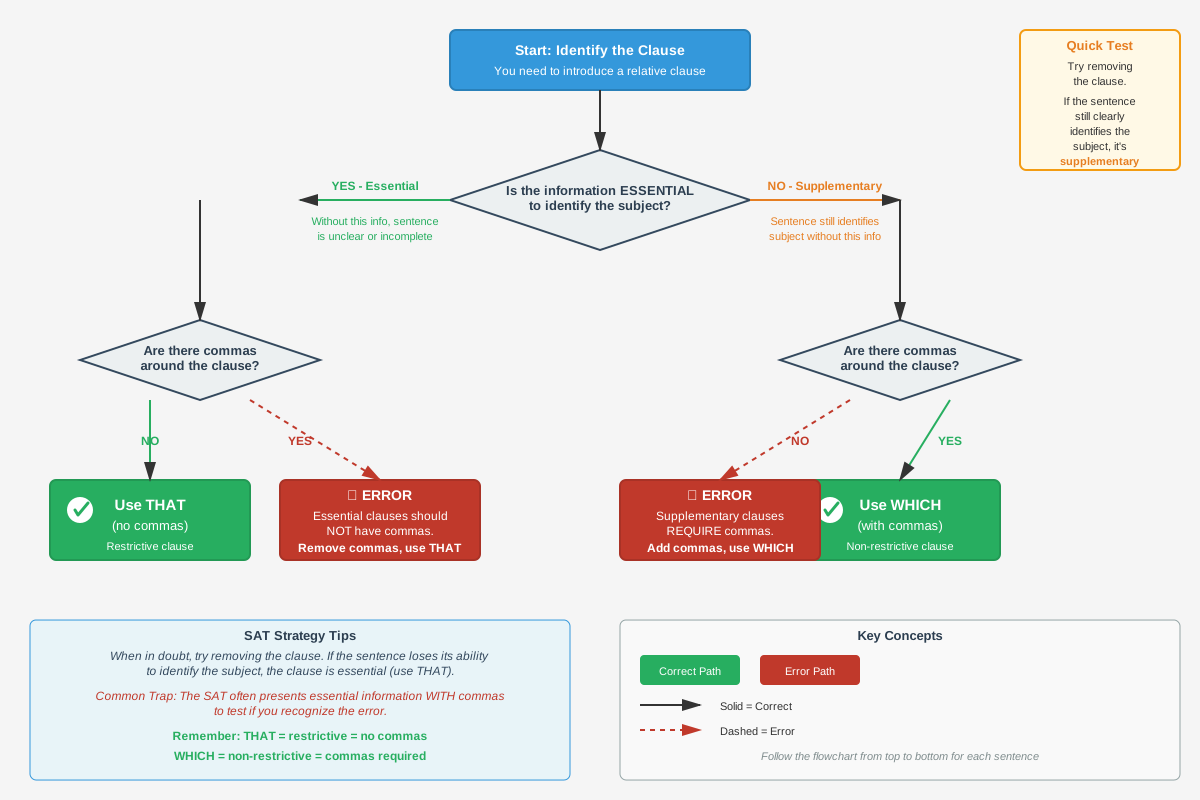
The most reliable method for distinguishing between restrictive and non-restrictive clauses involves the comma test: mentally remove the clause and its surrounding punctuation, then evaluate whether the sentence retains its intended meaning.
If removing the clause makes the sentence vague, incomplete, or changes which specific thing is being discussed, the clause is restrictive and requires "that" without commas. If removing the clause leaves a complete, clear sentence that maintains its core meaning (just with less detail), the clause is non-restrictive and requires "which" with commas.
Comparison Table
| Feature | Restrictive (That) | Non-Restrictive (Which) |
|---|---|---|
| Function | Identifies/specifies which one | Adds extra information |
| Punctuation | No commas | Requires commas |
| Removability | Cannot remove without changing meaning | Can remove; meaning stays intact |
| Relative Pronoun | That (preferred) | Which (required) |
| Question Answered | "Which one?" | "What else about it?" |
| SAT Frequency | High | High |
Special Considerations
While "that" is strongly preferred for restrictive clauses in American English (the standard the SAT follows), "which" can technically introduce restrictive clauses in British English. However, SAT questions always follow American conventions, so students should consistently use "that" for restrictive clauses without commas.
The word "that" can also function as a conjunction introducing noun clauses ("I know that you're right"), which differs from its use as a relative pronoun. SAT questions focus specifically on relative pronoun usage where "that" or "which" introduces a clause modifying a noun.
Identifying the Modified Noun
To apply which vs that correctly, students must identify the noun being modified. The relative pronoun immediately follows this noun (or follows a short prepositional phrase attached to it). In "The research that scientists conducted was groundbreaking," "that scientists conducted" modifies "research." In "The research, which took five years, was groundbreaking," "which took five years" also modifies "research" but provides non-essential timing information.
Meaning-Based Decision Making
The choice between which and that ultimately depends on the author's intended meaning, not just grammatical structure. Consider these two sentences:
- "The students that studied hard passed the exam." (Implies some students didn't study hard and didn't pass)
- "The students, who studied hard, passed the exam." (All students studied hard and passed)
The first uses a restrictive clause to identify a subset of students; the second uses a non-restrictive clause to describe all students in the group. SAT questions often test whether students can discern this meaning distinction from context.
Concept Relationships
The which vs that distinction fundamentally connects to the broader concept of clause types. Restrictive clauses function as essential modifiers → they require "that" → they take no commas. Non-restrictive clauses function as supplementary modifiers → they require "which" → they require comma separation. This logical chain demonstrates how grammatical form follows function.
This topic directly builds on comma usage rules, particularly the principle that commas separate non-essential elements from the main sentence. Understanding which vs that reinforces why commas appear in certain positions: they signal to readers that the enclosed information is supplementary rather than definitional.
The concept also connects to sentence clarity and precision. Choosing the correct relative pronoun → ensures accurate meaning → prevents reader confusion → demonstrates sophisticated writing. This relationship explains why the SAT tests this concept—it measures whether students can make grammatical choices that serve clear communication.
Relationship map: Clause identification → Determining essentiality → Selecting relative pronoun → Applying correct punctuation → Ensuring sentence clarity. Each step depends on the previous one, making this a sequential decision-making process rather than a simple memorization task.
Quick check — test yourself on Which vs that so far.
Try Flashcards →High-Yield Facts
⭐ "That" introduces restrictive (essential) clauses and never takes commas
⭐ "Which" introduces non-restrictive (non-essential) clauses and always requires commas
⭐ Restrictive clauses answer "which one?" and identify specific members of a group
⭐ Non-restrictive clauses answer "what else?" and add supplementary information
⭐ The comma test: if removing the clause changes the sentence's core meaning, use "that" without commas
- American English (SAT standard) strongly prefers "that" for restrictive clauses, while British English sometimes uses "which"
- Non-restrictive clauses can be removed entirely, leaving a grammatically complete sentence
- The relative pronoun typically appears immediately after the noun it modifies
- SAT questions often test this concept in scientific and historical passages where precision matters
- Both "which" and "that" can refer to things, ideas, or animals (but "who" is preferred for people)
- A sentence can contain both restrictive and non-restrictive clauses modifying different nouns
- The choice between which and that affects sentence meaning, not just style
- Commas with "which" function like parentheses—they set off extra information
- SAT wrong answers often include "which" without commas or "that" with commas
- Context clues in the surrounding passage help determine whether information is essential or supplementary
Common Misconceptions
Misconception: "Which" and "that" are completely interchangeable and the choice is just a matter of personal preference.
Correction: These relative pronouns serve different grammatical functions. "That" introduces essential information without commas, while "which" introduces non-essential information with commas. The choice affects both punctuation and meaning.
Misconception: Commas with relative clauses are optional and can be added for emphasis or pause.
Correction: Commas with relative clauses are grammatically determined, not optional. Their presence or absence signals whether information is essential (no commas with "that") or supplementary (commas with "which").
Misconception: "That" is always correct because it's shorter and simpler.
Correction: While "that" is correct for restrictive clauses, using "that" with non-essential information creates a grammatical error. When information is supplementary and set off by commas, "which" is required.
Misconception: If a sentence sounds right when read aloud, the relative pronoun choice is correct.
Correction: Many native speakers use "which" and "that" interchangeably in speech, so the "sounds right" test is unreliable. SAT questions require applying the restrictive vs. non-restrictive distinction based on meaning and punctuation rules.
Misconception: The relative pronoun choice depends on whether the noun is singular or plural.
Correction: Number agreement doesn't determine which vs that. The choice depends solely on whether the clause is essential (restrictive) or non-essential (non-restrictive) to the sentence's meaning.
Misconception: "Which" always needs two commas (one before and one after the clause).
Correction: While "which" clauses often appear mid-sentence with two commas, they can also end sentences with just one comma before "which" and a period after the clause.
Misconception: Long clauses use "which" while short clauses use "that."
Correction: Clause length is irrelevant. The distinction depends on whether the information is essential for identification (that) or supplementary (which).
Worked Examples
Example 1: Scientific Passage
Question: The researchers studied the bacteria that/which thrived in extreme temperatures to understand survival mechanisms.
Step 1 - Identify the modified noun: "bacteria" is the noun being modified by the relative clause.
Step 2 - Determine the clause's function: Does "thrived in extreme temperatures" identify which specific bacteria, or does it add extra information about already-identified bacteria?
Step 3 - Apply the comma test: Remove the clause: "The researchers studied the bacteria to understand survival mechanisms." This sentence is too vague—which bacteria? The clause is essential for specifying which bacteria were studied.
Step 4 - Check for commas: The original sentence has no commas around the clause, confirming it's restrictive.
Step 5 - Select the relative pronoun: Since the clause is restrictive (essential for identification), "that" is correct.
Answer: "The researchers studied the bacteria that thrived in extreme temperatures to understand survival mechanisms."
Connection to learning objectives: This example demonstrates identifying key features (restrictive clause without commas) and applying the concept to answer SAT-style questions by using the comma test and meaning analysis.
Example 2: Historical Passage
Question: The treaty that/which ended the war was signed in 1945, brought lasting peace to the region.
Step 1 - Identify punctuation clues: Notice the comma after "1945" but no comma before the relative pronoun. This inconsistency suggests a punctuation error.
Step 2 - Analyze sentence structure: "The treaty was signed in 1945" is a complete thought. "Brought lasting peace to the region" appears to be additional information.
Step 3 - Determine intended meaning: Is the clause identifying which specific treaty, or adding information about an already-identified treaty? The phrase "the treaty" (with the definite article) suggests a specific, already-identified treaty. The context implies there was one treaty that ended the war.
Step 4 - Apply the comma test: "The treaty was signed in 1945" makes sense alone. The information about ending the war and bringing peace appears supplementary.
Step 5 - Correct the sentence: Since the clause is non-restrictive, it needs "which" and should be set off by commas.
Answer: "The treaty, which ended the war, was signed in 1945 and brought lasting peace to the region." (Note: The sentence also needed "and" before "brought" to fix the comma splice.)
Connection to learning objectives: This example shows how SAT questions combine which vs that with other punctuation issues, requiring students to recognize multiple errors and apply comprehensive grammar knowledge.
Exam Strategy
When approaching sat which vs that questions on the Reading and Writing section, follow this systematic process:
Step 1 - Scan for commas first: Before even reading the full sentence, look at the punctuation around the relative pronoun. If there are commas, "which" is likely correct. If there are no commas, "that" is likely correct. This quick visual check eliminates two answer choices immediately.
Step 2 - Read the complete sentence: Understand the full context and meaning. SAT passages provide enough information to determine whether a clause is essential or supplementary.
Step 3 - Identify the modified noun: Find the noun immediately before the relative pronoun. Ask yourself: "Is this noun already specifically identified, or does the clause help identify it?"
Step 4 - Apply the comma test: Mentally remove the clause and evaluate whether the sentence's core meaning remains intact. If meaning is lost or becomes vague, the clause is restrictive (use "that"). If meaning remains clear with just less detail, the clause is non-restrictive (use "which").
Trigger words to watch for:
- Definite articles ("the"): Can indicate either type, so don't rely on this alone
- Possessives ("Maria's laptop"): Often signal non-restrictive clauses because the noun is already identified
- Proper nouns: Usually take non-restrictive clauses because they're already specific
- Plural nouns without articles: Often take restrictive clauses to specify which members of the group
Process of elimination tips:
- Immediately eliminate any choice with "that" plus commas—this combination is always wrong
- Eliminate "which" without commas in formal writing (SAT follows formal conventions)
- If two choices differ only in punctuation, the punctuation determines which relative pronoun is correct
- Watch for answer choices that change meaning—select the one matching the passage's intent
Time allocation: These questions should take 30-45 seconds once you've mastered the concept. Spend 10 seconds scanning punctuation, 15 seconds reading and applying the comma test, and 10 seconds confirming your answer. Don't overthink—the SAT tests a clear-cut distinction, not subtle nuances.
Exam Tip: If you're unsure, ask yourself: "Does this clause answer 'which one?' or 'what else?'" This simple question captures the essential distinction and works for virtually every SAT question on this topic.
Memory Techniques
THAT Mnemonic: That Helps Answer "The one?"
- Use this to remember that "that" identifies which specific one you're discussing
WHICH Mnemonic: With Helpful Information in Commas, Here's more
- Use this to remember that "which" provides additional information and requires commas
Visualization Strategy: Picture "that" as a pointing finger identifying one specific item in a group. Picture "which" as parentheses adding extra information in the margins. When you see "that," visualize pointing; when you see "which," visualize parentheses.
The Parentheses Trick: Whenever you see "which," mentally replace the commas with parentheses. If the sentence still makes sense with the clause in parentheses (meaning it's removable extra information), "which" is correct. If putting the clause in parentheses makes the sentence unclear, you need "that" instead.
Comma = Which: Create a strong mental association between commas and "which." Whenever you see commas around a relative clause, think "which." This automatic association helps on timed tests.
Essential = That: Link the word "essential" with "that" because they both have "t" sounds. "Essential information uses 'that.'"
Summary
The distinction between which and that represents a fundamental grammar concept tested frequently on the SAT Reading and Writing section. "That" introduces restrictive clauses—essential information that identifies which specific noun is being discussed—and never takes commas. "Which" introduces non-restrictive clauses—supplementary information about an already-identified noun—and always requires comma separation. The key to mastering this topic lies in determining whether a clause is essential for identification (restrictive) or provides additional details (non-restrictive). Students can apply the comma test by removing the clause and evaluating whether the sentence's core meaning remains intact. SAT questions test this concept by presenting sentences where students must choose the correct relative pronoun and punctuation combination, often embedding these questions in complex scientific or historical passages. Understanding this distinction requires both grammatical knowledge and reading comprehension—students must grasp the author's intended meaning to select the appropriate relative pronoun. Mastery of which vs that demonstrates sophisticated command of English conventions and directly contributes to higher scores on Standard English Conventions questions.
Key Takeaways
- "That" = restrictive clauses = no commas = essential information that identifies which one
- "Which" = non-restrictive clauses = requires commas = supplementary information about an already-identified noun
- The comma test is the most reliable method: remove the clause and check if core meaning remains
- Restrictive clauses answer "which one?" while non-restrictive clauses answer "what else?"
- SAT questions follow American English conventions where "that" is strongly preferred for restrictive clauses
- Punctuation and relative pronoun choice work together—"that" with commas is always wrong
- Context from the surrounding passage helps determine whether information is essential or supplementary
Related Topics
Comma Usage in Complex Sentences: Understanding which vs that provides foundation for mastering all comma rules involving clauses, including introductory clauses, coordinate clauses, and appositive phrases. This broader comma knowledge is essential for multiple SAT question types.
Relative Pronouns (Who, Whom, Whose): After mastering which vs that for things and ideas, students should study relative pronouns for people. These follow similar restrictive vs. non-restrictive patterns and appear frequently on the SAT.
Sentence Structure and Clause Types: Deep understanding of independent and dependent clauses, subordination, and coordination builds on the foundation established by which vs that. These concepts appear throughout the Standard English Conventions domain.
Punctuation with Appositives: Non-restrictive clauses function similarly to appositives—both provide supplementary information set off by commas. Mastering which vs that makes appositive questions significantly easier.
Practice CTA
Now that you understand the distinction between which and that, it's time to reinforce this knowledge through active practice. Complete the practice questions to test your ability to identify restrictive versus non-restrictive clauses in SAT-style contexts. Use the flashcards to drill the key concepts until selecting the correct relative pronoun becomes automatic. Remember: this topic appears on virtually every SAT administration, making it one of the highest-yield grammar concepts you can master. Every minute spent practicing which vs that directly translates to points on test day. You've built the foundation—now strengthen it through deliberate practice!
Sign up free to keep reading
Create a free AnvayaPrep account to finish this SAT guide on Which vs that — plus flashcards and practice questions.