Overview
Quotation integration is a critical punctuation skill tested extensively on the SAT Reading and Writing section. This topic examines how students incorporate quoted material into their own sentences while maintaining grammatical correctness and proper punctuation. The SAT frequently presents questions where test-takers must choose the correct way to integrate a quotation into a passage, making this one of the highest-yield punctuation topics to master.
Understanding quotation integration goes beyond simply knowing where to place quotation marks. Students must recognize how quoted material functions grammatically within a sentence, determine whether colons, commas, or no punctuation should precede a quotation, and ensure that the integrated quote flows naturally with the surrounding text. The SAT quotation integration questions test whether students can seamlessly blend source material into academic writing while following standard English conventions.
This topic connects directly to broader RW (Reading and Writing) skills including sentence structure, punctuation rules, and rhetorical effectiveness. Mastering quotation integration strengthens overall writing ability and prepares students for college-level academic work where proper citation and source integration are essential. On the SAT, these questions typically appear in the Standard English Conventions domain and require students to evaluate multiple options for incorporating quoted text into a passage.
Learning Objectives
- [ ] Identify key features of quotation integration
- [ ] Explain how quotation integration appears on the SAT
- [ ] Apply quotation integration to answer SAT-style questions
- [ ] Distinguish between situations requiring colons, commas, or no punctuation before quotations
- [ ] Evaluate whether a quotation is grammatically integrated into a sentence
- [ ] Recognize and correct common errors in quotation punctuation and capitalization
Prerequisites
- Basic punctuation rules: Understanding commas, colons, and periods is essential since these marks frequently precede or follow quotations
- Sentence structure fundamentals: Recognizing independent and dependent clauses helps determine proper quotation integration
- Parts of speech: Identifying verbs, nouns, and phrases enables students to assess grammatical flow when adding quotations
- Capitalization rules: Knowing when to capitalize helps students handle the first word of quotations correctly
Why This Topic Matters
Quotation integration appears in real-world academic writing, journalism, research papers, and professional communication. The ability to incorporate source material smoothly demonstrates sophisticated writing skills and prevents plagiarism by properly attributing ideas. In college, students must integrate quotations from scholarly sources into essays and research papers, making this skill foundational for academic success.
On the SAT, quotation integration questions appear with high frequency—typically 1-3 questions per test in the Reading and Writing section. These questions fall under the Standard English Conventions category and test Command of Evidence skills. The College Board consistently includes these questions because they assess both punctuation knowledge and the ability to maintain sentence coherence when adding external material.
Common SAT question formats include: selecting the correct punctuation before a quotation, choosing how to integrate a quote grammatically into a sentence, determining proper capitalization within quotations, and identifying whether a quotation should be set off with punctuation or blended directly into the sentence structure. These questions often present four answer choices that differ only in punctuation placement or capitalization, requiring precise knowledge of conventions.
Core Concepts
Types of Quotation Integration
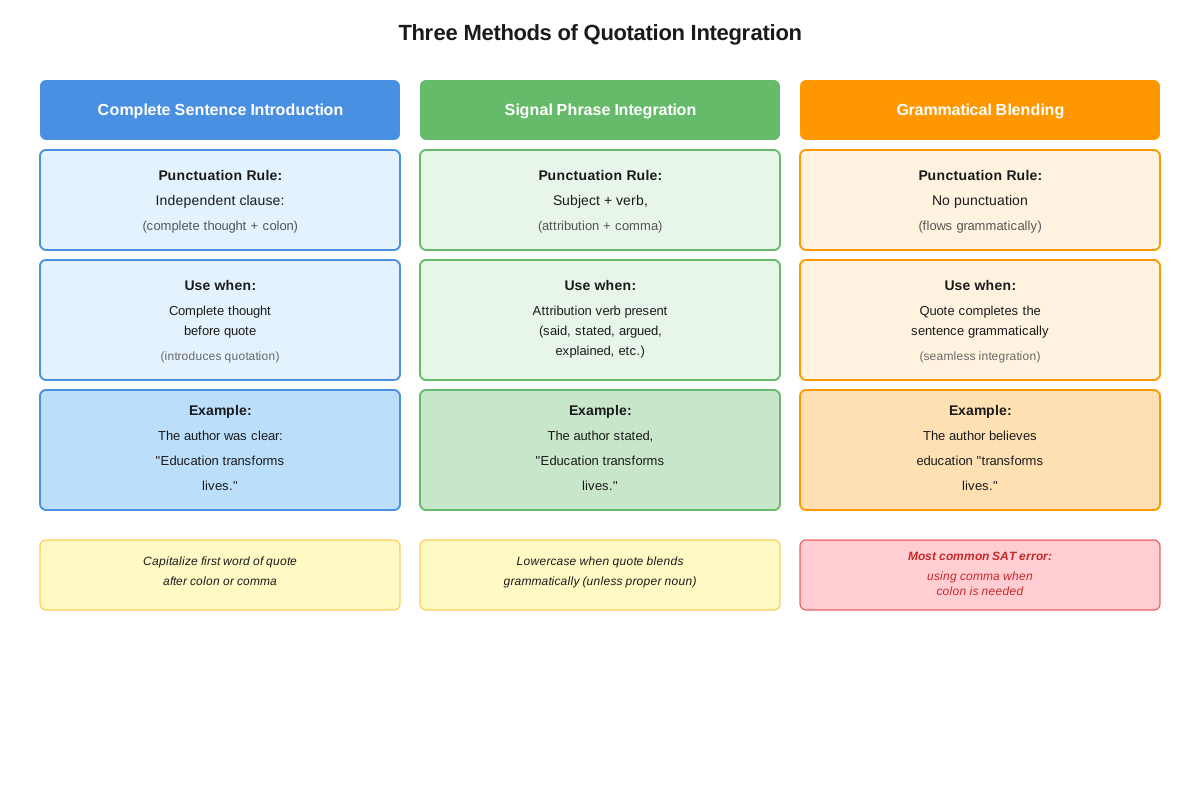
There are three primary methods for integrating quotations into sentences, each with distinct punctuation requirements. Understanding when to use each method is fundamental to SAT success.
Complete sentence introduction with colon: When an independent clause introduces a quotation, use a colon before the quoted material. The introductory statement must be grammatically complete and able to stand alone as a sentence. For example: "The researcher stated her conclusion clearly: 'Climate change requires immediate action.'" The phrase before the colon forms a complete thought, making the colon appropriate.
Signal phrase with comma: When a signal phrase (such as "according to," "she said," or "the author notes") introduces a quotation, use a comma before the quoted material. The signal phrase is typically not a complete sentence on its own. For example: "According to the study, 'most participants showed improvement.'" The comma separates the introductory phrase from the quotation.
Grammatical integration without punctuation: When a quotation flows grammatically as part of the sentence structure, no punctuation separates it from the surrounding text. The quoted material functions as a direct grammatical component. For example: "The author describes the landscape as 'harsh yet beautiful' in her memoir." The quotation serves as the object of the preposition "as" and integrates seamlessly without punctuation.
Capitalization Rules for Quotations
Capitalization within quotations follows specific patterns that the SAT tests regularly. The first word of a quotation is capitalized when the quotation forms a complete sentence or begins after a colon. For example: "The scientist concluded: 'Further research is necessary.'" The word "Further" is capitalized because it begins a complete quoted sentence.
However, when a quotation is grammatically integrated into the sentence or represents a fragment, the first word is not capitalized unless it's a proper noun. For example: "The report describes the results as 'promising but preliminary.'" The word "promising" remains lowercase because the quotation functions as part of the larger sentence structure.
Mid-sentence quotations that continue after an interruption maintain lowercase unless beginning a new sentence. For example: "The data," the researcher explained, "supports our hypothesis." The word "supports" stays lowercase because it continues the same sentence.
Punctuation Placement with Quotation Marks
Understanding where to place periods, commas, and other punctuation marks relative to quotation marks is essential for SAT questions. In American English, periods and commas always go inside closing quotation marks, regardless of whether they're part of the original quotation. For example: "The author calls the discovery 'revolutionary.'" and "According to the text, 'innovation drives progress,' which explains the company's success."
Colons and semicolons always go outside closing quotation marks. For example: "The study identified three 'critical factors': time, resources, and expertise." Question marks and exclamation points go inside quotation marks if they're part of the quoted material, but outside if they apply to the entire sentence.
Signal Phrases and Attribution
Signal phrases introduce quotations and attribute them to sources. Common signal phrases include "according to," "as stated by," "the author argues," "researchers found," and "the text notes." These phrases typically require commas before the quotation begins.
The placement of signal phrases affects punctuation. When a signal phrase precedes a quotation, use a comma: "The historian argues, 'Economic factors were decisive.'" When a signal phrase interrupts a quotation, use commas on both sides: "'Economic factors,' the historian argues, 'were decisive.'" When a signal phrase follows a quotation, the comma goes inside the closing quotation mark: "'Economic factors were decisive,' the historian argues."
Partial vs. Complete Quotations
The SAT distinguishes between complete sentence quotations and partial quotations (fragments). Complete quotations reproduce entire sentences from sources and typically require more formal introduction with colons or signal phrases with commas. Partial quotations extract specific phrases or words and often integrate grammatically without additional punctuation.
| Quotation Type | Punctuation | Example |
|---|---|---|
| Complete sentence after independent clause | Colon | The report concludes: "Renewable energy is cost-effective." |
| Complete sentence after signal phrase | Comma | The author states, "Technology shapes society." |
| Partial quotation, grammatically integrated | None | The theory is described as "fundamentally flawed." |
| Partial quotation after complete introduction | Colon | The study revealed one key finding: "significant improvement." |
Ellipses and Brackets in Quotations
While less frequently tested, the SAT occasionally includes questions about ellipses (. . .) and brackets [ ] in quotations. Ellipses indicate omitted material from the original source, while brackets show added or changed words for clarity or grammatical integration. For example: "The author notes that '[the] experiment yielded unexpected results.'" The bracketed article helps the quotation fit grammatically into the new sentence.
Concept Relationships
Quotation integration connects multiple punctuation and grammar concepts into a unified skill. The choice between colons, commas, and no punctuation depends on understanding independent clauses (prerequisite knowledge of sentence structure). When the introduction forms an independent clause, a colon is appropriate; when it's a dependent phrase, a comma works; when the quotation integrates grammatically, no punctuation is needed.
The relationship flows as follows: Sentence structure analysis → Determines punctuation choice → Affects capitalization → Creates proper quotation integration. Students must first analyze whether the introduction is a complete sentence, then select appropriate punctuation, then determine correct capitalization based on that punctuation choice.
Quotation integration also connects to comma usage (another punctuation topic) since signal phrases require commas. It relates to colon usage because colons introduce quotations after independent clauses. Additionally, it connects to sentence boundaries since students must recognize where sentences begin and end when incorporating quoted material.
The broader relationship to RW skills includes rhetorical effectiveness (choosing quotations that support arguments) and command of evidence (properly attributing source material). Mastering quotation integration enables students to handle more complex writing tasks involving synthesis of multiple sources.
Quick check — test yourself on Quotation integration so far.
Try Flashcards →High-Yield Facts
- ⭐ Use a colon to introduce a quotation only when the preceding text forms a complete, independent clause
- ⭐ Use a comma after signal phrases like "according to," "she said," or "the author notes" before quotations
- ⭐ When a quotation is grammatically integrated into the sentence structure, no punctuation separates it from surrounding text
- ⭐ Capitalize the first word of a quotation when it forms a complete sentence or follows a colon
- ⭐ Keep the first word of a quotation lowercase when it's grammatically integrated or is a sentence fragment
- Periods and commas always go inside closing quotation marks in American English
- Colons and semicolons always go outside closing quotation marks
- Signal phrases can appear before, after, or in the middle of quotations, affecting comma placement
- Question marks go inside quotation marks only if they're part of the original quoted material
- A quotation that continues after an interruption maintains lowercase unless starting a new sentence
Common Misconceptions
Misconception: All quotations require a comma before them.
Correction: Quotations only need commas when introduced by signal phrases or dependent clauses. Grammatically integrated quotations require no punctuation, and quotations after independent clauses require colons.
Misconception: The first word of every quotation must be capitalized.
Correction: Only capitalize the first word when the quotation is a complete sentence or follows a colon. Grammatically integrated quotations and fragments maintain lowercase (unless the first word is a proper noun).
Misconception: Colons and commas are interchangeable before quotations.
Correction: Colons require a complete independent clause before them, while commas follow signal phrases or dependent clauses. Using them incorrectly creates grammatical errors.
Misconception: Punctuation placement relative to quotation marks depends on whether it was in the original source.
Correction: In American English, periods and commas always go inside quotation marks regardless of the original source. Only question marks and exclamation points vary based on whether they apply to the quotation or the entire sentence.
Misconception: Long quotations always need colons, while short ones need commas.
Correction: The length of the quotation doesn't determine punctuation choice. The grammatical structure of the introduction determines whether to use a colon, comma, or no punctuation.
Misconception: Signal phrases like "according to" form complete sentences and should be followed by colons.
Correction: Signal phrases are typically dependent clauses or phrases, not complete sentences, so they require commas, not colons.
Worked Examples
Example 1: Choosing Correct Punctuation
Question: Which choice correctly integrates the quotation?
The environmental scientist emphasized the urgency of the situation [BLANK] "We have less than a decade to reverse current trends."
A) situation:
B) situation,
C) situation;
D) situation
Solution:
Step 1: Analyze the introduction. "The environmental scientist emphasized the urgency of the situation" is a complete independent clause—it has a subject (scientist) and verb (emphasized) and expresses a complete thought.
Step 2: Analyze the quotation. "We have less than a decade to reverse current trends" is a complete sentence being quoted.
Step 3: Apply the rule. When a complete independent clause introduces a complete sentence quotation, use a colon.
Step 4: Eliminate incorrect answers. Choice B (comma) would be correct only if the introduction were a signal phrase or dependent clause. Choice C (semicolon) is never used to introduce quotations. Choice D (no punctuation) would create a run-on sentence.
Answer: A The colon correctly follows the independent clause and introduces the complete quoted sentence.
Example 2: Grammatical Integration
Question: Which choice correctly integrates the quotation?
The author describes the protagonist's journey as [BLANK] "transformative and enlightening" throughout the novel.
A) as:
B) as,
C) as
D) as;
Solution:
Step 1: Identify the grammatical function. The quotation "transformative and enlightening" serves as the object of the preposition "as." It's not a complete sentence but rather adjectives describing the journey.
Step 2: Check for grammatical integration. The quotation flows directly as part of the sentence structure. Reading it aloud: "The author describes the protagonist's journey as transformative and enlightening" sounds natural without pause.
Step 3: Apply the rule. Grammatically integrated quotations require no punctuation between the introduction and the quoted material.
Step 4: Eliminate incorrect answers. Choice A (colon) requires a complete independent clause before it, which "as" doesn't provide. Choice B (comma) would incorrectly separate the preposition from its object. Choice D (semicolon) is grammatically incorrect here.
Answer: C No punctuation is needed because the quotation integrates grammatically into the sentence structure.
Exam Strategy
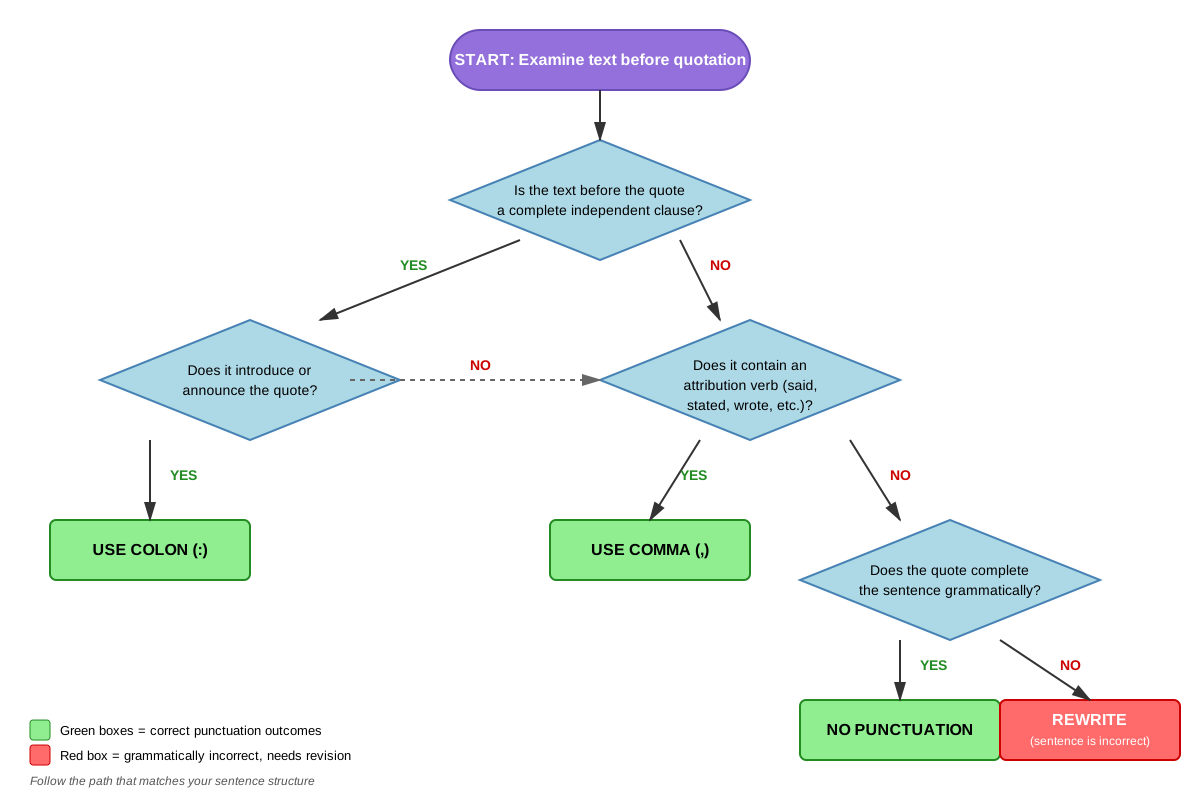
When approaching SAT quotation integration questions, follow this systematic process:
Step 1: Read the entire sentence including the quotation to understand the complete context. Don't focus only on the punctuation mark in isolation.
Step 2: Identify the introduction type. Ask: "Is the text before the quotation a complete sentence (independent clause), a signal phrase, or part of a grammatically integrated structure?" This determination drives the punctuation choice.
Step 3: Check capitalization. If answer choices differ in capitalization, determine whether the quotation should begin with a capital letter based on whether it's a complete sentence and what punctuation precedes it.
Step 4: Apply the three-rule framework:
- Complete independent clause → colon
- Signal phrase or dependent clause → comma
- Grammatical integration → no punctuation
Exam Tip: If you can remove the quotation marks and the sentence still makes grammatical sense, the quotation is grammatically integrated and needs no punctuation.
Trigger words to watch for: "according to," "states," "argues," "notes," "describes as," "calls," "refers to." These signal phrases typically require commas, but phrases like "describes as" often lead to grammatical integration.
Process of elimination strategy: Eliminate semicolons immediately—they're almost never correct for introducing quotations. If the introduction isn't a complete sentence, eliminate colons. If the quotation doesn't form a complete sentence and isn't introduced by a signal phrase, eliminate commas.
Time allocation: These questions should take 30-45 seconds. If you're unsure, read the sentence aloud mentally with each punctuation option to hear which sounds correct and natural.
Memory Techniques
The "CIG" Mnemonic for quotation integration:
- Colon after Complete sentences
- Integrated quotations need Invisible punctuation (none)
- Give commas to siGnal phrases
The "Complete Test": To remember when to use colons, ask "Is it complete?" If the introduction could stand alone as a complete sentence, use a colon. If not, it's either a comma or no punctuation.
Visualization Strategy: Picture quotation marks as a frame. If the words before the frame form a complete picture (sentence), use a colon. If they're just a label or description, use a comma. If the frame is part of a larger picture, use no punctuation.
The "As Test": When you see "as" before a quotation, it's almost always grammatically integrated with no punctuation. Remember: "as = no pause."
Capitalization Rhyme: "Complete sentence quote, capital you'll note. Fragment or flow, lowercase you'll go."
Summary
Quotation integration is a high-yield SAT topic that tests students' ability to incorporate quoted material into sentences using correct punctuation and capitalization. The three main integration methods—colon after independent clauses, comma after signal phrases, and no punctuation for grammatical integration—form the foundation of this skill. Success requires analyzing whether the introduction forms a complete sentence, identifying signal phrases, and recognizing when quotations function as grammatical components of sentences. Capitalization follows logically from punctuation choices: capitalize complete sentence quotations after colons, but keep grammatically integrated fragments lowercase. The SAT tests these concepts through questions where answer choices differ only in punctuation or capitalization, making precise knowledge of conventions essential. Mastering quotation integration strengthens overall writing ability and prepares students for college-level academic work requiring source integration.
Key Takeaways
- Use colons to introduce quotations only after complete independent clauses that can stand alone as sentences
- Signal phrases like "according to" and "the author states" require commas before quotations
- Grammatically integrated quotations need no punctuation separating them from surrounding text
- Capitalize the first word of quotations only when they're complete sentences or follow colons
- Periods and commas always go inside closing quotation marks in American English
- Analyze the grammatical structure of the introduction before selecting punctuation
- The "Complete Test" helps determine colon vs. comma usage: complete sentence = colon, signal phrase = comma, grammatical integration = no punctuation
Related Topics
Colon Usage: Understanding when colons are appropriate extends beyond quotations to include introducing lists, explanations, and examples. Mastering quotation integration provides a foundation for broader colon usage.
Comma Rules: Signal phrases requiring commas before quotations connect to larger comma usage patterns including introductory elements and interrupters. This topic deepens comma mastery.
Sentence Structure and Clauses: Identifying independent and dependent clauses is crucial for quotation integration and enables students to handle complex sentence construction questions.
Rhetorical Synthesis: Advanced questions combine quotation integration with choosing the most effective evidence, requiring both technical punctuation skills and rhetorical judgment.
Parenthetical Citations: College-level writing builds on quotation integration by adding citation formats, making this topic foundational for academic writing.
Practice CTA
Now that you've mastered the core concepts of quotation integration, it's time to apply your knowledge! Work through the practice questions to reinforce these skills and build confidence for test day. The flashcards will help you memorize the key rules and exceptions. Remember: quotation integration questions are highly predictable on the SAT, so consistent practice with these patterns will translate directly to points on your exam. You've got this!
Sign up free to keep reading
Create a free AnvayaPrep account to finish this SAT guide on Quotation integration — plus flashcards and practice questions.