Overview
Avoiding unsupported claims is a critical skill tested in the SAT Reading and Writing (RW) section, particularly within the Rhetorical Synthesis question type. These questions assess a student's ability to evaluate whether a writer's conclusion, assertion, or interpretation is adequately supported by the evidence presented in a passage or set of notes. The SAT expects test-takers to distinguish between claims that logically follow from the given information and those that overreach, distort, or misrepresent the evidence.
This topic is essential for the SAT because it directly tests analytical reasoning and critical reading skills—abilities that colleges value highly. Questions on sat avoiding unsupported claims typically present students with research notes, study findings, or observational data, followed by four possible conclusions. Only one conclusion will accurately reflect what the evidence actually demonstrates, while the others will contain logical flaws such as overgeneralization, causal assumptions without warrant, or claims about information not present in the source material. Mastering this skill ensures students can identify precise, evidence-based reasoning.
Within the broader context of Reading and Writing concepts, avoiding unsupported claims connects directly to skills like identifying main ideas, understanding authorial intent, evaluating argument structure, and synthesizing information from multiple sources. It represents the intersection of reading comprehension and logical reasoning, requiring students to move beyond simply understanding what a passage says to evaluating whether conclusions drawn from that passage are justified. This skill is foundational for academic success across disciplines, as it mirrors the critical thinking required in college-level coursework.
Learning Objectives
- [ ] Identify key features of avoiding unsupported claims in SAT passages and question stems
- [ ] Explain how avoiding unsupported claims appears on the SAT, including common question formats and trap answer patterns
- [ ] Apply avoiding unsupported claims principles to answer SAT-style questions accurately and efficiently
- [ ] Distinguish between claims that are fully supported, partially supported, and unsupported by given evidence
- [ ] Recognize common logical fallacies and reasoning errors that create unsupported claims
- [ ] Evaluate the scope and limitations of evidence to determine what conclusions can legitimately be drawn
Prerequisites
- Basic reading comprehension: Understanding literal meaning of passages is necessary before evaluating whether claims are supported
- Vocabulary knowledge: Recognizing qualifier words (e.g., "suggests," "proves," "may indicate") helps distinguish claim strength
- Understanding of evidence types: Familiarity with data, examples, expert testimony, and research findings enables proper evaluation
- Logical reasoning fundamentals: Basic understanding of cause-and-effect relationships and correlation versus causation aids in spotting unsupported leaps
Why This Topic Matters
In real-world contexts, the ability to identify unsupported claims is essential for media literacy, academic research, professional decision-making, and informed citizenship. Students who master this skill can evaluate news articles, scientific studies, political arguments, and advertising claims with appropriate skepticism, distinguishing between well-supported conclusions and those that overreach their evidence base. This critical thinking ability protects against misinformation and enables sound judgment in both personal and professional contexts.
On the SAT, questions testing this skill appear with high frequency in the Reading and Writing section, particularly in the Rhetorical Synthesis domain. Approximately 2-4 questions per test directly assess this ability, making it a high-yield topic for score improvement. These questions typically carry the same weight as other question types (one point each), but they often prove challenging for students who haven't specifically practiced identifying the subtle differences between supported and unsupported claims.
Common manifestations on the exam include: research study summaries followed by competing interpretations; historical or scientific passages with multiple possible conclusions; data presentations (tables, graphs, or described findings) requiring accurate synthesis; and comparative analyses where students must determine which claim best reflects the evidence without adding unsupported inferences. The SAT deliberately crafts wrong answers that sound plausible or contain partially accurate information, making careful evaluation essential.
Core Concepts
What Constitutes an Unsupported Claim
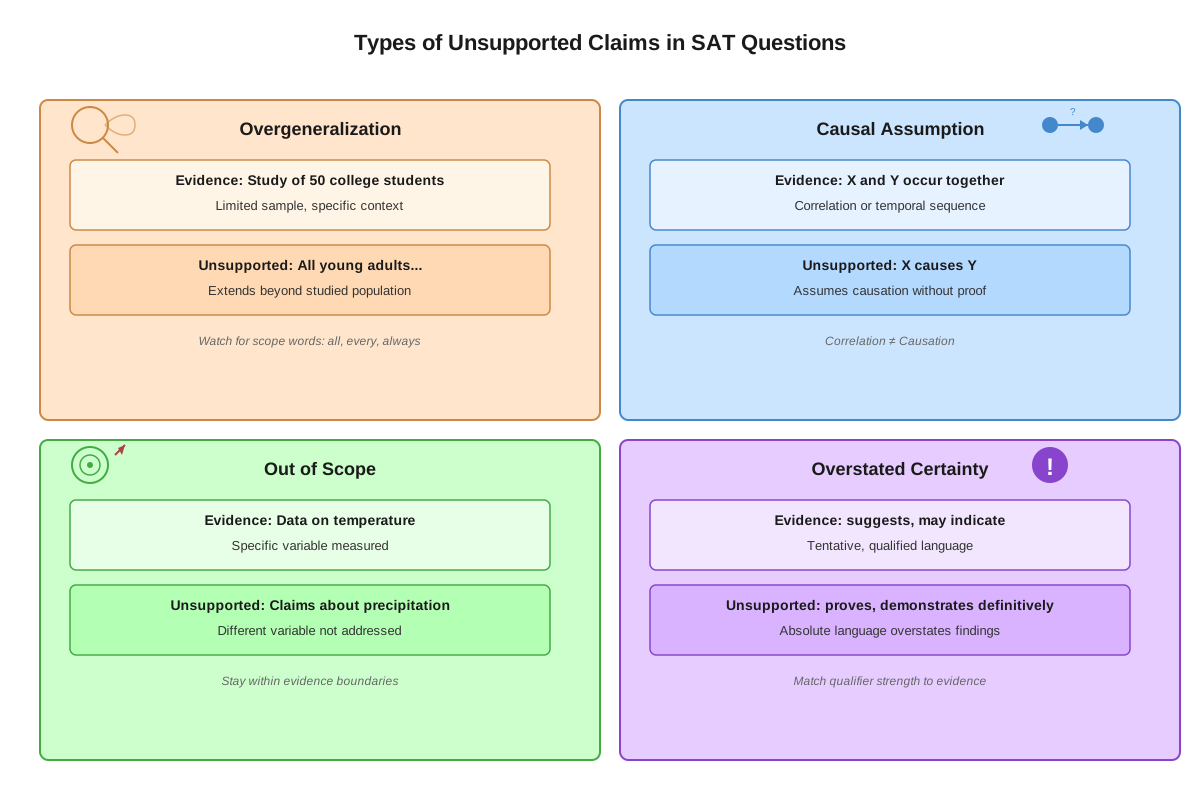
An unsupported claim is a statement, conclusion, or assertion that goes beyond what the available evidence actually demonstrates. On the SAT, these claims typically fail in one of several ways: they may introduce information not present in the source material, draw causal conclusions from correlational data, overgeneralize from limited examples, or make absolute statements when the evidence only supports qualified ones.
The key to identifying unsupported claims lies in carefully matching each element of a proposed conclusion against the specific evidence provided. Every assertion in a supported claim must have a clear basis in the passage or data. If any part of the claim requires assumptions, inferences beyond reasonable interpretation, or information from outside the passage, that claim is unsupported.
Types of Unsupported Claims on the SAT
Overgeneralization occurs when a claim extends findings beyond their demonstrated scope. For example, if a study examines the reading habits of high school students in one district, a claim about "all teenagers" or "students nationwide" would be unsupported. The SAT frequently tests whether students recognize these scope violations.
Causal claims from correlational evidence represent another common trap. When evidence shows that two phenomena occur together or that one follows another temporally, this does not establish that one causes the other. A supported claim would note the correlation or association; an unsupported claim would assert causation without additional evidence of mechanism or controlled experimentation.
Absolute statements (using words like "always," "never," "all," "none," "proves," "definitively shows") often signal unsupported claims when the evidence is more limited or qualified. Research findings typically support more modest conclusions using language like "suggests," "indicates," "may contribute to," or "is associated with."
Claims about unstated information introduce facts, interpretations, or context not present in the source material. Even if these additions are plausible or generally true, they make the claim unsupported because they rely on information beyond what was provided.
Characteristics of Well-Supported Claims
Well-supported claims demonstrate several key features. They match the scope of the evidence, neither narrowing it inappropriately nor extending it beyond what was studied or observed. They use appropriate qualifiers that reflect the certainty level justified by the evidence. They stick to what was actually measured or observed rather than making inferences about related but unstudied phenomena.
Additionally, supported claims acknowledge limitations when relevant and avoid logical leaps between evidence and conclusion. They recognize the difference between correlation and causation, between single examples and general patterns, and between preliminary findings and established facts.
The Evidence-Claim Relationship
| Evidence Type | Supported Claim Characteristics | Unsupported Claim Characteristics |
|---|---|---|
| Single study or limited sample | Uses qualifiers; acknowledges scope limitations | Generalizes to all populations; makes universal statements |
| Correlational data | Notes association or relationship | Asserts causation; claims one factor produces another |
| Observational findings | Describes what was observed | Explains why it occurred without mechanistic evidence |
| Comparative data | Notes differences or similarities | Ranks quality or makes value judgments without criteria |
| Expert opinion | Attributes view to specific source | Presents opinion as established fact |
Question Format and Structure
SAT questions testing this skill typically follow a consistent format. Students receive a passage, set of notes, or data description, followed by a prompt such as: "Which choice best describes the findings?" or "Which conclusion is most strongly supported by the text?" or "Based on the text, what can most reasonably be concluded?"
The four answer choices will include one fully supported claim and three that contain various types of unsupported elements. The challenge lies in the fact that wrong answers often contain some accurate information or sound plausible, requiring careful word-by-word comparison with the source material.
The Role of Qualifier Words
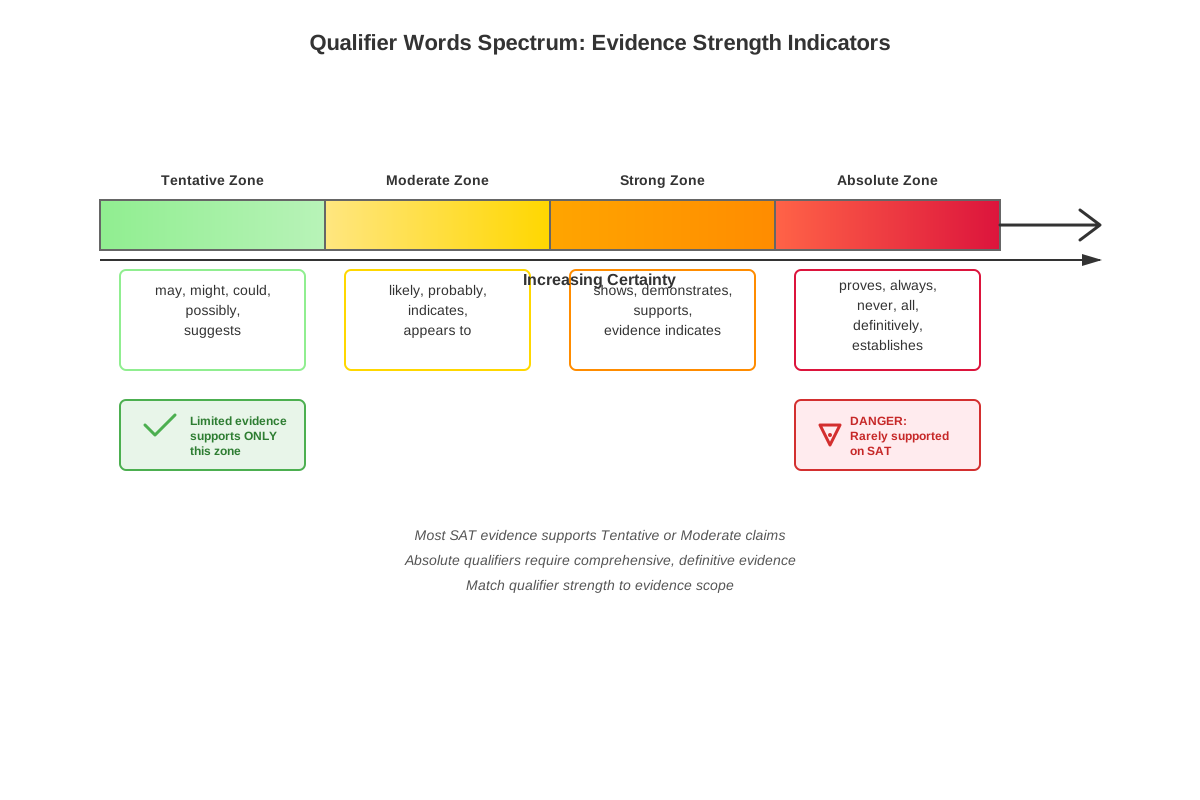
Qualifier words serve as crucial signals for claim strength and scope. Strong qualifiers like "proves," "demonstrates conclusively," "always," "never," and "all" set a high evidentiary bar that is rarely met by typical research findings or observations. Moderate qualifiers like "suggests," "indicates," "may," "appears to," "some," and "often" allow for appropriate uncertainty and scope limitation.
On the SAT, answer choices with strong qualifiers are frequently unsupported unless the evidence is exceptionally robust and comprehensive. Conversely, appropriately qualified claims that match the evidence's certainty level are more likely to be correct answers.
Concept Relationships
The skill of avoiding unsupported claims builds directly on fundamental reading comprehension abilities. Students must first accurately understand what a passage states (literal comprehension) before they can evaluate whether a claim is supported by that information (analytical comprehension). This represents a progression from understanding to evaluation.
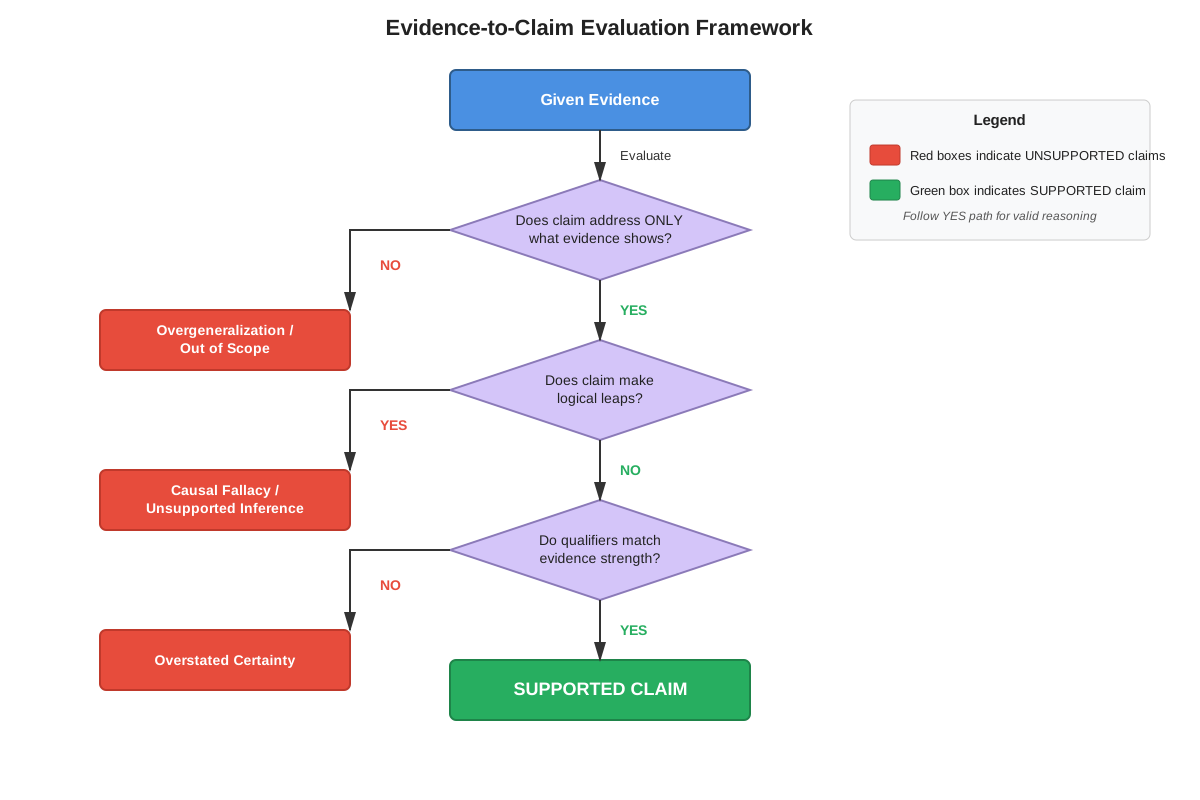
Within the topic itself, the concepts connect as follows: Understanding what constitutes an unsupported claim → Recognizing specific types of unsupported claims (overgeneralization, causal errors, etc.) → Identifying characteristics of well-supported claims → Applying the evidence-claim relationship to evaluate answer choices → Using qualifier words as signals to assess claim strength.
This topic also connects to broader rhetorical synthesis skills, including synthesizing information from multiple sources, understanding authorial purpose and tone, and evaluating argument structure. The ability to identify unsupported claims is essentially the inverse of constructing well-supported arguments—a skill tested in the SAT Essay (when offered) and crucial for college writing.
The relationship to data interpretation is particularly strong, as many avoiding unsupported claims questions present research findings or statistical information. Students must understand what the data shows before determining which conclusions it supports, creating a direct link between quantitative literacy and critical reading.
High-Yield Facts
- ⭐ Supported claims match the exact scope of the evidence provided without extending beyond it
- ⭐ Correlation does not equal causation; evidence showing two things occur together does not prove one causes the other
- ⭐ Qualifier words like "suggests," "may," and "indicates" signal appropriately limited claims, while "proves" and "always" require stronger evidence
- ⭐ Any information not explicitly stated or directly inferable from the passage makes a claim unsupported
- ⭐ Overgeneralization—extending findings from a specific group to all groups—is the most common type of unsupported claim on the SAT
- Single studies or limited samples cannot support universal claims about all populations
- Observational evidence can support claims about what happened but not why it happened without additional mechanistic evidence
- Comparative data showing differences does not automatically support claims about superiority or quality without defined criteria
- Expert opinions support claims about what that expert believes, not claims presented as objective facts
- Temporal sequence (one thing happening after another) does not prove causation without additional evidence
- Absolute statements ("never," "all," "none") are rarely supported by typical research evidence
- The correct answer to these questions often sounds less exciting or definitive than wrong answers because it appropriately limits its claims
Quick check — test yourself on Avoiding unsupported claims so far.
Try Flashcards →Common Misconceptions
Misconception: If a claim sounds reasonable or is generally true in the real world, it must be supported by the passage.
Correction: SAT questions test whether claims are supported by the specific evidence provided, not whether they are true in general. A claim must be justified by the passage itself, regardless of outside knowledge.
Misconception: Longer or more detailed answer choices are more likely to be correct because they provide more information.
Correction: Length does not indicate correctness. Wrong answers are often longer because they include additional unsupported details or unnecessary qualifications. The correct answer is the one that most accurately reflects the evidence, regardless of length.
Misconception: If most of a claim is supported by the evidence, it's acceptable even if one part isn't fully justified.
Correction: For a claim to be fully supported, every element must be justified by the evidence. A single unsupported component makes the entire claim unsupported, even if other parts are accurate.
Misconception: Scientific or academic language makes a claim more credible and therefore more likely to be supported.
Correction: Sophisticated vocabulary or technical terminology does not make a claim supported. The SAT often uses impressive-sounding language in wrong answers to make them appear authoritative. Evaluation must focus on the logical relationship between evidence and claim, not the language used.
Misconception: If the passage discusses a topic, any claim about that general topic is supported.
Correction: The claim must be supported by the specific information provided, not just related to the general topic. A passage about climate change might discuss temperature data without supporting claims about sea level rise, for example.
Misconception: The correct answer will always use the same words as the passage.
Correction: Supported claims often paraphrase or summarize passage information using different words. However, the meaning must remain faithful to the source. Conversely, wrong answers sometimes quote passage language while adding unsupported interpretations.
Worked Examples
Example 1: Research Study Interpretation
Passage: "Researchers studied the sleep patterns of 200 college students at a Midwestern university over one semester. They found that students who reported sleeping 7-8 hours per night had, on average, GPAs 0.3 points higher than students who reported sleeping less than 6 hours per night. The researchers noted that many variables could influence both sleep and academic performance."
Question: Which conclusion is most strongly supported by the text?
A) College students should sleep 7-8 hours per night to improve their grades.
B) Adequate sleep causes improved academic performance in college students.
C) Students at the Midwestern university who slept more had higher average GPAs than those who slept less.
D) Sleep duration is the most important factor in determining college academic success.
Analysis:
Choice A is unsupported because it makes a recommendation ("should") that goes beyond what the observational data demonstrates. The study shows correlation, not that changing sleep will improve grades.
Choice B is unsupported because it asserts causation ("causes") when the study only shows correlation. The passage explicitly notes that "many variables could influence both sleep and academic performance," warning against causal interpretation.
Choice C is correct because it accurately describes what the study found without adding unsupported interpretations. It matches the scope (students at this specific university), acknowledges the comparison made (more sleep associated with higher GPAs), and avoids causal language.
Choice D is unsupported because the passage provides no information comparing sleep to other factors in importance. The study examined sleep and GPA but did not evaluate sleep against other variables to determine relative importance.
Key Takeaway: The correct answer sticks precisely to what was measured and observed, uses appropriate language (correlation not causation), and matches the scope of the study without overgeneralizing.
Example 2: Historical Analysis
Passage: "Examination of letters written by residents of a coastal town in 1847 reveals frequent mentions of ships arriving from distant ports. Several letters describe exotic goods available for purchase, including spices, textiles, and manufactured items from Europe. One merchant's correspondence indicates that his store's inventory expanded significantly during this period."
Question: Based on the text, what can most reasonably be concluded?
A) The coastal town was the most important trading center in the region during 1847.
B) International trade contributed to the economic prosperity of all residents in the coastal town.
C) The town had access to goods from international sources during the period examined.
D) Maritime commerce was more important to the town's economy than agriculture or manufacturing.
Analysis:
Choice A is unsupported because the passage provides no comparative information about other towns or trading centers. It describes this town's trade activity but offers no basis for ranking it against other locations.
Choice B is unsupported due to overgeneralization ("all residents") and an unsupported claim about "economic prosperity." The passage mentions goods being available and one merchant's expanded inventory but doesn't provide information about the economic impact on all residents.
Choice C is correct because it accurately reflects what the evidence demonstrates: letters mention ships from distant ports and exotic goods from Europe, clearly indicating access to international goods. This claim matches the scope and content of the evidence without adding unsupported interpretations.
Choice D is unsupported because the passage provides no information about agriculture or manufacturing, making comparison impossible. The passage discusses maritime trade but doesn't evaluate its importance relative to other economic activities.
Key Takeaway: Supported claims describe what the evidence shows without making comparisons, generalizations, or assertions about information not present in the source material.
Exam Strategy
When approaching SAT questions on avoiding unsupported claims, follow this systematic process:
Step 1: Read the passage or notes carefully, identifying exactly what information is provided. Note the scope (who was studied, where, when), the type of evidence (observational, experimental, correlational), and any qualifications or limitations mentioned.
Step 2: Before looking at answer choices, mentally summarize what the evidence actually demonstrates. This prevents wrong answers from influencing your interpretation.
Step 3: Examine each answer choice systematically, comparing every element against the source material. Ask: "Is this specific claim stated or directly supported by the passage?"
Step 4: Watch for trigger words that signal potential problems:
- Causal language: "causes," "leads to," "produces," "results in" (requires strong evidence)
- Absolute terms: "always," "never," "all," "none," "proves" (rarely supported)
- Comparative claims: "most important," "best," "superior" (requires explicit comparison)
- Scope extensions: "all people," "everywhere," "throughout history" (check if evidence is this broad)
Step 5: Use process of elimination by identifying why wrong answers are unsupported:
- Does it introduce information not in the passage?
- Does it overgeneralize from limited evidence?
- Does it claim causation from correlational data?
- Does it make absolute statements without sufficient evidence?
- Does it extend beyond the scope of what was studied?
Step 6: Verify the remaining answer by confirming that every element has clear support in the passage. The correct answer should feel almost boring or obvious because it doesn't add exciting but unsupported interpretations.
Time allocation: Spend 60-75 seconds on these questions. They require careful reading but shouldn't consume excessive time. If stuck between two choices, identify the specific difference between them and check which version the passage actually supports.
Exam Tip: Wrong answers often sound more interesting, definitive, or important than the correct answer. The SAT deliberately makes unsupported claims appealing. Trust the evidence over what sounds impressive.
Memory Techniques
SCOPE Acronym for evaluating claims:
- Specific to the evidence (not overgeneralized)
- Correlation vs. causation (appropriate relationship)
- Only stated information (no additions)
- Proper qualifiers (matches certainty level)
- Evidence-matched (every element supported)
The "Prove It" Technique: For each element of a claim, point to the specific sentence or data in the passage that proves it. If you can't point to supporting evidence, the claim is unsupported.
Qualifier Spectrum Visualization: Picture a spectrum from weak to strong claims:
- Weak end: "may," "suggests," "some," "appears to" (easier to support)
- Strong end: "proves," "always," "all," "causes" (requires robust evidence)
- Most SAT evidence supports claims in the weak-to-moderate range
The Three C's of Unsupported Claims:
- Causation claimed without proof
- Comparisons made without basis
- Conclusions beyond the evidence
Mnemonic for Common Traps: "CAGE" the unsupported claims
- Causation from correlation
- Absolute statements
- Generalizations beyond scope
- Extra information not in passage
Summary
Avoiding unsupported claims is a high-yield SAT skill that tests the ability to distinguish between conclusions legitimately drawn from evidence and those that overreach, overgeneralize, or misrepresent source material. Success requires careful matching of every claim element against the specific evidence provided, attention to scope and qualifier language, and recognition of common logical errors like confusing correlation with causation. The correct answer to these questions accurately reflects what the evidence demonstrates without adding unsupported interpretations, even if it sounds less definitive than wrong answers. Mastery involves systematic evaluation of answer choices, identification of trigger words signaling potential problems, and disciplined focus on what the passage actually states rather than what seems generally plausible. This skill connects directly to broader critical thinking abilities essential for college success and informed citizenship, making it both practically valuable and frequently tested on the SAT.
Key Takeaways
- Supported claims match the exact scope, certainty level, and content of the evidence without extending beyond it
- Correlation between two factors does not prove causation; observational data supports claims about associations, not causal mechanisms
- Qualifier words signal claim strength; "suggests" and "may" are easier to support than "proves" or "always"
- Overgeneralization—extending findings beyond their demonstrated scope—is the most common type of unsupported claim on the SAT
- Every element of a claim must be justified by the passage; partially supported claims are still unsupported
- Wrong answers often sound more impressive or definitive than correct answers because they add unsupported interpretations
- Systematic comparison of each answer choice against source material, rather than relying on what sounds reasonable, is essential for accuracy
Related Topics
Synthesizing Multiple Sources: Building on avoiding unsupported claims, this skill involves combining information from multiple passages or data sources while ensuring all synthesis remains supported by the evidence provided.
Evaluating Argument Structure: Understanding how authors build arguments through claims and evidence helps identify when conclusions are properly supported versus when logical gaps exist.
Data Interpretation and Analysis: Many avoiding unsupported claims questions present research findings or statistical information, making quantitative literacy skills directly applicable.
Understanding Authorial Purpose and Tone: Recognizing what an author intends to prove versus what the evidence actually demonstrates helps distinguish between supported and unsupported claims.
Logical Reasoning and Fallacies: Deeper study of formal logic and common fallacies (post hoc ergo propter hoc, hasty generalization, etc.) provides additional frameworks for identifying unsupported claims.
Practice CTA
Now that you understand the principles of avoiding unsupported claims, it's time to apply this knowledge! Work through the practice questions to test your ability to distinguish supported from unsupported claims in various contexts. The flashcards will help reinforce key concepts and trigger words to watch for on test day. Remember: mastery comes from practice, and this high-yield topic appears frequently enough on the SAT that your investment in practice will directly translate to points on test day. You've built the foundation—now strengthen it through application!
Sign up free to keep reading
Create a free AnvayaPrep account to finish this SAT guide on Avoiding unsupported claims — plus flashcards and practice questions.