Overview
Cause-effect synthesis is a critical skill tested in the SAT Reading and Writing section that requires students to analyze multiple sources of information and combine them into a coherent statement that accurately represents causal relationships. Unlike simple reading comprehension questions that test understanding of a single passage, sat cause-effect synthesis questions present students with multiple short texts—typically research findings, observations, or data—and ask them to identify which answer choice best synthesizes these sources while correctly establishing cause-and-effect relationships. This question type appears regularly in the rw (Reading and Writing) section and represents one of the most challenging rhetorical synthesis tasks students will encounter.
The importance of mastering cause-effect synthesis extends beyond test performance. This skill mirrors the type of analytical thinking required in academic research, professional writing, and critical evaluation of information from multiple sources. Students must not only comprehend individual pieces of information but also understand how they relate to one another, distinguish between correlation and causation, and express these relationships with precision and clarity. The SAT specifically tests whether students can avoid common logical fallacies, recognize appropriate causal language, and select synthesis statements that accurately reflect the evidence without overgeneralizing or misrepresenting the data.
Within the broader context of SAT Reading and Writing, cause-effect synthesis represents an advanced application of several foundational skills: close reading, logical reasoning, evidence evaluation, and rhetorical awareness. It builds upon basic comprehension abilities and requires students to engage in higher-order thinking by analyzing relationships between ideas, evaluating the strength of causal claims, and recognizing appropriate qualifiers and hedging language that distinguish strong causal claims from weaker correlational observations.
Learning Objectives
- [ ] Identify key features of cause-effect synthesis questions on the SAT
- [ ] Explain how cause-effect synthesis appears on the SAT and what makes it distinct from other question types
- [ ] Apply cause-effect synthesis strategies to answer SAT-style questions accurately and efficiently
- [ ] Distinguish between correlation and causation in synthesis statements
- [ ] Evaluate whether synthesis statements appropriately represent the strength and scope of evidence presented
- [ ] Recognize common causal language patterns and their appropriate usage in different contexts
- [ ] Identify logical fallacies and overgeneralizations in incorrect answer choices
Prerequisites
- Basic reading comprehension: Understanding main ideas, supporting details, and explicit information in short passages is essential for processing the source texts presented in synthesis questions
- Vocabulary knowledge: Familiarity with transition words, causal connectors, and academic vocabulary enables students to distinguish between subtle differences in answer choices
- Logical reasoning fundamentals: Understanding basic logical relationships helps students evaluate whether causal claims are supported by the evidence provided
- Awareness of text structure: Recognizing how information is organized helps students identify relationships between different pieces of evidence
Why This Topic Matters
Cause-effect synthesis questions appear with high frequency on the SAT, typically comprising 2-4 questions per test administration in the Reading and Writing section. These questions are considered high-value targets because they test multiple skills simultaneously: reading comprehension, logical reasoning, and rhetorical awareness. Students who master this question type gain a significant advantage, as these questions often separate mid-range scorers from high scorers.
In real-world applications, the ability to synthesize information from multiple sources and accurately represent causal relationships is fundamental to academic success across disciplines. Scientists must synthesize research findings to draw conclusions, historians must analyze multiple accounts to understand cause-and-effect relationships in historical events, and professionals in virtually every field must evaluate information from various sources to make informed decisions. The critical thinking skills developed through mastering cause-effect synthesis transfer directly to college-level writing, research papers, and professional communication.
On the SAT, cause-effect synthesis questions typically appear in a standardized format: students receive 2-4 short texts (usually 1-3 sentences each) that present related information, followed by a prompt that begins with "Based on the texts..." and asks students to select the statement that best synthesizes the information while establishing or describing a causal relationship. The texts might present experimental results, observational data, theoretical explanations, or contrasting perspectives. Common contexts include scientific research findings, historical cause-and-effect relationships, social science observations, and technological developments and their impacts.
Core Concepts
Understanding Cause-Effect Relationships
A cause-effect relationship exists when one event, condition, or factor (the cause) directly produces or brings about another event or condition (the effect). In synthesis questions, students must recognize when evidence supports a genuine causal connection versus when it merely shows correlation or association. The SAT tests whether students can distinguish between strong causal claims backed by experimental evidence and weaker claims that describe patterns or associations without establishing direct causation.
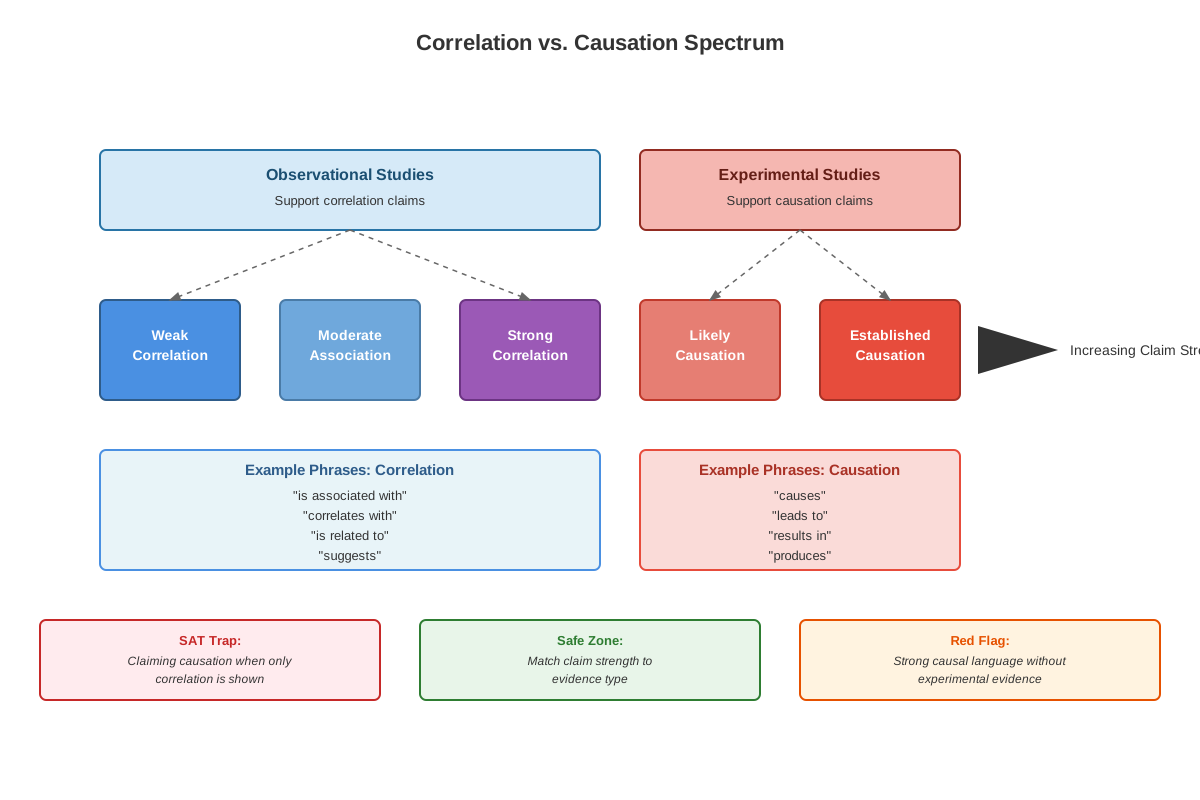
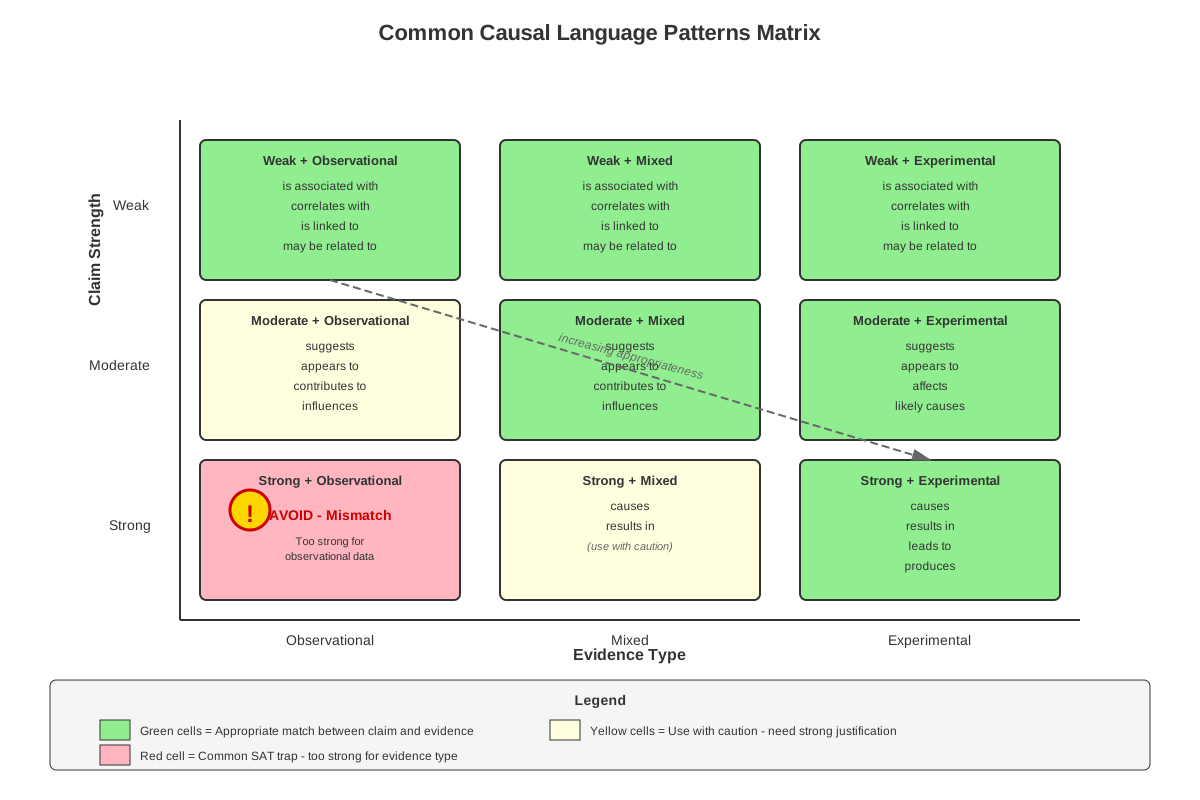
Causal relationships can be expressed with varying degrees of certainty. Strong causal language includes words and phrases like "causes," "results in," "leads to," "produces," "brings about," and "is responsible for." These expressions indicate direct causation and should only be used when evidence clearly supports such a relationship. Moderate causal language includes "contributes to," "influences," "affects," "plays a role in," and "is associated with." These expressions acknowledge a relationship while maintaining appropriate caution about the strength or directness of the connection. Correlational language includes "is related to," "corresponds with," "is linked to," and "occurs alongside." These expressions describe patterns without claiming causation.
The Structure of Synthesis Questions
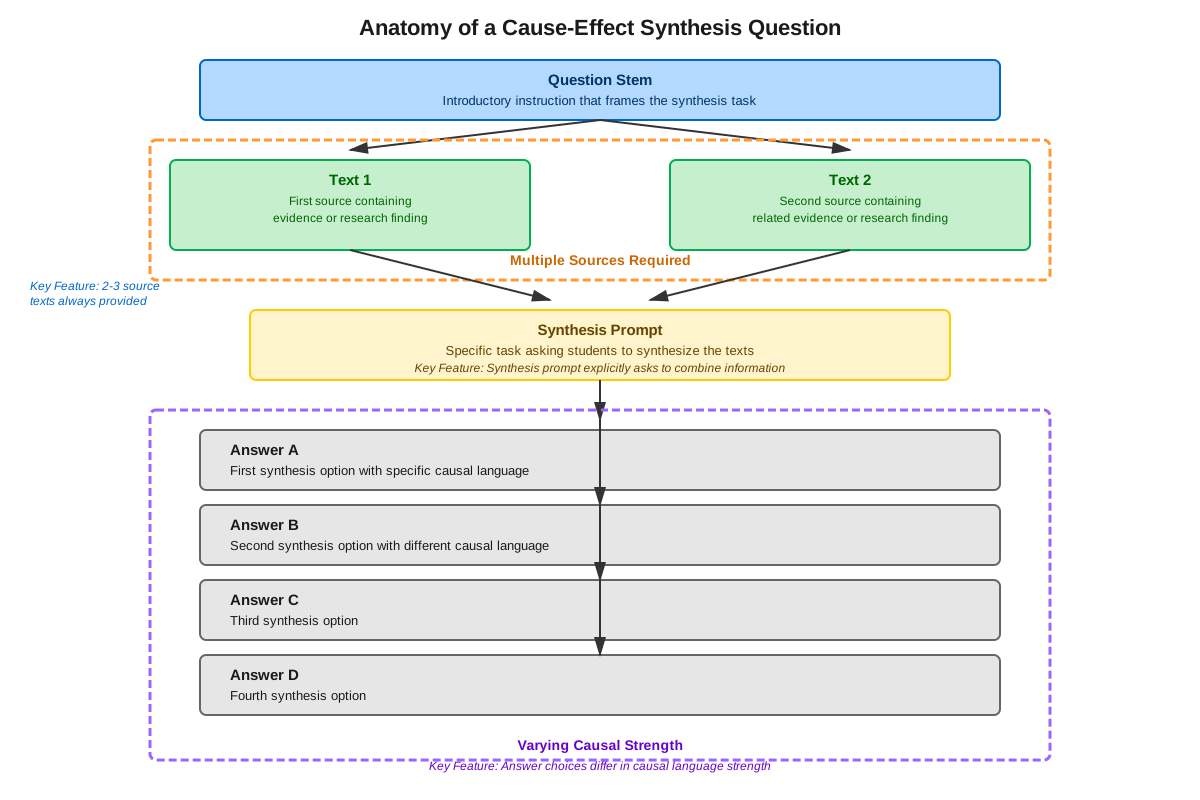
SAT cause-effect synthesis questions follow a predictable structure that students can learn to navigate efficiently. The question presents multiple texts (typically labeled Text 1, Text 2, etc.) that contain related information. These texts might present different aspects of the same phenomenon, sequential findings from research, or complementary observations. The prompt then asks students to identify which answer choice "best describes" or "best synthesizes" the information while addressing a specific causal relationship.
The answer choices in these questions vary in several key dimensions: the strength of causal claims, the scope of generalizations, the accuracy of details, and the completeness of synthesis. Incorrect answers typically fail in one or more of these areas—they might overstate causation, omit crucial information from one text, misrepresent details, or fail to synthesize all sources appropriately.
Types of Evidence and Appropriate Claims
Different types of evidence support different strengths of causal claims. Experimental evidence with controlled variables and demonstrated mechanisms supports strong causal language. When texts describe experiments where researchers manipulated variables and observed consistent effects, synthesis statements can appropriately use direct causal language. Observational evidence showing consistent patterns or correlations supports moderate causal language or correlational statements. When texts describe observations without experimental manipulation, synthesis statements should use more cautious language.
Theoretical explanations combined with empirical observations can support causal claims when the mechanism is well-established. If one text explains a theoretical mechanism and another provides supporting observations, a synthesis statement can appropriately describe the causal relationship while acknowledging the basis in both theory and observation. Multiple converging lines of evidence strengthen causal claims. When several texts present different types of evidence all pointing to the same causal relationship, synthesis statements can express greater confidence in the causal connection.
Common Patterns in Synthesis Questions
| Pattern Type | Text Structure | Synthesis Task | Key Challenge |
|---|---|---|---|
| Mechanism + Evidence | Text 1: Explains how X causes Y; Text 2: Provides supporting data | Combine explanation with evidence | Maintaining appropriate causal strength |
| Multiple Effects | Text 1: Shows X causes Y; Text 2: Shows X causes Z | Synthesize multiple effects of single cause | Including all effects without overgeneralizing |
| Causal Chain | Text 1: Shows X causes Y; Text 2: Shows Y causes Z | Connect sequential causes | Accurately representing the sequence |
| Contrasting Factors | Text 1: Factor A's effect; Text 2: Factor B's effect | Compare or contrast causal factors | Distinguishing between factors clearly |
| Scope Limitation | Text 1: General observation; Text 2: Specific limitation or condition | Synthesize with appropriate qualifiers | Avoiding overgeneralization |
Evaluating Synthesis Quality
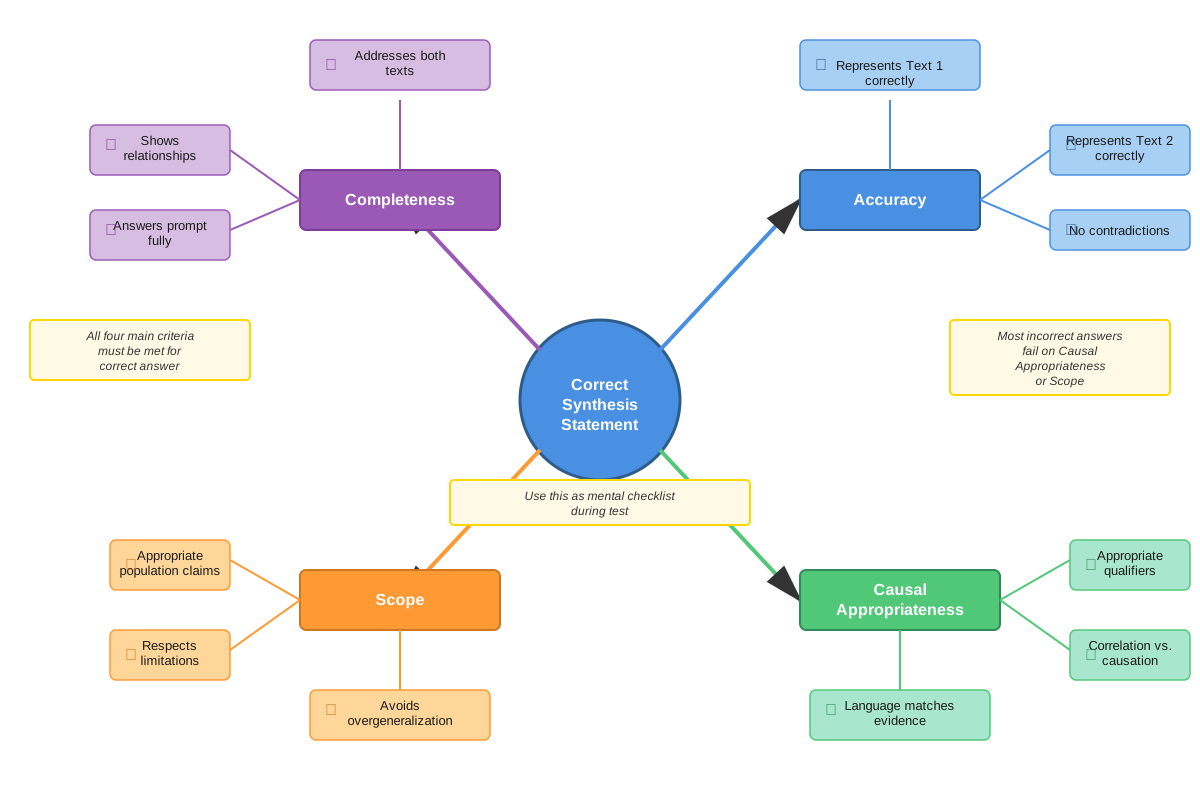
A high-quality synthesis statement must meet several criteria. Accuracy requires that all details from the source texts are represented correctly without distortion or misrepresentation. Completeness means the synthesis incorporates relevant information from all provided texts rather than focusing on only one source. Appropriate causal language ensures the strength of causal claims matches the strength of evidence provided. Proper scope means the synthesis doesn't overgeneralize beyond what the evidence supports, maintaining appropriate limitations and qualifiers.
Students must also evaluate whether synthesis statements maintain logical coherence—the relationships described must make logical sense and follow from the evidence. Additionally, conciseness matters; the best synthesis statements express relationships clearly without unnecessary complexity or redundant information.
Concept Relationships
The core concepts in cause-effect synthesis build upon and connect to each other in a hierarchical structure. Understanding cause-effect relationships (the foundation) → enables evaluation of evidence types → which determines appropriate causal language strength → leading to the ability to construct or identify quality synthesis statements.
The relationship between evidence types and causal language strength is particularly crucial: experimental evidence → supports strong causal claims, while observational evidence → supports moderate or correlational claims. This connection directly impacts answer choice evaluation, as students must match the language strength in answer choices to the evidence strength in the texts.
Synthesis question structure connects to all other concepts as the framework within which students apply their understanding. Recognizing the structure → allows efficient identification of what each text contributes → which facilitates evaluation of how well answer choices synthesize the information → leading to accurate answer selection.
The concept of synthesis quality evaluation serves as the culminating skill that integrates all other concepts. Students apply their understanding of causal relationships, evidence types, and appropriate language to assess whether answer choices meet the criteria for accuracy, completeness, appropriate causal strength, and proper scope.
High-Yield Facts
⭐ Cause-effect synthesis questions always present multiple texts (typically 2-4) that must be combined into a single coherent statement
⭐ Strong causal language ("causes," "results in," "leads to") should only appear in synthesis statements when experimental or mechanistic evidence clearly supports direct causation
⭐ Incorrect answer choices frequently overstate causation by using strong causal language when only correlational evidence is provided
⭐ Complete synthesis statements incorporate relevant information from ALL provided texts, not just one or two
⭐ Appropriate qualifiers ("may," "can," "suggests," "appears to") are often necessary in correct answers to match the certainty level of the evidence
- Observational studies showing correlation require more cautious language than controlled experiments demonstrating causation
- Synthesis statements must maintain the scope limitations present in the source texts without overgeneralizing to broader populations or contexts
- The correct answer often includes specific details from the texts that distinguish it from plausible but incomplete alternatives
- Causal chains (X causes Y, which causes Z) require synthesis statements that accurately represent the sequential relationship
- When texts present contrasting or complementary factors, the synthesis must acknowledge both rather than focusing exclusively on one
Quick check — test yourself on Cause-effect synthesis so far.
Try Flashcards →Common Misconceptions
Misconception: Any relationship described in the texts can be expressed using strong causal language like "causes" or "results in."
Correction: The strength of causal language must match the type and quality of evidence provided. Observational data showing correlation requires more cautious language like "is associated with" or "may contribute to," while only experimental evidence with clear mechanisms supports strong causal claims.
Misconception: The correct synthesis statement should be the longest or most detailed answer choice.
Correction: Length does not indicate correctness. The best synthesis is accurate, complete, and appropriately scoped—sometimes this requires fewer words than incorrect answers that add unsupported details or unnecessary complexity.
Misconception: If one text mentions a causal relationship, the synthesis statement should focus primarily on that text.
Correction: Synthesis requires integrating information from ALL provided texts. Even if one text explicitly states a causal relationship, the synthesis must incorporate relevant information from other texts that provide context, limitations, mechanisms, or additional effects.
Misconception: Correlation and causation are essentially the same thing and can be used interchangeably.
Correction: Correlation means two things occur together or show a pattern of association, while causation means one thing directly produces or brings about the other. The SAT specifically tests whether students can distinguish these concepts and use appropriate language for each.
Misconception: Adding qualifiers like "may" or "suggests" always weakens an answer and makes it less likely to be correct.
Correction: Appropriate qualifiers are often necessary in correct answers to accurately represent the certainty level of the evidence. When texts present preliminary findings, limited studies, or observational data, qualifiers make the synthesis more accurate, not weaker.
Misconception: The synthesis statement should introduce new information or draw conclusions beyond what the texts explicitly state.
Correction: Synthesis means combining the information provided in the texts, not adding new claims or making inferences beyond what the evidence supports. The correct answer stays within the bounds of what the texts actually say.
Worked Examples
Example 1: Experimental Evidence and Causal Language
Text 1: Researchers conducted an experiment in which they exposed tomato plants to varying levels of ultraviolet-B (UV-B) radiation. Plants exposed to moderate UV-B levels produced significantly higher concentrations of lycopene, an antioxidant compound, compared to plants grown without UV-B exposure.
Text 2: In a follow-up study, the same research team found that when they blocked UV-B radiation using special filters, tomato plants produced lycopene concentrations similar to those of plants grown in complete darkness, suggesting that UV-B exposure specifically triggers lycopene production.
Question: Based on the texts, which statement best synthesizes the research findings?
Answer Choices:
A) Tomato plants may produce lycopene when exposed to various environmental conditions.
B) UV-B radiation causes tomato plants to produce higher concentrations of lycopene.
C) Lycopene production in tomato plants is associated with light exposure.
D) Researchers have observed that some tomato plants produce more lycopene than others.
Analysis:
First, identify what each text contributes. Text 1 presents experimental evidence showing that moderate UV-B exposure leads to higher lycopene concentrations—this is a controlled experiment with a clear effect. Text 2 provides additional experimental evidence using a blocking mechanism, which strengthens the causal claim by showing that removing UV-B specifically reduces lycopene production.
Next, evaluate the answer choices:
Choice A uses weak language ("may produce") and vague conditions ("various environmental conditions"). This fails to synthesize the specific findings about UV-B radiation and understates the strength of the experimental evidence.
Choice B uses strong causal language ("causes") and specifically identifies UV-B radiation and its effect on lycopene concentration. This matches the strength of the experimental evidence from both texts and synthesizes the key finding.
Choice C uses correlational language ("is associated with") and generalizes to "light exposure" rather than specifically UV-B radiation. This weakens the claim inappropriately and loses the specificity of the findings.
Choice D describes a general observation without addressing the causal relationship established by the experiments. This fails to synthesize the actual findings about UV-B's effect.
Correct Answer: B
This example demonstrates how experimental evidence with controlled variables and blocking mechanisms supports strong causal language. The synthesis must match the evidence strength and maintain specificity about the causal factor (UV-B radiation, not just "light").
Example 2: Multiple Effects and Complete Synthesis
Text 1: A longitudinal study of urban development found that cities that increased their green space by at least 15% over a ten-year period experienced average temperature reductions of 2-3 degrees Celsius during summer months.
Text 2: The same study revealed that residents in neighborhoods where green space increased reported significantly higher life satisfaction scores and lower stress levels compared to residents in areas with unchanged green space.
Text 3: However, the researchers noted that the temperature reductions were most pronounced in areas where new green spaces included trees rather than just grass, suggesting that vegetation type matters for cooling effects.
Question: Based on the texts, which statement best synthesizes the study's findings?
Answer Choices:
A) Increasing urban green space reduces temperatures and improves resident well-being, with tree coverage being particularly important for temperature reduction.
B) Urban green spaces cause residents to feel less stressed.
C) Cities should plant more trees to reduce temperatures.
D) Green space is associated with various benefits in urban environments.
Analysis:
This question requires synthesizing information from three texts that present multiple effects and an important qualification.
Choice A incorporates all three texts: it mentions temperature reduction (Text 1), improved resident well-being (Text 2), and the specific importance of trees for cooling (Text 3). The language appropriately indicates causation ("reduces," "improves") based on the longitudinal study evidence while maintaining the qualification about tree coverage.
Choice B focuses only on Text 2 and uses strong causal language ("cause") for a correlational finding. The study showed association between green space and stress levels but didn't establish direct causation through experimental manipulation. This also ignores Texts 1 and 3 entirely.
Choice C introduces a prescriptive claim ("should plant") that goes beyond what the texts state and focuses only on one finding while ignoring the well-being effects.
Choice D uses appropriately cautious language but is too vague ("various benefits") and doesn't synthesize the specific findings about temperature and well-being. This fails to demonstrate understanding of what the study actually found.
Correct Answer: A
This example illustrates the importance of complete synthesis that incorporates all relevant texts while maintaining appropriate qualifications (the distinction about trees) and using causal language that matches the evidence type (longitudinal study findings).
Exam Strategy
When approaching cause-effect synthesis questions on the SAT, follow a systematic process to maximize accuracy and efficiency. Begin by reading all texts carefully before looking at the answer choices. As you read, mentally note what each text contributes: Does it provide evidence? Explain a mechanism? Present a limitation? Describe an effect? This initial analysis helps you understand what a complete synthesis must include.
Trigger words to watch for in the texts include causal connectors ("because," "therefore," "as a result"), experimental language ("researchers found," "the study demonstrated," "experiments showed"), and qualifying language ("may," "suggests," "appears to"). These words signal the strength of claims being made and the type of evidence provided.
In answer choices, pay special attention to:
- The strength of causal language (causes vs. may contribute to vs. is associated with)
- Scope qualifiers (all, some, certain, specific populations)
- Completeness (does it incorporate all texts or ignore some?)
- Accuracy of details (are specific findings correctly represented?)
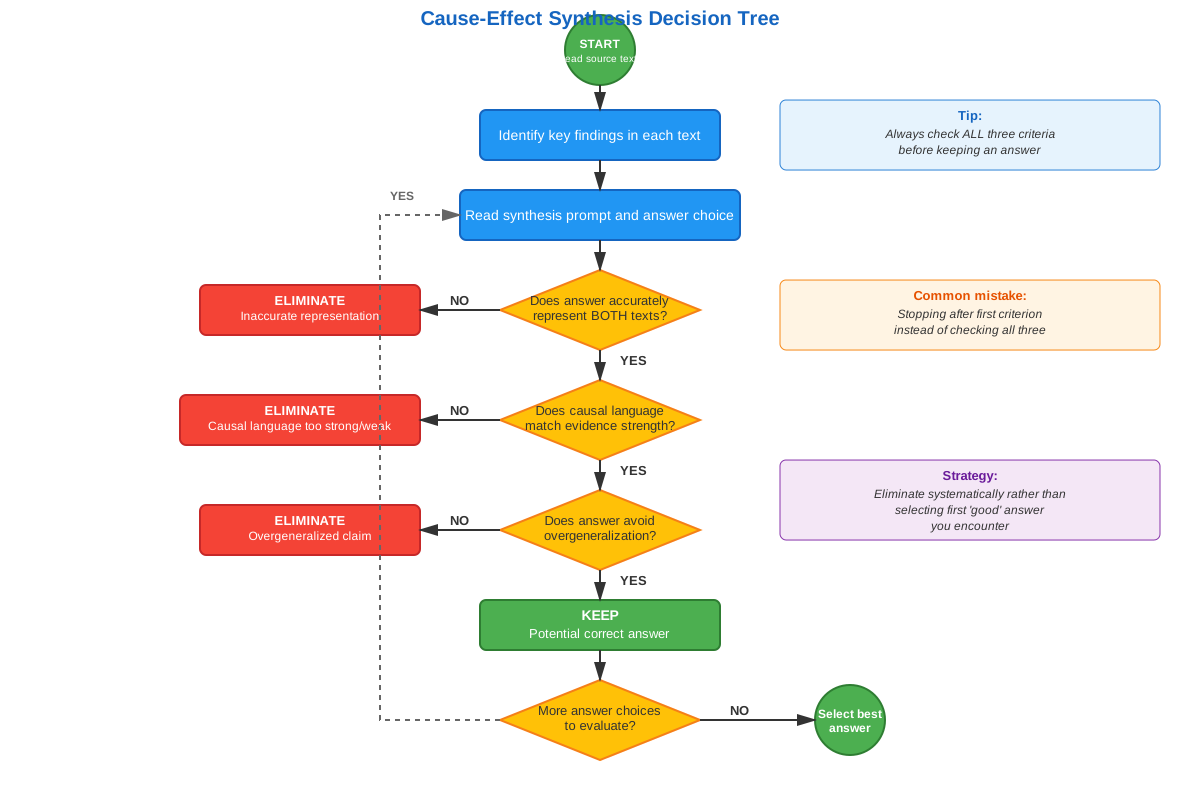
Process of elimination strategy: First, eliminate answers that misrepresent factual details from the texts—these are definitively wrong. Second, eliminate answers that use causal language stronger than the evidence supports (e.g., "causes" when only correlation is shown). Third, eliminate answers that fail to synthesize all texts or focus too narrowly on just one. Finally, choose between remaining options by identifying which best matches the evidence strength and includes all relevant information.
Time allocation: Synthesis questions typically require 60-90 seconds. Spend 30-40 seconds reading and analyzing the texts, 20-30 seconds evaluating answer choices, and 10-20 seconds confirming your selection. If you're stuck between two choices, focus on evidence strength and completeness—the correct answer will match causal language to evidence type and incorporate all texts appropriately.
Exam Tip: When two answer choices seem similar, look for subtle differences in causal language strength or scope. The SAT often includes one answer that's almost correct but uses slightly too strong causal language or overgeneralizes beyond what the evidence supports.
Memory Techniques
CASES - A mnemonic for evaluating synthesis statements:
- Completeness: Does it include all texts?
- Accuracy: Are details correct?
- Strength: Does causal language match evidence?
- Evidence: What type supports the claim?
- Scope: Are limitations maintained?
The Causation Ladder - Visualize evidence strength as a ladder:
- Top rung: Experimental evidence with mechanism → "causes," "results in"
- Middle rung: Strong observational patterns → "contributes to," "influences"
- Bottom rung: Correlation only → "is associated with," "is linked to"
The Three-Text Check - When questions present three texts, use your fingers to physically track whether each answer choice incorporates Text 1 (thumb), Text 2 (index finger), and Text 3 (middle finger). This physical reminder helps ensure completeness.
"Show me the experiment" - When you see strong causal language in an answer choice, mentally ask "Show me the experiment." If the texts don't describe experimental manipulation, the strong causal language is likely incorrect.
Summary
Cause-effect synthesis questions on the SAT require students to combine information from multiple short texts into a single coherent statement that accurately represents causal relationships. Success depends on matching the strength of causal language to the type of evidence provided: experimental evidence supports strong causal claims, while observational data requires more cautious correlational language. Students must evaluate synthesis statements for completeness (incorporating all texts), accuracy (correctly representing details), appropriate causal strength (matching language to evidence), and proper scope (maintaining limitations without overgeneralizing). Common pitfalls include overstating causation when only correlation is shown, focusing on only one text while ignoring others, and failing to include important qualifiers or limitations. The systematic approach of analyzing each text's contribution, evaluating evidence type, and checking answer choices against the CASES criteria enables students to navigate these questions efficiently and accurately.
Key Takeaways
- Cause-effect synthesis questions present multiple texts that must be combined into one accurate statement about causal relationships
- Strong causal language ("causes," "results in") requires experimental evidence; observational data requires cautious language ("is associated with," "may contribute to")
- Complete synthesis incorporates relevant information from ALL provided texts, not just one or two
- The correct answer matches causal language strength to evidence type and maintains appropriate scope limitations
- Systematic evaluation using the CASES framework (Completeness, Accuracy, Strength, Evidence, Scope) improves accuracy and efficiency
- Common wrong answers overstate causation, ignore texts, misrepresent details, or overgeneralize beyond the evidence
- These questions appear 2-4 times per SAT and represent high-value opportunities to demonstrate advanced analytical skills
Related Topics
Rhetorical Synthesis - Other Types: Beyond cause-effect synthesis, the SAT tests other synthesis patterns including comparison-contrast synthesis, problem-solution synthesis, and claim-evidence synthesis. Mastering cause-effect synthesis provides a foundation for these related question types, as they share the core skills of combining multiple sources and using appropriate language.
Evidence Evaluation: Understanding how to assess the strength and type of evidence connects directly to cause-effect synthesis. Further study of research methodology, experimental design, and statistical reasoning deepens the ability to evaluate whether evidence supports causal claims.
Logical Reasoning and Fallacies: Cause-effect synthesis builds on fundamental logical reasoning skills. Studying common logical fallacies (post hoc ergo propter hoc, correlation-causation confusion, hasty generalization) strengthens the ability to identify incorrect synthesis statements.
Academic Writing and Research Skills: The synthesis skills tested on the SAT transfer directly to college-level research writing, literature reviews, and analytical essays. Mastering these skills prepares students for academic success beyond the exam.
Practice CTA
Now that you've mastered the core concepts of cause-effect synthesis, it's time to apply your knowledge! Work through the practice questions to reinforce your understanding of evidence types, causal language strength, and synthesis evaluation. Use the flashcards to memorize key distinctions and trigger words. Remember, cause-effect synthesis questions are high-value opportunities on the SAT—students who master this skill consistently outperform those who don't. Each practice question you complete strengthens your ability to analyze relationships, evaluate evidence, and select synthesis statements with confidence. You've built the foundation; now practice will make these skills automatic on test day!
Sign up free to keep reading
Create a free AnvayaPrep account to finish this SAT guide on Cause-effect synthesis — plus flashcards and practice questions.