Overview
Citation context is a critical skill tested in the SAT Reading and Writing (RW) section, specifically within the Rhetorical Synthesis domain. This topic assesses a student's ability to integrate source material appropriately into written text by selecting citations that best support a given claim or purpose. Unlike simple comprehension questions, citation context questions require students to evaluate multiple potential quotations and determine which one most effectively accomplishes a specific rhetorical goal within a particular argumentative or informational context.
The SAT citation context questions present students with a brief passage that makes a claim or presents an argument, followed by notes from various sources. Students must then select which quotation from these sources would best support the writer's point while fitting naturally into the established context. This skill mirrors authentic academic writing tasks where writers must choose evidence strategically, considering not just relevance but also how well a quotation advances their specific argument. Mastering this topic is essential because it appears regularly on the SAT and directly tests critical thinking about evidence selection—a fundamental college-readiness skill.
Within the broader Reading and Writing section, citation context questions bridge multiple competencies: reading comprehension, rhetorical analysis, and synthesis of information from multiple sources. These questions typically appear in the second module of the RW section and are considered medium-to-high difficulty. Success requires understanding not just what a source says, but how effectively it serves a particular argumentative purpose. This topic connects directly to other rhetorical synthesis skills, including understanding authorial purpose, evaluating evidence quality, and recognizing how different types of support (statistical, anecdotal, expert testimony) function within arguments.
Learning Objectives
- [ ] Identify key features of citation context questions on the SAT
- [ ] Explain how citation context appears on the SAT and what skills it assesses
- [ ] Apply citation context principles to answer SAT-style questions accurately
- [ ] Evaluate multiple quotations to determine which best supports a specific claim
- [ ] Distinguish between relevant citations and those that most effectively advance an argument
- [ ] Recognize the relationship between a writer's purpose and appropriate evidence selection
- [ ] Analyze how different types of evidence (quantitative, qualitative, expert opinion) serve different rhetorical functions
Prerequisites
- Basic reading comprehension: Understanding main ideas and supporting details is essential for evaluating how well a citation supports a claim
- Understanding of claims and evidence: Recognizing the difference between assertions and the support used to validate them forms the foundation for citation selection
- Familiarity with source-based writing: Basic knowledge of how quotations function in academic writing helps students understand why certain citations work better than others
- Rhetorical awareness: Recognizing authorial purpose and audience considerations enables students to evaluate citation appropriateness
Why This Topic Matters
Citation context questions test a fundamental academic skill that extends far beyond the SAT. In college coursework, students must constantly select appropriate evidence from sources to support their arguments in research papers, lab reports, and analytical essays. The ability to evaluate which quotation best serves a specific purpose—rather than simply finding any relevant information—distinguishes sophisticated academic writing from basic summary. This skill also applies to professional contexts where individuals must support recommendations with data, cite precedents in legal arguments, or reference research in technical reports.
On the SAT, sat citation context questions typically appear 1-2 times per test administration, making them a high-yield topic for focused study. These questions are worth the same number of points as any other question, but they often prove challenging because they require synthesis rather than simple recall or comprehension. Students who master this topic gain a significant advantage because many test-takers struggle to distinguish between citations that are merely relevant and those that optimally support the specific claim being made.
Citation context questions commonly appear in passages discussing research findings, historical arguments, or analytical claims about literature, science, or social phenomena. The format is consistent: students receive a brief paragraph establishing a claim or argument, followed by numbered notes from various sources, and must select which quotation would best support the writer's point. The sources may include academic studies, expert commentary, historical documents, or literary analysis. Understanding how to quickly evaluate these options under timed conditions is crucial for SAT success.
Core Concepts
Understanding Citation Context
Citation context refers to the rhetorical situation in which a writer selects and integrates source material to support a specific claim or purpose. On the SAT, this concept is tested through questions that require students to evaluate which quotation from provided sources would most effectively support a given argument. The key principle is that effective citation selection depends not just on topical relevance but on how well the evidence advances the specific point being made.
The context includes several elements: the writer's claim or thesis, the purpose of the paragraph or section where the citation will appear, the type of support needed (statistical evidence, expert opinion, illustrative example), and the relationship between the citation and surrounding text. A citation that perfectly supports one argument might be ineffective for a slightly different claim, even if both claims address the same general topic.
Types of Evidence and Their Functions
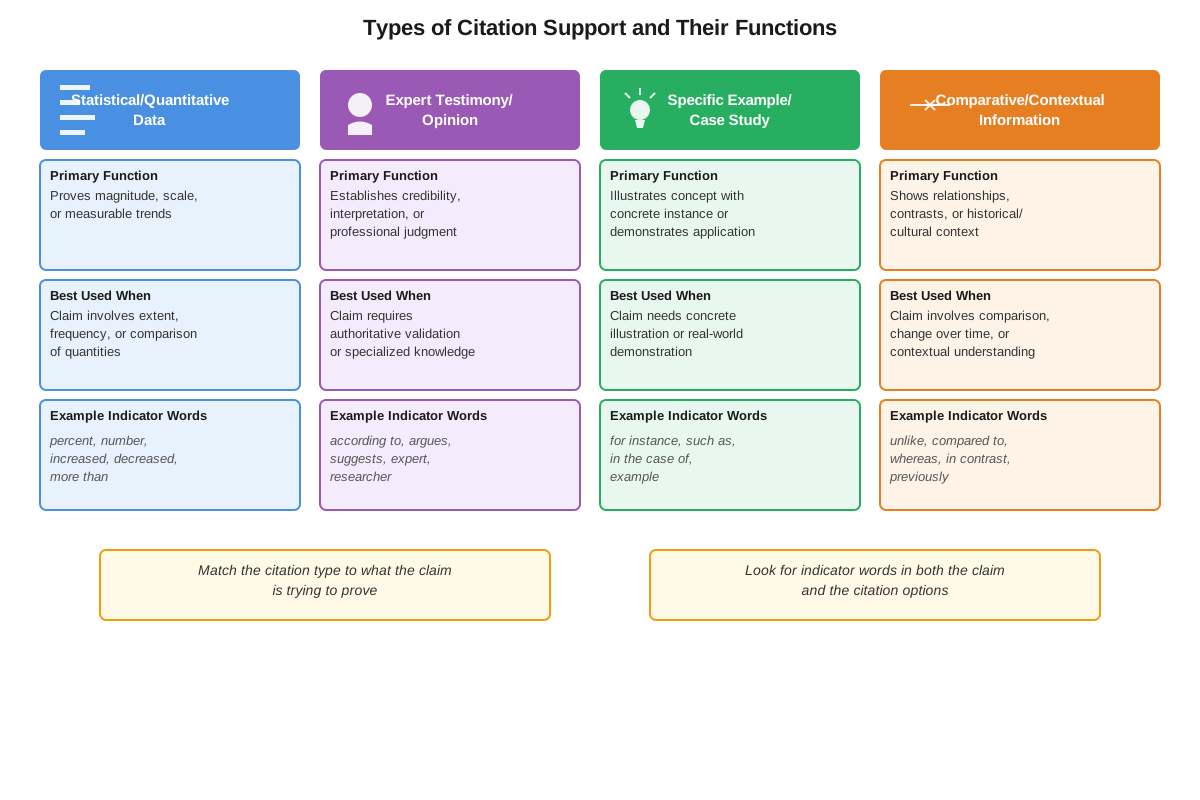
Different types of evidence serve distinct rhetorical purposes, and understanding these functions is crucial for citation context questions:
| Evidence Type | Primary Function | Best Used When |
|---|---|---|
| Quantitative data | Provides measurable support; establishes scope or magnitude | The claim involves extent, frequency, or comparative analysis |
| Expert testimony | Lends authority; validates interpretations | The claim requires specialized knowledge or credibility |
| Specific examples | Illustrates abstract concepts; makes ideas concrete | The claim needs clarification or demonstration |
| Historical precedent | Establishes patterns; provides context | The claim involves trends or contextual understanding |
| Anecdotal evidence | Humanizes issues; creates emotional connection | The claim benefits from personal or narrative dimension |
Evaluating Citation Effectiveness
When evaluating potential citations, students must consider multiple criteria simultaneously:
- Relevance: Does the citation address the same topic as the claim?
- Specificity: Does the citation provide precise support rather than general information?
- Directness: Does the citation directly support the claim without requiring inferential leaps?
- Sufficiency: Does the citation provide adequate support for the type of claim being made?
- Appropriateness: Does the type of evidence match the rhetorical purpose?
The most effective citation is not necessarily the one with the most information or the most impressive source. Instead, it's the quotation that most precisely and directly supports the specific claim while fitting naturally into the established context. For example, if a writer claims that a particular policy had widespread effects, a citation providing statistical data about the policy's reach would be more effective than an expert's general opinion about the policy's importance, even though both are relevant.
The Relationship Between Claims and Evidence
Understanding how claims and evidence interact is fundamental to citation context questions. Claims exist on a spectrum from broad to specific, and the appropriate evidence must match the claim's scope and nature:
- Broad claims (e.g., "Climate change affects global ecosystems") require comprehensive evidence or multiple examples
- Specific claims (e.g., "Rising temperatures have reduced Arctic sea ice by 13% per decade since 1979") require precise, quantitative support
- Causal claims (e.g., "Increased screen time contributes to sleep disruption") require evidence establishing mechanisms or correlations
- Interpretive claims (e.g., "Shakespeare's sonnets explore the tension between idealization and reality") require textual evidence and expert analysis
Signal Phrases and Integration
While SAT citation context questions focus primarily on selecting the right quotation, understanding how citations integrate into text helps students evaluate appropriateness. Effective citations flow naturally from the writer's prose and are introduced with appropriate signal phrases that establish the source's credibility and the quotation's purpose. Students should recognize that a citation that requires extensive explanation or qualification is less effective than one that directly supports the claim.
Common Question Structures
SAT citation context questions follow predictable patterns. The typical structure includes:
- A brief introductory sentence establishing the topic
- A specific claim or argument the writer wants to make
- A statement indicating the writer wants to support this claim with a quotation
- Four numbered notes from various sources
- A question asking which quotation would best accomplish the writer's goal
Understanding this structure helps students quickly identify the key claim they need to support and efficiently evaluate the options against that specific purpose.
Concept Relationships
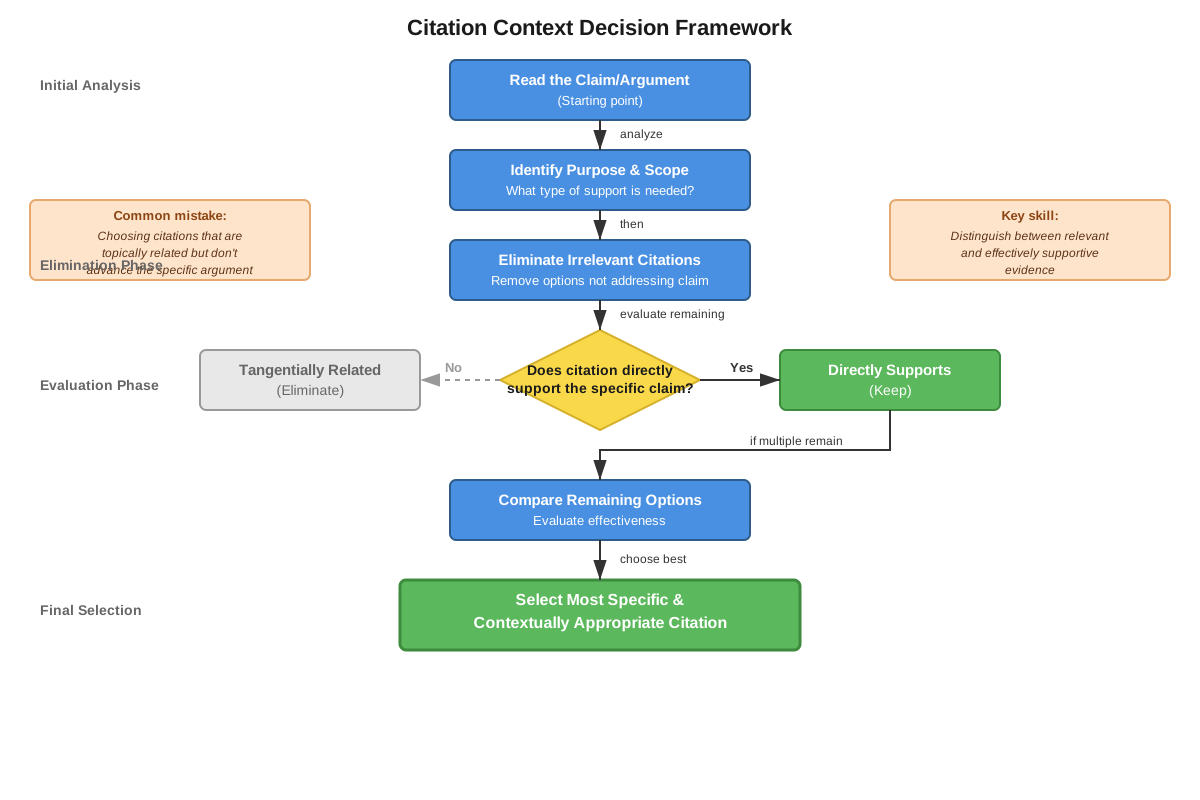
The concepts within citation context are hierarchically organized and interdependent. At the foundation lies understanding the writer's claim, which determines all subsequent evaluation. This leads to identifying the type of support needed (quantitative, qualitative, expert testimony, etc.), which then guides evaluating individual citations against criteria of relevance, specificity, and directness. Finally, students must select the optimal citation by comparing how well each option fulfills the rhetorical purpose.
Citation context connects to prerequisite knowledge of claims and evidence by applying these concepts in a practical selection task. While understanding claims and evidence is theoretical, citation context requires active decision-making about which evidence best serves a specific purpose. This topic also relates to broader rhetorical synthesis skills, as selecting appropriate citations is one component of synthesizing information from multiple sources to construct coherent arguments.
The relationship map flows as follows:
Writer's Purpose/Claim → determines → Type of Evidence Needed → guides → Evaluation Criteria → applied to → Individual Citations → results in → Optimal Selection
Additionally, citation context connects forward to college writing skills, where students must independently locate, evaluate, and integrate sources. Mastering citation context on the SAT builds the analytical framework students need for research-based writing in academic settings.
High-Yield Facts
⭐ Citation context questions require selecting the quotation that most effectively supports a specific claim, not just any relevant information
⭐ The correct answer directly addresses the specific point being made without requiring inferential leaps
⭐ Quantitative evidence is most effective for claims about extent, frequency, or magnitude
⭐ Expert testimony works best when specialized knowledge or credibility is needed to validate a claim
⭐ The type of evidence must match the type of claim being made (causal claims need causal evidence, interpretive claims need analytical support)
- Citation context questions typically provide four numbered notes from different sources as answer choices
- The introductory text always establishes both the topic and the specific claim that needs support
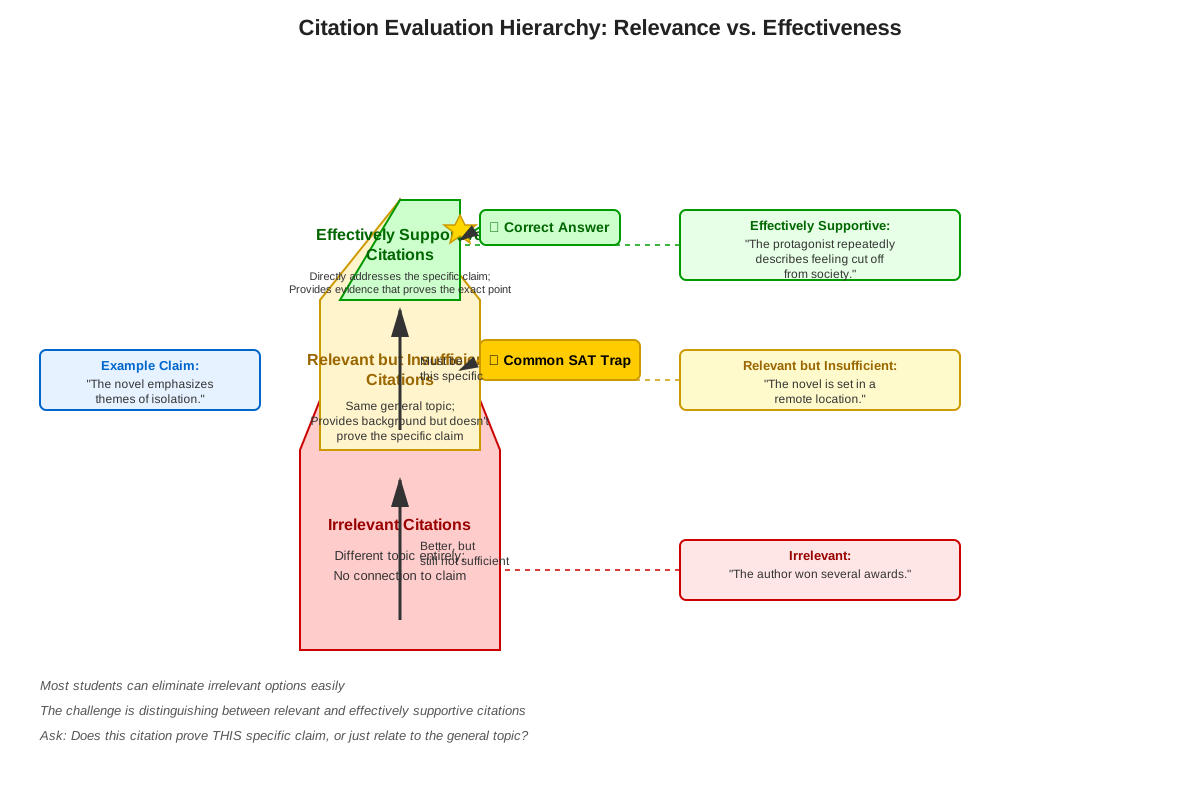
- Incorrect answers are often relevant to the general topic but don't directly support the specific claim
- The most effective citation provides sufficient detail to support the claim without being overly broad or tangential
⭐ A citation that addresses a related but different aspect of the topic is a common distractor
- Signal phrases in the question stem (like "to emphasize," "to illustrate," or "to provide evidence for") indicate the rhetorical purpose
- The correct citation should fit naturally into the context without requiring extensive explanation
- Sources with impressive credentials don't automatically make their quotations the best choice—relevance to the specific claim matters more
- Citations that merely restate the claim without adding new support are ineffective
- The correct answer often includes specific details, examples, or data that directly validate the claim
Quick check — test yourself on Citation context so far.
Try Flashcards →Common Misconceptions
Misconception: Any citation related to the general topic will work as support.
Correction: Effective citations must specifically support the particular claim being made, not just address the same general subject. A passage about climate change might need support for a specific claim about temperature increases, making a citation about sea level rise—though topically related—ineffective for that particular purpose.
Misconception: The citation from the most prestigious source or expert is automatically the best choice.
Correction: Source credibility matters, but the content of the citation must directly support the specific claim. An expert's general observation about a topic is less effective than a less prestigious source providing precise data that directly validates the claim.
Misconception: Longer, more detailed citations are always better than shorter ones.
Correction: Citation effectiveness depends on relevance and directness, not length. A concise quotation that precisely supports the claim is superior to a lengthy passage that includes relevant information buried among tangential details.
Misconception: If a citation is factually accurate and interesting, it will work as support.
Correction: Accuracy and interest are necessary but insufficient. The citation must serve the specific rhetorical purpose established in the question. A fascinating fact that doesn't directly support the claim is an ineffective choice.
Misconception: The correct answer will always use the same key terms as the claim.
Correction: While keyword overlap can indicate relevance, the best citation might use different terminology to express the same concept or provide supporting details that validate the claim without repeating its exact language. Students should focus on conceptual alignment rather than surface-level word matching.
Misconception: Citations that provide background information or context are good support for any claim about that topic.
Correction: Background information and context serve different rhetorical purposes than direct evidence. If the claim makes a specific assertion that requires validation, contextual information—though useful in other parts of an essay—won't effectively support that particular claim.
Worked Examples
Example 1: Scientific Research Context
Passage Setup:
A student is writing a research paper about the effects of urbanization on bird populations. The student makes the following claim: "Urban development has led to significant declines in songbird populations in North American cities." The student wants to support this claim with a quotation from a scientific source.
Source Notes:
- "Urban areas provide diverse habitats including parks, gardens, and green spaces that can support various bird species" (Urban Ecology Journal)
- "A 30-year study of bird populations in 15 major North American cities found that songbird numbers decreased by an average of 45% in areas with more than 70% impervious surface coverage" (Conservation Biology Research)
- "Birds have adapted to urban environments in remarkable ways, with some species thriving in cities" (Nature Magazine)
- "Urbanization affects many aspects of ecosystems, including plant diversity, water quality, and animal behavior" (Environmental Science Review)
Analysis:
Let's evaluate each option against the specific claim about songbird population declines:
- Option 1 discusses urban habitats supporting birds, which contradicts or at least doesn't support the claim about declines. This is relevant to urbanization and birds but doesn't address population decreases. Eliminate.
- Option 2 provides specific quantitative data (45% decrease) directly supporting the claim about significant declines. It specifies songbirds, mentions North American cities, and provides measurable evidence of the decline. The 30-year timeframe and 15-city scope establish credibility. Strong candidate.
- Option 3 suggests some birds thrive in cities, which works against the claim about declines. While relevant to urban bird populations, it doesn't support this specific claim. Eliminate.
- Option 4 mentions urbanization's effects broadly but doesn't specifically address bird populations or provide evidence of decline. Too general. Eliminate.
Answer: Option 2 provides the most effective support because it directly validates the claim with specific, quantitative evidence about songbird population declines in North American cities.
Example 2: Literary Analysis Context
Passage Setup:
A student is writing an essay about Emily Dickinson's poetry. The student makes the following claim: "Dickinson frequently used unconventional punctuation to create pauses that emphasize key ideas in her poems." The student wants to support this claim with commentary from a literary scholar.
Source Notes:
- "Dickinson's poems often explore themes of death, nature, and immortality with remarkable depth" (Professor James Miller, American Literature)
- "The poet's use of dashes throughout her work serves to fragment thoughts and create rhythmic interruptions that draw readers' attention to specific words and concepts" (Dr. Sarah Chen, Dickinson Studies Quarterly)
- "Emily Dickinson lived a reclusive life in Amherst, Massachusetts, and wrote nearly 1,800 poems during her lifetime" (Biography of American Poets)
- "Many nineteenth-century poets experimented with form and structure to distinguish their work from traditional verse" (History of American Poetry)
Analysis:
- Option 1 addresses Dickinson's themes, which is relevant to her poetry generally but doesn't address punctuation or emphasis techniques. Eliminate.
- Option 2 specifically discusses Dickinson's use of dashes (unconventional punctuation), explains how they create pauses ("rhythmic interruptions"), and describes their function in emphasizing ideas ("draw readers' attention to specific words and concepts"). This directly supports all elements of the claim. Strong candidate.
- Option 3 provides biographical information that doesn't address the claim about punctuation and emphasis. Eliminate.
- Option 4 discusses nineteenth-century poets broadly but doesn't specifically address Dickinson or punctuation. Too general. Eliminate.
Answer: Option 2 most effectively supports the claim because it specifically addresses Dickinson's unconventional punctuation (dashes), explains how it creates pauses (rhythmic interruptions), and describes how this technique emphasizes key ideas (draws attention to specific words and concepts).
Exam Strategy
When approaching SAT citation context questions, follow this systematic process:
Step 1: Identify the Specific Claim (15-20 seconds)
Read the introductory text carefully and underline or mentally note the exact claim that needs support. Pay attention to qualifiers, scope, and specific assertions. Don't just identify the general topic—pinpoint the precise point being made.
Step 2: Determine the Type of Support Needed (5-10 seconds)
Based on the claim, identify what kind of evidence would best support it:
- Does it need quantitative data?
- Does it require expert interpretation?
- Does it need a specific example?
- Does it require causal evidence?
Step 3: Eliminate Obviously Wrong Answers (20-30 seconds)
Quickly scan all four options and eliminate those that:
- Address a different aspect of the topic
- Contradict the claim
- Provide only background information
- Are too general or vague
Step 4: Compare Remaining Options (20-30 seconds)
For the remaining choices, evaluate which most directly and specifically supports the claim. Ask:
- Which provides the most precise support?
- Which requires the fewest inferential leaps?
- Which matches the type of evidence needed?
Exam Tip: The correct answer will feel like it "clicks" into place with the claim. If you're making complex logical connections to justify an answer, it's probably wrong.
Trigger Words and Phrases to Watch For:
- "To emphasize" → Look for evidence that highlights or stresses a particular point
- "To illustrate" → Look for specific examples or concrete instances
- "To provide evidence for" → Look for data or facts that validate the claim
- "To support the claim that" → Focus on what directly proves the assertion
- "To demonstrate" → Look for evidence that shows or proves something
Process of Elimination Tips:
- Eliminate citations that are about a related but different topic (e.g., if the claim is about temperature increases, eliminate citations about precipitation changes)
- Eliminate citations that provide interesting context but don't validate the specific claim
- Eliminate citations where the connection to the claim requires you to make assumptions
- Eliminate citations that are too broad when the claim is specific, or too narrow when the claim is general
Time Allocation:
Spend approximately 60-75 seconds per citation context question. These questions require careful reading but shouldn't consume excessive time. If you're spending more than 90 seconds, make your best choice and move on—you can return if time permits.
Memory Techniques
DIRECT Acronym for Evaluating Citations:
- Directly addresses the claim
- Includes specific details or data
- Relevant to the exact point being made
- Evidence type matches claim type
- Clear connection without inference
- Tightly focused, not tangential
The "Perfect Fit" Visualization:
Imagine the claim as a puzzle piece with a specific shape. The correct citation should fit perfectly into that shape without forcing or stretching. If you have to mentally "explain" why a citation works, it's not the perfect fit.
The Three-Question Filter:
Before selecting an answer, ask:
- Does this citation talk about the same specific thing as the claim?
- Does this citation provide the type of support the claim needs?
- Could I explain in one sentence why this citation supports the claim?
If you answer "no" to any question, eliminate that option.
Evidence Type Matching:
Remember: Quantitative for Quantity claims, Expert for Evaluation claims, Specific examples for Supporting illustrations (QES).
Summary
Citation context questions on the SAT assess the critical academic skill of selecting appropriate evidence to support specific claims. Success requires understanding that effective citations must do more than relate to the general topic—they must directly support the particular assertion being made with the appropriate type of evidence. Students must quickly identify the writer's specific claim, determine what type of support would best validate that claim, and evaluate multiple quotations to select the one that most effectively serves the rhetorical purpose. The correct answer provides precise, direct support without requiring inferential leaps or extensive explanation. Common pitfalls include selecting citations that are topically relevant but don't address the specific claim, choosing impressive-sounding sources whose content doesn't directly support the point, or favoring longer, more detailed quotations over concise, targeted ones. Mastering this topic requires practice distinguishing between general relevance and specific effectiveness, understanding how different types of evidence serve different rhetorical purposes, and systematically evaluating options against clear criteria. This skill directly translates to college-level research writing and represents a fundamental component of academic literacy.
Key Takeaways
- Citation context questions require selecting the quotation that most effectively supports a specific claim, not just any relevant information about the topic
- The correct citation directly addresses the particular point being made and provides the appropriate type of evidence (quantitative, expert testimony, specific example, etc.)
- Evaluate citations using the DIRECT criteria: Directly addresses claim, Includes specific details, Relevant to exact point, Evidence type matches claim, Clear connection, Tightly focused
- Common wrong answers are topically relevant but don't support the specific claim, provide background instead of evidence, or require inferential leaps
- Systematic evaluation—identifying the claim, determining needed support type, eliminating wrong answers, comparing remaining options—leads to consistent success
- The type of evidence must match the type of claim: quantitative data for extent/magnitude claims, expert analysis for interpretive claims, specific examples for illustrative purposes
- Practice distinguishing between general relevance and specific effectiveness to master this high-yield SAT topic
Related Topics
Rhetorical Purpose and Audience: Understanding how writers adapt evidence selection based on their purpose and intended audience builds on citation context skills by adding layers of rhetorical awareness. Mastering citation context provides the foundation for analyzing how evidence functions differently in various rhetorical situations.
Synthesis of Multiple Sources: Citation context focuses on selecting one quotation, while synthesis involves integrating information from multiple sources to construct complex arguments. The evaluation skills developed through citation context questions directly transfer to synthesis tasks.
Evaluating Source Credibility: While citation context questions provide pre-selected sources, understanding how to evaluate source reliability and authority enhances the ability to select effective citations and prepares students for independent research.
Textual Evidence in Reading Comprehension: Citation context applies evidence evaluation skills in a writing context, complementing the reading comprehension skill of identifying textual evidence that supports interpretations of passages.
Practice CTA
Now that you've mastered the core concepts of citation context, it's time to apply these skills to authentic SAT-style questions. The practice questions and flashcards will reinforce your ability to quickly identify claims, evaluate evidence types, and select the most effective citations under timed conditions. Remember: citation context questions are highly predictable in structure, which means consistent practice leads to reliable success. Each practice question you complete strengthens your pattern recognition and decision-making speed. Approach the practice materials with the systematic strategy outlined in this guide, and you'll build the confidence and competence needed to excel on these high-yield SAT questions. Your investment in mastering this topic will pay dividends not only on test day but throughout your academic career!
Sign up free to keep reading
Create a free AnvayaPrep account to finish this SAT guide on Citation context — plus flashcards and practice questions.