Overview
Claim synthesis is one of the most sophisticated and high-stakes question types in the SAT Reading and Writing (RW) section. These questions require students to analyze multiple sources of information—often including data, research findings, or expert opinions—and then synthesize this information to support or evaluate a specific claim. Unlike traditional reading comprehension questions that test literal understanding, claim synthesis questions assess a student's ability to integrate evidence from different perspectives, identify logical relationships between ideas, and determine which evidence best supports a particular argument.
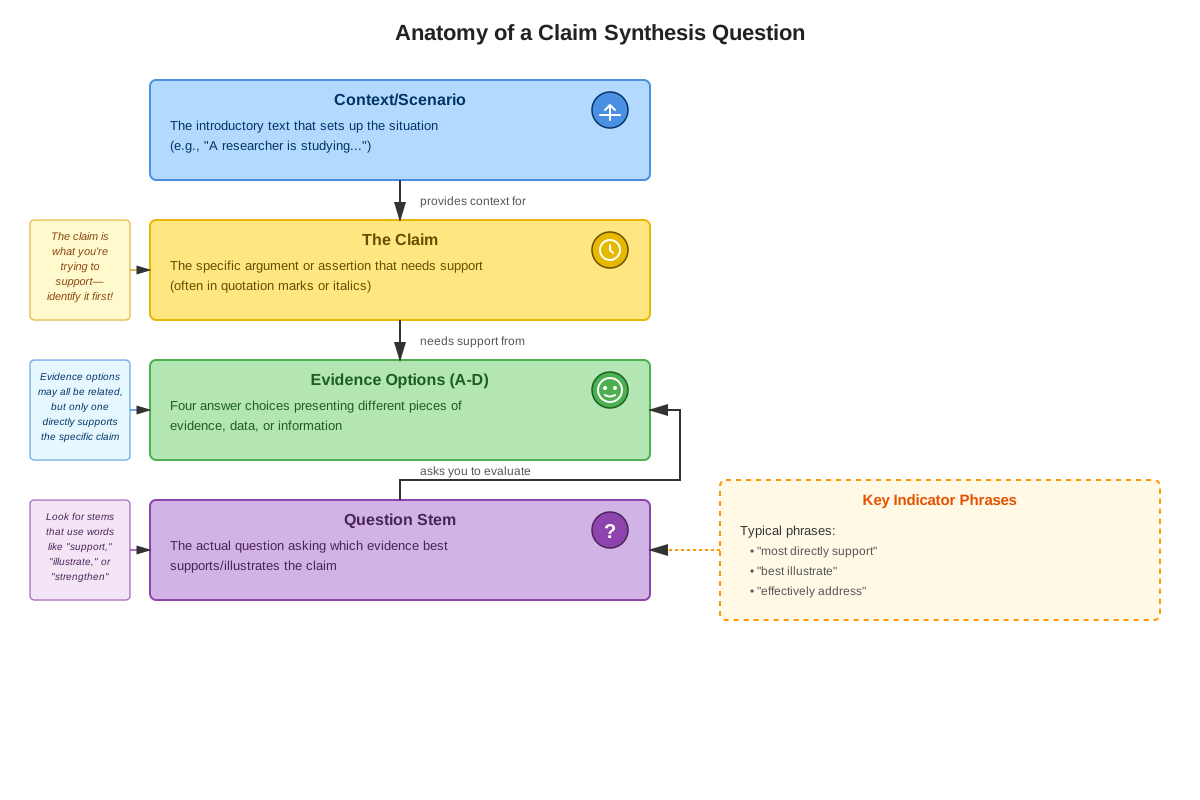
On the SAT, claim synthesis questions typically present students with a scenario where a researcher, student, or writer is making an argument about a topic. The question then provides several pieces of evidence or data points and asks students to identify which piece of information most effectively supports, illustrates, or challenges the claim being made. These questions are essential because they mirror the type of analytical thinking required in college-level academic work, where students must regularly evaluate sources, synthesize information, and construct evidence-based arguments.
Within the broader landscape of SAT RW skills, claim synthesis represents the pinnacle of rhetorical analysis. It builds upon foundational skills like identifying main ideas, understanding textual evidence, and recognizing logical relationships. However, it goes further by requiring students to actively evaluate the strength and relevance of different pieces of evidence in relation to a specific argumentative purpose. Mastering claim synthesis is crucial not only for achieving a high SAT score but also for developing the critical thinking skills that underpin academic success in college and beyond.
Learning Objectives
- [ ] Identify key features of claim synthesis questions on the SAT
- [ ] Explain how claim synthesis appears on the SAT and what makes these questions unique
- [ ] Apply claim synthesis skills to answer SAT-style questions accurately and efficiently
- [ ] Evaluate the relevance and strength of different pieces of evidence in supporting a claim
- [ ] Distinguish between evidence that directly supports a claim versus evidence that is merely related to the topic
- [ ] Analyze the logical relationship between a claim and various supporting details
- [ ] Synthesize information from multiple sources to determine the most effective support for an argument
Prerequisites
- Reading comprehension skills: Understanding main ideas, supporting details, and author's purpose is essential for identifying what a claim is actually asserting before evaluating evidence.
- Basic understanding of argumentation: Recognizing the difference between claims, evidence, and reasoning helps students understand what role each element plays in constructing an argument.
- Ability to identify relevant information: Students must be able to distinguish between information that is topically related versus information that specifically supports a particular point.
- Familiarity with data interpretation: Many claim synthesis questions include numerical data, charts, or research findings that require basic analytical skills to understand.
Why This Topic Matters
Claim synthesis questions represent a significant portion of the SAT Reading and Writing section, appearing regularly throughout the exam. These questions are considered high-difficulty items and often serve as score differentiators between students aiming for scores in the 650-700+ range. According to College Board data, claim synthesis questions appear in approximately 10-15% of all RW questions, making them one of the most important question types to master for students targeting competitive college admissions.
In real-world applications, the skills tested by claim synthesis questions are fundamental to academic and professional success. College students must constantly evaluate sources, determine which evidence best supports their thesis statements, and synthesize information from multiple texts. Professionals in fields ranging from law to medicine to business regularly engage in evidence-based reasoning, weighing different data points to support recommendations and decisions. The ability to quickly identify the most relevant and compelling evidence for a specific claim is a hallmark of critical thinking.
On the SAT, claim synthesis questions typically appear in passages about scientific research, historical analysis, or social science topics. They often present a student or researcher making an argument, followed by several pieces of evidence drawn from studies, observations, or data sets. The question then asks which piece of evidence "best illustrates," "most directly supports," or "most effectively demonstrates" the claim. These questions test not just reading comprehension but also logical reasoning and the ability to evaluate the strength of argumentative support.
Core Concepts
Understanding Claims
A claim is an assertion or argument that someone makes about a topic. In the context of SAT claim synthesis questions, claims are typically presented as statements that require evidence to be convincing. Claims can take many forms: they might assert a causal relationship ("X causes Y"), describe a pattern or trend ("X has increased over time"), make a comparison ("X is more effective than Y"), or argue for a particular interpretation of data or events.
The key to understanding claims is recognizing that they are not self-evident facts but rather arguments that need support. For example, "The population of monarch butterflies has declined" is a factual statement that can be verified, while "Agricultural pesticides are the primary cause of monarch butterfly population decline" is a claim that requires evidence to support it. On the SAT, students must first understand exactly what a claim is asserting before they can evaluate which evidence best supports it.
The Synthesis Process
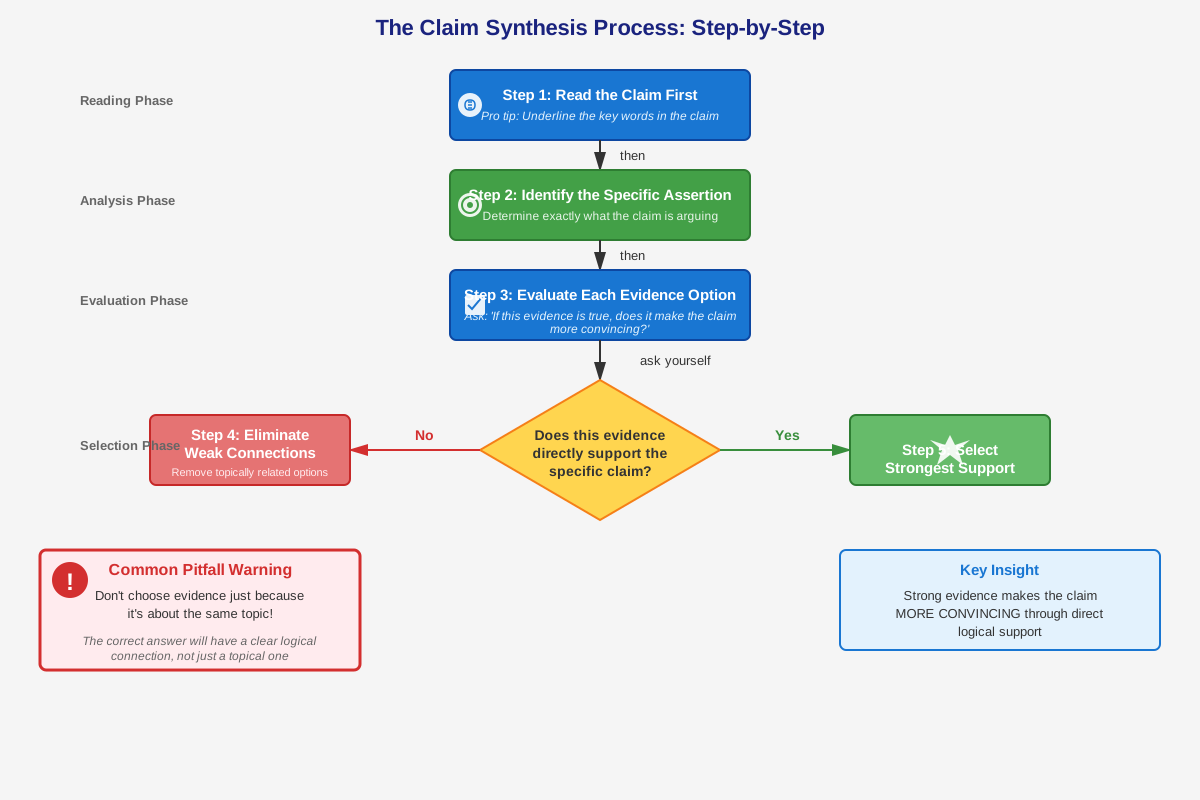
Claim synthesis involves bringing together information from multiple sources or data points to support or evaluate an argument. This process requires several cognitive steps:
- Comprehension: Understanding what the claim is actually asserting
- Analysis: Breaking down the claim into its component parts and identifying what type of evidence would support it
- Evaluation: Assessing each piece of available evidence for relevance and strength
- Selection: Choosing the evidence that most directly and effectively supports the claim
The synthesis aspect is crucial because students must actively integrate information rather than simply recall it. This means understanding not just what each piece of evidence says, but how it relates to the specific claim being made.
Types of Evidence
SAT claim synthesis questions present various types of evidence that students must evaluate:
| Evidence Type | Description | Example |
|---|---|---|
| Quantitative data | Numerical information, statistics, measurements | "The study found a 45% decrease in butterfly populations" |
| Observational findings | Descriptions of what researchers observed | "Researchers noted that butterflies avoided fields treated with pesticides" |
| Expert testimony | Statements from authorities in a field | "Dr. Smith argues that habitat loss is the primary factor" |
| Comparative data | Information that shows differences between groups | "Butterfly populations in organic farms were three times higher than in conventional farms" |
| Temporal data | Information showing changes over time | "Butterfly populations declined steadily from 1990 to 2020" |
Understanding these evidence types helps students quickly categorize information and determine what kind of support a particular claim needs.
Evaluating Evidence Strength
Not all evidence is equally strong or relevant. When evaluating evidence for claim synthesis, students should consider:
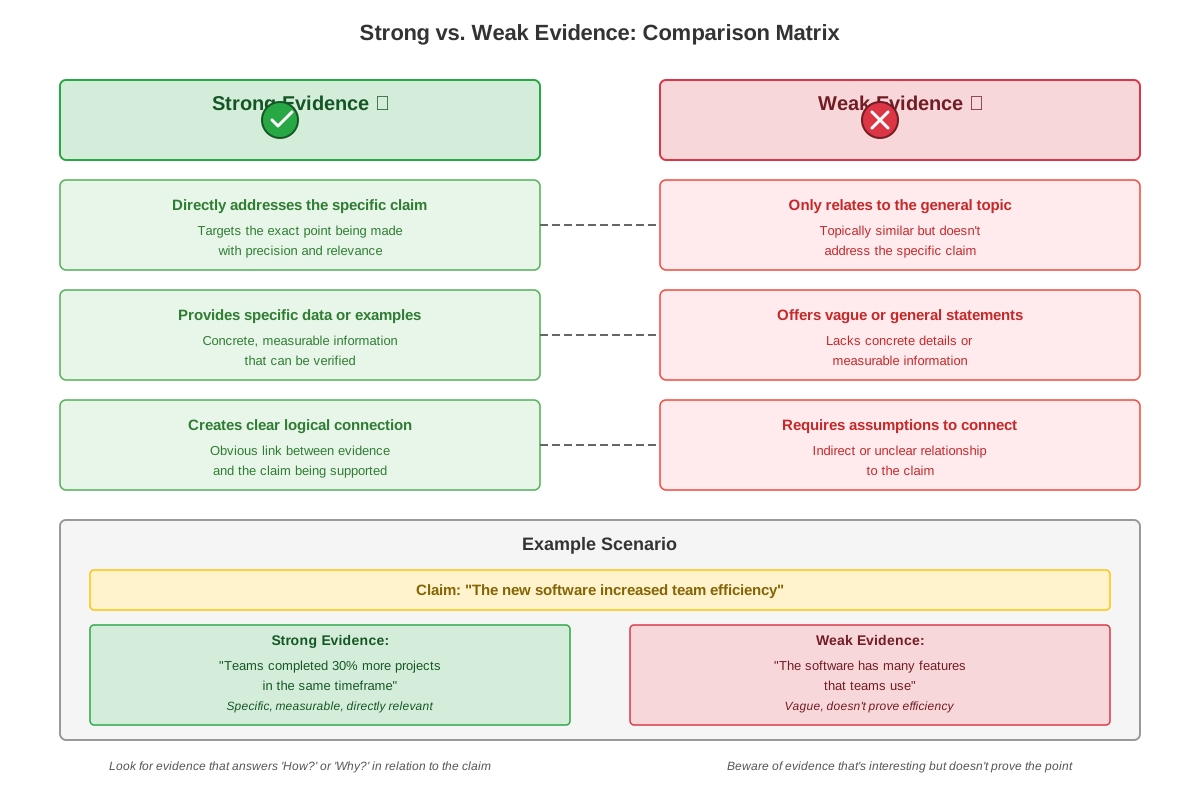
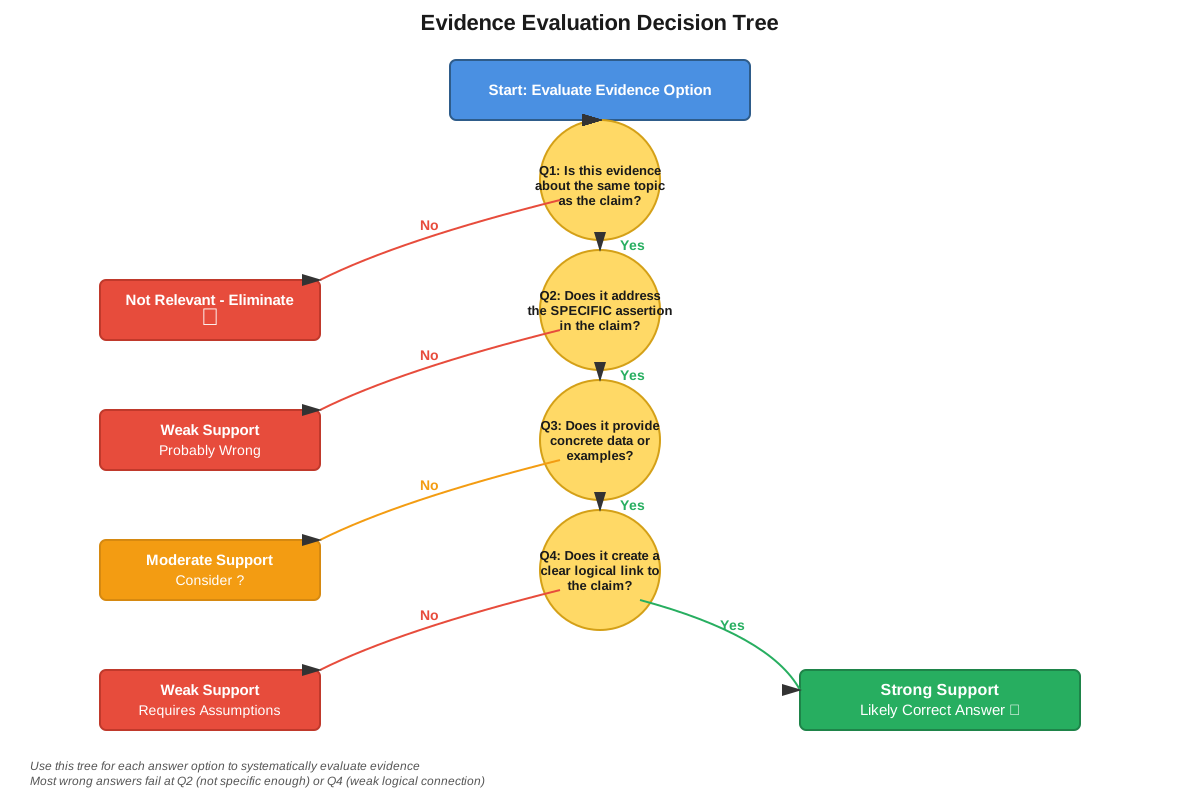
- Directness: Does the evidence directly address the claim, or is it only tangentially related?
- Specificity: Does the evidence provide concrete, specific information rather than vague generalizations?
- Relevance: Does the evidence actually support the particular aspect of the claim being made?
- Sufficiency: Is the evidence substantial enough to support the claim, or is it merely suggestive?
For example, if a claim states that "pesticide use is the primary cause of butterfly decline," strong evidence would show a direct correlation between pesticide exposure and butterfly population decreases, ideally with data that rules out other potential causes. Weak evidence might simply show that butterflies and pesticides exist in the same environment without demonstrating a causal relationship.
Common Claim-Evidence Relationships
Understanding typical relationships between claims and evidence helps students quickly identify the best support:
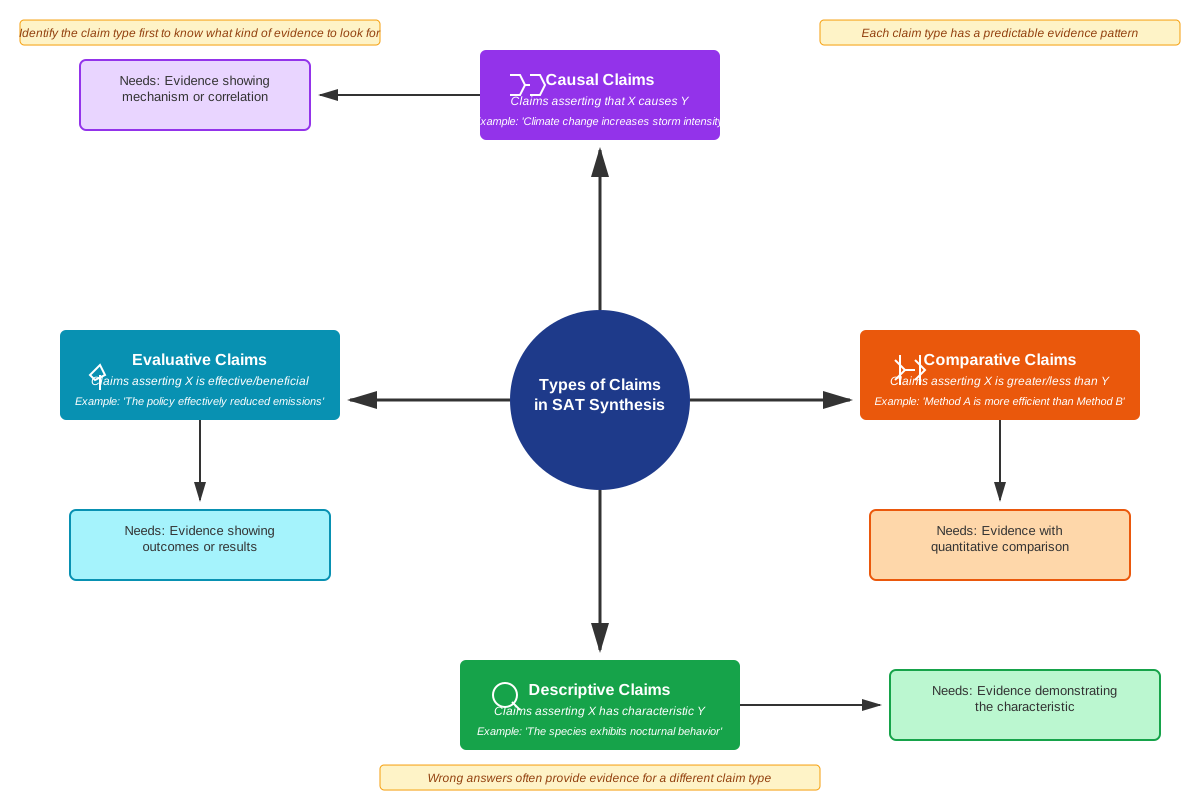
- Causal claims require evidence showing that one factor produces an effect on another
- Comparative claims require evidence demonstrating differences or similarities between two or more things
- Trend claims require evidence showing patterns over time or across conditions
- Descriptive claims require evidence providing specific details or characteristics
- Evaluative claims require evidence establishing criteria and showing how something meets or fails to meet those criteria
The Role of Context
Context is crucial in claim synthesis. The same piece of evidence might strongly support one claim but be irrelevant to another, even if both claims are about the same general topic. Students must pay careful attention to the specific wording of the claim and understand exactly what it is asserting. For instance, a claim about "the most significant factor" requires different evidence than a claim about "one contributing factor," even if both are discussing the same phenomenon.
Concept Relationships
The concepts within claim synthesis are deeply interconnected and build upon each other in a logical progression. Understanding claims → enables → evaluating evidence types → which leads to → assessing evidence strength → which culminates in → successful synthesis and selection of the best support.
The relationship between claims and evidence is bidirectional: understanding what makes a strong claim helps students identify what type of evidence would support it, while analyzing different types of evidence helps students understand what claims can be legitimately made. The synthesis process serves as the integrative framework that brings all these elements together, requiring students to move beyond simple comprehension to active evaluation and judgment.
Claim synthesis connects to prerequisite topics in important ways. Reading comprehension skills provide the foundation for understanding both claims and evidence. Argumentation knowledge helps students recognize the logical structure of claim-evidence relationships. Data interpretation skills enable students to extract meaning from quantitative evidence. These prerequisite skills are not just helpful but essential—claim synthesis questions are impossible to answer correctly without them.
Looking forward, mastering claim synthesis prepares students for more advanced analytical tasks both on the SAT and in academic work. The skills developed through claim synthesis practice directly transfer to essay writing, research paper composition, and critical analysis of arguments in any field. The logical reasoning required for claim synthesis also supports success on other SAT question types, including inference questions, purpose questions, and questions about textual relationships.
High-Yield Facts
⭐ Claim synthesis questions always present multiple pieces of evidence and ask which one BEST supports a specific claim—"best" means most direct and most relevant.
⭐ The correct answer will directly address the specific aspect of the claim being made, not just relate to the general topic.
⭐ Evidence that is factually accurate and topically related can still be wrong if it doesn't specifically support the claim's particular assertion.
⭐ Quantitative evidence (numbers, percentages, measurements) often provides the strongest support for claims about trends, comparisons, or magnitudes.
⭐ The claim's exact wording matters enormously—pay attention to qualifiers like "primary," "most significant," "one factor," or "contributes to."
- Claim synthesis questions typically appear 2-3 times per SAT Reading and Writing section.
- Wrong answers in claim synthesis questions often provide evidence for a related but different claim than the one actually stated.
- Evidence that describes correlation is not sufficient for claims asserting causation unless the evidence also establishes a causal mechanism.
- The best evidence will match the scope of the claim—broad claims need broad evidence, specific claims need specific evidence.
- Temporal alignment matters: evidence from the wrong time period cannot support claims about a specific era or trend.
- Evidence that contradicts part of a claim cannot be the best support, even if it supports another part.
- The most common wrong answer type is evidence that is topically related but doesn't address the claim's specific assertion.
Quick check — test yourself on Claim synthesis so far.
Try Flashcards →Common Misconceptions
Misconception: Any evidence related to the topic of the claim will support that claim. → Correction: Evidence must specifically address what the claim is asserting, not just be about the same general subject. A claim about causes requires causal evidence; a claim about effects requires evidence of outcomes; a claim about comparisons requires comparative data.
Misconception: The longest or most detailed piece of evidence is usually the correct answer. → Correction: The best evidence is the most relevant and direct, regardless of length. Sometimes the shortest, most focused piece of evidence provides the strongest support because it directly addresses the claim without extraneous information.
Misconception: If evidence is factually true, it supports any claim about that topic. → Correction: Truth and relevance are different qualities. Evidence can be completely accurate but still irrelevant to a particular claim. The question is not whether the evidence is true, but whether it supports the specific assertion being made.
Misconception: Evidence showing correlation is sufficient to support claims about causation. → Correction: Correlation (two things happening together) does not prove causation (one thing causing another). Claims asserting causal relationships require evidence that demonstrates a causal mechanism or rules out alternative explanations, not just co-occurrence.
Misconception: The correct answer will use the same vocabulary as the claim. → Correction: The best evidence often paraphrases or provides concrete examples of what the claim describes in more abstract terms. Students should focus on conceptual alignment rather than word matching.
Misconception: Evidence that supports part of a compound claim is sufficient. → Correction: If a claim makes multiple assertions (e.g., "X is both widespread and increasing"), the best evidence must support all parts of the claim, not just one aspect.
Worked Examples
Example 1: Scientific Research Claim
Scenario: A biology student is researching the impact of urbanization on bird populations. The student claims that "urban development has led to significant declines in native songbird populations primarily through habitat loss rather than other environmental factors."
Evidence Options:
A) A study showing that songbird populations in urban areas are 60% lower than in rural areas.
B) Research demonstrating that when natural vegetation is removed for construction, songbird nesting sites decrease by 75%, while populations in urban areas with preserved green spaces remain stable.
C) Data indicating that urban areas have higher levels of noise pollution, which can affect bird communication.
D) A survey showing that many urban residents enjoy watching birds in city parks.
Analysis:
First, identify what the claim specifically asserts: (1) urban development causes declines, (2) the decline is significant, (3) the primary mechanism is habitat loss, and (4) habitat loss is more important than other factors.
Option A shows correlation between urbanization and population decline but doesn't explain the mechanism or rule out other causes. It supports that there is a decline but not the "primarily through habitat loss" part of the claim.
Option B directly addresses the causal mechanism (habitat loss through vegetation removal) and provides evidence that habitat preservation maintains populations, which suggests habitat loss is indeed the primary factor. The 75% decrease in nesting sites when vegetation is removed, combined with stable populations where green spaces are preserved, strongly supports the specific claim about habitat loss being the primary cause.
Option C mentions an environmental factor (noise pollution) but doesn't support the claim that habitat loss is the primary factor—if anything, it suggests an alternative explanation.
Option D is topically related but completely irrelevant to the claim about population decline mechanisms.
Answer: B is correct because it provides specific evidence for the causal mechanism (habitat loss) and includes comparative information (preserved vs. removed vegetation) that supports the claim that habitat loss is the primary factor.
Example 2: Historical Analysis Claim
Scenario: A history student is writing about economic changes in the 19th century. The student claims that "the expansion of railroad networks in the 1850s was the most significant factor in accelerating industrial growth in the northeastern United States."
Evidence Options:
A) Records showing that railroad mileage in the Northeast increased from 3,000 miles in 1850 to 9,000 miles in 1860.
B) Data demonstrating that industrial output in northeastern states grew by 150% between 1850 and 1860, while states without significant railroad expansion grew by only 40% during the same period.
C) Historical accounts describing how railroads made travel more convenient for business owners.
D) Statistics indicating that railroad construction created thousands of jobs in the 1850s.
Analysis:
The claim makes a specific assertion about causation ("was the most significant factor") and effect ("accelerating industrial growth"). The claim requires evidence showing both that railroads expanded and that this expansion specifically drove industrial growth more than other factors.
Option A shows railroad expansion occurred but doesn't connect this to industrial growth at all. It's necessary context but insufficient support.
Option B provides comparative data showing that industrial growth was dramatically higher in areas with railroad expansion (150%) versus areas without it (40%). This directly supports both the causal relationship and the "most significant factor" aspect by showing the magnitude of difference.
Option C describes a benefit of railroads but doesn't provide concrete evidence of impact on industrial growth or demonstrate that this was the most significant factor.
Option D shows an economic effect of railroad construction but focuses on job creation rather than industrial growth, which is what the claim specifically addresses.
Answer: B is correct because it provides comparative quantitative evidence directly linking railroad expansion to accelerated industrial growth and demonstrates the magnitude of the effect, supporting the "most significant factor" claim.
Exam Strategy
When approaching SAT claim synthesis questions, follow this systematic process:
Step 1: Read and parse the claim carefully. Underline or mentally note key words, especially qualifiers like "primary," "most significant," "one factor," "mainly," or "partially." These words define exactly what the claim is asserting and what type of evidence will support it.
Step 2: Identify what type of evidence the claim requires. Ask yourself: Is this a causal claim? A comparative claim? A claim about trends? A descriptive claim? Different claim types require different evidence types.
Step 3: Predict what good evidence would look like before reading the options. This prevents you from being swayed by attractive but irrelevant evidence. If the claim is about causation, predict that you need evidence showing a causal mechanism. If it's about comparison, predict that you need comparative data.
Step 4: Eliminate options that are topically related but don't address the specific claim. This is the most common wrong answer type. An option might be about the same subject but not support the particular assertion being made.
Step 5: Among remaining options, choose the most direct and specific evidence. The correct answer will have a clear, logical connection to the claim without requiring additional assumptions or inferential leaps.
Exam Tip: Watch for trigger phrases in questions like "best illustrates," "most directly supports," "most effectively demonstrates," or "best completes." These phrases signal that you're looking for the strongest, most relevant evidence, not just any related information.
Time allocation: Spend 60-90 seconds on claim synthesis questions. They require more careful analysis than simple comprehension questions but shouldn't consume excessive time. If you're stuck between two options, choose the one that addresses more aspects of the claim or provides more specific, quantitative support.
Process of elimination strategy: First eliminate options that are off-topic or address a different claim. Then eliminate options that show correlation when causation is needed, or that provide examples when data is needed (or vice versa). Finally, choose between remaining options based on directness and specificity.
Memory Techniques
CLAIM Acronym for Evaluation:
- Connection: Does the evidence connect directly to the claim?
- Logical: Is there a logical relationship between evidence and claim?
- Adequate: Is the evidence sufficient in scope and strength?
- Inclusive: Does it address all parts of the claim?
- Matching: Does the evidence type match what the claim requires?
The "Specific Beats General" Rule: When in doubt, choose evidence that is more specific and concrete over evidence that is vague or general. Claims need concrete support, not abstract statements.
Visualization Strategy: Picture the claim as a bridge that needs support pillars. Each piece of evidence is a potential pillar. The correct answer is the pillar that actually touches and supports the bridge, while wrong answers might be nearby but not actually supporting the structure.
The "So What?" Test: After reading each piece of evidence, ask "So what does this tell me about the claim?" If you can't articulate a clear connection, it's probably not the right answer.
Qualifier Alert System: Train yourself to immediately notice and highlight qualifiers in claims (primary, most, one, mainly, partially, significantly). These words are not filler—they define what the claim is actually asserting and therefore what evidence is needed.
Summary
Claim synthesis represents a sophisticated SAT Reading and Writing skill that requires students to evaluate multiple pieces of evidence and determine which best supports a specific claim. Success on these questions depends on careful analysis of what the claim actually asserts, understanding different types of evidence and their strengths, and recognizing that topical relevance is not the same as logical support. The key to mastering claim synthesis is developing a systematic approach: parse the claim to understand its specific assertion, identify what type of evidence it requires, eliminate options that are merely topically related, and select the evidence that most directly and specifically supports the claim's particular argument. These questions test not just reading comprehension but critical thinking and logical reasoning—skills that are essential for college-level academic work and that distinguish high-scoring students from average performers on the SAT.
Key Takeaways
- Claim synthesis questions require identifying which evidence BEST supports a specific claim, not just which evidence relates to the topic
- The exact wording of the claim matters enormously—qualifiers like "primary," "most significant," or "one factor" define what evidence is needed
- Evidence must match the claim type: causal claims need causal evidence, comparative claims need comparative data, trend claims need temporal information
- The most common wrong answers are topically related but don't address the claim's specific assertion
- Strong evidence is direct, specific, relevant, and sufficient—it addresses what the claim actually asserts without requiring inferential leaps
- Systematic evaluation using the CLAIM acronym (Connection, Logical, Adequate, Inclusive, Matching) helps identify the best support
- Mastering claim synthesis develops critical thinking skills essential for college success and high SAT scores
Related Topics
Textual Evidence Questions: These questions ask students to identify which quotation from a passage best supports a given conclusion. Mastering claim synthesis provides the analytical framework for evaluating evidence strength in these questions.
Inference Questions: While inference questions require drawing conclusions from text, claim synthesis requires the reverse process—evaluating which evidence supports a given conclusion. The logical reasoning skills overlap significantly.
Purpose and Function Questions: Understanding why an author includes specific evidence or how it functions in an argument builds on the same evidence evaluation skills used in claim synthesis.
Data Interpretation in Science Passages: Many claim synthesis questions involve scientific data. Developing comfort with interpreting graphs, statistics, and research findings enhances performance on these questions.
Rhetorical Analysis: Understanding how writers construct arguments and use evidence to support claims provides deeper insight into the claim-evidence relationships tested in synthesis questions.
Practice CTA
Now that you understand the key concepts and strategies for claim synthesis, it's time to put your knowledge into practice. Work through the practice questions to apply these skills to authentic SAT-style scenarios. Pay special attention to parsing claims carefully and evaluating evidence systematically using the strategies outlined in this guide. Remember, claim synthesis questions are high-value opportunities to demonstrate your critical thinking skills—mastering them can significantly boost your SAT Reading and Writing score. Review the flashcards to reinforce key concepts and ensure you can quickly recall the evaluation criteria when you encounter these questions on test day. Your investment in mastering this challenging question type will pay dividends both on the SAT and in your future academic work.
Sign up free to keep reading
Create a free AnvayaPrep account to finish this SAT guide on Claim synthesis — plus flashcards and practice questions.