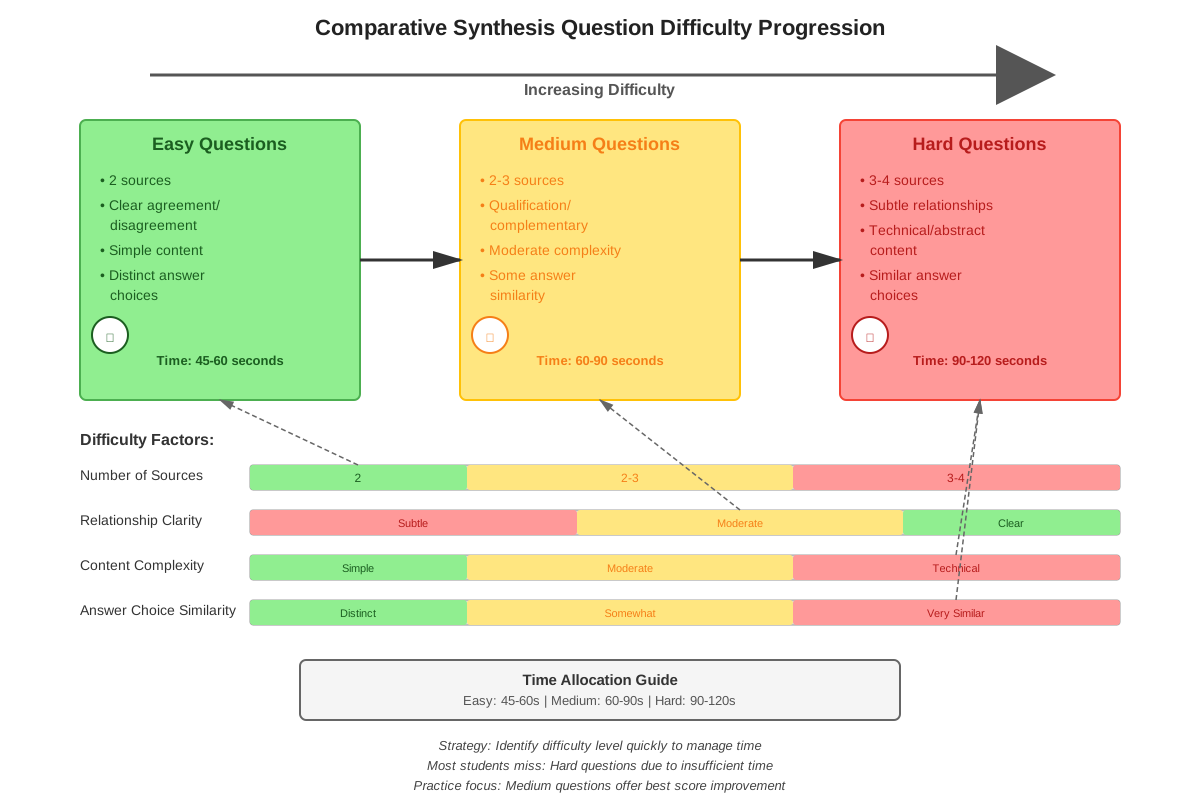
Overview
Comparative synthesis is a critical skill tested in the SAT Reading and Writing (RW) section that requires students to analyze multiple sources presenting different perspectives, findings, or approaches to a topic, then synthesize this information into a coherent understanding. Unlike simple comprehension questions that focus on a single passage, comparative synthesis questions present students with two or more brief texts—often research findings, expert opinions, or historical accounts—and ask them to identify relationships, contrasts, or complementary information between these sources.
This skill represents one of the highest-level cognitive tasks on the SAT because it mirrors authentic academic and professional work: scholars must compare competing theories, researchers must reconcile conflicting data, and informed citizens must evaluate multiple viewpoints before forming conclusions. The sat comparative synthesis questions assess whether students can move beyond surface-level reading to recognize how different sources relate to one another, whether they agree, disagree, qualify each other's claims, or address different aspects of a broader topic.
Mastering comparative synthesis is essential not only for SAT success but also for college readiness. These questions typically appear in the Rhetorical Synthesis portion of the RW section and carry significant weight in determining overall scores. Students who excel at comparative synthesis demonstrate the analytical sophistication that colleges value: the ability to hold multiple perspectives simultaneously, identify nuanced relationships between ideas, and articulate how different pieces of evidence work together or against each other. This skill builds upon fundamental reading comprehension abilities while adding layers of critical analysis and integration that distinguish high-scoring students from those who struggle with complex, multi-source reasoning tasks.
Learning Objectives
- [ ] Identify key features of comparative synthesis questions on the SAT
- [ ] Explain how comparative synthesis appears on the SAT and what makes these questions distinct
- [ ] Apply comparative synthesis strategies to answer SAT-style questions accurately and efficiently
- [ ] Distinguish between different types of relationships between sources (agreement, disagreement, qualification, complementary information)
- [ ] Evaluate answer choices by determining which most accurately represents the relationship between multiple texts
- [ ] Synthesize information from 2-4 brief passages to form a coherent understanding of how sources interact
Prerequisites
- Basic reading comprehension: Understanding main ideas, supporting details, and author's purpose in single passages is essential because comparative synthesis builds upon these foundational skills
- Vocabulary in context: Recognizing how words function within sentences helps identify subtle differences in meaning between sources
- Identifying claims and evidence: Distinguishing between assertions and supporting information enables students to compare what different sources actually argue
- Understanding rhetorical purpose: Recognizing why authors make certain choices helps identify how different texts approach the same topic differently
Why This Topic Matters
Comparative synthesis represents one of the most authentic academic skills tested on the SAT. In college courses, students constantly encounter situations requiring them to compare multiple scholarly perspectives, reconcile conflicting research findings, or integrate information from various sources into research papers. Professionals in every field—from medicine to law to business—must regularly evaluate competing viewpoints and synthesize information from multiple sources to make informed decisions.
On the SAT, comparative synthesis questions appear with high frequency in the Reading and Writing section, typically comprising 10-15% of all questions. These questions carry the same point value as other question types, but they often prove more challenging because they require students to process multiple texts simultaneously while maintaining awareness of subtle distinctions. The College Board has increasingly emphasized these questions in recent test administrations, recognizing that synthesis skills strongly predict college success.
Comparative synthesis questions most commonly appear in formats where students receive 2-4 brief texts (each 1-3 sentences) followed by a question asking them to identify how the texts relate. Common scenarios include: two research studies with different findings, historical accounts offering contrasting interpretations, expert opinions that qualify or extend each other's claims, or scientific observations that address different aspects of a phenomenon. The texts might present complementary information that builds toward a fuller picture, contradictory claims that require reconciliation, or nuanced positions where one source adds conditions or limitations to another's broader statement.
Core Concepts
Understanding Comparative Synthesis
Comparative synthesis is the cognitive process of analyzing multiple independent sources and determining the relationships between them. Unlike summarization (which condenses a single source) or simple comparison (which merely notes similarities and differences), synthesis requires students to construct a new understanding that accounts for how multiple perspectives interact, complement, or contradict each other.
The SAT tests this skill through questions that present multiple brief texts and ask students to identify the most accurate characterization of their relationship. These questions assess whether students can recognize patterns such as agreement, disagreement, qualification, extension, or complementary focus across sources.
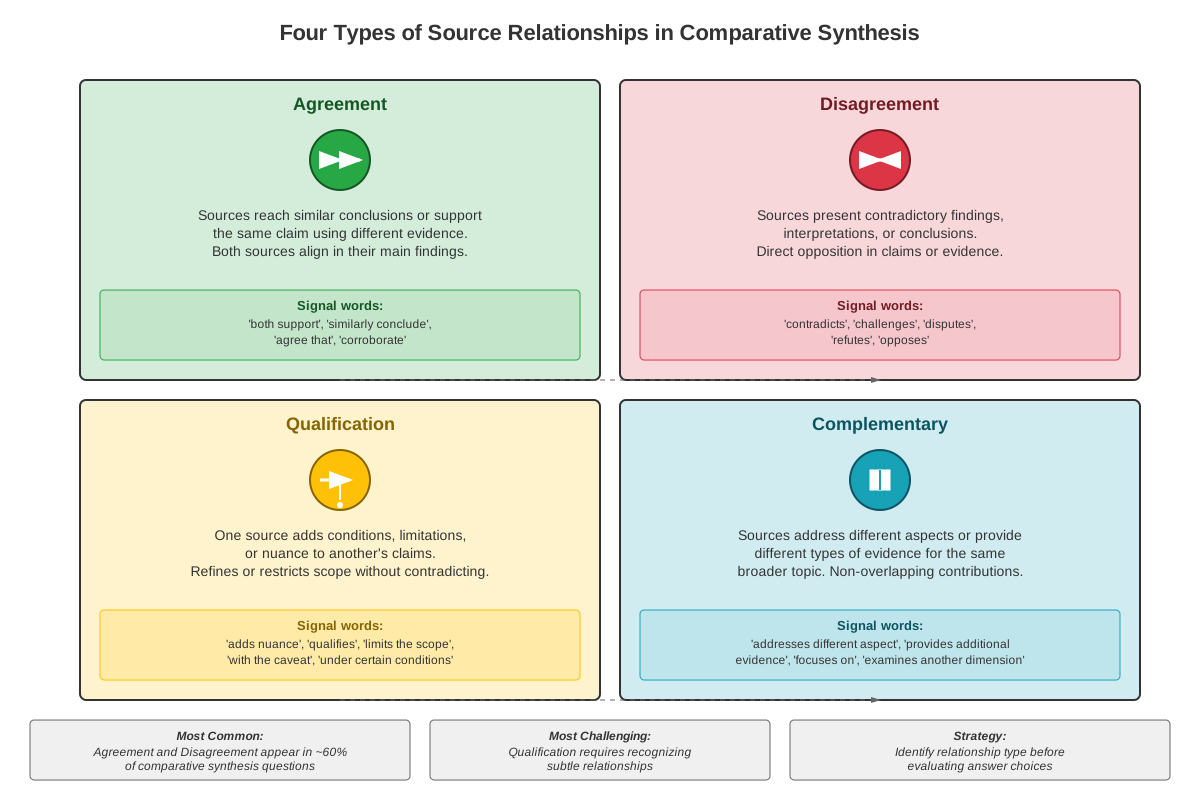
Types of Relationships Between Sources
Understanding the specific ways sources can relate to each other is crucial for success on comparative synthesis questions. The following table outlines the most common relationship types:
| Relationship Type | Definition | Key Indicators |
|---|---|---|
| Agreement | Sources support the same conclusion or make compatible claims | "Similarly," "likewise," "also found," "confirms" |
| Disagreement | Sources present contradictory findings or opposing viewpoints | "However," "in contrast," "contradicts," "disputes" |
| Qualification | One source adds conditions, limitations, or nuances to another's claim | "Only when," "except in cases," "under certain conditions" |
| Extension | One source builds upon or expands another's ideas | "Furthermore," "additionally," "goes beyond," "expands on" |
| Complementary Focus | Sources address different aspects of the same topic without contradicting | Different subjects, methods, or time periods while discussing related phenomena |
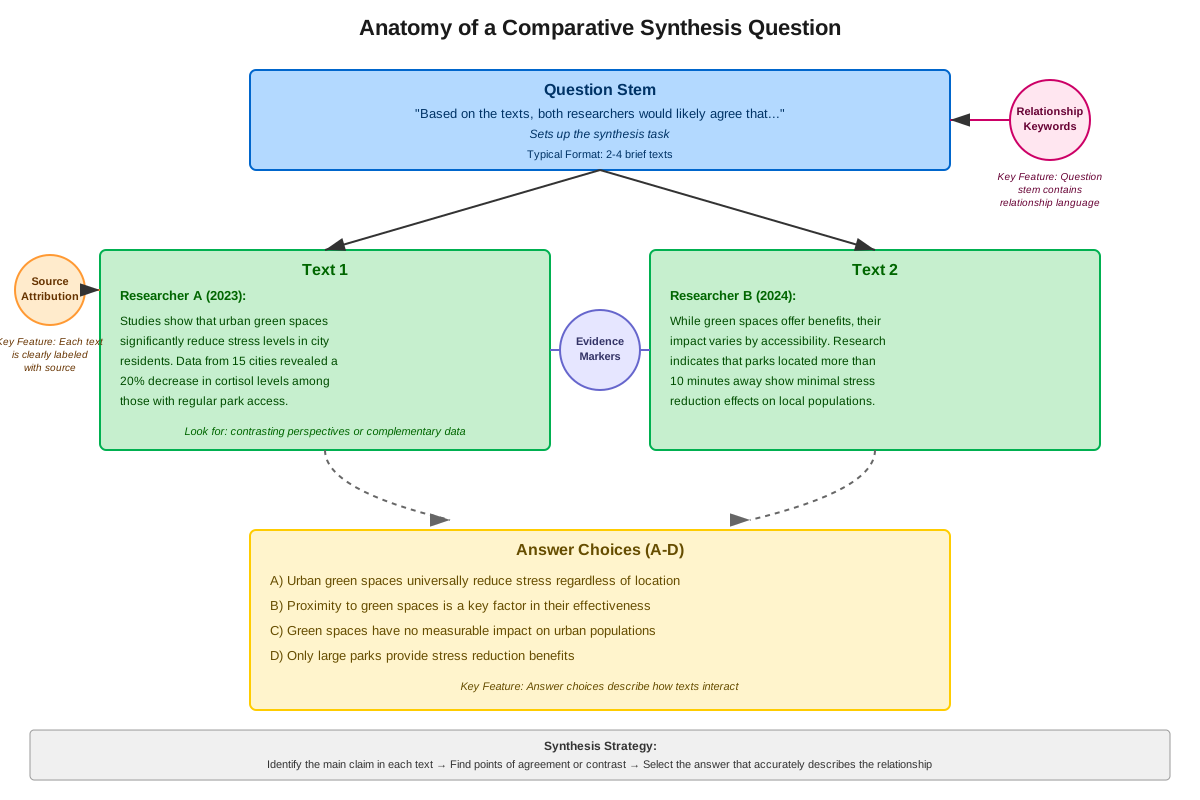
The Structure of SAT Comparative Synthesis Questions
SAT comparative synthesis questions follow a predictable structure that students can learn to navigate efficiently:
- Prompt/Context: A brief introduction (1-2 sentences) establishing the general topic
- Text 1: A short passage (1-3 sentences) presenting a perspective, finding, or claim
- Text 2: Another short passage presenting a related perspective, finding, or claim
- Text 3-4 (sometimes): Additional sources when the question requires synthesizing more complex information
- Question Stem: Asks students to identify the relationship or synthesize the information
- Answer Choices: Four options that characterize the relationship differently
The question stem typically uses phrases like:
- "Based on the texts, how would [Author 2] most likely respond to [Author 1's] claim?"
- "Which statement best describes the relationship between the two texts?"
- "What do both researchers agree about?"
- "How does Text 2 relate to Text 1?"
Critical Reading Strategies for Synthesis
Successful comparative synthesis requires specific reading strategies:
Active Annotation: As students read each text, they should mentally or physically note:
- The main claim or finding
- The scope (what specifically is being discussed)
- The certainty level (definitive claims vs. tentative suggestions)
- Key qualifying words (all, some, most, only, except)
Relationship Mapping: After reading all texts, students should identify:
- Points of overlap (same topic, same conclusion)
- Points of divergence (different conclusions, different focus)
- Hierarchical relationships (general vs. specific claims)
- Temporal or causal connections
Precision in Language: The SAT rewards careful attention to nuance. Students must distinguish between:
- "Contradicts" (direct opposition) vs. "qualifies" (adds conditions)
- "Supports" (provides evidence for) vs. "agrees with" (makes similar claims)
- "Extends" (builds upon) vs. "addresses a different aspect" (complementary but separate)
Common Question Formats
Format 1: Direct Relationship Identification
Students must select the answer that most accurately describes how the texts relate. These questions test whether students can recognize the fundamental connection between sources.
Format 2: Hypothetical Response
Students must predict how one author would respond to another's claim based on their stated position. These questions require understanding not just what each source says, but the implications of their positions.
Format 3: Synthesis Statement
Students must identify which statement accurately incorporates information from multiple sources. These questions test whether students can create a new claim that respects the boundaries and relationships between sources.
Format 4: Point of Agreement/Disagreement
Students must identify what all sources agree upon or where they diverge. These questions require careful attention to scope and specificity.
Concept Relationships
Comparative synthesis builds directly upon fundamental reading comprehension skills. Students must first understand each individual text (main idea, supporting details, author's purpose) before they can analyze relationships between texts. This creates a hierarchical relationship: Single-text comprehension → Multi-text analysis → Relationship identification → Synthesis.
Within comparative synthesis itself, the concepts form an interconnected web. Understanding relationship types (agreement, disagreement, qualification, etc.) enables students to apply appropriate reading strategies (looking for specific signal words, noting scope differences). These strategies, in turn, help students navigate different question formats more efficiently. The ability to recognize precision in language affects all other aspects of synthesis, as subtle word choices often determine whether sources truly agree or merely address related topics.
Comparative synthesis also connects forward to more advanced academic skills. It serves as the foundation for research writing, where students must integrate multiple sources into coherent arguments. It prepares students for evidence-based reasoning tasks in science and social studies courses. The skill also relates laterally to other SAT question types: analyzing arguments, evaluating evidence, and understanding rhetorical choices all require similar attention to how ideas relate and interact.
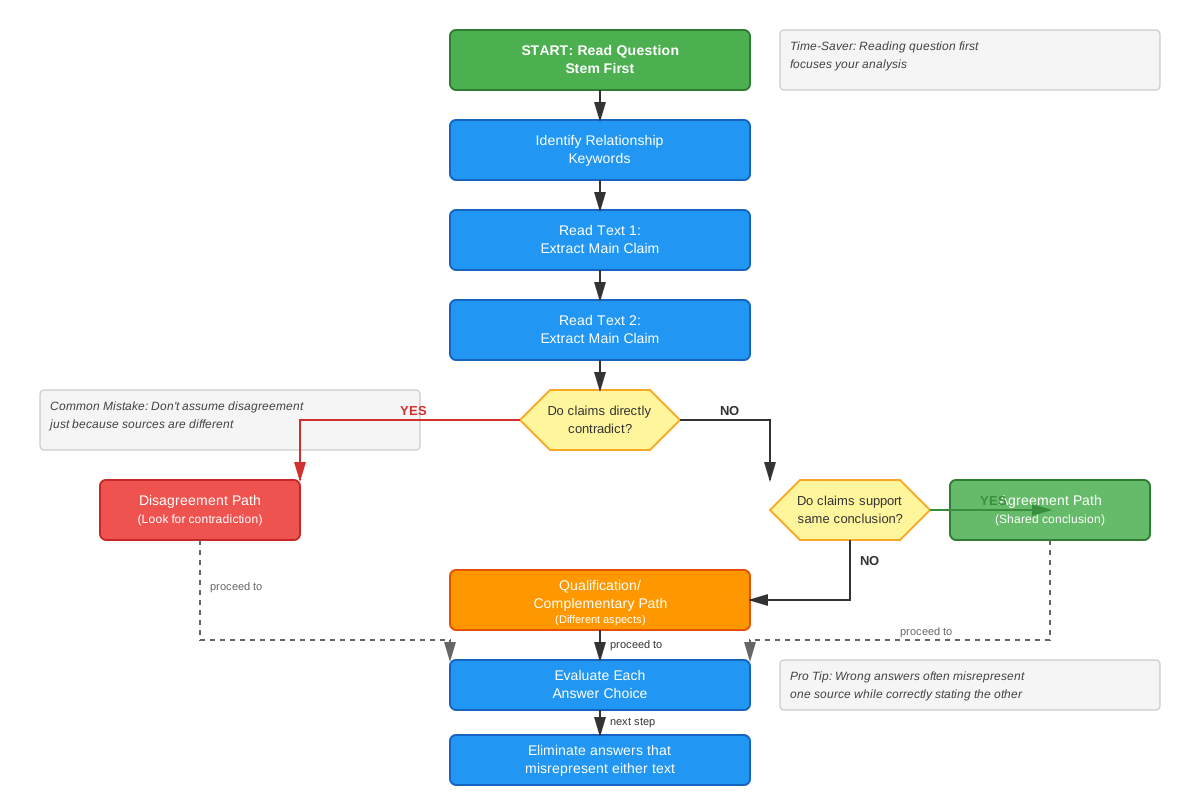
The relationship map flows as follows:
Reading Comprehension → Identifying Individual Claims → Comparing Scope and Certainty → Recognizing Relationship Type → Evaluating Answer Choices → Selecting Most Accurate Synthesis
High-Yield Facts
⭐ Comparative synthesis questions always require analyzing relationships between 2-4 brief texts, not synthesizing information within a single passage
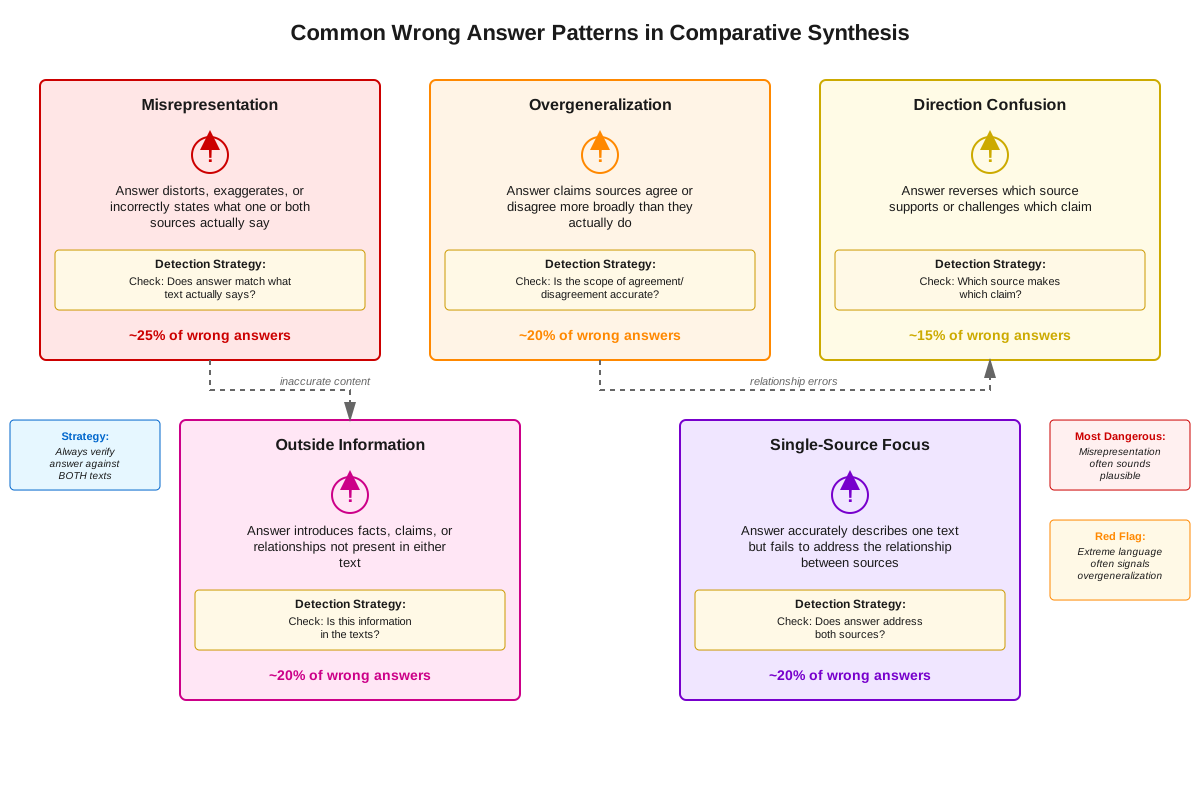
⭐ The most common wrong answers mischaracterize the relationship by being too strong (claiming contradiction when sources merely address different aspects) or too weak (claiming sources are unrelated when they actually complement each other)
⭐ Signal words like "however," "similarly," "only when," and "except" are crucial indicators of relationship type and must be carefully noted
⭐ Sources can address the same general topic while focusing on different specific aspects without contradicting each other—this is "complementary focus," not disagreement
⭐ Qualification is distinct from disagreement: a source that adds conditions to another's claim doesn't necessarily contradict it
- Comparative synthesis questions typically appear 3-5 times per SAT Reading and Writing section
- The correct answer must be supported by explicit information in the texts, not by outside knowledge or assumptions
- Scope differences are critical: a source discussing "some cases" doesn't contradict a source discussing "other cases"
- Temporal and methodological differences often explain apparent contradictions between research findings
- Answer choices that use absolute language ("completely contradicts," "proves wrong") are often incorrect unless the texts explicitly present direct opposition
Quick check — test yourself on Comparative synthesis so far.
Try Flashcards →Common Misconceptions
Misconception: If two texts discuss the same topic, they must either agree or disagree with each other.
Correction: Texts can address different aspects of the same topic without taking opposing positions. For example, one study might examine urban populations while another examines rural populations—they're complementary, not contradictory, even if their findings differ.
Misconception: Qualification means the same thing as disagreement.
Correction: When one source qualifies another, it adds conditions or limitations without necessarily contradicting the original claim. For instance, "Exercise improves health" and "Exercise improves health when combined with adequate sleep" have a qualification relationship, not a disagreement.
Misconception: The correct answer will always use the same words as the passages.
Correction: SAT answer choices typically paraphrase the relationship rather than quoting directly. Students must understand the conceptual relationship, not just match keywords.
Misconception: Longer, more complex answer choices are more likely to be correct.
Correction: The SAT doesn't reward verbosity. The correct answer is the one that most accurately captures the relationship, regardless of length. Often, simpler answers are correct because they avoid overstatement.
Misconception: If sources use different methods or study different populations, they contradict each other.
Correction: Methodological or population differences don't create contradiction unless the sources make incompatible claims about the same phenomenon. Different approaches often provide complementary evidence.
Misconception: Personal interpretation of how sources "should" relate matters more than what the texts explicitly state.
Correction: The SAT tests reading comprehension, not opinion. The correct answer must be directly supported by the language in the texts, even if students think a different relationship would make more sense.
Worked Examples
Example 1: Identifying Qualification vs. Disagreement
Prompt: Two researchers have studied the effects of social media on adolescent well-being.
Text 1: Dr. Martinez's study found that social media use correlates with increased anxiety among teenagers, with participants reporting higher stress levels after extended platform engagement.
Text 2: Dr. Chen's research indicates that social media use correlates with increased anxiety primarily among teenagers who already experience social difficulties, while socially confident teens showed no significant increase in anxiety.
Question: Based on the texts, how does Dr. Chen's research relate to Dr. Martinez's findings?
Answer Choices:
A) It contradicts Dr. Martinez's findings by showing social media doesn't affect anxiety
B) It qualifies Dr. Martinez's findings by identifying a specific population where the effect is most pronounced
C) It extends Dr. Martinez's findings by studying a different age group
D) It supports Dr. Martinez's findings by using a different research method
Solution Process:
Step 1: Identify Dr. Martinez's main claim: Social media use correlates with increased anxiety in teenagers (general population).
Step 2: Identify Dr. Chen's main claim: Social media use correlates with increased anxiety primarily in teenagers with social difficulties (specific subpopulation).
Step 3: Analyze the relationship: Dr. Chen doesn't say Martinez is wrong—the correlation exists. However, Chen adds a condition: the effect is "primarily" seen in a specific group. This is adding nuance, not contradicting.
Step 4: Evaluate answer choices:
- A is incorrect: Chen doesn't deny the correlation exists
- B is correct: Chen identifies conditions under which Martinez's finding is most pronounced
- C is incorrect: Both study teenagers, not different age groups
- D is incorrect: While both might support the general idea, the question asks about the specific relationship, which is qualification, not simple support
Answer: B
Connection to Learning Objectives: This example demonstrates how to distinguish between disagreement (claiming something is false) and qualification (adding conditions to when something is true), a critical skill for comparative synthesis.
Example 2: Recognizing Complementary Focus
Prompt: Historians have examined the factors contributing to the Industrial Revolution.
Text 1: Historian James argues that technological innovations, particularly the steam engine and mechanized textile production, were the primary drivers of the Industrial Revolution, enabling unprecedented increases in manufacturing efficiency.
Text 2: Historian Rodriguez contends that social and economic changes, including the enclosure movement that displaced rural workers and created an urban labor force, were essential preconditions for industrialization.
Question: Which statement best describes the relationship between the two historians' arguments?
Answer Choices:
A) Rodriguez contradicts James by identifying different causes of the Industrial Revolution
B) Rodriguez and James agree that multiple factors contributed to the Industrial Revolution
C) Rodriguez's argument addresses different aspects of industrialization than James's argument
D) Rodriguez extends James's argument by examining later developments in the Industrial Revolution
Solution Process:
Step 1: Identify James's focus: Technological innovations as "primary drivers"
Step 2: Identify Rodriguez's focus: Social and economic changes as "essential preconditions"
Step 3: Check for direct contradiction: Does Rodriguez say technology wasn't important? No. Does James say social changes weren't important? No. They're discussing different types of factors.
Step 4: Analyze the relationship: James discusses what enabled increased production (technology). Rodriguez discusses what made industrialization possible in the first place (available labor force). These are complementary—both could be true simultaneously.
Step 5: Evaluate answer choices:
- A is incorrect: Identifying different causes isn't the same as contradiction if both causes could coexist
- B is tempting but incorrect: Neither text explicitly acknowledges multiple factors; they each focus on their own factor
- C is correct: James focuses on technological aspects, Rodriguez on social-economic aspects—different dimensions of the same phenomenon
- D is incorrect: Rodriguez discusses preconditions (what came before), not later developments
Answer: C
Connection to Learning Objectives: This example shows how sources can address the same topic from different angles without contradicting each other, requiring students to recognize complementary focus rather than assuming disagreement.
Exam Strategy
Step 1: Read the Context/Prompt First
Before diving into the texts, read the brief introduction to understand the general topic. This primes your brain for the specific domain and helps you read more efficiently.
Step 2: Read Each Text Actively
For each text, identify and mentally note:
- The main claim (what is this source arguing or finding?)
- The scope (who/what/when does this apply to?)
- Qualifying words (all, some, most, primarily, only, except)
- The certainty level (definitive vs. tentative language)
Step 3: Identify the Relationship Before Looking at Answers
After reading all texts, pause and ask yourself: "How do these relate?" Try to articulate the relationship in your own words before examining answer choices. This prevents the test from leading you toward attractive wrong answers.
Step 4: Watch for Trigger Words in Answer Choices
Exam Tip: Words like "contradicts," "refutes," and "disproves" require direct opposition. If texts merely address different aspects or populations, these strong words are incorrect.
Exam Tip: Words like "qualifies," "adds nuance to," and "specifies conditions for" indicate one source is adding detail to another without contradicting it.
Exam Tip: Words like "supports," "confirms," and "corroborates" require sources to provide evidence for the same conclusion, not just discuss related topics.
Step 5: Eliminate Based on Scope Mismatches
Wrong answers often mischaracterize relationships by ignoring scope differences. If Text 1 discusses "urban areas" and Text 2 discusses "rural areas," they're not contradicting each other even if their findings differ.
Step 6: Check for Overstatement
The SAT frequently includes wrong answers that overstate the relationship. If sources somewhat align, an answer saying they "completely agree on all aspects" is likely wrong. If sources differ in focus, an answer saying they "directly contradict" is likely wrong.
Time Allocation: Spend approximately 60-75 seconds on comparative synthesis questions:
- 15-20 seconds reading context and texts
- 10-15 seconds identifying the relationship
- 25-30 seconds evaluating answer choices
- 10 seconds confirming your selection
Process of Elimination Tips:
- Eliminate answers that use relationship words (contradicts, supports, qualifies) that don't match what you identified
- Eliminate answers that reference information not present in the texts
- Eliminate answers that ignore important qualifying words from the original texts
- Eliminate answers that claim agreement or disagreement on points the texts don't actually address
Memory Techniques
SCOPE Mnemonic for analyzing each text:
- Subject: What/who is being discussed?
- Claim: What is being argued or found?
- Outlook: Is the tone certain or tentative?
- Parameters: What conditions or limitations are mentioned?
- Evidence: What type of support is provided?
AQEC Framework for relationship types:
- Agree: Same conclusion, compatible claims
- Qualify: Adds conditions or limitations
- Extend: Builds upon or expands
- Complement: Different aspects of same topic
Visualization Strategy: Picture each text as a circle. Ask yourself:
- Do the circles overlap completely? (Agreement)
- Do the circles overlap partially? (Partial agreement or complementary focus)
- Is one circle inside the other? (Qualification or extension)
- Do the circles not touch? (Unrelated or addressing different aspects)
- Do the circles push against each other? (Disagreement)
Signal Word Categories:
- Agreement signals: similarly, likewise, also, confirms, supports
- Disagreement signals: however, in contrast, contradicts, disputes, challenges
- Qualification signals: only when, except, primarily, mainly, under certain conditions
- Extension signals: furthermore, additionally, moreover, beyond
Summary
Comparative synthesis is a high-level analytical skill that requires students to read multiple brief texts, understand each source's specific claims and scope, and accurately identify the relationship between them. Success on SAT comparative synthesis questions depends on recognizing that sources can relate in various ways—through agreement, disagreement, qualification, extension, or complementary focus—and that subtle differences in language determine which relationship type applies. Students must pay careful attention to scope (who/what/when each source discusses), qualifying words (all, some, primarily, only), and the precision of relationship terms in answer choices. The most common errors involve mistaking complementary focus for disagreement, confusing qualification with contradiction, or selecting answers that overstate or understate the actual relationship between sources. By reading actively, identifying relationships before examining answer choices, and eliminating options based on scope mismatches and overstatement, students can consistently answer these high-value questions correctly. Mastering comparative synthesis not only improves SAT scores but also develops essential academic skills for college-level research and analysis.
Key Takeaways
- Comparative synthesis questions present 2-4 brief texts and ask students to identify or characterize the relationship between them
- The five main relationship types are agreement, disagreement, qualification, extension, and complementary focus—each requires different evidence
- Scope differences are critical: sources discussing different populations, time periods, or aspects of a topic may not contradict each other even if findings differ
- Qualifying words (some, most, primarily, only, except) often determine whether sources agree, disagree, or have a more nuanced relationship
- The correct answer must be directly supported by the texts' explicit language, not by assumptions about how sources "should" relate
- Wrong answers typically overstate relationships (claiming contradiction when sources merely differ in focus) or ignore important qualifying conditions
- Active reading strategies—noting each source's claim, scope, and certainty level—enable accurate relationship identification before evaluating answer choices
Related Topics
Rhetorical Analysis: Understanding how authors construct arguments and use evidence connects directly to comparative synthesis, as students must recognize not just what sources claim but how they support those claims. Mastering comparative synthesis provides a foundation for analyzing how different rhetorical strategies affect persuasiveness.
Evidence Evaluation: Assessing the strength and relevance of evidence within single passages prepares students for comparing how different sources use evidence. This skill becomes essential when determining whether sources truly contradict or simply use different types of support.
Argument Structure: Recognizing claims, counterclaims, and rebuttals in single arguments helps students identify when multiple sources are engaging with each other's positions versus addressing separate aspects of a topic.
Research and Citation Skills: The synthesis skills developed for the SAT directly transfer to college research writing, where students must integrate multiple sources while accurately representing each source's position and the relationships between them.
Practice CTA
Now that you've mastered the core concepts of comparative synthesis, it's time to put your knowledge into action! The practice questions and flashcards are specifically designed to reinforce the relationship types, reading strategies, and elimination techniques covered in this guide. Each practice question mirrors authentic SAT formats and difficulty levels, giving you the repetition needed to make these skills automatic under test conditions. Remember: comparative synthesis is a skill that improves dramatically with deliberate practice. Challenge yourself to identify the relationship before looking at answer choices, and review any mistakes to understand exactly where your analysis went wrong. You're building the analytical sophistication that colleges value—keep pushing forward!
Sign up free to keep reading
Create a free AnvayaPrep account to finish this SAT guide on Comparative synthesis — plus flashcards and practice questions.