Overview
Evidence synthesis is a critical skill tested in the SAT Reading and Writing section that requires students to analyze multiple sources of information and draw logical conclusions based on the combined evidence presented. This skill goes beyond simple reading comprehension by asking test-takers to evaluate how different pieces of evidence relate to each other, support or contradict claims, and contribute to a broader understanding of a topic. On the SAT, evidence synthesis questions typically present students with multiple texts, data points, or perspectives and ask them to identify which statement is best supported by the combined information or how the sources work together to develop an idea.
Mastering sat evidence synthesis is essential because these questions appear frequently throughout the Reading and Writing section and carry significant weight in determining overall scores. Unlike questions that focus on a single passage, synthesis questions assess higher-order thinking skills that colleges value: the ability to integrate information from multiple sources, recognize patterns across texts, and make evidence-based judgments. These questions often appear in the Rhetorical Synthesis portion of the exam, where students must demonstrate their ability to work with complex information structures.
Evidence synthesis connects directly to other fundamental rw skills including main idea identification, supporting detail recognition, and logical reasoning. It builds upon basic comprehension skills by requiring students to move beyond understanding individual passages to seeing how multiple pieces of evidence interact. This skill also relates closely to argument analysis, as students must evaluate how different sources contribute to or challenge specific claims. Understanding evidence synthesis provides a foundation for success not only on the SAT but also in college-level research and writing, where synthesizing multiple sources is a fundamental academic skill.
Learning Objectives
- [ ] Identify key features of Evidence synthesis
- [ ] Explain how Evidence synthesis appears on the SAT
- [ ] Apply Evidence synthesis to answer SAT-style questions
- [ ] Distinguish between evidence that supports, contradicts, or is irrelevant to a given claim
- [ ] Evaluate the relative strength and relevance of multiple pieces of evidence
- [ ] Construct logical conclusions based on the integration of information from multiple sources
- [ ] Recognize common patterns in how SAT questions frame evidence synthesis tasks
Prerequisites
- Reading comprehension skills: The ability to understand individual passages is foundational before attempting to synthesize information across multiple texts
- Identifying main ideas and supporting details: Students must recognize key claims and evidence within single sources before combining information from multiple sources
- Understanding logical relationships: Recognizing cause-and-effect, comparison-contrast, and other logical structures helps students see how different pieces of evidence relate
- Basic argument structure: Familiarity with claims, evidence, and reasoning helps students evaluate how multiple sources support or challenge positions
Why This Topic Matters
Evidence synthesis represents a fundamental academic and professional skill that extends far beyond standardized testing. In college coursework, students regularly write research papers that require integrating information from multiple scholarly sources, evaluating conflicting perspectives, and drawing evidence-based conclusions. In professional contexts, decision-makers must synthesize data from various reports, studies, and expert opinions to make informed choices. The ability to work with multiple sources of information simultaneously is essential for critical thinking in the information age, where individuals encounter diverse and sometimes contradictory information daily.
On the SAT, evidence synthesis questions appear with high frequency, typically comprising 10-15% of all Reading and Writing questions. These questions are distributed throughout the exam and often appear in the more challenging portions of the test. The College Board has increasingly emphasized synthesis skills in recent SAT iterations, recognizing that these abilities better predict college readiness than simple recall or single-passage comprehension. Evidence synthesis questions typically appear in several formats: students might be asked to identify which statement is supported by two brief texts, determine how a second text relates to the first, or select evidence from multiple sources that best supports a given conclusion.
Common manifestations of evidence synthesis on the SAT include paired short passages (50-150 words each) from different sources on related topics, questions that reference data from tables or graphs alongside written text, and scenarios where students must evaluate how new information affects or relates to previously presented claims. These questions frequently appear in contexts involving scientific research findings, historical perspectives on events, literary criticism, or social science data. The passages may present complementary information that builds toward a shared conclusion, contrasting viewpoints that highlight different aspects of an issue, or evidence that challenges or refines an initial claim.
Core Concepts
What Is Evidence Synthesis?
Evidence synthesis is the cognitive process of combining information from multiple sources to form a coherent understanding, draw conclusions, or evaluate claims. Unlike simple comprehension, which focuses on understanding a single text, synthesis requires students to identify relationships between different pieces of information, recognize patterns across sources, and integrate evidence into a unified framework. This process involves several mental operations: comparing and contrasting information, identifying complementary or contradictory evidence, evaluating the relevance and strength of different sources, and constructing logical inferences based on combined information.
On the SAT, evidence synthesis questions assess whether students can move beyond isolated reading to see the bigger picture created by multiple sources. These questions test the ability to recognize when different sources support the same conclusion through different evidence, when sources provide complementary information that together creates a more complete understanding, or when sources present conflicting information that requires careful evaluation. The synthesis process requires active engagement with texts rather than passive reading, as students must constantly ask themselves how new information relates to what they have already read.
Types of Evidence Relationships
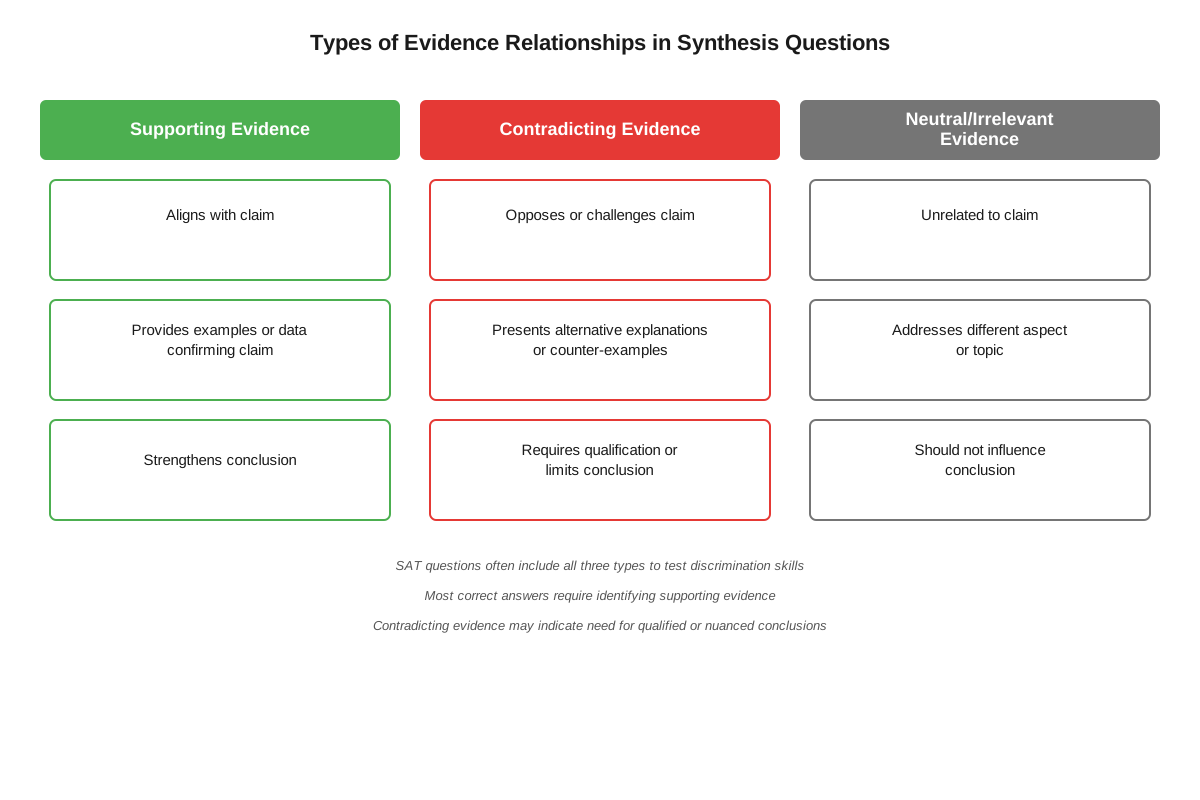
Understanding how different pieces of evidence relate to each other is crucial for successful synthesis. Evidence relationships fall into several categories that appear regularly on the SAT:
Supporting/Reinforcing Evidence: Multiple sources provide different evidence that points toward the same conclusion. For example, one text might describe behavioral observations of an animal species while another presents genetic data, with both supporting the conclusion that the species has adapted to its environment. These relationships require students to recognize that different types of evidence can support the same claim.
Complementary Evidence: Sources provide different pieces of information that together create a more complete picture. One text might explain the causes of a historical event while another describes its effects. Neither contradicts the other; instead, they address different aspects of the same topic. Students must recognize how these pieces fit together like puzzle pieces.
Contrasting/Contradictory Evidence: Sources present information that appears to conflict or offer different perspectives on the same issue. One study might find positive effects of a policy while another identifies negative consequences. Students must evaluate whether the contradiction is genuine or whether the sources are actually addressing different aspects of a complex issue.
Qualifying/Refining Evidence: A second source provides information that adds nuance, limitations, or conditions to claims made in the first source. For example, an initial text might state a general principle, while a follow-up text identifies exceptions or boundary conditions. Students must recognize how the second source modifies rather than contradicts the first.
The Synthesis Process
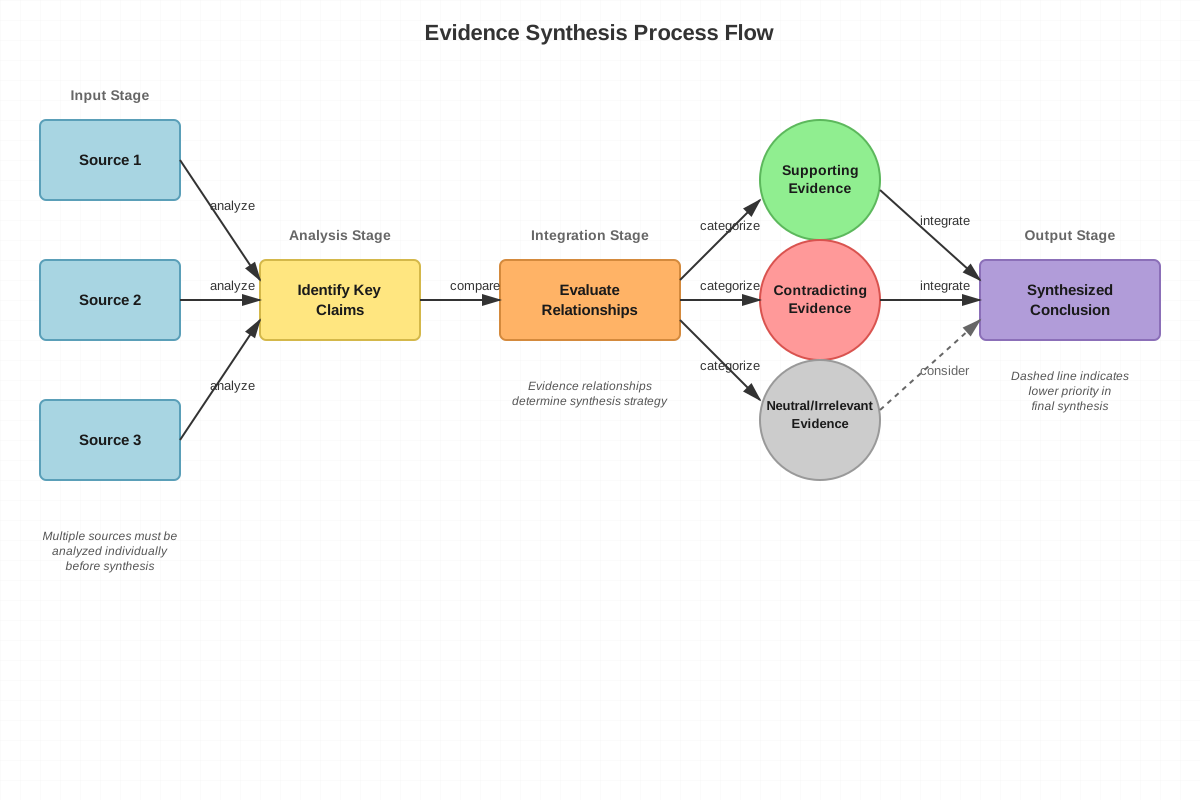
Successful evidence synthesis follows a systematic approach that can be applied to any SAT question:
- Read the question first: Understanding what type of synthesis is required (support, contrast, completion) helps focus reading
- Identify the main claim or conclusion: Determine what statement or idea the evidence should address
- Extract key information from each source: Note the central point and supporting details from each text
- Map relationships: Determine how the sources relate to each other and to the claim in question
- Evaluate relevance and strength: Assess which evidence most directly and strongly addresses the question
- Eliminate irrelevant information: Recognize details that, while interesting, do not contribute to answering the specific question
- Construct or select the synthesis: Choose the answer that accurately reflects the combined evidence
Evaluating Evidence Quality
Not all evidence carries equal weight in synthesis tasks. The SAT often includes answer choices that reference evidence from the passages but misrepresent its relevance or strength. Students must evaluate evidence based on several criteria:
Relevance: Does the evidence directly address the claim or question at hand? Evidence can be accurate but irrelevant if it pertains to a different aspect of the topic.
Specificity: Specific, detailed evidence generally provides stronger support than vague generalizations. Concrete examples, numerical data, and precise observations carry more weight than broad statements.
Directness: Evidence that directly demonstrates a point is stronger than evidence that requires multiple inferential steps. The fewer assumptions needed to connect evidence to claim, the stronger the support.
Consistency: Evidence that aligns with other credible sources is generally more reliable than isolated claims. When multiple independent sources point to the same conclusion, the synthesis becomes more robust.
Common Synthesis Question Formats
The SAT presents evidence synthesis challenges in several recurring formats:
| Format | Description | Key Strategy |
|---|---|---|
| Paired Passages | Two short texts on related topics | Identify the relationship between texts before looking at answers |
| Text + Data | Written passage with accompanying graph or table | Look for explicit connections between textual claims and data points |
| Multiple Perspectives | Different viewpoints on the same issue | Distinguish between genuine contradictions and different emphases |
| Claim + Evidence | Question provides a claim and asks which evidence supports it | Eliminate evidence that is irrelevant even if true |
| Completion | First text presents partial information; second text completes the picture | Identify what information gap the second text fills |
Signal Words and Phrases
Recognizing linguistic signals helps students identify evidence relationships quickly. Reinforcing signals include "similarly," "likewise," "additionally," "furthermore," and "also," which indicate that new evidence supports or extends previous information. Contrasting signals such as "however," "nevertheless," "on the other hand," "in contrast," and "despite" alert readers to conflicting or qualifying information. Causal signals like "therefore," "consequently," "as a result," and "because" indicate that evidence explains why something occurs. Qualifying signals including "although," "while," "except," and "unless" suggest that evidence adds nuance or limitations to claims.
Concept Relationships
Evidence synthesis serves as an integrative skill that connects multiple foundational reading abilities. The relationship begins with basic comprehension → which enables identifying main ideas and supporting details → which allows recognizing argument structure → which culminates in evidence synthesis. Each level builds upon the previous one, with synthesis representing the highest-order skill in this progression.
Within evidence synthesis itself, the core concepts interconnect systematically. Understanding types of evidence relationships provides the framework for executing the synthesis process. Both of these concepts depend on the ability to perform evidence quality evaluation, as students must assess not just how sources relate but also which relationships are most relevant and reliable. All three concepts converge when students encounter common synthesis question formats, where they must apply their understanding of relationships, process, and evaluation to specific SAT question types.
Evidence synthesis also connects forward to other advanced reading skills. Mastery of synthesis enables more sophisticated argument analysis, as students who can synthesize evidence can better evaluate whether an argument's evidence adequately supports its claims. Synthesis skills also support rhetorical analysis, as understanding how authors use multiple pieces of evidence to build arguments reveals rhetorical strategies. Finally, synthesis provides the foundation for research writing, where students must integrate information from multiple sources into coherent academic essays.
The relationship between evidence synthesis and data interpretation deserves special attention. When SAT questions combine textual passages with graphs, tables, or charts, students must synthesize across different modes of information presentation. This requires translating between verbal and quantitative representations, recognizing when numerical data supports textual claims, and identifying discrepancies between what text states and what data shows.
High-Yield Facts
⭐ Evidence synthesis questions typically present 2-3 short passages (50-150 words each) and ask how they relate or what conclusion they jointly support
⭐ The correct answer to a synthesis question must be supported by evidence from ALL sources mentioned in the question, not just one
⭐ Wrong answers often include information that appears in only one source or makes claims that go beyond what the combined evidence supports
⭐ When sources appear to contradict, look for whether they actually address different aspects of a topic rather than genuinely conflicting
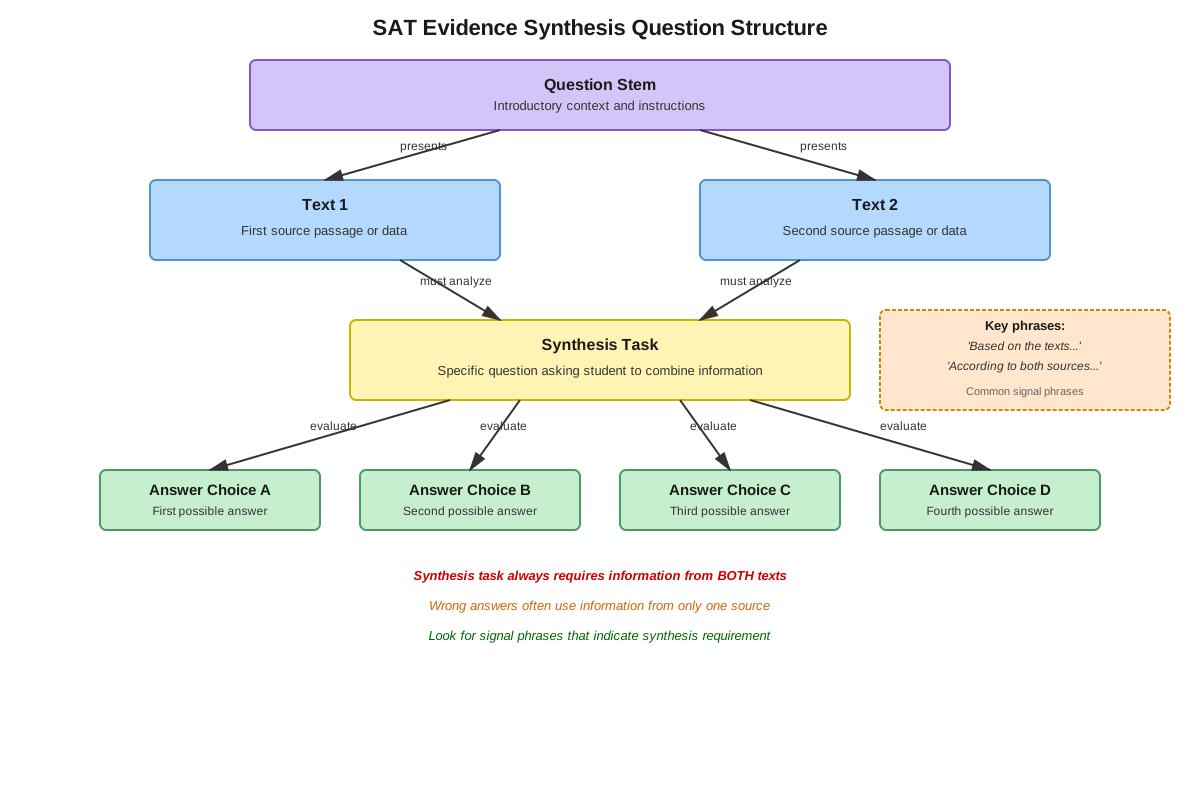
⭐ Evidence synthesis questions frequently use phrases like "based on the texts," "both texts support," "the two sources together suggest," or "which statement is supported by both"
- Synthesis questions test higher-order thinking and typically appear in the medium-to-difficult range of SAT questions
- The SAT never requires outside knowledge for synthesis questions; all necessary information appears in the provided sources
- Quantitative data (graphs, tables) can serve as one of the sources in synthesis questions, requiring integration of numerical and textual evidence
- Effective synthesis requires distinguishing between what sources explicitly state and what can be reasonably inferred from combined evidence
- Time management is crucial: synthesis questions often take longer than single-passage questions due to the need to process multiple sources
- The most common error is selecting an answer supported by only one source when the question asks about multiple sources
- Synthesis questions may ask students to identify the relationship between sources (support, contradict, qualify) rather than asking for a conclusion
- Evidence that is interesting or detailed is not necessarily relevant to the specific synthesis task at hand
Quick check — test yourself on Evidence synthesis so far.
Try Flashcards →Common Misconceptions
Misconception: Evidence synthesis means finding information that appears in all sources word-for-word → Correction: Synthesis involves combining different pieces of information that together support a conclusion, not finding identical statements. Sources typically provide complementary evidence using different examples, data, or perspectives that point toward the same conclusion.
Misconception: If two sources discuss the same topic, they must support the same conclusion → Correction: Sources can address the same topic while emphasizing different aspects, reaching different conclusions, or providing qualifying information. The SAT often presents sources that complicate rather than simply reinforce each other, requiring careful analysis of how they relate.
Misconception: Longer or more detailed evidence is automatically stronger → Correction: Evidence strength depends on relevance and directness, not length. A brief, specific example that directly demonstrates a point provides stronger support than lengthy tangential information. The SAT often includes detailed but irrelevant information as distractors.
Misconception: Synthesis questions always have one source that supports a claim and another that contradicts it → Correction: Most synthesis questions present sources that work together in complementary ways, with each providing different evidence for the same conclusion. Genuine contradictions are less common than complementary relationships or qualifying information.
Misconception: The correct answer will use the same vocabulary and phrasing as the source texts → Correction: Correct answers often paraphrase or synthesize information using different language than the sources. Students must recognize conceptual matches rather than looking for word-for-word repetition. Wrong answers sometimes use language from the passages but misrepresent the relationships between sources.
Misconception: All information from both sources must be incorporated into the synthesis → Correction: Effective synthesis involves selecting relevant information and setting aside details that do not address the specific question. Sources often contain background information or tangential details that should not influence the answer to a particular synthesis question.
Misconception: If sources present different types of evidence (e.g., one anecdotal, one statistical), they cannot support the same conclusion → Correction: Different types of evidence can effectively support the same claim. A personal narrative and statistical data might both demonstrate the same phenomenon through different lenses, and recognizing this complementary relationship is a key synthesis skill.
Worked Examples
Example 1: Supporting Evidence Synthesis
Text 1: A study of 500 urban gardens found that plots incorporating native plant species attracted 40% more pollinator species than gardens using only non-native ornamental plants. Researchers observed that native plants bloomed at different times throughout the growing season, providing consistent food sources.
Text 2: Ecologist Maria Santos examined pollinator populations in residential areas and noted that neighborhoods with diverse native plantings maintained stable bee populations even during regional declines. She attributed this resilience to the reliable nectar sources that native plants provide throughout the year.
Question: Based on the texts, what conclusion is supported by both sources?
Answer Choices:
A) Native plants are more attractive than non-native plants
B) Urban gardens should only include native species
C) Native plant diversity supports pollinator populations
D) Pollinator populations are declining in most regions
Solution Process:
Step 1 - Identify the main point of each source:
- Text 1: Native plants in gardens attract more pollinator species and provide food throughout the season
- Text 2: Areas with native plantings maintain stable bee populations due to reliable nectar sources
Step 2 - Map the relationship:
Both texts present evidence that native plants benefit pollinators. Text 1 provides quantitative data (40% more species) and explains the mechanism (blooming at different times). Text 2 provides observational evidence (stable populations) and confirms the mechanism (reliable nectar sources). These are complementary pieces of evidence supporting the same conclusion.
Step 3 - Evaluate answer choices:
- A) Neither text compares attractiveness; they discuss pollinator support
- B) Text 1 mentions incorporating native species, not exclusively using them
- C) Both texts provide evidence that native plants support pollinators through diversity and reliability ✓
- D) Text 2 mentions regional declines but this is context, not the main point of either text
Step 4 - Verify the synthesis:
Choice C accurately captures what both sources demonstrate: native plants (specifically their diversity and seasonal coverage) support pollinator populations. This synthesis incorporates the key evidence from both texts without overstating the claims.
Connection to Learning Objectives: This example demonstrates identifying supporting evidence relationships and applying synthesis to select the statement best supported by combined sources.
Example 2: Qualifying Evidence Synthesis
Text 1: Researchers analyzing social media use among teenagers found that participants who spent more than three hours daily on social platforms reported higher levels of anxiety and depression compared to those with less usage. The study concluded that excessive social media use negatively impacts adolescent mental health.
Text 2: A follow-up analysis of the same data revealed that the relationship between social media use and mental health varied significantly based on how teenagers used the platforms. Participants who primarily engaged in direct communication with friends showed no increase in anxiety, while those who spent time passively viewing others' posts showed the strongest negative effects.
Question: How does Text 2 relate to Text 1?
Answer Choices:
A) It contradicts the findings by showing social media has no effect on mental health
B) It provides additional evidence that social media use is harmful
C) It refines the conclusion by identifying conditions that affect the relationship
D) It explains why teenagers spend time on social media
Solution Process:
Step 1 - Identify the relationship type:
Text 2 begins with "follow-up analysis of the same data," signaling it builds on rather than contradicts Text 1. The key phrase "varied significantly based on" indicates qualifying information.
Step 2 - Analyze what Text 2 adds:
Text 1 presents a general finding: more social media use correlates with worse mental health. Text 2 doesn't reject this but adds nuance: the effect depends on type of use. Some uses show no negative effect; others show strong negative effects.
Step 3 - Evaluate answer choices:
- A) Text 2 doesn't contradict; it confirms negative effects exist but adds conditions
- B) Text 2 actually shows some uses have no negative effect, not just additional harm
- C) "Refines" and "conditions" accurately describe how Text 2 adds nuance to Text 1's general conclusion ✓
- D) Neither text addresses motivations for social media use
Step 4 - Confirm the synthesis:
Choice C correctly identifies that Text 2 qualifies Text 1 by showing the relationship is more complex than initially stated. This is a refining relationship where the second source adds important conditions without rejecting the first source's findings.
Connection to Learning Objectives: This example demonstrates distinguishing between different types of evidence relationships (qualifying vs. contradicting) and recognizing how sources can work together in sophisticated ways.
Exam Strategy
Approaching Synthesis Questions
When encountering evidence synthesis questions on the SAT, follow a systematic approach that maximizes accuracy while managing time effectively. Read the question stem first to understand what type of synthesis is required before diving into the passages. Questions that ask "what do both texts support" require different reading than questions asking "how does Text 2 relate to Text 1." Knowing the task focuses attention on relevant information.
Process each source individually before synthesizing. Quickly identify the main point of each text and note 1-2 key pieces of supporting evidence. Resist the temptation to immediately look for connections; understanding each source independently first prevents confusion and misreading. For passages with data, identify what the graph or table shows before reading how the text interprets it.
Map relationships explicitly, even if just mentally. Ask: Do these sources support the same point with different evidence? Does one qualify or limit the other? Do they address different aspects of the same topic? Are they genuinely contradictory? Identifying the relationship type narrows down possible correct answers significantly.
Trigger Words and Phrases
Certain phrases in question stems signal specific synthesis tasks:
"Based on the texts" or "According to both texts": The answer must be supported by evidence from all mentioned sources. Eliminate any choice supported by only one source.
"How does Text 2 relate to Text 1": Focus on the relationship between sources rather than their content. Look for answers using relationship words like "supports," "contradicts," "qualifies," "extends," or "illustrates."
"Which statement is best supported by": Evaluate each answer choice against all sources, eliminating those that go beyond the evidence or ignore information from one source.
"Both researchers would likely agree": Find common ground between sources, even if they emphasize different aspects or use different evidence.
"The data in the graph support which statement from the text": Identify explicit connections between quantitative and qualitative information, looking for where numbers confirm textual claims.
Process of Elimination Strategies
Evidence synthesis questions lend themselves particularly well to strategic elimination:
Eliminate "one-source" answers first. If a question asks about multiple sources, any answer supported by only one source is incorrect, even if that answer accurately represents that source. This single strategy often eliminates 2-3 choices immediately.
Eliminate answers that go beyond the evidence. Synthesis questions test whether students can work with provided information, not whether they can make creative leaps. Answers that require assumptions not supported by the texts are incorrect, even if they seem plausible.
Watch for "scope creep". Wrong answers often take a specific finding and overgeneralize it. If a source discusses one species of bird, an answer about "all birds" likely exceeds the evidence. If a study examines one city, conclusions about "urban areas in general" may be too broad.
Identify "Frankenstein answers" that combine elements from different sources in ways that misrepresent their relationship. These answers use vocabulary from the passages but create connections that don't actually exist in the sources.
Time Allocation
Evidence synthesis questions typically require 60-90 seconds, slightly longer than average SAT Reading and Writing questions due to the need to process multiple sources. Budget this time accordingly, and don't rush the initial reading of sources. Thirty seconds spent carefully understanding each source saves time by preventing the need to re-read when evaluating answer choices.
If a synthesis question is taking more than two minutes, employ aggressive elimination and make an educated guess rather than consuming time needed for other questions. Mark the question for review if time permits at the end of the section.
Memory Techniques
The RACE Synthesis Framework
Remember the synthesis process with RACE:
Read the question first to understand the synthesis task
Analyze each source individually for main points
Connect the sources by identifying their relationship
Eliminate answers not supported by all relevant sources
This acronym provides a quick mental checklist for approaching any synthesis question systematically.
The Three C's of Evidence Relationships
Evidence relationships fall into three categories, the Three C's:
Complementary: Sources provide different pieces of the same puzzle
Confirming: Sources provide different evidence for the same conclusion
Contrasting: Sources present different perspectives or qualifying information
When reading multiple sources, quickly categorize the relationship using these three C's to guide your synthesis.
Visualization Strategy
Picture synthesis questions as a Venn diagram. Each source occupies a circle, and the correct answer lives in the overlap where both circles intersect. Information appearing in only one circle (one source) cannot be the correct answer to a question asking about both sources. This mental image helps students focus on shared conclusions rather than getting distracted by details unique to individual sources.
The "All or Nothing" Rule
For questions asking what multiple sources support: ALL sources must support the answer, or it's NOTHING. This simple rule prevents the most common error in synthesis questions—selecting an answer well-supported by one source but not addressed by others.
Signal Word Categories
Group signal words into three categories using the acronym RCQ:
Reinforcing signals (similarly, likewise, additionally): Sources agree
Contrasting signals (however, nevertheless, despite): Sources differ
Qualifying signals (although, while, except): Sources add nuance
Recognizing these signals while reading helps quickly identify evidence relationships.
Summary
Evidence synthesis represents a critical higher-order reading skill that requires students to integrate information from multiple sources to draw conclusions, evaluate claims, or understand relationships between texts. On the SAT Reading and Writing section, synthesis questions present two or more short passages, sometimes including data visualizations, and ask students to identify what the combined evidence supports, how sources relate to each other, or which conclusions can be drawn from integrated information. Success requires moving beyond comprehension of individual texts to recognize patterns across sources, distinguish between supporting, complementary, contrasting, and qualifying relationships, and evaluate evidence based on relevance, specificity, and directness. The most common error is selecting answers supported by only one source when questions require evidence from multiple sources. Effective synthesis follows a systematic process: reading the question first to understand the task, analyzing each source individually, mapping relationships between sources, and eliminating answers that exceed the evidence or ignore information from any source. These questions appear frequently on the SAT and test skills essential for college-level academic work, where synthesizing multiple sources is fundamental to research and critical thinking.
Key Takeaways
- Evidence synthesis questions require combining information from multiple sources; answers must be supported by all relevant sources, not just one
- The three main evidence relationships are complementary (different pieces of the same puzzle), confirming (different evidence for the same conclusion), and contrasting (different perspectives or qualifying information)
- Read the question stem first to understand what type of synthesis is required before processing the source texts
- Eliminate answers that go beyond what the combined evidence supports, even if they seem plausible or are supported by a single source
- Signal words like "similarly," "however," and "although" indicate the type of relationship between sources
- Evidence strength depends on relevance and directness to the specific question, not on length or level of detail
- Synthesis questions typically take 60-90 seconds; budget time accordingly and use aggressive elimination if a question exceeds two minutes
Related Topics
Argument Analysis: Evidence synthesis provides the foundation for evaluating arguments, as students who can synthesize multiple pieces of evidence can better assess whether an argument's evidence adequately supports its claims. Mastering synthesis enables more sophisticated argument evaluation.
Rhetorical Analysis: Understanding how authors use multiple pieces of evidence to build arguments reveals rhetorical strategies and techniques. Synthesis skills help students recognize how effective writers integrate diverse sources to support their positions.
Data Interpretation: Many synthesis questions combine textual and quantitative information, requiring students to translate between verbal and numerical representations. Strengthening synthesis skills improves the ability to work with mixed-mode information.
Research Writing: College-level research papers require synthesizing information from multiple scholarly sources. The synthesis skills developed for the SAT directly transfer to academic writing tasks where students must integrate and cite multiple sources.
Critical Reading: Evidence synthesis represents an advanced application of critical reading skills, requiring evaluation of source reliability, relevance, and relationships. Mastering synthesis deepens overall critical reading abilities.
Practice CTA
Now that you understand the principles and strategies of evidence synthesis, it's time to apply these skills to authentic SAT-style questions. The practice questions and flashcards will reinforce your ability to identify evidence relationships, evaluate combined sources, and select answers supported by multiple texts. Remember that synthesis is a skill that improves with deliberate practice—each question you work through strengthens your ability to integrate information quickly and accurately. Approach the practice materials systematically, using the RACE framework and elimination strategies you've learned. You're building a crucial skill that will serve you not only on test day but throughout your academic career!
Sign up free to keep reading
Create a free AnvayaPrep account to finish this SAT guide on Evidence synthesis — plus flashcards and practice questions.