Overview
An objective summary is a concise, neutral restatement of the main ideas and essential supporting details from a text, presented without personal opinions, interpretations, or judgments. On the SAT Reading and Writing section, objective summary questions test a student's ability to distinguish between central ideas and peripheral details, recognize author-neutral language, and synthesize information from complex passages into accurate, unbiased statements. These questions appear frequently in the Rhetorical Synthesis unit, where students must demonstrate comprehension by selecting or constructing summaries that faithfully represent source material without distortion or editorializing.
Mastering objective summary skills is essential for SAT success because these questions directly assess reading comprehension—the foundation of the entire RW (Reading and Writing) section. Students who can quickly identify main ideas, filter out minor details, and recognize biased language gain a significant advantage not only on explicit summary questions but also on inference, purpose, and structure questions throughout the exam. The ability to create objective summaries demonstrates critical thinking and analytical reading, skills that the College Board considers fundamental to college readiness.
Within the broader Reading and Writing curriculum, objective summary connects to multiple competencies: identifying central ideas and themes, understanding rhetorical purpose, distinguishing between fact and opinion, and synthesizing information across multiple sources. Strong summary skills enable students to tackle more complex rhetorical synthesis tasks, such as comparing arguments across passages or evaluating how different authors approach the same topic. This topic serves as a bridge between basic comprehension and advanced analytical skills required for top SAT scores.
Learning Objectives
- [ ] Identify key features of objective summary
- [ ] Explain how objective summary appears on the SAT
- [ ] Apply objective summary to answer SAT-style questions
- [ ] Distinguish between objective and subjective language in answer choices
- [ ] Evaluate whether a summary includes all essential information from a passage
- [ ] Recognize common distractor patterns in summary questions
- [ ] Synthesize information from multiple sentences or paragraphs into a cohesive summary statement
Prerequisites
- Basic reading comprehension: Understanding literal meaning of sentences and paragraphs is necessary before evaluating summaries of those ideas
- Vocabulary knowledge: Recognizing connotative differences between words helps identify subjective versus objective language
- Main idea identification: Students must be able to locate central claims before determining whether a summary accurately captures them
- Paragraph structure awareness: Understanding topic sentences and supporting details enables recognition of what information is essential versus supplementary
Why This Topic Matters
Objective summary questions appear with high frequency on the SAT, typically comprising 2-4 questions per test administration. These questions assess fundamental comprehension skills that underpin success across the entire Reading and Writing section. According to College Board data, students who perform well on summary questions demonstrate stronger overall reading proficiency and score significantly higher on the exam. The ability to create accurate, unbiased summaries translates directly to academic success in college, where students must synthesize research, summarize scholarly arguments, and present information objectively in essays and reports.
In real-world applications, objective summary skills prove invaluable across professional contexts: journalists must summarize events without bias, researchers must accurately represent prior studies in literature reviews, lawyers must summarize case law objectively, and business professionals must present data-driven reports without personal interpretation clouding facts. The cognitive skill of separating essential information from peripheral details while maintaining neutrality represents a cornerstone of critical thinking applicable far beyond standardized testing.
On the SAT, objective summary questions commonly appear in several formats: selecting the best summary from four options, identifying which statement accurately represents a passage's main claim, or determining which summary avoids introducing bias or unsupported inferences. Passages used for these questions span diverse subjects—scientific research, historical analysis, literary criticism, social science studies—requiring students to apply summary skills flexibly across content domains. The Digital SAT format presents these questions within shorter, focused passages (typically 25-150 words), making efficient summary skills even more critical for time management.
Core Concepts
Defining Objective Summary
An objective summary captures the essential meaning of a text using neutral language that avoids personal opinions, emotional reactions, or interpretive judgments. The term "objective" emphasizes factual accuracy and impartiality—the summary should represent what the author actually stated rather than what the reader thinks about those statements. An effective objective summary includes three core elements: the main idea or central claim, key supporting details that are essential to understanding that claim, and neutral language that maintains the author's intended meaning without distortion.
The length of an objective summary varies based on the source text, but on the sat objective summary questions, summaries typically condense passages into one or two sentences. This compression requires careful selection of information—students must distinguish between details that are truly necessary for understanding the passage's core message and those that provide interesting but non-essential elaboration.
Essential Components of Objective Summaries
Every strong objective summary must include the main idea—the central point, argument, or thesis the author presents. This represents the "so what?" of the passage: what overarching message does the author want readers to understand? Supporting this main idea, the summary should incorporate key supporting details that are indispensable for comprehension. These are not all details mentioned in the passage, but rather those without which the main idea would be incomplete or unclear.
Equally important is what objective summaries exclude: personal reactions ("This fascinating study..."), evaluative judgments ("The author makes an excellent point..."), interpretations beyond what the text explicitly states, and minor details that, while present in the passage, don't contribute to understanding the central message. The summary must also avoid introducing information not present in the original text, even if that information seems logically related.
Neutral Language and Objectivity
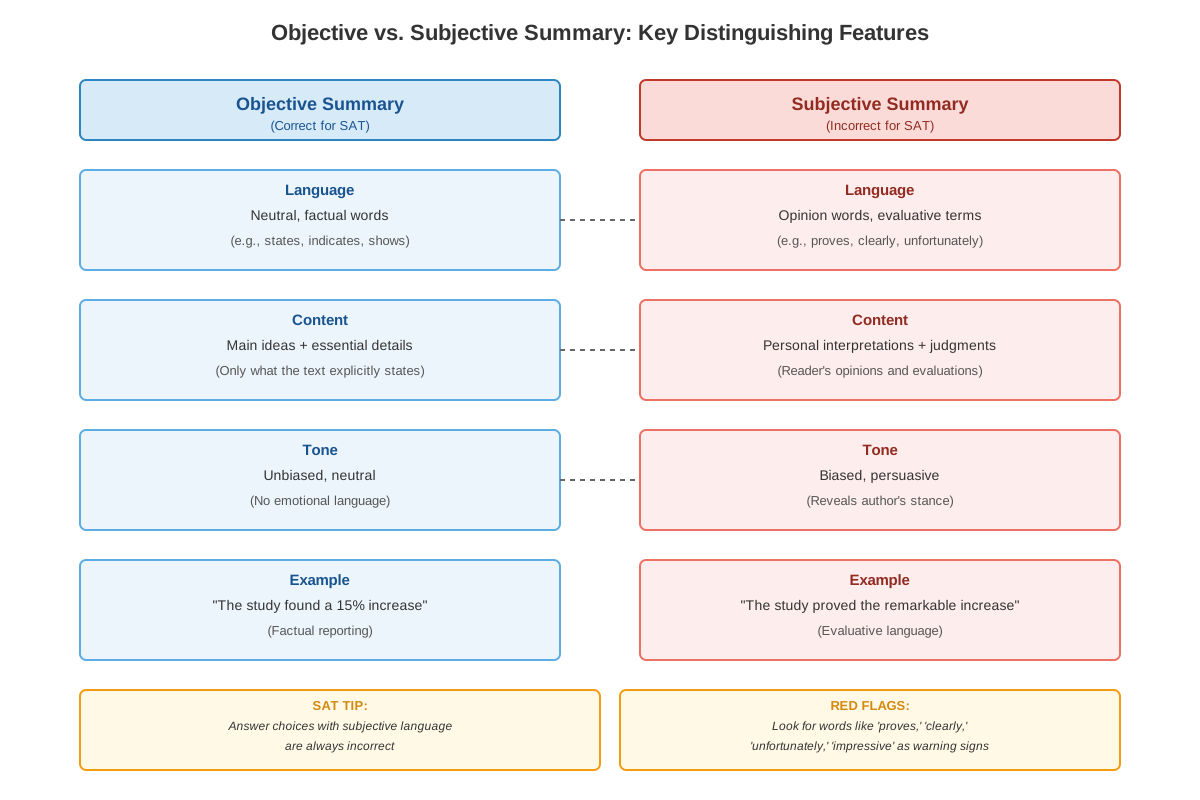
Neutral language forms the foundation of objectivity in summaries. This means selecting words that accurately convey meaning without adding emotional coloring, value judgments, or interpretive spin. Consider the difference between these phrasings:
| Objective Language | Subjective Language |
|---|---|
| The study found a correlation between variables | The study proved a definitive link |
| The author argues that policy changes are necessary | The author convincingly demonstrates the urgent need |
| Participants reported increased satisfaction | Participants were thrilled with the results |
| The data suggests a possible relationship | The data clearly shows an undeniable connection |
Objective summaries use reporting verbs that accurately reflect the author's level of certainty: "suggests," "indicates," "argues," "proposes," "describes," "explains." Subjective summaries often employ stronger language that overstates claims: "proves," "demonstrates conclusively," "obviously shows," "clearly establishes."
Distinguishing Essential from Non-Essential Information
A critical skill for creating objective summaries involves determining which details are essential. Essential information includes: the main claim or thesis, the primary evidence or reasoning supporting that claim, key definitions or concepts necessary for understanding, and significant qualifications or limitations the author mentions. Non-essential information typically includes: specific examples when the general principle is sufficient, background information that contextualizes but doesn't directly support the main idea, tangential points that don't connect to the central argument, and descriptive details that add color but not meaning.
For example, if a passage discusses how a scientist developed a new water purification method, the essential information includes what the method is, how it works (in general terms), and why it's significant. Non-essential details might include the scientist's educational background, the specific laboratory where research occurred, or anecdotal stories about the research process—unless these details directly connect to understanding the method's development or significance.
Recognizing Bias and Subjectivity in Answer Choices
SAT objective summary questions frequently include distractor answer choices that introduce subtle bias or subjectivity. Students must develop sensitivity to language that signals opinion rather than fact. Bias indicators include: intensifiers that exaggerate ("extremely," "absolutely," "completely"), evaluative adjectives ("impressive," "unfortunate," "remarkable"), emotional language ("alarming," "exciting," "disappointing"), and absolute statements that go beyond the passage's claims ("always," "never," "impossible," "certain").
Additionally, watch for answer choices that make unsupported inferences—logical conclusions that might follow from the passage but aren't explicitly stated. While inference questions ask students to draw conclusions, objective summary questions require staying within the boundaries of what the author actually communicated.
Synthesis Across Multiple Ideas
Many SAT passages present multiple related ideas that must be synthesized into a cohesive summary. This requires understanding how different sentences or paragraphs connect: Does the second paragraph provide evidence for the first paragraph's claim? Does it present a contrasting viewpoint? Does it qualify or limit the initial statement? Effective objective summaries capture these relationships without listing ideas in disconnected fashion.
For instance, if a passage first describes a problem, then presents a proposed solution, and finally acknowledges limitations of that solution, the summary should reflect this structure: "The author describes [problem], proposes [solution], but notes [limitation]." This synthesis demonstrates comprehension of how ideas relate rather than merely listing facts.
Concept Relationships
The core concepts within objective summary form an interconnected system where each element supports and depends on others. Neutral language serves as the foundation enabling objectivity, which in turn allows accurate representation of the main idea. The ability to distinguish essential from non-essential information directly impacts whether a summary captures the main idea without unnecessary elaboration. Recognizing bias acts as a quality-control mechanism, ensuring that neutral language and objectivity are maintained throughout the summary.
These concepts connect to prerequisite knowledge in clear ways: main idea identification (prerequisite) → enables → distinguishing essential information (current topic) → leads to → complete objective summary. Similarly, vocabulary knowledge (prerequisite) → enables → recognizing neutral versus subjective language → ensures → objectivity in summaries.
Within the broader Rhetorical Synthesis unit, objective summary skills form the foundation for more advanced tasks. The progression flows: objective summary → enables → comparing multiple sources → leads to → synthesizing arguments across texts → culminates in → evaluating rhetorical effectiveness. Students cannot effectively compare how two authors approach a topic without first accurately summarizing each author's position objectively.
High-Yield Facts
⭐ An objective summary includes only information explicitly stated or directly implied in the passage, never introducing outside knowledge or unsupported inferences
⭐ Neutral language avoids intensifiers, evaluative adjectives, emotional words, and absolute statements that go beyond the passage's claims
⭐ The main idea must appear in every objective summary; supporting details should be included only if essential for understanding that main idea
⭐ Objective summaries maintain the author's level of certainty—if the author "suggests" something, the summary shouldn't say the author "proves" it
⭐ Personal reactions, opinions about the passage's quality or importance, and interpretive judgments have no place in objective summaries
- Effective objective summaries typically condense passages to approximately 20-30% of the original length on the SAT
- Answer choices that use extreme language ("always," "never," "impossible," "certainly") are rarely correct for objective summary questions
- The correct summary answer choice will account for important qualifications or limitations the author mentions
- Objective summaries should preserve the passage's organizational structure when that structure is meaningful (e.g., problem-solution, cause-effect)
- Minor examples and anecdotal details can usually be omitted from summaries unless they serve as the primary evidence for the main claim
- Summaries should use the same verb tense as the original passage when referring to the author's actions (typically present tense: "the author argues")
- When a passage presents multiple perspectives, an objective summary must acknowledge this multiplicity rather than presenting only one view
- Background information that contextualizes the main idea but doesn't directly support it should generally be excluded from concise summaries
- Objective summaries avoid rhetorical questions, exclamations, and other stylistic devices that add emotional emphasis
- The most common error in student-generated summaries is including too much detail rather than too little
Quick check — test yourself on Objective summary so far.
Try Flashcards →Common Misconceptions
Misconception: Objective summaries must include every detail mentioned in the passage to be complete. → Correction: Objective summaries should include only the main idea and essential supporting details; comprehensive coverage of all details creates a paraphrase, not a summary. The goal is concise representation of core meaning, not exhaustive restatement.
Misconception: Using different words than the passage automatically makes a summary more objective. → Correction: While summaries should use original phrasing rather than copying sentences verbatim, changing words doesn't ensure objectivity. A summary using entirely different vocabulary can still be subjective if it introduces evaluative language or bias. Objectivity depends on neutrality of meaning, not novelty of word choice.
Misconception: If something is true and related to the passage topic, it's appropriate to include in the summary. → Correction: Objective summaries must include only information the passage actually presents. Even if a statement is factually accurate and topically relevant, including it when the passage doesn't mention it violates the principle of objective representation. The summary represents the passage's content, not the broader topic.
Misconception: Objective summaries should avoid mentioning the author or using phrases like "the author argues." → Correction: Explicitly attributing ideas to the author ("The author contends that...") actually enhances objectivity by making clear these are the passage's claims, not universal facts. This attribution helps maintain the distinction between what the text says and what might be objectively true about the world.
Misconception: The longest or most detailed answer choice is usually the best objective summary. → Correction: Length doesn't correlate with quality in objective summaries. Longer answer choices often include non-essential details or introduce subtle bias through elaboration. The best summary is sufficiently complete to capture the main idea but concise enough to exclude peripheral information.
Misconception: Objective summaries should always present information in the same order as the original passage. → Correction: While preserving meaningful organizational structures is important, effective summaries may reorder information for clarity and conciseness. If a passage presents the main claim in the final sentence after building up to it, the summary might appropriately begin with that claim.
Misconception: Using words like "important" or "significant" makes a summary subjective. → Correction: Context determines whether such words introduce bias. If the passage itself describes something as important or significant, the summary can reflect this. However, if the summary adds these evaluative terms when the passage doesn't use them, that introduces subjectivity.
Worked Examples
Example 1: Scientific Research Passage
Passage: "Marine biologists studying coral reef ecosystems in the Caribbean have observed that parrotfish populations significantly influence reef health. These fish consume algae that would otherwise overgrow and suffocate coral. In areas where parrotfish are abundant, coral coverage remains stable or increases. However, in regions where overfishing has depleted parrotfish numbers, algae proliferation has led to substantial coral decline. The researchers suggest that protecting parrotfish populations should be a priority in coral conservation efforts."
Question: Which choice most effectively summarizes the passage?
Answer Choices:
A) Parrotfish are fascinating creatures that play a crucial role in maintaining the delicate balance of Caribbean coral reef ecosystems by consuming harmful algae.
B) Research indicates that parrotfish populations affect coral reef health because these fish eat algae that can harm coral, and areas with fewer parrotfish show more coral decline.
C) Overfishing has created an environmental catastrophe in Caribbean reefs, and immediate action must be taken to protect parrotfish before coral reefs disappear entirely.
D) Marine biologists have made an important discovery about the relationship between fish populations and coral health that could revolutionize conservation strategies.
Analysis:
Choice A introduces subjective language ("fascinating," "delicate balance") and uses "crucial" without the passage stating this level of importance. The word "harmful" also adds interpretation—the passage says algae "overgrow and suffocate" coral but doesn't use the evaluative term "harmful."
Choice B accurately captures the main idea (parrotfish populations affect reef health), includes the essential mechanism (eating algae), and notes the key supporting evidence (areas with fewer parrotfish show decline). The language remains neutral ("indicates," "affect," "show") and makes no claims beyond what the passage states. This is the correct answer.
Choice C introduces extreme emotional language ("catastrophe") and urgency ("immediate action," "before coral reefs disappear entirely") not present in the passage. While the passage mentions overfishing and suggests protection as a priority, it doesn't characterize the situation as catastrophic or imminent.
Choice D uses evaluative language ("important discovery," "revolutionize") that adds interpretation. The passage presents research findings but doesn't claim the discovery is revolutionary or particularly important compared to other research.
Connection to Learning Objectives: This example demonstrates identifying key features of objective summary (neutral language, main idea, essential details) and applying these concepts to eliminate subjective answer choices.
Example 2: Historical Analysis Passage
Passage: "Historians have long debated the primary causes of the Industrial Revolution in 18th-century Britain. While earlier scholars emphasized technological innovations like the steam engine, recent research highlights the role of economic factors, particularly the accumulation of capital from colonial trade. Some historians argue that access to coal deposits was the decisive factor, while others point to Britain's political stability and property rights as creating favorable conditions for industrial development. Most contemporary historians acknowledge that multiple interconnected factors contributed to industrialization rather than any single cause."
Question: Which choice best summarizes the passage without introducing bias?
Answer Choices:
A) The passage explains that colonial exploitation was the true cause of Britain's Industrial Revolution, though some historians mistakenly focus on technology or coal.
B) Historians disagree about what caused the Industrial Revolution, with various scholars emphasizing technology, economics, coal access, or political factors, though most now recognize multiple causes.
C) The complex debate over the Industrial Revolution's causes demonstrates how difficult it is for historians to reach consensus on important historical questions.
D) Recent research has finally revealed that economic factors, not technological innovations, drove the Industrial Revolution in Britain.
Analysis:
Choice A introduces bias by claiming colonial trade was the "true cause" and characterizing other interpretations as "mistaken." The passage presents multiple perspectives without declaring one correct and others wrong.
Choice B accurately represents the passage's structure: acknowledging historical debate, listing the various factors different historians emphasize (technology, economics, coal, political factors), and noting the contemporary consensus about multiple causes. The language remains neutral throughout. This is the correct answer.
Choice C adds interpretation not present in the passage. While the passage describes disagreement among historians, it doesn't comment on whether reaching consensus is "difficult" or characterize the question as particularly "important" compared to other historical questions.
Choice D uses "finally revealed" to suggest definitive resolution and claims recent research established economics as the cause. The passage actually states that recent research "highlights" economic factors (not proves them decisive) and concludes that most historians recognize "multiple interconnected factors," not a single economic cause.
Connection to Learning Objectives: This example shows how to distinguish between objective and subjective language, recognize when answer choices introduce unsupported interpretations, and identify summaries that accurately synthesize multiple ideas from a passage.
Exam Strategy
When approaching SAT objective summary questions, begin by reading the passage carefully and identifying the main idea before looking at answer choices. Underline or mentally note the central claim and any essential supporting details. This pre-reading strategy prevents answer choices from influencing interpretation of the passage.
Trigger words that signal objective summary questions include: "Which choice best summarizes...," "Which statement most accurately represents...," "Which option effectively captures...," and "The passage primarily discusses..." When encountering these phrases, immediately activate your objectivity filter—prepare to eliminate answer choices with subjective language.
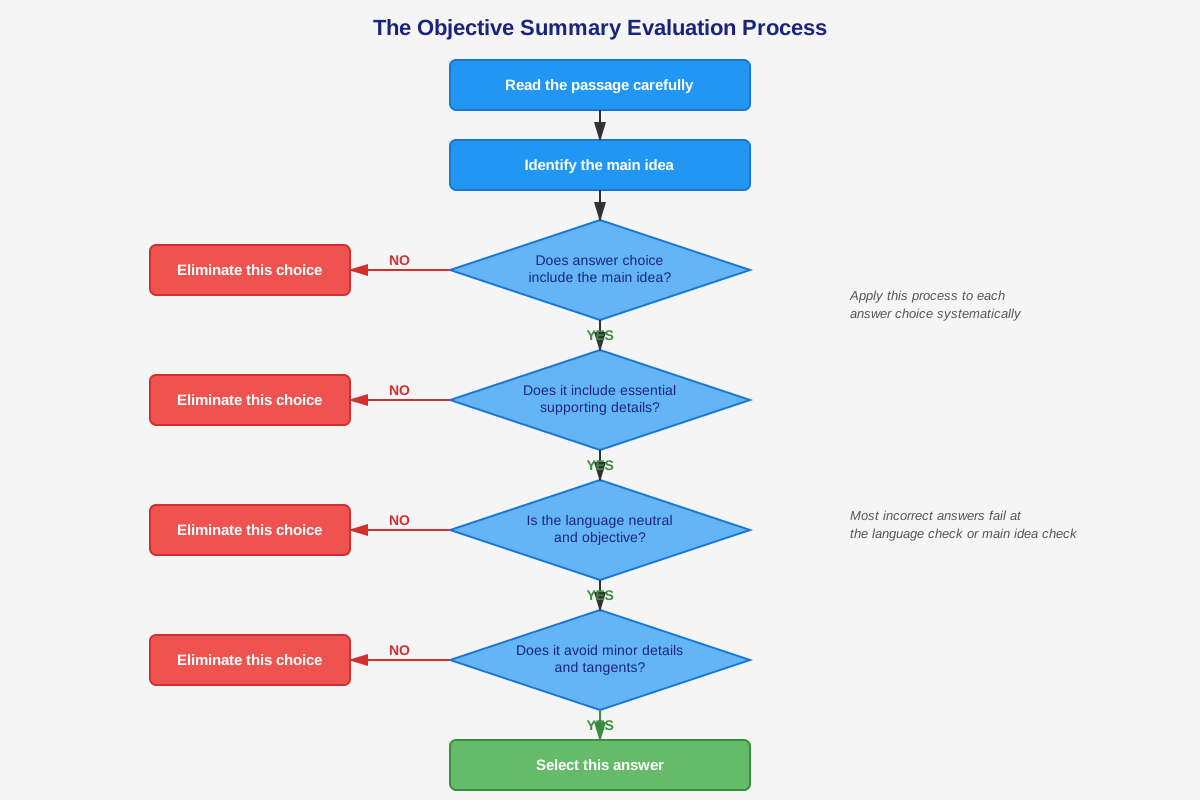
Apply a systematic elimination process:
- First pass: Eliminate choices with obvious subjective language (intensifiers, evaluative adjectives, emotional words)
- Second pass: Remove choices that introduce information not in the passage or make unsupported inferences
- Third pass: Between remaining choices, select the one that includes the main idea and essential details without omitting critical information
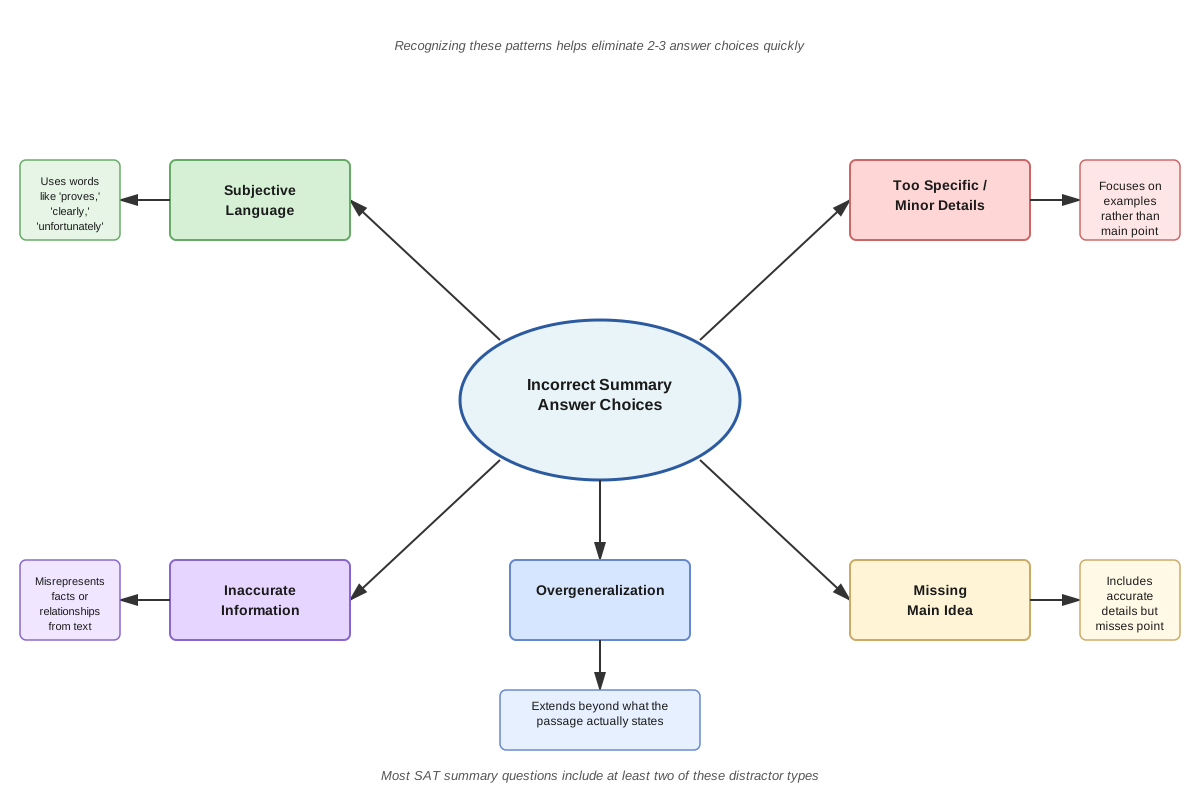
Watch for these common distractor patterns:
- Too narrow: Focuses on one supporting detail rather than the main idea
- Too broad: Makes general statements that could apply to many passages but doesn't capture this specific passage's content
- Subtle bias: Uses mostly neutral language but includes one or two subjective words
- Incomplete: Captures part of the main idea but omits essential qualifications or limitations
- Overstated: Represents the author's tentative suggestion as a definitive claim
Time allocation: Objective summary questions should take 45-60 seconds on average. If spending more than 75 seconds, make your best choice and move forward. These questions test comprehension, not complex analysis, so if the answer isn't becoming clear, you may have misidentified the main idea—quickly reread the passage's first and last sentences, which often contain the central claim.
Exam Tip: When two answer choices seem equally objective, compare them to the passage's first and last sentences. The correct summary almost always aligns with the framing provided in these key positions.
Memory Techniques
MAIN acronym for evaluating objective summaries:
- Main idea included
- Accurate representation (no distortion)
- Impartial language (no bias)
- No unsupported additions
BIAS checklist for identifying subjective language:
- Boosters (intensifiers like "extremely," "absolutely")
- Interpretations (going beyond what's stated)
- Adjectives (evaluative words like "impressive," "unfortunate")
- Superlatives and absolutes ("always," "never," "best," "worst")
Visualization strategy: Picture an objective summary as a photograph of the passage's meaning—it captures what's actually there without filters, enhancement, or artistic interpretation. Subjective summaries are like paintings that add the artist's perspective and emotional coloring.
The "Robot Test": Imagine a robot with no emotions or opinions reading the passage. What would it report as the main idea and key details? This mental model helps maintain objectivity by removing human tendency to evaluate and interpret.
Three-Question Filter: Before selecting an answer, ask:
- Does this include the main idea?
- Is every word neutral?
- Is everything here actually in the passage?
If the answer to all three is "yes," you've found the objective summary.
Summary
Objective summary represents a foundational skill for SAT Reading and Writing success, requiring students to identify main ideas, distinguish essential from non-essential information, and express understanding using neutral, unbiased language. An effective objective summary captures the passage's central claim and key supporting details without introducing personal opinions, evaluative judgments, or information not present in the original text. The critical distinction between objective and subjective language—recognizing intensifiers, emotional words, and interpretive additions—enables students to eliminate incorrect answer choices efficiently. SAT objective summary questions appear frequently across diverse passage types, testing whether students can accurately represent an author's ideas without distortion. Mastery requires understanding that summaries should be complete enough to convey the main idea but concise enough to exclude peripheral details, maintaining the author's level of certainty and acknowledging important qualifications. Success on these questions demonstrates the reading comprehension and analytical thinking skills essential for college readiness and forms the foundation for more advanced rhetorical synthesis tasks.
Key Takeaways
- Objective summaries include the main idea and essential supporting details while excluding minor examples, background information, and non-essential elaboration
- Neutral language avoids intensifiers, evaluative adjectives, emotional words, and absolute statements that introduce bias or go beyond the passage's claims
- The correct summary maintains the author's level of certainty—tentative suggestions remain tentative, definitive claims remain definitive
- Common wrong answers introduce subtle subjectivity, make unsupported inferences, focus too narrowly on details, or omit critical qualifications
- Systematic elimination using the MAIN acronym (Main idea, Accurate, Impartial, No additions) efficiently identifies correct answers
- Objective summary skills form the foundation for advanced rhetorical synthesis tasks and appear in 2-4 questions per SAT administration
- The ability to separate essential from peripheral information and maintain objectivity represents a critical thinking skill valuable far beyond standardized testing
Related Topics
Central Ideas and Themes: Building on objective summary skills, this topic explores how to identify and analyze overarching themes across longer passages and multiple texts, requiring synthesis of main ideas from different sections.
Rhetorical Purpose and Audience: Understanding why authors make specific choices connects to objective summary by requiring students to objectively identify authorial intent without imposing their own interpretations.
Comparing Multiple Sources: This advanced synthesis skill depends on the ability to create objective summaries of each source before analyzing similarities and differences in arguments or approaches.
Evidence and Support: Distinguishing between essential and non-essential details in objective summaries directly prepares students to evaluate which evidence most effectively supports claims in argumentative passages.
Inference Questions: While objective summaries stay within stated information, inference questions ask students to draw logical conclusions—mastering the boundary between these skills enhances performance on both question types.
Practice CTA
Now that you understand the principles of objective summary, it's time to apply these skills to authentic SAT-style questions. The practice questions and flashcards will reinforce your ability to identify neutral language, distinguish essential information, and eliminate subjective answer choices efficiently. Remember: objective summary questions reward careful reading and systematic thinking, not speed-reading or gut reactions. Approach each practice question methodically, using the MAIN acronym and BIAS checklist to evaluate answer choices. With focused practice, you'll develop the instinct to spot subjective language immediately and confidently select accurate, unbiased summaries. Your investment in mastering this high-yield topic will pay dividends across the entire Reading and Writing section—let's put your knowledge to work!
Sign up free to keep reading
Create a free AnvayaPrep account to finish this SAT guide on Objective summary — plus flashcards and practice questions.