Overview
Research notes questions represent one of the most distinctive and high-stakes question types in the SAT Reading and Writing section. These questions assess a student's ability to synthesize information from multiple sources, evaluate evidence, and construct coherent arguments—skills that mirror authentic academic research processes. Unlike traditional reading comprehension questions that focus on a single passage, research notes questions present students with 3-4 brief notes from hypothetical research sources, then ask them to complete a statement or claim using appropriate evidence and logical reasoning.
The SAT research notes format challenges students to think like researchers and writers, requiring them to identify relevant information, recognize logical relationships between sources, and select conclusions that are properly supported by the evidence provided. This question type appears consistently in the RW (Reading and Writing) section and typically accounts for a significant portion of the Rhetorical Synthesis questions. Students must demonstrate not only reading comprehension but also critical thinking, evidence evaluation, and an understanding of how academic arguments are constructed.
Mastering research notes questions is essential because they integrate multiple Reading and Writing skills simultaneously: identifying main ideas, understanding supporting details, recognizing logical relationships, and evaluating the strength of evidence. These questions also connect directly to the essay-writing and research skills students need for college success, making them particularly valuable for demonstrating college readiness. Performance on research notes questions often correlates strongly with overall SAT Reading and Writing scores, as they require the synthesis of comprehension, analysis, and reasoning abilities.
Learning Objectives
- [ ] Identify key features of research notes questions and their structural components
- [ ] Explain how research notes appears on the SAT and what skills are being assessed
- [ ] Apply research notes strategies to answer SAT-style questions accurately and efficiently
- [ ] Evaluate which pieces of evidence from multiple sources best support a given claim
- [ ] Distinguish between conclusions that are fully supported versus those that overreach the evidence
- [ ] Synthesize information from multiple brief sources to form logical conclusions
- [ ] Recognize common patterns in how research notes are structured and what answer choices test
Prerequisites
- Basic reading comprehension skills: Understanding main ideas and supporting details in short passages is fundamental to extracting information from research notes
- Vocabulary knowledge: Students must comprehend academic and domain-specific terminology that appears in research contexts
- Understanding of evidence and claims: Recognizing the difference between a statement that requires support and the evidence that supports it is essential
- Logical reasoning fundamentals: The ability to identify when a conclusion follows logically from premises is necessary for evaluating answer choices
Why This Topic Matters
Research notes questions reflect authentic academic skills that students will use throughout their college careers and professional lives. The ability to synthesize information from multiple sources, evaluate evidence quality, and draw appropriate conclusions is fundamental to research papers, literature reviews, and evidence-based decision-making in virtually every field. These questions assess whether students can think critically about information rather than simply recall facts.
On the SAT, research notes questions appear with high frequency in the Reading and Writing section, typically comprising 10-15% of all questions in the Rhetorical Synthesis domain. Each test administration includes multiple research notes questions, and they are considered medium-to-high difficulty items that effectively differentiate between students at different skill levels. Because these questions require multiple cognitive steps—reading, analyzing, comparing, and synthesizing—they often determine whether students achieve scores in the highest percentiles.
Research notes questions commonly appear in various academic contexts, including scientific studies (biology, psychology, environmental science), historical research, literary analysis, and social science investigations. The notes might present experimental findings, survey results, historical documents, expert opinions, or observational data. Students must be prepared to work with quantitative data, qualitative observations, and mixed-method research findings. The answer choices typically test whether students can identify conclusions that are appropriately limited to what the evidence actually supports, avoiding overgeneralizations or unsupported claims.
Core Concepts
Structure of Research Notes Questions
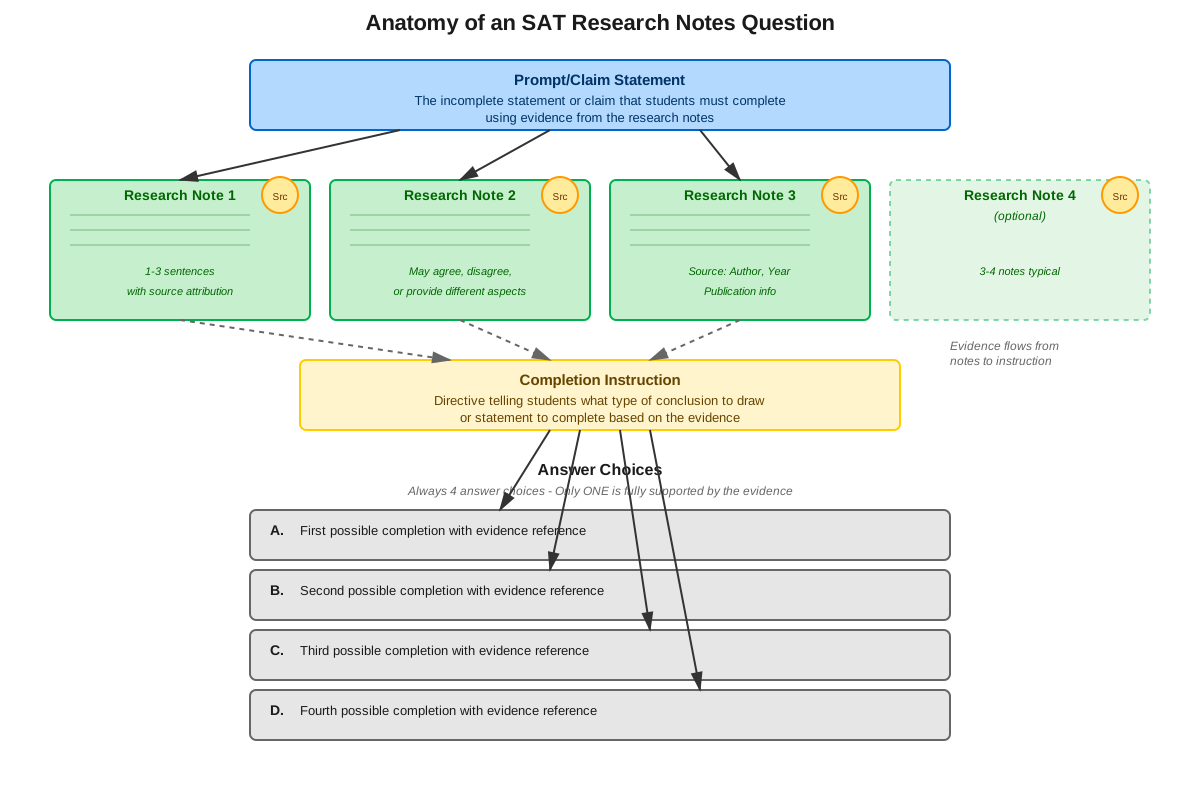
Research notes questions follow a consistent format that students must recognize immediately. The question stem begins with a scenario describing a student who is researching a particular topic. This is followed by 3-4 numbered notes, each representing information from a different source. These notes are intentionally brief—typically 1-3 sentences each—and present distinct pieces of information that may complement, contrast, or build upon each other. After the notes, students encounter an incomplete statement that begins with "The student wants to..." followed by a specific rhetorical goal (emphasize a particular finding, present a generalization, make a claim, etc.). The question then asks which choice "most effectively uses relevant information from the notes to accomplish this goal."
The notes themselves are carefully constructed to include both relevant and irrelevant information for the specific task described. Each note is attributed to a source (though the actual source citation is not important for answering the question), and students must evaluate which information from which note(s) best serves the stated purpose. The structure deliberately mirrors the research process: gathering information from multiple sources, identifying what's relevant to a specific claim, and synthesizing that information into a coherent statement.
Types of Information in Research Notes
Research notes contain several distinct types of information that students must recognize and evaluate. Quantitative data includes numerical findings, percentages, measurements, and statistical results (e.g., "The study found that 73% of participants showed improvement"). Qualitative observations describe characteristics, behaviors, or phenomena without numerical measurement (e.g., "Researchers observed that the birds displayed distinctive mating behaviors"). Historical facts provide dates, events, or contextual information about when something occurred. Expert opinions or interpretations present conclusions or explanations that researchers have drawn from their observations. Comparative information shows relationships between two or more subjects, often highlighting similarities or differences.
Understanding these information types is crucial because the question stem will specify what kind of conclusion or claim the student wants to make, and the correct answer must match that purpose with appropriate evidence. For example, if the goal is to "emphasize the magnitude of a change," quantitative data showing before-and-after measurements would be most relevant, while qualitative descriptions might be less effective.
Evaluating Evidence Relevance
The core skill in research notes questions is determining which pieces of information are relevant to the specific rhetorical goal stated in the question. Relevance is not about whether information is true or interesting—it's about whether it directly supports the particular claim or purpose described. Students must read the incomplete statement carefully to understand exactly what needs to be accomplished: Is the goal to make a broad generalization? To highlight a specific finding? To show a contrast? To explain a mechanism? Each goal requires different types of supporting evidence.
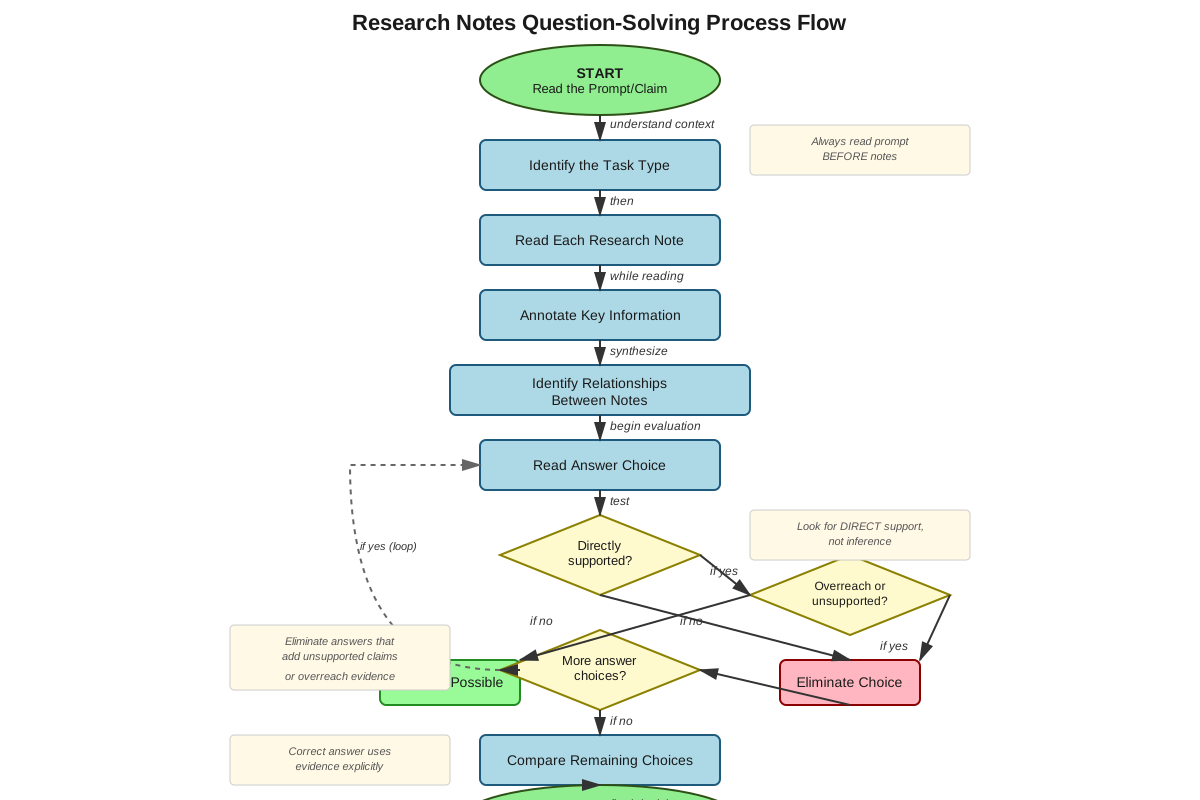
A systematic approach involves: (1) identifying the key terms and concepts in the incomplete statement, (2) scanning each note for information related to those concepts, (3) eliminating notes that don't address the specific goal, and (4) comparing remaining options to find the one that most directly and completely supports the claim. Students must avoid the trap of selecting information simply because it seems important or interesting—it must be specifically relevant to the stated purpose.
Synthesis and Logical Relationships
Synthesis in research notes questions means combining information from multiple notes to form a coherent conclusion. Some questions require students to recognize that the correct answer draws on information from two or more notes, showing how different pieces of evidence work together. For example, one note might establish that a phenomenon exists, while another note explains why it occurs, and the correct answer synthesizes both to present a complete claim.
Logical relationships between notes fall into several patterns: complementary (notes provide different aspects of the same finding), contrasting (notes present different or opposing findings), causal (one note describes a cause while another describes an effect), temporal (notes show how something changed over time), and hierarchical (one note presents a general principle while another provides a specific example). Recognizing these relationships helps students predict what kind of synthesis the correct answer will perform.
Scope and Precision in Conclusions
A critical concept in research notes questions is matching the scope of the conclusion to the scope of the evidence. The correct answer will make a claim that is neither too broad (overgeneralizing beyond what the evidence supports) nor too narrow (failing to capture the full significance of the findings). If the notes present evidence about "three species of birds in coastal California," the correct answer should not make claims about "all birds" or "birds worldwide"—that would be overgeneralization. Conversely, if the evidence supports a broader pattern, the answer should not focus on just one specific detail while ignoring the larger finding.
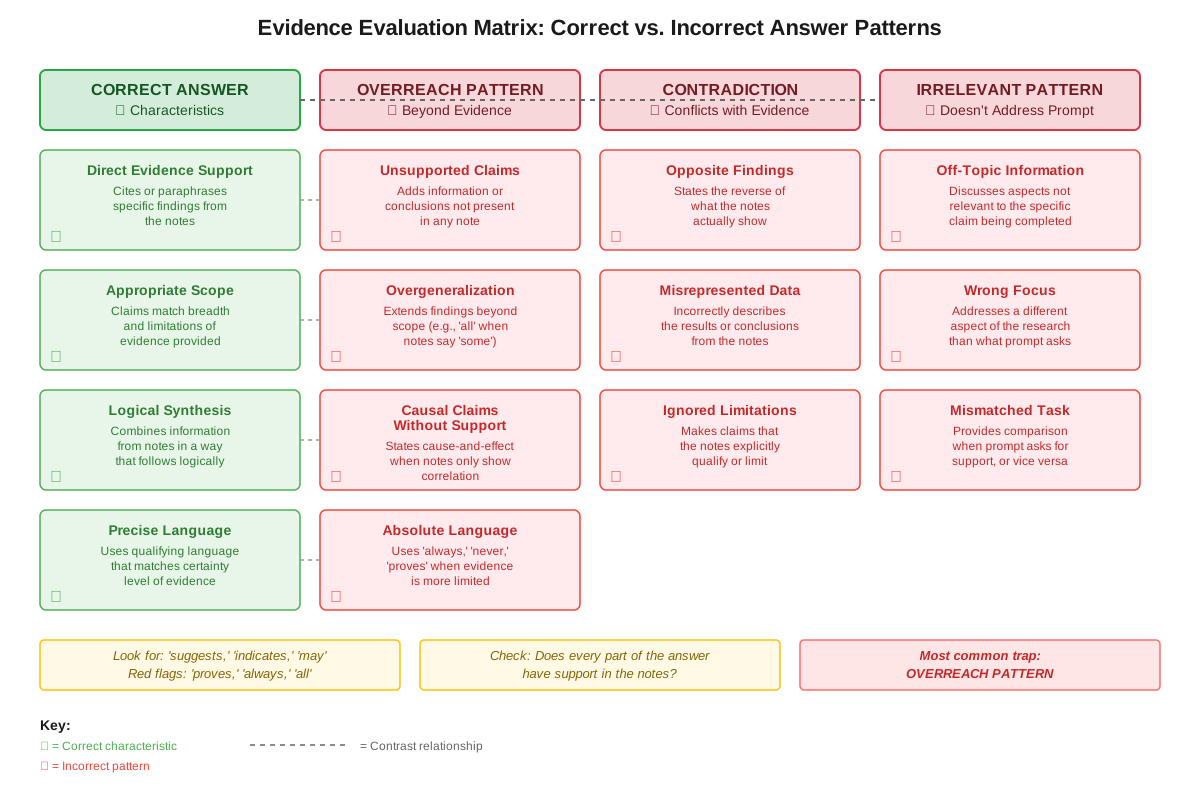
Precision involves using language that accurately reflects what the evidence shows. If a study found a correlation, the answer should not claim causation. If the evidence shows "many" or "most," the answer should not say "all." If the finding applies to a specific context or population, the answer must include those qualifications. The SAT consistently includes wrong answers that are factually based on the notes but use imprecise language that misrepresents the strength or scope of the evidence.
Answer Choice Patterns
Research notes answer choices follow predictable patterns that students can learn to recognize. Correct answers typically: (1) directly address the specific rhetorical goal stated in the question, (2) use information from the most relevant note(s), (3) maintain appropriate scope and precision, (4) synthesize information when multiple notes are relevant, and (5) use clear, logical language that accurately represents the evidence.
Incorrect answers commonly exhibit these flaws: (1) using information from notes that don't address the specific goal, (2) overgeneralizing beyond what the evidence supports, (3) being too narrow or specific when a broader claim is warranted, (4) misrepresenting the relationship between pieces of evidence, (5) including accurate information that doesn't accomplish the stated purpose, or (6) making logical leaps that the evidence doesn't support. Recognizing these patterns allows students to eliminate wrong answers efficiently.
Concept Relationships
The concepts within research notes questions form an interconnected system where each element depends on the others. The structure of the question (scenario → notes → incomplete statement → goal) establishes the framework within which all other concepts operate. Understanding this structure enables students to identify the types of information present in each note, which then allows them to evaluate relevance based on the specific rhetorical goal. The relevance evaluation process requires understanding logical relationships between notes, which informs the synthesis process. Throughout this entire chain, students must maintain awareness of scope and precision to avoid selecting answers that misrepresent the evidence. Finally, recognizing answer choice patterns helps students apply all previous concepts efficiently during the test.
This topic connects to prerequisite knowledge of basic reading comprehension by building on the ability to identify main ideas and supporting details, but extends those skills into multi-source synthesis. It relates to other Reading and Writing topics such as command of evidence (selecting quotations that support claims), transitions (understanding logical relationships between ideas), and rhetorical purpose (recognizing what different types of statements accomplish). Mastering research notes questions strengthens skills that apply across the entire Reading and Writing section.
Concept flow: Question Structure → Information Type Recognition → Relevance Evaluation → Logical Relationship Identification → Evidence Synthesis → Scope/Precision Checking → Answer Selection
High-Yield Facts
⭐ Research notes questions always present 3-4 brief notes from different sources, followed by an incomplete statement with a specific rhetorical goal
⭐ The correct answer must accomplish the specific goal stated in the question stem—relevance is determined by the goal, not by general importance
⭐ Wrong answers often contain accurate information from the notes but fail to address the specific rhetorical purpose
⭐ Scope errors are the most common trap: answers that overgeneralize beyond the evidence or are too narrow for the claim being made
⭐ When the goal involves emphasizing a specific finding or magnitude, quantitative data is typically most relevant
- Research notes questions test synthesis skills, not just comprehension of individual sources
- The student scenario at the beginning establishes context but the actual task is defined by the incomplete statement and goal
- Multiple notes may contain relevant information, and the correct answer may need to synthesize information from more than one note
- Precision in language matters: "suggests," "indicates," "proves," "demonstrates," and "shows" have different strengths and should match the evidence
- The source citations provided with each note are not important for answering the question—focus on the content, not the source
- Temporal relationships (before/after, cause/effect) are frequently tested in research notes questions
- If a note contains both relevant and irrelevant information, the correct answer will use only the relevant portion
- Answer choices are typically similar in length and structure, so elimination must be based on logical analysis, not superficial features
- Research notes questions appear throughout the Reading and Writing section, not clustered together
- These questions typically take longer than average to answer (90-120 seconds) due to the multiple reading and analysis steps required
Quick check — test yourself on Research notes so far.
Try Flashcards →Common Misconceptions
Misconception: The longest or most detailed note contains the most important information for answering the question.
Correction: Relevance is determined by the specific rhetorical goal, not by the length or apparent importance of a note. Sometimes the briefest note contains the most relevant information for the particular task.
Misconception: The correct answer must use information from all the notes provided.
Correction: The correct answer uses only the information that is relevant to the specific goal. Often, one or two notes will be most relevant, while others provide context or contrasting information that isn't needed for the particular claim being made.
Misconception: If information appears in the notes, any answer choice that includes that information must be correct.
Correction: Wrong answers frequently contain accurate information from the notes but use it in ways that don't accomplish the stated rhetorical goal, apply it with incorrect scope, or combine it illogically with other information.
Misconception: Research notes questions are primarily testing reading comprehension of the individual notes.
Correction: These questions primarily test synthesis, evaluation, and reasoning skills—the ability to select relevant information, recognize logical relationships, and construct appropriate conclusions. Simply understanding each note individually is insufficient.
Misconception: The order of the notes indicates their relative importance, with Note 1 being most important.
Correction: Notes are presented in a logical sequence for reading, but their order does not indicate importance or relevance. The last note may be most relevant for one question, while the first note might be most relevant for another.
Misconception: Scientific or technical research notes are harder than humanities research notes.
Correction: The difficulty of research notes questions depends on the complexity of the logical relationships and synthesis required, not on the subject matter. Both scientific and humanities topics can produce easy or difficult questions depending on how the information must be synthesized.
Worked Examples
Example 1: Biological Research
Scenario: A student is researching the feeding behavior of hummingbirds. The student has found the following notes:
Note 1: A 2019 study observed 45 hummingbirds in Southern California and found that they visited an average of 1,200 flowers per day, with individual birds showing consistent preferences for certain flower colors.
Note 2: Researchers have determined that hummingbirds have excellent color vision and can see ultraviolet light, which helps them locate flowers with high nectar content.
Note 3: In laboratory experiments, hummingbirds demonstrated the ability to remember the locations of productive feeding sites and returned to them repeatedly over several days.
Note 4: A survey of hummingbird species across North America found significant variation in beak length and shape, which corresponds to the types of flowers each species typically feeds from.
The student wants to emphasize the efficiency of hummingbird feeding behavior. Which choice most effectively uses relevant information from the notes to accomplish this goal?
A) Hummingbirds have evolved various beak shapes that allow different species to feed from different types of flowers.
B) With their ability to see ultraviolet light and remember productive feeding locations, hummingbirds can efficiently locate and return to flowers with high nectar content.
C) A study of hummingbirds in Southern California found that individual birds showed consistent preferences for certain flower colors.
D) Hummingbirds visit an average of 1,200 flowers per day and demonstrate consistent preferences in their feeding behavior.
Analysis:
The key phrase in the goal is "emphasize the efficiency of hummingbird feeding behavior." We need to identify which information best demonstrates efficiency—the ability to accomplish feeding effectively and without waste.
- Note 1 provides quantitative data (1,200 flowers per day) and mentions consistent preferences, both of which relate to efficiency
- Note 2 explains mechanisms (color vision, UV detection) that help hummingbirds locate high-quality food sources—directly relevant to efficiency
- Note 3 describes memory and repeated visits to productive sites—another efficiency mechanism
- Note 4 discusses beak variation and species differences—interesting but not directly about efficiency
Now examining the answer choices:
Choice A uses information from Note 4 about beak shapes and species variation. While this relates to feeding, it doesn't emphasize efficiency—it's about diversity and adaptation. Eliminated.
Choice B synthesizes information from Notes 2 and 3, combining the UV vision capability with memory of productive locations. This directly addresses efficiency by explaining how hummingbirds avoid wasting time on poor food sources. Strong candidate.
Choice C uses only part of Note 1 (color preferences) without the quantitative data or any explanation of why this matters for efficiency. Too narrow and doesn't emphasize efficiency.
Choice D uses the quantitative data from Note 1 (1,200 flowers per day) which shows the scale of feeding activity, but doesn't explain the mechanisms that make this efficiency possible. Partially relevant but incomplete.
Correct Answer: B
Choice B is correct because it synthesizes two distinct mechanisms (visual capability and spatial memory) that work together to create efficient feeding behavior. It directly addresses the goal by explaining how these abilities help hummingbirds "efficiently locate and return to" productive food sources.
Example 2: Historical Research
Scenario: A student is researching the development of public libraries in the United States. The student has found the following notes:
Note 1: The first public library in the United States, the Boston Public Library, opened in 1854 and was funded by both city taxes and private donations.
Note 2: By 1900, philanthropist Andrew Carnegie had funded the construction of more than 1,600 public libraries across the United States, dramatically expanding access to books in small towns and rural areas.
Note 3: A 2018 study found that communities with public libraries showed higher rates of educational attainment and civic engagement compared to similar communities without libraries.
Note 4: In the late 19th century, many public libraries restricted access based on race, gender, or social class, despite being funded by public money.
The student wants to make a generalization about the impact of philanthropic funding on library access. Which choice most effectively uses relevant information from the notes to accomplish this goal?
A) The Boston Public Library, which opened in 1854, was funded by both city taxes and private donations, establishing a model for future libraries.
B) Despite being funded by public money, many 19th-century libraries restricted access based on race, gender, or social class.
C) Andrew Carnegie's funding of more than 1,600 libraries dramatically expanded access to books in small towns and rural areas across the United States.
D) Communities with public libraries show higher rates of educational attainment and civic engagement than those without libraries.
Analysis:
The goal specifies making "a generalization about the impact of philanthropic funding on library access." Key terms: "philanthropic funding" (private donations, not public money) and "library access" (who could use libraries and where they were available).
- Note 1 mentions private donations but focuses on one specific library—too narrow for a generalization
- Note 2 directly addresses philanthropic funding (Carnegie) and its impact on access (expansion to small towns and rural areas)—highly relevant
- Note 3 discusses library impact on communities but doesn't mention philanthropic funding—not relevant to this specific goal
- Note 4 discusses access restrictions but focuses on publicly funded libraries, not philanthropic funding—not relevant
Examining answer choices:
Choice A uses Note 1 but focuses on a single library (Boston Public Library) rather than making a generalization. The goal requires a broader statement. Too specific.
Choice B uses Note 4 to discuss access restrictions, but this note is about publicly funded libraries, not philanthropic funding. Addresses wrong type of funding.
Choice C uses Note 2 to make a generalization about Carnegie's philanthropic funding and its impact on access (expansion to underserved areas). This directly addresses both key elements of the goal. Correct.
Choice D uses Note 3 to discuss library impact but makes no mention of philanthropic funding, which is essential to the goal. Missing required element.
Correct Answer: C
Choice C is correct because it makes a generalization (not about one specific library but about a large-scale pattern) about philanthropic funding (Carnegie's donations) and its impact on library access (expansion to previously underserved small towns and rural areas). It directly accomplishes the stated goal with appropriate scope.
Exam Strategy
When approaching research notes questions on the SAT, follow this systematic process: First, read the incomplete statement and goal carefully before reading the notes—this tells you what to look for and prevents wasting time on irrelevant details. Underline or mentally note the key terms in the goal (e.g., "emphasize the magnitude," "present a generalization," "explain a mechanism"). These terms define what type of information and what scope the correct answer must have.
As you read each note, actively evaluate its relevance to the specific goal. Mark or mentally categorize each note: highly relevant, possibly relevant, or not relevant. Don't get distracted by interesting information that doesn't serve the stated purpose. Look for the type of information the goal requires: if it asks for emphasis on magnitude or scale, look for quantitative data; if it asks for a mechanism or explanation, look for causal relationships; if it asks for a generalization, look for patterns across multiple instances.
Trigger words in the goal that indicate specific requirements:
- "Emphasize the magnitude/scale/extent" → look for quantitative data, numbers, measurements
- "Present a generalization" → look for patterns that apply broadly, not single instances
- "Explain why/how" → look for causal mechanisms, not just descriptions
- "Highlight a contrast/difference" → look for comparative information between two things
- "Support the claim that" → look for evidence that directly proves the specific claim
Use process of elimination strategically. First, eliminate answers that use information from clearly irrelevant notes. Second, eliminate answers with scope errors (too broad or too narrow). Third, eliminate answers that contain accurate information but don't accomplish the specific goal. Finally, compare remaining options to select the one that most directly and completely addresses the goal.
Time management: Research notes questions typically require 90-120 seconds. If you find yourself spending more than two minutes, make your best elimination-based guess and move on. These questions reward systematic analysis, but overthinking can lead to second-guessing correct answers. Trust your initial evaluation of relevance and scope.
Memory Techniques
GREASE - A mnemonic for evaluating answer choices:
- Goal: Does it accomplish the specific goal stated?
- Relevance: Does it use information relevant to that goal?
- Evidence: Does it accurately represent what the notes say?
- Appropriate scope: Is the claim neither too broad nor too narrow?
- Synthesis: Does it combine information logically if needed?
- Exact language: Does the wording precisely match the evidence strength?
The "Spotlight" Visualization: Imagine the goal statement as a spotlight that illuminates only certain parts of the notes. Information outside the spotlight might be true and interesting, but it's in shadow for this particular question. Train yourself to see only what the spotlight reveals as relevant.
The Scope Ruler: Visualize a ruler with "too narrow" on the left, "appropriate scope" in the middle, and "too broad" on the right. For each answer choice, mentally place it on this ruler. If the evidence is about "three species in California," an answer about "all birds everywhere" slides too far right, while an answer about "one specific bird" slides too far left.
RIPS - For identifying information types in notes:
- Results (quantitative data, numbers, measurements)
- Interpretations (expert opinions, conclusions)
- Phenomena (qualitative observations, descriptions)
- Sources (where/when information was gathered - usually less important)
Summary
Research notes questions on the SAT Reading and Writing section assess the ability to synthesize information from multiple brief sources and construct appropriately supported conclusions. These questions present 3-4 notes from different sources, followed by an incomplete statement with a specific rhetorical goal. Success requires identifying which information is relevant to the particular goal, evaluating the logical relationships between notes, and selecting an answer that accomplishes the stated purpose with appropriate scope and precision. The correct answer must use relevant evidence, maintain accuracy to what the notes actually say, avoid overgeneralization or excessive narrowness, and directly address the specific task described in the question stem. Common pitfalls include selecting answers with interesting but irrelevant information, choosing answers with scope errors, and failing to synthesize information when multiple notes are relevant. A systematic approach—reading the goal first, evaluating each note's relevance, eliminating answers with clear flaws, and checking that the remaining choice accomplishes the specific purpose—leads to consistent success on these high-value questions.
Key Takeaways
- Research notes questions test synthesis and evidence evaluation, not just comprehension of individual sources
- The specific rhetorical goal stated in the question determines what information is relevant—always read this carefully before evaluating answer choices
- Correct answers match the scope of the evidence: neither overgeneralizing beyond what the notes support nor being unnecessarily narrow
- Wrong answers often contain accurate information from the notes but fail to accomplish the specific stated purpose
- Systematic elimination based on relevance, scope, and goal-alignment is more reliable than trying to identify the "best" answer immediately
- These questions require 90-120 seconds on average and are worth the time investment due to their frequency and point value
- Recognizing information types (quantitative data, qualitative observations, expert interpretations) helps quickly identify what's relevant for different goals
Related Topics
Command of Evidence: Research notes questions are closely related to command of evidence questions, which ask students to select quotations that support claims. Mastering research notes strengthens the ability to evaluate evidence relevance and support strength, skills that transfer directly to command of evidence questions.
Rhetorical Synthesis - Transitions: Understanding logical relationships between ideas (cause-effect, contrast, sequence) is essential for both research notes and transition questions. The synthesis skills developed for research notes help students recognize how ideas connect and flow.
Rhetorical Purpose: Many research notes questions require understanding what different types of statements accomplish (generalizing, emphasizing, explaining, contrasting). This connects directly to rhetorical purpose questions that ask why an author included specific information.
Data Interpretation: Some research notes include quantitative data, charts, or statistical findings. Strengthening data interpretation skills enhances performance on research notes questions with numerical evidence.
Argument Analysis: Research notes questions assess whether conclusions are properly supported by evidence—a fundamental aspect of argument analysis throughout the Reading and Writing section.
Practice CTA
Now that you've mastered the core concepts and strategies for research notes questions, it's time to apply your knowledge! Work through the practice questions to reinforce your understanding of how to evaluate relevance, check scope, and synthesize information from multiple sources. Use the flashcards to memorize key concepts like information types, common wrong answer patterns, and the systematic approach to these questions. Remember: research notes questions reward careful, systematic analysis rather than quick intuition. With practice, the process becomes faster and more automatic, allowing you to consistently identify correct answers with confidence. Each practice question you complete strengthens your synthesis skills and builds the pattern recognition that leads to top scores on test day!
Sign up free to keep reading
Create a free AnvayaPrep account to finish this SAT guide on Research notes — plus flashcards and practice questions.