Overview
Rhetorical structure refers to the organizational framework authors use to arrange ideas, arguments, and information within a text to achieve specific communicative purposes. On the SAT Reading and Writing section (RW), understanding rhetorical structure means recognizing how writers organize their thoughts—whether through comparison, cause-and-effect relationships, chronological sequences, problem-solution frameworks, or other patterns—and why they make these organizational choices. This skill extends beyond simply identifying what a passage says to understanding how the passage is constructed and what effect that construction has on the reader.
Mastering sat rhetorical structure is essential because approximately 13-15% of Reading and Writing questions directly test this concept, making it one of the highest-yield topics in the Text Structure and Purpose unit. These questions ask students to identify the overall organizational pattern of a passage, determine how specific sentences function within that structure, or recognize the relationship between different parts of a text. Unlike questions that focus solely on comprehension or vocabulary, rhetorical structure questions require students to step back and analyze the architecture of the passage itself.
This topic connects fundamentally to other Reading and Writing concepts, particularly main idea identification, purpose analysis, and transition recognition. Understanding rhetorical structure provides the framework for comprehending how authors develop arguments, support claims with evidence, and guide readers through complex information. Students who master rhetorical structure gain a significant advantage not only on direct structure questions but also on inference, purpose, and synthesis questions, as recognizing organizational patterns helps predict where key information will appear and how ideas relate to one another.
Learning Objectives
- [ ] Identify key features of rhetorical structure in SAT passages
- [ ] Explain how rhetorical structure appears on the SAT
- [ ] Apply rhetorical structure to answer SAT-style questions
- [ ] Distinguish between different organizational patterns (comparison, cause-effect, chronological, problem-solution, claim-evidence)
- [ ] Analyze how individual sentences function within the overall structure of a passage
- [ ] Evaluate why an author chose a particular structural approach for their communicative purpose
Prerequisites
- Basic reading comprehension: Understanding literal meaning is necessary before analyzing how that meaning is organized
- Paragraph structure awareness: Recognizing topic sentences and supporting details provides the foundation for understanding larger organizational patterns
- Transition word knowledge: Familiarity with words like "however," "therefore," and "for example" helps identify structural relationships between ideas
- Main idea identification: Determining the central point of a passage is essential for understanding how the structure supports that point
Why This Topic Matters
Understanding rhetorical structure has practical applications far beyond standardized testing. In academic settings, recognizing organizational patterns helps students comprehend textbooks, research articles, and lectures more efficiently. In professional contexts, this skill enables effective analysis of reports, proposals, and communications. Strong structural awareness also improves one's own writing by providing models for organizing complex information clearly.
On the SAT specifically, rhetorical structure questions appear in approximately 6-8 questions per test across the Reading and Writing section. These questions typically fall into three categories: (1) identifying the overall organizational pattern of a passage, (2) determining how a specific sentence functions within the passage, and (3) recognizing the relationship between different parts of the text. The passages used for structure questions range from 50-150 words and cover diverse subjects including science, humanities, social studies, and literature.
Common manifestations of this topic on the exam include passages that present a scientific hypothesis followed by supporting evidence, historical narratives that trace cause-and-effect relationships, argumentative texts that acknowledge and refute counterarguments, and informational passages that compare and contrast different theories or phenomena. The Digital SAT format presents these questions with answer choices that describe structural functions using terms like "introduces a claim," "provides supporting evidence," "presents a contrasting viewpoint," or "explains a consequence."
Core Concepts
Fundamental Organizational Patterns
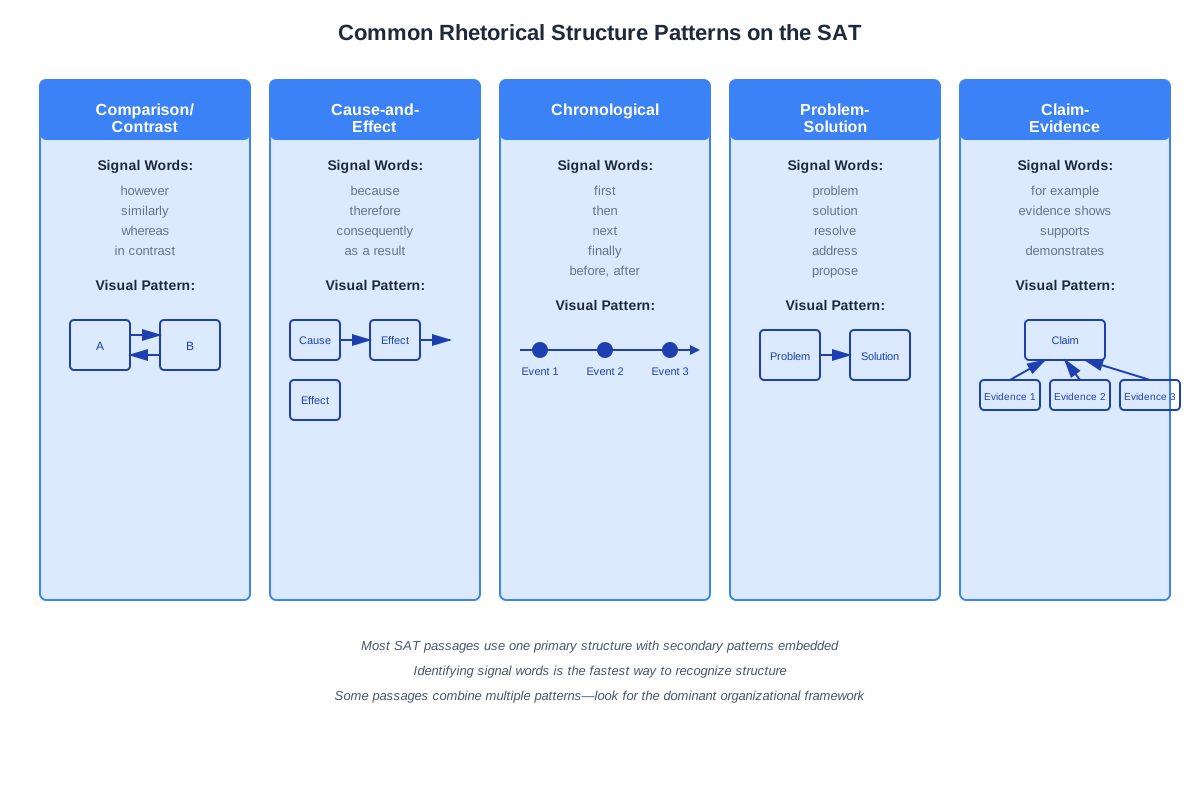
The foundation of rhetorical structure lies in recognizing the major organizational patterns authors use to arrange information. Each pattern serves specific communicative purposes and creates different effects on readers.
Chronological/Sequential Structure arranges information in time order or step-by-step sequences. This pattern appears frequently in historical narratives, process descriptions, and biographical passages. Authors use temporal transitions like "first," "subsequently," "eventually," and "finally" to signal this structure. On the SAT, chronological passages often trace the development of scientific discoveries, historical events, or biographical milestones.
Cause-and-Effect Structure establishes relationships between events, actions, or phenomena and their consequences. This pattern may present a single cause with multiple effects, multiple causes leading to one effect, or causal chains where one effect becomes the cause of subsequent events. Signal words include "because," "consequently," "as a result," "leads to," and "therefore." SAT passages using this structure frequently discuss scientific phenomena, historical developments, or social trends.
Compare-and-Contrast Structure examines similarities and differences between two or more subjects. Authors may use block organization (discussing all aspects of Subject A, then all aspects of Subject B) or point-by-point organization (alternating between subjects for each characteristic). Transition words like "similarly," "in contrast," "whereas," "both," and "unlike" signal this pattern. The SAT commonly uses this structure when presenting competing theories, different approaches to a problem, or contrasting perspectives.
Problem-Solution Structure identifies an issue, challenge, or question and then presents one or more responses, answers, or resolutions. This pattern often appears in scientific and social science passages where researchers address questions or policymakers tackle challenges. The structure typically includes background on the problem, explanation of why it matters, and detailed discussion of proposed or implemented solutions.
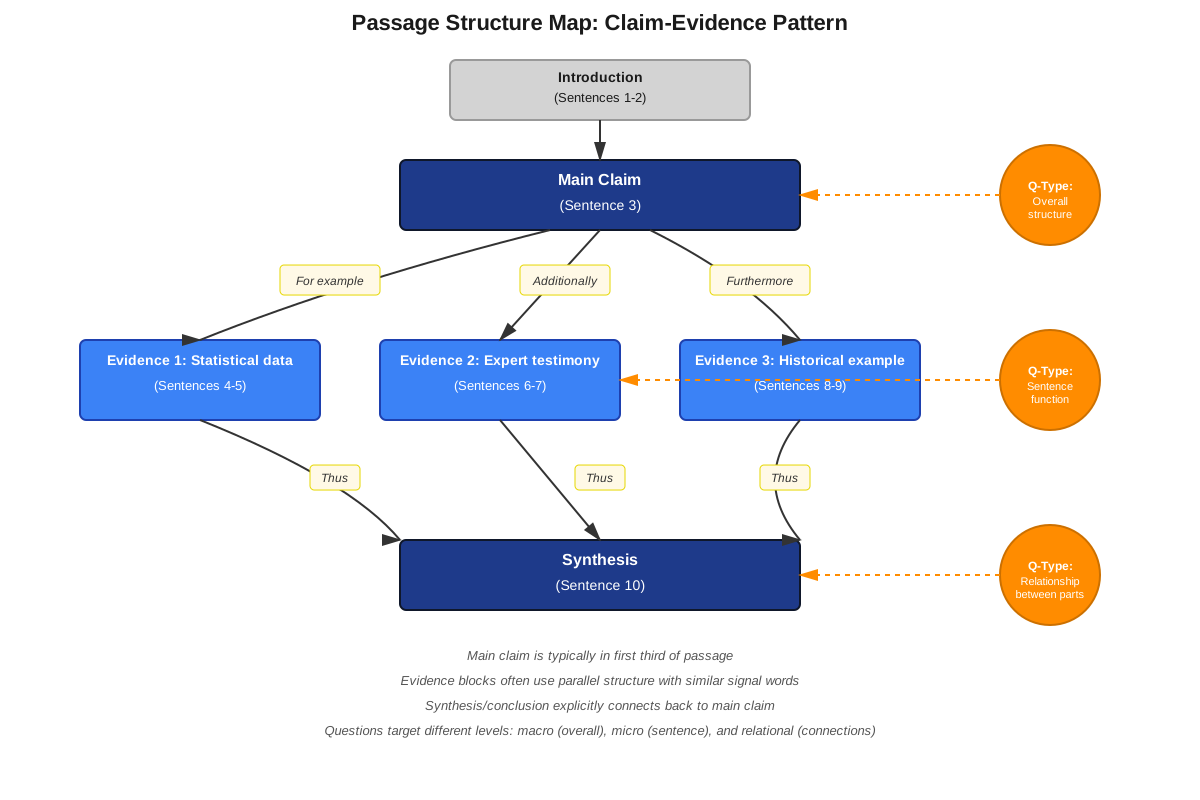
Claim-Evidence Structure presents an argument, thesis, or assertion followed by supporting information, examples, data, or reasoning. This pattern dominates argumentative and analytical passages. The claim may appear at the beginning (deductive structure) or at the end after presenting evidence (inductive structure). SAT passages frequently use this structure in both scientific and humanities contexts.
Functional Roles of Sentences
Beyond overall organizational patterns, understanding how individual sentences function within a passage is crucial for SAT success. Each sentence serves a specific structural function that contributes to the passage's overall purpose.
Introductory sentences establish context, present the main topic, or pose a question the passage will address. These sentences orient readers and set up the information that follows. On the SAT, questions may ask students to identify which sentence "introduces the passage's main subject" or "establishes the context for the discussion."
Claim or thesis sentences state the author's main argument, position, or central idea. These sentences represent what the author wants readers to accept or understand. Recognizing claim sentences helps students distinguish between the author's position and supporting information.
Evidence sentences provide support for claims through data, examples, expert testimony, logical reasoning, or factual information. These sentences answer the implicit question "How do you know?" or "What supports that claim?" Understanding this function helps students recognize the relationship between assertions and their justification.
Elaboration sentences expand on, clarify, or provide additional detail about a previously stated idea. These sentences don't introduce new major points but deepen understanding of existing points. Signal phrases like "in other words," "specifically," or "that is" often introduce elaboration.
Transition sentences connect different sections of a passage, showing relationships between ideas and guiding readers through the argument's progression. These sentences may signal shifts in focus, introduce contrasting viewpoints, or show causal relationships.
Concession sentences acknowledge opposing viewpoints, limitations, or counterarguments before refuting them or explaining why they don't undermine the main argument. Words like "although," "admittedly," "while it's true that," and "despite" often signal concessions.
Conclusion sentences synthesize information, restate main points, or explain implications and significance. These sentences provide closure and often emphasize why the information matters.
Structural Markers and Transitions
Transition words and phrases serve as explicit signals of rhetorical structure, indicating relationships between ideas and guiding readers through the text's organization. Recognizing these markers helps students quickly identify structural patterns.
| Structural Relationship | Common Transitions |
|---|---|
| Addition/Continuation | furthermore, moreover, additionally, also, in addition |
| Contrast/Opposition | however, nevertheless, conversely, on the other hand, yet |
| Cause/Effect | therefore, consequently, thus, as a result, because |
| Example/Illustration | for instance, for example, specifically, such as |
| Emphasis | indeed, in fact, certainly, notably, especially |
| Sequence | first, next, then, subsequently, finally |
| Comparison | similarly, likewise, in the same way, correspondingly |
| Concession | although, while, despite, admittedly, granted |
Analyzing Structural Choices
Understanding why authors choose particular structures involves recognizing the relationship between organizational patterns and communicative purposes. Different structures serve different rhetorical goals:
- Chronological structure works best for showing development over time, explaining processes, or narrating events where sequence matters
- Cause-effect structure effectively demonstrates relationships between phenomena, explains why events occurred, or predicts consequences
- Compare-contrast structure helps readers understand new concepts by relating them to familiar ones, evaluate alternatives, or recognize important distinctions
- Problem-solution structure motivates reader interest by establishing stakes, demonstrates practical applications of research, or proposes actionable responses
- Claim-evidence structure builds persuasive arguments, establishes credibility through support, or demonstrates logical reasoning
On the SAT, questions may ask students to identify not just what structure is present but why it's effective for the author's purpose. For example, a passage about climate change might use cause-effect structure to demonstrate how human activities lead to environmental consequences, making this organizational choice particularly appropriate for the author's goal of establishing causal relationships.
Concept Relationships
The concepts within rhetorical structure form an interconnected system where understanding one element enhances comprehension of others. Organizational patterns provide the macro-level framework, while functional roles of sentences represent the micro-level building blocks that create those patterns. Transition words serve as the explicit connective tissue linking these elements, making structural relationships visible to readers.
This relationship flows as follows: Authors select an organizational pattern based on their purpose → They construct the passage using sentences with specific functional roles → They use transition words to signal relationships and guide readers through the structure → Readers recognize these elements to understand both content and structure.
Rhetorical structure connects to prerequisite knowledge by building on basic paragraph structure (topic sentence + supporting details) and extending it to longer passages with more complex organizational schemes. It also relates to main idea identification because the structure often reveals which ideas are central (claims, thesis statements) versus supporting (evidence, examples).
Looking forward, mastery of rhetorical structure enables progression to more advanced skills like synthesis (combining information from multiple sources with different structures), rhetorical analysis (evaluating the effectiveness of structural choices), and sophisticated writing (deliberately employing various structures for specific purposes).
The relationship map: Purpose → determines → Organizational Pattern → implemented through → Sentence Functions → signaled by → Transitions → enables → Reader Comprehension → supports → Effective Response to SAT Questions
High-Yield Facts
⭐ Approximately 13-15% of SAT Reading and Writing questions directly test rhetorical structure, making it one of the highest-yield topics
⭐ The five most common organizational patterns on the SAT are: chronological, cause-effect, compare-contrast, problem-solution, and claim-evidence
⭐ Transition words are the most reliable explicit signals of structural relationships between ideas
⭐ Questions asking "Which choice best describes the overall structure of the text?" require identifying the passage's organizational pattern
⭐ Questions asking "Which choice best describes the function of the underlined sentence?" require determining the sentence's role within the passage structure
- Rhetorical structure questions appear across all content domains: science, social studies, humanities, and literature
- Most SAT passages use multiple organizational patterns, but one typically dominates the overall structure
- Evidence sentences are the most common sentence type in SAT passages, as most passages aim to support claims with information
- Concession sentences often appear before strong claims, following the pattern: acknowledge opposing view → refute or qualify it → state main claim
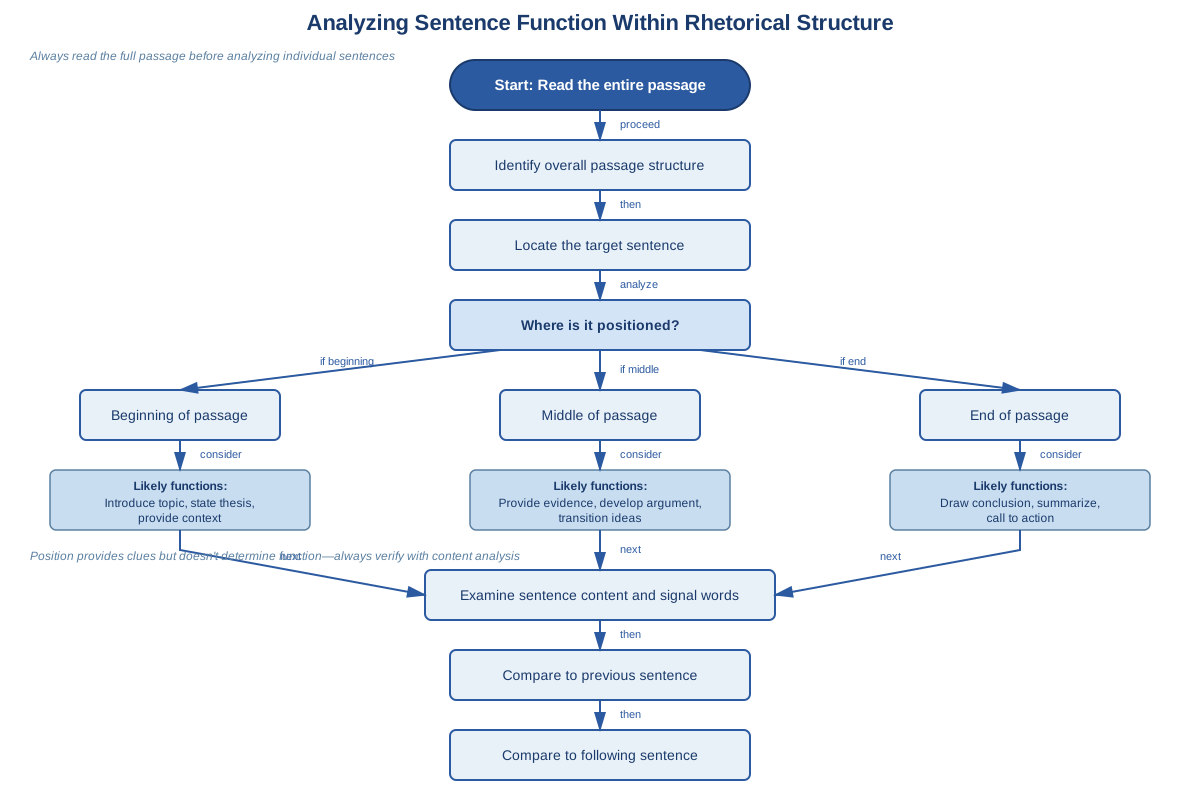
- The position of a sentence within a passage provides clues to its function: opening sentences typically introduce or establish context, while closing sentences often emphasize significance or implications
Quick check — test yourself on Rhetorical structure so far.
Try Flashcards →Common Misconceptions
Misconception: Rhetorical structure only refers to the overall organization of a passage → Correction: Rhetorical structure operates at multiple levels, including overall organizational patterns, paragraph-level structure, and sentence-level functions. SAT questions test understanding at all these levels.
Misconception: Identifying transition words is sufficient for understanding structure → Correction: While transition words are helpful signals, understanding structure requires recognizing the actual relationships between ideas, not just the presence of transitional phrases. Some structural relationships are implicit rather than explicitly signaled.
Misconception: All passages follow a single, pure organizational pattern → Correction: Most real-world passages, including those on the SAT, combine multiple organizational patterns. A passage might have an overall compare-contrast structure while using cause-effect relationships within individual paragraphs.
Misconception: The first sentence always introduces the main claim → Correction: While opening sentences often establish context or introduce topics, the main claim may appear later in the passage. Some passages use inductive structure, presenting evidence first and stating the main claim at the end.
Misconception: Longer sentences have more important structural functions → Correction: Sentence length doesn't determine structural importance. A brief sentence can state the main claim, while a longer sentence might provide supporting detail. Function depends on content and position, not length.
Misconception: Rhetorical structure questions are subjective and have multiple correct answers → Correction: These questions have definitively correct answers based on objective analysis of how ideas are organized and how sentences function. The SAT provides clear evidence within the passage to support the correct answer.
Misconception: Understanding structure isn't necessary if you comprehend the content → Correction: Content comprehension and structural understanding are distinct skills. You might understand what a passage says without recognizing how it's organized, but SAT questions specifically test structural awareness, requiring explicit analysis of organization.
Worked Examples
Example 1: Identifying Overall Structure
Passage: "The Industrial Revolution transformed manufacturing processes in the late 18th and early 19th centuries. Previously, goods were produced by hand in small workshops or homes, a system that limited production capacity and kept costs high. The introduction of water-powered and steam-powered machinery changed this dramatically. Factories could now produce goods in much larger quantities and at lower costs. This shift had profound consequences: urban populations swelled as workers migrated to factory towns, traditional craft skills became less valuable, and the gap between industrial and agricultural economies widened. These changes, in turn, sparked social and political movements that would reshape society for generations."
Question: Which choice best describes the overall structure of the text?
A) It presents a problem and then proposes multiple solutions
B) It describes a historical development and traces its effects
C) It compares two competing theories about economic change
D) It introduces a claim and provides supporting evidence
Solution:
Step 1: Identify the main organizational pattern by examining how ideas progress through the passage.
The passage begins by identifying a historical event (Industrial Revolution) and describing the previous state of affairs. It then explains what changed (introduction of machinery) and systematically traces the consequences of this change (increased production, urbanization, devaluation of craft skills, economic gaps, social movements).
Step 2: Eliminate answer choices that don't match this pattern.
Choice A is incorrect because the passage doesn't identify a problem requiring solutions; it describes a historical transformation and its consequences.
Choice C is incorrect because the passage doesn't present competing theories or compare different viewpoints; it traces a single historical development.
Choice D is incorrect because while the passage contains factual claims, its primary organization isn't claim-evidence but rather event-consequences.
Step 3: Confirm the correct answer.
Choice B accurately describes the structure: the passage describes a historical development (Industrial Revolution and mechanization) and traces its effects (increased production, urbanization, economic changes, social movements). This is a cause-effect structure focused on historical change.
Answer: B
Connection to Learning Objectives: This example demonstrates how to identify the overall organizational pattern (cause-effect/chronological) and apply this understanding to answer SAT-style questions by systematically analyzing how ideas progress through the passage.
Example 2: Determining Sentence Function
Passage: "Marine biologists have long observed that coral reefs support extraordinary biodiversity, with thousands of species inhabiting relatively small areas. Recent research by Dr. Elena Martinez suggests that this diversity results from the complex three-dimensional structure reefs provide. The intricate architecture creates numerous microhabitats, each with distinct light levels, water flow patterns, and nutrient availability. This structural complexity allows species with different environmental requirements to coexist in close proximity. While some scientists initially attributed reef biodiversity primarily to warm water temperatures and abundant sunlight, Martinez's findings indicate that physical structure plays an equally crucial role."
Question: Which choice best describes the function of the underlined sentence in the text?
A) It presents the main claim that the passage seeks to support
B) It provides a contrasting viewpoint to Martinez's research
C) It explains the mechanism behind the phenomenon Martinez identified
D) It introduces a limitation of Martinez's research findings
Solution:
Step 1: Identify what comes before and after the underlined sentence to understand its context.
Before: Martinez's research suggests diversity results from three-dimensional structure
Underlined sentence: Describes how the architecture creates microhabitats with varying conditions
After: Explains that this complexity allows species coexistence
Step 2: Determine the relationship between the underlined sentence and surrounding content.
The underlined sentence doesn't introduce a new claim—it elaborates on Martinez's finding mentioned in the previous sentence. It doesn't contrast with Martinez's research—it supports and explains it. It doesn't present a limitation—it provides detail about how the mechanism works.
Step 3: Identify the specific function.
The underlined sentence explains how the three-dimensional structure leads to biodiversity. It describes the mechanism: complex architecture → creates microhabitats → different conditions in each microhabitat. This is an elaboration/explanation sentence that clarifies the causal mechanism behind Martinez's finding.
Step 4: Match this function to the answer choices.
Choice C correctly identifies this function: the sentence explains the mechanism (how structure creates diverse microhabitats) behind the phenomenon Martinez identified (structure-driven biodiversity).
Answer: C
Connection to Learning Objectives: This example demonstrates how to analyze individual sentence functions within a passage's structure, recognizing that the underlined sentence serves an explanatory role that bridges the claim (structure causes diversity) and the consequence (species coexistence).
Exam Strategy
When approaching rhetorical structure questions on the SAT, employ a systematic process that moves from understanding content to analyzing organization:
Step 1: Read for Content First - Before analyzing structure, ensure you understand what the passage says. Identify the main topic, key claims, and supporting information. This content comprehension provides the foundation for structural analysis.
Step 2: Identify Structural Signals - Look for transition words, repeated concepts, and shifts in focus. These markers reveal how ideas connect and where the passage changes direction. Pay special attention to words like "however" (contrast), "therefore" (cause-effect), "for example" (evidence), and "similarly" (comparison).
Step 3: Map the Passage's Organization - Create a mental or brief written outline of how the passage progresses. Ask: What does each section do? How do the parts relate? This bird's-eye view helps identify overall organizational patterns.
For "Overall Structure" Questions:
- Read the entire passage before selecting an answer
- Identify the dominant organizational pattern (even if multiple patterns appear)
- Eliminate choices that describe only part of the passage
- Confirm your answer accounts for all major sections
For "Sentence Function" Questions:
- Read at least one sentence before and after the target sentence
- Determine whether the sentence introduces new information, supports a previous claim, contrasts with prior content, or provides examples
- Consider the sentence's position: opening sentences often introduce, middle sentences often support, closing sentences often conclude or emphasize significance
- Match the sentence's actual role to answer choices, avoiding choices that describe content rather than function
Trigger Words to Watch For:
In questions: "overall structure," "function of the sentence," "role of the underlined portion," "best describes how the text is organized," "primarily serves to"
In answer choices: "introduces," "supports," "contrasts," "elaborates," "refutes," "acknowledges," "illustrates," "explains," "emphasizes," "concludes"
Process of Elimination Tips:
- Eliminate choices that describe content rather than structure (e.g., "discusses coral reefs" instead of "provides supporting evidence")
- Eliminate choices that apply to only part of the passage when the question asks about overall structure
- Eliminate choices that describe functions the sentence doesn't perform, even if that function appears elsewhere in the passage
- Be wary of choices using extreme language ("completely refutes," "proves definitively") unless the passage clearly supports such strong claims
Time Allocation: Spend approximately 60-75 seconds on rhetorical structure questions. These questions require careful analysis but shouldn't demand extensive time since the passages are relatively short (50-150 words). If you're spending more than 90 seconds, make your best educated guess and move forward.
Memory Techniques
CCCPC Mnemonic for Major Organizational Patterns:
- Chronological (time order)
- Cause-effect (relationships between events)
- Compare-contrast (similarities and differences)
- Problem-solution (issue and response)
- Claim-evidence (argument and support)
TICCE Mnemonic for Common Sentence Functions:
- Transition (connects ideas)
- Introduce (establishes context or topic)
- Claim (states main argument)
- Concede (acknowledges opposing view)
- Evidence (supports claims)
Visualization Strategy for Structure: Picture the passage as a building. The overall organizational pattern is the architectural style (ranch house, skyscraper, etc.). Individual paragraphs are rooms with specific purposes (kitchen, bedroom). Sentences are furniture pieces that serve particular functions. Transitions are doorways connecting rooms. This spatial metaphor helps visualize how parts relate to the whole.
The "So What?" Test for Sentence Function: When determining a sentence's function, ask "So what does this sentence do for the passage?" If it answers "What's the main point?"—it's a claim. If it answers "How do you know?"—it's evidence. If it answers "What about opposing views?"—it's a concession. If it answers "What does this mean?"—it's elaboration.
Transition Word Categories Acronym - CECE:
- Contrast (however, nevertheless, yet)
- Example (for instance, such as)
- Cause (therefore, consequently, thus)
- Extension (furthermore, moreover, additionally)
Summary
Rhetorical structure encompasses both the overall organizational patterns authors use to arrange information and the specific functions individual sentences serve within those patterns. The five most common organizational patterns on the SAT—chronological, cause-effect, compare-contrast, problem-solution, and claim-evidence—each serve distinct communicative purposes and appear across all content domains. Understanding rhetorical structure requires recognizing explicit signals like transition words while also analyzing implicit relationships between ideas. SAT questions test this understanding by asking students to identify overall organizational patterns or determine how specific sentences function within passages. Success requires moving beyond content comprehension to structural analysis: recognizing not just what a passage says but how it's constructed and why those organizational choices effectively serve the author's purpose. Mastering this skill provides advantages on 13-15% of Reading and Writing questions and enhances overall reading comprehension by helping students predict where information will appear and how ideas relate throughout a text.
Key Takeaways
- Rhetorical structure questions constitute 13-15% of SAT Reading and Writing questions, making this a high-yield topic requiring thorough mastery
- The five dominant organizational patterns—chronological, cause-effect, compare-contrast, problem-solution, and claim-evidence—account for the vast majority of passage structures on the exam
- Transition words serve as explicit structural signals, but understanding structure also requires recognizing implicit relationships between ideas
- Sentence function questions require analyzing what a sentence does (its role) rather than what it says (its content)
- Successful structural analysis involves reading for content first, then identifying organizational patterns and sentence functions through systematic examination of how ideas progress and relate
- Most passages combine multiple organizational patterns, but one typically dominates the overall structure
- Understanding rhetorical structure enhances performance not only on direct structure questions but also on inference, purpose, and synthesis questions by revealing how passages are constructed
Related Topics
Main Idea and Purpose: Understanding rhetorical structure directly supports identifying main ideas, as organizational patterns reveal which ideas are central versus supporting. Mastering structure helps distinguish between the author's primary claim and the evidence used to support it.
Transitions and Logical Flow: This topic explores in greater depth how transition words and phrases create coherence within and between sentences, building on the structural signals introduced in rhetorical structure.
Argument Analysis: Analyzing arguments requires understanding claim-evidence structure, recognizing how authors support assertions, and identifying counterarguments—all skills that build directly on rhetorical structure foundations.
Synthesis Questions: These questions require combining information from multiple sources, often with different organizational structures. Mastering rhetorical structure enables efficient navigation of multiple passages and recognition of how different texts approach similar topics.
Rhetorical Devices and Style: While rhetorical structure focuses on organization, rhetorical devices examine specific techniques authors use within that structure to achieve effects, representing a natural progression toward more sophisticated textual analysis.
Practice CTA
Now that you've mastered the core concepts of rhetorical structure, it's time to apply this knowledge through practice. Attempt the practice questions to test your ability to identify organizational patterns and determine sentence functions in authentic SAT-style passages. Use the flashcards to reinforce key terminology and structural signals. Remember: recognizing rhetorical structure is a skill that improves with deliberate practice. Each question you analyze strengthens your ability to see how passages are constructed, giving you a significant advantage on test day. You've built the foundation—now solidify it through application!
Sign up free to keep reading
Create a free AnvayaPrep account to finish this SAT guide on Rhetorical structure — plus flashcards and practice questions.