Overview
The role of concession is a critical rhetorical device that appears frequently in SAT Reading and Writing passages. A concession occurs when an author acknowledges a point that seems to contradict or weaken their main argument before ultimately reinforcing their position. This sophisticated writing technique demonstrates intellectual honesty and strengthens persuasive writing by addressing counterarguments directly. Understanding how concessions function allows students to identify an author's true position even when they temporarily appear to support an opposing view.
On the SAT, questions about the role of concession typically ask students to identify why an author includes information that seems contrary to their thesis or how a particular sentence functions within the broader argument structure. These questions test reading comprehension at a sophisticated level, requiring students to distinguish between what an author acknowledges and what they ultimately argue. Mastering this concept is essential because concession questions appear regularly in the RW (Reading and Writing) section and often challenge students who focus only on surface-level content rather than argumentative structure.
The role of concession connects directly to broader concepts in text structure and purpose, including author's purpose, argumentative reasoning, and rhetorical strategies. When students understand concessions, they gain insight into how skilled writers build credibility, anticipate objections, and create more nuanced arguments. This understanding proves valuable not only for answering direct questions about concessions but also for comprehending complex passages where authors present multiple perspectives before establishing their position.
Learning Objectives
- [ ] Identify key features of role of concession in SAT passages
- [ ] Explain how role of concession appears on the SAT
- [ ] Apply role of concession to answer SAT-style questions
- [ ] Distinguish between genuine concessions and statements that support the main argument
- [ ] Recognize common transition words and phrases that signal concessions
- [ ] Analyze how concessions strengthen rather than weaken an author's overall argument
- [ ] Evaluate the strategic placement of concessions within argumentative texts
Prerequisites
- Basic understanding of main idea and thesis statements: Recognizing concessions requires first identifying what the author's primary argument is, so students must be able to distinguish central claims from supporting details.
- Familiarity with argumentative structure: Students should understand that arguments consist of claims, evidence, and reasoning, as concessions function as a specific type of argumentative move.
- Knowledge of transition words and phrases: Many concessions are signaled by specific transitional language, so recognizing these markers helps identify when an author is making a concession.
- Ability to identify author's tone and purpose: Understanding whether an author ultimately supports or opposes an idea requires sensitivity to tone and rhetorical purpose.
Why This Topic Matters
Understanding the role of concession has significant real-world applications beyond standardized testing. In academic writing, professional communication, and everyday discourse, recognizing when someone acknowledges opposing viewpoints helps readers evaluate the strength and fairness of arguments. This skill proves essential in analyzing political speeches, opinion articles, scientific debates, and legal reasoning. People who understand concessions can better assess whether an argument addresses legitimate objections or simply ignores contrary evidence.
On the SAT, concession-related questions appear with high frequency, typically 2-4 times per test in the Reading and Writing section. These questions often appear in the "Craft and Structure" category, which comprises approximately 28% of the RW section. The College Board specifically tests whether students can identify how specific sentences or paragraphs function within a larger argument, and concessions represent one of the most common functional roles tested.
Concessions appear in SAT passages in several predictable ways: authors may acknowledge limitations of their own research, recognize valid points made by opponents, admit exceptions to general rules, or concede that alternative explanations have some merit. These concessions typically appear before transition words like "however," "nevertheless," or "yet" that signal the author's return to their main argument. Questions might ask "Which choice best describes the function of the underlined sentence?" or "The author mentions [opposing view] primarily to..." Understanding concessions allows students to recognize that these seemingly contradictory statements actually serve to strengthen the author's credibility and overall argument.
Core Concepts
Definition and Function of Concession
A concession is a rhetorical move in which an author acknowledges a point, fact, or argument that appears to contradict or weaken their main position. Rather than ignoring opposing viewpoints or contrary evidence, skilled writers incorporate concessions strategically to demonstrate fairness, build credibility, and ultimately strengthen their arguments. The key characteristic of a true concession is that it temporarily grants validity to an opposing perspective before the author pivots back to reinforce their own position.
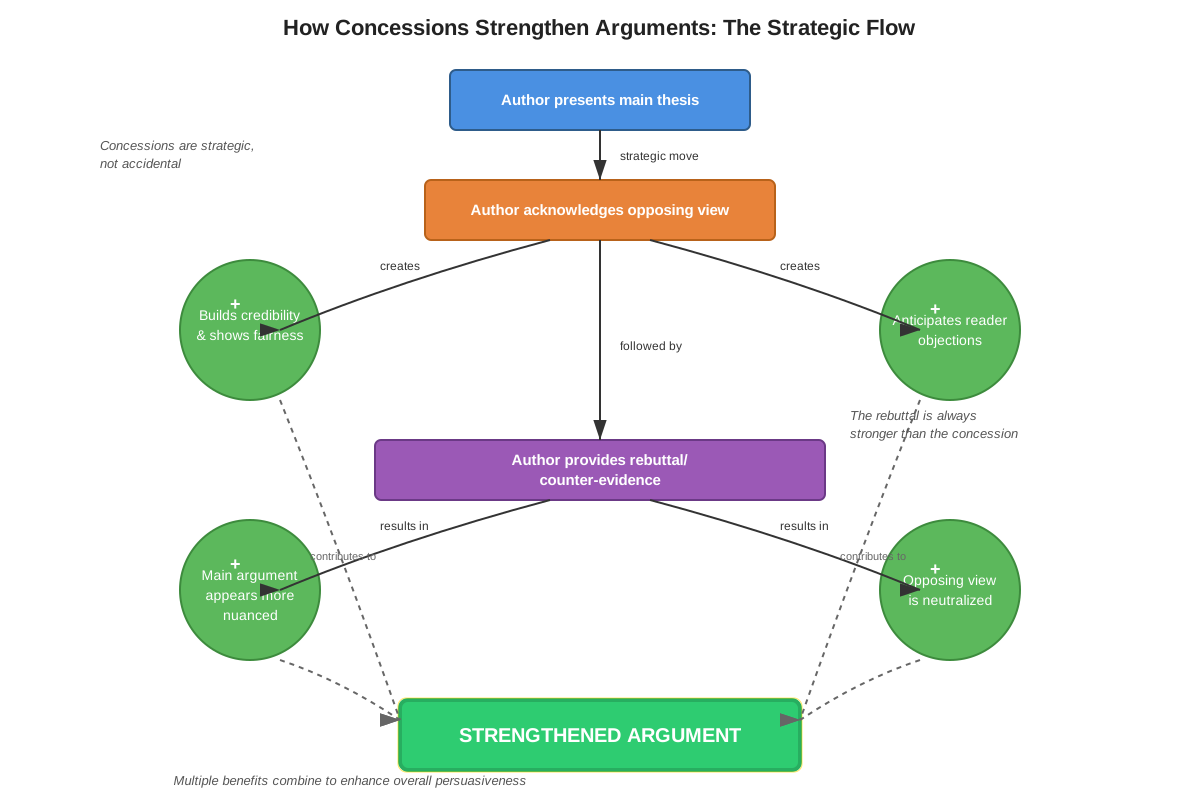
Concessions serve multiple rhetorical functions. First, they establish the author as reasonable and intellectually honest—someone who has considered alternative viewpoints rather than simply ignoring them. Second, they allow the author to control the narrative around potential objections by addressing them directly rather than leaving readers to wonder about unaddressed counterarguments. Third, they create opportunities for the author to demonstrate why, despite the validity of certain opposing points, their own argument remains stronger overall.
Structural Patterns of Concession
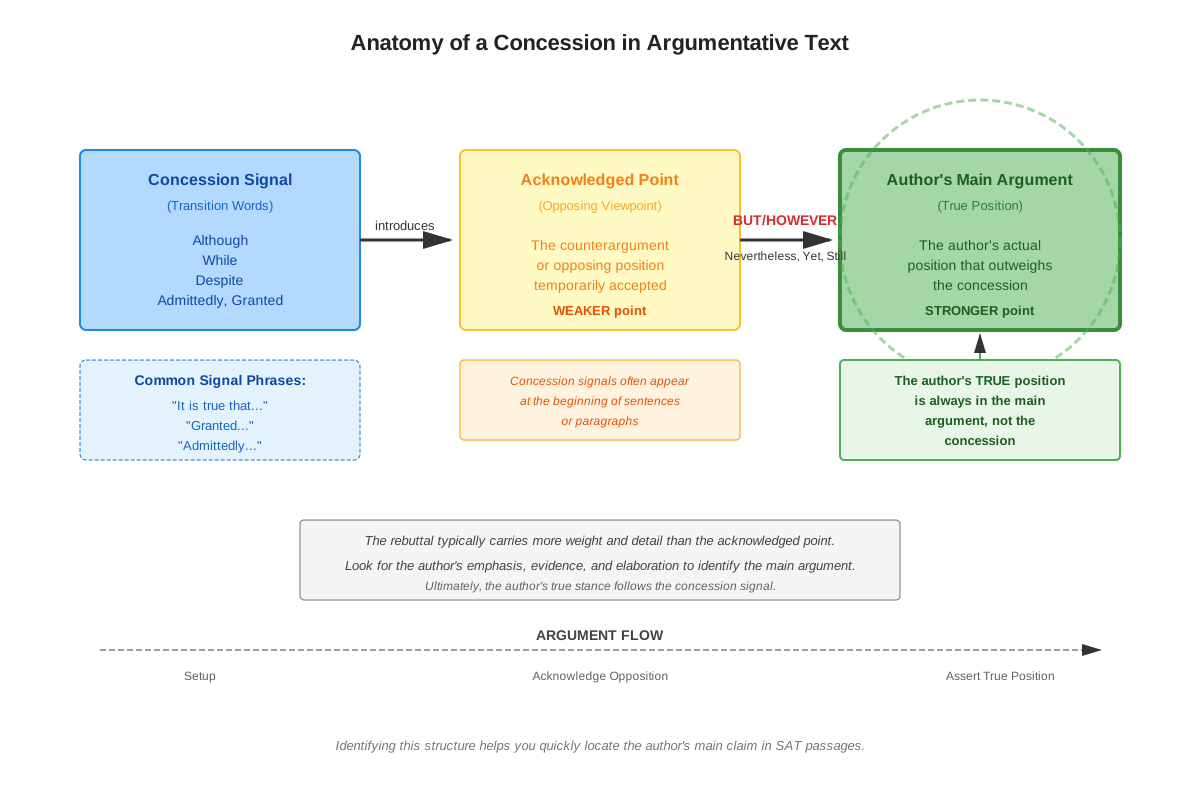
Concessions follow predictable structural patterns that help readers identify them. The most common pattern consists of three parts:
- The concession statement: The author acknowledges an opposing point, limitation, or exception
- The transition: A contrasting word or phrase signals the shift back to the main argument
- The rebuttal or reinforcement: The author reasserts their position, often explaining why it remains valid despite the concession
For example: "While some studies suggest that homework has minimal impact on elementary students (concession), research consistently demonstrates that structured practice significantly improves retention in middle and high school students (rebuttal)." This pattern allows authors to acknowledge contrary evidence while maintaining their overall argumentative stance.
Signal Words and Phrases
Certain transition words and phrases reliably indicate concessions. Recognizing these markers helps students quickly identify when an author is making a concession:
Concession indicators (introducing the opposing view):
- Although, though, even though
- While, whereas
- Despite, in spite of
- Admittedly, granted, certainly
- It is true that, no doubt
- To be sure, of course
Contrast indicators (pivoting back to main argument):
- However, nevertheless, nonetheless
- Yet, still, but
- Even so, all the same
- That said, having said that
- Regardless, in any case
Understanding this two-part signal system—concession markers followed by contrast markers—allows students to recognize the complete concession pattern and understand how the author is structuring their argument.
Types of Concessions
| Type | Description | Example Context |
|---|---|---|
| Limitation Concession | Author acknowledges limitations of their own argument or research | "While this study examined only urban populations..." |
| Opposing Evidence Concession | Author recognizes valid evidence that supports an alternative view | "Although some data suggests benefits to the alternative approach..." |
| Exception Concession | Author admits exceptions to their general claim | "Though this principle holds in most cases, certain situations require different approaches..." |
| Partial Agreement Concession | Author agrees with part of an opposing argument | "Critics are correct that implementation costs are high..." |
| Historical/Contextual Concession | Author acknowledges that their position may not have always been correct or may be context-dependent | "While this approach would have been impractical a decade ago..." |
Distinguishing Concessions from Supporting Points
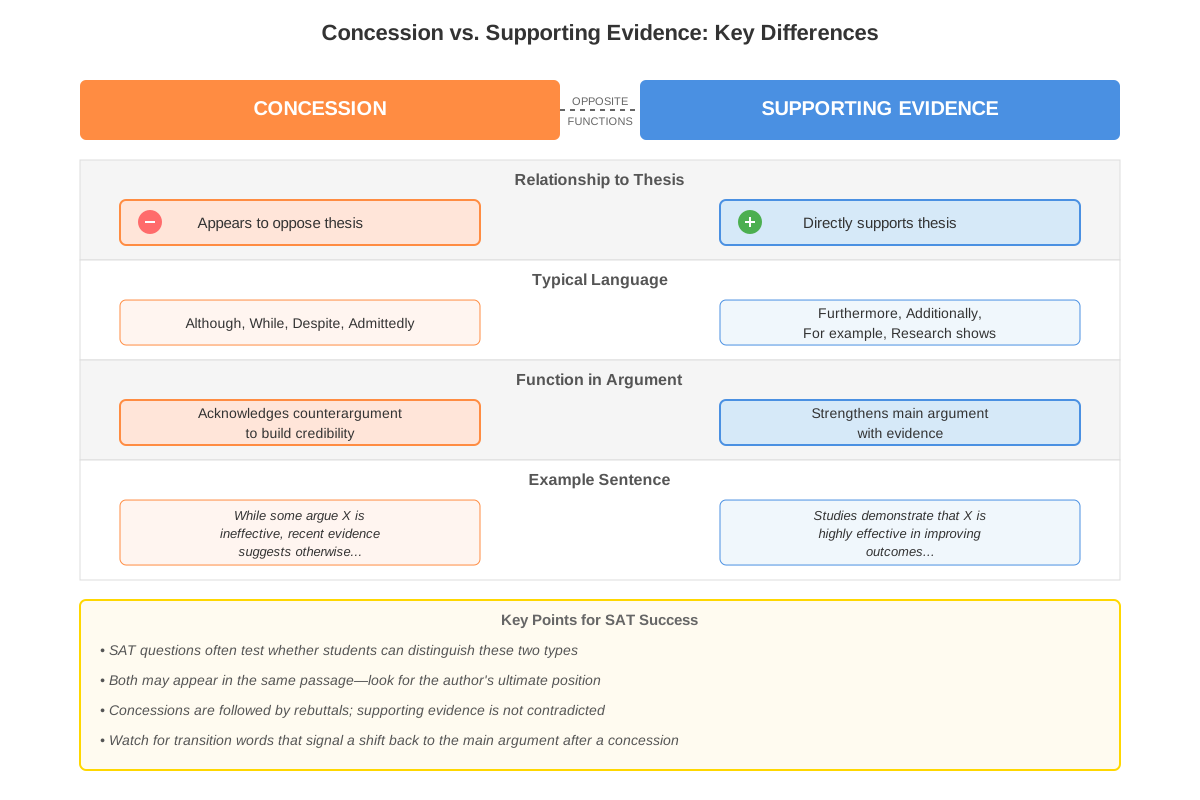
A critical skill for SAT success involves distinguishing genuine concessions from statements that actually support the author's main argument. This distinction confuses many students because both types of statements may present factual information. The key difference lies in whether the information appears to contradict or support the author's position.
Supporting points align with and strengthen the author's thesis. They provide evidence, examples, or reasoning that directly advances the main argument. Concessions, by contrast, acknowledge information that seems to weaken the author's position or support an opposing view—even though the author ultimately uses this acknowledgment to strengthen their overall argument.
Consider these two statements in an argument supporting renewable energy:
- "Solar panel efficiency has increased by 40% in the past decade" (supporting point—directly strengthens the argument)
- "Although solar installation costs remain high for individual homeowners" (concession—acknowledges a limitation before likely arguing that benefits outweigh costs)
Strategic Placement of Concessions
Authors strategically place concessions at specific points in their arguments. Understanding these placement patterns helps students predict where concessions will appear and why:
Early placement: Concessions near the beginning of a passage or paragraph allow authors to address objections upfront before building their positive case. This prevents readers from fixating on unaddressed counterarguments.
Mid-argument placement: Concessions in the middle of an argument often appear when transitioning between related points, acknowledging complexity while maintaining forward momentum.
Pre-conclusion placement: Some authors place concessions just before their conclusion, demonstrating that even after considering all objections, their position remains sound.
The placement itself often provides clues about the concession's function. Early concessions typically serve to establish credibility, while later concessions often emphasize the strength of the author's position by showing it withstands scrutiny.
Concept Relationships
The role of concession connects intimately with several other concepts in text structure and purpose. Understanding these relationships deepens comprehension and improves performance on complex SAT questions.
Concession → Argumentative Structure: Concessions function as a specific component within larger argumentative frameworks. They typically appear in the "acknowledgment of counterarguments" phase of classical argument structure, positioned between the presentation of the author's main claims and the final reinforcement of their position.
Transition Words → Concession Identification: Recognizing transition words serves as the primary mechanism for identifying concessions. The two-part pattern (concession markers + contrast markers) creates a reliable signal that students can use to locate and understand concessions quickly.
Author's Purpose → Concession Function: Understanding why authors include concessions requires grasping their broader purpose. Authors writing to persuade use concessions differently than those writing to inform or analyze. Persuasive concessions typically acknowledge opposing views before refuting them, while analytical concessions might present multiple valid perspectives without necessarily choosing one.
Main Idea → Concession Contrast: The relationship between main idea and concession is one of apparent contradiction. Students must first identify the main idea to recognize when a statement functions as a concession. The concession temporarily moves away from the main idea before the author redirects back to it.
Evidence and Support → Concession Distinction: While both concessions and supporting evidence present factual information, they serve opposite functions. Supporting evidence strengthens the main argument directly, while concessions acknowledge information that appears to weaken it. This distinction is crucial for answering function questions correctly.
Textual Relationship Map:
Main Idea Identification → Enables Recognition of Contradictory Information → Signals Potential Concession → Confirmed by Transition Words → Followed by Return to Main Argument → Strengthens Overall Argumentative Structure → Demonstrates Author's Credibility and Thoroughness
High-Yield Facts
⭐ Concessions acknowledge opposing viewpoints or limitations but ultimately strengthen rather than weaken the author's main argument.
⭐ The most common concession pattern includes: concession statement + contrasting transition word + return to main argument.
⭐ Words like "although," "while," "despite," and "admittedly" typically introduce concessions, while "however," "nevertheless," and "yet" signal the return to the main argument.
⭐ On the SAT, concession questions often ask about the "function" or "purpose" of a specific sentence or paragraph within the passage.
⭐ A statement is only a concession if it appears to contradict or complicate the author's main position; statements that directly support the thesis are not concessions.
- Concessions demonstrate intellectual honesty and make arguments more persuasive by showing the author has considered alternative perspectives.
- Authors may concede limitations of their own research, validity of opposing evidence, exceptions to their claims, or contextual factors that complicate their argument.
- The strategic placement of concessions—early, mid-argument, or pre-conclusion—serves different rhetorical purposes and provides clues about their function.
- Distinguishing between concessions and supporting points requires first identifying the author's main argument or thesis.
- Concession-related questions appear 2-4 times per SAT test, primarily in the Craft and Structure category of the Reading and Writing section.
- Multiple concessions in a single passage often indicate a nuanced, balanced argument that acknowledges complexity rather than presenting an oversimplified position.
- The strength of the rebuttal or reinforcement following a concession often indicates how seriously the author takes the opposing viewpoint.
Quick check — test yourself on Role of concession so far.
Try Flashcards →Common Misconceptions
Misconception: Concessions weaken an author's argument by admitting flaws or acknowledging opposing views.
Correction: Concessions actually strengthen arguments by demonstrating that the author has considered alternatives and still maintains their position. They build credibility and make arguments more persuasive by showing intellectual honesty rather than one-sided thinking.
Misconception: Any statement that presents a different perspective is a concession.
Correction: A concession must acknowledge a point that appears to contradict or complicate the author's main argument. Statements that present alternative views the author clearly disagrees with (without granting them any validity) are not concessions—they are simply descriptions of opposing positions that the author will refute.
Misconception: The presence of words like "however" or "but" always indicates a concession.
Correction: These contrast words often follow concessions, but they can also introduce other types of contrasts or shifts in an argument. The concession itself typically appears before these words, introduced by terms like "although" or "while." The "however" signals the return to the main argument, not the concession itself.
Misconception: If an author concedes a point, they are changing their position or admitting they were wrong.
Correction: Concessions acknowledge validity in opposing viewpoints or limitations in the author's own argument without abandoning the main position. Authors use concessions strategically while maintaining their overall thesis. The concession is temporary and controlled, not a reversal of position.
Misconception: Concessions only appear in argumentative or persuasive texts.
Correction: While concessions are most common in argumentative writing, they also appear in informative and analytical texts where authors acknowledge complexity, limitations of current knowledge, or multiple valid interpretations. Scientific writing frequently includes concessions about research limitations or alternative explanations.
Misconception: The longer a concession section, the more the author doubts their own position.
Correction: The length of a concession reflects the complexity of the issue and the author's thoroughness, not their level of doubt. Detailed concessions often appear in sophisticated arguments where authors want to demonstrate they have carefully considered objections. The strength of the subsequent rebuttal matters more than the length of the concession.
Worked Examples
Example 1: Identifying Concession Function
Passage excerpt: "Urban vertical farming offers promising solutions to food security challenges in densely populated areas. These innovative agricultural systems can produce crops year-round in controlled environments, using significantly less water than traditional farming. Although initial construction and operational costs for vertical farms remain substantially higher than conventional agriculture, the long-term benefits of reduced transportation costs, elimination of weather-related crop failures, and decreased pesticide use make vertical farming economically viable for many urban centers."
Question: Which choice best describes the function of the underlined sentence in the overall argument?
A) It provides evidence that vertical farming is too expensive to implement widely.
B) It acknowledges a limitation of vertical farming before arguing that benefits outweigh this drawback.
C) It contradicts the author's main claim about vertical farming's promise.
D) It introduces an alternative perspective that the author will explore in detail.
Solution Process:
Step 1: Identify the main argument. The author clearly supports urban vertical farming, as evidenced by phrases like "promising solutions" and the list of benefits in the first two sentences.
Step 2: Analyze the underlined sentence. It begins with "Although," a classic concession marker, and presents information (high costs) that appears to contradict or weaken the argument for vertical farming.
Step 3: Examine what follows the concession. The author immediately pivots with "the long-term benefits" and provides reasons why vertical farming remains "economically viable" despite the acknowledged costs.
Step 4: Evaluate answer choices:
- Choice A misinterprets the concession as the author's final position, ignoring the rebuttal that follows
- Choice B correctly identifies this as a concession (acknowledging a limitation) followed by a rebuttal (benefits outweigh drawbacks)
- Choice C incorrectly suggests the concession contradicts rather than complicates the main claim
- Choice D is incorrect because the author doesn't explore this alternative in detail; they quickly return to supporting vertical farming
Answer: B
Connection to learning objectives: This example demonstrates how to identify key features of concessions (concession markers, apparent contradiction to main argument) and apply this understanding to answer SAT-style questions about textual function.
Example 2: Distinguishing Concession from Supporting Evidence
Passage excerpt: "The Mediterranean diet has gained recognition as one of the healthiest eating patterns worldwide. Studies consistently show that adherence to this diet reduces cardiovascular disease risk by up to 30%. While individual responses to dietary changes vary based on genetic factors and existing health conditions, population-level data demonstrates clear benefits. The diet's emphasis on olive oil, fish, and vegetables provides essential nutrients and anti-inflammatory compounds. Some nutritionists argue that any balanced diet with similar caloric content would produce comparable results, but research specifically comparing Mediterranean dietary patterns to other healthy eating plans shows superior outcomes for heart health and longevity."
Question: The author includes two italicized statements. How do these statements function differently in the argument?
Solution Process:
Step 1: Identify the main argument. The author supports the Mediterranean diet as particularly beneficial for health, specifically cardiovascular health.
Step 2: Analyze the first italicized statement. It begins with "While," a concession marker, and acknowledges that individual results vary—a limitation that could complicate the argument. However, the author immediately follows with "population-level data demonstrates clear benefits," showing this is a concession followed by a rebuttal.
Step 3: Analyze the second italicized statement. It presents an opposing viewpoint (that any balanced diet would work equally well), which the author then refutes with "but research specifically comparing..." This is also a concession—acknowledging what "some nutritionists argue"—before refuting it.
Step 4: Determine the difference. Both statements are concessions, but they concede different types of information. The first concedes a limitation of the research (individual variation), while the second concedes an opposing interpretation (alternative explanation for the benefits).
Analysis: Both italicized statements function as concessions because they acknowledge information that appears to complicate or contradict the author's support for the Mediterranean diet. Neither is supporting evidence because neither directly strengthens the argument for the Mediterranean diet. Instead, both temporarily acknowledge complications before the author reinforces their position. This example illustrates that passages may contain multiple concessions serving different purposes within the same argument.
Connection to learning objectives: This example helps students distinguish between different types of concessions and recognize that multiple concessions can appear in a single passage, each serving a specific rhetorical function.
Exam Strategy
When approaching SAT role of concession questions, employ a systematic strategy that maximizes accuracy and efficiency:
Step 1: Identify the main argument first (15-20 seconds). Before analyzing any specific sentence, determine what the author's overall position is. Skim the passage for thesis statements, concluding sentences, or repeated claims. You cannot identify a concession without knowing what it appears to contradict.
Step 2: Look for structural signals (10 seconds). Scan for concession markers ("although," "while," "despite") and contrast markers ("however," "nevertheless," "yet"). These words create a roadmap showing where concessions likely appear.
Step 3: Apply the contradiction test (10 seconds). Ask: "Does this statement seem to weaken, contradict, or complicate the author's main position?" If yes, it's likely a concession. If it clearly supports the main argument, it's not a concession regardless of what transition words appear.
Step 4: Check for the rebuttal (10 seconds). True concessions are almost always followed by the author returning to their main argument. If a statement acknowledges an opposing view but no rebuttal follows, it might be presenting an alternative perspective rather than making a strategic concession.
Trigger words and phrases to watch for:
- Question stems asking about "function," "purpose," or "role" of a sentence
- Questions asking why an author "mentions" or "includes" specific information
- Answer choices containing words like "acknowledge," "concede," "grant," or "admit"
- Answer choices describing "limitations," "objections," or "counterarguments"
Process-of-elimination tips:
- Eliminate choices suggesting the concession represents the author's final position
- Eliminate choices that ignore the rebuttal following the concession
- Eliminate choices describing the statement as "supporting evidence" if it appears to contradict the main argument
- Be wary of choices using extreme language ("completely undermines," "proves wrong") for concession functions
Time allocation advice: Spend no more than 60 seconds total on concession questions. These questions test structural understanding rather than detailed content knowledge, so they should be answerable relatively quickly once you identify the main argument and locate the concession pattern. If you find yourself re-reading the entire passage, refocus on the specific sentence in question and the sentences immediately before and after it.
Exam Tip: When answer choices seem similar, focus on whether they correctly identify both parts of the concession pattern: (1) acknowledging an opposing point, and (2) ultimately maintaining the author's position. Incorrect answers often capture only one part of this pattern.
Memory Techniques
The "ACR" Mnemonic for Concession Structure:
- Acknowledge (the opposing point or limitation)
- Contrast (transition word signaling the shift)
- Reinforce (return to and strengthen the main argument)
Visualize this as a boomerang: the argument temporarily moves away (acknowledge) but curves back (contrast) to return stronger (reinforce).
The "WHADDY" Acronym for Concession Markers:
- While
- However (follows the concession)
- Although
- Despite
- Doubtless / admittedly
- Yet (follows the concession)
Remember: The first four introduce concessions; the last two signal the return to the main argument.
Visualization Strategy: Picture a debate where the author temporarily "hands the microphone" to an opponent, lets them make one point, then takes the microphone back and explains why their own position still stands. This mental image captures the essence of how concessions function rhetorically.
The "Opposite Day" Technique: When you encounter a statement that seems to contradict what you thought the author believed, mentally flag it as "Opposite Day"—a signal that you've likely found a concession. Then look for the transition word that ends "Opposite Day" and returns to the author's real position.
Color-Coding Mental Strategy: As you read, mentally "color-code" sentences:
- Green = supports main argument
- Yellow = concession (caution: this isn't the author's final position)
- Blue = neutral/background information
This mental categorization helps you quickly identify concessions and their function.
Summary
The role of concession represents a sophisticated rhetorical strategy where authors acknowledge opposing viewpoints, limitations, or contradictory evidence before ultimately reinforcing their main argument. Understanding concessions requires recognizing their three-part structure: the acknowledgment of an opposing point, a contrasting transition, and a return to the author's position. On the SAT Reading and Writing section, concession questions test whether students can identify how specific sentences function within larger arguments, distinguishing between statements that genuinely support the thesis and those that temporarily acknowledge complications before strengthening the overall argument. Success with these questions depends on first identifying the author's main position, then recognizing structural signals like "although" and "however" that mark concession patterns, and finally understanding that concessions build credibility and argumentative strength rather than weakening the author's position. Students must avoid the common misconception that concessions represent the author's final stance or indicate doubt; instead, concessions demonstrate intellectual honesty and thorough consideration of complex issues, making arguments more persuasive and nuanced.
Key Takeaways
- Concessions acknowledge opposing points or limitations but ultimately strengthen arguments by demonstrating thoroughness and intellectual honesty
- The standard concession pattern follows ACR structure: Acknowledge (opposing point) → Contrast (transition word) → Reinforce (main argument)
- Concession markers like "although," "while," and "despite" introduce the opposing point, while "however," "nevertheless," and "yet" signal the return to the main argument
- A statement only functions as a concession if it appears to contradict or complicate the author's main position; supporting evidence directly strengthens the thesis
- SAT questions about concessions typically ask about the "function" or "purpose" of specific sentences, requiring students to understand argumentative structure rather than just content
- Identifying the author's main argument first is essential for recognizing concessions, as you cannot identify what contradicts a position without knowing what that position is
- Concessions appear frequently on the SAT (2-4 times per test) and represent high-yield content that rewards strategic preparation and pattern recognition
Related Topics
Counterarguments and Rebuttals: While concessions acknowledge opposing views with some validity, counterarguments present opposing positions that the author will more thoroughly refute. Understanding the distinction between strategic concessions and full counterargument-rebuttal sequences deepens comprehension of argumentative structure.
Author's Tone and Attitude: Recognizing concessions requires sensitivity to subtle shifts in tone. Authors may use concessive language while maintaining an overall confident or critical tone, and understanding these nuances improves interpretation of complex passages.
Rhetorical Strategies and Devices: Concessions represent one of many rhetorical strategies authors employ. Mastering concessions enables progression to understanding other sophisticated techniques like rhetorical questions, appeals to authority, and strategic use of evidence.
Claim and Evidence Relationships: Understanding how concessions differ from supporting evidence clarifies the broader relationship between claims and the information authors use to support them. This foundation proves essential for analyzing argumentative passages effectively.
Synthesis and Multiple Perspectives: Advanced passages may present multiple viewpoints without clearly favoring one. Understanding concessions helps students navigate these complex texts where authors acknowledge validity in multiple perspectives while still maintaining a nuanced position.
Practice CTA
Now that you've mastered the role of concession, it's time to apply this knowledge! Work through the practice questions to test your ability to identify concessions, distinguish them from supporting evidence, and understand their function in complex arguments. Use the flashcards to reinforce key concepts like concession markers, the ACR structure, and common misconceptions. Remember: understanding concessions isn't just about memorizing definitions—it's about recognizing patterns in real passages and applying strategic thinking to answer questions accurately and efficiently. Each practice question you complete strengthens your ability to navigate sophisticated arguments on test day. You've got this!
Sign up free to keep reading
Create a free AnvayaPrep account to finish this SAT guide on Role of concession — plus flashcards and practice questions.