Overview
The role of counterargument is a critical text structure concept that appears frequently on the SAT Reading and Writing section. Understanding how authors use counterarguments—opposing viewpoints or alternative explanations that challenge a main claim—is essential for analyzing argumentative and persuasive texts. On the SAT, students must identify when an author introduces a counterargument, understand why it appears in a particular location, and recognize how the author responds to or refutes it. This skill directly impacts performance on questions about text structure, author's purpose, and logical reasoning.
Mastering the sat role of counterargument enables students to navigate complex argumentative passages with confidence. Authors strategically place counterarguments to strengthen their own positions by acknowledging opposing views before dismantling them, to demonstrate fairness and credibility, or to clarify what their argument is NOT claiming. Recognizing these patterns helps students predict how arguments will develop and identify the author's ultimate stance even in nuanced passages.
Within the broader rw (Reading and Writing) curriculum, counterargument analysis connects to multiple competencies: understanding text structure and purpose, identifying claims and evidence, analyzing rhetorical strategies, and evaluating logical relationships between ideas. Students who excel at identifying counterarguments can better comprehend how authors build persuasive cases, which translates to improved performance across various question types including main idea, function, and inference questions.
Learning Objectives
- [ ] Identify key features of role of counterargument in SAT passages
- [ ] Explain how role of counterargument appears on the SAT
- [ ] Apply role of counterargument to answer SAT-style questions
- [ ] Distinguish between counterarguments and supporting evidence within argumentative texts
- [ ] Analyze how authors use counterarguments to strengthen their primary claims
- [ ] Predict author responses to counterarguments based on text structure patterns
- [ ] Evaluate the effectiveness of counterargument placement in persuasive writing
Prerequisites
- Basic argument structure: Understanding claims, evidence, and reasoning is necessary because counterarguments function as opposing claims within larger argumentative frameworks
- Text structure awareness: Recognizing organizational patterns (cause-effect, compare-contrast, problem-solution) helps identify where counterarguments typically appear
- Transition word knowledge: Familiarity with contrast transitions (however, although, despite) signals counterargument introduction
- Author's purpose concepts: Understanding why authors write (to persuade, inform, entertain) provides context for why counterarguments appear
Why This Topic Matters
In academic and professional contexts, engaging with counterarguments demonstrates intellectual rigor and critical thinking. Scientists address alternative hypotheses, lawyers anticipate opposing counsel's arguments, and policy makers consider objections to proposed solutions. The ability to recognize and evaluate counterarguments is fundamental to informed citizenship and effective communication.
On the SAT, counterargument questions appear with high frequency—approximately 3-5 questions per test directly assess this skill, with many additional questions requiring implicit understanding of counterargument function. These questions typically appear in the "Text Structure and Purpose" category but also influence comprehension across paired passages and rhetorical analysis questions. The College Board consistently includes passages where authors present, then refute, alternative viewpoints, making this a high-yield topic for score improvement.
Common manifestations in SAT passages include: scientific texts where researchers address competing theories before supporting their hypothesis; historical analyses where authors acknowledge but challenge traditional interpretations; social science passages where writers present opposing perspectives on policy issues; and literary criticism where scholars engage with alternative readings of texts. Questions often ask students to identify the function of a specific sentence or paragraph, requiring recognition that the author is introducing a counterargument before pivoting to their own position.
Core Concepts
What Is a Counterargument?
A counterargument is an opposing viewpoint, alternative explanation, or objection to the author's main claim. Unlike supporting evidence that strengthens the author's position, a counterargument challenges it—at least temporarily. Authors include counterarguments not because they agree with them, but to acknowledge their existence and demonstrate why their own position remains superior. This rhetorical strategy enhances credibility by showing the author has considered multiple perspectives rather than ignoring inconvenient objections.
Counterarguments differ from mere contrasts or alternative examples. When an author presents two different species' behaviors, that's comparison. When an author presents a theory that contradicts their own preferred explanation, that's a counterargument. The key distinction lies in opposition to the author's thesis rather than simple difference.
Structural Patterns of Counterarguments
Counterarguments follow predictable patterns in well-constructed arguments:
The Acknowledge-and-Refute Pattern
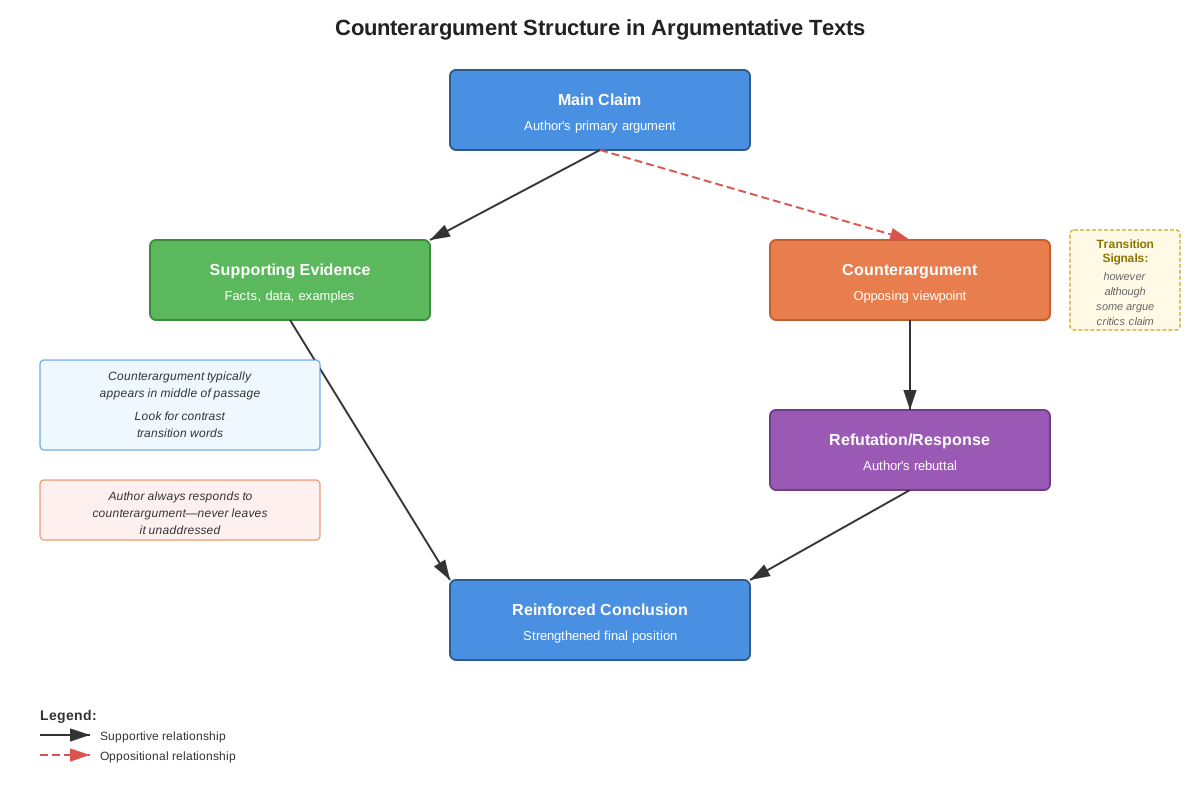
- Author states their main claim
- Author introduces counterargument with transition ("Some argue that...", "Critics contend...", "An alternative explanation suggests...")
- Author presents the counterargument fairly
- Author refutes or limits the counterargument with evidence or reasoning
- Author returns to supporting their original claim
The Preemptive Pattern
- Author anticipates potential objections before fully developing their claim
- Author addresses these objections early
- Author then builds their positive case with objections already neutralized
The Concession Pattern
- Author acknowledges partial validity of counterargument
- Author uses "although" or "while" constructions
- Author pivots to explain why their position still holds despite this concession
Signal Words and Phrases
Recognizing transition words that introduce counterarguments is crucial for SAT success:
| Function | Signal Words/Phrases |
|---|---|
| Introducing opposition | However, nevertheless, yet, but, although, though, despite, in spite of |
| Presenting alternative views | Some argue, critics claim, opponents suggest, an alternative explanation, one might object |
| Acknowledging validity | Admittedly, granted, to be sure, certainly, it is true that |
| Refuting counterarguments | However, yet, still, nonetheless, even so, this objection fails because |
Why Authors Use Counterarguments
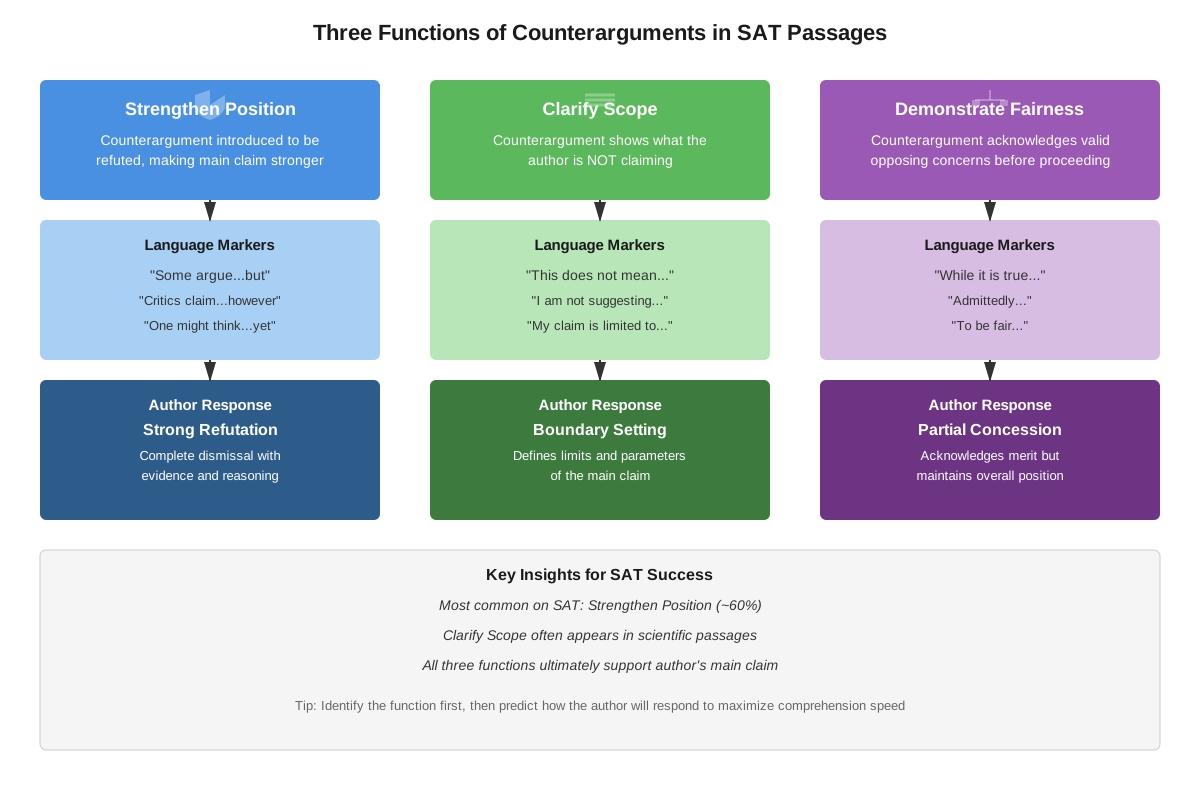
Authors incorporate counterarguments for several strategic reasons:
Establishing Credibility: By acknowledging opposing views, authors demonstrate fairness and thorough research. This builds trust with readers who might otherwise dismiss the argument as one-sided.
Strengthening Their Position: Refuting counterarguments allows authors to address weaknesses proactively. If readers think of objections that go unaddressed, they may doubt the author's claim. By raising and dismantling counterarguments, authors make their position appear more robust.
Clarifying Their Claim: Sometimes counterarguments help define what the author is NOT arguing. This prevents misunderstanding and narrows the scope of the discussion.
Demonstrating Complexity: In academic writing, acknowledging counterarguments shows intellectual sophistication and recognition that most issues have multiple valid perspectives.
Identifying Counterargument Function on the SAT
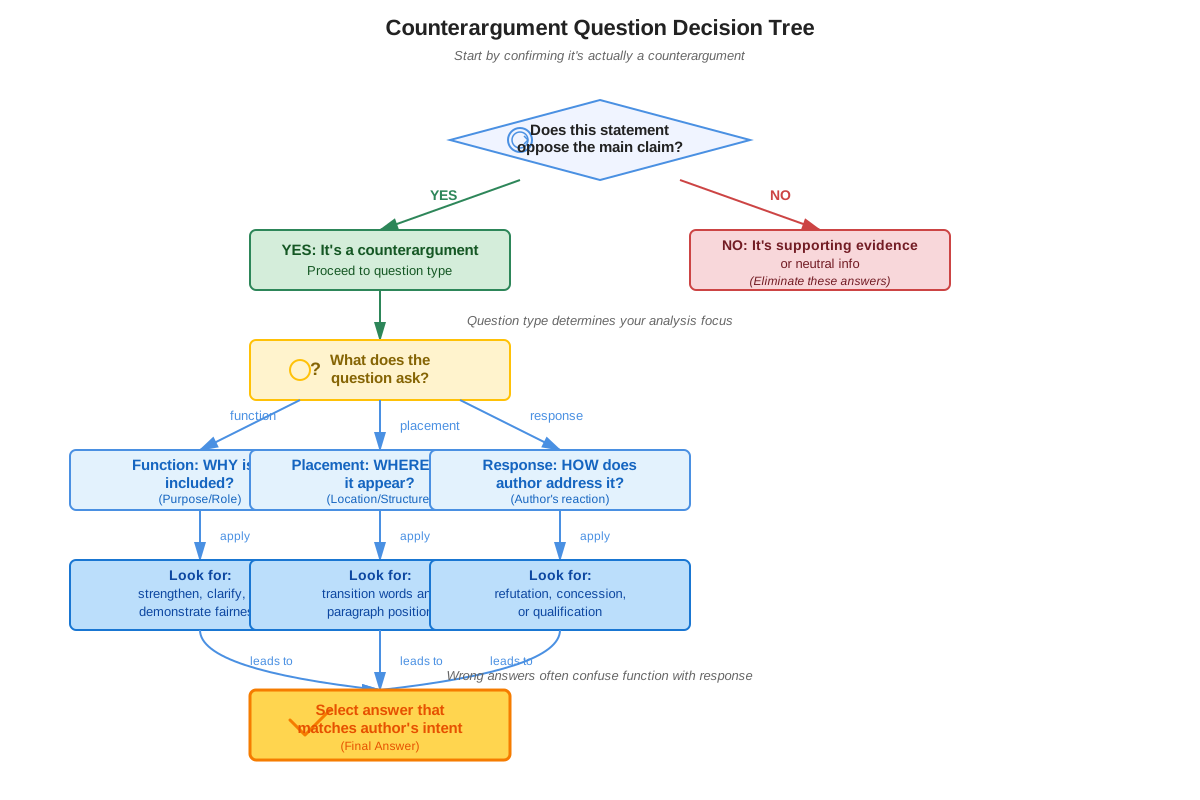
SAT questions about counterarguments typically ask:
- "Which choice best describes the function of the underlined sentence?"
- "The author mentions [opposing view] primarily to..."
- "In the context of the passage, the second paragraph serves mainly to..."
The correct answer will identify that the text segment introduces an opposing view that the author will challenge, presents an alternative explanation the author finds insufficient, or acknowledges a limitation before explaining why the main claim still holds.
Incorrect answer choices often mischaracterize counterarguments as:
- Supporting evidence for the author's claim (counterarguments oppose, not support)
- The author's actual position (confusing the counterargument with the author's view)
- Neutral information (counterarguments have argumentative force)
- Tangential examples (counterarguments directly challenge the thesis)
The Refutation Component
A counterargument alone is incomplete; authors must respond to it. The refutation or rebuttal explains why the counterargument fails or why the author's position remains superior despite the objection. Common refutation strategies include:
- Evidence-based refutation: Providing data that contradicts the counterargument
- Logical refutation: Identifying flaws in the counterargument's reasoning
- Scope limitation: Acknowledging the counterargument applies in limited cases but not generally
- Alternative explanation: Showing the evidence cited by the counterargument better supports the author's view
On the SAT, recognizing the refutation helps students understand the complete argumentative move: counterargument introduction → refutation → return to main claim.
Concept Relationships
The role of counterargument connects to multiple text structure concepts. Main claim identification is prerequisite to recognizing counterarguments, since counterarguments oppose the main claim. Students must first determine what the author argues before identifying what challenges that argument.
Transition analysis → counterargument recognition → author's purpose understanding forms a logical progression. Transition words signal structural shifts, counterarguments represent one type of shift (from support to opposition and back), and understanding why authors include counterarguments reveals their persuasive purpose.
Within argumentative passages, the relationship flows: Claim → Supporting Evidence → Counterargument → Refutation → Conclusion. Each element builds on previous ones, with counterarguments serving as the "challenge" phase that makes the ultimate conclusion more convincing.
Counterargument analysis also connects to paired passage questions. When the SAT presents two passages on the same topic, Passage 2 often functions as a counterargument to Passage 1's position. Recognizing this relationship helps students answer questions about how the passages relate.
The concept extends to rhetorical strategy analysis. Counterarguments represent one rhetorical choice among many (others include analogy, anecdote, expert testimony). Understanding when and why authors deploy counterarguments versus other strategies deepens comprehension of persuasive writing.
High-Yield Facts
⭐ Counterarguments oppose the author's main claim, even though the author presents them—they represent views the author will challenge or refute.
⭐ Signal phrases like "some argue," "critics claim," "an alternative explanation," and "one might object" typically introduce counterarguments.
⭐ Authors include counterarguments to strengthen their own position by addressing objections proactively, not because they agree with the opposing view.
⭐ The complete counterargument pattern includes introduction, fair presentation, refutation, and return to the main claim.
⭐ On SAT questions asking about function, counterargument sentences serve to "present a view the author will challenge" or "introduce an objection the author will address."
- Counterarguments typically appear after the author establishes their main claim but before the conclusion, though preemptive counterarguments can appear earlier.
- Concession words like "although," "while," and "despite" often introduce counterarguments that the author partially accepts before pivoting to their main point.
- Refutations frequently begin with "however," "yet," "nevertheless," or "still" to signal the shift from counterargument back to the author's position.
- Misidentifying a counterargument as the author's actual view is one of the most common SAT errors—always check whether the author supports or challenges the claim.
- In scientific passages, counterarguments often take the form of "alternative hypotheses" or "competing theories" that researchers address before supporting their preferred explanation.
- Counterarguments differ from neutral background information; they have argumentative force and directly challenge the thesis.
- The strength of an argument often depends on how thoroughly the author addresses counterarguments—weak refutations undermine the overall claim.
Quick check — test yourself on Role of counterargument so far.
Try Flashcards →Common Misconceptions
Misconception: If an author mentions an idea, they must support it.
Correction: Authors frequently present ideas they disagree with (counterarguments) to demonstrate why those ideas are insufficient. Always determine whether the author endorses or challenges each claim.
Misconception: Counterarguments only appear in passages explicitly labeled as "arguments" or "debates."
Correction: Counterarguments appear across passage types including scientific reports (alternative hypotheses), historical analyses (competing interpretations), and social science discussions (opposing policy positions). Any passage where an author takes a position may include counterarguments.
Misconception: Longer passages contain more counterarguments than shorter ones.
Correction: Even brief SAT passages (100-150 words) frequently include counterarguments. Length doesn't determine presence; argumentative purpose does.
Misconception: Counterarguments always appear in separate paragraphs.
Correction: Counterarguments can appear within the same paragraph as supporting evidence, often in a single sentence introduced by "although" or "despite." Paragraph breaks don't reliably signal counterargument boundaries.
Misconception: If an author concedes any point to the opposition, they're abandoning their main claim.
Correction: Partial concessions ("while X may be true in some cases...") strengthen arguments by showing nuance. Authors can acknowledge limited validity of counterarguments while maintaining their overall position.
Misconception: Counterarguments and contrasts are the same thing.
Correction: Contrasts present differences without argumentative opposition (comparing two species' behaviors), while counterarguments challenge the author's thesis. Not all differences constitute counterarguments.
Misconception: The counterargument is always wrong and the author's view is always right.
Correction: On the SAT, the task is identifying what the author believes and how they structure their argument, not determining absolute truth. Recognize the counterargument's function regardless of personal agreement.
Worked Examples
Example 1: Scientific Passage
Passage:
"Recent studies suggest that increased screen time correlates with decreased attention spans in adolescents. Some researchers, however, argue that this correlation reflects not causation but rather a third variable: socioeconomic factors that influence both screen access and educational resources. While this alternative explanation accounts for some variance in the data, it fails to explain why the correlation persists even within socioeconomic groups. Moreover, experimental studies that control for background variables continue to show attention deficits following extended screen exposure, suggesting a genuine causal relationship."
Question: The author mentions the view of "some researchers" primarily to:
A) Support the claim that screen time affects attention spans
B) Present an alternative explanation that the author will challenge
C) Introduce the main hypothesis of the passage
D) Provide evidence for socioeconomic influences on attention
Analysis:
Step 1: Identify the author's main claim. The opening sentence states that screen time correlates with decreased attention, and the passage ultimately supports a causal relationship.
Step 2: Locate the counterargument. "Some researchers, however, argue..." introduces an opposing view—that the correlation doesn't indicate causation but reflects socioeconomic factors.
Step 3: Identify the refutation. "While this alternative explanation accounts for some variance..." begins the author's response. The author concedes partial validity ("accounts for some variance") but then refutes with two points: the correlation persists within socioeconomic groups, and experimental studies support causation.
Step 4: Determine function. The "some researchers" view opposes the author's position and appears so the author can address and refute it.
Answer: B - The author presents this alternative explanation specifically to challenge it, strengthening the original claim about screen time's causal role.
Connection to Learning Objectives: This example demonstrates identifying counterargument features (signal phrase "some researchers...however"), explaining how it appears (as an alternative explanation), and applying this knowledge to answer correctly.
Example 2: Historical Analysis Passage
Passage:
"Historians have traditionally attributed the rapid industrialization of 19th-century Britain primarily to technological innovations like the steam engine. This interpretation, while capturing an important factor, overlooks the crucial role of colonial exploitation in generating the capital necessary for industrial investment. Without the wealth extracted from colonies, British entrepreneurs would have lacked the resources to fund large-scale manufacturing operations, regardless of technological capabilities."
Question: In the passage, the author characterizes the traditional historical interpretation as:
A) Completely inaccurate and based on false premises
B) Partially valid but insufficient as a complete explanation
C) The most convincing explanation for British industrialization
D) Irrelevant to understanding economic development
Analysis:
Step 1: Identify what the passage says about the traditional interpretation. The author states it "captures an important factor" but "overlooks the crucial role" of colonial exploitation.
Step 2: Recognize the counterargument structure. The traditional interpretation (technology-focused) is the counterargument to the author's claim (colonial exploitation was crucial).
Step 3: Note the concession. "While capturing an important factor" acknowledges partial validity—the author doesn't completely dismiss the traditional view.
Step 4: Identify the limitation. "Overlooks" indicates incompleteness rather than total incorrectness.
Step 5: Evaluate answer choices. The author neither fully endorses (eliminating C) nor completely rejects (eliminating A and D) the traditional view.
Answer: B - The phrase "while capturing an important factor" is a concession acknowledging partial validity, while "overlooks the crucial role" indicates insufficiency.
Connection to Learning Objectives: This example shows how authors use concession patterns ("while...") to acknowledge counterargument validity before explaining why their own position provides a more complete explanation. Recognizing this nuanced approach prevents mischaracterizing the author's stance.
Exam Strategy
Step 1: Identify the Author's Main Claim First
Before hunting for counterarguments, determine what the author actually argues. Underline or mentally note the thesis. This prevents confusing counterarguments with the author's position—a common trap.
Step 2: Watch for Transition Signals
When you encounter "however," "some argue," "critics claim," "an alternative explanation," or "one might object," immediately flag this as a potential counterargument. These phrases almost always introduce opposing views.
Step 3: Determine Whose View Is Presented
Ask: "Does the AUTHOR believe this, or is this someone else's view that the author will challenge?" Look for attribution phrases ("researchers argue," "opponents suggest") that indicate the claim belongs to others, not the author.
Step 4: Locate the Refutation
Counterarguments rarely stand alone. Find where the author responds, typically signaled by "however," "yet," "nevertheless," or "this objection fails because." Understanding both the counterargument AND the refutation reveals the complete argumentative move.
Step 5: Eliminate Wrong Answer Choices Systematically
For function questions about counterarguments:
- Eliminate choices suggesting the text "supports" or "provides evidence for" the main claim (counterarguments oppose, not support)
- Eliminate choices suggesting the text represents the author's view (unless it's clearly the author's position)
- Eliminate choices suggesting the text is neutral background (counterarguments have argumentative force)
- Select choices indicating the text "presents a view the author challenges," "introduces an objection," or "acknowledges an alternative explanation"
Time Management:
Counterargument questions typically require 45-60 seconds. Spend 20 seconds re-reading the relevant sentence in context, 15 seconds identifying whether it's a counterargument or refutation, and 20-25 seconds evaluating answer choices. Don't rush—these questions reward careful analysis of function rather than surface-level comprehension.
Trigger Words to Watch:
- Counterargument introducers: "Some argue," "critics claim," "an alternative view," "opponents suggest," "one might object," "it could be argued"
- Concession markers: "Although," "while," "despite," "granted," "admittedly," "to be sure"
- Refutation signals: "However," "yet," "nevertheless," "still," "even so," "this objection fails"
Memory Techniques
The CAR Mnemonic for Counterargument Structure:
- Counterargument introduced (opposing view presented)
- Acknowledged (author shows they understand it)
- Refuted (author explains why their view is superior)
Visualize an author driving a CAR through their argument, encountering a counterargument roadblock, acknowledging it exists, then driving around it to reach their destination (conclusion).
The "NOT ME" Technique:
When you see phrases like "some argue" or "critics claim," mentally insert "NOT ME" after them: "Some argue [NOT ME] that..." This reminds you the view belongs to others, not the author.
The Two-Voice Visualization:
Picture argumentative passages as dialogues between two speakers: the Author and the Critic. When the Critic speaks (counterargument), the Author must respond (refutation). This prevents confusion about whose view is whose.
The "However" Pivot:
Remember that "however" almost always signals a shift. If it follows a claim, that claim was likely a counterargument, and what follows "however" is the author's actual position or refutation.
Acronym for Signal Words - SACO:
- Some argue
- Alternative explanation
- Critics claim
- Opponents suggest
These four phrases introduce counterarguments in approximately 70% of SAT passages containing them.
Summary
The role of counterargument is a high-yield SAT concept requiring students to recognize when authors present opposing views, understand why these views appear, and identify how authors respond to them. Counterarguments oppose the author's main claim but appear in the passage because addressing objections strengthens arguments by demonstrating thoroughness and credibility. The typical pattern involves introduction (often with signal phrases like "some argue" or "critics claim"), fair presentation, refutation (frequently beginning with "however" or "yet"), and return to the main claim. On the SAT, questions about counterargument function test whether students can distinguish between views the author supports versus views the author challenges. Success requires identifying the author's thesis first, recognizing transition signals that introduce opposing views, locating the refutation that follows, and selecting answer choices that accurately describe the counterargument's role in the argumentative structure. Mastering this concept improves performance across multiple question types including text structure, author's purpose, and rhetorical strategy questions.
Key Takeaways
- Counterarguments oppose the author's main claim even though the author presents them—they represent views the author will challenge, not endorse
- Signal phrases like "some argue," "critics claim," and "an alternative explanation" reliably introduce counterarguments on the SAT
- The complete counterargument pattern includes introduction, presentation, refutation, and return to the main claim
- Authors use counterarguments strategically to strengthen their positions by addressing objections proactively and demonstrating intellectual fairness
- On function questions, counterarguments serve to "present a view the author will challenge" or "introduce an objection the author addresses"—never to "support" or "provide evidence for" the main claim
- Concession words like "although" and "while" often introduce counterarguments the author partially accepts before pivoting to their main point
- Always identify the author's main claim first to avoid confusing counterarguments with the author's actual position—the most common error on these questions
Related Topics
Claims and Evidence Analysis: Understanding how authors support their main claims with evidence builds on counterargument recognition, since distinguishing supporting evidence from opposing views requires clear claim identification.
Rhetorical Strategy and Purpose: Counterarguments represent one rhetorical choice among many. Studying how authors deploy various persuasive techniques (analogy, anecdote, expert testimony, counterargument) provides broader context for argumentative writing.
Paired Passage Relationships: When the SAT presents two passages on the same topic, one often functions as a counterargument to the other. Mastering counterargument recognition within single passages prepares students for analyzing how entire passages relate.
Logical Reasoning and Fallacies: Evaluating whether refutations successfully address counterarguments requires understanding logical validity, connecting counterargument analysis to broader critical thinking skills.
Transition Words and Text Structure: Deepening knowledge of how transition words signal relationships between ideas enhances counterargument recognition and overall passage comprehension.
Practice CTA
Now that you understand how counterarguments function in SAT passages, it's time to apply this knowledge! Work through the practice questions to test your ability to identify counterarguments, determine their function, and distinguish them from supporting evidence. The flashcards will help reinforce signal words and structural patterns. Remember: recognizing counterarguments is a skill that improves rapidly with focused practice. Each question you analyze strengthens your ability to navigate complex argumentative passages with confidence. You've got this!
Sign up free to keep reading
Create a free AnvayaPrep account to finish this SAT guide on Role of counterargument — plus flashcards and practice questions.