Overview
The role of data is a critical concept tested in the SAT Reading and Writing section, particularly within questions that assess how authors use evidence to support claims, illustrate concepts, or strengthen arguments. Understanding the role of data means recognizing how quantitative information, research findings, statistics, examples, and empirical evidence function within a text's structure and purpose. On the SAT, students must identify whether data serves to support a hypothesis, provide context, challenge an assumption, illustrate a trend, or fulfill another specific rhetorical function.
This topic is essential for the SAT because approximately 15-20% of Reading and Writing questions directly or indirectly test a student's ability to analyze how evidence functions within passages. The College Board designs questions that require students to determine which piece of data best accomplishes a stated purpose, or to identify what role existing data plays in an author's argument. These questions appear across various passage types—from scientific research summaries to historical analyses to social science discussions—making this skill universally applicable throughout the RW section.
The role of data connects intimately with broader concepts in text structure and purpose. Understanding how data functions requires recognizing an author's thesis, identifying supporting versus contradictory evidence, and analyzing how different textual elements work together to achieve communicative goals. This topic builds upon fundamental reading comprehension skills while preparing students for more advanced analytical tasks, such as evaluating argument strength and identifying logical relationships between claims and evidence.
Learning Objectives
- [ ] Identify key features of role of data in SAT passages
- [ ] Explain how role of data appears on the SAT Reading and Writing section
- [ ] Apply role of data concepts to answer SAT-style questions accurately
- [ ] Distinguish between different functions data can serve within a text (supporting, contradicting, illustrating, contextualizing)
- [ ] Evaluate whether given data effectively accomplishes a stated rhetorical purpose
- [ ] Analyze the relationship between claims and the data presented to support them
Prerequisites
- Basic reading comprehension: Understanding main ideas, supporting details, and paragraph structure is necessary to identify how data relates to surrounding text
- Claim and evidence recognition: Distinguishing between assertions and the proof offered for them enables analysis of data's function
- Passage structure awareness: Recognizing how texts are organized (introduction, body, conclusion) helps locate where and why data appears
- Quantitative literacy: Basic comfort with statistics, percentages, and numerical information allows focus on function rather than calculation
Why This Topic Matters
Understanding the role of data extends far beyond standardized testing into academic, professional, and civic life. In college courses, students must evaluate research studies, assess the strength of evidence in scholarly articles, and incorporate data appropriately into their own writing. Professionally, nearly every field—from business to healthcare to education—requires the ability to interpret how data supports or challenges claims. In everyday life, citizens encounter data-driven arguments in news articles, political speeches, and advertising, making critical evaluation of evidence essential for informed decision-making.
On the SAT, questions about the sat role of data appear with high frequency and in predictable formats. Approximately 3-5 questions per test directly assess this skill, typically asking students to select which piece of evidence best supports a claim, identify what function existing data serves, or determine whether data strengthens or weakens an argument. These questions carry significant weight because they test higher-order thinking skills that the College Board values: analysis, evaluation, and synthesis rather than mere recall.
Common question formats include: "Which finding, if true, would most directly support the researcher's hypothesis?"; "Which quotation from the passage best illustrates the concept described?"; "The data in the graph primarily serves to..."; and "The author includes the statistic in sentence 3 in order to..." These questions appear across all passage types, from literary analysis to scientific research summaries, making mastery of this topic essential for consistent performance across the entire Reading and Writing section.
Core Concepts
Understanding Data in Context
Data in SAT passages refers to any form of evidence, including quantitative information (statistics, percentages, measurements), qualitative information (examples, anecdotes, case studies), research findings, expert testimony, historical facts, and observational details. The key to mastering the role of data is recognizing that data never exists in isolation—it always serves a specific purpose within the author's larger communicative goal.
When analyzing data's role, students must ask three fundamental questions: (1) What claim or idea does this data relate to? (2) How does this data relate to that claim—does it support, challenge, illustrate, or contextualize it? (3) Why did the author choose to include this particular piece of data rather than other possible evidence? These questions guide the analytical process that SAT questions assess.
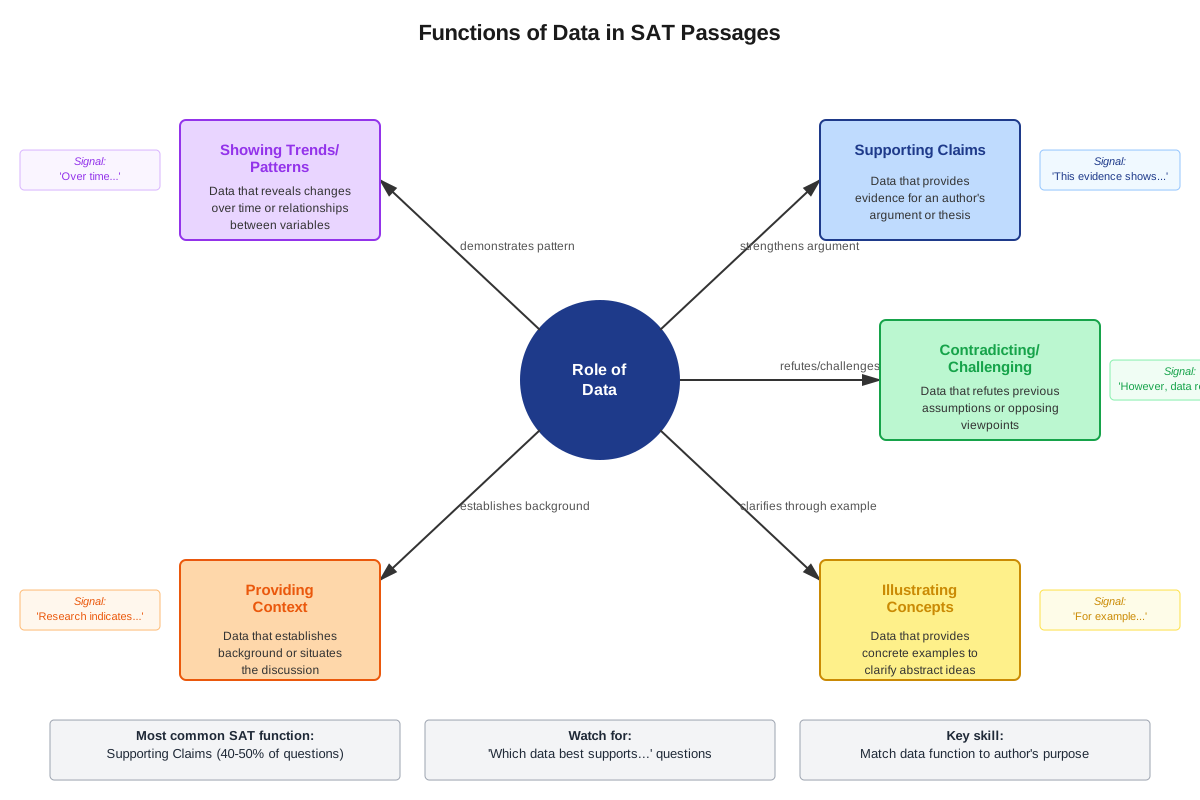
Primary Functions of Data
Data can serve multiple distinct functions within a text, and recognizing these functions is crucial for answering SAT questions correctly:
| Function | Description | Example Signal Phrases |
|---|---|---|
| Supporting | Provides evidence that strengthens or proves a claim | "This is demonstrated by...", "Evidence for this includes...", "Studies show that..." |
| Contradicting | Presents evidence that challenges or disproves a claim | "However, data reveals...", "Contrary to this view...", "This assumption is challenged by..." |
| Illustrating | Offers a concrete example that makes an abstract concept clearer | "For instance...", "Consider the case of...", "This can be seen in..." |
| Contextualizing | Provides background information that helps readers understand significance | "Historically...", "In comparison to...", "The broader context includes..." |
| Quantifying | Adds numerical precision to a general claim | "Specifically, 73% of...", "The rate increased from X to Y...", "Measurements showed..." |
| Qualifying | Adds nuance or limitations to a claim | "In most cases...", "With certain exceptions...", "Under specific conditions..." |
Analyzing Claim-Evidence Relationships
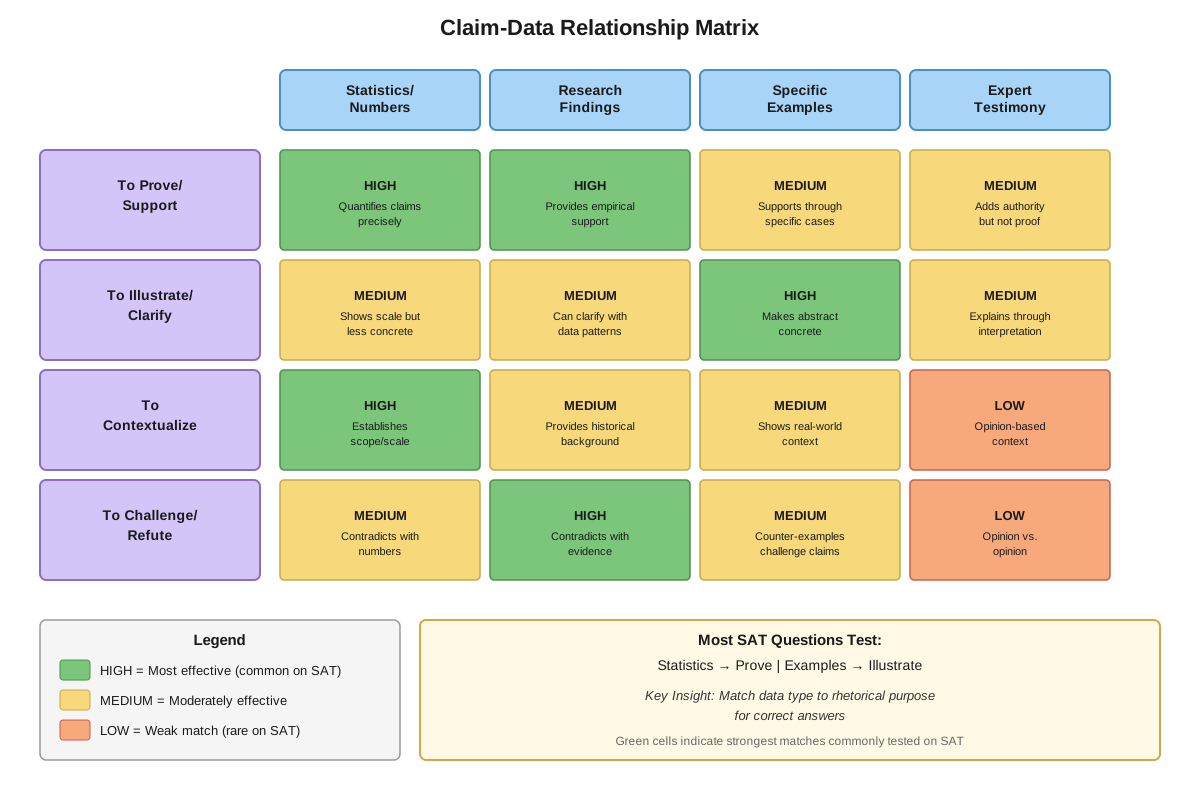
The relationship between claims and data follows predictable patterns that SAT questions frequently test. A claim is an assertion that requires proof—a statement that could be disputed or questioned. Evidence is the data provided to make that claim more credible or convincing. Strong evidence directly relates to the claim, comes from credible sources, and provides sufficient detail to be persuasive.
On the SAT, students must evaluate whether evidence effectively supports its associated claim. Effective evidence is relevant (directly addresses the claim), sufficient (provides adequate proof), and credible (comes from reliable sources or methods). Weak evidence may be tangentially related, insufficient in scope, or questionable in origin. Questions often present multiple pieces of potential evidence and ask students to select which one best accomplishes a specific purpose.
Data in Different Passage Types
The role of data manifests differently across passage genres. In scientific passages, data typically comes from experiments, observations, or measurements and serves to support or challenge hypotheses. These passages often include numerical results, statistical analyses, or descriptions of experimental outcomes. The data's role is usually to provide empirical support for theoretical claims.
In historical and social science passages, data often takes the form of historical facts, demographic statistics, or documented events. This data contextualizes arguments, provides evidence for interpretations, or illustrates broader trends. Authors use this data to ground abstract historical or sociological claims in concrete reality.
In literary and humanities passages, data might include quotations from texts, descriptions of artistic techniques, or examples of cultural practices. This evidence illustrates critical interpretations, supports analytical claims about meaning or significance, or provides examples of broader patterns.
Evaluating Data Effectiveness
Not all data equally serves its intended purpose. The SAT tests students' ability to evaluate data effectiveness by presenting scenarios where multiple pieces of evidence could potentially support a claim, but only one does so optimally. Effective data is specific rather than vague, directly relevant rather than tangentially related, and sufficient in scope rather than based on limited examples.
For instance, if a passage claims that "urban gardens improve community health," strong supporting data might be "a five-year study of 200 neighborhoods found that areas with community gardens had 15% lower rates of diet-related illness." Weak supporting data might be "many people enjoy gardening" or "vegetables are healthy"—these statements relate to the topic but don't directly prove the specific claim about urban gardens and community health.
Concept Relationships
The concepts within the role of data topic interconnect systematically. Understanding data in context provides the foundation for recognizing primary functions of data—students must first understand that data serves purposes before they can identify which specific purpose applies. Recognizing functions enables analysis of claim-evidence relationships, as students can evaluate whether data effectively fulfills its intended function of supporting, illustrating, or contextualizing claims.
The ability to analyze claim-evidence relationships then allows students to evaluate data effectiveness, determining whether evidence strongly or weakly accomplishes its purpose. This evaluation skill varies across data in different passage types, as the criteria for effective evidence differ somewhat between scientific, historical, and literary contexts.
These concepts connect to prerequisite knowledge of basic reading comprehension and passage structure—students must identify main ideas before they can determine how data relates to those ideas. The topic also connects forward to more advanced skills like evaluating argument strength, identifying logical fallacies, and synthesizing information across multiple sources.
Relationship map: Data in Context → Primary Functions → Claim-Evidence Relationships → Effectiveness Evaluation → Application Across Passage Types → Advanced Argument Analysis
High-Yield Facts
- ⭐ Data on the SAT always serves a specific rhetorical purpose within the passage's structure and argument
- ⭐ The most common data functions tested are supporting claims, illustrating concepts, and providing context
- ⭐ Effective supporting evidence must be directly relevant, sufficiently specific, and credibly sourced
- ⭐ Questions often ask students to select which piece of data "best" supports a claim, requiring comparison of multiple options
- ⭐ Signal phrases like "for example," "studies show," and "however" indicate the function data will serve
- Data can simultaneously serve multiple functions (e.g., supporting one claim while contextualizing another)
- Quantitative data (numbers, statistics) often serves to quantify or provide precision to qualitative claims
- Contradictory data is sometimes included to show complexity, acknowledge counterarguments, or demonstrate nuance
- The placement of data within a passage (beginning, middle, end) often signals its function
- Authors typically introduce claims before presenting supporting data, though this order can be reversed for rhetorical effect
- Data from studies or research is generally more credible than anecdotal evidence or single examples
- The SAT tests whether students can distinguish between data that supports a claim and data that merely relates to the topic
Quick check — test yourself on Role of data so far.
Try Flashcards →Common Misconceptions
Misconception: All data in a passage supports the author's main argument.
Correction: Authors often include contradictory data to acknowledge complexity, present counterarguments they'll refute, or show limitations of their claims. Students must carefully read surrounding context to determine whether data supports or challenges claims.
Misconception: Longer or more detailed data is always more effective evidence.
Correction: Effectiveness depends on relevance and directness, not length. A single precise statistic often provides stronger support than a lengthy but tangentially related example. The SAT rewards recognition of targeted, specific evidence over verbose but less relevant information.
Misconception: Data and claims are the same thing.
Correction: Claims are assertions that require proof; data is the evidence provided to support those assertions. A claim might be "exercise improves mental health," while data supporting it would be "a study of 1,000 participants found that those who exercised regularly reported 30% lower anxiety levels." Distinguishing between these is essential for analyzing their relationship.
Misconception: If data relates to the passage topic, it must support the author's argument.
Correction: Data can relate to a topic while serving functions other than support—it might provide background context, illustrate a concept without proving it, or even challenge the author's position. Students must analyze the specific relationship between data and claims, not just topical relevance.
Misconception: Scientific or numerical data is always more credible than qualitative examples.
Correction: Credibility depends on context and purpose. In literary analysis, a well-chosen quotation may be more effective evidence than statistics about reading habits. In historical arguments, a documented event may be more persuasive than demographic data. The SAT tests recognition of appropriate evidence types for different contexts.
Misconception: The role of data is always explicitly stated by the author.
Correction: While authors sometimes use signal phrases like "this evidence demonstrates," they often present data without explicitly stating its function. Students must infer the role from context, position within the argument structure, and relationship to surrounding claims.
Worked Examples
Example 1: Identifying Data Function
Passage excerpt: "Urban heat islands—metropolitan areas significantly warmer than surrounding rural regions—pose serious health risks. During the 2003 European heat wave, Paris experienced temperatures up to 8°C higher than nearby countryside, contributing to thousands of heat-related deaths. This temperature differential results from heat-absorbing surfaces like asphalt and concrete, which replace vegetation that would otherwise cool the environment through evapotranspiration."
Question: The author includes the information about the 2003 European heat wave primarily to:
A) Explain the scientific mechanism behind urban heat islands
B) Illustrate the serious consequences of urban heat islands
C) Compare European and American urban planning approaches
D) Argue for increased vegetation in rural areas
Solution Process:
Step 1: Identify the main claim in the passage. The opening sentence establishes that urban heat islands "pose serious health risks."
Step 2: Locate the data in question. The 2003 heat wave information provides a specific historical example with quantitative details (8°C temperature difference, thousands of deaths).
Step 3: Analyze the relationship between the claim and the data. The heat wave example demonstrates the "serious health risks" mentioned in the claim by showing actual consequences (deaths) that occurred.
Step 4: Evaluate each answer choice:
- A is incorrect because the mechanism is explained in the final sentence, not the heat wave example
- B correctly identifies that the example illustrates consequences/seriousness
- C is incorrect because no comparison to American approaches appears
- D is incorrect because the data concerns urban, not rural, areas
Answer: B
This question tests the learning objective of identifying how data functions within a passage. The heat wave data serves an illustrating function—it makes the abstract claim about "serious health risks" concrete by providing a specific, dramatic example with real consequences.
Example 2: Selecting Effective Supporting Evidence
Passage setup: A researcher claims that "bilingual education in early childhood enhances cognitive flexibility in adolescence."
Question: Which finding, if true, would most directly support the researcher's claim?
A) A survey found that 78% of parents believe bilingual education benefits their children.
B) Students in bilingual programs scored higher on standardized language tests than monolingual peers.
C) A longitudinal study showed that children in bilingual programs from ages 5-7 demonstrated superior problem-solving abilities at age 15 compared to a control group.
D) Many successful professionals report speaking multiple languages.
Solution Process:
Step 1: Identify the key elements of the claim:
- Population: early childhood (young children)
- Intervention: bilingual education
- Outcome: cognitive flexibility (not just language skills)
- Timing: effects visible in adolescence (later)
Step 2: Evaluate each option against these elements:
Option A: Addresses bilingual education but relies on parental beliefs (not objective evidence) and doesn't specifically address cognitive flexibility or the early-childhood-to-adolescence timeline. Weak support.
Option B: Addresses bilingual programs and provides objective data, but measures language skills rather than cognitive flexibility, and doesn't specify the early-childhood-to-adolescence connection. Partially relevant but not direct.
Option C: Addresses all key elements—early childhood intervention (ages 5-7), bilingual programs, cognitive outcome (problem-solving, a measure of cognitive flexibility), and adolescent results (age 15). Uses rigorous methodology (longitudinal study with control group). Strong, direct support.
Option D: Relates to multilingualism but provides only anecdotal evidence, doesn't specify early childhood education, doesn't measure cognitive flexibility, and doesn't establish causation. Weak support.
Answer: C
This question tests the ability to evaluate data effectiveness and select evidence that best supports a specific claim. Option C succeeds because it directly addresses every component of the claim with credible, specific evidence, while other options are tangentially related or address only some aspects of the claim.
Exam Strategy
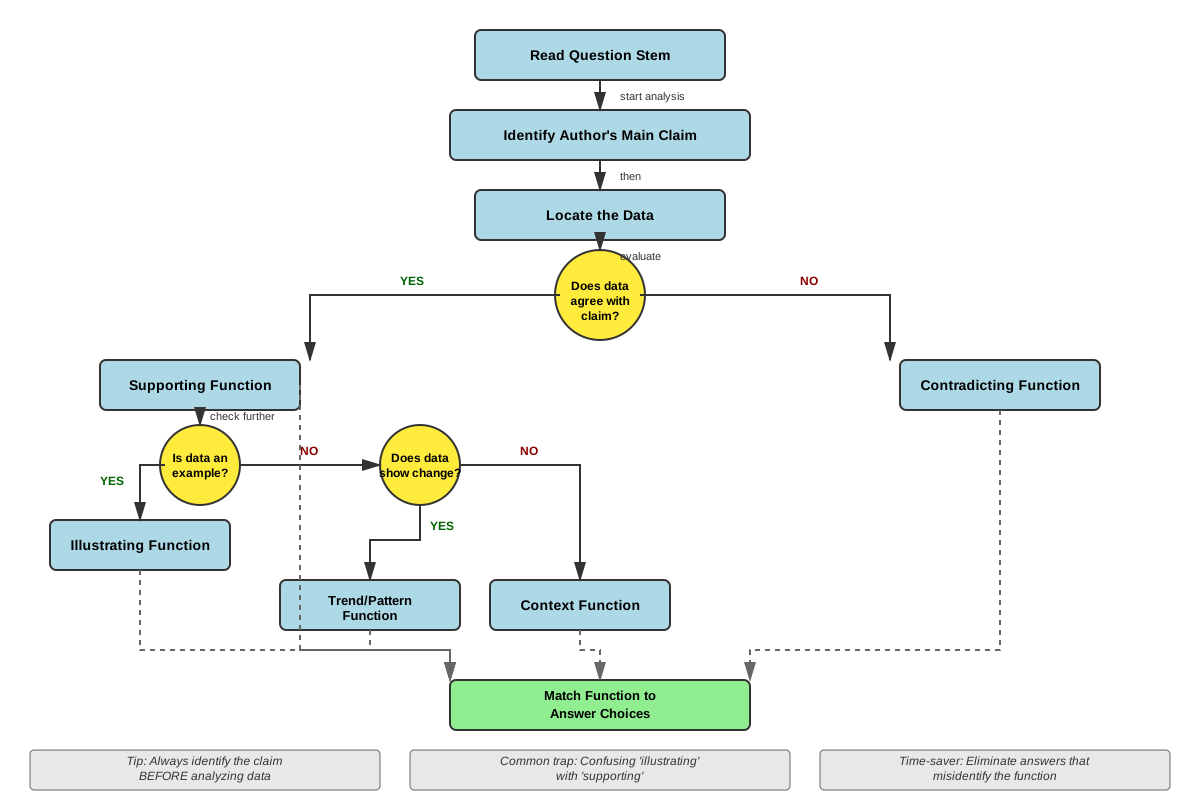
When approaching sat role of data questions, follow this systematic process:
Step 1: Identify the claim or purpose. Before analyzing data, locate the specific claim, hypothesis, or purpose mentioned in the question. Underline or mentally note this—it's your target for evaluation.
Step 2: Read surrounding context. Data rarely appears in isolation. Read 1-2 sentences before and after the data in question to understand how it fits into the passage's argument structure.
Step 3: Determine the function. Ask yourself: "Is this data supporting, contradicting, illustrating, contextualizing, or qualifying a claim?" Use signal phrases as clues.
Step 4: Evaluate directness and specificity. When comparing multiple pieces of evidence, the most effective option typically addresses the claim most directly and specifically. Eliminate options that are vague, tangentially related, or address only part of the claim.
Exam Tip: Watch for trigger words that signal data function: "for example" (illustrating), "studies show" (supporting), "however" (contradicting), "specifically" (quantifying), "in context" (contextualizing).
Time allocation: Spend 45-60 seconds on role of data questions. These require careful analysis but shouldn't demand extensive calculation or complex inference. If you're spending more than a minute, you may be overthinking—return to the basic question of how the data relates to the stated claim or purpose.
Process of elimination strategy:
- Eliminate options that address the wrong claim or purpose
- Eliminate options where the data-claim relationship is weak or indirect
- Between remaining options, choose the one that's most specific and direct
Common trap answers: The SAT often includes options that are factually true or topically related but don't fulfill the specific function asked about. Always return to the question's exact wording—if it asks what "best supports" a claim, an option that merely "relates to" the topic is incorrect.
Memory Techniques
SIQCE Mnemonic for data functions:
- Supporting (proves a claim)
- Illustrating (provides an example)
- Qualifying (adds nuance or limits)
- Contextualizing (provides background)
- Expanding (adds detail or precision)
The "So What?" Test: When analyzing data's role, ask "So what does this prove or show?" The answer reveals the function. If the answer is "It proves the claim is true," the function is supporting. If it's "It shows what the concept looks like in practice," the function is illustrating.
Visualization Strategy: Picture the passage structure as a building. Claims are the main support beams, and data are the materials that strengthen those beams. Ask yourself: "Is this data making the beam stronger (supporting), showing what the beam looks like (illustrating), or explaining why we need this beam (contextualizing)?"
RED acronym for evaluating evidence effectiveness:
- Relevant: Does it directly address the claim?
- Explicit: Is it specific rather than vague?
- Documented: Does it come from credible sources or methods?
Summary
The role of data is a high-yield SAT Reading and Writing concept that tests students' ability to analyze how evidence functions within texts. Mastery requires understanding that data always serves specific rhetorical purposes—most commonly supporting claims, illustrating concepts, providing context, or adding precision. Success on these questions depends on identifying the relationship between claims and evidence, evaluating whether data effectively accomplishes its intended purpose, and selecting the most direct and relevant evidence when multiple options are presented. Students must distinguish between data that merely relates to a topic and data that specifically supports, challenges, or illustrates particular claims. The skill applies across all passage types—scientific, historical, social science, and literary—making it essential for consistent performance throughout the Reading and Writing section. By systematically identifying claims, analyzing data function, and evaluating effectiveness using criteria of relevance, specificity, and credibility, students can confidently approach the 3-5 questions per test that directly assess this critical analytical skill.
Key Takeaways
- Data on the SAT always serves a specific purpose within the passage's argument or explanation structure
- The six primary data functions are supporting, contradicting, illustrating, contextualizing, quantifying, and qualifying claims
- Effective evidence must be directly relevant to the specific claim, sufficiently specific, and credibly sourced
- Signal phrases like "for example," "studies show," and "however" indicate the function data will serve
- Questions asking for the "best" evidence require comparing options for directness, specificity, and relevance
- Understanding data's role requires identifying both the data itself and the claim it relates to
- The same piece of data can serve different functions depending on context and the author's purpose
Related Topics
Text Structure and Organization: Understanding how passages are organized helps predict where and why data appears, as evidence typically follows claims in well-structured arguments.
Argument Analysis: Mastering the role of data provides foundation for evaluating argument strength, identifying logical fallacies, and assessing whether conclusions are justified by evidence.
Synthesis Across Texts: Advanced questions may require comparing how different authors use data to support similar or contrasting claims, building on single-passage data analysis skills.
Quantitative Information in Texts: Some passages include graphs, tables, or charts; understanding data's role helps interpret how visual information supports textual claims.
Practice CTA
Now that you've mastered the core concepts of how data functions in SAT passages, it's time to apply this knowledge! Work through the practice questions to test your ability to identify data functions, evaluate evidence effectiveness, and select the best supporting information. Each practice question reinforces the strategies and concepts covered in this guide. The flashcards will help you memorize key functions and signal phrases, ensuring quick recognition on test day. Remember: understanding the role of data isn't just about memorizing definitions—it's about developing the analytical instinct to see how evidence and claims work together. With focused practice, you'll approach these high-frequency questions with confidence and accuracy!
Sign up free to keep reading
Create a free AnvayaPrep account to finish this SAT guide on Role of data — plus flashcards and practice questions.