Overview
The word although is one of the most frequently tested transition words in the SAT Reading and Writing section. As a contrasting conjunction, it signals an unexpected relationship between two ideas, indicating that the second clause presents information that contrasts with or contradicts what the reader might expect based on the first clause. Understanding how to properly use and identify although is critical for success on transition questions, which regularly appear throughout the RW (Reading and Writing) section of the digital SAT.
Mastering sat although questions requires more than simply recognizing the word itself. Students must develop the ability to analyze the logical relationship between sentences and paragraphs, determining whether ideas oppose each other, support each other, or follow a different logical pattern entirely. The SAT tests this skill by presenting passages with blank spaces where transition words should appear, asking students to select the most appropriate transition based on the context. Questions involving although typically require students to identify situations where an outcome differs from what would normally be expected, or where two seemingly contradictory facts coexist.
This topic connects directly to broader Reading and Writing concepts including logical flow, sentence structure, and rhetorical effectiveness. The ability to recognize contrasting relationships is foundational for understanding author's purpose, analyzing argumentative structure, and interpreting complex informational texts. Students who master although and similar contrasting transitions will find themselves better equipped to tackle not only transition questions but also questions about main ideas, supporting details, and textual evidence throughout the SAT.
Learning Objectives
- [ ] Identify key features of although and recognize its function as a contrasting conjunction
- [ ] Explain how although appears on the SAT in transition questions and passage contexts
- [ ] Apply although to answer SAT-style questions by analyzing logical relationships between clauses
- [ ] Distinguish between although and other transition words based on the logical relationship between ideas
- [ ] Evaluate whether although is the appropriate transition by identifying unexpected or contrasting outcomes
- [ ] Analyze sentence pairs to determine when a contrasting transition is needed versus other transition types
Prerequisites
- Basic sentence structure: Understanding subjects, verbs, and clauses is necessary to identify where transitions connect ideas and how they affect meaning
- Fundamental transition word categories: Familiarity with the concept that transitions show relationships (addition, contrast, cause-effect) helps students categorize although correctly
- Reading comprehension skills: The ability to understand the main idea of sentences and paragraphs enables students to determine logical relationships between them
Why This Topic Matters
In real-world communication, contrasting transitions like although enable writers to present nuanced arguments, acknowledge counterpoints, and describe complex situations where multiple factors interact in unexpected ways. Academic writing, professional communication, and persuasive texts all rely heavily on these transitions to create sophisticated, credible arguments. Students who master these transitions become more effective writers and more critical readers, able to detect subtle shifts in an author's reasoning.
On the SAT, transition questions appear with high frequency—students can expect to encounter approximately 3-5 transition questions per Reading and Writing section. Among these, although and its synonyms (though, even though, while, whereas) represent a significant portion, making contrasting transitions one of the highest-yield categories to master. According to College Board data, transition questions have a medium difficulty rating, with success rates varying widely based on whether students have developed systematic approaches to analyzing logical relationships.
The SAT presents although in several common contexts: scientific passages describing unexpected research findings, historical texts explaining outcomes that defied predictions, argumentative essays acknowledging opposing viewpoints, and informational passages presenting contrasting characteristics of subjects. The test frequently places although at the beginning of sentences, requiring students to understand how it connects back to previous information. Questions may also test whether students can distinguish although from similar-looking transitions that actually signal different relationships, such as because (cause-effect) or furthermore (addition).
Core Concepts
The Function of Although
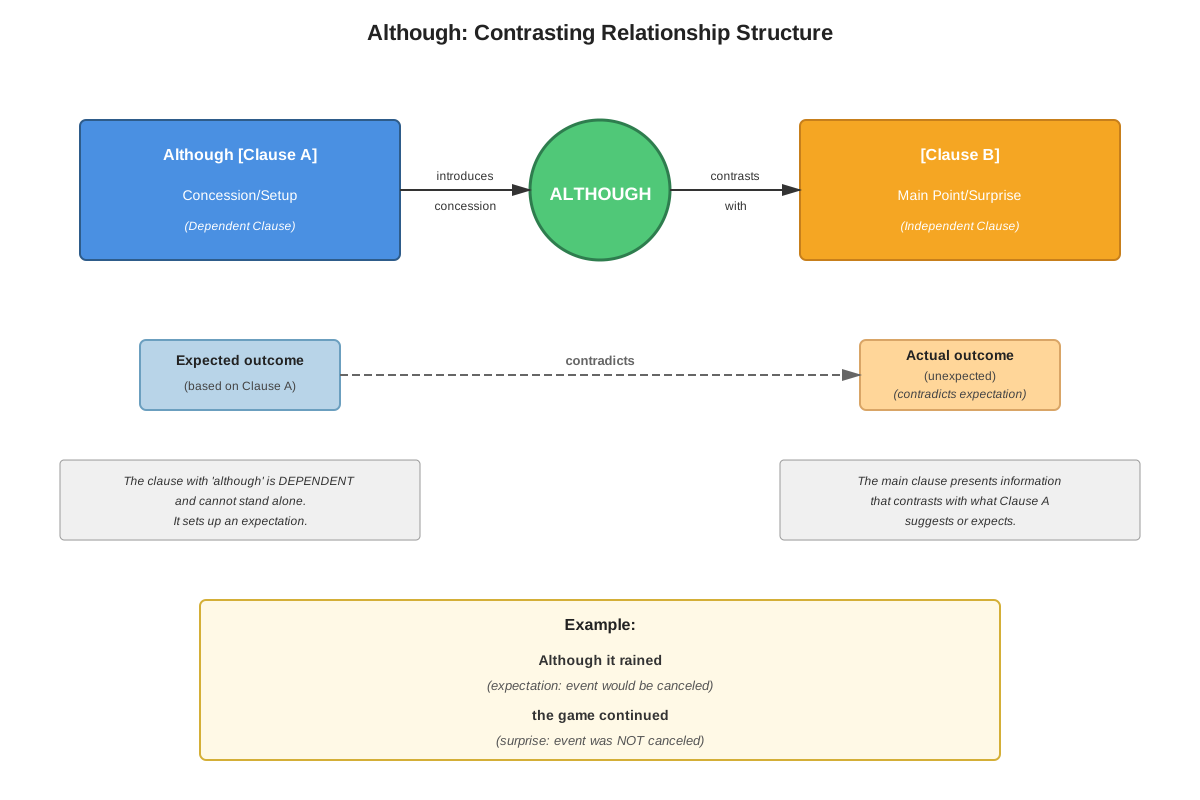
Although functions as a subordinating conjunction that introduces a dependent clause expressing a contrast or concession. When a sentence begins with although, it signals that the information in the dependent clause will be followed by an independent clause containing information that contrasts with, contradicts, or presents an unexpected outcome relative to the first clause. The core meaning can be paraphrased as "despite the fact that" or "even though it is true that."
The grammatical structure follows this pattern: "Although [dependent clause], [independent clause]" or "[Independent clause] although [dependent clause]." The comma placement varies depending on whether although appears at the beginning or middle of the sentence. When although introduces the sentence, a comma separates the dependent clause from the independent clause. When it appears in the middle, comma usage depends on whether the clause is essential or non-essential to the sentence meaning.
Logical Relationship Signaled by Although
The key to mastering although on the SAT lies in understanding the specific logical relationship it signals: unexpected contrast or concession. This differs from simple contrast (however, on the other hand) because although specifically introduces information that would normally lead to one expectation, then presents an outcome that defies that expectation.
Consider this structure: "Although X is true, Y is also true." The relationship implies that X would normally prevent Y, make Y unlikely, or contradict Y, yet both exist simultaneously. For example: "Although the medication was expensive, it became widely adopted." The high cost would typically prevent wide adoption, making the actual outcome unexpected.
Although vs. Other Transitions
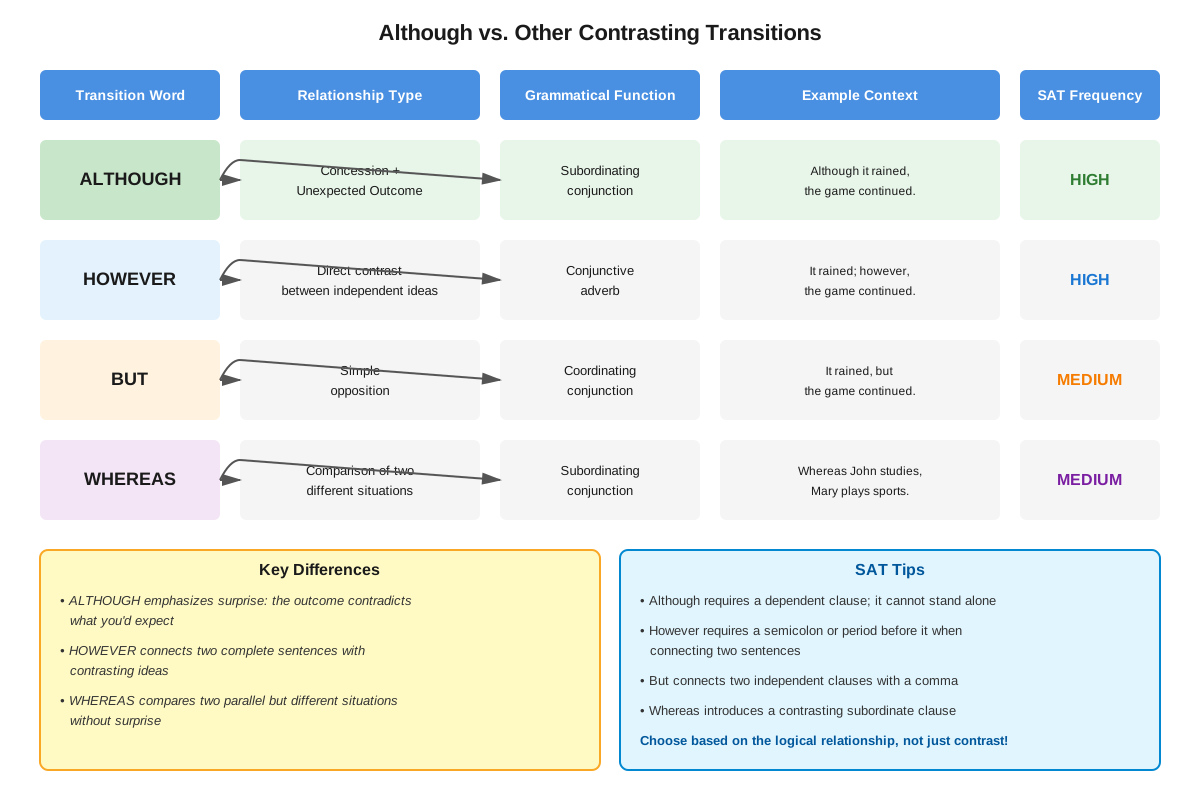
Understanding when to use although requires distinguishing it from other transition categories:
| Transition Type | Function | Examples | When to Use |
|---|---|---|---|
| Contrasting (Concessive) | Shows unexpected contrast or concession | although, though, even though, while, whereas | When two facts seem contradictory or one doesn't lead to the expected outcome |
| Contrasting (Adversative) | Shows direct opposition or shift | however, nevertheless, nonetheless, but | When directly opposing a previous statement or shifting direction |
| Cause-Effect | Shows causation | because, since, therefore, thus | When one thing causes or results from another |
| Addition | Adds supporting information | furthermore, moreover, additionally | When providing more evidence for the same point |
| Example | Introduces specific instances | for example, for instance, such as | When illustrating a general statement |
Identifying the Need for Although
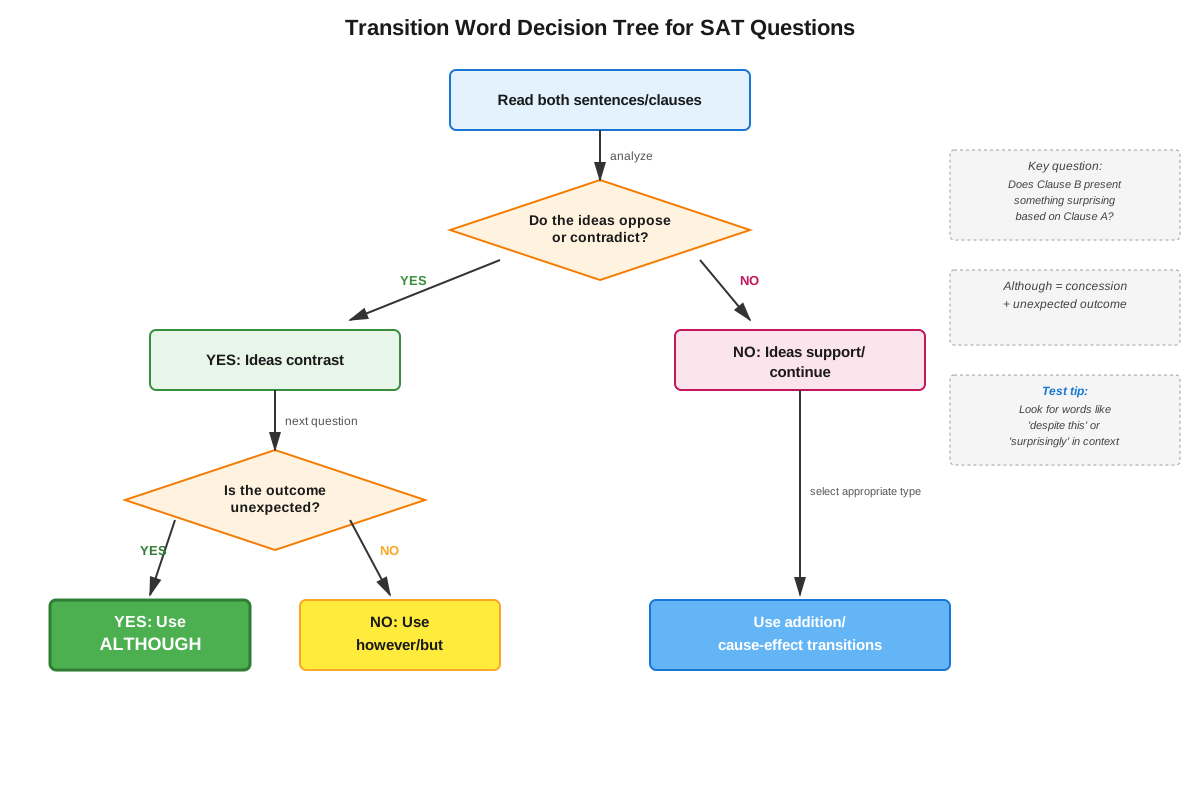
On the SAT, students must analyze the relationship between sentences or clauses to determine whether although is appropriate. The process involves three steps:
- Read the sentence before the blank (or the clause before although) and identify its main claim or fact
- Read the sentence after the blank (or the clause after although) and identify its main claim or fact
- Determine the relationship: Does the second fact contradict what you'd expect based on the first? If yes, although is likely correct
For example, if a passage states that a species lives in harsh desert conditions (first fact) and then mentions it has no special adaptations for water conservation (second fact), the relationship is unexpected contrast—harsh desert conditions would normally require such adaptations. Therefore, although would be appropriate: "Although the species lives in harsh desert conditions, it has no special adaptations for water conservation."
Common SAT Patterns with Although
The SAT frequently tests although in these specific patterns:
Pattern 1: Acknowledging Limitations Before Main Point
"Although [limitation/drawback], [main positive point]"
Example: "Although the study had a small sample size, its findings were statistically significant."
Pattern 2: Presenting Unexpected Outcomes
"Although [expected cause of outcome X], [outcome Y occurred instead]"
Example: "Although the policy was designed to reduce costs, expenses actually increased."
Pattern 3: Contrasting Characteristics
"Although [characteristic A], [contrasting characteristic B]"
Example: "Although the material is lightweight, it demonstrates exceptional strength."
Pattern 4: Conceding Opposition Before Argument
"Although [opposing viewpoint], [author's position]"
Example: "Although critics argue the approach is impractical, evidence suggests otherwise."
Placement and Punctuation
The position of although in a sentence affects both meaning and punctuation. When although begins a sentence, it introduces the subordinate clause first, creating emphasis on the main clause that follows. When although appears mid-sentence, the main clause receives initial emphasis. On the SAT, both structures appear, and students must recognize that the logical relationship remains the same regardless of placement.
Punctuation rules are consistent: a comma separates the although-clause from the main clause when although begins the sentence. When although appears mid-sentence connecting two clauses, the comma typically precedes although if it's joining two independent clauses, though this structure is less common in formal writing.
Concept Relationships
The concept of although as a contrasting transition connects directly to the broader framework of logical relationships in writing. Understanding although requires first grasping that sentences and paragraphs relate to each other in predictable patterns (addition, contrast, cause-effect, example, emphasis). Although specifically occupies the contrast category, but with the nuanced subcategory of concessive contrast rather than simple opposition.
Within the topic itself, the concepts build hierarchically: Function of Although (what it does grammatically) → Logical Relationship (what it means semantically) → Distinguishing from Other Transitions (how to identify when it's appropriate) → SAT Patterns (how it appears on the test) → Application Strategy (how to use this knowledge to answer questions).
The relationship to prerequisite knowledge flows as follows: Basic sentence structure enables recognition of dependent and independent clauses → Understanding clause relationships enables identification of logical connections → Recognizing logical connections enables proper transition selection → Proper transition selection enables success on SAT questions.
Although also connects forward to more advanced Reading and Writing skills. Mastering this transition word enhances the ability to analyze argumentative structure (recognizing when authors acknowledge counterarguments), understand rhetorical choices (why an author might emphasize contrast), and evaluate logical coherence (whether ideas flow logically throughout a passage).
High-Yield Facts
⭐ Although is a subordinating conjunction that introduces a dependent clause showing unexpected contrast or concession
⭐ The SAT tests although by asking students to select appropriate transitions based on logical relationships between sentences
⭐ Although signals that the outcome or second fact contradicts what would normally be expected from the first fact
⭐ Transition questions appear 3-5 times per Reading and Writing section, with contrasting transitions being highly represented
⭐ Although differs from however: although introduces dependent clauses and shows concession, while however connects independent clauses and shows direct opposition
- Although can appear at the beginning of a sentence or in the middle, with comma placement varying accordingly
- Common SAT patterns include acknowledging limitations, presenting unexpected outcomes, and conceding opposing viewpoints
- The words though, even though, and while can function similarly to although in showing contrast
- When although begins a sentence, the main point appears in the independent clause after the comma
- Incorrect transition choices on the SAT often include cause-effect words (because, since) or addition words (furthermore, moreover) that don't match the contrasting relationship
Quick check — test yourself on Although so far.
Try Flashcards →Common Misconceptions
Misconception: Although and however are interchangeable and can be used in the same contexts.
Correction: Although is a subordinating conjunction that creates a dependent clause and must be attached to an independent clause, while however is a conjunctive adverb that connects two independent clauses. They also signal slightly different relationships—although shows concession (acknowledging something while presenting a contrasting point), while however shows direct opposition or contradiction.
Misconception: If two sentences present different information, although is always the correct transition.
Correction: Although specifically requires an unexpected contrast or concession, not just any difference. If two facts simply present different aspects without contradiction (e.g., "The building is tall. It was constructed in 1920."), although would be inappropriate. The relationship must involve one fact that would normally prevent, contradict, or make unlikely the other fact.
Misconception: Although always appears at the beginning of sentences on the SAT.
Correction: While although frequently begins sentences in SAT passages, it can also appear mid-sentence connecting clauses. Students must be prepared to recognize and work with both structures. The logical relationship remains the same regardless of position.
Misconception: When a passage acknowledges a negative aspect before making a positive point, although is automatically correct.
Correction: While this pattern often uses although, students must verify that the relationship is truly contrastive. Sometimes the negative aspect leads logically to the positive point (cause-effect), or the negative aspect is simply mentioned before adding more information (addition). Always analyze the specific logical relationship rather than relying on surface patterns.
Misconception: Although and because can both introduce reasons, so they're similar in function.
Correction: Although and because signal opposite relationships. Because introduces a cause or reason that explains why something happened (cause-effect relationship), while although introduces information that would normally prevent something but didn't (contrasting relationship). Confusing these is a common trap on the SAT.
Worked Examples
Example 1: Scientific Research Passage
Passage Context:
"Researchers hypothesized that increased screen time would correlate with decreased academic performance among adolescents. _____ the study found a positive correlation between moderate screen time and test scores, suggesting that digital learning tools may provide educational benefits."
Answer Choices:
A) Therefore,
B) Although
C) Furthermore,
D) For example,
Step-by-Step Solution:
- Identify the first claim: Researchers expected screen time to correlate with decreased performance (negative outcome expected)
- Identify the second claim: The study found screen time correlated with increased test scores (positive outcome occurred)
- Analyze the relationship: The actual finding contradicts the hypothesis—this is an unexpected outcome, which signals the need for a contrasting transition showing concession
- Evaluate each choice:
- Therefore (cause-effect): Would suggest the positive finding resulted from the hypothesis, which makes no logical sense
- Although (contrast/concession): Would need to be restructured: "Although researchers hypothesized negative effects, the study found positive correlation"—but as written, we need a transition at the beginning of the second sentence
- Furthermore (addition): Would suggest the positive finding adds to or supports the hypothesis, but it actually contradicts it
- For example (illustration): Would suggest the finding illustrates the hypothesis, but it contradicts it
- Recognize the structure: The blank appears at the beginning of the second sentence, and we need to show that despite the hypothesis (first sentence), the opposite occurred (second sentence)
Correct Answer: B) Although
Restructured sentence: "Although researchers hypothesized that increased screen time would correlate with decreased academic performance among adolescents, the study found a positive correlation between moderate screen time and test scores, suggesting that digital learning tools may provide educational benefits."
Connection to Learning Objectives: This example demonstrates how although appears in scientific contexts to present unexpected research findings, requiring students to identify the contrasting relationship between hypothesis and results.
Example 2: Historical Biography Passage
Passage Context:
"Marie Curie faced significant obstacles as a woman in early 20th-century science, including denial of laboratory access and exclusion from professional societies. _____ these barriers, she became the first person to win Nobel Prizes in two different scientific fields, fundamentally changing physics and chemistry."
Answer Choices:
A) Because of
B) In addition to
C) Despite
D) As a result of
Step-by-Step Solution:
- Identify the first claim: Curie faced significant obstacles and barriers
- Identify the second claim: She achieved extraordinary success (two Nobel Prizes, fundamental contributions)
- Analyze the relationship: The barriers would normally prevent such success, yet she succeeded anyway—this is a classic unexpected contrast/concession pattern
- Evaluate each choice:
- Because of (cause-effect): Would illogically suggest the barriers caused her success
- In addition to (addition): Would suggest her achievements add to the barriers, which doesn't make sense
- Despite (contrast/concession): Correctly shows that her success occurred even though barriers would normally prevent it
- As a result of (cause-effect): Would illogically suggest barriers caused success
- Note the synonym: Despite functions identically to although in this context (Despite = Although she faced)
Correct Answer: C) Despite
Alternative with Although: "Although Marie Curie faced significant obstacles as a woman in early 20th-century science, including denial of laboratory access and exclusion from professional societies, she became the first person to win Nobel Prizes in two different scientific fields."
Connection to Learning Objectives: This example shows how although (and its synonyms like despite) appears in biographical and historical contexts to highlight achievements that occurred contrary to expectations, requiring students to recognize when obstacles and success create a contrasting relationship.
Exam Strategy
When approaching SAT transition questions involving although, follow this systematic process:
Step 1: Read Before and After
Always read the complete sentence before the blank and the complete sentence after the blank (or the clauses on both sides if the blank is mid-sentence). Never try to answer based on partial information. Understanding both ideas fully is essential for determining their relationship.
Step 2: Identify the Core Claims
Strip each sentence down to its essential claim. Ignore descriptive details temporarily and focus on the main point. Ask: "What is the fundamental fact or argument being made here?"
Step 3: Determine the Relationship
Ask yourself: "Does the second fact contradict what I would expect based on the first fact?" If yes, you need a contrasting transition. If the second fact results from the first, you need cause-effect. If it adds support, you need addition.
Step 4: Watch for Trigger Phrases
Certain phrases signal that although is likely correct:
- "would normally/typically/usually" followed by an opposite outcome
- Positive characteristic followed by unexpected limitation, or vice versa
- Hypothesis/expectation followed by contradictory finding
- Obstacle/challenge followed by success
- Advantage followed by failure to capitalize on it
Step 5: Eliminate Systematically
On the SAT, incorrect answers often include:
- Cause-effect transitions (because, therefore, thus) when no causal relationship exists
- Addition transitions (furthermore, moreover) when ideas contrast rather than align
- Example transitions (for instance) when the second sentence isn't illustrating the first
- Simple contrast transitions (however) when concessive contrast (although) is more precise
Step 6: Verify with Substitution
Before finalizing your answer, mentally read the sentence with your chosen transition. Does it create a logical, coherent meaning? If although is your choice, verify that one fact would normally prevent or contradict the other.
Time Management Tip: Transition questions should take 30-45 seconds each. If you find yourself spending more than a minute, you're likely overthinking. Trust your analysis of the logical relationship and move forward.
Elimination Tip: If you can identify that a contrast exists between the sentences, immediately eliminate all non-contrasting transitions. This typically removes 2-3 answer choices, significantly improving your odds.
Memory Techniques
The "Surprise Test" Mnemonic:
When deciding if although is correct, apply the SURPRISE test:
- Seems contradictory
- Unexpected outcome
- Result defies logic
- Prevention didn't occur
- Relationship shows concession
- Incongruous facts coexist
- Should have prevented but didn't
- Expectation was violated
If 2+ elements of SURPRISE apply, although is likely correct.
The "But Despite" Visualization:
Visualize although as a bridge connecting two islands that seem too far apart to connect. One island represents what should happen, the other represents what actually happened. Although is the bridge that acknowledges the gap while connecting them anyway. This mental image reinforces that although specifically handles unexpected connections.
The Contrast Spectrum Acronym:
Remember the hierarchy of contrasting transitions with CHAW:
- Concessive (although, though, even though) - acknowledges while contrasting
- However (however, nevertheless, nonetheless) - direct opposition
- Alternative (on the other hand, conversely) - presents alternative view
- Whereas (whereas, while) - compares contrasting characteristics
Although belongs to the Concessive category, the strongest form of contrast.
The "Even Though" Substitution Trick:
If you can substitute "even though" for although and the sentence still makes perfect sense, you've likely identified the correct usage. "Even though" emphasizes the unexpected nature of the contrast, making it a useful test phrase.
Summary
Although functions as a subordinating conjunction that signals unexpected contrast or concession between two ideas, making it one of the most frequently tested transitions on the SAT Reading and Writing section. Success with although questions requires understanding that it specifically introduces situations where one fact would normally prevent, contradict, or make unlikely another fact, yet both coexist. The SAT tests this concept by presenting passages where students must analyze logical relationships between sentences and select appropriate transitions. Although differs from other contrasting transitions like however in that it creates dependent clauses and emphasizes concession rather than simple opposition. Common SAT patterns include acknowledging limitations before main points, presenting unexpected research findings, and conceding opposing viewpoints before arguments. Students should approach these questions systematically by reading surrounding context, identifying core claims, determining relationships, and eliminating transitions that signal different logical connections. Mastering although enhances overall reading comprehension and writing effectiveness while directly improving performance on high-frequency SAT question types.
Key Takeaways
- Although is a subordinating conjunction that introduces dependent clauses showing unexpected contrast or concession between ideas
- The SAT tests although 3-5 times per section through transition questions requiring analysis of logical relationships
- Although specifically signals that one fact would normally prevent or contradict another, yet both are true
- Distinguish although from however (direct opposition), because (cause-effect), and furthermore (addition) by analyzing the specific relationship
- Common SAT patterns include unexpected outcomes, acknowledged limitations, and conceded opposing viewpoints
- Apply systematic strategy: read context, identify claims, determine relationship, eliminate wrong categories, verify logic
- Although and its synonyms (though, even though, despite, while) represent high-yield content for SAT preparation
Related Topics
Other Contrasting Transitions (However, Nevertheless): Understanding the full spectrum of contrasting transitions enables students to distinguish subtle differences in meaning and select the most precise option. However and nevertheless signal direct opposition rather than concession, making them appropriate in different contexts than although.
Cause-Effect Transitions (Because, Therefore): Mastering cause-effect transitions helps students avoid the common error of confusing causation with contrast. Many SAT questions deliberately include both contrasting and cause-effect options to test whether students can accurately identify relationships.
Addition Transitions (Furthermore, Moreover): Understanding addition transitions prevents students from selecting these options when ideas contrast rather than align. The SAT frequently includes furthermore as a distractor in questions where although is correct.
Sentence Structure and Clause Types: Deeper knowledge of dependent and independent clauses enhances understanding of how although functions grammatically and why it requires specific sentence structures.
Logical Reasoning and Argument Structure: The skills developed through mastering although transfer directly to analyzing argumentative passages, identifying counterarguments, and evaluating logical coherence throughout longer texts.
Practice CTA
Now that you've mastered the core concepts of although and its role in SAT Reading and Writing, it's time to reinforce your learning through active practice. Complete the practice questions to apply your knowledge to realistic SAT scenarios, testing your ability to identify contrasting relationships and select appropriate transitions under timed conditions. Use the flashcards to drill high-yield facts and distinctions between although and other transitions until recognition becomes automatic. Remember: understanding the concept is the first step, but consistent practice transforms that understanding into test-day confidence and speed. Every practice question you complete strengthens your pattern recognition and decision-making skills, bringing you closer to your target score. You've built a strong foundation—now apply it!
Sign up free to keep reading
Create a free AnvayaPrep account to finish this SAT guide on Although — plus flashcards and practice questions.