Overview
Transition words and phrases serve as the connective tissue of written communication, guiding readers through logical relationships between ideas. Among these transitions, by contrast stands as one of the most powerful tools for signaling opposition or difference between two concepts, statements, or perspectives. On the SAT Reading and Writing section, understanding how by contrast functions is not merely helpful—it is essential for success on transition questions, which consistently appear on every test administration.
The SAT frequently tests students' ability to recognize when ideas shift from one direction to another, requiring a transition that explicitly signals difference or opposition. Questions involving by contrast and similar transitions assess whether students can identify logical relationships between sentences and paragraphs, a fundamental skill for both the RW (Reading and Writing) section and college-level academic work. These questions typically present a passage with a blank where a transition should appear, then ask students to select the most appropriate transition from four options.
Mastering by contrast connects directly to broader Reading and Writing competencies, including understanding paragraph structure, recognizing authorial intent, and following complex argumentative threads. This topic intersects with other transition categories (such as cause-and-effect, continuation, and emphasis transitions) and reinforces critical reading skills that underpin passage comprehension questions. Students who develop expertise in identifying when contrast transitions are appropriate will find themselves better equipped to navigate the full spectrum of SAT Reading and Writing challenges.
Learning Objectives
- [ ] Identify key features of by contrast
- [ ] Explain how by contrast appears on the SAT
- [ ] Apply by contrast to answer SAT-style questions
- [ ] Distinguish between by contrast and other contrast transitions (however, on the other hand, nevertheless)
- [ ] Recognize the structural patterns that signal the need for contrast transitions
- [ ] Evaluate incorrect transition choices by identifying logical mismatches
- [ ] Analyze passage context to determine when contrast is the appropriate logical relationship
Prerequisites
- Basic sentence structure: Understanding subjects, predicates, and independent clauses is necessary to recognize where transitions connect ideas
- Paragraph organization: Familiarity with topic sentences and supporting details helps identify when ideas shift direction
- Logical relationships: Recognizing cause-and-effect, similarity, and sequence relationships provides context for understanding when contrast is appropriate
- Reading comprehension fundamentals: The ability to extract main ideas and supporting details from passages enables accurate transition selection
Why This Topic Matters
In academic and professional writing, contrast transitions like by contrast enable writers to present balanced arguments, acknowledge counterpoints, and highlight differences between concepts. These transitions appear throughout scholarly articles, opinion pieces, scientific reports, and literary analysis—all text types that students encounter in college and beyond. The ability to recognize and use contrast transitions appropriately demonstrates sophisticated thinking and clear communication skills.
On the SAT, transition questions appear with remarkable consistency, typically comprising 3-5 questions per test administration. These questions carry significant weight because they assess multiple competencies simultaneously: reading comprehension, logical reasoning, and understanding of rhetorical structure. By contrast specifically appears in approximately 15-20% of all transition questions, making it one of the highest-yield contrast transitions to master. Questions testing this concept typically present medium difficulty, though they can range from straightforward to challenging depending on passage complexity and the subtlety of the logical relationship.
The SAT presents by contrast questions in several common formats. Most frequently, students encounter a two-sentence structure where the first sentence establishes a claim, characteristic, or situation, and the second sentence (beginning with the blank) presents an opposing or different claim. Less commonly, the transition may appear mid-paragraph to signal a shift in focus or to introduce an exception to a general rule. Occasionally, by contrast questions involve comparing two subjects, time periods, or perspectives within a longer passage, requiring students to track multiple threads of information before selecting the appropriate transition.
Core Concepts
Definition and Function of By Contrast
By contrast is a transitional phrase that explicitly signals opposition, difference, or comparison between two ideas, situations, or entities. Unlike simple contrast words like "but" or "yet," by contrast carries a more formal tone and typically introduces a complete sentence that stands in direct opposition to the preceding statement. The phrase functions as a conjunctive adverb, meaning it can connect independent clauses while maintaining grammatical independence for each clause.
The primary function of by contrast is to alert readers that the information following the transition will differ significantly from what came before. This difference might involve opposing characteristics (hot versus cold), contradictory behaviors (spending versus saving), different outcomes (success versus failure), or contrasting perspectives (one group's view versus another's). The transition creates a clear pivot point in the text, helping readers adjust their mental framework to accommodate the new, contrasting information.
Structural Patterns with By Contrast
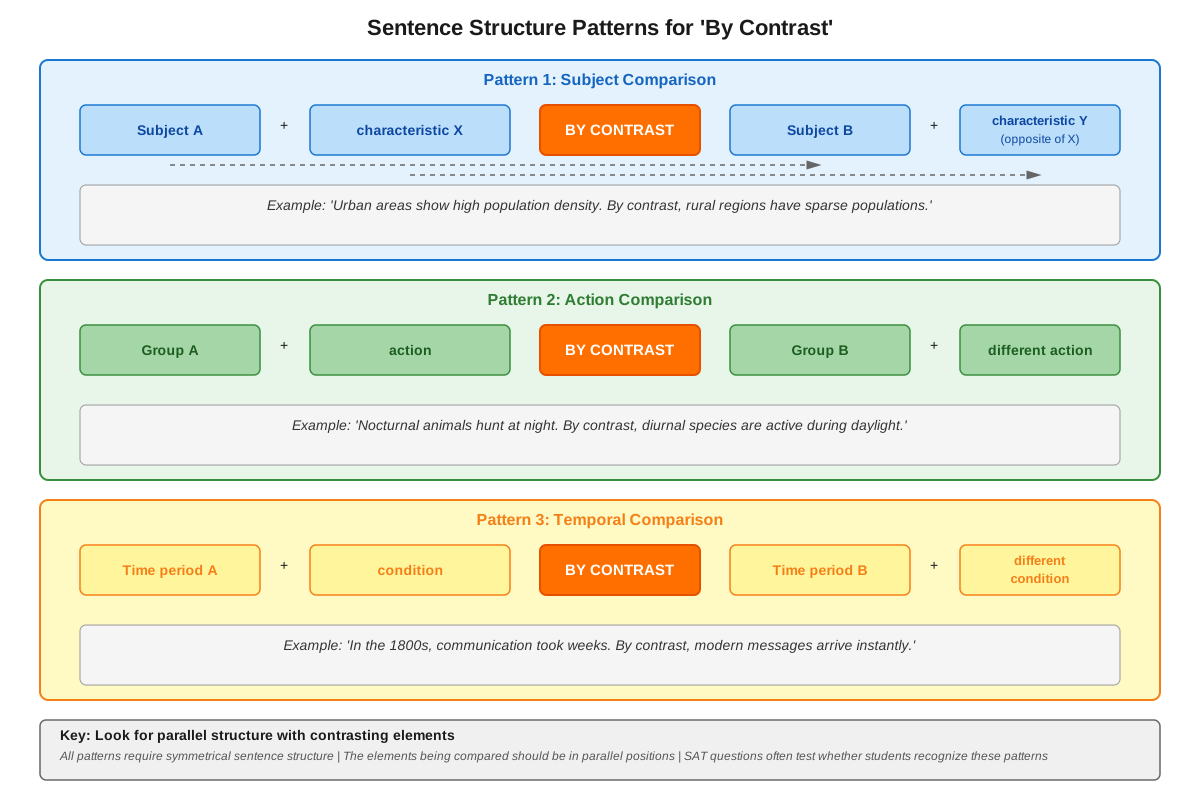
By contrast typically appears at the beginning of a sentence, immediately followed by a comma. This placement maximizes its effectiveness as a signal to readers that a shift is occurring. The standard pattern follows this structure:
Sentence 1: [Statement A with specific characteristics or claims]
Sentence 2: By contrast, [Statement B with opposing characteristics or claims]
For example: "The northern region experiences harsh winters with temperatures regularly dropping below freezing. By contrast, the southern region maintains mild temperatures year-round, rarely seeing frost."
Less commonly, by contrast may appear after the subject of the second sentence, set off by commas on both sides: "The southern region, by contrast, maintains mild temperatures year-round." This mid-sentence placement emphasizes the contrasting element (the southern region) while still maintaining the oppositional relationship.
Logical Relationships Signaled by By Contrast
Understanding when by contrast is appropriate requires recognizing specific logical relationships between ideas. The transition works best when:
- Direct opposition exists: Two entities, concepts, or situations have clearly opposing characteristics (Example: "Species A thrives in acidic soil. By contrast, Species B requires alkaline conditions.")
- Comparative differences are highlighted: While not complete opposites, two subjects differ in significant, noteworthy ways (Example: "The first method prioritizes speed. By contrast, the second method emphasizes accuracy.")
- Expectations are reversed: The second statement contradicts what might be expected based on the first (Example: "Most participants improved their scores. By contrast, the control group showed declining performance.")
- Different perspectives are presented: Two viewpoints, theories, or interpretations stand in opposition (Example: "Early scholars attributed the phenomenon to divine intervention. By contrast, modern researchers identify natural causes.")
Distinguishing By Contrast from Similar Transitions
The SAT frequently tests whether students can distinguish by contrast from other transitions that might seem similar but signal different logical relationships. Understanding these distinctions is crucial for selecting correct answers.
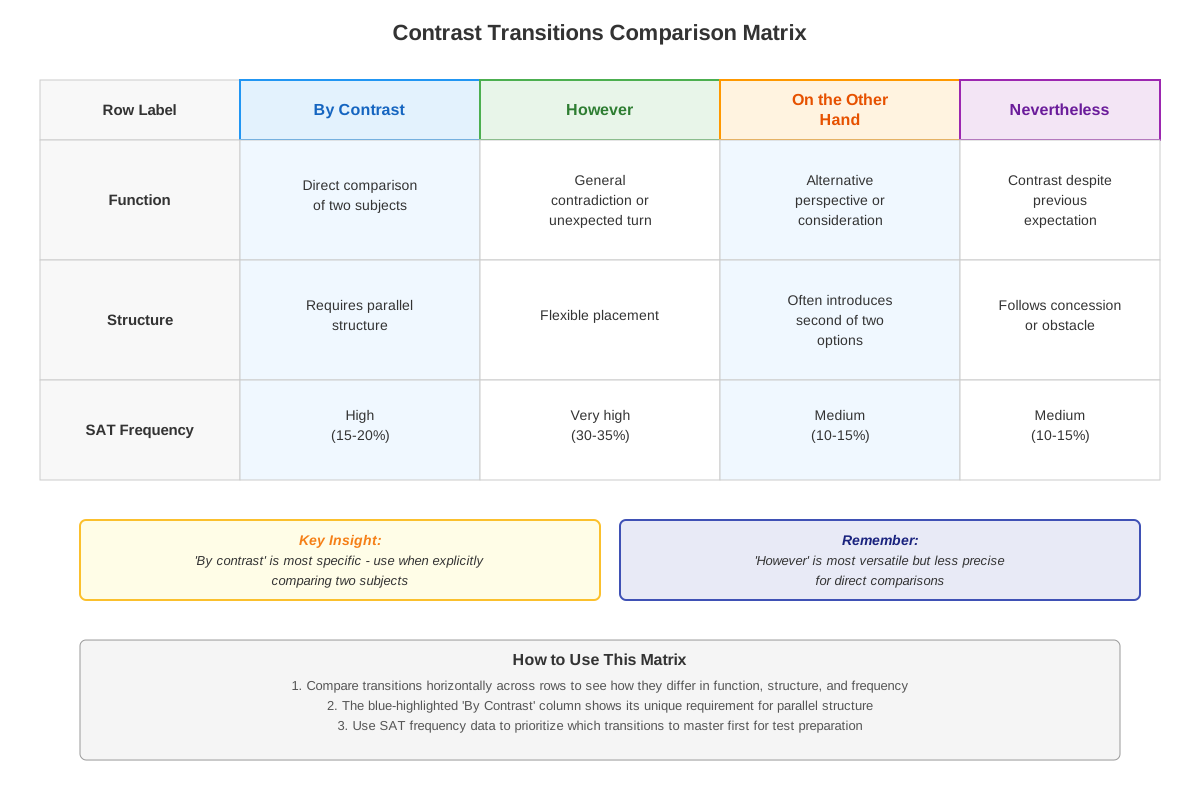
| Transition | Logical Relationship | When to Use | Example Context |
|---|---|---|---|
| By contrast | Direct opposition or significant difference | Two subjects/ideas have opposing characteristics | "Dogs are social animals. By contrast, cats are more solitary." |
| However | Contradiction or qualification | Second idea contradicts or limits the first | "The plan seemed perfect. However, it had one fatal flaw." |
| On the other hand | Alternative perspective or consideration | Presenting another side while maintaining balance | "The policy benefits businesses. On the other hand, it may burden consumers." |
| Nevertheless | Concession followed by persistence | Despite the first idea, the second remains true | "The task was difficult. Nevertheless, they completed it." |
| Conversely | Inverse or opposite relationship | Second idea is the reverse of the first | "Heating expands the metal. Conversely, cooling contracts it." |
Context Clues for Identifying Contrast Needs
Successful application of by contrast on the SAT requires reading both the sentence before and after the blank to identify context clues that signal opposition. Key indicators include:
- Antonyms or opposing concepts: Words with opposite meanings appearing in consecutive sentences (increase/decrease, support/oppose, ancient/modern)
- Different subjects being compared: Two distinct entities, groups, or time periods being discussed
- Contradictory data or outcomes: Statistics, results, or observations that differ significantly
- Structural parallelism with opposing content: Similar sentence structures containing contrasting information
- Qualifying language in the first sentence: Words like "some," "certain," or "one group" that suggest another group will be discussed with different characteristics
Concept Relationships
The concept of by contrast exists within a hierarchical system of transition words and phrases. At the broadest level, all transitions serve to connect ideas and guide readers through logical relationships. Within this category, contrast transitions form a distinct subset focused on opposition and difference. By contrast represents one specific tool within this subset, distinguished by its formal tone and explicit signaling of comparison.
The relationship between concepts can be mapped as follows:
Transitions (general category) → Contrast transitions (subset) → By contrast (specific tool) → Application in SAT questions (practical use)
Understanding by contrast also requires recognizing its relationship to paragraph structure and argumentation. When writers present balanced arguments, they often follow this pattern: Claim/Evidence → Contrast transition → Counterclaim/Contrasting evidence. This structure appears frequently in SAT passages, particularly in social science and argumentative texts.
The connection to prerequisite knowledge is direct: students must understand basic logical relationships (similarity, difference, cause-and-effect) to recognize when contrast is appropriate. This foundational understanding enables them to distinguish by contrast from continuation transitions (furthermore, additionally) and causal transitions (therefore, consequently). Each transition type signals a different logical move, and recognizing these differences is essential for SAT success.
High-Yield Facts
⭐ By contrast always signals opposition or significant difference between two ideas, never similarity or continuation
⭐ On the SAT, by contrast typically appears at the beginning of a sentence, followed by a comma
⭐ The sentence before the blank and the sentence after must contain opposing or contrasting elements for by contrast to be correct
⭐ By contrast is more formal than "but" or "yet" and typically introduces a complete independent clause
⭐ When by contrast is correct, you should be able to identify specific opposing characteristics, outcomes, or perspectives in the surrounding sentences
- By contrast questions appear in approximately 15-20% of all SAT transition questions
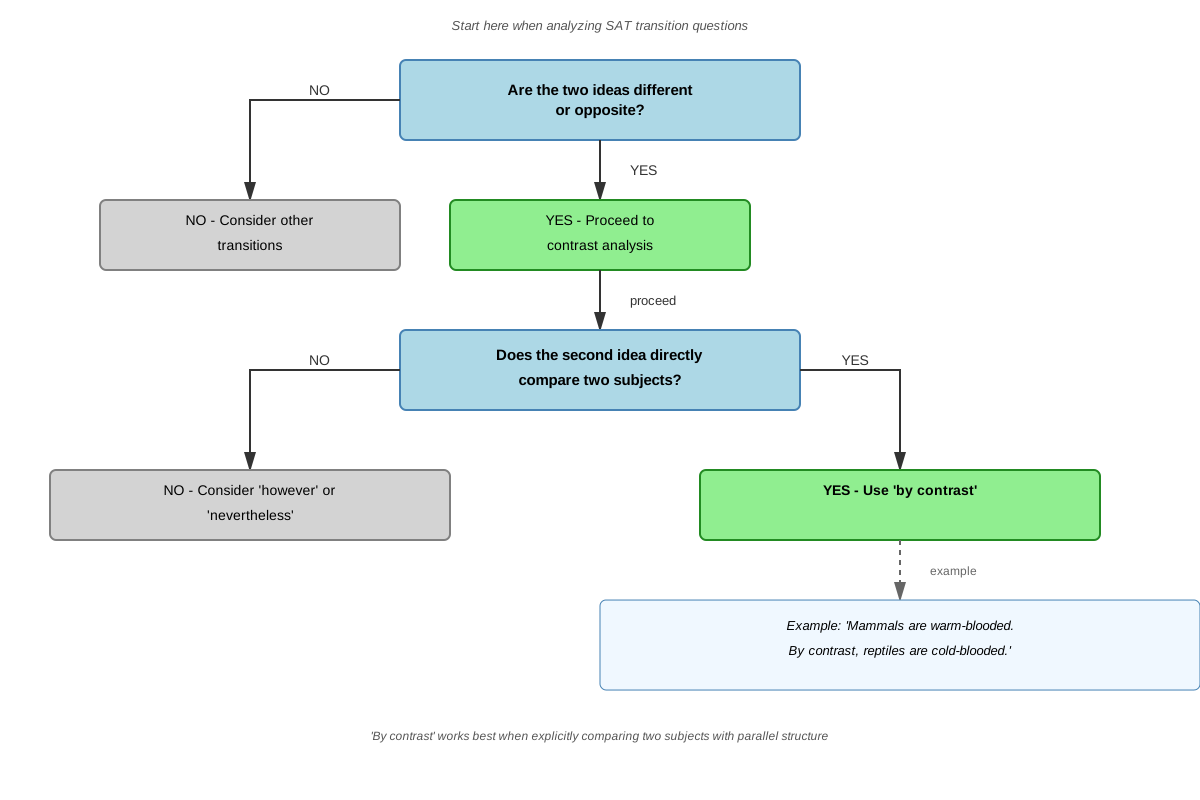
- The transition can be distinguished from "however" because by contrast emphasizes comparison between two subjects, while "however" emphasizes contradiction within a single line of reasoning
- Incorrect answer choices on by contrast questions often include continuation transitions (furthermore, moreover) or causal transitions (therefore, thus)
- By contrast works best when two distinct subjects, groups, or entities are being compared
- The phrase can appear mid-sentence (set off by commas) but most commonly appears at the sentence beginning
- SAT passages using by contrast often employ parallel sentence structures to emphasize the comparison
- Reading both sentences completely before selecting a transition is essential—the contrast may not be apparent from the first sentence alone
Quick check — test yourself on By contrast so far.
Try Flashcards →Common Misconceptions
Misconception: By contrast can be used whenever two different things are mentioned in consecutive sentences.
Correction: By contrast requires not just difference but opposition or significant contrast. Two things can be different without being contrasting. For example, "The museum features paintings. The library contains books" presents different subjects but not contrasting ones. By contrast would be inappropriate here.
Misconception: By contrast and however are interchangeable.
Correction: While both signal contrast, however typically introduces a contradiction or qualification within a single line of reasoning, while by contrast compares two distinct subjects or situations. "The plan was expensive. However, it succeeded" uses however correctly. "Group A preferred option 1. By contrast, Group B preferred option 2" uses by contrast correctly because it compares two groups.
Misconception: If the second sentence is different from the first, by contrast must be correct.
Correction: The difference must be meaningful and oppositional. Additionally, other transitions might better capture the logical relationship. If the second sentence provides an example of the first, "for instance" would be correct despite the sentences being different. If the second sentence results from the first, "therefore" would be appropriate.
Misconception: By contrast should be used when presenting a counterargument.
Correction: While by contrast can introduce opposing viewpoints, it's most effective when comparing two subjects, not when qualifying or contradicting a single claim. For counterarguments within a single line of reasoning, "however," "nevertheless," or "yet" are often more appropriate.
Misconception: The contrast must be explicitly stated with antonyms.
Correction: While antonyms provide clear contrast, by contrast can also signal differences in degree, approach, outcome, or perspective without requiring opposite words. "Method A takes three hours. By contrast, Method B takes thirty minutes" shows contrast through different time frames, not antonyms.
Worked Examples
Example 1: Species Adaptation
Passage: Desert plants have evolved numerous adaptations to conserve water in arid environments. Their leaves are often small or needle-like, reducing surface area and minimizing water loss through evaporation. _____ rainforest plants typically feature broad, expansive leaves that maximize surface area for capturing sunlight in the dim understory.
Options:
A) Therefore,
B) By contrast,
C) For example,
D) Additionally,
Step 1: Read both sentences completely
The first sentence discusses desert plants and their water-conservation adaptations (small leaves to reduce water loss). The second sentence discusses rainforest plants and their leaves (broad leaves to capture sunlight).
Step 2: Identify the logical relationship
Two different plant types are being compared. Desert plants have small leaves (for water conservation), while rainforest plants have broad leaves (for light capture). These are opposing characteristics serving different environmental needs.
Step 3: Evaluate each option
- "Therefore" suggests the second sentence results from the first—incorrect, as rainforest plants don't result from desert plant adaptations
- "By contrast" signals opposition between two subjects—correct, as it highlights the opposing leaf characteristics
- "For example" suggests the second sentence exemplifies the first—incorrect, as rainforest plants aren't examples of desert plants
- "Additionally" suggests continuation or addition—incorrect, as the second sentence doesn't add to the first idea but opposes it
Step 4: Confirm the answer
B) By contrast is correct because it appropriately signals the opposition between desert plants (small leaves) and rainforest plants (broad leaves), with each adaptation serving different environmental challenges.
Connection to Learning Objectives: This example demonstrates identifying key features of by contrast (signaling opposition between two subjects) and applying it to answer SAT-style questions by recognizing the comparative structure.
Example 2: Economic Policy
Passage: The government's initial economic policy focused on reducing inflation through aggressive interest rate increases and spending cuts. This approach successfully lowered inflation from 8% to 3% within two years. _____ the revised policy prioritizes economic growth through tax reductions and infrastructure investment, even at the risk of modest inflation increases.
Options:
A) By contrast,
B) Consequently,
C) Similarly,
D) In fact,
Step 1: Read both sentences completely
The first two sentences describe an initial policy focused on reducing inflation through specific methods, achieving success. The third sentence (with the blank) describes a revised policy with different priorities and methods.
Step 2: Identify the logical relationship
The initial policy prioritized inflation reduction (through rate increases and spending cuts), while the revised policy prioritizes growth (through tax cuts and investment). These represent opposing priorities and contrasting approaches.
Step 3: Evaluate each option
- "By contrast" signals opposition—potentially correct, as the policies have different priorities and methods
- "Consequently" suggests the revised policy results from the initial policy's success—incorrect, as the revised policy doesn't follow logically from the success but represents a different choice
- "Similarly" suggests the policies are alike—incorrect, as they have opposite priorities
- "In fact" suggests emphasis or clarification—incorrect, as the revised policy doesn't clarify or emphasize the initial policy
Step 4: Confirm the answer
A) By contrast is correct because it signals the shift from one policy approach (inflation-focused) to an opposing approach (growth-focused), highlighting the different priorities and methods.
Connection to Learning Objectives: This example demonstrates explaining how by contrast appears on the SAT (comparing two approaches or time periods) and distinguishing it from causal transitions like "consequently."
Exam Strategy
When approaching SAT questions involving by contrast, employ a systematic strategy that maximizes accuracy while managing time effectively. Begin by reading the complete sentence before the blank and the complete sentence containing the blank. Never attempt to select a transition based solely on the first sentence—the contrast must be evident in both sentences.
Trigger words and phrases to watch for:
- Antonym pairs (increase/decrease, support/oppose, ancient/modern, simple/complex)
- Different subjects being discussed (Group A/Group B, Species X/Species Y, Method 1/Method 2)
- Temporal shifts with different characteristics (initially/later, historically/currently, before/after)
- Comparative language (more/less, larger/smaller, faster/slower)
- Opposing outcomes or results (succeeded/failed, increased/decreased, improved/declined)
Process-of-elimination approach:
- Eliminate continuation transitions first: If the second sentence opposes rather than adds to the first, eliminate "furthermore," "additionally," "moreover," and "also"
- Eliminate causal transitions: If the second sentence doesn't result from the first, eliminate "therefore," "thus," "consequently," and "as a result"
- Distinguish among remaining contrast transitions: If by contrast remains alongside "however" or "nevertheless," check whether two distinct subjects are being compared (favoring by contrast) or whether a single line of reasoning is being qualified (favoring "however" or "nevertheless")
Time allocation advice: Transition questions should take approximately 30-45 seconds each. If you find yourself spending more than one minute, select your best answer, mark the question for review, and return if time permits. The systematic approach outlined above should enable quick, confident answers on most transition questions.
Exam Tip: When by contrast appears as an answer choice, immediately look for two distinct subjects, groups, or entities being compared in the surrounding sentences. If you can't identify two clear subjects with opposing characteristics, by contrast is likely incorrect.
Memory Techniques
Mnemonic for By Contrast usage: "Two Subjects, Opposite Sides" (TSOS)
- Two distinct subjects must be present
- Subjects must have opposing characteristics
- Opposition should be clear and meaningful
- Sentence structure often shows parallelism
Visualization strategy: Picture a scale or balance with two sides. When by contrast is appropriate, imagine two different objects on opposite sides of the scale, representing the two subjects being compared. If you can't visualize two distinct objects with opposing characteristics, by contrast is likely incorrect.
Acronym for contrast transition distinctions: BENCH
- By contrast = Between two subjects with opposing traits
- Even so/Nevertheless = Despite the first idea, second persists
- Nonetheless = Similar to nevertheless
- Conversely = Inverse relationship
- However = Contradiction within single reasoning line
Memory hook: Think of by contrast as requiring a "comparison photo"—you need two distinct subjects in the frame, positioned to show their differences. If your mental photo only has one subject or shows similarity rather than difference, by contrast doesn't fit.
Summary
By contrast serves as a formal transition phrase that signals opposition or significant difference between two ideas, subjects, or situations. On the SAT Reading and Writing section, this transition appears consistently in questions testing students' ability to recognize logical relationships between sentences. The phrase functions most effectively when two distinct entities are being compared, with each possessing opposing or contrasting characteristics. Success with by contrast questions requires reading both surrounding sentences completely, identifying the specific opposing elements, and distinguishing this transition from similar options like "however" (which qualifies a single line of reasoning) or continuation transitions like "furthermore" (which add to rather than oppose the first idea). The key to mastery lies in recognizing that by contrast demands not merely difference but meaningful opposition, typically between two subjects rather than within a single argumentative thread. Students who develop the ability to quickly identify comparative structures and opposing characteristics will find these questions among the most straightforward on the SAT.
Key Takeaways
- By contrast signals opposition or significant difference between two subjects, ideas, or situations, requiring both sentences to contain contrasting elements
- The transition most commonly appears at the beginning of a sentence followed by a comma, introducing a complete independent clause
- Distinguishing by contrast from "however" is crucial: by contrast compares two subjects, while "however" qualifies a single line of reasoning
- Context clues for by contrast include antonym pairs, different subjects being discussed, and parallel sentence structures with opposing content
- Systematic elimination of continuation and causal transitions first, followed by careful distinction among contrast transitions, yields the highest accuracy
- Reading both complete sentences before selecting a transition is essential—the contrast may not be apparent from the first sentence alone
- By contrast appears in approximately 15-20% of SAT transition questions, making it a high-yield topic for focused study
Related Topics
Other Contrast Transitions: Mastering by contrast provides a foundation for understanding the full range of contrast transitions, including "however," "nevertheless," "on the other hand," and "conversely." Each signals a slightly different type of opposition or qualification, and distinguishing among them represents an advanced skill that builds directly on by contrast mastery.
Continuation Transitions: Understanding when ideas continue rather than contrast helps students avoid common errors. Transitions like "furthermore," "moreover," and "additionally" signal that the second sentence adds to or extends the first, representing the logical opposite of contrast transitions.
Causal Transitions: Recognizing cause-and-effect relationships through transitions like "therefore," "consequently," and "thus" complements contrast transition knowledge. Many SAT questions require distinguishing between contrast and causation.
Paragraph Structure and Organization: The broader context of how paragraphs are organized—with topic sentences, supporting details, and transitions—provides the framework within which by contrast operates. Understanding paragraph structure enables more sophisticated analysis of when transitions are appropriate.
Practice CTA
Now that you've mastered the core concepts of by contrast and developed strategies for SAT success, it's time to put your knowledge into action. Complete the practice questions to reinforce your understanding and build the pattern recognition that leads to quick, confident answers on test day. Use the flashcards to cement high-yield facts and distinctions in your memory. Remember: transition questions are among the most predictable on the SAT—consistent practice with by contrast and related transitions will translate directly into points on your exam. Every practice question you complete strengthens your ability to recognize logical relationships and select appropriate transitions with confidence. You've built the foundation; now apply it!
Sign up free to keep reading
Create a free AnvayaPrep account to finish this SAT guide on By contrast — plus flashcards and practice questions.