Overview
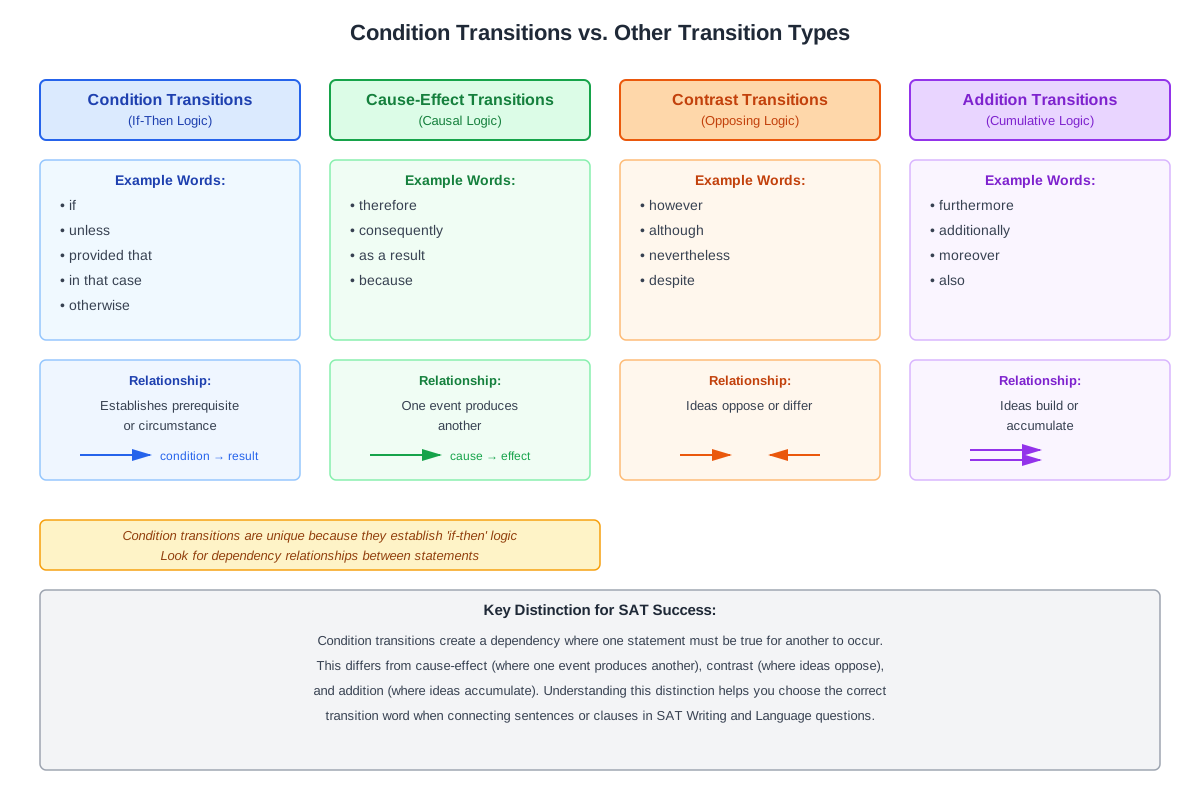
Condition transitions are logical connectors that signal a specific relationship between ideas: one statement establishes the circumstances, requirements, or stipulations under which another statement becomes true or relevant. On the SAT Reading and Writing (RW) section, these transitions appear frequently in questions that test a student's ability to recognize how sentences relate to one another within a passage. Understanding condition transitions is crucial because they represent one of the four major transition categories tested on the digital SAT, alongside addition, contrast, and cause-and-effect relationships.
Mastering sat condition transitions requires recognizing that these words and phrases establish "if-then" relationships, prerequisites, or necessary conditions between ideas. Words like "if," "unless," "provided that," and "in that case" all signal conditional logic. When a passage states that something occurs "only if" a certain condition is met, or that an outcome happens "otherwise," the writer is using condition transitions to show dependency between concepts. These transitions are particularly important in argumentative and scientific passages where authors must establish the specific circumstances under which their claims hold true.
The ability to identify and apply condition transitions connects directly to broader reading comprehension skills tested throughout the SAT. Transition questions typically appear once or twice per test module, making them high-yield content that can directly impact scores. Beyond isolated transition questions, understanding conditional relationships helps students navigate complex sentence structures, follow multi-step arguments, and comprehend nuanced scientific explanations—all critical skills for achieving top scores in the Reading and Writing section.
Learning Objectives
- [ ] Identify key features of condition transitions
- [ ] Explain how condition transitions appears on the SAT
- [ ] Apply condition transitions to answer SAT-style questions
- [ ] Distinguish condition transitions from other transition types (contrast, cause-and-effect, addition)
- [ ] Recognize subtle variations in conditional meaning (sufficient vs. necessary conditions)
- [ ] Evaluate whether a proposed transition word correctly establishes a conditional relationship in context
Prerequisites
- Basic understanding of sentence structure: Recognizing independent and dependent clauses helps identify where transitions connect ideas and what logical relationship they establish.
- Familiarity with logical relationships: Understanding fundamental concepts like cause-and-effect and contrast provides the foundation for distinguishing conditional relationships from other transition types.
- Reading comprehension fundamentals: The ability to identify main ideas and supporting details enables students to determine whether a conditional relationship appropriately connects two statements.
Why This Topic Matters
Condition transitions appear in virtually every domain of academic and professional writing, from scientific research papers that specify experimental conditions to legal documents that outline contractual stipulations. In everyday reading, recognizing conditional relationships helps readers understand when claims are universal versus when they apply only under specific circumstances. This skill prevents misinterpretation of nuanced arguments and helps readers identify the scope and limitations of any statement.
On the SAT, transition questions account for approximately 10-15% of the Reading and Writing section, with condition transitions representing roughly 25-30% of all transition questions. This translates to 1-2 questions per test module specifically testing conditional relationships. These questions typically appear in the "Craft and Structure" domain and are considered medium difficulty, though they can reach higher difficulty when the conditional relationship is subtle or when multiple transition types seem plausible.
Condition transitions most commonly appear in SAT passages discussing scientific processes (where specific conditions must be met for reactions or phenomena to occur), historical cause-and-effect relationships (where outcomes depend on particular circumstances), and argumentative texts (where authors qualify their claims by specifying when they apply). Students frequently encounter these transitions in passages about experiments, policy proposals, technological innovations, and theoretical frameworks where the author must establish the boundaries of their assertions.
Core Concepts
Defining Condition Transitions
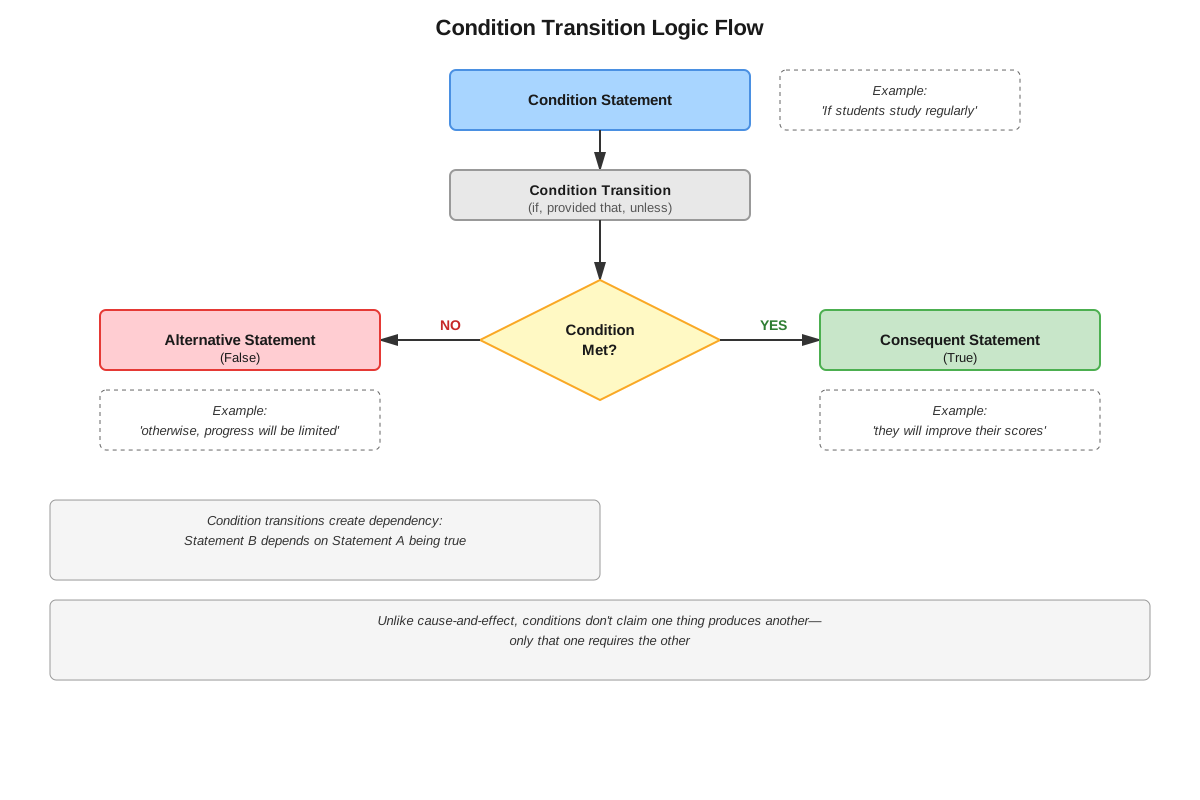
Condition transitions are words or phrases that establish a dependent relationship between two statements, where one statement specifies the circumstances, requirements, or stipulations necessary for the other statement to be true, relevant, or applicable. Unlike cause-and-effect transitions that show one event producing another, condition transitions establish the parameters or prerequisites without necessarily implying causation. The key distinction is that conditional relationships answer "under what circumstances?" rather than "why did this happen?"
Common condition transition words and phrases include:
- If, unless, provided that, as long as
- In that case, then, otherwise
- Only if, even if, whether or not
- Assuming that, supposing that, granted that
- On the condition that, contingent upon
Types of Conditional Relationships
Sufficient Conditions
A sufficient condition is one where the presence of the first statement guarantees the second statement. The transition "if" typically introduces sufficient conditions. For example: "If the temperature drops below 32°F, water will freeze." The temperature dropping is sufficient (enough) to guarantee freezing, though it's not the only way water could freeze (pressure changes could also cause it).
Necessary Conditions
A necessary condition is one that must be present for the second statement to be true, but its presence alone doesn't guarantee the outcome. The phrase "only if" typically introduces necessary conditions. For example: "Water will freeze only if the temperature is at or below its freezing point." The temperature condition is necessary (required) but might not be sufficient if other factors (like impurities or pressure) prevent freezing.
Negative Conditions
These transitions establish what happens when a condition is NOT met. "Unless" and "otherwise" are the most common negative condition transitions. For example: "Unless the experiment is conducted in a vacuum, air resistance will affect the results." This means the condition (vacuum environment) must be met to avoid the consequence (air resistance effects).
Conditional Logic in Context
Understanding how condition transitions function requires recognizing the two-part structure they create:
- The condition clause: States the requirement, circumstance, or stipulation
- The consequence clause: States what follows, applies, or becomes true given the condition
| Transition Type | Example Phrase | Relationship Established | SAT Context |
|---|---|---|---|
| Simple condition | "if," "when" | Basic if-then relationship | Most common in scientific passages |
| Negative condition | "unless," "otherwise" | What happens without the condition | Frequent in argumentative texts |
| Qualified condition | "provided that," "as long as" | Condition with emphasis on requirement | Common in policy/proposal passages |
| Alternative condition | "whether or not," "even if" | Outcome regardless of condition | Less common but high-difficulty |
Distinguishing Conditions from Other Transitions
The most challenging aspect of condition transitions on the SAT is distinguishing them from cause-and-effect transitions, as both can involve "if-then" logic. The key difference:
- Cause-and-effect: One event produces or brings about another (temporal and causal relationship)
- Condition: One statement establishes the parameters under which another applies (logical relationship about applicability)
Consider these examples:
- Cause-and-effect: "Because the temperature dropped, the water froze." (The temperature drop caused the freezing)
- Condition: "If the temperature drops below freezing, water will freeze." (Establishes when freezing occurs, not describing a specific causal event)
Contextual Clues for Condition Transitions
When determining whether a condition transition is appropriate, examine:
- Temporal relationship: Conditions often describe general rules or repeated scenarios rather than one-time events
- Certainty level: Conditions establish parameters for when something is true, not assert that it definitely happened
- Scope markers: Words like "any," "all," "whenever" often accompany conditional statements
- Hypothetical language: Conditions frequently appear with modal verbs (would, could, might) indicating possibility rather than certainty
Concept Relationships
Condition transitions form part of the broader transition framework tested on the SAT, which includes four main categories: addition, contrast, cause-and-effect, and condition. Understanding how these categories relate helps students quickly eliminate incorrect answer choices.
Relationship hierarchy: Addition transitions (furthermore, moreover) → show accumulation of similar ideas; Contrast transitions (however, nevertheless) → show opposition between ideas; Cause-and-effect transitions (therefore, consequently) → show one idea producing another; Condition transitions (if, unless) → show one idea establishing parameters for another.
Internal relationships within condition transitions: Simple conditions (if, when) → establish basic conditional relationships; Negative conditions (unless, otherwise) → specify what happens when conditions aren't met; Qualified conditions (provided that, as long as) → emphasize the requirement aspect; Alternative conditions (whether or not, even if) → show outcomes independent of conditions.
Connection to prerequisite knowledge: Understanding sentence structure → enables identification of condition and consequence clauses; Recognizing logical relationships → allows distinction between conditional and causal relationships; Reading comprehension skills → help determine whether the conditional relationship makes sense in context.
Progression to advanced skills: Mastering condition transitions → enables analysis of complex argumentative structures; Understanding conditional logic → supports critical reasoning in evidence-based questions; Recognizing scope limitations → improves inference question accuracy.
High-Yield Facts
⭐ Condition transitions establish "under what circumstances" relationships, not "why" relationships—this distinguishes them from cause-and-effect transitions.
⭐ "Unless" means "if not"—it introduces a negative condition where the consequence occurs when the condition is NOT met.
⭐ "Only if" introduces a necessary condition (required but not sufficient), while "if" alone introduces a sufficient condition (enough to guarantee the outcome).
⭐ Condition transitions frequently appear with modal verbs (would, could, might) indicating hypothetical or repeated scenarios rather than specific past events.
⭐ On the SAT, condition transition questions typically provide four options representing different transition categories—eliminate by identifying the logical relationship first.
- "Provided that" and "as long as" are synonymous condition transitions emphasizing the requirement aspect of the conditional relationship.
- "Otherwise" signals what happens when a stated condition is not met, making it functionally equivalent to "if not."
- Condition transitions often appear in scientific passages describing experimental parameters or natural phenomena that occur under specific circumstances.
- "In that case" and "then" serve as consequence markers, appearing in the clause that follows from the condition rather than introducing the condition itself.
- Conditional statements can be reversed: "If A, then B" is logically equivalent to "B only if A," though the emphasis differs.
- "Whether or not" and "even if" indicate that the consequence occurs regardless of the condition, representing a special case where the conditional relationship is negated.
- Time-based transitions like "when" can function as condition transitions when they establish general rules rather than specific temporal sequences.
Quick check — test yourself on Condition transitions so far.
Try Flashcards →Common Misconceptions
Misconception: All "if-then" relationships are condition transitions. → Correction: Some "if-then" statements describe cause-and-effect relationships where one event produces another. Condition transitions establish parameters or rules rather than describing causal production. Look for hypothetical language, general rules, or repeated scenarios to identify true conditional relationships.
Misconception: "Unless" means "except" or "in addition to." → Correction: "Unless" means "if not" and introduces a negative condition. "The experiment will fail unless the temperature is controlled" means "If the temperature is NOT controlled, the experiment will fail." The condition (temperature control) must be met to avoid the consequence (failure).
Misconception: Condition transitions always appear at the beginning of sentences. → Correction: Condition transitions can appear mid-sentence or even connect ideas across sentences. "The hypothesis holds true. If, however, the sample size is too small, the results become unreliable" uses a condition transition to qualify the previous statement.
Misconception: "If" and "only if" are interchangeable. → Correction: These establish different logical relationships. "If A, then B" means A is sufficient for B (A guarantees B). "B only if A" means A is necessary for B (B requires A, but A doesn't guarantee B). On the SAT, this distinction rarely matters for answer selection, but understanding it prevents confusion.
Misconception: Condition transitions and contrast transitions are mutually exclusive. → Correction: Some transitions like "even if" and "whether or not" combine conditional and concessive (contrast-like) meanings, indicating that a consequence occurs despite or regardless of a condition. These represent advanced conditional relationships but still fall under the condition category.
Worked Examples
Example 1: Scientific Process Passage
Passage Context: A passage discusses photosynthesis in plants. The previous sentence explains that plants convert light energy into chemical energy. The next sentence reads: "_____ chlorophyll is present in the plant cells, this energy conversion cannot occur."
Answer Choices:
A) Therefore,
B) However,
C) Unless
D) Moreover,
Step 1 - Identify the logical relationship: The sentence establishes that chlorophyll presence is required for energy conversion. Without chlorophyll, the process cannot happen. This is a conditional relationship about necessary requirements.
Step 2 - Eliminate non-conditional transitions:
- "Therefore" (Choice A) indicates cause-and-effect or conclusion—eliminated
- "However" (Choice B) indicates contrast—eliminated
- "Moreover" (Choice D) indicates addition—eliminated
Step 3 - Verify the conditional logic: "Unless" means "if not." The sentence would read: "If chlorophyll is NOT present, energy conversion cannot occur." This correctly establishes chlorophyll as a necessary condition for photosynthesis.
Step 4 - Check for alternative interpretations: Could this be cause-and-effect? No, because the sentence establishes a general rule about requirements rather than describing one event causing another. The use of "cannot occur" (modal verb indicating impossibility) rather than "does not occur" (simple statement of fact) confirms this is conditional.
Answer: C) Unless
Connection to learning objectives: This example demonstrates identifying key features of condition transitions (negative condition establishing necessary requirements) and applying this knowledge to select the correct transition in an SAT-style question.
Example 2: Historical Argument Passage
Passage Context: A passage argues that economic reforms in the 1930s prevented complete economic collapse. The previous sentences describe various reform measures. The next sentence reads: "_____ these reforms had been implemented, the economic situation would likely have deteriorated further."
Answer Choices:
A) Because
B) If
C) Although
D) Unless
Step 1 - Analyze the sentence structure: The sentence uses "would have" (past conditional modal), indicating a hypothetical scenario about what might have happened under different circumstances. This signals a conditional relationship.
Step 2 - Determine the direction of the condition: The sentence suggests that WITHOUT the reforms, deterioration would have occurred. We need a negative condition transition.
Step 3 - Evaluate each choice:
- "Because" (Choice A) would indicate the reforms caused deterioration—opposite of the intended meaning—eliminated
- "If" (Choice B) would suggest "If reforms had been implemented, deterioration would have occurred"—opposite meaning—eliminated
- "Although" (Choice C) indicates contrast but doesn't establish the conditional relationship about what would have happened without reforms—eliminated
- "Unless" (Choice D) means "if not": "If reforms had NOT been implemented, deterioration would have occurred"—correct meaning
Step 4 - Verify with context: The passage argues reforms were beneficial. "Unless these reforms had been implemented" correctly conveys that the reforms prevented deterioration by establishing what would have happened without them.
Answer: D) Unless
Connection to learning objectives: This example shows how to distinguish condition transitions from other types (particularly contrast and cause-and-effect), recognize negative conditions, and apply conditional logic to complex historical arguments with hypothetical scenarios.
Exam Strategy
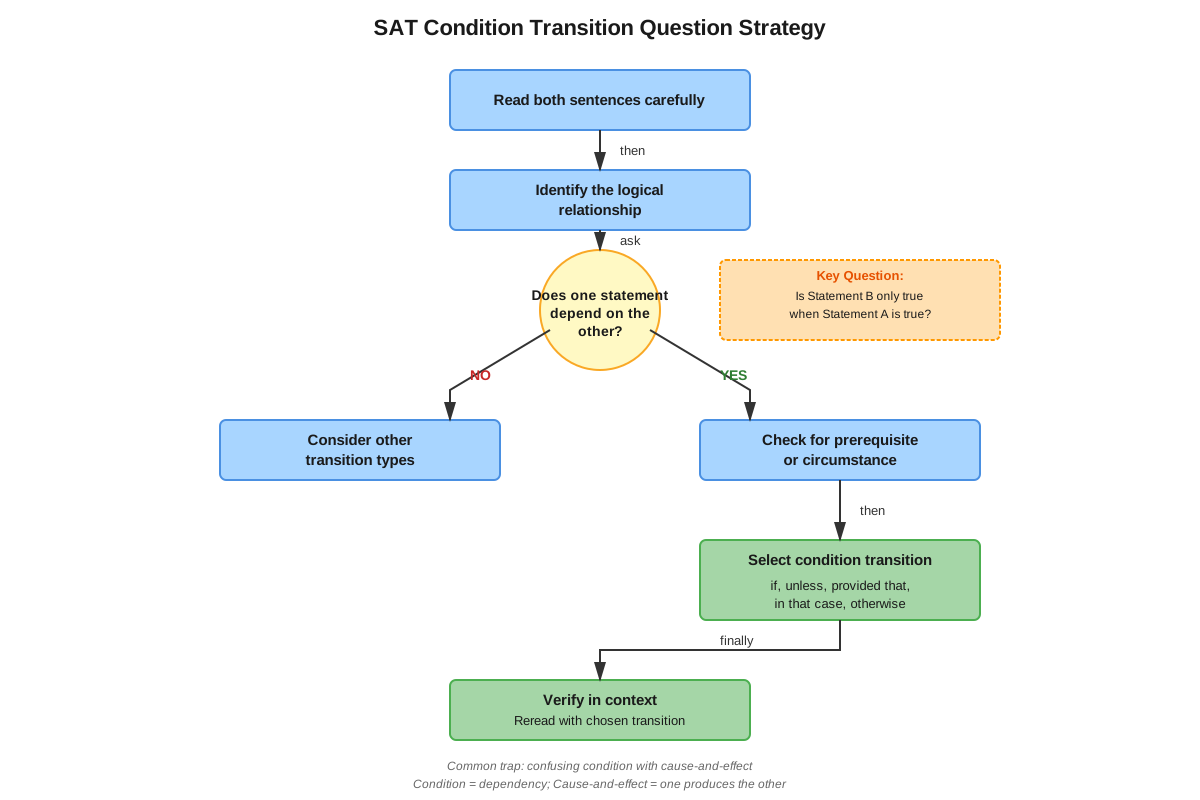
Approach SAT condition transition questions systematically:
- Read the surrounding context (1-2 sentences before and after the blank) to understand the logical relationship between ideas
- Identify the relationship type before looking at answer choices (condition, cause-and-effect, contrast, or addition)
- Look for trigger words in the sentence that signal conditional relationships
- Eliminate obviously wrong categories first (if you need condition, eliminate all contrast and addition options immediately)
- Verify your choice by reading the complete sentence with your selected transition
Trigger words and phrases to watch for:
Condition transitions often appear in sentences containing:
- Modal verbs: would, could, might, can, will (indicating hypothetical or general scenarios)
- Negative constructions: cannot, will not, would not (often paired with "unless")
- Requirement language: necessary, required, must, need (suggesting necessary conditions)
- Hypothetical markers: suppose, assume, imagine (indicating conditional scenarios)
- Scope limiters: only, solely, exclusively (often appearing with "only if")
Process-of-elimination tips specific to condition transitions:
When condition transitions appear in answer choices alongside other transition types, eliminate by category first. If the sentence establishes "under what circumstances" something applies, you need a condition transition—immediately eliminate all cause-and-effect, contrast, and addition options.
Distinguishing similar transitions:
- If choosing between "if" and "unless": Determine whether the condition is positive (use "if") or negative (use "unless")
- If choosing between condition and cause-and-effect: Check for hypothetical language or general rules (condition) versus specific events or outcomes (cause-and-effect)
- If choosing between "provided that" and "assuming that": Both work for most conditional contexts; choose based on emphasis (requirement vs. hypothesis)
Time allocation advice:
Transition questions should take 30-45 seconds each. If you spend more than one minute, you're overthinking. The correct answer will make logical sense when you read the complete sentence. If you're stuck between two options, reread the sentence with each transition and trust your ear—the correct transition will sound natural and logical, while the incorrect one will create an awkward or illogical relationship.
Memory Techniques
Mnemonic for common condition transitions - "I PLOW":
- If / In that case
- Provided that
- Lest (archaic but occasionally appears)
- Otherwise / Only if
- Whether or not / When (in conditional contexts)
Visualization strategy for "unless":
Picture a locked door (the consequence you want to avoid) with a key (the condition). "Unless" means the door stays locked (consequence occurs) if you don't use the key (condition not met). "The door stays locked UNLESS you use the key" = "If you DON'T use the key, the door stays locked."
Acronym for distinguishing transition types - "CACC":
- Condition: Under what circumstances?
- Addition: What else?
- Contrast: What's different?
- Cause: Why/what resulted?
Memory hook for "only if" vs. "if":
"ONLY IF" = One Necessary Limitation You need → necessary condition (required)
"IF" alone = sufficient condition (enough to guarantee)
Sentence template for practice:
"[Condition transition] + [requirement/circumstance], [consequence/result]"
Practice filling this template with different condition transitions to internalize their usage patterns.
Summary
Condition transitions are logical connectors that establish the circumstances, requirements, or stipulations under which a statement becomes true or applicable. On the SAT Reading and Writing section, these transitions appear in approximately 1-2 questions per test module, making them high-yield content for score improvement. The key to mastering condition transitions lies in recognizing that they answer "under what circumstances?" rather than "why?" (cause-and-effect), "what else?" (addition), or "what's different?" (contrast). Common condition transitions include "if," "unless," "provided that," "otherwise," and "only if," each establishing slightly different conditional relationships. Success on SAT condition transition questions requires identifying the logical relationship between sentences before examining answer choices, recognizing trigger words like modal verbs and requirement language, and systematically eliminating transitions from incorrect categories. Students must particularly focus on distinguishing conditions from cause-and-effect relationships and understanding that "unless" means "if not," introducing negative conditions. Mastering these transitions not only improves performance on direct transition questions but also enhances overall reading comprehension by helping students recognize when claims apply universally versus under specific circumstances.
Key Takeaways
- Condition transitions establish "under what circumstances" relationships, distinguishing them from cause-and-effect ("why"), contrast ("what's different"), and addition ("what else") transitions
- "Unless" means "if not" and introduces negative conditions where the consequence occurs when the condition is NOT met
- Identify the logical relationship first, before looking at answer choices, then eliminate entire categories of transitions that don't match
- Modal verbs (would, could, might) and hypothetical language are strong indicators that a sentence requires a condition transition rather than cause-and-effect
- "Only if" establishes necessary conditions (required but not sufficient), while "if" alone establishes sufficient conditions (enough to guarantee the outcome)
- Condition transitions appear frequently in scientific passages describing experimental parameters and in argumentative texts where authors qualify their claims
- Read the complete sentence with your selected transition to verify it creates a logical, natural-sounding relationship between ideas
Related Topics
Cause-and-Effect Transitions: Understanding the distinction between conditional and causal relationships is essential for accurate transition selection. Mastering condition transitions provides the foundation for recognizing when passages describe production of outcomes versus establishment of parameters.
Contrast Transitions: Some advanced condition transitions like "even if" and "whether or not" combine conditional and concessive meanings. Understanding basic condition transitions enables progression to these more nuanced relationship types.
Logical Reasoning in Evidence Questions: The conditional logic skills developed through mastering condition transitions directly apply to evidence-based questions where students must determine whether data supports a claim under specific circumstances.
Complex Sentence Structure: Recognizing condition and consequence clauses within sentences builds skills for analyzing complex grammatical structures tested throughout the Reading and Writing section.
Inference Questions: Understanding when claims apply conditionally versus universally improves inference accuracy, as students learn to recognize the scope and limitations of statements in passages.
Practice CTA
Now that you've mastered the core concepts of condition transitions, it's time to solidify your understanding through active practice. Attempt the practice questions to apply these strategies to authentic SAT-style scenarios, and use the flashcards to reinforce your recognition of key condition transition words and their specific functions. Remember: transition questions are among the most predictable and learnable question types on the SAT—consistent practice with these concepts can directly translate to points on test day. Each practice question you complete strengthens your ability to quickly identify logical relationships and select correct transitions with confidence. You've built the foundation; now make it automatic through deliberate practice!
Sign up free to keep reading
Create a free AnvayaPrep account to finish this SAT guide on Condition transitions — plus flashcards and practice questions.