Overview
Consequently is a critical transition word that signals a cause-and-effect relationship in written passages. On the SAT Reading and Writing section (RW), understanding how to identify and use "consequently" correctly is essential for success on transition questions, which appear frequently throughout the exam. This transition word indicates that what follows is a direct result or outcome of what was previously stated, making it a powerful tool for tracking logical flow in complex passages.
Mastering sat consequently questions requires more than simply recognizing the word itself. Students must develop the ability to analyze the logical relationship between sentences and paragraphs, determining whether a consequence or result is being introduced. The SAT tests this skill by presenting passages with missing transitions and asking students to select the most appropriate word or phrase to maintain coherence and logical flow. Questions involving "consequently" typically appear in the Standard English Conventions domain, specifically within the Expression of Ideas category, where they assess a student's ability to improve the effectiveness of written expression.
Understanding "consequently" fits into the broader framework of transition mastery on the SAT. Transitions serve as the connective tissue of written communication, guiding readers through arguments, explanations, and narratives. "Consequently" belongs to a family of result-indicating transitions that includes words like "therefore," "thus," "as a result," and "hence." However, each of these transitions carries subtle differences in tone, formality, and usage context. The ability to distinguish between these similar transitions and select the most appropriate one for a given context is a high-yield skill that directly impacts SAT performance and overall reading comprehension ability.
Learning Objectives
- [ ] Identify key features of Consequently
- [ ] Explain how Consequently appears on the SAT
- [ ] Apply Consequently to answer SAT-style questions
- [ ] Distinguish between "consequently" and other result-indicating transitions
- [ ] Analyze sentence relationships to determine when a consequence transition is appropriate
- [ ] Evaluate answer choices by testing logical coherence in context
- [ ] Recognize common distractor patterns in transition questions involving cause-and-effect relationships
Prerequisites
- Basic sentence structure understanding: Recognizing independent clauses and how they connect is essential for understanding how transitions function between complete thoughts.
- Familiarity with logical relationships: Students should understand fundamental relationships like cause-and-effect, contrast, and addition to distinguish when "consequently" is appropriate versus other transition types.
- Reading comprehension skills: The ability to understand the main idea and supporting details of a passage is necessary to determine the logical flow that transitions support.
- Knowledge of transition categories: Understanding that transitions fall into different categories (contrast, addition, example, result) helps students quickly narrow down answer choices.
Why This Topic Matters
In real-world communication, transitions like "consequently" are fundamental to constructing clear, persuasive arguments and explanations. Professional writing, academic essays, scientific reports, and business communications all rely on precise transitions to guide readers through complex ideas. The ability to use and recognize appropriate transitions distinguishes sophisticated writing from choppy, unclear prose. Beyond the SAT, this skill transfers directly to college-level writing, where professors expect students to construct well-organized arguments with clear logical connections.
On the SAT, transition questions appear with remarkable frequency—students can expect to encounter 4-6 transition questions per test, making this one of the highest-yield question types in the Reading and Writing section. Questions specifically involving consequence transitions like "consequently" typically appear 2-3 times per exam. These questions are considered medium difficulty, meaning they separate average scorers from high scorers. Students who master transition questions can quickly and confidently earn points that others struggle with or guess on.
Transition questions involving "consequently" most commonly appear in passages discussing scientific processes, historical cause-and-effect relationships, economic analyses, and argumentative essays. The SAT frequently presents passages where a cause is established in one sentence, and the following sentence describes the effect or result. Students must recognize this relationship and select "consequently" or an equivalent transition. These questions also appear in passages where multiple transitions could seem plausible, requiring careful analysis of the specific logical relationship being expressed.
Core Concepts
Definition and Function of "Consequently"
Consequently is an adverbial transition that signals a cause-and-effect relationship where the second statement is a direct result or outcome of the first statement. It derives from the Latin "consequi," meaning "to follow." When a writer uses "consequently," they are explicitly telling the reader: "Because of what I just stated, this next thing happened or is true." This transition creates a logical bridge that helps readers understand not just what happened, but why it happened.
The word functions as a conjunctive adverb, which means it can connect independent clauses while also modifying the relationship between them. Unlike coordinating conjunctions (and, but, or), conjunctive adverbs like "consequently" require specific punctuation: typically a semicolon before and a comma after when joining two independent clauses, or a comma after when beginning a new sentence.
Punctuation Patterns with "Consequently"
Understanding proper punctuation is crucial for both identifying correct usage and eliminating incorrect answer choices on the SAT. "Consequently" follows three main punctuation patterns:
Pattern 1 - Between Independent Clauses:
The research showed alarming pollution levels; consequently, the city council banned single-use plastics.
Pattern 2 - Beginning a New Sentence:
The research showed alarming pollution levels. Consequently, the city council banned single-use plastics.
Pattern 3 - Mid-sentence (less common):
The city council, consequently, banned single-use plastics after reviewing the research.
The SAT most frequently tests Patterns 1 and 2, where "consequently" appears at the beginning of a clause or sentence. Students must recognize that when "consequently" begins a clause following a semicolon, it should be followed by a comma. This punctuation pattern distinguishes conjunctive adverbs from coordinating conjunctions.
Logical Relationship: Cause and Effect
The core logical relationship that "consequently" signals is cause → effect. To use "consequently" correctly, the preceding statement must present a cause, reason, or condition, and the following statement must present the result, outcome, or consequence. This relationship is unidirectional: the effect follows from the cause, not vice versa.
Consider this structure:
- Cause: The drought lasted for three consecutive years.
- Effect: Consequently, crop yields decreased by 40%.
The drought (cause) directly led to decreased crop yields (effect). The word "consequently" makes this causal relationship explicit and guides the reader's understanding. Without this transition, readers might not immediately recognize the connection between these facts.
Distinguishing "Consequently" from Similar Transitions
The SAT frequently tests whether students can distinguish between "consequently" and other transitions that might seem similar but signal different relationships. Understanding these distinctions is essential for selecting the correct answer.
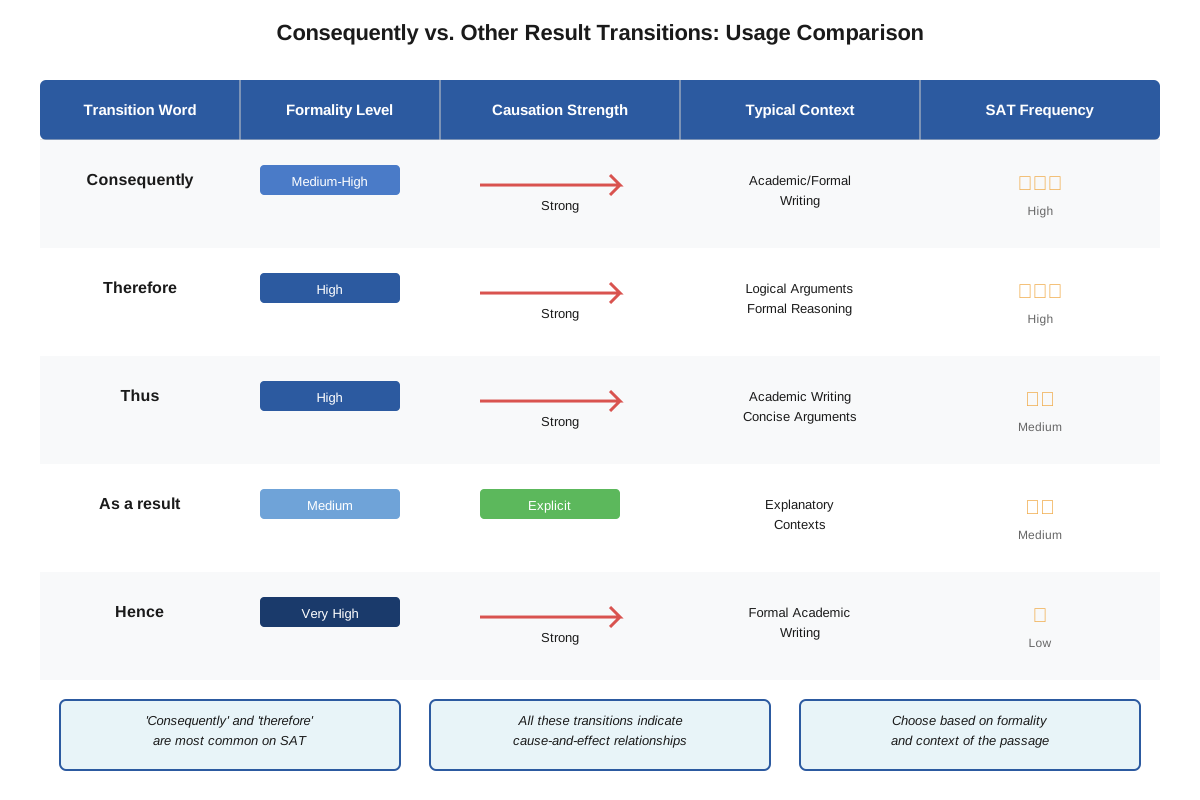
| Transition | Relationship Signaled | Usage Context | Example |
|---|---|---|---|
| Consequently | Direct cause-and-effect; result | Formal; emphasizes logical outcome | The experiment failed; consequently, the hypothesis was revised. |
| Therefore | Logical conclusion; inference | Formal; emphasizes reasoning | All mammals are warm-blooded; therefore, whales are warm-blooded. |
| Thus | Logical result; summary | Very formal; academic | The data supports the theory; thus, we accept the hypothesis. |
| As a result | Direct outcome; consequence | Neutral formality; clear causation | The storm damaged the roof; as a result, repairs cost $10,000. |
| Hence | Logical conclusion; reason | Formal; slightly archaic | The evidence is insufficient; hence, the case was dismissed. |
While these transitions all indicate some form of result or conclusion, "consequently" specifically emphasizes that one event or fact directly caused another. "Therefore" emphasizes logical reasoning rather than temporal or causal sequence. "Thus" is more formal and often summarizes a chain of reasoning. "As a result" is more explicit and less formal. "Hence" emphasizes the reason or basis for something.
Identifying When "Consequently" is Appropriate
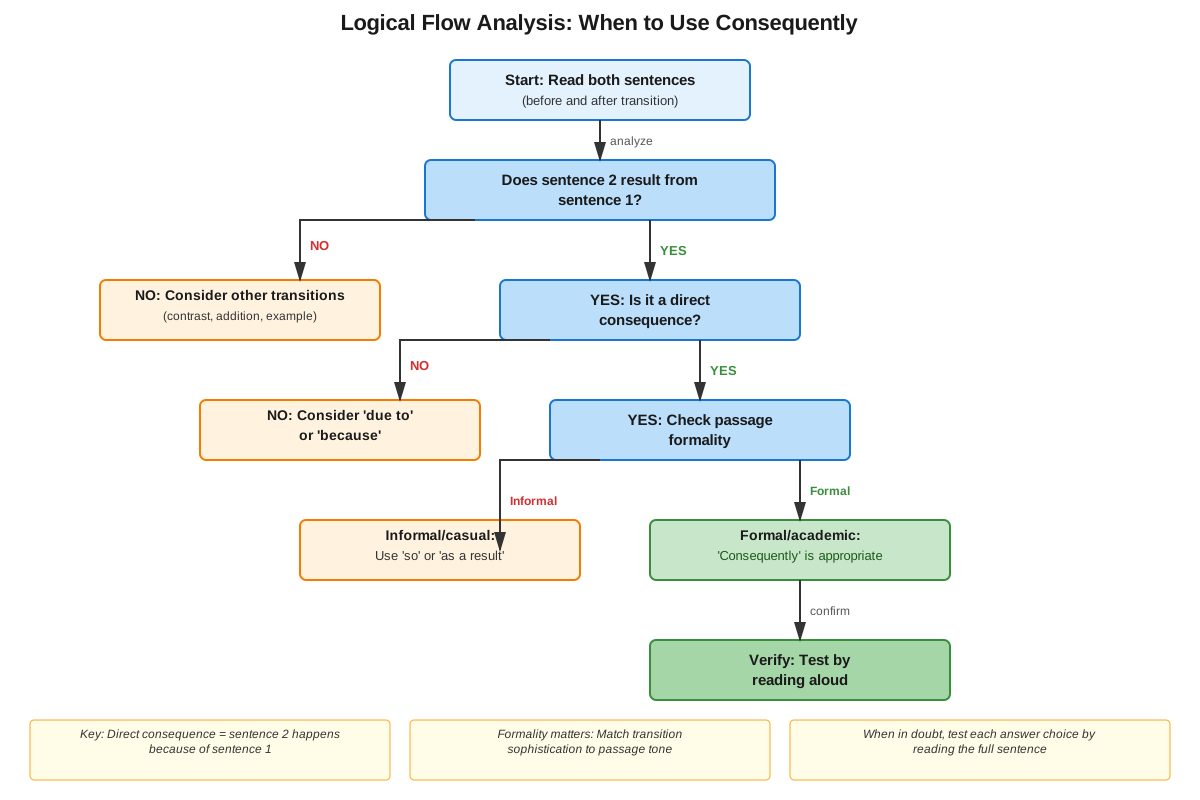
To determine whether "consequently" is the correct transition, students should apply this three-step test:
- Identify the relationship: Does the second sentence describe something that happened because of the first sentence?
- Check directionality: Is there a clear cause in the first statement and a clear effect in the second?
- Verify logical necessity: Does the effect logically follow from the cause, or is it merely associated with it?
If all three conditions are met, "consequently" is likely appropriate. If the relationship is contrast (use "however"), addition (use "moreover"), or example (use "for instance"), then "consequently" would be incorrect.
Common SAT Question Formats
The SAT presents "consequently" in several standard question formats:
Format 1 - Direct Transition Selection:
Students see a passage with a blank where a transition should appear, followed by four answer choices including "consequently" and three alternatives representing different logical relationships.
Format 2 - Revision Questions:
Students are asked which revision best improves the passage, with options including adding, removing, or changing "consequently" to another transition.
Format 3 - Sentence Placement:
Students must determine where a sentence containing "consequently" should be placed within a paragraph to maintain logical flow.
Understanding these formats helps students quickly recognize what the question is testing and apply the appropriate strategy.
Concept Relationships
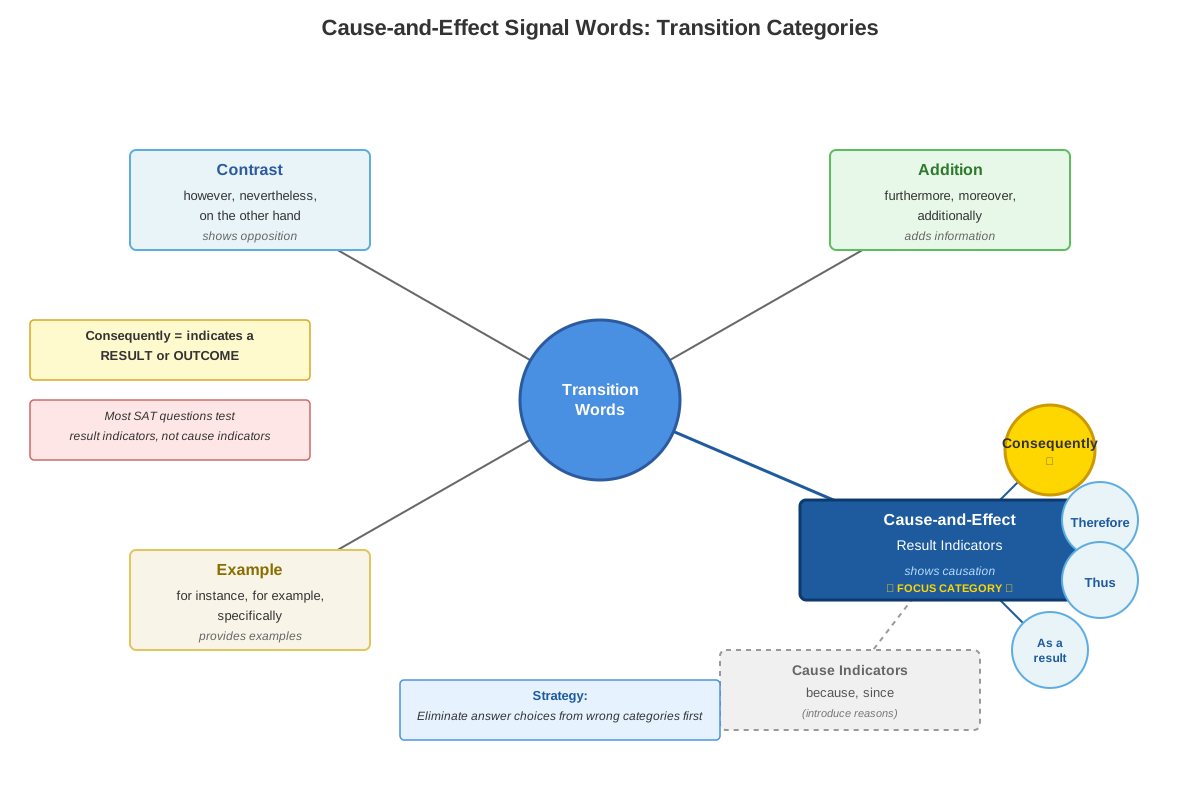
The concept of "consequently" exists within a hierarchical framework of transition understanding. At the broadest level, transitions serve to connect ideas and guide readers through text. Within this category, transitions divide into several types: addition transitions (furthermore, moreover), contrast transitions (however, nevertheless), example transitions (for instance, specifically), and result transitions (consequently, therefore, thus).
"Consequently" belongs to the result transition family, which specifically signals cause-and-effect relationships. Within this family, subtle distinctions exist: "consequently" emphasizes direct causation, "therefore" emphasizes logical inference, and "thus" emphasizes formal conclusion. Understanding these distinctions requires recognizing the logical relationship between sentences, which in turn depends on reading comprehension skills.
The relationship map flows as follows:
Reading Comprehension → enables → Identifying Logical Relationships → enables → Categorizing Transition Types → enables → Distinguishing Between Similar Transitions → enables → Selecting "Consequently" Appropriately
Additionally, "consequently" connects to punctuation rules for conjunctive adverbs, which relates to the broader topic of sentence structure and independent clauses. Mastering "consequently" also supports understanding of rhetorical effectiveness, as choosing the precise transition strengthens argumentative writing and analytical reading.
High-Yield Facts
⭐ "Consequently" signals a direct cause-and-effect relationship where the second statement is the result of the first.
⭐ When "consequently" appears after a semicolon connecting two independent clauses, it must be followed by a comma.
⭐ The SAT includes 2-3 questions per test specifically testing consequence transitions like "consequently."
⭐ "Consequently" and "therefore" are NOT interchangeable: "consequently" emphasizes causation while "therefore" emphasizes logical inference.
⭐ To verify "consequently" is correct, confirm that the first statement presents a cause and the second presents its direct effect.
- "Consequently" is more formal than "as a result" and more specific than "then."
- The SAT often includes "however" as a distractor in questions where "consequently" is correct, testing whether students recognize cause-and-effect versus contrast.
- "Consequently" can appear at the beginning of a sentence, after a semicolon, or (rarely) mid-sentence set off by commas.
- In SAT passages, "consequently" most frequently appears in scientific, historical, and argumentative contexts.
- When "consequently" begins a sentence, it should always be followed by a comma.
- The absence of a transition where "consequently" belongs creates a run-on sentence or unclear logical relationship.
- "Consequently" derives from Latin "consequi" (to follow), which helps explain its meaning: what follows as a result.
- On the SAT, if two answer choices both indicate results (like "consequently" and "therefore"), the correct answer usually depends on whether direct causation or logical inference is being expressed.
Quick check — test yourself on Consequently so far.
Try Flashcards →Common Misconceptions
Misconception: "Consequently" and "therefore" mean exactly the same thing and can always be used interchangeably.
Correction: While both indicate results, "consequently" emphasizes direct causation (one event causing another), while "therefore" emphasizes logical inference or conclusion drawn from evidence. "The building caught fire; consequently, it was evacuated" (direct cause-effect) versus "All the evidence points to his innocence; therefore, he should be acquitted" (logical conclusion).
Misconception: "Consequently" can be used with just a comma to connect two independent clauses, like coordinating conjunctions.
Correction: "Consequently" is a conjunctive adverb, not a coordinating conjunction. It requires either a semicolon before it (when connecting clauses) or a period (when starting a new sentence). Using only a comma creates a comma splice: INCORRECT: "The store closed early, consequently, we went home." CORRECT: "The store closed early; consequently, we went home."
Misconception: Any time two events happen in sequence, "consequently" is appropriate.
Correction: "Consequently" requires a causal relationship, not just temporal sequence. "I woke up at 7 AM; consequently, I ate breakfast at 8 AM" is incorrect because waking up didn't cause eating breakfast—they're just sequential events. "I overslept; consequently, I missed breakfast" is correct because oversleeping caused missing breakfast.
Misconception: "Consequently" always appears at the beginning of a sentence or clause.
Correction: While this is the most common placement on the SAT, "consequently" can appear mid-sentence for stylistic variation: "The company, consequently, filed for bankruptcy." However, the SAT most frequently tests the beginning-of-clause position.
Misconception: If a passage discusses results or outcomes, "consequently" is automatically the right answer.
Correction: The specific logical relationship matters. If the passage contrasts an expected result with an actual result, "however" might be correct. If it's adding another result, "additionally" might work. Students must analyze the precise relationship between the specific sentences in question, not just the general topic of the passage.
Misconception: "Consequently" is too formal for SAT passages and should be avoided.
Correction: The SAT includes passages of varying formality levels, and "consequently" is entirely appropriate for academic, scientific, and formal argumentative writing that frequently appears on the test. The SAT rewards precise, sophisticated vocabulary when used correctly.
Worked Examples
Example 1: Scientific Process Passage
Passage:
Scientists studying coral reefs noticed that water temperatures in the region had increased by 2°C over the past decade. [1] This temperature rise exceeded the tolerance threshold for the coral's symbiotic algae. [2] The algae began to die off, leaving the coral bleached and vulnerable. [3] The reef ecosystem experienced a 60% decline in biodiversity.
Question:
Which choice most effectively combines sentences 2 and 3 at the underlined portion?
A) vulnerable, and
B) vulnerable; consequently,
C) vulnerable, however,
D) vulnerable, for example,
Solution Process:
Step 1 - Identify the relationship: Sentence 2 describes coral becoming bleached and vulnerable. Sentence 3 describes a decline in biodiversity. Is sentence 3 a result of sentence 2?
Yes—the coral becoming vulnerable directly caused the ecosystem decline. This is a cause-and-effect relationship.
Step 2 - Eliminate non-result transitions:
- Choice C ("however") signals contrast, not result. ELIMINATE.
- Choice D ("for example") signals an example, not result. ELIMINATE.
Step 3 - Distinguish between remaining choices:
- Choice A ("and") merely adds information without showing the causal relationship.
- Choice B ("consequently") explicitly signals that the biodiversity decline resulted from the coral becoming vulnerable.
Step 4 - Verify punctuation: "Consequently" after a semicolon requires a comma after it. Choice B includes this comma.
Answer: B - The semicolon properly separates two independent clauses, and "consequently" correctly signals that the biodiversity decline was a direct result of the coral becoming vulnerable.
Connection to Learning Objectives: This example demonstrates identifying key features of "consequently" (cause-and-effect signaling), explaining how it appears on the SAT (in transition selection questions), and applying it to answer SAT-style questions (through systematic elimination).
Example 2: Historical Cause-and-Effect Passage
Passage:
The invention of the printing press in 1440 revolutionized information distribution in Europe. Prior to this innovation, books were copied by hand, making them expensive and rare. _____ literacy rates began to climb, and ideas spread more rapidly across the continent, ultimately contributing to the Renaissance and Reformation.
Question:
Which transition best fits the blank?
A) For instance,
B) Nevertheless,
C) Consequently,
D) Similarly,
Solution Process:
Step 1 - Analyze what comes before the blank: The printing press made books less expensive and more available (implied by contrasting with hand-copied books).
Step 2 - Analyze what comes after the blank: Literacy rates increased and ideas spread more rapidly.
Step 3 - Determine the relationship: Did the printing press's effect on book availability cause increased literacy and idea spread? Yes—this is direct causation. More available books → more people could learn to read → literacy increased.
Step 4 - Evaluate each choice:
- Choice A ("For instance") would introduce an example of something previously mentioned. The literacy increase isn't an example; it's a result. ELIMINATE.
- Choice B ("Nevertheless") signals contrast, suggesting literacy increased despite the printing press. This contradicts the logical relationship. ELIMINATE.
- Choice C ("Consequently") signals that literacy increases resulted from the printing press innovation. This matches the cause-and-effect relationship. KEEP.
- Choice D ("Similarly") would indicate a comparison or parallel situation. Nothing is being compared here. ELIMINATE.
Answer: C - "Consequently" correctly signals that increased literacy and rapid idea spread were direct results of the printing press making books more accessible.
Connection to Learning Objectives: This example shows how to distinguish "consequently" from other transitions by analyzing the specific logical relationship between sentences, a key skill for SAT success.
Exam Strategy
Systematic Approach to Transition Questions
When encountering a question involving "consequently" or other transitions, follow this strategic process:
Step 1 (10 seconds): Read the surrounding context. Read the sentence before the blank, the sentence with the blank, and the sentence after (if provided). Don't just read the sentence with the blank in isolation.
Step 2 (5 seconds): Identify the logical relationship. Ask yourself: "What is the relationship between these ideas?" Is it cause-and-effect, contrast, addition, example, or emphasis?
Step 3 (10 seconds): Predict the transition category. Before looking at answer choices, decide what type of transition is needed: result, contrast, addition, or example.
Step 4 (15 seconds): Eliminate wrong categories first. If you've determined the relationship is cause-and-effect, immediately eliminate any contrast, addition, or example transitions. This typically eliminates 2-3 answer choices.
Step 5 (10 seconds): Distinguish between remaining choices. If multiple result transitions remain (consequently, therefore, thus), determine whether the passage emphasizes direct causation (consequently), logical inference (therefore), or formal conclusion (thus).
Trigger Words and Phrases
Certain words and phrases in the surrounding sentences signal that "consequently" is likely correct:
Before the blank (indicating a cause):
- "This led to..."
- "Because of this..."
- "Due to..."
- "The result was..."
- Descriptions of actions, events, or conditions that could cause something
After the blank (indicating an effect):
- Descriptions of outcomes, results, or changes
- Statements about what happened next
- Descriptions of impacts or consequences
Red flag words suggesting "consequently" is WRONG:
- "Despite" or "although" (suggests contrast, not consequence)
- "Another" or "also" (suggests addition, not consequence)
- "Such as" or "including" (suggests example, not consequence)
Process of Elimination Tips
Exam Tip: On transition questions, you can usually eliminate at least two answer choices within 5 seconds by identifying the wrong relationship category.
Elimination Strategy 1 - Category Mismatch:
If the passage shows cause-and-effect but an answer choice signals contrast (however, nevertheless, yet), eliminate immediately.
Elimination Strategy 2 - Punctuation Errors:
If "consequently" appears in an answer choice without proper punctuation (missing comma after it, or using just a comma to connect independent clauses), eliminate it even if the logic seems right.
Elimination Strategy 3 - Tone Mismatch:
If the passage is formal and academic, eliminate informal transitions like "so" or "then" in favor of "consequently."
Elimination Strategy 4 - Reversed Logic:
If an answer choice would create a logical contradiction (like using "consequently" when the second statement contradicts rather than results from the first), eliminate it.
Time Allocation
Transition questions should take 30-50 seconds on average. If you find yourself spending more than one minute, you're likely overthinking. Trust your first instinct about the logical relationship, eliminate wrong categories quickly, and move on. These questions reward quick pattern recognition more than deep analysis.
Memory Techniques
The "CAUSE" Mnemonic for "Consequently"
Check for causation (Is there a cause-and-effect relationship?)
Analyze the sequence (Does the effect follow the cause?)
Understand the logic (Is the effect a direct result?)
Select "consequently" (If all above are true)
Eliminate alternatives (Remove contrast, addition, example transitions)
Visualization Strategy
Picture "consequently" as an arrow: →
The arrow points from cause to effect. When reading a passage, mentally draw an arrow from the first sentence to the second. If the arrow represents causation (one thing leading to another), "consequently" fits. If the arrow would need to curve back, split into multiple directions, or reverse, a different transition is needed.
The "Result Family" Grouping
Remember that "consequently" belongs to the Result Family of transitions:
- Consequently = direct causation (one event causing another)
- Therefore = logical inference (reasoning leading to conclusion)
- Thus = formal conclusion (summarizing reasoning)
- As a result = explicit outcome (stating the effect clearly)
Memorize this family together, noting the subtle distinctions. On the SAT, if you see multiple Result Family members as answer choices, the question is testing these subtle distinctions.
Punctuation Pattern Acronym: "SCC"
Semicolon before
Consequently
Comma after
This reminds you of the most common punctuation pattern when "consequently" connects two independent clauses: "The cause occurred; consequently, the effect followed."
Summary
"Consequently" is a high-yield transition word on the SAT Reading and Writing section that signals direct cause-and-effect relationships between sentences or clauses. Mastering this transition requires understanding three core elements: its function as a conjunctive adverb that connects independent clauses while showing causation, its proper punctuation patterns (semicolon before, comma after, or period before with comma after), and its distinction from similar transitions like "therefore" and "thus." The SAT tests "consequently" through transition selection questions where students must analyze the logical relationship between sentences and select the most appropriate connector. Success requires systematic analysis: identifying whether a cause-and-effect relationship exists, eliminating transitions that signal different relationships (contrast, addition, example), and distinguishing between similar result-indicating transitions based on whether direct causation or logical inference is being expressed. Students who master "consequently" can confidently answer 2-3 questions per SAT test, making this a high-impact topic for score improvement.
Key Takeaways
- "Consequently" specifically signals direct cause-and-effect relationships where one event or fact causes another, distinguishing it from "therefore" (logical inference) and "thus" (formal conclusion)
- Proper punctuation is essential: "consequently" requires a semicolon before and comma after when connecting independent clauses, or a period before and comma after when beginning a new sentence
- The SAT includes 2-3 questions per test involving consequence transitions, making this a high-frequency, high-yield topic worth mastering
- Systematic elimination is the key strategy: first eliminate wrong relationship categories (contrast, addition, example), then distinguish between remaining result transitions
- Context analysis is crucial: read surrounding sentences to identify whether a true causal relationship exists, not just temporal sequence or loose association
- Common distractors include "however" and "therefore": the SAT frequently tests whether students can distinguish cause-and-effect from contrast or logical inference
- Trigger words in surrounding sentences help predict when "consequently" is correct: look for causes before the blank and effects after it
Related Topics
Other Result Transitions (Therefore, Thus, Hence): Understanding the subtle distinctions between consequence-indicating transitions enables students to select the most precise option when multiple result transitions appear as answer choices. Mastering "consequently" provides the foundation for distinguishing these related terms.
Contrast Transitions (However, Nevertheless, Nonetheless): These transitions signal opposite relationships from "consequently," and the SAT frequently includes them as distractors in consequence questions. Understanding both categories helps students quickly eliminate wrong answers.
Addition Transitions (Moreover, Furthermore, Additionally): Like contrast transitions, addition transitions represent a different relationship category that often appears as distractors. Recognizing the distinction between adding information and showing causation is essential.
Punctuation Rules for Conjunctive Adverbs: "Consequently" follows the same punctuation patterns as other conjunctive adverbs (however, therefore, moreover). Mastering these rules enables students to eliminate grammatically incorrect answer choices quickly.
Logical Relationships in Reading Comprehension: The ability to identify cause-and-effect relationships extends beyond transition questions to general reading comprehension, helping students understand passage structure and author's purpose.
Practice CTA
Now that you've mastered the core concepts of "consequently" and its application on the SAT, it's time to reinforce your learning through active practice. Complete the practice questions to test your ability to identify appropriate contexts for "consequently," distinguish it from similar transitions, and apply proper punctuation rules. Use the flashcards to memorize key distinctions between result-indicating transitions and common trigger words. Remember: transition questions are among the fastest points you can earn on the SAT when you've developed systematic strategies. Each practice question you complete builds the pattern recognition that leads to quick, confident answers on test day. You've invested the time to understand this high-yield topic—now cement that knowledge through deliberate practice!
Sign up free to keep reading
Create a free AnvayaPrep account to finish this SAT guide on Consequently — plus flashcards and practice questions.