Overview
Transition words and phrases serve as the connective tissue of written communication, guiding readers smoothly from one idea to the next. Among these linguistic signposts, for example stands as one of the most frequently tested transition types on the SAT Reading and Writing section. This exemplification transition signals that the writer is about to provide a specific instance, illustration, or concrete detail to support a general claim or abstract concept that preceded it.
Understanding how for example functions is critical for SAT success because the exam regularly tests whether students can identify the logical relationship between sentences and select the appropriate transition to maintain coherence. Questions involving exemplification transitions appear in approximately 15-20% of all transition questions, making this a high-yield topic that directly impacts your score. These questions assess not just vocabulary recognition but your ability to analyze the logical flow of ideas within academic passages spanning science, humanities, history, and social studies.
Mastery of exemplification transitions connects directly to broader RW (Reading and Writing) skills tested throughout the SAT. The ability to recognize when a writer shifts from general statement to specific illustration demonstrates comprehension of paragraph structure, argument development, and rhetorical strategies—all fundamental competencies that the College Board evaluates. Furthermore, understanding sat for example questions prepares students for the analytical reading required in college-level coursework, where distinguishing between claims and evidence is essential for critical thinking.
Learning Objectives
- [ ] Identify key features of for example and other exemplification transitions
- [ ] Explain how for example appears on the SAT in transition questions
- [ ] Apply for example to answer SAT-style questions accurately
- [ ] Distinguish between exemplification transitions and other transition types (contrast, causation, addition)
- [ ] Analyze sentence pairs to determine when exemplification is the appropriate logical relationship
- [ ] Evaluate incorrect transition choices by identifying logical mismatches in SAT questions
Prerequisites
- Basic sentence structure understanding: Recognizing subjects, predicates, and how sentences connect is necessary to identify logical relationships between ideas.
- Familiarity with transition word categories: Knowing that transitions serve different purposes (showing contrast, cause-effect, sequence, etc.) provides the framework for understanding exemplification's specific role.
- Reading comprehension fundamentals: The ability to identify main ideas versus supporting details enables recognition of when a specific example supports a general statement.
Why This Topic Matters
In real-world communication, exemplification transitions bridge the gap between abstract concepts and concrete understanding. When scientists explain research findings, journalists report news stories, or professors deliver lectures, they consistently use "for example" and similar phrases to make complex ideas accessible through specific illustrations. This skill transfers directly to academic writing, professional communication, and critical reading across all disciplines.
On the SAT, transition questions appear in every Reading and Writing module, with exemplification transitions representing a substantial portion of these items. Based on College Board data, students can expect to encounter 2-4 questions per test that specifically assess understanding of exemplification relationships. These questions typically appear in the "Craft and Structure" domain and are worth the same point value as any other question, making them essential for score optimization.
The SAT presents exemplification transitions in several characteristic ways: passages may discuss a broad phenomenon followed by a specific case study, introduce a general principle before providing concrete applications, or present a category before listing specific members. Recognizing these patterns allows students to predict when "for example" or its synonyms will be the correct answer, even before reading all answer choices. Common passage contexts include scientific studies with specific experimental results, historical discussions with particular events as illustrations, and social science theories supported by real-world instances.
Core Concepts
Definition and Function of Exemplification Transitions
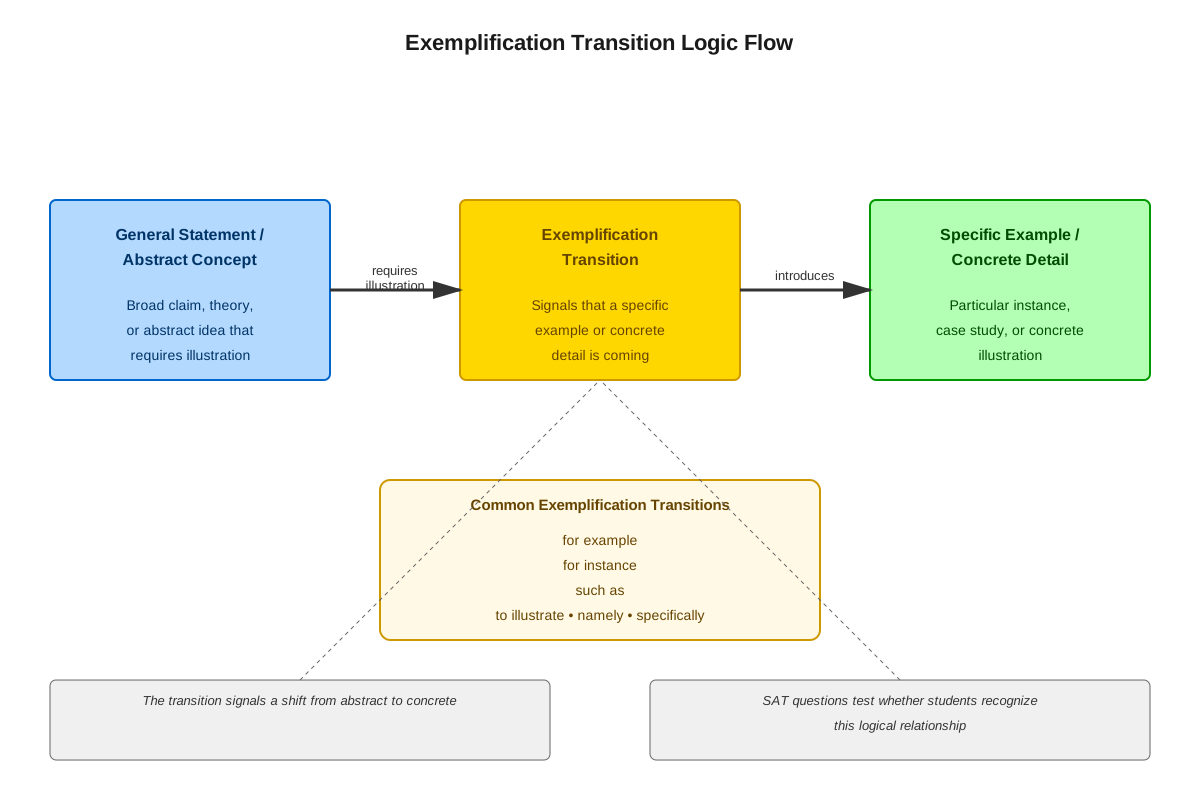
For example belongs to the category of exemplification transitions—words and phrases that signal the writer is providing a specific instance to illustrate, clarify, or support a preceding general statement. The primary function is to move from the abstract or general to the concrete or specific. When a sentence begins with "for example," readers immediately understand that what follows will be a particular case demonstrating the broader point just made.
The logical structure follows this pattern: General Statement → Exemplification Transition → Specific Instance(s). This relationship is unidirectional; the specific example supports the general claim but does not introduce a new, unrelated idea. The example serves as evidence, illustration, or clarification rather than as a contrasting point, consequence, or additional separate claim.
Common Exemplification Transitions on the SAT
While "for example" is the most recognizable exemplification transition, the SAT tests several synonymous phrases that serve identical logical functions:
| Transition Phrase | Usage Notes | Formality Level |
|---|---|---|
| For example | Most common; universally appropriate | Neutral |
| For instance | Interchangeable with "for example" | Neutral |
| To illustrate | Emphasizes the clarifying function | Slightly formal |
| Specifically | Highlights precision of the example | Neutral |
| In particular | Suggests the example is especially relevant | Neutral |
| Namely | Introduces a precise identification | Formal |
| Such as | Often embedded mid-sentence rather than initial position | Neutral |
Understanding that these phrases are functionally equivalent prevents students from being distracted by vocabulary differences when the logical relationship is what matters for SAT questions.
Identifying the General-to-Specific Relationship
The key to mastering exemplification transitions lies in recognizing the general-to-specific relationship between sentences. The first sentence typically contains:
- Broad categories or classifications
- Abstract concepts or principles
- Plural nouns indicating multiple possibilities
- General claims about groups, phenomena, or patterns
- Theoretical frameworks or overarching ideas
The second sentence (following the exemplification transition) contains:
- Specific names, dates, or locations
- Singular instances from the broader category
- Concrete details or measurements
- Particular cases or scenarios
- Named individuals, organizations, or events
Distinguishing Exemplification from Other Transitions
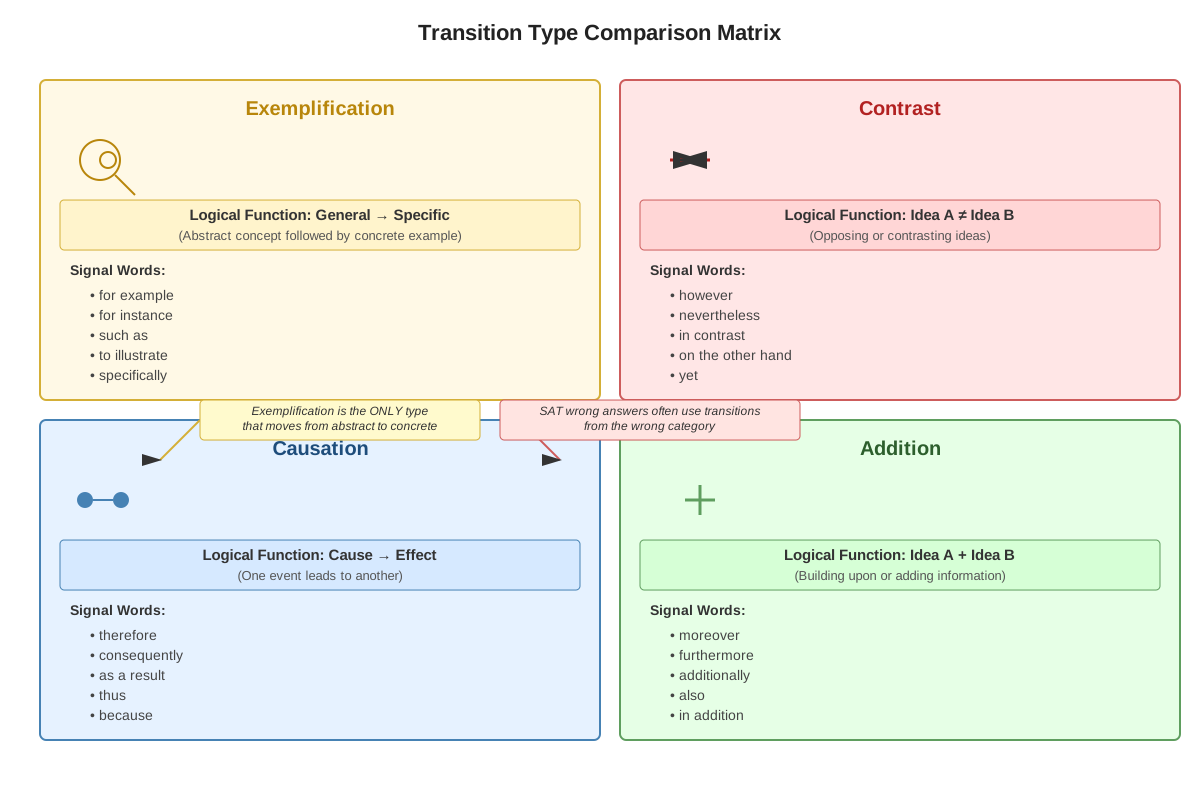
A critical skill for SAT success involves differentiating exemplification from other transition types that students might confuse:
Exemplification vs. Addition: Addition transitions (furthermore, moreover, additionally) introduce a separate, equal point at the same level of generality. Exemplification moves to a more specific level. If both sentences are equally general or equally specific, addition is appropriate; if the second is more specific than the first, exemplification is needed.
Exemplification vs. Causation: Cause-effect transitions (therefore, consequently, as a result) indicate that the second sentence is a consequence or outcome of the first. Exemplification shows an instance of something, not a result of it. Ask: "Did the first sentence cause the second, or is the second just an example of the first?"
Exemplification vs. Contrast: Contrast transitions (however, nevertheless, on the other hand) signal opposition or difference. Exemplification maintains the same direction of thought while providing specificity. If the sentences agree in direction but differ in specificity level, exemplification is correct.
Structural Patterns in SAT Passages
SAT passages employing exemplification transitions follow predictable organizational patterns:
- Category-Member Pattern: First sentence names a category; second provides a specific member
- Principle-Application Pattern: First sentence states a rule or principle; second shows it in action
- Phenomenon-Case Study Pattern: First sentence describes a general occurrence; second details a particular instance
- Multiple Examples Pattern: First sentence makes a claim; subsequent sentences provide several examples (may use "for example" before the first)
Recognizing these patterns during the reading phase enables students to anticipate the logical relationship before even looking at the transition question.
Concept Relationships
The concepts within exemplification transitions form a hierarchical relationship: the general-to-specific relationship serves as the foundation, upon which transition word selection depends, which in turn enables accurate question answering. Understanding that "for example" and its synonyms are interchangeable allows students to focus cognitive energy on identifying the logical relationship rather than memorizing subtle distinctions between synonymous phrases.
Exemplification transitions connect to prerequisite knowledge of sentence structure because students must parse sentences to identify their level of generality or specificity. This topic also relates closely to other transition types—students must understand exemplification in contrast to addition, causation, and opposition to select correctly among answer choices that typically include one option from each category.
The relationship map flows as follows:
Sentence Analysis → Identify Generality Level → Determine Logical Relationship → Match Relationship to Transition Category → Select Exemplification Transition → Verify with Specific Answer Choice
This systematic approach ensures students don't skip the crucial middle steps of relationship identification, which is where most errors occur.
High-Yield Facts
⭐ For example signals that a specific instance or illustration of a preceding general statement will follow.
⭐ Exemplification transitions move from general/abstract to specific/concrete, never the reverse direction.
⭐ "For example," "for instance," and "to illustrate" are functionally interchangeable on the SAT and serve identical logical purposes.
⭐ The sentence before an exemplification transition typically contains plural nouns, categories, or broad claims; the sentence after contains specific names, dates, or singular instances.
⭐ Approximately 15-20% of SAT transition questions test exemplification relationships, making this a high-frequency topic.
- Exemplification differs from addition because addition introduces a separate equal point, while exemplification provides a subordinate specific instance.
- When both sentences are at the same level of generality, exemplification is incorrect; look for addition or continuation transitions instead.
- SAT wrong answers for exemplification questions often include contrast transitions (however) or causation transitions (therefore) to test whether students understand the logical relationship.
- The phrase "such as" functions as an exemplification transition but typically appears mid-sentence rather than at the beginning.
- Exemplification transitions can introduce single examples or multiple examples in sequence; the transition appears before the first example.
- In scientific passages, exemplification often connects research findings (general) to specific studies or data points (specific).
- Historical passages frequently use exemplification to connect broad movements or trends to particular events or figures.
Quick check — test yourself on For example so far.
Try Flashcards →Common Misconceptions
Misconception: "For example" and "for instance" have different meanings and should be used in different contexts.
Correction: These phrases are complete synonyms on the SAT and serve identical logical functions. The exam treats them as interchangeable, so students should focus on whether exemplification is the correct relationship type, not on choosing between these two phrases.
Misconception: Any time a sentence provides more information about the previous sentence, "for example" is appropriate.
Correction: "For example" specifically requires a general-to-specific relationship. If the second sentence adds a separate point at the same level of generality, addition transitions (furthermore, additionally) are correct. If it provides a result or consequence, causation transitions are needed.
Misconception: The second sentence must use the exact same words as the first sentence for exemplification to be correct.
Correction: Exemplification requires a logical relationship, not lexical repetition. The second sentence should provide a specific instance of the concept in the first sentence, but it may use entirely different vocabulary. Focus on the conceptual relationship, not word matching.
Misconception: Longer, more complex transitions are more sophisticated and therefore more likely to be correct on the SAT.
Correction: The SAT values logical accuracy over stylistic complexity. "For example" is just as correct as "to illustrate" if exemplification is the appropriate relationship. Students should select based on logic, not perceived sophistication.
Misconception: If the second sentence contains specific details, "for example" is automatically correct.
Correction: Specificity in the second sentence is necessary but not sufficient for exemplification. The first sentence must be more general than the second, and the second must be an instance of the first. Specific details could also follow causation (specific result) or contrast (specific counterexample) relationships.
Worked Examples
Example 1: Scientific Research Passage
Passage: Many marine species have developed remarkable adaptations to survive in extreme ocean environments. _____ the yeti crab, discovered near hydrothermal vents in 2005, has specialized hair-like structures on its claws that cultivate bacteria for food.
Answer Choices:
A) However,
B) Therefore,
C) For instance,
D) Subsequently,
Step 1 - Analyze the First Sentence: The first sentence makes a general claim about "many marine species" and their "adaptations." This is broad and categorical—it refers to multiple species and doesn't name any specific ones.
Step 2 - Analyze the Second Sentence: The second sentence discusses "the yeti crab," a single, named species, and describes its specific adaptation (hair-like structures for bacteria cultivation). This is concrete and particular.
Step 3 - Identify the Relationship: The second sentence provides a specific example of the general category mentioned in the first sentence. The yeti crab is one of the "many marine species" with "remarkable adaptations." This is a classic general-to-specific relationship.
Step 4 - Eliminate Wrong Answers:
- Choice A (However) indicates contrast, but the sentences agree—both discuss adaptations
- Choice B (Therefore) indicates causation, but the yeti crab isn't a result of many species having adaptations
- Choice D (Subsequently) indicates time sequence, but we're not tracking events in chronological order
Step 5 - Confirm Correct Answer: Choice C (For instance) is an exemplification transition, which perfectly matches the general-to-specific relationship we identified. The yeti crab serves as one instance of the many species mentioned.
Answer: C
Connection to Learning Objectives: This example demonstrates how to identify the key feature of exemplification (general-to-specific movement) and apply it to answer an SAT-style question by systematically analyzing both sentences and eliminating answers based on logical mismatches.
Example 2: Social Science Passage
Passage: Urban planners have implemented various strategies to reduce traffic congestion in major cities. _____ Singapore introduced an electronic road pricing system that charges drivers variable fees based on traffic conditions, successfully reducing peak-hour congestion by 25%.
Answer Choices:
A) In contrast,
B) As a result,
C) For example,
D) Meanwhile,
Step 1 - Analyze the First Sentence: This sentence discusses "various strategies" (plural, general) used by "urban planners" (broad professional category) to address congestion in "major cities" (general location type). Everything here is categorical and non-specific.
Step 2 - Analyze the Second Sentence: This sentence names a specific city (Singapore), describes one particular strategy (electronic road pricing system), and provides concrete details (variable fees, 25% reduction). This is highly specific.
Step 3 - Identify the Relationship: Singapore's electronic road pricing system is one of the "various strategies" mentioned in the first sentence. The second sentence illustrates the general claim with a concrete case study. This is exemplification.
Step 4 - Eliminate Wrong Answers:
- Choice A (In contrast) suggests opposition, but Singapore's strategy supports rather than contradicts the first sentence
- Choice B (As a result) would mean Singapore's system was caused by the existence of various strategies, which is illogical
- Choice D (Meanwhile) indicates simultaneous but separate events, not an illustrative relationship
Step 5 - Confirm Correct Answer: Choice C (For example) correctly signals that Singapore's specific case exemplifies the general strategies mentioned. The logical flow is: general strategies exist → here's a specific instance of one.
Answer: C
Connection to Learning Objectives: This example shows how exemplification appears in social science contexts and reinforces the importance of distinguishing exemplification from causation—a common trap on the SAT. Students must recognize that specific details don't automatically indicate a result; they may simply illustrate a prior general statement.
Exam Strategy
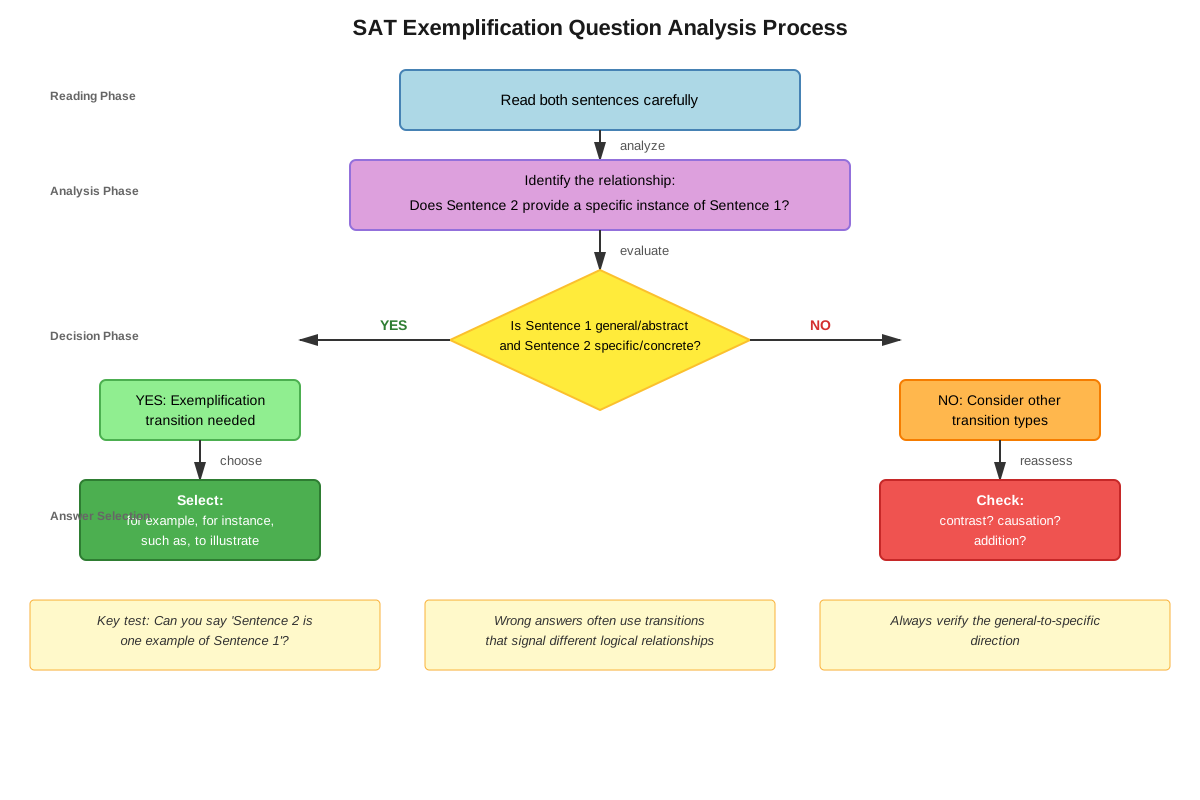
When approaching sat for example questions, employ this systematic process:
Step 1 - Read Both Sentences Completely: Never select a transition after reading only the first sentence. The relationship between sentences determines the correct answer, so both must be analyzed.
Step 2 - Identify Generality Levels: Ask yourself: "Is the first sentence more general or more specific than the second?" Look for categorical language (many, various, several, types of) in the first sentence and specific names, dates, or singular instances in the second.
Step 3 - Check for the Exemplification Pattern: Confirm that the second sentence is an instance, example, or illustration of something mentioned in the first sentence. The second should fit within the category or concept established by the first.
Step 4 - Eliminate Based on Logic, Not Vocabulary: Don't be distracted by sophisticated-sounding transitions. Focus on whether the logical relationship is exemplification, causation, contrast, or addition. Eliminate all choices that represent the wrong relationship type.
Step 5 - Verify Your Selection: Before finalizing your answer, reread both sentences with your chosen transition inserted. The flow should feel natural, and the logical relationship should be clear.
Exam Tip: Watch for trigger phrases in the first sentence like "many," "various," "several types," "numerous," or "different approaches." These often signal that exemplification will follow.
Exam Tip: If you're torn between "for example" and "therefore," ask: "Is the second sentence caused by the first, or is it just an instance of it?" Causation requires that the first sentence makes the second happen; exemplification only requires that the second illustrates the first.
Time Allocation: Transition questions should take 30-45 seconds each. If you're spending more than one minute, you're likely overthinking. Trust your analysis of the logical relationship and move forward.
Process of Elimination for Exemplification Questions: SAT answer choices for transition questions typically include one option from each major category. Expect to see:
- One exemplification transition (for example, for instance)
- One contrast transition (however, nevertheless)
- One causation transition (therefore, consequently)
- One addition or sequence transition (furthermore, subsequently)
Quickly eliminate the three that don't match the logical relationship you've identified.
Memory Techniques
Mnemonic for Exemplification Function: G.E.T. Specific
- General statement first
- Exemplification transition
- Then specific instance
This reminds students of the directional flow required for exemplification transitions.
Visualization Strategy: Picture a pyramid with a wide base (general statement) and a narrow point (specific example). The exemplification transition is the line connecting them, always moving from wide to narrow, never the reverse.
Acronym for Exemplification Synonyms: FIST-N
- For example
- In particular
- Specifically
- To illustrate
- Namely
This helps students remember that multiple phrases serve the same function, so they should focus on the logical relationship rather than memorizing subtle differences.
The "One of Many" Test: When evaluating whether exemplification is correct, ask: "Is the second sentence describing one of the many things mentioned in the first sentence?" If yes, exemplification is likely correct. This simple question captures the essence of the general-to-specific relationship.
Summary
Exemplification transitions, particularly for example, serve the critical function of connecting general statements to specific illustrations, moving readers from abstract concepts to concrete instances. On the SAT Reading and Writing section, these transitions appear frequently in questions that assess students' ability to identify logical relationships between sentences. Mastery requires recognizing the characteristic general-to-specific pattern: the first sentence presents a broad category, principle, or claim, while the second provides a particular instance, case study, or named example. Success on these questions depends not on memorizing subtle distinctions between synonymous phrases like "for example" and "for instance"—which are functionally identical—but on accurately analyzing the logical relationship between sentences and distinguishing exemplification from other transition types such as causation, contrast, and addition. Students should systematically evaluate both sentences for their level of generality, confirm that the second illustrates rather than contradicts or results from the first, and eliminate answer choices that represent incorrect logical relationships.
Key Takeaways
- For example and its synonyms (for instance, to illustrate, specifically) signal a general-to-specific relationship where the second sentence provides a concrete illustration of the first sentence's broader claim.
- Exemplification transitions appear in 15-20% of SAT transition questions, making them a high-yield topic that directly impacts scores.
- The key to correct answers is identifying the logical relationship between sentences, not memorizing vocabulary differences between synonymous exemplification phrases.
- Distinguish exemplification from addition (which introduces separate equal points), causation (which shows results), and contrast (which shows opposition) by analyzing whether the second sentence is more specific than and illustrative of the first.
- Look for trigger words in first sentences (many, various, several, types) that signal a general statement likely to be followed by specific examples.
- Use systematic analysis: read both sentences, identify generality levels, confirm the exemplification pattern, eliminate wrong relationship types, and verify your selection.
- Practice recognizing exemplification across different passage types—scientific studies with specific experiments, historical discussions with particular events, and social science theories with real-world applications.
Related Topics
Other Transition Types (Contrast, Causation, Addition): Understanding how exemplification differs from these other major transition categories is essential for accurate answer selection. Mastering exemplification provides a foundation for learning the distinctive features of contrast transitions (however, nevertheless), causation transitions (therefore, consequently), and addition transitions (furthermore, moreover).
Paragraph Structure and Organization: Exemplification transitions reflect broader principles of effective paragraph organization, where topic sentences present main ideas and supporting sentences provide specific evidence. This topic connects to questions about sentence placement and paragraph coherence.
Claims and Evidence in Argumentation: The general-to-specific relationship inherent in exemplification mirrors the logical structure of arguments, where claims require supporting evidence. This connection extends to questions about rhetorical strategies and author's purpose.
Reading Comprehension - Main Ideas vs. Details: Distinguishing between general statements and specific examples is fundamental to identifying main ideas versus supporting details in passages, a skill tested throughout the Reading and Writing section.
Practice CTA
Now that you've mastered the core concepts of exemplification transitions, it's time to reinforce your understanding through active practice. Attempt the practice questions designed specifically for this topic, focusing on applying the systematic approach outlined in the exam strategy section. Use the flashcards to drill the key distinctions between exemplification and other transition types until recognizing the general-to-specific relationship becomes automatic. Remember: understanding the concept is the first step, but consistent practice transforms that understanding into the quick, confident decision-making required for SAT success. Each practice question you complete strengthens your ability to identify logical relationships and select correct transitions under timed conditions. You've built a solid foundation—now apply it!
Sign up free to keep reading
Create a free AnvayaPrep account to finish this SAT guide on For example — plus flashcards and practice questions.