Overview
The transition word "instead" is a critical component of the SAT Reading and Writing section, appearing frequently in questions that test a student's ability to understand logical relationships between ideas. This seemingly simple word carries significant weight in determining how sentences and paragraphs connect, making it essential for success on transition questions—one of the most common question types in the RW section.
Understanding "instead" goes beyond merely recognizing its definition. On the SAT, students must identify when this transition word appropriately signals a contrast or substitution between ideas, and when other transition words would be more suitable. The College Board consistently tests whether students can distinguish between different types of logical relationships, and "instead" questions appear in approximately 8-12% of all transition-related items. Mastering this concept directly impacts a student's ability to score in the higher percentile ranges, as transition questions are considered medium-difficulty items that separate average performers from high achievers.
Within the broader context of SAT Reading and Writing, "instead" belongs to the family of contrast transitions, but with a unique characteristic: it specifically indicates replacement or substitution rather than simple opposition. This distinction connects to larger skills tested throughout the exam, including understanding authorial intent, recognizing logical flow in argumentative and informational texts, and identifying the most effective way to connect ideas. Students who master "instead" develop sharper analytical skills that transfer to other question types, including rhetorical synthesis, cross-text connections, and purpose questions.
Learning Objectives
- [ ] Identify key features of "instead" as a transition word
- [ ] Explain how "instead" appears on the SAT
- [ ] Apply "instead" to answer SAT-style questions
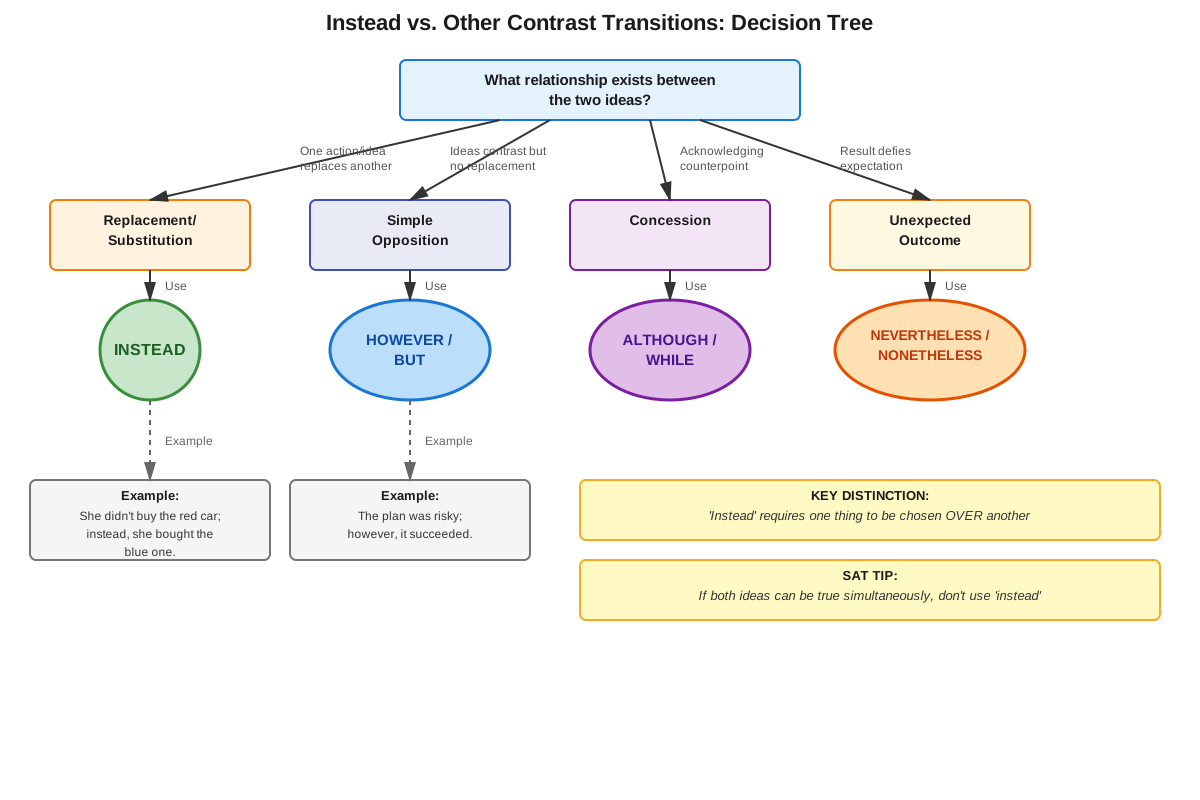
- [ ] Distinguish between "instead" and other contrast transitions (however, although, nevertheless)
- [ ] Recognize the grammatical structures that accompany "instead" in sentences
- [ ] Evaluate whether "instead" is the most logical transition choice in context
- [ ] Analyze the semantic relationship between ideas that "instead" connects
Prerequisites
- Basic understanding of sentence structure: Necessary to recognize how transitions connect independent and dependent clauses
- Familiarity with contrast relationships: Essential for distinguishing "instead" from other types of logical connections
- Knowledge of transition word categories: Provides the framework for understanding where "instead" fits within the broader transition family
- Reading comprehension at grade level: Required to understand the context in which transition words appear
Why This Topic Matters
In real-world communication, "instead" serves as a linguistic signal that helps readers navigate shifts in direction, understand alternatives, and follow an author's reasoning. Professional writing, academic discourse, and everyday communication all rely on precise transition usage to convey meaning efficiently. Students who master transition words like "instead" become more effective writers and more sophisticated readers, skills that extend far beyond standardized testing into college coursework and professional environments.
On the SAT, transition questions constitute a significant portion of the Reading and Writing section, with the College Board dedicating approximately 10-15% of questions to testing transition word knowledge. Among these, "sat instead" questions appear with notable frequency—typically 2-4 questions per full-length exam. These questions are strategically placed throughout the adaptive testing modules, meaning they can appear in both easier and more challenging sections depending on student performance. The medium difficulty rating indicates that these questions effectively differentiate between students scoring in the 500-600 range and those achieving 650+.
Transition questions involving "instead" commonly appear in several contexts: scientific passages describing alternative hypotheses or methods, historical texts presenting contrasting policies or decisions, and argumentative essays where authors reject one approach in favor of another. The College Board favors passages where the substitution relationship is clear but requires careful reading to identify, avoiding both obvious answers and overly subtle distinctions. Students can expect to encounter "instead" in passages ranging from 25-150 words, with the transition word either provided as an option or already present in the text for evaluation.
Core Concepts
Definition and Function of "Instead"
Instead functions as a transition word that signals substitution, replacement, or an alternative choice between two ideas. Unlike general contrast transitions that merely indicate difference or opposition, "instead" specifically communicates that one action, idea, or situation occurs in place of another. The word carries an implicit meaning of "rather than" or "as an alternative to," making it more specific than broader contrast markers.
The semantic function of "instead" requires two elements: (1) a rejected or negated option, and (2) an alternative that is chosen or occurs. This binary relationship distinguishes "instead" from other transitions. For example, in the sentence "The researcher did not use the traditional method; instead, she developed a novel approach," the traditional method is explicitly rejected while the novel approach is presented as its replacement.
Grammatical Structures with "Instead"
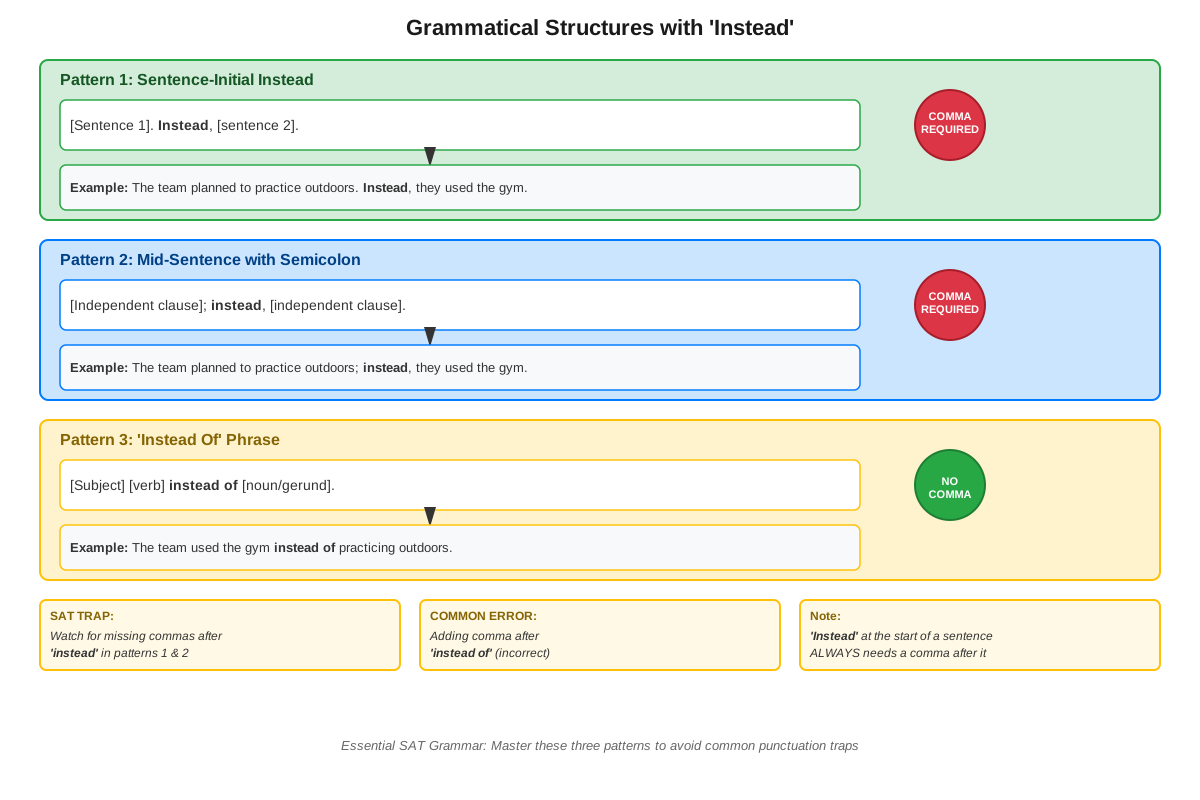
"Instead" appears in several grammatical configurations on the SAT, and recognizing these patterns helps students identify correct usage:
Standalone transition (with semicolon or period): "Instead" can begin a new independent clause, typically following a semicolon or period. In this position, it is usually followed by a comma.
- Example: "The city council rejected the highway expansion; instead, they invested in public transportation."
Mid-sentence with "instead of": When used as a prepositional phrase, "instead of" introduces the rejected option directly.
- Example: "Instead of increasing taxes, the government reduced spending."
End position: Less common but grammatically correct, "instead" can appear at the end of a sentence to emphasize the substitution.
- Example: "They didn't choose the expensive option; they selected the economical one instead."
Logical Relationship: Substitution vs. Simple Contrast
Understanding the distinction between substitution and simple contrast is crucial for SAT success. The following table illustrates this difference:
| Transition Type | Function | Example | Key Indicator |
|---|---|---|---|
| Instead (Substitution) | One option replaces another | "He didn't study biology; instead, he focused on chemistry." | Clear alternative chosen |
| However (Contrast) | Ideas oppose or differ | "Biology is challenging; however, many students enjoy it." | No replacement implied |
| Although (Concession) | Acknowledges opposing point | "Although biology is difficult, students persist." | Both ideas coexist |
| Nevertheless (Contrast) | Despite opposition, outcome occurs | "The test was hard; nevertheless, she passed." | Unexpected result |
The SAT frequently tests whether students can distinguish these relationships. A passage might present two contrasting ideas where "however" is appropriate, but "instead" would be incorrect because no substitution occurs. Conversely, when one action explicitly replaces another, "instead" is the precise choice.
Contextual Clues for "Instead"
Several textual signals indicate that "instead" is the appropriate transition:
- Negation in the first clause: Words like "not," "didn't," "refused," "rejected," or "avoided" often precede "instead"
- Explicit alternatives: Phrases like "rather," "alternatively," or "in place of" suggest substitution
- Contrasting actions by the same agent: When the same subject performs a different action than expected
- Binary choices: Situations presenting two mutually exclusive options where one is selected
Common SAT Presentation Formats
The College Board presents "instead" questions in several formats:
Format 1: Transition selection - Students choose from four transition options (instead, however, for example, therefore) to complete a sentence.
Format 2: Sentence revision - Students evaluate whether "instead" is used correctly in context and select the best revision.
Format 3: Logical flow - Students determine which transition best maintains the logical progression of ideas across sentences.
Each format tests the same underlying skill—recognizing substitution relationships—but requires slightly different analytical approaches. The most challenging questions present contexts where multiple transitions seem plausible, requiring students to identify the most precise choice based on subtle contextual clues.
Concept Relationships
The concept of "instead" exists within a hierarchical relationship structure. At the broadest level, it belongs to the category of transition words, which connect ideas across sentences and paragraphs. Within this category, "instead" is classified as a contrast transition, indicating some form of difference or opposition between ideas. However, "instead" occupies a specific subcategory: substitution transitions, which signal replacement rather than mere difference.
This relationship can be mapped as: Transition Words → Contrast Transitions → Substitution Transitions → "Instead"
Understanding "instead" requires prerequisite knowledge of basic sentence structure because the transition must connect grammatically complete ideas. It also builds on familiarity with contrast relationships, as students must first recognize that ideas differ before determining whether that difference involves substitution.
The concept connects forward to more advanced skills tested on the SAT. Mastering "instead" enables students to better understand rhetorical strategy questions, where authors use substitution to strengthen arguments by rejecting weaker alternatives. It also supports cross-text synthesis questions, where students must recognize when two authors propose different solutions to the same problem—a substitution relationship across texts.
Within the topic itself, the grammatical structures of "instead" connect to its logical function. The standalone usage (with semicolon) emphasizes the substitution by creating a clear break between rejected and chosen options. The "instead of" prepositional phrase makes the rejected option explicit, while end-position usage adds emphasis through placement. These structural variations all serve the same semantic purpose: signaling replacement.
High-Yield Facts
⭐ "Instead" specifically signals substitution or replacement, not merely contrast or opposition
⭐ "Instead" requires two elements: a rejected option and an alternative that is chosen
⭐ When "instead" begins a sentence or clause, it is typically followed by a comma
⭐ The phrase "instead of" directly introduces the rejected option
⭐ "Instead" questions appear 2-4 times per full-length SAT exam
- "Instead" is more specific than "however," which indicates general contrast without replacement
- Negation words (not, didn't, refused) in the preceding clause often signal that "instead" is appropriate
- "Instead" can appear at the beginning, middle, or end of sentences with different grammatical structures
- The SAT tests whether students can distinguish "instead" from other contrast transitions like "nevertheless" and "although"
- Approximately 10-15% of SAT Reading and Writing questions test transition word knowledge
- "Instead" appears most frequently in scientific and historical passages describing alternative methods or policies
- When the same subject performs two different actions, "instead" is often the correct transition
- "Instead" cannot be used when both ideas coexist or when one idea merely contrasts with another without replacement
- The College Board considers "instead" questions medium difficulty, effectively separating mid-range from high-scoring students
- Recognizing the binary choice structure (Option A vs. Option B) helps identify when "instead" is appropriate
Quick check — test yourself on Instead so far.
Try Flashcards →Common Misconceptions
Misconception: "Instead" and "however" are interchangeable because both indicate contrast.
Correction: While both signal contrast, "instead" specifically indicates substitution (one thing replaces another), whereas "however" indicates general opposition or difference without replacement. "The team lost; however, they played well" shows contrast without substitution, while "The team didn't give up; instead, they fought harder" shows one action replacing another.
Misconception: "Instead" can only appear at the beginning of a sentence.
Correction: "Instead" functions in multiple positions: at the beginning of an independent clause (after a semicolon or period), within a sentence as part of "instead of," or at the end of a sentence for emphasis. Each position is grammatically correct and may appear on the SAT.
Misconception: If two ideas are different, "instead" is always appropriate.
Correction: "Instead" requires not just difference but explicit substitution. Two ideas can differ without one replacing the other. "Dogs are loyal; cats are independent" shows difference but not substitution, so "instead" would be incorrect. "She didn't adopt a dog; instead, she adopted a cat" shows substitution, making "instead" appropriate.
Misconception: "Instead" always requires a comma after it.
Correction: When "instead" begins an independent clause (after a semicolon or period), it typically takes a comma. However, when used in "instead of" or at the end of a sentence, comma usage follows different rules. "Instead of studying, he watched TV" uses a comma after the prepositional phrase, not after "instead" itself.
Misconception: The rejected option must always be explicitly stated before using "instead."
Correction: While the rejected option is often explicit, it can be implied by context. "The government implemented tax cuts instead" implies that some other policy was rejected, even if not directly stated. However, on the SAT, the context will always make the substitution relationship clear enough to justify "instead."
Misconception: "Instead" and "rather" mean exactly the same thing and are always interchangeable.
Correction: While closely related, "instead" is a standalone transition word, whereas "rather" typically appears in the phrase "but rather" or "or rather." "She didn't run; instead, she walked" is correct, but "She didn't run; rather, she walked" is less standard without "but" before "rather."
Worked Examples
Example 1: Identifying the Correct Transition
Question: Which choice completes the text with the most logical transition?
"The archaeological team initially planned to excavate the northern section of the site, where preliminary surveys suggested the presence of ancient pottery. After analyzing soil samples, they discovered that the southern section contained far richer deposits of artifacts. _______, they redirected their efforts to the southern area."
A) For example,
B) Therefore,
C) Instead,
D) Similarly,
Solution Process:
Step 1: Identify the logical relationship between ideas.
- First idea: Team planned to excavate the northern section
- Second idea: They discovered the southern section was better
- Third idea: They redirected efforts to the southern area
Step 2: Determine what type of relationship exists.
The team changed their plan from one location (north) to another (south). This is a substitution—one action replaced another.
Step 3: Evaluate each option.
- "For example" introduces an illustration, but the southern excavation isn't an example of the northern plan—it's a replacement. Eliminate A.
- "Therefore" indicates causation. While the discovery caused the change, "therefore" doesn't capture the substitution aspect. Eliminate B.
- "Instead" signals substitution, which matches the relationship: they excavated the south in place of the north. Keep C.
- "Similarly" indicates likeness, but the two actions are alternatives, not similar actions. Eliminate D.
Step 4: Verify the choice.
"Instead" correctly signals that the southern excavation replaced the northern excavation. The sentence structure supports this: a rejected plan followed by an alternative action.
Answer: C) Instead,
Connection to Learning Objectives: This example demonstrates how to identify the key features of "instead" (substitution relationship) and apply it to answer SAT-style questions by distinguishing it from other transition types.
Example 2: Evaluating "Instead" in Context
Question: Which choice completes the text with the most logical transition?
"Renewable energy sources like solar and wind power have become increasingly cost-effective over the past decade. _______, fossil fuel prices have remained volatile, subject to geopolitical tensions and supply disruptions."
A) Instead,
B) Meanwhile,
C) Consequently,
D) For instance,
Solution Process:
Step 1: Analyze the relationship between sentences.
- First sentence: Renewable energy has become cost-effective
- Second sentence: Fossil fuel prices have remained volatile
Step 2: Determine if substitution occurs.
Both situations exist simultaneously—renewable energy becoming cost-effective doesn't replace fossil fuel volatility. These are parallel developments, not alternatives.
Step 3: Evaluate "instead" specifically.
"Instead" would suggest that fossil fuel volatility occurred in place of renewable energy cost-effectiveness, which doesn't match the meaning. Both situations coexist.
Step 4: Consider the correct answer.
"Meanwhile" indicates simultaneous occurrence, which matches the relationship. The passage presents two parallel trends happening at the same time.
Answer: B) Meanwhile,
Why "Instead" is Wrong: This example illustrates a common SAT trap. Students might see contrast (renewable vs. fossil fuel) and incorrectly choose "instead." However, no substitution occurs—both situations exist simultaneously. This demonstrates why understanding the specific function of "instead" (replacement, not mere contrast) is crucial.
Connection to Learning Objectives: This example shows how to distinguish "instead" from other transitions and evaluate whether it's the most logical choice in context, even when contrast is present.
Exam Strategy
Approaching "Instead" Questions
When encountering transition questions on the SAT, follow this systematic approach:
Step 1: Read the full context - Always read at least one sentence before and after the transition. The College Board designs questions where the relationship isn't obvious from a single sentence.
Step 2: Identify the logical relationship - Before looking at answer choices, determine what relationship exists between ideas. Ask: "Does one thing replace another, or do they merely contrast?"
Step 3: Look for substitution markers - Check for negation words (not, didn't, refused), explicit alternatives, or binary choices that signal substitution.
Step 4: Eliminate clearly wrong answers - Remove transitions that signal completely different relationships (causation, example, similarity) before choosing between similar options.
Step 5: Verify with "instead" - If "instead" is an option, mentally insert "in place of" or "rather than" to confirm the substitution relationship makes sense.
Trigger Words and Phrases
Watch for these textual signals that often indicate "instead" is correct:
- Negation: "not," "didn't," "refused," "rejected," "avoided," "abandoned"
- Contrast with action change: "rather than," "in place of," "alternatively"
- Binary structures: "either...or," "Option A...Option B," "this approach...that approach"
- Reversal language: "changed course," "shifted focus," "redirected," "pivoted"
Conversely, these signals suggest "instead" is likely incorrect:
- Coexistence: "both," "also," "additionally," "at the same time"
- Causation: "because," "as a result," "due to," "caused"
- Concession: "despite," "although," "even though," "while"
- Continuation: "furthermore," "moreover," "in addition"
Process of Elimination Tips
When "instead" appears among answer choices:
- Eliminate causation transitions first (therefore, thus, consequently) unless the passage explicitly shows cause-and-effect
- Remove example transitions (for instance, for example) unless the second idea illustrates the first
- Distinguish between contrast types: If ideas merely differ without replacement, eliminate "instead" in favor of "however" or "yet"
- Check for temporal relationships: If ideas occur simultaneously rather than sequentially, "meanwhile" or "at the same time" is likely better than "instead"
Time Allocation
Transition questions should take approximately 30-45 seconds each. Spending more than one minute indicates overthinking. If uncertain between two choices:
- Reread the sentences with each transition inserted
- Choose the more specific option (if substitution is clear, "instead" is more precise than "however")
- Trust your first instinct if both seem plausible—the SAT rarely includes truly ambiguous questions
Exam Tip: The SAT rewards precision. When both "instead" and "however" seem possible, ask whether one thing explicitly replaces another. If yes, choose "instead." If ideas merely contrast without replacement, choose "however."
Memory Techniques
Mnemonic for "Instead"
In Place Of = Instead Properly Occurs
This mnemonic reminds students that "instead" signals "in place of"—one thing occurring where another was expected or planned.
Visualization Strategy
Picture a fork in the road with two paths:
- Path A (rejected): marked with an X or stop sign
- Path B (chosen): marked with an arrow or checkmark
- "Instead" is the signpost at the fork pointing from Path A to Path B
When reading a passage, visualize this fork whenever you see negation or alternatives. If the passage clearly shows movement from one path to the other, "instead" is likely correct.
The "Swap Test"
Mentally replace "instead" with "in place of" or "rather than." If the sentence still makes logical sense, "instead" is appropriate. If it sounds awkward or changes the meaning, another transition is needed.
Example: "She didn't study math; instead, she studied history."
Swap test: "She didn't study math; rather than [that], she studied history." ✓ Makes sense
Counter-example: "Math is difficult; instead, history is easier."
Swap test: "Math is difficult; in place of [that], history is easier." ✗ Doesn't make sense
Acronym: RAIN
Rejected option
Alternative chosen
Instead signals
Not mere contrast
This acronym helps remember the key features: "instead" requires a rejected option and an alternative, signaling more than simple contrast.
Summary
The transition word "instead" serves a specific and testable function on the SAT Reading and Writing section: signaling substitution or replacement between ideas. Unlike general contrast transitions such as "however" or "although," "instead" indicates that one action, idea, or situation occurs in place of another, requiring both a rejected option and a chosen alternative. This distinction is crucial for SAT success, as the College Board frequently tests whether students can identify the precise logical relationship between ideas. "Instead" appears in multiple grammatical structures—as a standalone transition following semicolons, within the prepositional phrase "instead of," or at sentence end—each serving the same semantic purpose. Students must recognize contextual clues including negation words, binary choices, and explicit alternatives that signal substitution relationships. Mastering "instead" requires distinguishing it from other contrast transitions by identifying whether true replacement occurs or whether ideas merely differ without one supplanting the other. This skill appears in 2-4 questions per exam and effectively differentiates mid-range from high-scoring students, making it a high-yield topic for focused study.
Key Takeaways
- "Instead" specifically signals substitution or replacement, not general contrast—one thing occurs in place of another
- Two elements are required: a rejected or negated option and an alternative that is chosen
- Distinguish "instead" from "however": "instead" shows replacement; "however" shows opposition without substitution
- Watch for negation words (not, didn't, refused) and binary structures that signal substitution relationships
- "Instead" appears 2-4 times per SAT exam in various grammatical positions, making it a high-yield topic
- Use the "swap test": mentally replace "instead" with "in place of" to verify appropriateness
- Context is crucial: always read surrounding sentences to identify the logical relationship before selecting a transition
Related Topics
Other Contrast Transitions (However, Nevertheless, Although): Understanding how "instead" differs from these related transitions deepens comprehension of contrast relationships and improves accuracy on transition questions. Mastering "instead" provides a foundation for distinguishing between types of contrast.
Cause-and-Effect Transitions (Therefore, Consequently, Thus): Learning to distinguish substitution from causation helps students avoid common errors where both relationships seem plausible. This skill builds on understanding "instead" by requiring precise identification of logical relationships.
Rhetorical Strategy and Purpose: Authors use "instead" strategically to strengthen arguments by rejecting weaker alternatives. Understanding this transition enables deeper analysis of authorial choices in purpose questions.
Cross-Text Connections: When two passages present different solutions to the same problem, recognizing the substitution relationship (one author's approach instead of another's) supports synthesis questions that appear later in the exam.
Practice CTA
Now that you've mastered the core concepts of "instead" and its application on the SAT, it's time to reinforce your learning through active practice. Attempt the practice questions designed specifically for this topic, focusing on distinguishing "instead" from other transitions and identifying substitution relationships in context. Use the flashcards to drill the key features, trigger words, and common misconceptions until they become automatic. Remember: transition questions are highly predictable and reward systematic preparation. Each practice question you complete builds the pattern recognition skills that lead to quick, confident answers on test day. You've invested the time to understand the concept—now cement that knowledge through deliberate practice and watch your accuracy improve!
Sign up free to keep reading
Create a free AnvayaPrep account to finish this SAT guide on Instead — plus flashcards and practice questions.