Overview
The transition word nevertheless is a critical component of the SAT Reading and Writing section, appearing frequently in questions that test a student's ability to understand logical relationships between ideas. This conjunctive adverb signals a specific type of contrast: it acknowledges a preceding point while introducing information that contradicts expectations or presents an opposing perspective despite what came before. Understanding nevertheless goes beyond simple vocabulary recognition—it requires grasping the nuanced logical structure it creates between sentences and clauses.
On the SAT nevertheless questions appear primarily in the Transitions subsection of the Reading and Writing module, where students must select the most appropriate transition word to maintain logical coherence in a passage. These questions assess whether students can identify when an author acknowledges one idea but proceeds with a contrasting point anyway. The ability to recognize this specific contrast pattern is essential because transition questions typically appear 2-4 times per test, and mastering them provides quick, high-confidence points that boost overall scores.
Within the broader context of RW (Reading and Writing) skills, nevertheless belongs to the family of contrast transitions, but it occupies a unique position. Unlike simple contrast words such as "however" or "but," nevertheless carries an additional layer of meaning: it implies that despite the validity or strength of the first point, the second point still holds true. This makes it particularly important for understanding complex argumentative structures in SAT passages, where authors frequently present counterarguments before asserting their main claims. Mastering nevertheless strengthens overall comprehension skills and prepares students for the sophisticated logical reasoning required throughout the Reading and Writing section.
Learning Objectives
- [ ] Identify key features of Nevertheless
- [ ] Explain how Nevertheless appears on the SAT
- [ ] Apply Nevertheless to answer SAT-style questions
- [ ] Distinguish nevertheless from other contrast transitions (however, yet, but)
- [ ] Recognize the concessive relationship that nevertheless establishes between ideas
- [ ] Evaluate whether nevertheless is the appropriate transition based on logical flow
- [ ] Analyze passages to determine when nevertheless creates the intended meaning versus when it disrupts coherence
Prerequisites
- Basic understanding of sentence structure: Recognizing independent clauses is essential because nevertheless typically connects two complete thoughts that could stand alone as sentences.
- Familiarity with transition words in general: Students should understand that transitions create logical bridges between ideas and that different transitions signal different relationships.
- Ability to identify main ideas in sentences: Determining whether nevertheless is appropriate requires understanding what each sentence communicates and how those ideas relate.
- Recognition of contrast relationships: Students must grasp that some transitions show similarity while others show difference or opposition between ideas.
Why This Topic Matters
In real-world communication, nevertheless appears frequently in academic writing, professional correspondence, and persuasive texts. Writers use it to acknowledge opposing viewpoints while maintaining their position, making it essential for critical reading across disciplines. Students who master nevertheless develop stronger analytical skills that transfer to college-level reading and writing tasks, where understanding nuanced argumentative structures is paramount.
On the SAT, transition questions account for approximately 10-15% of the Reading and Writing section, with nevertheless appearing in roughly 15-20% of transition questions. This translates to an expected 1-2 questions per test specifically involving nevertheless or similar concessive transitions. These questions typically present a two-sentence passage with a blank where a transition should appear, followed by four transition options. The passages span various topics—science, history, literature, and social studies—but the logical relationship remains consistent.
Nevertheless commonly appears in SAT passages in several contexts: scientific discussions where researchers present unexpected findings despite previous theories, historical narratives where events occurred contrary to expectations, literary analysis where authors employ techniques that seem contradictory to their themes, and social science arguments where data contradicts common assumptions. Recognizing the pattern "Point A is true/valid/expected, [nevertheless] Point B (which contradicts or opposes A) is also true" is the key to success on these questions.
Core Concepts
Definition and Function of Nevertheless
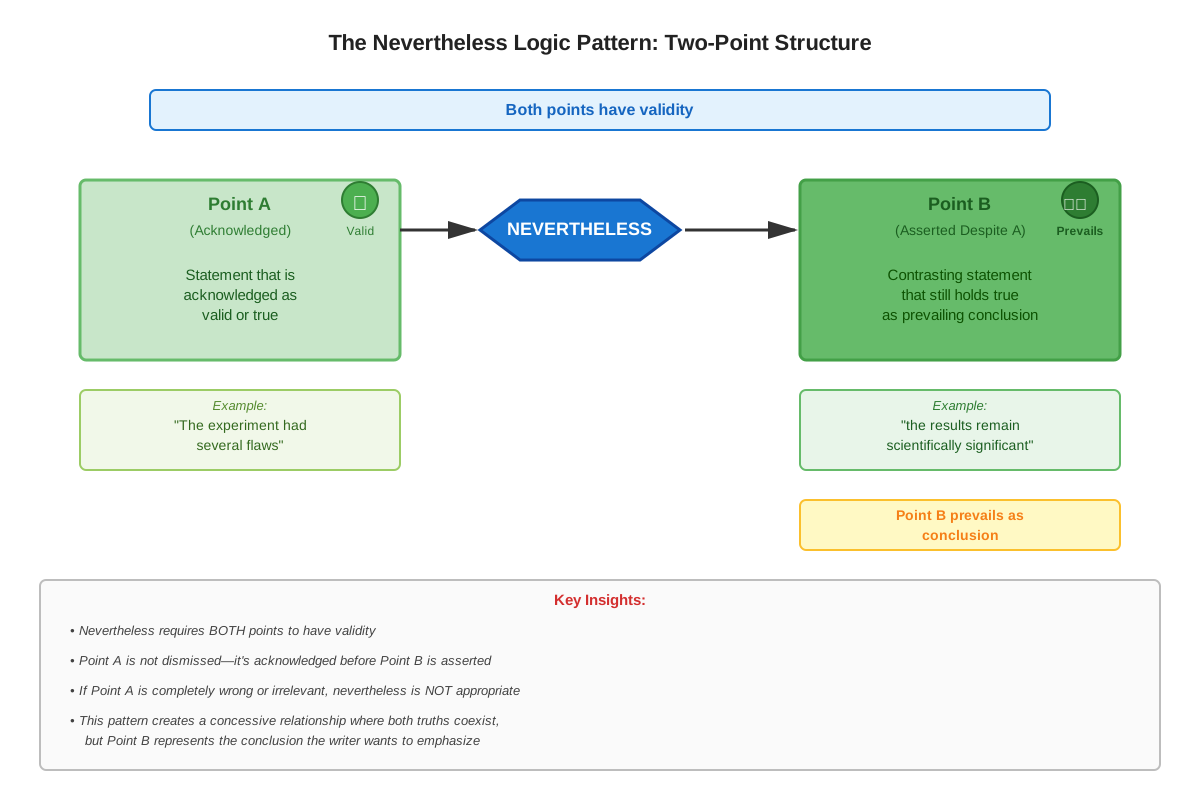
Nevertheless is a conjunctive adverb that creates a concessive relationship between two ideas. It acknowledges the validity or truth of a preceding statement while introducing a contrasting point that remains true despite the first statement. The word derives from "never the less," meaning "not any less true" or "nonetheless," emphasizing that the second point's validity is not diminished by the first point.
The primary function of nevertheless is to signal a specific logical pattern: concession followed by contrast. This differs from simple contrast (showing difference) because it implies that the first statement might logically lead to one conclusion, but the second statement presents a different reality. For example: "The experiment had significant methodological flaws. Nevertheless, the results provided valuable insights." Here, the flaws might suggest the results are worthless, but nevertheless signals that valuable insights emerged anyway.
Logical Structure Created by Nevertheless
Nevertheless establishes a three-part logical framework:
- Acknowledgment: The first statement presents a fact, condition, or argument
- Expected consequence: An implied logical outcome based on the first statement
- Contrary reality: The second statement (introduced by nevertheless) presents what actually occurs, contradicting the expected consequence
This structure is crucial for SAT questions because students must identify when all three elements are present. If a passage lacks the implied expectation that gets contradicted, nevertheless is likely incorrect.
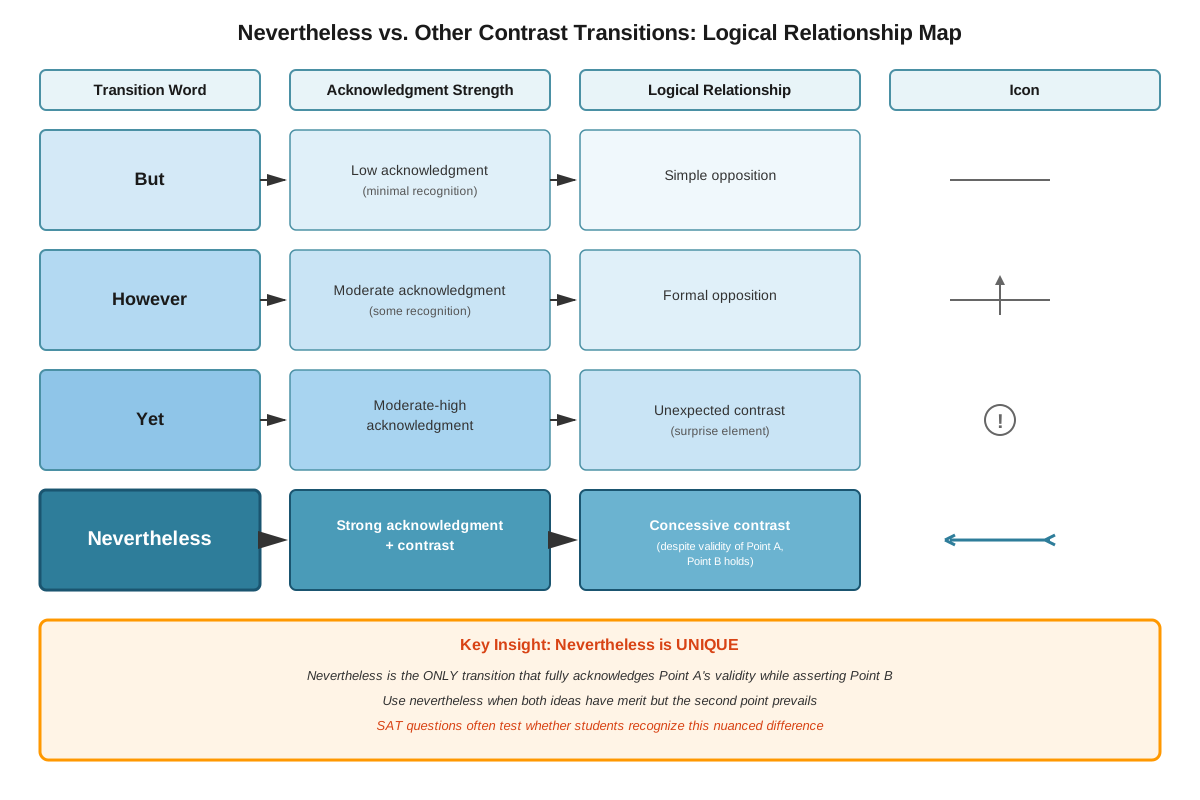
Nevertheless vs. Other Contrast Transitions
Understanding nevertheless requires distinguishing it from similar transitions:
| Transition | Relationship Type | Implication | Example Context |
|---|---|---|---|
| Nevertheless | Concessive contrast | Despite the first point being valid, the second point is still true | "The treatment is expensive. Nevertheless, it remains the most effective option." |
| However | Simple contrast | The second point differs from or opposes the first | "The treatment is effective. However, it is expensive." |
| Yet | Surprising contrast | The second point is unexpected given the first | "The treatment is simple. Yet, few doctors prescribe it." |
| But | Direct opposition | The second point directly contradicts or limits the first | "The treatment works, but not for all patients." |
The key distinction is that nevertheless specifically acknowledges a point that might seem to undermine what follows, but the following point remains valid anyway. This makes it stronger than "however" and more specific than "yet."
Punctuation and Placement
Nevertheless typically appears in one of three positions:
- Beginning of a new sentence: "The data was incomplete. Nevertheless, the researchers published their findings."
- After a semicolon: "The data was incomplete; nevertheless, the researchers published their findings."
- Mid-sentence with commas: "The data was incomplete. The researchers, nevertheless, published their findings."
On the SAT, nevertheless most commonly appears at the beginning of a sentence, preceded by a period or semicolon. When it begins a sentence, it is always followed by a comma. This punctuation pattern helps students identify it in passages and understand its function as a sentence connector rather than a simple conjunction.
Semantic Weight and Formality
Nevertheless carries a formal, academic tone and substantial semantic weight. It signals that the writer is making a deliberate rhetorical move: acknowledging a potential objection or complicating factor while asserting their point anyway. This makes it particularly common in argumentative and analytical writing—exactly the types of passages that appear on the SAT.
The semantic weight means nevertheless should only be used when the contrast is significant. Using it for minor differences creates an awkward, overblown tone. SAT questions exploit this by including nevertheless as an incorrect option when the contrast is too weak to justify such a strong transition.
Concept Relationships
The concepts within this topic form a hierarchical structure: understanding the basic definition of nevertheless enables recognition of the logical structure it creates, which in turn allows students to distinguish it from other transitions. This distinction skill then supports the ability to evaluate punctuation and placement, ultimately leading to mastery of when nevertheless is appropriate versus inappropriate.
Nevertheless connects to broader transition concepts as a specific type within the contrast family. While all contrast transitions show difference or opposition, nevertheless occupies the "concessive contrast" subcategory alongside "nonetheless" and "even so." This relationship can be mapped as:
Transitions → Contrast Transitions → Concessive Contrast → Nevertheless
The topic also connects to argumentative structure and rhetorical analysis. When authors use nevertheless, they're employing a specific persuasive technique: acknowledging counterarguments or complications to appear balanced while still advancing their thesis. This connects to the SAT's emphasis on understanding author's purpose and rhetorical choices.
Furthermore, nevertheless relates to logical reasoning skills tested throughout the Reading and Writing section. The pattern "A is true, nevertheless B is true" requires students to hold two seemingly contradictory ideas simultaneously and understand how both can be valid—a critical thinking skill that appears in inference questions, main idea questions, and evidence-based questions.
High-Yield Facts
- ⭐ Nevertheless signals concessive contrast: it acknowledges one point while introducing a contrasting point that remains true despite the first
- ⭐ Nevertheless implies an expected consequence that doesn't occur: the first statement suggests one outcome, but the second statement presents a different reality
- ⭐ Nevertheless is stronger and more formal than "however": it carries greater semantic weight and appears primarily in academic or formal contexts
- ⭐ Nevertheless appears 1-2 times per SAT test: typically in transition questions within the Reading and Writing section
- ⭐ Nevertheless requires a significant contrast: minor differences or simple oppositions don't justify its use
- Nevertheless is always followed by a comma when it begins a sentence
- Nevertheless can be replaced with "nonetheless" or "even so" in most contexts without changing meaning
- Nevertheless typically connects two independent clauses that could stand alone as complete sentences
- Nevertheless is incorrect when the second statement is a logical consequence of the first rather than a contradiction
- Nevertheless appears most frequently in scientific and argumentative passages on the SAT
- The pattern "Despite X, Y" can often be rewritten as "X. Nevertheless, Y"
- Nevertheless should not be used when the relationship is cause-and-effect rather than concessive contrast
Quick check — test yourself on Nevertheless so far.
Try Flashcards →Common Misconceptions
Misconception: Nevertheless and however are completely interchangeable in all contexts.
Correction: While both show contrast, nevertheless specifically implies that the first point might logically prevent or undermine the second point, but the second point remains true anyway. However simply shows that two points differ or oppose each other without the concessive element. "The medicine is expensive. However, it is effective" (simple contrast) versus "The medicine is expensive. Nevertheless, many patients can afford it" (concessive—expense might prevent affordability, but affordability exists anyway).
Misconception: Nevertheless can be used to introduce a logical consequence or result.
Correction: Nevertheless introduces information that contradicts expected consequences, not information that follows logically. If the second statement is a natural result of the first, transitions like "therefore," "thus," or "consequently" are appropriate, not nevertheless. "The experiment failed. Nevertheless, the researchers learned valuable lessons" (correct—failure might mean no learning, but learning occurred) versus "The experiment failed. Therefore, the researchers redesigned it" (consequence, not contrast).
Misconception: Nevertheless is appropriate whenever two sentences present different information.
Correction: Nevertheless requires a specific type of contrast where the first statement creates an expectation that the second statement defies. Simple difference or unrelated information doesn't justify nevertheless. "The study examined 500 participants. Nevertheless, it lasted three years" is incorrect because participant number and duration are simply different facts, not contradictory points.
Misconception: Nevertheless always appears at the beginning of a sentence.
Correction: While nevertheless most commonly begins sentences on the SAT, it can appear mid-sentence set off by commas ("The researchers, nevertheless, continued their work") or after a semicolon ("The data was limited; nevertheless, patterns emerged"). Understanding all positions helps students recognize it in various contexts.
Misconception: If two statements seem to contradict each other, nevertheless is always the right transition.
Correction: The statements must have a specific relationship: the first must create an expectation or implication that the second contradicts. Pure contradiction without this expectation-defiance pattern might require "on the contrary," "conversely," or "in contrast" instead. "Some scientists support the theory. Nevertheless, others oppose it" is weak because opposition is expected when some support exists; "however" or "while" would be better.
Worked Examples
Example 1: Identifying the Correct Transition
Passage: "The archaeological site had been thoroughly excavated by previous teams, leaving little hope for new discoveries. _______ the current team uncovered a previously hidden chamber containing significant artifacts."
Options:
A) Therefore,
B) For example,
C) Nevertheless,
D) Similarly,
Step 1: Identify the relationship between sentences
The first sentence establishes that thorough previous excavation left "little hope for new discoveries." This creates an expectation: new discoveries are unlikely. The second sentence states that new discoveries (a hidden chamber with artifacts) were made anyway.
Step 2: Determine what type of relationship exists
This is not cause-and-effect (eliminating "therefore"), not an example (eliminating "for example"), and not similarity (eliminating "similarly"). The second sentence contradicts the expectation created by the first sentence—this is concessive contrast.
Step 3: Confirm nevertheless is appropriate
The pattern fits perfectly: "Little hope for discoveries existed [implying discoveries wouldn't happen]. Nevertheless, discoveries were made [contradicting the expectation]." The first point is acknowledged as valid (previous excavation was thorough), but the second point is true despite it.
Answer: C) Nevertheless
Connection to learning objectives: This example demonstrates identifying key features of nevertheless (concessive contrast, expectation-defiance pattern) and applying it to answer SAT-style questions by analyzing logical relationships.
Example 2: Distinguishing Nevertheless from However
Passage: "The new solar panel design increases energy efficiency by 15%. _______ it costs 30% more to manufacture than traditional panels."
Options:
A) Nevertheless,
B) However,
C) Therefore,
D) Furthermore,
Step 1: Analyze the logical relationship
The first sentence presents a benefit (increased efficiency). The second sentence presents a drawback (higher cost). These are contrasting points about the same product.
Step 2: Determine if concessive contrast exists
Ask: Does the first statement create an expectation that the second statement defies? The increased efficiency doesn't create an expectation about cost—efficiency and cost are independent variables. The statements simply present two different aspects (one positive, one negative) without one undermining the expectation created by the other.
Step 3: Choose the appropriate contrast transition
This is simple contrast (showing two different aspects), not concessive contrast (one point remaining true despite another). "However" is appropriate for simple contrast. "Nevertheless" would imply that high efficiency somehow suggests low cost, which it doesn't.
Answer: B) However
Why not nevertheless?: Nevertheless would be correct if the passage said something like "The new solar panel design uses cheaper materials. Nevertheless, it costs 30% more to manufacture" because cheaper materials create an expectation of lower cost, which is then contradicted.
Connection to learning objectives: This example demonstrates distinguishing nevertheless from other contrast transitions and evaluating whether nevertheless creates the intended meaning based on logical flow.
Exam Strategy
Approaching Nevertheless Questions
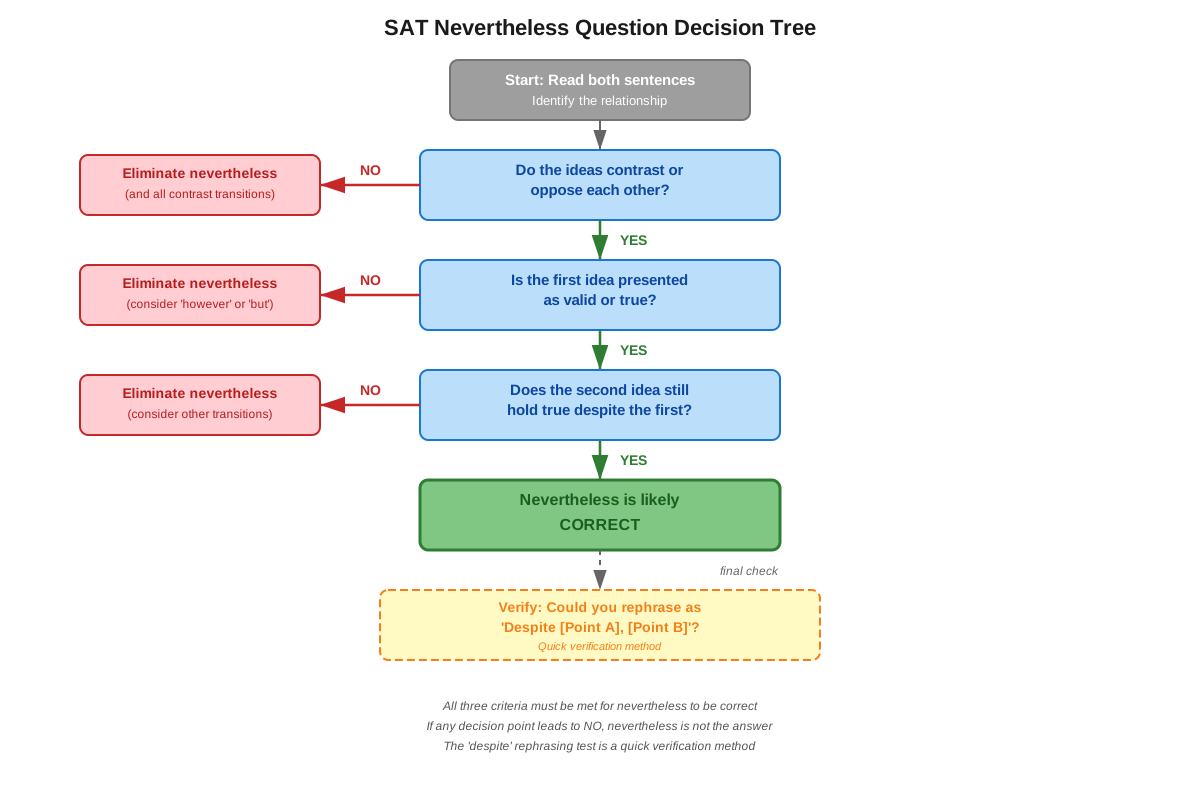
When encountering a transition question that includes nevertheless as an option, follow this systematic approach:
- Read both sentences completely: Understand what each sentence communicates before considering transitions
- Identify the relationship: Determine whether the sentences show contrast, similarity, cause-effect, or example
- Check for the expectation-defiance pattern: If contrast exists, ask whether the first sentence creates an expectation that the second sentence contradicts
- Verify significance: Ensure the contrast is substantial enough to warrant nevertheless rather than a weaker transition
- Eliminate systematically: Rule out non-contrast options first, then distinguish among contrast options
Trigger Words and Phrases
Watch for these patterns that suggest nevertheless might be correct:
- First sentence contains: "little hope," "unlikely," "impossible," "prevented," "obstacles," "challenges," "despite," "although"
- Second sentence contains: "still," "managed to," "succeeded," "achieved," "found," "discovered," "continued"
- Phrases suggesting defied expectations: "contrary to predictions," "unexpectedly," "surprisingly"
- Acknowledgment language: "while it is true that," "although," "even though"
Conversely, these patterns suggest nevertheless is likely incorrect:
- Second sentence is a logical result of the first (use "therefore," "thus," "consequently")
- Sentences present unrelated information (use "additionally," "furthermore," or no transition)
- Second sentence provides an example of the first (use "for example," "for instance")
- Sentences show simple difference without expectation-defiance (use "however," "in contrast")
Process of Elimination Tips
- Eliminate cause-effect transitions first: If the second sentence doesn't logically follow from the first, eliminate "therefore," "thus," "consequently," and "as a result"
- Eliminate addition transitions: If the second sentence doesn't add similar information, eliminate "furthermore," "moreover," "additionally," and "also"
- Distinguish among remaining contrast options: If multiple contrast transitions remain, nevertheless is correct only when the expectation-defiance pattern exists
- Test by substitution: Mentally replace nevertheless with "however"—if the meaning stays essentially the same, "however" is likely better because it's less formal and requires less specific conditions
Time Allocation
Transition questions should take 30-45 seconds each. Spending more time suggests overthinking. If uncertain between nevertheless and another contrast transition (usually however), choose the simpler option (however) unless clear evidence of expectation-defiance exists. The SAT rewards recognizing when nevertheless is specifically required, not when it's merely acceptable.
Exam Tip: If you can insert "despite this" or "even so" before the second sentence and it makes sense, nevertheless is likely correct. If "on the other hand" or "in contrast" fits better, choose however instead.
Memory Techniques
Mnemonic for Nevertheless
"Never Less True": Remember that nevertheless means the second point is "never less true" despite the first point. This helps recall that both points are valid, but the second remains true even though the first might suggest otherwise.
Visualization Strategy
Picture a scale with two weights: the first statement is a heavy weight pulling down (creating an expectation), but the second statement is an equally heavy weight on the other side that remains balanced despite the first weight. Nevertheless is the fulcrum that allows both weights to coexist.
The "Despite Test"
Convert the passage to a "despite" structure: "Despite [first sentence], [second sentence]." If this conversion makes logical sense and preserves meaning, nevertheless is appropriate. If it sounds awkward or illogical, nevertheless is wrong.
Example: "The treatment is expensive. Nevertheless, it is effective" → "Despite the treatment being expensive, it is effective" (makes sense—nevertheless is correct)
Counter-example: "The treatment is expensive. However, it is effective" → "Despite the treatment being expensive, it is effective" (also makes sense, but the original doesn't have expectation-defiance, so however is better)
Acronym: ACED
Use ACED to remember when nevertheless is appropriate:
- Acknowledgment: First sentence acknowledges a point
- Contrast: Second sentence contrasts with the first
- Expectation: First sentence creates an expectation
- Defiance: Second sentence defies that expectation
All four elements must be present for nevertheless to be the best choice.
Summary
Nevertheless is a high-yield transition word on the SAT that signals concessive contrast—acknowledging one point while introducing a contrasting point that remains true despite the first. Unlike simple contrast transitions such as however, nevertheless specifically implies that the first statement creates an expectation that the second statement contradicts. Mastering nevertheless requires understanding this expectation-defiance pattern, distinguishing it from other contrast transitions, and recognizing when the contrast is significant enough to warrant such a formal, weighty transition. On the SAT, nevertheless appears in 1-2 questions per test, typically in passages where unexpected findings, contrary outcomes, or persistent conditions exist despite obstacles or opposing factors. Success on these questions depends on systematically analyzing the logical relationship between sentences, identifying whether the expectation-defiance pattern exists, and eliminating options that signal different relationships. Students who master nevertheless gain quick, high-confidence points while developing broader critical reading skills essential for college-level academic work.
Key Takeaways
- Nevertheless signals concessive contrast: it acknowledges one valid point while asserting a contrasting point that remains true despite the first
- The expectation-defiance pattern is essential: the first statement must create an expectation that the second statement contradicts
- Nevertheless is stronger and more formal than however, requiring a more significant contrast and specific logical structure
- On the SAT, nevertheless appears 1-2 times per test in transition questions across various passage topics
- Systematic elimination (removing cause-effect and addition transitions first, then distinguishing among contrast options) is the most efficient approach
- The "despite test" (converting to "Despite X, Y" structure) helps verify whether nevertheless is appropriate
- Nevertheless is incorrect when the second statement is a logical consequence, an example, or simply different information without expectation-defiance
Related Topics
Other Contrast Transitions (However, Yet, But): Understanding the full spectrum of contrast transitions enables precise selection based on the specific logical relationship between ideas. Mastering nevertheless provides a foundation for distinguishing among all contrast options.
Cause-and-Effect Transitions (Therefore, Thus, Consequently): Recognizing when ideas have a causal relationship versus a contrastive relationship is essential for avoiding confusion between nevertheless and result-indicating transitions.
Addition Transitions (Furthermore, Moreover, Additionally): Distinguishing between adding similar information and contrasting information prevents errors where students might confuse nevertheless with transitions that build on rather than oppose previous points.
Concession and Counterargument in Argumentative Writing: Nevertheless frequently appears in passages that acknowledge counterarguments, making understanding of argumentative structure valuable for recognizing when nevertheless is appropriate.
Logical Reasoning and Inference: The expectation-defiance pattern that nevertheless signals connects to broader inference skills tested throughout the SAT Reading and Writing section.
Practice CTA
Now that you've mastered the core concepts of nevertheless and understand how it appears on the SAT, it's time to reinforce your learning through active practice. Attempt the practice questions to apply the expectation-defiance pattern, distinguish nevertheless from other transitions, and build the quick recognition skills that lead to confident, accurate answers on test day. Use the flashcards to memorize high-yield facts and trigger words that will help you identify nevertheless questions instantly. Remember: transition questions are among the fastest points you can earn on the SAT—mastering nevertheless means mastering easy points that boost your score. You've got this!
Sign up free to keep reading
Create a free AnvayaPrep account to finish this SAT guide on Nevertheless — plus flashcards and practice questions.