Overview
Sentence-to-sentence logic is one of the most frequently tested skills in the SAT Reading and Writing (RW) section, appearing in the Transitions question type. These questions assess a student's ability to understand how ideas flow from one sentence to the next and to select the appropriate transitional word or phrase that accurately reflects the logical relationship between those ideas. Unlike vocabulary-in-context questions that test word meaning in isolation, sentence-to-sentence logic questions require students to analyze the semantic and rhetorical connection between adjacent sentences or clauses.
Mastering sat sentence-to-sentence logic is essential because these questions appear consistently throughout the digital SAT, with approximately 2-4 questions per test module. The College Board designs these questions to evaluate whether students can recognize logical relationships such as cause-and-effect, contrast, elaboration, emphasis, and sequence. Success on these questions demonstrates reading comprehension at a sophisticated level—the ability to track an author's line of reasoning and understand how each sentence builds upon or modifies the previous one.
This topic sits at the intersection of reading comprehension and rhetorical analysis within the rw section. While it shares connections with other transition-focused skills, sentence-to-sentence logic specifically emphasizes the micro-level connections between adjacent ideas rather than paragraph-level organization. Students who excel at identifying these logical relationships will find that their overall reading comprehension improves, as understanding transitions is fundamental to following complex arguments, analyzing evidence, and interpreting authorial intent across all passage types on the SAT.
Learning Objectives
- [ ] Identify key features of sentence-to-sentence logic
- [ ] Explain how sentence-to-sentence logic appears on the SAT
- [ ] Apply sentence-to-sentence logic to answer SAT-style questions
- [ ] Categorize the major types of logical relationships between sentences (contrast, cause-effect, elaboration, emphasis, sequence)
- [ ] Distinguish between similar transition words that signal different logical relationships
- [ ] Evaluate answer choices by testing each transition against the specific relationship between sentences
- [ ] Recognize common distractor patterns in transition questions
Prerequisites
- Basic sentence structure understanding: Students must recognize independent and dependent clauses to identify where one complete idea ends and another begins, which is essential for analyzing the relationship between those ideas.
- Fundamental reading comprehension: The ability to extract the main idea from a sentence is necessary before determining how that idea relates to adjacent sentences.
- Familiarity with common transition words: While this topic will deepen that knowledge, students should have encountered basic transitions like "however," "therefore," and "additionally" in their prior reading and writing.
Why This Topic Matters
Understanding sentence-to-sentence logic extends far beyond the SAT. In academic writing, professional communication, and critical reading, the ability to follow an argument's logical progression is fundamental. Writers use transitions to guide readers through complex ideas, and skilled readers use those transitions as signposts to understand relationships between concepts. This skill directly translates to college-level reading, where students must navigate dense academic texts with sophisticated argumentation.
On the SAT specifically, transition questions appear with high frequency and predictability. Each Reading and Writing module typically contains 2-4 transition questions, making them one of the most reliable question types students will encounter. These questions are considered medium difficulty by the College Board, meaning they separate average scorers from high scorers. Students who master this topic can quickly and confidently answer these questions, banking time for more challenging items.
Transition questions appear across all passage types on the SAT: literary narratives, historical documents, scientific explanations, and argumentative essays. The format is consistent—students see a brief passage with a blank where a transition should appear, followed by four answer choices offering different transitional words or phrases. The passage context varies, but the underlying skill remains constant: identifying the logical relationship between the sentence containing the blank and the surrounding sentences.
Core Concepts
Understanding Logical Relationships
The foundation of sentence-to-sentence logic lies in recognizing that sentences don't exist in isolation—they form chains of reasoning where each link connects to the next through specific logical relationships. When analyzing these relationships, students must read both the sentence before and after the transition (or the clauses on either side) to determine how the ideas interact.
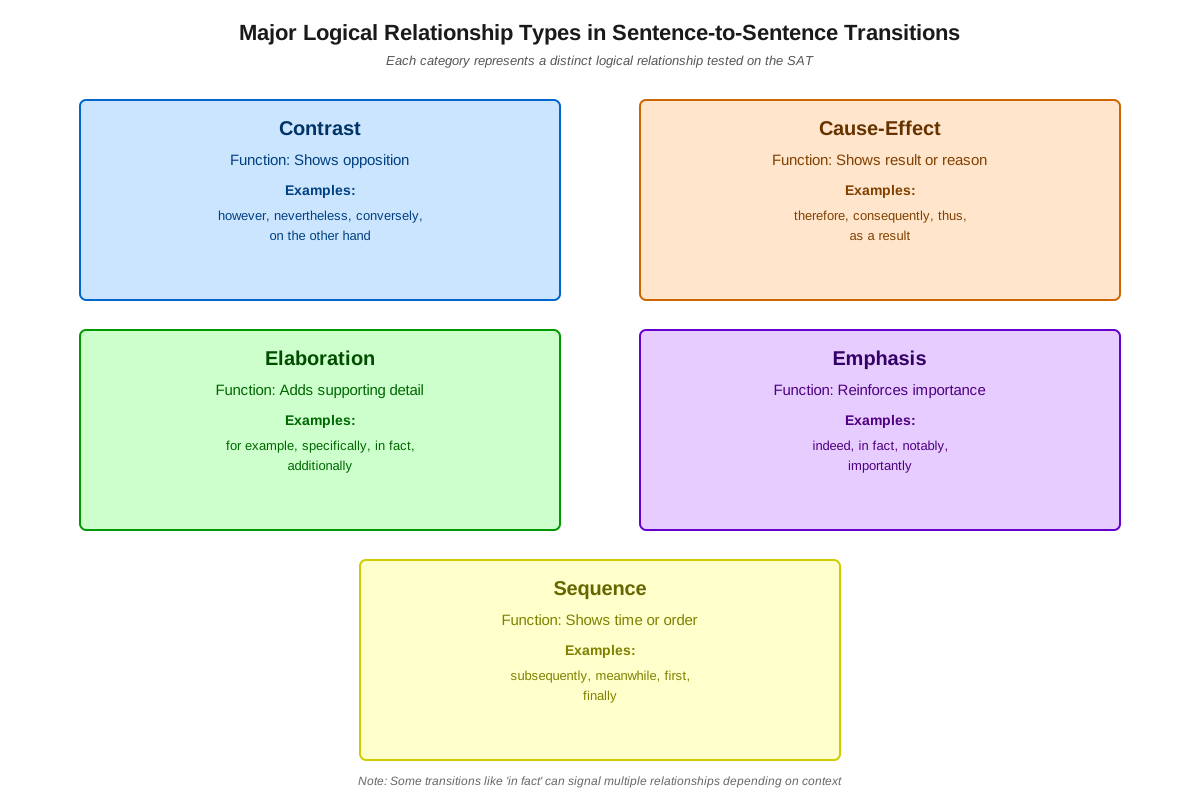
There are six primary logical relationships that appear on the SAT:
- Contrast/Opposition: The second idea contradicts, opposes, or presents an alternative to the first idea
- Cause and Effect: The second idea results from the first, or the first idea explains why the second occurred
- Elaboration/Support: The second idea provides additional detail, evidence, or explanation for the first idea
- Emphasis/Reinforcement: The second idea strengthens or underscores the first idea
- Sequence/Chronology: The second idea follows the first in time or in a logical progression of steps
- Comparison/Similarity: The second idea parallels or resembles the first idea
Contrast and Opposition Transitions
Contrast transitions signal that the author is shifting to an idea that differs from, contradicts, or qualifies the previous statement. These are among the most frequently tested relationships on the SAT. The key to identifying contrast is noticing when two ideas cannot both be fully true simultaneously, or when the second idea presents an unexpected turn from the first.
Common contrast transitions include:
| Strong Contrast | Mild Contrast | Concessive Contrast |
|---|---|---|
| However | Nevertheless | Although |
| But | Nonetheless | Even though |
| Yet | Still | Despite |
| On the contrary | Rather | While |
| Conversely | Instead | Whereas |
Example: "The ancient library contained thousands of scrolls. _____, only a fraction survived the fire." The blank requires a contrast transition because the second sentence presents an unfortunate limitation to the impressive collection mentioned in the first sentence.
Cause and Effect Transitions
Cause-and-effect transitions indicate that one idea produces, results in, or explains another. These relationships can flow in two directions: the cause can come first followed by the effect, or the effect can be stated first followed by its cause. Students must determine which sentence presents the reason and which presents the outcome.
Key cause-and-effect transitions:
- Effect follows cause: Therefore, thus, consequently, as a result, accordingly, hence, so
- Cause follows effect: Because, since, due to, as, for this reason
Example: "The coastal town invested heavily in seawall construction. _____, property damage from the recent hurricane was minimal." The blank needs a result transition like "Consequently" because the second sentence describes the positive outcome of the action mentioned in the first sentence.
Elaboration and Support Transitions
Elaboration transitions signal that the author is providing additional information, examples, evidence, or explanation that develops the previous idea further. Unlike emphasis transitions, elaboration adds new details rather than restating the same point more forcefully. This is one of the most common relationships on the SAT.
Common elaboration transitions:
- For example, for instance, specifically, in particular
- Additionally, furthermore, moreover, also, in addition
- In fact, indeed, actually
Example: "Photosynthesis allows plants to convert sunlight into chemical energy. _____, this process produces oxygen as a byproduct, which is essential for animal life." The blank requires an elaboration transition like "Additionally" because the second sentence provides supplementary information about photosynthesis.
Emphasis and Reinforcement Transitions
Emphasis transitions indicate that the author is restating, strengthening, or underscoring the previous point. The second sentence doesn't add substantially new information but rather reinforces the same idea with greater force or clarity. Students sometimes confuse emphasis with elaboration, but the key distinction is whether new information is being added (elaboration) or the same point is being strengthened (emphasis).
Emphasis transitions include:
- Indeed, in fact, certainly, undoubtedly
- Clearly, obviously, evidently
- Above all, especially, particularly
Sequence and Chronology Transitions
Sequence transitions indicate temporal order or logical progression through steps. These appear less frequently than contrast or elaboration transitions but are straightforward to identify when they do appear. The key is recognizing when the author is describing events in time order or steps in a process.
Sequence transitions:
- First, second, third, finally, lastly
- Then, next, subsequently, afterward
- Meanwhile, simultaneously, at the same time
- Previously, formerly, earlier
Comparison and Similarity Transitions
Comparison transitions signal that the second idea parallels, resembles, or shares characteristics with the first idea. These are less common than contrast transitions but follow similar logic in reverse—instead of highlighting differences, they highlight similarities.
Comparison transitions:
- Similarly, likewise, in the same way
- Equally, correspondingly, analogously
Concept Relationships
The six logical relationships form a conceptual framework where understanding one type helps clarify others through contrast. Contrast transitions and comparison transitions represent opposite ends of a spectrum—one highlights differences while the other highlights similarities. Both require students to evaluate whether two ideas align or diverge.
Cause-and-effect transitions connect to sequence transitions because both involve ordering ideas, though cause-effect focuses on causal relationships while sequence focuses on temporal or procedural order. When analyzing a passage, students should first determine whether the relationship involves causation; if not, they should consider whether it involves time sequence.
Elaboration transitions and emphasis transitions both involve developing a previous idea, making them easy to confuse. The distinction lies in whether new information is introduced (elaboration → adds details) or the same information is reinforced (emphasis → strengthens the point). This relationship can be visualized as: Initial Idea → Elaboration (adds new supporting details) versus Initial Idea → Emphasis (restates with greater force).
All six relationship types connect back to the fundamental skill of sentence-to-sentence logic: understanding how authors construct coherent arguments by linking ideas through specific logical connections. Mastering these relationships enables students to tackle not just transition questions but also inference questions, main idea questions, and rhetorical purpose questions throughout the RW section.
High-Yield Facts
⭐ Transition questions always require reading both the sentence before and after the blank to determine the logical relationship.
⭐ Contrast transitions (however, but, yet, nevertheless) are the most frequently tested transition type on the SAT.
⭐ "Therefore" and "thus" signal cause-and-effect relationships where the effect follows the cause.
⭐ "For example" and "for instance" always introduce specific illustrations of a general point made previously.
⭐ The transition must match the logical relationship between ideas, not just sound sophisticated or formal.
- "Moreover" and "furthermore" signal that additional supporting information is being added to strengthen an argument.
- "In fact" and "indeed" emphasize or reinforce a previous point rather than introducing new information.
- "Meanwhile" indicates that two events or situations are occurring simultaneously.
- "Conversely" signals a complete reversal or opposite situation from what was previously stated.
- "Consequently" and "as a result" indicate that what follows is an outcome or effect of what came before.
- "Nevertheless" and "nonetheless" acknowledge a previous point but indicate the author is proceeding despite it.
- "Specifically" narrows focus from a general statement to a particular detail or example.
Quick check — test yourself on Sentence-to-sentence logic so far.
Try Flashcards →Common Misconceptions
Misconception: All transition questions can be answered by reading only the sentence with the blank. → Correction: Effective transition analysis requires reading at minimum the sentence before and the sentence after the blank, and sometimes the entire paragraph, to fully understand the logical relationship between ideas.
Misconception: Longer or more sophisticated-sounding transitions are more likely to be correct. → Correction: The SAT tests logical accuracy, not vocabulary sophistication. A simple transition like "but" can be correct over a complex phrase like "notwithstanding the aforementioned considerations" if it accurately reflects the relationship between sentences.
Misconception: "However" and "therefore" are interchangeable because both are formal transitions. → Correction: These transitions signal opposite logical relationships—"however" indicates contrast or opposition, while "therefore" indicates cause-and-effect. Using them interchangeably creates logical incoherence.
Misconception: If a sentence provides more information about the previous topic, "for example" is always appropriate. → Correction: "For example" specifically introduces an illustrative instance of a general principle. If the sentence adds different types of information rather than an example, transitions like "additionally" or "furthermore" are more appropriate.
Misconception: Emphasis transitions and elaboration transitions are the same because both develop previous ideas. → Correction: Emphasis transitions (indeed, in fact) reinforce the same point with greater force, while elaboration transitions (additionally, furthermore) introduce new supporting details. The distinction lies in whether new information is added.
Misconception: The correct transition is whichever one "sounds right" when read aloud. → Correction: While fluency matters, the correct transition must accurately represent the logical relationship between ideas. A transition might sound smooth but be logically incorrect, leading to a wrong answer.
Worked Examples
Example 1: Identifying Contrast
Passage: "Marine biologists initially believed that deep-sea creatures relied solely on organic matter falling from surface waters for nutrition. _____, recent discoveries of hydrothermal vent ecosystems revealed that some deep-sea organisms derive energy from chemical processes independent of sunlight."
Answer Choices:
A) For example,
B) Therefore,
C) However,
D) Additionally,
Step 1: Read the sentence before the blank. It states that marine biologists held a specific belief about deep-sea creature nutrition—that it came only from surface waters.
Step 2: Read the sentence after the blank. It describes recent discoveries that revealed a different source of nutrition—chemical processes at hydrothermal vents.
Step 3: Determine the logical relationship. The second sentence contradicts or revises the belief stated in the first sentence. The initial belief was that nutrition came from one source (surface waters), but discoveries showed nutrition could come from a different source (chemical processes). This is a contrast relationship.
Step 4: Evaluate each answer choice:
- A) "For example" would introduce a specific instance of the general principle in the first sentence, but the second sentence contradicts rather than exemplifies the first sentence. Eliminate.
- B) "Therefore" would indicate that the discoveries are a result of the belief, which makes no logical sense. Eliminate.
- C) "However" signals contrast, which matches the relationship between the old belief and the new discoveries. Keep.
- D) "Additionally" would suggest the second sentence adds supporting information to the first, but it actually contradicts it. Eliminate.
Answer: C) However,
Connection to Learning Objectives: This example demonstrates how to identify key features of sentence-to-sentence logic (contrast relationship), explains how this appears on the SAT (standard transition question format), and applies the concept to answer an SAT-style question.
Example 2: Distinguishing Elaboration from Emphasis
Passage: "The invention of the printing press in the 15th century revolutionized information distribution across Europe. _____, this technology enabled the rapid spread of scientific knowledge, religious texts, and political ideas to audiences previously unable to access written materials."
Answer Choices:
A) In fact,
B) Specifically,
C) However,
D) Therefore,
Step 1: Read the sentence before the blank. It makes a broad claim about the printing press revolutionizing information distribution.
Step 2: Read the sentence after the blank. It provides specific details about what types of information were distributed and to whom.
Step 3: Determine the logical relationship. The second sentence doesn't contradict the first (eliminating contrast), nor does it result from the first (eliminating cause-effect). Instead, it provides concrete details that explain and support the general claim. This is elaboration.
Step 4: Evaluate each answer choice:
- A) "In fact" emphasizes or reinforces a point but doesn't introduce new specific details. The second sentence adds substantial new information (types of texts, new audiences), so this is elaboration rather than emphasis. Eliminate.
- B) "Specifically" signals that specific details or examples will follow a general statement, which matches the relationship perfectly. Keep.
- C) "However" signals contrast, but the second sentence supports rather than contradicts the first. Eliminate.
- D) "Therefore" signals cause-and-effect, but the second sentence doesn't describe a result of the revolution—it describes what the revolution consisted of. Eliminate.
Answer: B) Specifically,
Key Distinction: This example highlights the difference between emphasis transitions (which restate the same point more forcefully) and elaboration transitions (which add new supporting details). "In fact" would be appropriate if the second sentence said something like "this technology fundamentally transformed European society," which reinforces the same idea. But because the second sentence provides specific new information about types of texts and audiences, "specifically" is correct.
Exam Strategy
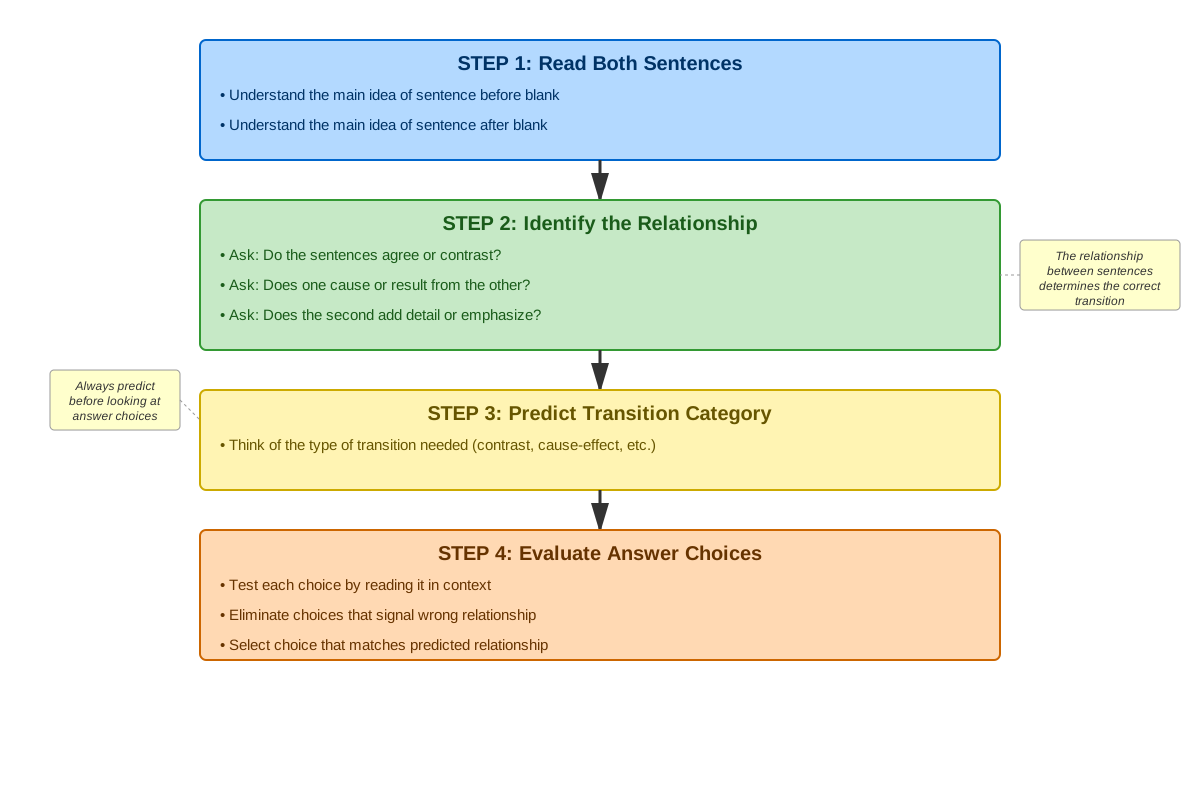
When approaching transition questions on the SAT, follow this systematic process:
Step 1: Read the entire passage first (usually 2-4 sentences). Don't jump immediately to the blank. Understanding the overall context prevents misidentifying the logical relationship.
Step 2: Identify the ideas on both sides of the blank. Mentally summarize the main point of the sentence before the blank and the main point of the sentence after the blank in simple terms.
Step 3: Determine the logical relationship. Ask yourself: Does the second idea contrast with the first? Result from it? Provide an example? Add new information? Emphasize the same point?
Step 4: Predict the type of transition needed before looking at answer choices. This prevents answer choices from influencing your analysis of the logical relationship.
Step 5: Eliminate answer choices that signal different logical relationships from what you identified. Often you can eliminate 2-3 choices immediately.
Step 6: Test remaining choices by reading the passage with each transition inserted. The correct answer will create logical coherence.
Exam Tip: Watch for trigger words in the sentences surrounding the blank. Words like "but," "although," "despite" in the sentence content (not as the transition itself) often signal that a contrast relationship exists. Words like "because," "since," "result" often signal cause-and-effect.
Common trigger phrases:
- "Initially believed... but recent evidence" → signals contrast
- "This led to..." → signals cause-and-effect (effect follows)
- "One example of this..." → signals elaboration with example
- "This is especially true..." → signals emphasis
Time allocation: Transition questions should take 30-45 seconds each. They're designed to be answered relatively quickly compared to inference or main idea questions. If you find yourself spending more than a minute, you may be overthinking—return to the basic logical relationship between the two ideas.
Process of elimination strategy: Eliminate answer choices that create logical incoherence. If inserting a transition makes the passage contradict itself or creates a nonsensical relationship, that transition is wrong regardless of how sophisticated it sounds.
Memory Techniques
Mnemonic for contrast transitions - "HONEY":
- However
- On the contrary
- Nevertheless
- Even though
- Yet
Mnemonic for cause-and-effect (effect follows cause) - "TEACH":
- Therefore
- Ergo (less common but appears)
- Accordingly
- Consequently
- Hence
Visualization strategy: Picture transitions as road signs. Contrast transitions are like "U-turn" signs—the argument is changing direction. Cause-and-effect transitions are like "Next Exit" signs—one idea leads directly to the next. Elaboration transitions are like "Rest Area - 5 Services" signs—more details about the same location are coming.
The "Same or Different" Quick Test: When stuck between answer choices, ask: "Is the second sentence saying something that agrees with the first sentence (same direction) or disagrees with it (different direction)?" Same direction = elaboration, emphasis, or cause-effect. Different direction = contrast. This simple binary choice eliminates at least half the options.
Acronym for elaboration transitions - "FAME":
- Furthermore
- Additionally
- Moreover
- Example (for example)
Summary
Sentence-to-sentence logic is a high-yield SAT skill that tests the ability to identify logical relationships between adjacent ideas and select appropriate transitions. The six primary relationships—contrast, cause-and-effect, elaboration, emphasis, sequence, and comparison—form the foundation of coherent writing and appear consistently across all passage types. Success requires reading both sentences surrounding the blank, determining the specific logical relationship, and selecting the transition that accurately signals that relationship. Contrast transitions (however, but, yet) and elaboration transitions (additionally, furthermore, for example) are most frequently tested. The key to mastery is recognizing that transitions must match the logical relationship between ideas, not simply sound formal or sophisticated. Students should approach these questions systematically: read the full context, identify the relationship, predict the transition type, and eliminate choices that create logical incoherence. With practice, transition questions become reliable points that can be answered quickly and confidently, contributing to overall success in the Reading and Writing section.
Key Takeaways
- Sentence-to-sentence logic questions test the ability to identify logical relationships between adjacent ideas and select appropriate transitions
- The six primary logical relationships are contrast, cause-and-effect, elaboration, emphasis, sequence, and comparison
- Always read the sentence before and after the blank to determine the relationship—never rely on the blank sentence alone
- Contrast transitions (however, nevertheless, yet) and elaboration transitions (additionally, furthermore, for example) are the most frequently tested
- The correct transition must accurately reflect the logical relationship, not just sound sophisticated or formal
- Eliminate answer choices that create logical incoherence when inserted into the passage
- Transition questions should take 30-45 seconds each and appear 2-4 times per test module
Related Topics
Rhetorical Synthesis: Building on sentence-to-sentence logic, rhetorical synthesis questions ask students to combine information from multiple sources or notes into a coherent sentence, requiring understanding of how ideas connect across longer passages.
Text Structure and Purpose: Understanding sentence-to-sentence logic provides the foundation for analyzing how entire paragraphs and passages are organized, as transitions signal the structural relationships between larger sections of text.
Command of Evidence: Recognizing elaboration transitions helps students identify when authors are providing evidence for claims, a skill essential for command of evidence questions that ask which quotation best supports a conclusion.
Inference Questions: The logical relationships tested in transition questions—especially cause-and-effect and contrast—are fundamental to making valid inferences about unstated ideas in passages.
Practice CTA
Now that you've mastered the core concepts of sentence-to-sentence logic, it's time to put your knowledge into action! Complete the practice questions to reinforce your understanding of logical relationships and transition selection. Use the flashcards to memorize the different transition types and their functions. Remember, these questions appear consistently on every SAT, making them reliable opportunities to earn points. With focused practice, you'll develop the ability to identify logical relationships quickly and confidently, turning transition questions into some of the fastest and most reliable points in the Reading and Writing section. You've got this!
Sign up free to keep reading
Create a free AnvayaPrep account to finish this SAT guide on Sentence-to-sentence logic — plus flashcards and practice questions.