Overview
Transition words are the connective tissue of effective writing, and similarly is one of the most important comparison transitions tested on the SAT Reading and Writing section. This transition word signals to readers that the author is about to present information that parallels, resembles, or reinforces a previously stated idea. Understanding how similarly functions is crucial for success on the SAT because it appears frequently in questions that test logical coherence and the ability to maintain consistent relationships between ideas across sentences and paragraphs.
The SAT Reading and Writing section (RW) dedicates a significant portion of its questions to transition logic, and "similarly" questions represent a high-yield subcategory within this domain. These questions assess whether students can recognize when two ideas share comparable characteristics, follow parallel patterns, or support the same conclusion through analogous evidence. Mastering this transition type directly impacts performance on 2-4 questions per test administration, which can translate to meaningful score improvements in the 600-800 range.
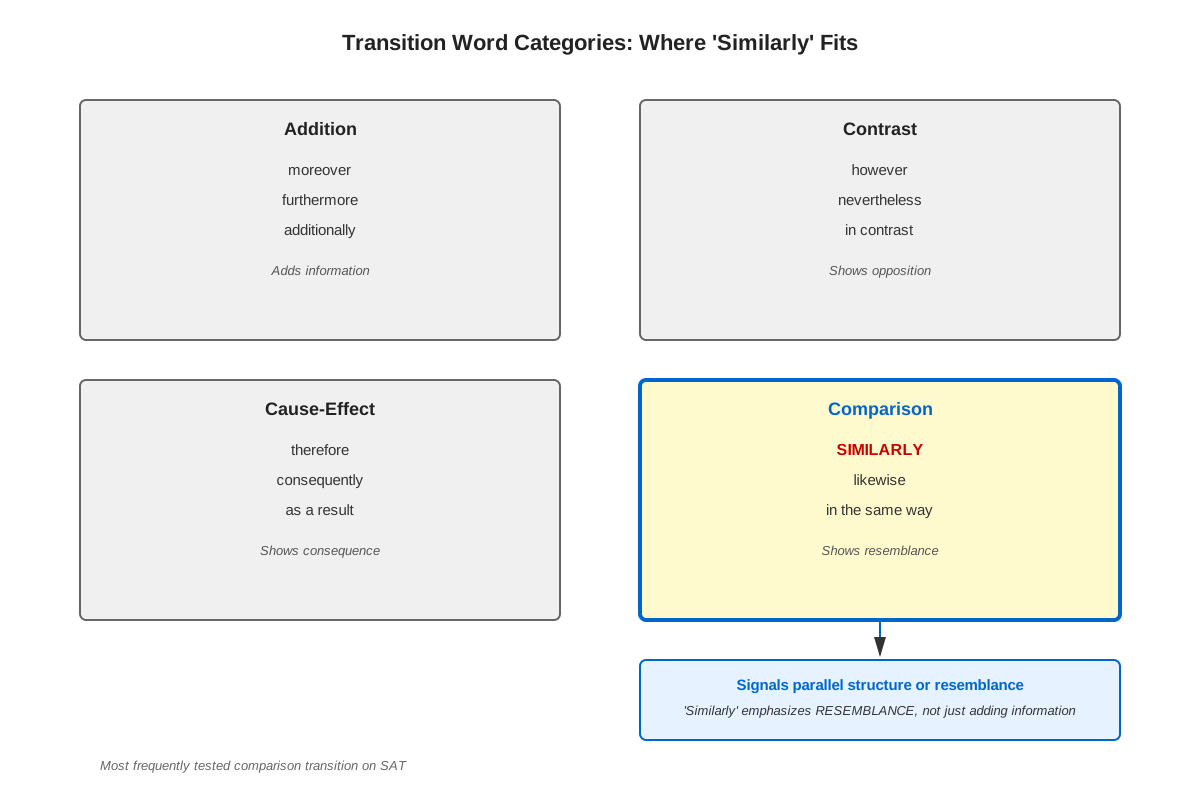
Within the broader landscape of SAT transitions, "similarly" belongs to the comparison/continuation family, working alongside transitions like "likewise," "in the same way," and "by the same token." However, it differs from pure addition transitions (such as "moreover" or "furthermore") because it specifically emphasizes resemblance or parallel structure rather than simply adding new information. Understanding these nuanced distinctions enables students to make precise choices when selecting the most logical transition for a given context, a skill that extends beyond test-taking to college-level academic writing and professional communication.
Learning Objectives
- [ ] Identify key features of Similarly
- [ ] Explain how Similarly appears on the SAT
- [ ] Apply Similarly to answer SAT-style questions
- [ ] Distinguish between "similarly" and other comparison transitions in context
- [ ] Recognize the structural patterns that signal when "similarly" is the correct transition choice
- [ ] Evaluate incorrect transition choices by identifying logical mismatches in SAT questions
Prerequisites
- Basic understanding of sentence structure: Students must recognize independent clauses and how sentences connect to form coherent paragraphs, as transition questions require analyzing relationships between complete thoughts.
- Familiarity with transition word categories: Knowledge that transitions fall into categories (addition, contrast, cause-effect, comparison) helps students quickly eliminate inappropriate choices.
- Reading comprehension fundamentals: The ability to identify main ideas and supporting details is essential because transition questions require understanding what each sentence contributes to the overall argument.
Why This Topic Matters
In real-world communication, transition words like "similarly" create logical bridges that help readers follow complex arguments, compare different scenarios, and understand how multiple examples support a central claim. Professional writing in business, academia, and journalism relies heavily on these connective devices to maintain clarity and coherence. Students who master transition logic develop stronger analytical reading skills and produce more sophisticated written work in college and beyond.
On the SAT, transition questions appear with remarkable consistency—typically 3-5 questions per test administration focus specifically on selecting the most logical transition word or phrase. Among these, "similarly" and its comparison-transition counterparts account for approximately 20-30% of all transition questions, making this a high-frequency, high-impact topic. The College Board has increased emphasis on these questions in recent test versions, recognizing that transition logic reflects critical thinking skills essential for college success.
Sat similarly questions most commonly appear in passages discussing scientific studies (where researchers compare multiple experiments), historical analyses (where parallel events or movements are examined), or argumentative texts (where analogous examples support a thesis). The passages typically present two or more situations, phenomena, or pieces of evidence that share key characteristics, and students must identify where "similarly" appropriately signals this parallel relationship. These questions test not just vocabulary recognition but the deeper skill of logical reasoning—understanding when two ideas genuinely mirror each other versus when they contrast, build upon, or cause one another.
Core Concepts
The Function of "Similarly" as a Comparison Transition
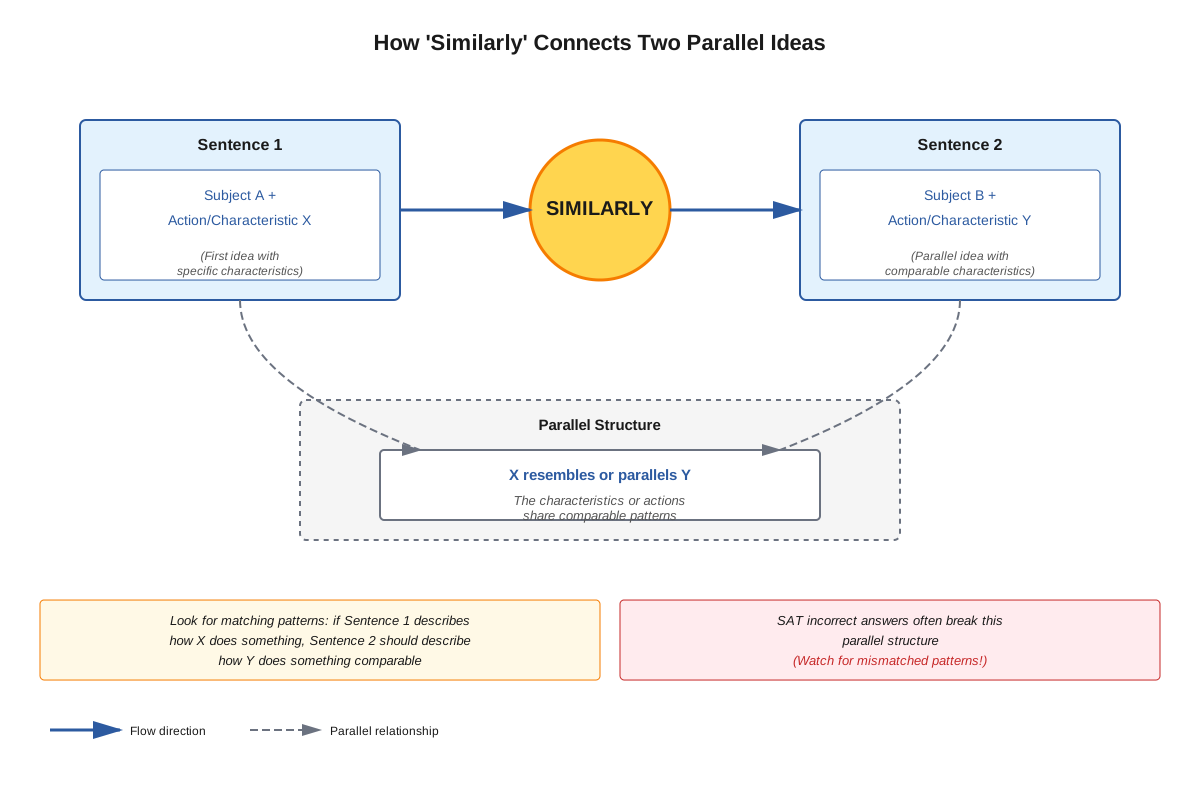
Similarly serves as a comparison transition that signals the upcoming sentence will present information that parallels, mirrors, or closely resembles what was just stated. Unlike addition transitions that simply introduce new information, "similarly" specifically tells readers: "What I'm about to say follows the same pattern, exhibits the same characteristics, or leads to the same conclusion as what I just described." This transition creates an expectation of structural or conceptual parallelism.
The word functions as a sentence adverb, typically appearing at the beginning of a sentence followed by a comma, though it can also appear mid-sentence set off by commas. Its placement signals to readers that they should actively compare the new information with the preceding content, looking for matching patterns, analogous situations, or reinforcing evidence.
Logical Requirements for Using "Similarly"
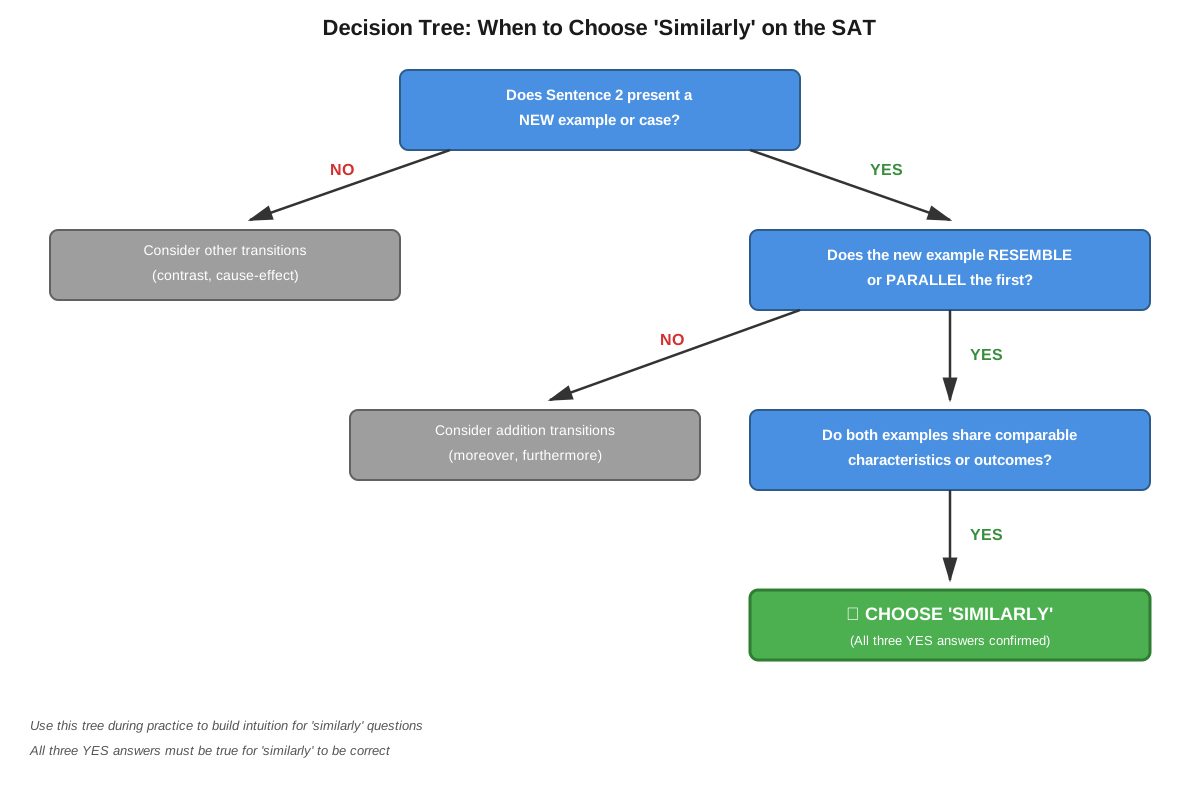
For "similarly" to be the correct transition choice, three conditions must be met:
- Two distinct subjects or situations: The text must present at least two different entities, scenarios, or examples
- Shared characteristics or outcomes: These subjects must exhibit comparable features, behaviors, or results
- Parallel structure: The information should follow a similar logical pattern (if A does X with result Y, then B does X with result Y)
When these conditions exist, "similarly" creates coherence by explicitly marking the comparison relationship. Without these elements, "similarly" creates logical confusion because readers expect parallelism that doesn't exist.
Distinguishing "Similarly" from Related Transitions
Understanding what "similarly" is NOT helps clarify when to use it:
| Transition Type | Example Words | Function | When NOT to Use "Similarly" |
|---|---|---|---|
| Pure Addition | moreover, furthermore, additionally | Adds new, different information | When the second idea doesn't mirror the first |
| Contrast | however, nevertheless, conversely | Shows opposition or difference | When ideas oppose rather than parallel |
| Cause-Effect | therefore, consequently, thus | Shows result or conclusion | When the second idea results from, rather than resembles, the first |
| Comparison | similarly, likewise, in the same way | Shows parallel or resemblance | Never—these are synonymous in most contexts |
Structural Patterns That Signal "Similarly"
Certain textual patterns strongly indicate "similarly" is the appropriate transition:
Pattern 1: Parallel Examples Supporting a Claim
- Sentence 1: States a general principle or makes a claim
- Sentence 2: Provides Example A demonstrating this principle
- Sentence 3: [SIMILARLY] Provides Example B demonstrating the same principle
Pattern 2: Comparative Research or Studies
- Sentence 1: Describes Study A's methodology and findings
- Sentence 2: [SIMILARLY] Describes Study B's methodology and findings (which parallel Study A)
Pattern 3: Analogous Situations Across Contexts
- Sentence 1: Describes how Phenomenon X occurs in Context A
- Sentence 2: [SIMILARLY] Describes how Phenomenon X occurs in Context B
Pattern 4: Matching Characteristics
- Sentence 1: Lists characteristics or behaviors of Subject A
- Sentence 2: [SIMILARLY] Lists matching characteristics or behaviors of Subject B
Context Clues for Identifying Comparison Relationships
When reading SAT passages, specific linguistic markers signal that a comparison relationship exists, making "similarly" the logical choice:
- Parallel sentence structures: When two consecutive sentences follow identical grammatical patterns
- Repeated key terms: When the same nouns, verbs, or concepts appear in both sentences
- Comparative language: Phrases like "another example," "a comparable situation," or "this pattern also appears"
- Symmetrical descriptions: When two subjects are described using matching adjectives or action verbs
Common SAT Question Formats for "Similarly"
The College Board presents "similarly" questions in several standard formats:
Format 1: Four-option transition selection
Students see a passage with a blank where a transition should appear, followed by four options including "similarly" and three alternatives from different transition categories.
Format 2: Logical coherence questions
Students must determine which sentence would most logically follow a given paragraph, requiring recognition of comparison relationships.
Format 3: Sentence placement questions
Students must identify where a sentence containing "similarly" should be inserted into a paragraph to maintain logical flow.
Concept Relationships
The concept of "similarly" as a comparison transition connects directly to broader principles of logical coherence in writing. Understanding "similarly" requires first grasping that sentences within paragraphs must maintain logical relationships—they cannot exist in isolation but must connect through addition, contrast, cause-effect, or comparison. "Similarly" represents one specific type within this larger framework of logical connections.
Within the comparison category itself, "similarly" relates closely to synonymous transitions like "likewise" and "in the same way," which can often substitute for one another. However, "similarly" differs subtly from "by the same token" (which emphasizes logical consistency) and "analogously" (which suggests a more formal, structured comparison). On the SAT, these distinctions rarely matter because the test typically contrasts "similarly" with transitions from entirely different categories rather than testing fine gradations within the comparison family.
The relationship map for this topic flows as follows:
Logical Coherence (foundation) → Transition Categories → Comparison Transitions → "Similarly" specifically → Application to SAT questions
Additionally, "similarly" connects to prerequisite knowledge of sentence structure because students must identify where one complete thought ends and another begins to determine whether a comparison relationship exists between them. It also relates to reading comprehension skills because recognizing when "similarly" is appropriate requires understanding what each sentence contributes to the passage's overall argument or explanation.
High-Yield Facts
⭐ "Similarly" signals that the upcoming information parallels or mirrors what was just stated, not that it adds different information or shows contrast.
⭐ For "similarly" to be correct, there must be two distinct subjects or situations that share key characteristics or outcomes.
⭐ "Similarly" appears most frequently in SAT passages discussing scientific research, historical parallels, or multiple examples supporting a thesis.
⭐ When two sentences follow identical structural patterns (Subject A does X; Subject B does X), "similarly" is likely the correct transition.
⭐ "Similarly" and "likewise" are functionally interchangeable on the SAT—if one is correct, the other would be too, but they rarely appear as competing options.
- "Similarly" typically appears at the beginning of a sentence followed by a comma, though mid-sentence placement is grammatically acceptable.
- The most common incorrect alternatives paired with "similarly" in SAT questions are "however" (contrast), "therefore" (cause-effect), and "for example" (illustration).
- Approximately 20-30% of SAT transition questions test comparison transitions like "similarly."
- "Similarly" requires active comparison—readers must mentally connect the new information with previous content to understand the parallel.
- When "similarly" appears in a passage, the preceding sentence almost always contains the comparison point that the current sentence mirrors.
Quick check — test yourself on Similarly so far.
Try Flashcards →Common Misconceptions
Misconception: "Similarly" can be used whenever adding any new information to support a point.
Correction: "Similarly" specifically requires parallel or mirroring information, not just additional supporting details. If the new information is different in nature or structure from what preceded it, transitions like "additionally" or "furthermore" are more appropriate. "Similarly" demands that readers recognize a matching pattern between the two pieces of information.
Misconception: "Similarly" and "however" can both be correct depending on interpretation.
Correction: These transitions are logically opposite and cannot both be correct for the same context. "Similarly" indicates agreement or parallel, while "however" indicates contrast or opposition. If you're uncertain which is correct, identify whether the second sentence agrees with or contradicts the first—this determines which transition category applies.
Misconception: "Similarly" is correct whenever two things are mentioned in consecutive sentences.
Correction: Mere proximity of two subjects doesn't justify "similarly." The subjects must share specific characteristics, behaviors, or outcomes that create a meaningful parallel. Simply mentioning two different things in sequence doesn't establish the comparison relationship that "similarly" signals.
Misconception: "Similarly" means "in addition to" or "also."
Correction: While "similarly" does introduce additional information, it specifically introduces information that mirrors or parallels what came before. "Also" and "in addition" are neutral additions that don't require parallel structure. "Similarly" creates a stronger expectation that readers will recognize matching patterns between the two pieces of information.
Misconception: If a passage discusses two studies, "similarly" is automatically correct when introducing the second study.
Correction: "Similarly" is only appropriate if the second study parallels the first in methodology, findings, or implications. If the second study contrasts with the first, uses different methods, or reaches opposite conclusions, "similarly" would be incorrect despite both being studies. The content relationship, not the subject category, determines the correct transition.
Misconception: "Similarly" can introduce the first example in a series.
Correction: "Similarly" requires a preceding point of comparison—it cannot introduce the initial example because there's nothing yet to be "similar to." The first example might be introduced with "for example" or "for instance," while "similarly" would introduce subsequent examples that parallel the first.
Worked Examples
Example 1: Scientific Research Passage
Passage Context:
"Researchers studying sleep patterns in adolescents found that participants who used electronic devices within one hour of bedtime took an average of 45 minutes longer to fall asleep than those who avoided screens. _____ a separate study examining adults aged 30-50 discovered that screen exposure before bed delayed sleep onset by an average of 40 minutes compared to control groups who engaged in reading printed materials."
Options:
A) However,
B) Therefore,
C) Similarly,
D) For instance,
Analysis:
First, identify what the first sentence establishes: a research finding showing that screen use before bed delays sleep onset in adolescents (45 minutes longer).
Next, examine what the second sentence presents: a different study with a different age group (adults 30-50) that found essentially the same pattern—screen exposure delays sleep onset (40 minutes).
Now, determine the logical relationship:
- Are these ideas contrasting? No—both show screen use delaying sleep.
- Is the second a result of the first? No—these are independent studies.
- Is the second an example of the first? No—the first sentence already describes a complete study.
- Do these ideas parallel each other? Yes—both studies found the same pattern in different populations.
Eliminate incorrect options:
- (A) "However" signals contrast, but both studies reached the same conclusion
- (B) "Therefore" signals cause-effect, but the second study doesn't result from the first
- (D) "For instance" introduces an example, but the second study isn't an example of the first—it's a parallel investigation
Correct Answer: C) Similarly
The second study mirrors the first in structure (research methodology), subject matter (screen use and sleep), and findings (delayed sleep onset). "Similarly" appropriately signals this parallel relationship, telling readers that the pattern observed in adolescents also appears in adults.
Example 2: Historical Comparison Passage
Passage Context:
"During the Industrial Revolution in Britain, rapid urbanization led to severe overcrowding in cities like Manchester and Liverpool, where inadequate sanitation systems resulted in frequent cholera outbreaks. _____ American cities such as New York and Chicago experienced comparable public health crises in the late 19th century as their populations swelled due to industrial growth and immigration."
Options:
A) Consequently,
B) Similarly,
C) Nevertheless,
D) In other words,
Analysis:
Identify the first sentence's content: British cities during industrialization faced overcrowding and disease outbreaks due to rapid urbanization.
Examine the second sentence: American cities in roughly the same era faced the same problems (overcrowding, health crises) from the same cause (industrial growth and population increase).
Determine the relationship:
- The American situation doesn't result from the British situation (they're parallel developments, not cause-effect)
- The American situation doesn't contrast with the British situation (both faced the same problems)
- The American situation doesn't restate the British situation (they're different locations and contexts)
- The American situation mirrors the British situation (same causes, same effects, same time period)
Eliminate incorrect options:
- (A) "Consequently" suggests the American crisis resulted from the British crisis, which is historically inaccurate
- (C) "Nevertheless" signals contrast or unexpected outcome, but the American experience matched rather than contradicted the British pattern
- (D) "In other words" signals restatement, but American cities aren't a restatement of British cities—they're a parallel example
Correct Answer: B) Similarly
The passage presents two analogous historical situations: industrialization causing urban health crises in both British and American contexts. "Similarly" correctly signals that the American experience paralleled the British experience, following the same pattern of cause and effect in a different geographical context.
Exam Strategy
When approaching SAT transition questions involving "similarly," follow this systematic process:
Step 1: Read the full context (30 seconds)
Always read the complete sentence before the blank and the complete sentence after the blank. Many students make errors by reading only fragments, missing crucial information about the logical relationship.
Step 2: Identify the core claim of each sentence (15 seconds)
Strip away modifiers and subordinate clauses to identify what each sentence fundamentally states. Write brief mental summaries: "Sentence 1 says X does Y" and "Sentence 2 says Z does Y."
Step 3: Determine the relationship (20 seconds)
Ask yourself: Does the second sentence agree with, contrast with, result from, or parallel the first? If you identify a parallel (same pattern, matching characteristics, analogous situation), "similarly" becomes a strong candidate.
Step 4: Predict before looking at options (10 seconds)
Based on your relationship determination, predict which transition category is needed: comparison, contrast, cause-effect, or addition. This prevents answer choices from influencing your logical analysis.
Step 5: Eliminate and confirm (15 seconds)
Eliminate options from wrong categories first, then select the best remaining option. If "similarly" remains after elimination and you've identified a parallel relationship, it's likely correct.
Exam Tip: The SAT rarely tests fine distinctions between synonymous transitions. If you've identified a comparison relationship, don't second-guess yourself by trying to find subtle differences between "similarly" and "likewise"—they're functionally identical on this test.
Trigger phrases that signal "similarly" may be correct:
- "Another study found..."
- "This pattern also appears..."
- "A comparable situation..."
- "In the same way..."
- Repeated key terms in consecutive sentences
- Parallel sentence structures
Red flags that "similarly" is likely wrong:
- The second sentence contradicts the first
- The second sentence explains why the first is true
- The second sentence provides a specific example of a general principle stated first
- Only one subject or situation is discussed
- The second sentence introduces entirely new information unrelated to the first
Time allocation: Spend no more than 90 seconds on any single transition question. If you're uncertain after applying the five-step process, make your best educated guess and move forward. These questions test logical reasoning, not obscure vocabulary, so your first instinct after careful analysis is usually correct.
Memory Techniques
The MIRROR Mnemonic for "Similarly":
- Matching patterns between sentences
- Identical or analogous situations
- Repeated key concepts
- Resemblance in structure or outcome
- Overlapping characteristics
- Reinforcing the same point through parallel examples
Visualization Strategy:
Picture "similarly" as a mirror placed between two sentences. Just as a mirror reflects an image, "similarly" reflects the pattern, structure, or characteristics from the first sentence into the second. If the "reflection" doesn't match (if the ideas contrast or one causes the other), the mirror is broken—"similarly" doesn't work.
The Parallel Parking Analogy:
Think of "similarly" like parallel parking—both cars (sentences) must face the same direction, occupy similar spaces, and serve the same function. If one car faces forward and another backward (contrast), or if one car is parked because the other pushed it there (cause-effect), they're not parallel. "Similarly" only works when both sentences "park" in the same logical direction.
Contrast Pair Memory Aid:
Remember that "similarly" and "however" are logical opposites. If you're torn between these two on an SAT question, you're actually choosing between agreement and disagreement. Ask: "Does sentence 2 agree with or disagree with sentence 1?" This simple question immediately eliminates one option.
The "Two Examples, Same Point" Rule:
Create a mental template: "Similarly" appears when an author presents Example A supporting Point X, then presents Example B also supporting Point X. If you can identify this "two examples, same point" structure, "similarly" is almost certainly correct.
Summary
"Similarly" functions as a comparison transition that signals parallel relationships between ideas, indicating that the upcoming information mirrors, resembles, or follows the same pattern as what was previously stated. On the SAT Reading and Writing section, questions testing "similarly" assess students' ability to recognize when two distinct subjects, situations, or examples share key characteristics or outcomes. Success requires identifying three elements: two separate entities being discussed, shared features or results between them, and parallel logical structure. The most common SAT contexts for "similarly" include scientific research passages comparing multiple studies, historical analyses examining analogous events, and argumentative texts using parallel examples to support a thesis. Students must distinguish "similarly" from addition transitions (which introduce different information), contrast transitions (which show opposition), and cause-effect transitions (which show results). Mastering this transition type directly impacts performance on high-frequency question types, as comparison transitions appear in approximately 20-30% of all SAT transition questions. The key to success lies in systematic analysis: reading full context, identifying core claims, determining logical relationships, and eliminating options from incorrect transition categories before confirming the answer.
Key Takeaways
- "Similarly" signals parallel relationships: It indicates the upcoming sentence will present information that mirrors or resembles what was just stated, not information that contrasts, causes, or simply adds to it.
- Three requirements must be met: Two distinct subjects or situations, shared characteristics or outcomes between them, and parallel logical structure.
- High-frequency SAT topic: Comparison transitions like "similarly" appear in 20-30% of transition questions, making this a high-yield study focus.
- Context is crucial: Always read complete sentences before and after the blank to accurately determine the logical relationship.
- Systematic elimination works: Identify the relationship type first (comparison, contrast, cause-effect, addition), eliminate options from wrong categories, then select the best remaining choice.
- Parallel patterns are the key signal: When two sentences follow identical structures or describe matching characteristics, "similarly" is likely correct.
- Don't confuse with pure addition: "Similarly" requires mirroring or parallel structure, not just additional supporting information—that's where "furthermore" or "moreover" would be appropriate.
Related Topics
Contrast Transitions (However, Nevertheless): After mastering "similarly," students should study contrast transitions to understand how ideas oppose rather than parallel each other. This creates a complete framework for distinguishing agreement from disagreement in logical relationships.
Cause-Effect Transitions (Therefore, Consequently): Understanding cause-effect transitions helps students recognize when one idea results from another rather than mirroring it, preventing confusion between "similarly" and "therefore" on exam questions.
Addition Transitions (Moreover, Furthermore): Studying pure addition transitions clarifies the distinction between simply adding new information and adding parallel information, refining students' ability to select the most precise transition.
Logical Coherence in Paragraph Structure: Mastering "similarly" provides foundation for understanding how entire paragraphs maintain coherence through varied transition types, a skill tested in sentence placement and organization questions.
Evidence and Support in Argumentative Writing: The concept of parallel examples supporting a thesis (where "similarly" often appears) connects to broader SAT skills in analyzing how authors construct and support arguments.
Practice CTA
Now that you've mastered the core concepts of "similarly" as a comparison transition, it's time to cement your understanding through active practice. Attempt the practice questions designed specifically for this topic, paying careful attention to identifying parallel relationships and eliminating transitions from incorrect categories. Use the flashcards to reinforce high-yield facts and trigger phrases that signal when "similarly" is the appropriate choice. Remember: transition questions are among the most predictable and learnable question types on the SAT—consistent practice with systematic analysis will translate directly to points on test day. Every question you practice strengthens your pattern recognition and builds the confidence needed to approach these questions efficiently under timed conditions.
Sign up free to keep reading
Create a free AnvayaPrep account to finish this SAT guide on Similarly — plus flashcards and practice questions.