Overview
The word therefore is one of the most important transition words tested on the SAT Reading and Writing section. As a logical connector, therefore signals a cause-and-effect relationship where the second clause presents a conclusion or result that follows from the first clause. Understanding how to identify and use therefore correctly is essential for success on transition questions, which appear consistently throughout the SAT exam and test students' ability to recognize logical relationships between ideas.
On the SAT therefore questions, students must determine whether this transition word appropriately connects two sentences or clauses based on the logical relationship between them. These questions assess reading comprehension at a sophisticated level—students must not only understand what each sentence says but also grasp how ideas relate to one another. The ability to recognize when a conclusion follows from evidence or when a result stems from a cause is fundamental to academic reading and writing across all disciplines.
Within the broader context of RW (Reading and Writing) skills, therefore belongs to the family of conclusion and result transitions. It works alongside similar transitions like "thus," "consequently," and "hence," but each has subtle differences in usage and formality. Mastering therefore helps students understand logical argumentation, recognize patterns of reasoning in complex texts, and make informed choices about how ideas connect—skills that extend far beyond the SAT into college-level academic work and professional communication.
Learning Objectives
- [ ] Identify key features of therefore and distinguish it from other transition words
- [ ] Explain how therefore appears on the SAT and what logical relationship it signals
- [ ] Apply therefore to answer SAT-style questions with accuracy and confidence
- [ ] Analyze the cause-and-effect relationship between sentences to determine if therefore is appropriate
- [ ] Differentiate between therefore and similar conclusion transitions based on context and formality
- [ ] Evaluate incorrect transition choices and explain why they fail to establish proper logical connections
Prerequisites
- Basic understanding of sentence structure: Recognizing independent clauses and how they can be connected is essential for understanding how therefore functions as a transition between complete thoughts.
- Familiarity with cause-and-effect relationships: Students should understand that some events or ideas lead to others, as therefore specifically signals this logical progression.
- General transition word knowledge: Awareness that transition words serve to connect ideas and that different transitions signal different relationships helps contextualize therefore's specific function.
- Reading comprehension skills: The ability to understand the main idea of individual sentences is necessary before analyzing how those sentences relate to each other.
Why This Topic Matters
Understanding therefore is crucial for real-world academic and professional success. In college essays, research papers, and professional reports, writers must clearly signal when they're drawing conclusions from evidence. The ability to recognize and use therefore correctly demonstrates logical thinking and helps readers follow complex arguments. In scientific writing, therefore often introduces findings that result from experimental data. In legal documents, it signals conclusions drawn from precedents or statutes. These practical applications make therefore an essential tool for clear, persuasive communication.
On the SAT, transition questions appear in approximately 10-15% of Reading and Writing questions, making them high-yield content for score improvement. Therefore specifically appears in multiple questions per exam, either as the correct answer or as a distractor. The College Board consistently tests students' ability to recognize conclusion and result relationships, making therefore one of the most frequently tested transition words. Questions involving therefore typically appear at medium difficulty, meaning they separate average scorers from high scorers.
Therefore appears in SAT passages across all content areas—science, social studies, humanities, and literature. In science passages, it might connect experimental procedures to results. In social studies texts, it could link historical causes to their effects. In argumentative passages, therefore often introduces the author's main conclusion after presenting supporting evidence. The versatility of therefore across disciplines makes it an essential transition to master for comprehensive SAT preparation.
Core Concepts
The Logical Function of Therefore
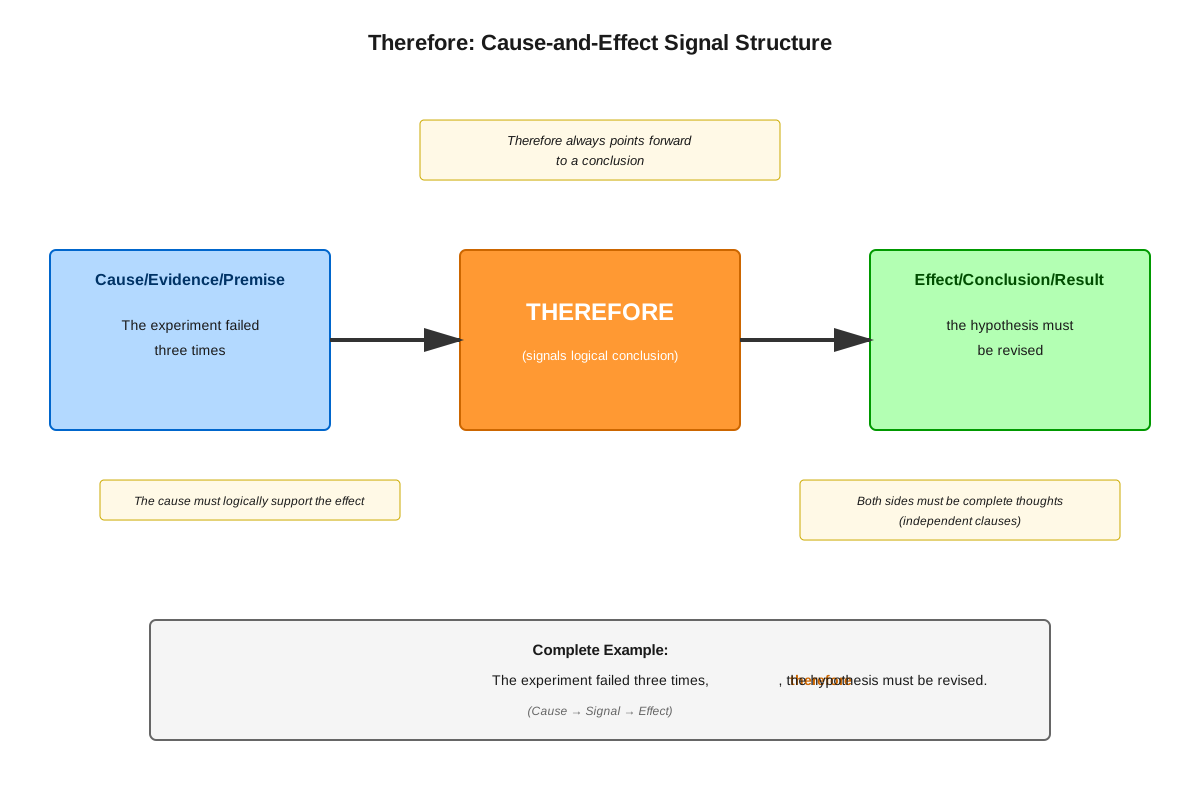
Therefore is a conjunctive adverb that signals a conclusion or result following logically from previously stated information. When a writer uses therefore, they indicate that what comes next is a consequence, outcome, or logical inference drawn from what came before. The relationship is directional: the first statement provides the reason, evidence, or cause, while the statement following therefore presents the effect, result, or conclusion.
The logical structure follows this pattern: Premise/Evidence/Cause → Therefore → Conclusion/Result/Effect. For example: "The experiment showed that plants exposed to sunlight grew 40% faster. Therefore, adequate light is essential for optimal plant growth." The first sentence provides evidence (the experimental finding), and therefore introduces the conclusion drawn from that evidence.
Grammatical Placement and Punctuation
Therefore can appear in several positions within a sentence, and its placement affects punctuation. When therefore connects two independent clauses, it typically appears at the beginning of the second clause and requires specific punctuation:
Between two sentences: "The data supports the hypothesis. Therefore, we can proceed with the next phase."
After a semicolon: "The data supports the hypothesis; therefore, we can proceed with the next phase."
Mid-sentence with commas: "The data supports the hypothesis. We can, therefore, proceed with the next phase."
On the SAT, therefore most commonly appears at the beginning of a sentence or clause, set off by a comma. Understanding this punctuation pattern helps students recognize therefore in context and distinguish it from other transition types.
Distinguishing Therefore from Similar Transitions
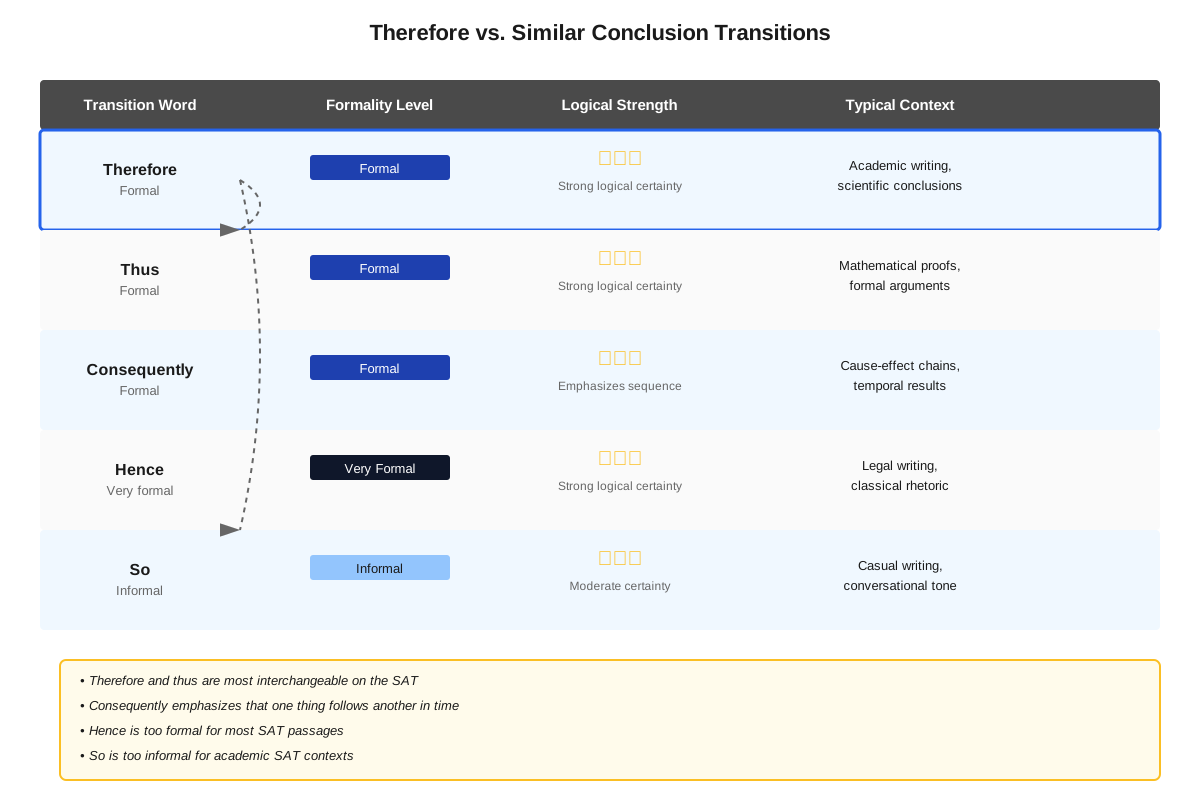
Several transition words signal similar logical relationships, but subtle differences exist:
| Transition | Relationship | Formality | Emphasis |
|---|---|---|---|
| Therefore | Conclusion/result | Formal | Strong logical connection |
| Thus | Conclusion/result | Very formal | Emphasizes inevitability |
| Consequently | Result/effect | Formal | Emphasizes sequence |
| Hence | Conclusion | Very formal | Mathematical/scientific |
| So | Result | Informal | Casual connection |
| As a result | Effect | Neutral | Explicit causation |
On the SAT, therefore is preferred in formal academic writing when drawing logical conclusions. "So" would be too informal for most SAT passages, while "hence" might be too formal except in mathematical or highly technical contexts. Understanding these distinctions helps students eliminate incorrect answer choices.
The Cause-Effect Test
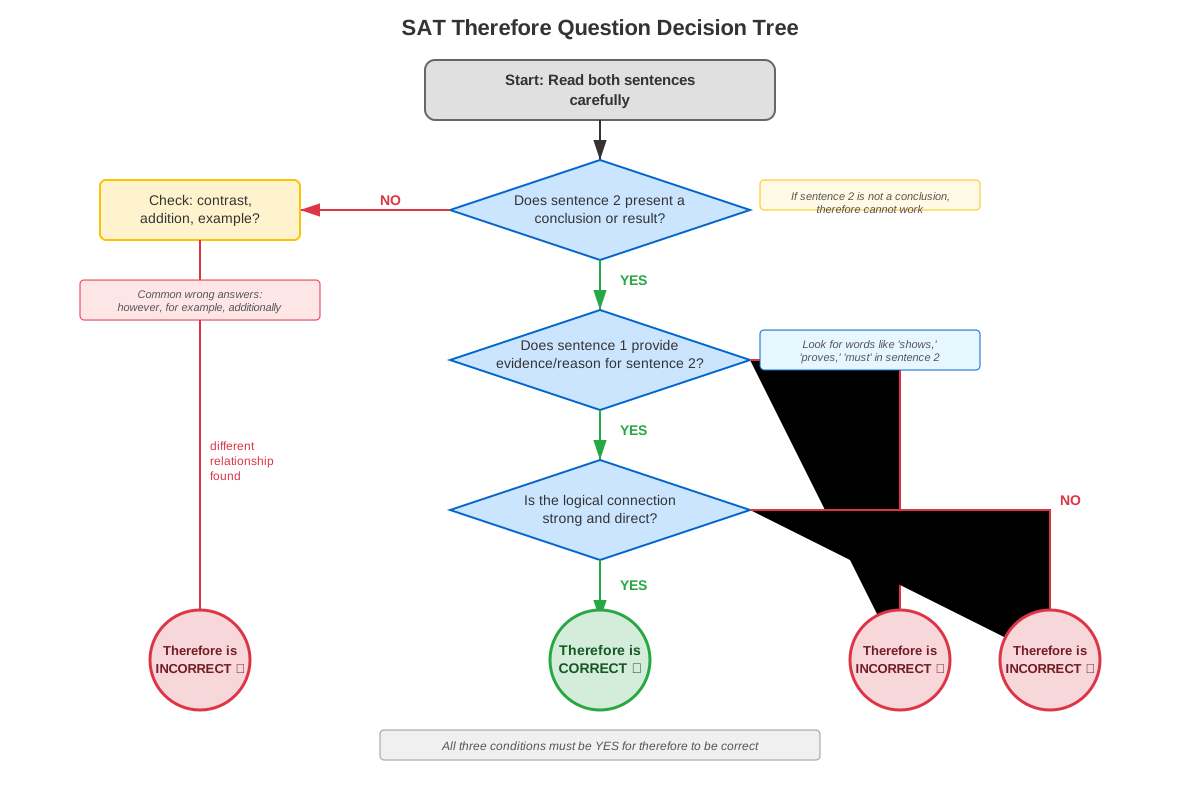
To determine if therefore is appropriate, students should apply the cause-effect test: Can the first statement be reasonably understood as causing, leading to, or providing evidence for the second statement? If yes, therefore works. If the relationship is different (contrast, addition, example, etc.), therefore is incorrect.
Consider these examples:
Correct use: "Carbon dioxide levels have increased by 40% since industrialization. Therefore, human activity has significantly impacted atmospheric composition." (The first statement provides evidence for the conclusion in the second.)
Incorrect use: "Carbon dioxide levels have increased by 40% since industrialization. Therefore, methane is also a greenhouse gas." (The second statement doesn't follow as a conclusion from the first; it's an additional fact, so "moreover" or "additionally" would be appropriate.)
Common SAT Question Formats
SAT therefore questions typically present a two-sentence passage with a blank where a transition should appear. Students must choose which transition best connects the ideas. The passage structure usually follows one of these patterns:
- Evidence → Conclusion: Research findings or data followed by an interpretation or implication
- Cause → Effect: A situation or action followed by its consequence
- Premise → Inference: A statement of fact followed by a logical deduction
The answer choices typically include therefore alongside contrasting transitions (however, nevertheless), additive transitions (moreover, furthermore), and example transitions (for instance, specifically). Students must identify the logical relationship to select therefore correctly.
Concept Relationships
The concepts within this topic build upon each other in a clear progression. Understanding the logical function of therefore forms the foundation—students must first grasp that it signals conclusions and results. This understanding enables students to apply the cause-effect test, which provides a practical method for determining when therefore is appropriate. The cause-effect test, in turn, helps students distinguish therefore from similar transitions, as recognizing the specific type of logical relationship determines which transition word fits best.
These concepts connect to prerequisite knowledge of sentence structure and cause-and-effect relationships. The ability to identify independent clauses (prerequisite) allows students to understand where therefore can be placed grammatically. Knowledge of cause-and-effect relationships (prerequisite) provides the conceptual framework for understanding what therefore signals logically.
The relationship map flows as follows:
Sentence Structure Knowledge → Understanding Therefore's Grammatical Function → Recognizing Logical Relationships → Applying Cause-Effect Test → Distinguishing Therefore from Alternatives → Selecting Correct Answers on SAT Questions
This progression moves from foundational grammar knowledge through logical analysis to practical test-taking application. Each step builds essential skills for the next, culminating in the ability to confidently answer SAT transition questions involving therefore.
High-Yield Facts
⭐ Therefore signals that the second statement is a conclusion or result that follows logically from the first statement.
⭐ On the SAT, therefore is correct when the first sentence provides evidence, cause, or reasoning for the second sentence.
⭐ Therefore requires a comma after it when it begins a sentence or clause.
⭐ The cause-effect test is the most reliable method for determining if therefore is appropriate: Does the first statement cause or provide evidence for the second?
⭐ Therefore is more formal than "so" and is preferred in academic writing contexts typical of SAT passages.
- Therefore can appear at the beginning, middle, or end of a clause, but most commonly appears at the beginning on the SAT.
- When therefore connects two independent clauses, it must be preceded by a semicolon or period, not just a comma (comma splice error).
- Therefore is interchangeable with "thus" in most contexts, but "thus" is slightly more formal.
- If the second sentence contrasts with or contradicts the first, therefore is incorrect regardless of other factors.
- Therefore should not be used to introduce examples; "for instance" or "for example" serve that function.
- In scientific passages, therefore often introduces conclusions drawn from experimental data or observations.
- Therefore cannot correctly connect two sentences that simply add information without a logical conclusion relationship.
- The presence of words like "because," "since," or "due to" in the first sentence often signals that therefore might be appropriate for the second sentence.
Quick check — test yourself on Therefore so far.
Try Flashcards →Common Misconceptions
Misconception: Therefore can be used whenever two sentences are related in any way.
Correction: Therefore specifically signals a conclusion or result relationship. If the second sentence adds information, provides an example, or contrasts with the first, therefore is incorrect even though the sentences are related.
Misconception: Therefore and "however" are interchangeable depending on what sounds better.
Correction: Therefore and "however" signal opposite relationships. Therefore indicates that the second statement follows logically from the first, while "however" signals a contrast or contradiction. They cannot be substituted for each other.
Misconception: If the second sentence happens after the first sentence chronologically, therefore is appropriate.
Correction: Therefore signals logical consequence, not merely chronological sequence. "Then" or "next" indicate time order, while therefore indicates that the second statement is a result or conclusion drawn from the first.
Misconception: Therefore is always the most formal choice, so it's the safest answer on the SAT.
Correction: While therefore is formal, the SAT tests logical relationships, not formality level. A more informal transition like "for example" might be correct if the relationship is illustrative rather than conclusive.
Misconception: You can use therefore to introduce any kind of supporting detail or elaboration.
Correction: Therefore specifically introduces conclusions or results, not supporting details. If the second sentence provides additional evidence or explanation for the same point, transitions like "furthermore," "additionally," or "in fact" are more appropriate.
Misconception: Therefore always appears at the beginning of a sentence on the SAT.
Correction: While therefore most commonly appears at the beginning of the second sentence in SAT questions, it can also appear mid-sentence ("The results, therefore, support the hypothesis") or after a semicolon connecting two independent clauses.
Worked Examples
Example 1: Scientific Passage
Passage: "Researchers observed that coral reefs exposed to warmer water temperatures experienced a 60% increase in bleaching events over a five-year period. _____ rising ocean temperatures pose a significant threat to coral reef ecosystems."
Answer Choices:
A) For example,
B) However,
C) Therefore,
D) In addition,
Step 1: Identify the relationship between sentences
The first sentence presents evidence (observation about coral bleaching and temperature). The second sentence makes a claim about what this evidence means (rising temperatures threaten reefs).
Step 2: Apply the cause-effect test
Does the first sentence provide evidence or reasoning for the second? Yes—the observation about increased bleaching in warmer water supports the conclusion that rising temperatures threaten reefs.
Step 3: Evaluate each choice
- "For example" would introduce a specific instance, but the second sentence is a conclusion, not an example.
- "However" signals contrast, but the second sentence agrees with and follows from the first.
- "Therefore" signals a conclusion drawn from evidence—this matches the relationship.
- "In addition" would add more information at the same level, but the second sentence draws a conclusion rather than adding another observation.
Answer: C) Therefore
Connection to Learning Objectives: This example demonstrates how to identify the key feature of therefore (signaling conclusions from evidence), recognize how it appears on the SAT (in scientific passages connecting data to implications), and apply the cause-effect test to select the correct answer.
Example 2: Social Studies Passage
Passage: "The introduction of the printing press in the 15th century dramatically reduced the cost of producing books and increased literacy rates across Europe. _____ the printing press is considered one of the most important inventions in human history."
Answer Choices:
A) Nevertheless,
B) For instance,
C) Therefore,
D) Similarly,
Step 1: Identify the relationship between sentences
The first sentence describes the effects of the printing press (reduced costs, increased literacy). The second sentence makes an evaluative claim (it's one of the most important inventions).
Step 2: Apply the cause-effect test
Does the first sentence provide reasoning for the second? Yes—the significant positive effects described in the first sentence justify the claim in the second sentence that the printing press was extremely important.
Step 3: Evaluate each choice
- "Nevertheless" signals contrast despite expectations, but there's no contradiction between the sentences.
- "For instance" would introduce an example, but the second sentence is a conclusion about importance, not an example of the printing press's effects.
- "Therefore" signals a conclusion based on the evidence provided—the effects described lead to the judgment of importance.
- "Similarly" would compare to something else, but no comparison is being made.
Answer: C) Therefore
Step 4: Verify the logic
Reading with "therefore" inserted: The printing press had these significant effects; therefore, it's considered very important. This logical flow confirms the answer.
Connection to Learning Objectives: This example shows how therefore appears in humanities passages, connecting historical facts to interpretive conclusions, and demonstrates the process of eliminating incorrect transitions by understanding the specific relationship each signals.
Exam Strategy
When approaching SAT questions involving therefore, follow this systematic process:
Step 1: Read both sentences carefully before looking at the answer choices. Understanding the content of each sentence is essential before analyzing their relationship.
Step 2: Identify the logical relationship between the sentences. Ask: Is the second sentence a conclusion, result, or inference drawn from the first? Or does it contrast, add information, provide an example, or establish a different relationship?
Step 3: Apply the cause-effect test: Can you reasonably say "because of the first sentence, the second sentence follows"? If yes, therefore is likely correct.
Step 4: Watch for trigger words in the first sentence that often precede therefore:
- Evidence words: "research shows," "studies indicate," "data reveals"
- Cause words: "because," "since," "due to"
- Observation words: "scientists observed," "analysis found"
Step 5: Eliminate obviously wrong answers first. If the sentences don't contrast, eliminate "however" and "nevertheless." If the second sentence isn't an example, eliminate "for instance." This process of elimination often leaves therefore and one other plausible choice.
Step 6: Verify your choice by reading the complete passage with your selected transition. It should sound natural and the logic should flow clearly.
Exam Tip: If you're torn between therefore and another conclusion transition like "thus" or "consequently," choose therefore—it's the most commonly tested and versatile conclusion transition on the SAT.
Time allocation: Spend approximately 30-45 seconds on transition questions. They're designed to be answered relatively quickly once you understand the logical relationships. If you're spending more than a minute, make your best choice and move on—you can return if time permits.
Common trap: The SAT often includes answer choices where the transition word might work in a different context but doesn't fit the specific relationship between these two sentences. Always base your answer on the actual logical relationship present, not on whether the transition word could theoretically work somewhere.
Memory Techniques
Mnemonic for Therefore's Function: "THERE-FORE means THERE's a reason FOR what comes next"—this reminds students that therefore signals a conclusion based on prior reasoning.
The Arrow Visualization: Picture an arrow pointing from evidence to conclusion. When you see facts, data, or reasoning in the first sentence, visualize an arrow labeled "therefore" pointing to the conclusion in the second sentence. This visual reinforces the directional, logical flow that therefore establishes.
The "Because-Therefore" Flip: If you can insert "because" into the first sentence and it logically connects to the second, then "therefore" likely works in reverse. For example: "Because the experiment showed X, therefore we conclude Y." This technique helps students verify the logical relationship.
The Formality Ladder: Remember that transitions exist on a formality spectrum:
- Casual: so
- Standard: therefore, thus, consequently
- Very formal: hence
For the SAT, "therefore" sits in the sweet spot of formal academic writing—formal enough for scholarly passages but not overly technical.
The Three C's of Therefore: Conclusion, Consequence, Conclusion—therefore introduces one of these three things. If the second sentence isn't a conclusion drawn from evidence, a consequence of an action, or a conclusion based on reasoning, therefore is wrong.
Summary
Therefore is a high-yield transition word on the SAT Reading and Writing section that signals a conclusion or result following logically from previously stated information. Understanding therefore requires recognizing cause-and-effect relationships and distinguishing logical conclusions from other types of connections like contrast, addition, or exemplification. On the SAT, therefore appears in approximately 10-15% of transition questions across all passage types—science, social studies, humanities, and literature. The key to mastering therefore is applying the cause-effect test: determining whether the first sentence provides evidence, reasoning, or cause for the second sentence. When it does, therefore is likely correct. When the relationship is different—such as contrast (however), addition (moreover), or example (for instance)—therefore is incorrect. Students should approach these questions systematically by reading both sentences carefully, identifying the logical relationship, applying the cause-effect test, and eliminating obviously incorrect transitions before selecting their answer. Mastering therefore not only improves SAT scores but also develops critical thinking skills essential for college-level academic work, where recognizing and constructing logical arguments is fundamental to success.
Key Takeaways
- Therefore signals a conclusion or result that follows logically from the previous statement—it's not used for contrast, addition, or examples.
- Apply the cause-effect test: If the first sentence provides evidence or reasoning for the second, therefore is likely correct.
- Therefore appears frequently on the SAT in transition questions across all passage types, making it high-yield content for score improvement.
- Distinguish therefore from similar transitions: "however" signals contrast, "moreover" adds information, "for instance" provides examples—only therefore introduces logical conclusions.
- Watch for trigger words like "research shows," "data indicates," or "because" in the first sentence, which often signal that therefore might connect to the conclusion in the second sentence.
- Read both sentences completely before selecting a transition—understanding the content and relationship is essential for choosing correctly.
- Verify your answer by reading the passage with your selected transition to ensure the logic flows naturally and clearly.
Related Topics
Other Conclusion Transitions (Thus, Consequently, Hence): Understanding the subtle differences between therefore and similar conclusion transitions helps students make precise choices when multiple conclusion transitions appear as answer options. These transitions share the function of signaling results but differ in formality and emphasis.
Contrast Transitions (However, Nevertheless, Nonetheless): Mastering therefore requires distinguishing it from contrast transitions, which signal opposite relationships. Understanding when ideas oppose rather than follow from each other is essential for transition questions.
Addition Transitions (Moreover, Furthermore, Additionally): These transitions add information at the same level rather than drawing conclusions. Distinguishing additive relationships from conclusive relationships prevents common errors on transition questions.
Example Transitions (For Instance, For Example, Specifically): Recognizing when a sentence provides a specific instance rather than a logical conclusion helps students avoid selecting therefore when an example transition is correct.
Logical Reasoning in Reading Comprehension: The skills developed through mastering therefore—identifying cause-effect relationships, recognizing conclusions drawn from evidence, and understanding logical flow—directly support success on inference questions and main idea questions throughout the Reading and Writing section.
Practice CTA
Now that you've mastered the core concepts of therefore and understand how it appears on the SAT, it's time to put your knowledge into practice! Complete the practice questions to reinforce your understanding and build confidence with SAT-style transition questions. Use the flashcards to memorize key distinctions between therefore and other transitions, ensuring you can quickly identify the correct answer under test conditions. Remember, transition questions are high-yield opportunities for score improvement—mastering therefore and related transitions can directly boost your Reading and Writing score. Approach each practice question systematically, apply the cause-effect test, and verify your answers by checking the logical flow. With focused practice, you'll develop the instinct to recognize when therefore is correct, setting yourself up for success on test day!
Sign up free to keep reading
Create a free AnvayaPrep account to finish this SAT guide on Therefore — plus flashcards and practice questions.