Overview
The transition word thus is a critical logical connector that appears frequently in SAT Reading and Writing (RW) questions, particularly within the Transitions subsection. Understanding how to properly use and identify thus is essential for achieving a high score on the SAT, as transition questions consistently appear on every test administration. This seemingly simple word carries significant logical weight, signaling a cause-and-effect relationship or a conclusion drawn from preceding information.
On the SAT thus questions test a student's ability to recognize logical flow between sentences and paragraphs. The exam presents passages with blank spaces where transition words should appear, and students must select the transition that best maintains coherence and accurately reflects the relationship between ideas. Mastering thus—along with other transition words—demonstrates sophisticated reading comprehension and an understanding of how arguments are constructed in academic and professional writing.
Within the broader context of SAT Reading and Writing, transition questions represent a high-yield category that rewards pattern recognition and logical thinking. The word thus specifically indicates that what follows is a logical consequence, result, or conclusion of what came before. This places it in the category of "result/consequence" transitions, distinguishing it from transitions that show contrast, addition, emphasis, or other relationships. Success with thus questions requires understanding not just the word's definition, but its precise logical function within complex passages.
Learning Objectives
- [ ] Identify key features of Thus
- [ ] Explain how Thus appears on the SAT
- [ ] Apply Thus to answer SAT-style questions
- [ ] Distinguish thus from other result-indicating transitions (therefore, consequently, hence)
- [ ] Recognize incorrect uses of thus in context
- [ ] Analyze the logical relationship between sentences to determine when thus is appropriate
Prerequisites
- Basic sentence structure: Understanding subjects, predicates, and independent clauses is necessary to recognize how thus connects complete thoughts.
- Cause-and-effect relationships: Students must identify when one statement logically results from another, as this is the fundamental relationship thus signals.
- Transition word categories: Familiarity with the concept that different transitions serve different logical purposes (contrast, addition, result) helps position thus within its proper category.
- SAT question format: General knowledge of how SAT multiple-choice questions are structured allows students to focus on content rather than format.
Why This Topic Matters
In academic writing, professional communication, and standardized testing, the ability to recognize and use logical connectors separates competent writers from exceptional ones. The word thus appears across disciplines—from scientific papers explaining experimental results to historical analyses drawing conclusions from evidence. Mastering thus demonstrates sophisticated thinking about how ideas relate to one another.
On the SAT, transition questions appear in approximately 3-5 questions per test, making them a consistent and predictable question type. Among transition words, thus ranks as one of the most frequently tested because it requires students to understand causation and logical consequence—skills that underlie critical reading comprehension. Questions featuring thus typically appear at medium difficulty, making them accessible to students aiming for scores in the 600-700+ range.
Thus questions commonly appear in several contexts on the exam: scientific passages explaining research findings, historical passages drawing conclusions from events, argumentative passages presenting logical claims, and informational passages connecting facts to implications. The passages may discuss topics ranging from biology and environmental science to social studies and literature. Regardless of subject matter, the logical function of thus remains constant—it always signals that what follows is a consequence or conclusion of what preceded it.
Core Concepts
The Logical Function of Thus
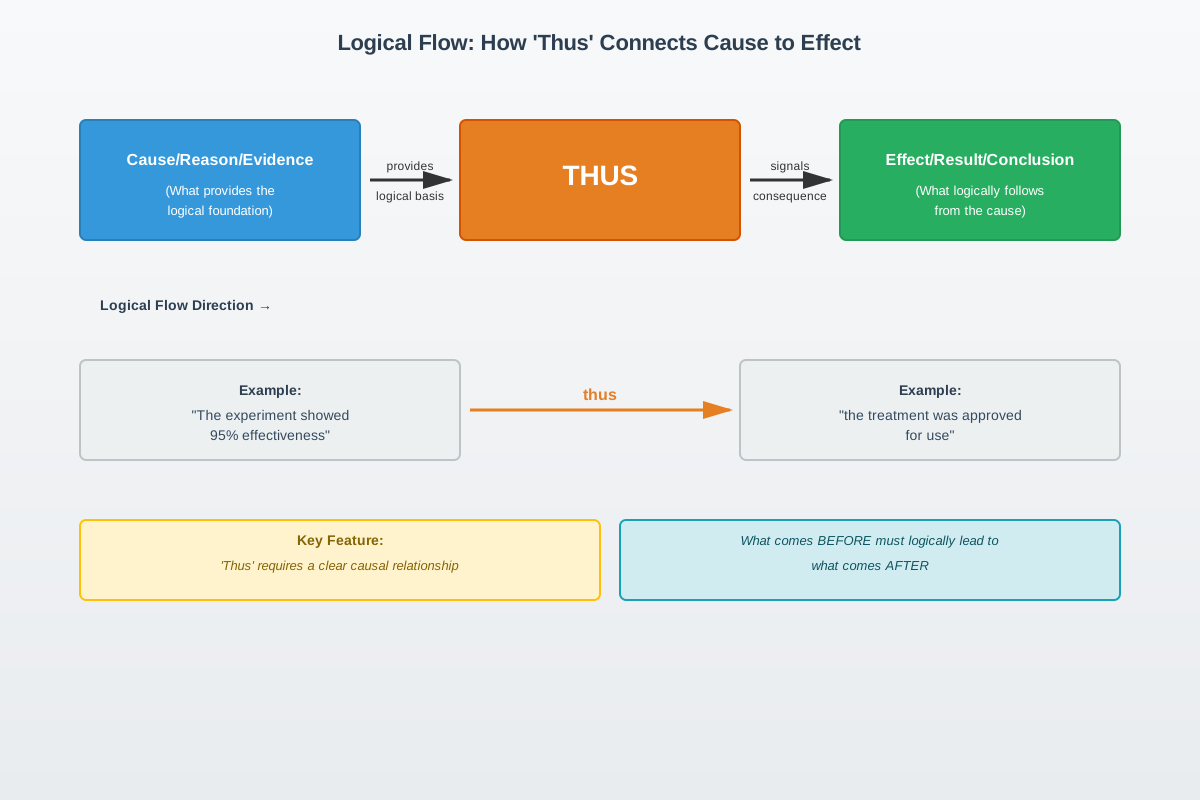
Thus is a conjunctive adverb that signals a cause-and-effect relationship or indicates that a conclusion follows from previous information. When a sentence or clause begins with thus, readers should understand that the information presented is a direct result, consequence, or logical conclusion of what came before. This word creates a forward-moving logical chain: Premise → Thus → Conclusion.
The word functions as a formal transition, meaning it appears more frequently in academic and professional writing than in casual conversation. On the SAT, passages maintain an academic tone, making thus an appropriate and common choice. Understanding this formality helps students recognize when thus fits the passage's register and when a more casual transition might be inappropriate.
Grammatical Positioning and Punctuation
Thus can appear in several positions within a sentence, each requiring specific punctuation:
- Beginning of a sentence: "The experiment failed to produce results. Thus, the hypothesis was rejected."
- After a semicolon: "The experiment failed to produce results; thus, the hypothesis was rejected."
- Mid-sentence (less common on SAT): "The experiment failed to produce results and thus led to hypothesis rejection."
When thus begins a sentence or follows a semicolon, it is typically followed by a comma. This punctuation pattern appears consistently on the SAT and helps students identify thus in answer choices. The comma after thus provides a brief pause before the consequent statement.
Thus vs. Other Result Transitions
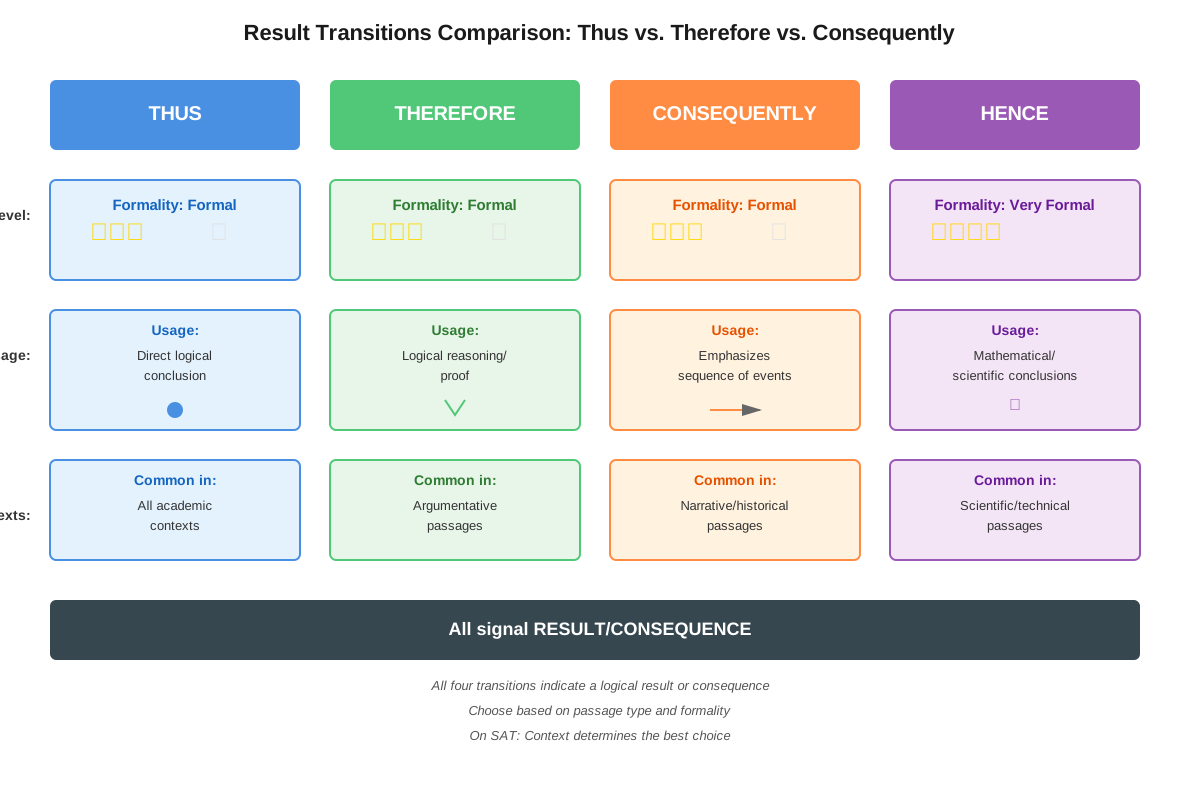
Understanding the subtle differences between result-indicating transitions helps students make precise choices on the SAT:
| Transition | Formality | Emphasis | Common SAT Usage |
|---|---|---|---|
| Thus | Formal | Logical conclusion | High frequency |
| Therefore | Formal | Strong logical necessity | High frequency |
| Consequently | Formal | Direct consequence | Medium frequency |
| Hence | Very formal | Logical deduction | Low frequency |
| So | Informal | Casual result | Rare (too informal) |
| As a result | Moderate | Clear causation | Medium frequency |
While these words share similar meanings, thus specifically emphasizes the logical inevitability of the conclusion. It suggests that given the preceding information, the following statement must be true or must occur. This makes thus particularly appropriate in scientific, mathematical, and analytical contexts where logical reasoning is paramount.
Identifying the Cause-Effect Relationship
To correctly use or identify thus, students must analyze the logical relationship between sentences. The pattern follows this structure:
Cause/Evidence/Premise → Thus → Effect/Conclusion/Result
For example:
- Cause: "Carbon dioxide levels in the atmosphere have increased by 40% since pre-industrial times."
- Thus: [transition word]
- Effect: "Global temperatures have risen correspondingly."
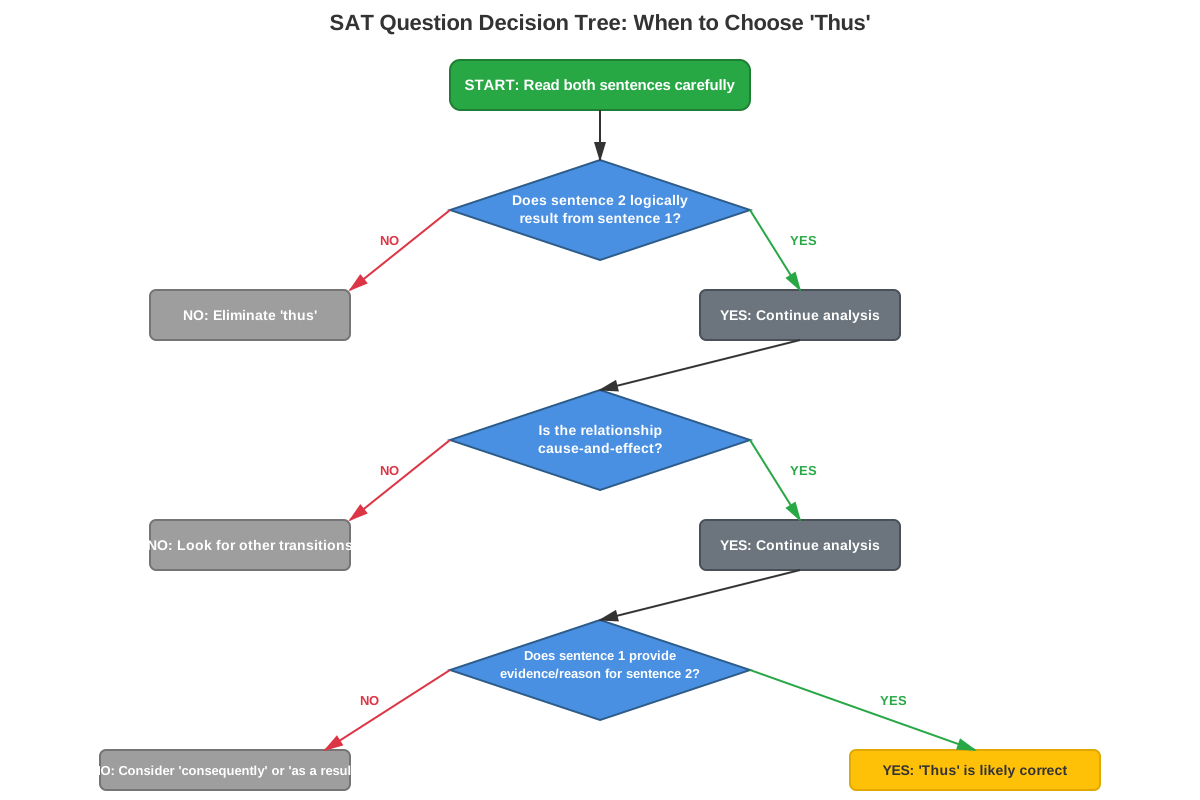
The second sentence is a direct consequence of the first, making thus an appropriate connector. Students should ask: "Does the second statement logically follow from the first?" If yes, thus may be correct. If the second statement contrasts, adds unrelated information, or provides an example, thus would be incorrect.
Common Incorrect Contexts for Thus
Understanding when NOT to use thus is equally important:
- Contrast relationships: When the second sentence contradicts or contrasts with the first, transitions like "however" or "nevertheless" are appropriate, not thus.
- Additional information: When the second sentence adds related but not consequential information, "moreover" or "additionally" work better.
- Examples: When the second sentence illustrates the first, "for example" or "for instance" are correct.
- Temporal sequence: When the second sentence describes what happened next in time (but not as a logical result), "then" or "subsequently" are better choices.
The SAT Question Format
SAT transition questions present a passage with a blank space (often marked with a number in a box) where a transition should appear. Four answer choices provide different transitions, and students must select the one that best maintains logical flow. The question stem typically reads: "Which choice completes the text with the most logical transition?"
The passage provides context both before and after the blank, requiring students to read and understand both sections. Thus is correct when the sentence after the blank presents a logical consequence of the sentence before the blank. The incorrect answer choices often include transitions that signal different relationships (contrast, addition, emphasis), testing whether students truly understand the logical connection between ideas.
Concept Relationships
The concept of thus exists within a hierarchy of transition word understanding. At the broadest level, students must understand that transitions signal relationships between ideas. Within this category, transitions divide into subcategories: contrast, addition, result/consequence, emphasis, and example. Thus belongs specifically to the result/consequence category.
Within the result/consequence category, thus relates closely to therefore, consequently, and hence. These words form a family of similar transitions, with subtle differences in formality and emphasis. Understanding thus requires distinguishing it from these near-synonyms, particularly therefore, which appears equally frequently on the SAT.
The relationship map looks like this:
Logical Relationships → Transition Words → Result/Consequence Transitions → Thus (formal, logical conclusion)
Additionally, thus connects to the broader concept of cause-and-effect reasoning, a fundamental skill tested throughout the SAT Reading and Writing section. Questions about main ideas, supporting details, and argument structure all require understanding how causes lead to effects. Thus explicitly marks these relationships, making it a linguistic signal of logical reasoning.
Understanding thus also prepares students for more complex transition questions where multiple transitions might seem plausible. By recognizing the precise logical function of thus, students can eliminate answer choices that signal different relationships, even if those relationships might loosely fit the context.
Quick check — test yourself on Thus so far.
Try Flashcards →High-Yield Facts
⭐ Thus signals that what follows is a logical consequence or conclusion of what came before.
⭐ Thus appears in 3-5 transition questions per SAT test, making it a high-frequency word to master.
⭐ When thus begins a sentence or follows a semicolon, it is followed by a comma.
⭐ Thus is a formal transition appropriate for academic writing, making it suitable for SAT passages.
⭐ The correct use of thus requires a genuine cause-and-effect or premise-conclusion relationship between sentences.
- Thus is a conjunctive adverb, not a coordinating conjunction, so it cannot join independent clauses with only a comma (this would create a comma splice).
- Thus and therefore are nearly interchangeable in most contexts, though thus emphasizes logical inevitability slightly more.
- On the SAT, incorrect answer choices for thus questions often include contrast transitions (however, nevertheless) or addition transitions (moreover, furthermore).
- Thus can appear in passages about any subject—science, history, literature, or social studies—because it signals logical relationships that exist across disciplines.
- Reading the sentence before and after the blank is essential; the sentence before provides the cause/premise, and the sentence after provides the effect/conclusion.
- Thus questions test logical reasoning as much as vocabulary knowledge; students must analyze relationships, not just recognize word definitions.
Common Misconceptions
Misconception: Thus and "so" are interchangeable and equally appropriate on the SAT.
Correction: While both indicate result, "so" is informal and rarely appears as a correct answer on the SAT. Thus maintains the academic tone required for standardized test passages.
Misconception: Thus can be used whenever two sentences are related to the same topic.
Correction: Thus specifically requires a cause-and-effect or premise-conclusion relationship. Two sentences about the same topic might be related through addition, contrast, or example rather than consequence.
Misconception: If the second sentence happens after the first in time, thus is appropriate.
Correction: Thus indicates logical consequence, not merely temporal sequence. "The bell rang. Thus, students left the classroom" is incorrect if students left because of the bell's meaning (dismissal), not because of the sound itself. "Subsequently" or "then" would be better for pure time sequence.
Misconception: Thus always appears at the beginning of a sentence.
Correction: While thus commonly begins sentences on the SAT, it can also follow a semicolon or appear mid-sentence. Students should recognize thus in various positions.
Misconception: Any result-indicating transition (thus, therefore, consequently) will work equally well in a given context.
Correction: While these words are similar, the SAT tests precise word choice. The surrounding context, formality level, and specific type of logical relationship determine which transition is best. Students should consider subtle differences in emphasis and usage.
Misconception: The sentence with thus must explicitly restate the cause mentioned before it.
Correction: The sentence after thus presents the effect or conclusion, which may be new information that logically follows from the cause. It doesn't repeat the cause but rather shows what results from it.
Worked Examples
Example 1: Scientific Passage
Passage: "Researchers discovered that the coral reef's water temperature had increased by 3 degrees Celsius over the past decade. _____ the coral experienced widespread bleaching, losing the symbiotic algae essential for survival."
Answer Choices:
A) For example,
B) However,
C) Thus,
D) Moreover,
Step 1: Identify the relationship between sentences
The first sentence presents a cause: water temperature increased. The second sentence presents an effect: coral bleaching occurred. This is a clear cause-and-effect relationship.
Step 2: Eliminate incorrect relationships
- "For example" (A) would indicate the second sentence illustrates the first, but bleaching isn't an example of temperature increase—it's a result.
- "However" (B) signals contrast, but the sentences don't contradict each other.
- "Moreover" (D) adds information but doesn't show causation.
Step 3: Confirm the correct answer
"Thus" (C) correctly signals that coral bleaching is a logical consequence of increased water temperature. The relationship is: Temperature increase → Thus → Bleaching.
Answer: C) Thus,
Connection to Learning Objectives: This example demonstrates identifying key features of thus (cause-and-effect signaling) and applying thus to answer SAT-style questions.
Example 2: Historical Passage
Passage: "The invention of the printing press in 1440 dramatically reduced the cost of producing books. _____ literacy rates across Europe began to rise as books became accessible to the middle class."
Answer Choices:
A) Nevertheless,
B) In other words,
C) Thus,
D) For instance,
Step 1: Analyze the logical connection
Sentence 1: Printing press reduced book costs (cause)
Sentence 2: Literacy rates increased (effect)
The second sentence describes a consequence of the first—cheaper books led to more reading and higher literacy.
Step 2: Evaluate each choice
- "Nevertheless" (A) indicates contrast despite expectations, but there's no contradiction here.
- "In other words" (B) suggests rephrasing the same idea, but rising literacy is a new consequence, not a restatement.
- "Thus" (C) signals that rising literacy is a logical result of cheaper books.
- "For instance" (D) introduces an example, but rising literacy isn't an example of reduced costs—it's an outcome.
Step 3: Select the transition that shows result
"Thus" correctly indicates that the second sentence presents a consequence of the first. The logical chain is: Cheaper books → Thus → Increased literacy.
Answer: C) Thus,
Connection to Learning Objectives: This example shows how thus appears in historical contexts on the SAT and reinforces the ability to distinguish thus from other transition types.
Exam Strategy
When approaching SAT questions involving thus, follow this systematic process:
1. Read both surrounding sentences completely: Never select a transition based solely on the sentence that follows it. The sentence before the blank provides the cause or premise; the sentence after provides the effect or conclusion.
2. Identify the relationship type: Ask yourself: "What is the relationship between these sentences?" Is it cause-and-effect, contrast, addition, example, or emphasis? Only proceed with thus if you identify a genuine cause-and-effect or premise-conclusion relationship.
3. Look for trigger words and phrases:
- Before the blank: words like "discovered," "found," "showed," "increased," "decreased," "changed" often introduce causes
- After the blank: words like "resulted," "led to," "caused," "experienced," "began to" often signal effects
4. Use process of elimination strategically:
- Immediately eliminate contrast transitions (however, nevertheless, yet) if sentences don't contradict
- Eliminate addition transitions (moreover, furthermore, additionally) if the second sentence isn't adding parallel information
- Eliminate example transitions (for instance, for example) if the second sentence isn't illustrating the first
5. Verify the logical chain: Before selecting thus, mentally insert "as a result" or "because of this" in place of the blank. If the sentence makes logical sense with these phrases, thus is likely correct.
Exam Tip: If you're torn between thus and therefore, either is likely correct—they're nearly interchangeable. Focus instead on eliminating the clearly wrong answers first.
Time allocation: Transition questions should take 30-45 seconds each. They're designed to be quicker than comprehension questions. If you're spending more than a minute, you may be overthinking. Trust your instinct about the logical relationship.
Common trap: The SAT sometimes includes answer choices that relate to the passage's overall topic but don't fit the specific logical relationship between the two sentences. Stay focused on the immediate connection, not the broader theme.
Memory Techniques
Mnemonic for Thus: Therefore Happens Under Specific causes
This reminds students that thus indicates something happens (an effect) because of specific causes mentioned before.
Visualization Strategy: Picture thus as an arrow pointing forward: Cause → THUS → Effect. When you see or consider using thus, visualize this arrow to confirm the logical flow moves from cause to consequence.
The "Because Test": Mentally insert "because of this" before the sentence following thus. If the sentence makes sense with "because of this" at the beginning, thus is appropriate. Example: "Temperature increased. [Because of this] coral bleached." This works, so thus is correct.
Formality Spectrum: Remember the formality order: "so" (casual) < "as a result" (moderate) < "thus/therefore" (formal) < "hence" (very formal). For SAT passages, aim for the formal middle range where thus lives.
The RACE acronym for transition questions:
- Read both sentences
- Analyze the relationship
- Check for cause-and-effect
- Eliminate wrong relationships
Summary
Thus is a formal conjunctive adverb that signals a cause-and-effect relationship or logical conclusion, making it a high-yield transition word for SAT Reading and Writing questions. It appears in 3-5 questions per test across various passage types and subjects. To correctly identify or use thus, students must recognize genuine logical consequences—where the sentence following thus presents a result, effect, or conclusion that flows inevitably from the preceding sentence. Thus differs from contrast transitions (however), addition transitions (moreover), and example transitions (for instance), requiring students to analyze the specific relationship between ideas rather than simply recognizing related topics. Success with thus questions depends on reading both surrounding sentences, identifying the cause-and-effect structure, and using process of elimination to remove transitions that signal different relationships. Mastering thus demonstrates sophisticated logical reasoning and prepares students for the broader category of transition questions that consistently appear on every SAT administration.
Key Takeaways
- Thus signals that what follows is a logical consequence or conclusion of what came before, requiring a genuine cause-and-effect relationship between sentences
- Thus appears frequently on the SAT (3-5 questions per test) and is considered a high-yield, medium-difficulty topic worth mastering
- When thus begins a sentence or follows a semicolon, it is followed by a comma, following standard punctuation rules for conjunctive adverbs
- To answer thus questions correctly, read both the sentence before and after the blank to identify the logical relationship
- Eliminate answer choices that signal different relationships (contrast, addition, example) before confirming thus is appropriate
- Thus is interchangeable with therefore in most contexts but maintains a slightly more formal tone than "as a result" and is far more formal than "so"
- Success with thus questions demonstrates broader logical reasoning skills that apply throughout the SAT Reading and Writing section
Related Topics
Other Result/Consequence Transitions: After mastering thus, students should study therefore, consequently, hence, and "as a result" to understand subtle differences in emphasis and formality. These transitions appear with similar frequency on the SAT and require the same cause-and-effect analysis.
Contrast Transitions: Understanding however, nevertheless, yet, and other contrast transitions helps students distinguish between opposing relationships and consequential relationships, a key skill for eliminating wrong answers on transition questions.
Addition Transitions: Studying moreover, furthermore, and additionally helps students recognize when sentences add parallel information rather than showing causation, preventing confusion between these relationship types.
Logical Reasoning in Reading Comprehension: The cause-and-effect analysis required for thus questions applies to main idea questions, supporting detail questions, and argument structure questions throughout the Reading and Writing section.
Sentence Structure and Punctuation: Understanding independent clauses, conjunctive adverbs, and proper punctuation with semicolons and commas deepens comprehension of how thus functions grammatically within sentences.
Practice CTA
Now that you've mastered the logical function and strategic application of thus, it's time to reinforce your learning through active practice. Attempt the practice questions designed specifically for this topic, focusing on identifying cause-and-effect relationships and eliminating incorrect transition types. Use the flashcards to drill the key distinctions between thus and other transitions until recognition becomes automatic. Remember: transition questions are among the most predictable and high-yield question types on the SAT—consistent practice with thus will translate directly into points on test day. You've built the foundation; now strengthen it through application!
Sign up free to keep reading
Create a free AnvayaPrep account to finish this SAT guide on Thus — plus flashcards and practice questions.