Overview
Context clues are linguistic hints embedded within a sentence or passage that help readers determine the meaning of unfamiliar words without consulting a dictionary. On the SAT Reading and Writing section, the ability to use sat context clues effectively is not just helpful—it's essential. These questions appear consistently throughout the exam, testing whether students can infer word meanings from surrounding text rather than relying solely on memorized vocabulary.
The SAT's approach to vocabulary has evolved significantly. Rather than testing obscure words in isolation, the exam now emphasizes words that appear frequently in college-level texts and professional settings. This shift means that success depends less on rote memorization and more on the ability to analyze how words function within their textual environment. Context clues questions typically present a passage with a word or phrase highlighted, asking students to select the meaning that best fits the specific usage. These questions assess reading comprehension, analytical reasoning, and vocabulary knowledge simultaneously.
Within the broader RW (Reading and Writing) framework, context clues serve as a foundational skill that supports nearly every other competency. Understanding how to extract meaning from context enhances passage comprehension, improves inference abilities, and strengthens analytical reading skills. This topic connects directly to rhetorical synthesis, author's purpose analysis, and evidence-based reasoning—all critical components of SAT success.
Learning Objectives
- [ ] Identify key features of context clues
- [ ] Explain how context clues appears on the SAT
- [ ] Apply context clues to answer SAT-style questions
- [ ] Distinguish between different types of context clues and recognize when each appears
- [ ] Evaluate multiple possible meanings and select the one that best fits the specific context
- [ ] Analyze how sentence structure and syntax provide meaning indicators
- [ ] Synthesize information from multiple sentences to determine word meaning
Prerequisites
- Basic vocabulary knowledge: Understanding common English words provides the foundation for recognizing when a word is being used in an unusual or specific way
- Sentence structure comprehension: Recognizing subjects, verbs, objects, and modifiers helps identify which words provide contextual information
- Reading comprehension fundamentals: The ability to understand main ideas and supporting details enables effective use of broader context
- Part of speech recognition: Knowing whether a word functions as a noun, verb, adjective, or adverb narrows possible meanings
Why This Topic Matters
Context clues represent one of the most practical reading skills tested on the SAT. In academic and professional settings, readers constantly encounter unfamiliar terminology, specialized jargon, and words used in unexpected ways. The ability to determine meaning from context enables efficient reading without constant interruption for dictionary consultation. This skill directly translates to college coursework, where students must navigate dense textbooks across multiple disciplines.
On the SAT specifically, context clues questions appear with remarkable consistency. Approximately 13-15% of Reading and Writing questions directly test vocabulary in context, making this one of the highest-yield topics for focused study. These questions typically appear in the "Words in Context" category, which comprises a significant portion of the exam's overall score calculation. Each test administration includes multiple questions requiring students to select the best synonym or interpretation of a word based on its usage in a passage.
The exam presents context clues in diverse formats: literary fiction, historical documents, scientific explanations, and argumentative essays. Words tested range from moderately challenging terms with multiple meanings (like "pedestrian" meaning ordinary rather than a person walking) to more sophisticated vocabulary that appears in academic discourse. The SAT deliberately selects words that educated adults should recognize but that have nuanced meanings requiring careful contextual analysis.
Core Concepts
Definition and Function of Context Clues
Context clues are textual signals that reveal the meaning of unfamiliar or ambiguous words through their relationship to surrounding content. These clues operate on multiple levels: within the immediate sentence, across adjacent sentences, and throughout the broader passage. The fundamental principle is that language provides redundancy—authors naturally include information that helps readers understand their intended meaning, even when using challenging vocabulary.
The effectiveness of context clues depends on active reading. Passive readers may skip over unfamiliar words, losing comprehension, while strategic readers pause to analyze the textual environment. This analysis involves examining syntax (word order and sentence structure), semantics (meaning relationships between words), and discourse patterns (how ideas connect across sentences).
Types of Context Clues
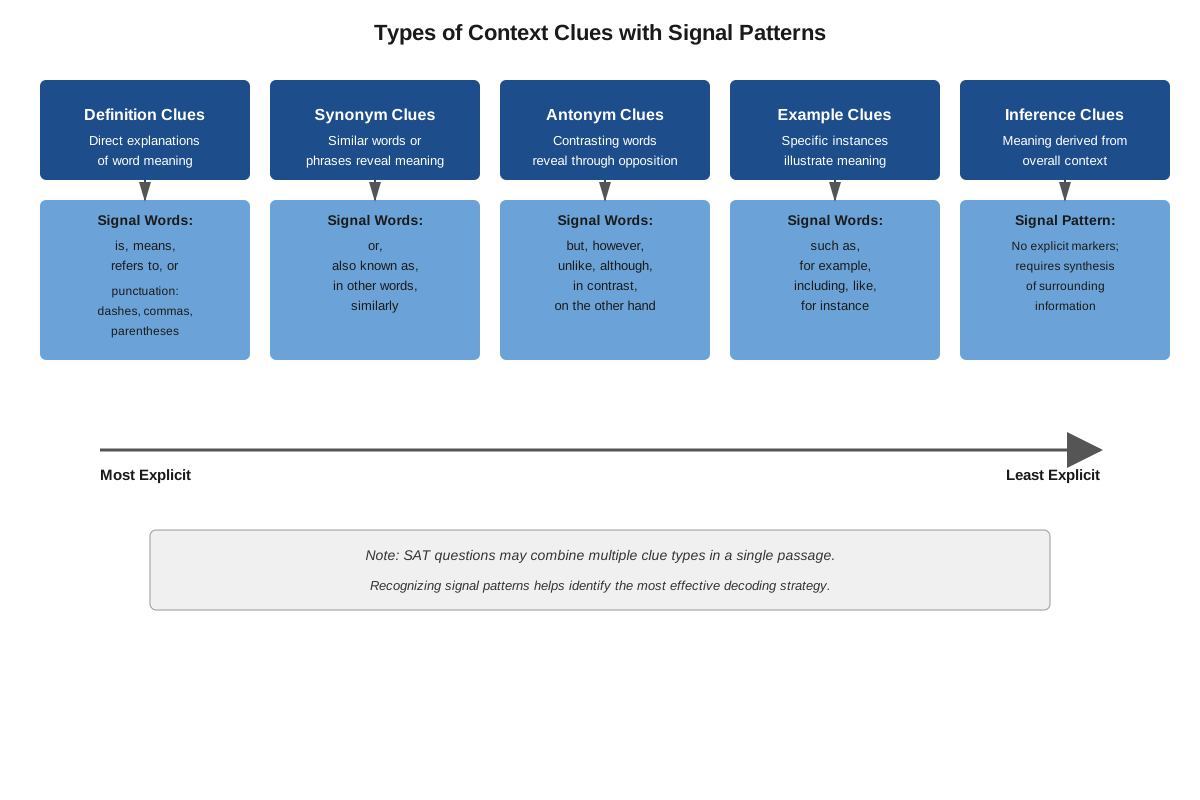
Definition Clues
Definition clues provide explicit explanations of unfamiliar words, often using signal phrases like "is defined as," "means," "refers to," or "is called." These are the most straightforward context clues because the author directly states the meaning.
Example: "The scientist studied bioluminescence, the production and emission of light by living organisms."
The phrase following the comma directly defines bioluminescence, leaving no ambiguity about its meaning.
Synonym Clues
Synonym clues present a familiar word with similar meaning near the unfamiliar term. Authors use synonyms to reinforce ideas or vary their language while maintaining clarity. Signal words include "or," "also known as," "in other words," and "that is."
Example: "The politician's mendacious statements, or lies, damaged her credibility."
The word "lies" serves as a synonym for "mendacious," clarifying its meaning through direct equivalence.
Antonym Clues
Antonym clues reveal meaning through contrast, using words like "but," "however," "unlike," "although," "while," and "in contrast." By understanding what something is NOT, readers can infer what it IS.
Example: "Unlike his gregarious sister who loved parties, Marcus was quite introverted."
The contrast with "gregarious" and the description of loving parties helps define "introverted" as its opposite.
Example Clues
Example clues provide specific instances that illustrate the unfamiliar word's meaning. Signal phrases include "such as," "for example," "including," "like," and "for instance."
Example: "The garden contained many perennials, such as roses, peonies, and lavender, that returned each spring."
The specific flowers listed as examples help readers understand that perennials are plants that grow back annually.
Inference Clues
Inference clues require readers to synthesize information from the broader context without explicit definition. These are the most challenging because they demand active reasoning about how the word functions within the passage's logic.
Example: "After three days without sleep, her exhaustion was so palpable that even strangers noticed her struggle to stay awake."
No direct definition appears, but the context (three days without sleep, visible struggle) helps readers infer that "palpable" means obvious or easily perceived.
Structural Indicators
Punctuation and sentence structure provide powerful context clues. Commas, dashes, parentheses, and colons often signal that clarifying information follows. Appositive phrases (noun phrases that rename or explain another noun) frequently appear after commas or between dashes.
| Punctuation | Function | Example |
|---|---|---|
| Commas | Set off definitions or synonyms | "The ephemeral, short-lived flowers bloomed for only one day." |
| Dashes | Emphasize explanatory information | "Her acrophobia—fear of heights—prevented her from climbing." |
| Parentheses | Provide supplementary clarification | "The document used archaic (outdated) language." |
| Colons | Introduce explanations or lists | "He exhibited one clear trait: tenacity." |
Semantic Relationships
Words within sentences maintain logical relationships that provide meaning clues. Understanding these relationships helps readers make accurate inferences:
- Cause and effect: "Because of the drought, the once verdant landscape turned brown." (Verdant must describe something green/lush)
- Part to whole: "The facade, along with the roof and foundation, needed repair." (Facade must be part of a building)
- Function or purpose: "She used a tourniquet to stop the bleeding." (A tourniquet must be something that stops blood flow)
Multiple Meaning Words
The SAT frequently tests words with multiple meanings, requiring students to select the definition that fits the specific context. Common examples include:
- Pedestrian: walker (noun) vs. ordinary/dull (adjective)
- Novel: book (noun) vs. new/original (adjective)
- Temper: anger (noun) vs. moderate/soften (verb)
- Plastic: synthetic material (noun) vs. moldable/flexible (adjective)
Success with these questions requires careful attention to how the word functions grammatically and semantically within its sentence.
Concept Relationships
Context clues function as an interconnected system rather than isolated techniques. The relationship flows as follows:
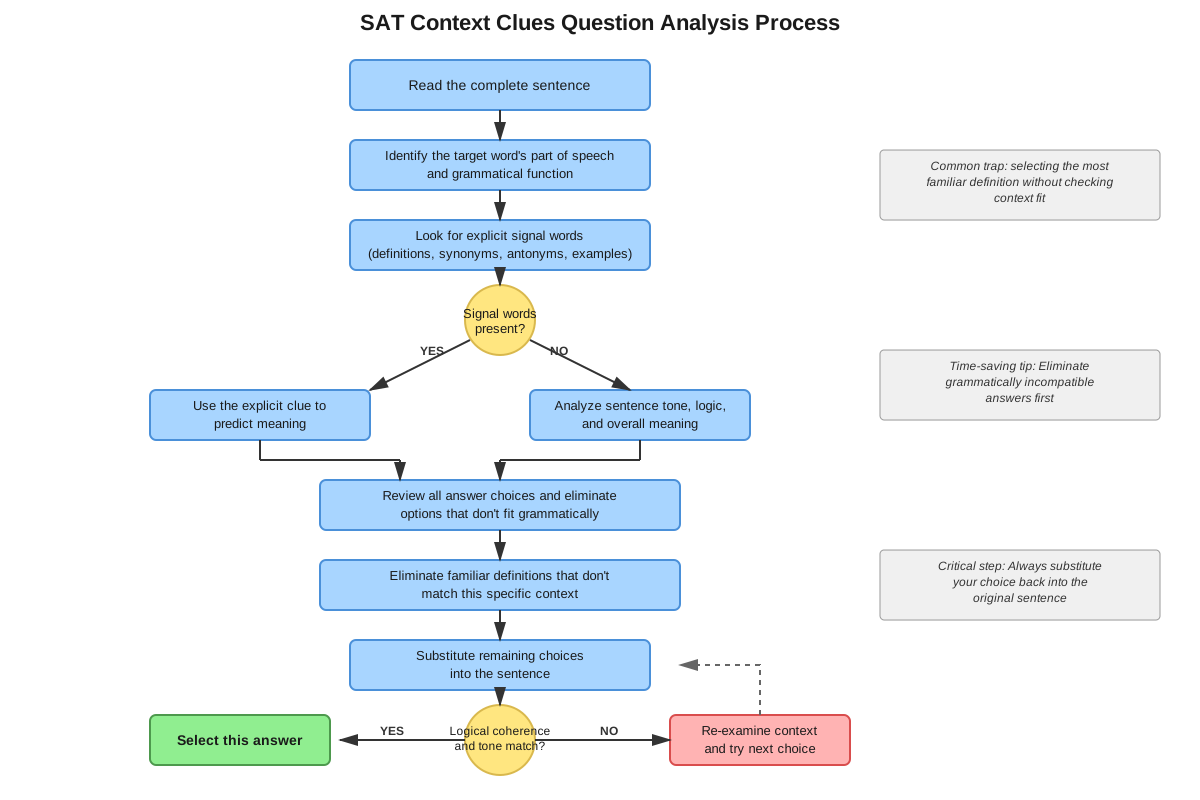
Sentence Structure Analysis → Identification of Signal Words → Recognition of Clue Type → Meaning Inference → Verification Against Context
Each step builds on the previous one. Readers first parse the sentence to understand its basic structure, then identify words or punctuation that signal contextual information. Recognizing whether the clue is a definition, synonym, antonym, example, or inference determines the analytical approach. After inferring meaning, readers must verify their interpretation against the broader passage context to ensure consistency.
This topic connects to prerequisite knowledge of sentence structure because identifying context clues requires understanding how clauses relate and how modifiers function. It also links to broader reading comprehension skills—students who can identify context clues more effectively understand main ideas, author's purpose, and argumentative structure.
Context clues serve as a gateway to more advanced RW skills. Mastering this topic enables better performance on inference questions, rhetorical analysis, and evidence-based reasoning tasks. The analytical thinking required for context clues—examining relationships, evaluating possibilities, and selecting the best interpretation—transfers directly to other question types.
Quick check — test yourself on Context clues so far.
Try Flashcards →High-Yield Facts
⭐ The SAT tests words with multiple meanings more frequently than obscure vocabulary—focus on recognizing which definition fits the specific context.
⭐ Punctuation marks (commas, dashes, parentheses, colons) often signal that a definition or clarification follows—pay special attention to text immediately after these marks.
⭐ The correct answer must fit both the grammatical structure and the logical meaning of the sentence—eliminate options that work grammatically but don't make sense contextually.
⭐ Contrast words (but, however, although, unlike, while) indicate antonym clues—the unfamiliar word means the opposite of what follows the contrast word.
⭐ Example phrases (such as, for example, including, like) introduce specific instances that illustrate the unfamiliar word's meaning—analyze what the examples have in common.
- Words appearing in quotation marks or italics often receive immediate definition or explanation in the surrounding text.
- The SAT rarely tests highly technical or specialized jargon without providing sufficient context for meaning determination.
- Incorrect answer choices often include common meanings of the word that don't fit the specific passage context.
- Reading one sentence before and one sentence after the target word usually provides sufficient context for accurate inference.
- Synonym clues frequently use the word "or" to connect the unfamiliar term with its familiar equivalent.
- The tone and style of the passage provide additional context—formal academic writing uses words differently than narrative fiction.
- Verifying your answer by substituting it into the original sentence helps confirm it maintains logical coherence.
- Context clues questions always provide enough information within the passage to determine the correct answer—outside knowledge of the word is not required.
Common Misconceptions
Misconception: The correct answer is always the most common definition of the word. → Correction: The SAT specifically tests whether students can identify the meaning that fits the specific context, which is often a secondary or less common definition. Always evaluate how the word functions within its particular sentence.
Misconception: If you know the word's meaning, you don't need to read the context carefully. → Correction: Even familiar words may be used in unexpected ways. The question asks for the meaning "as used in line X," requiring verification that your known definition matches the contextual usage.
Misconception: Context clues only appear in the same sentence as the unfamiliar word. → Correction: Effective context clues often span multiple sentences. The sentence before or after the target word frequently contains crucial information for meaning determination.
Misconception: Longer, more complex answer choices are more likely to be correct. → Correction: The SAT does not favor complex language in correct answers. The best answer is the one that most accurately fits the context, regardless of sophistication level.
Misconception: You should skip context clues questions if you don't know the word and return to them later. → Correction: Context clues questions are specifically designed to be answerable without prior knowledge of the word. The passage provides all necessary information—skipping wastes the opportunity to use the provided context.
Misconception: All context clues are equally obvious and easy to identify. → Correction: Context clues range from explicit definitions to subtle inference requirements. Developing skill with inference clues requires practice and careful attention to logical relationships within passages.
Worked Examples
Example 1: Multiple Meaning Word
Passage: "The committee's decision to renovate the historic building was not without controversy. Some members argued that the structure's antiquated electrical system posed safety risks, while others insisted that modern updates would compromise the building's architectural integrity."
Question: As used in the passage, "compromise" most nearly means:
A) Reach an agreement
B) Endanger
C) Negotiate
D) Include
Solution Process:
Step 1: Identify the sentence structure. "Modern updates would compromise the building's architectural integrity" suggests that updates would do something negative to the integrity.
Step 2: Analyze the context. The passage discusses controversy about renovation. One side worries about safety, the other about preserving architectural integrity. The word "compromise" appears in the context of concerns about preservation.
Step 3: Evaluate each option by substitution:
- A) "Modern updates would reach an agreement with the building's architectural integrity"—doesn't make logical sense
- B) "Modern updates would endanger the building's architectural integrity"—fits logically; updates could threaten or harm the integrity
- C) "Modern updates would negotiate the building's architectural integrity"—doesn't make logical sense
- D) "Modern updates would include the building's architectural integrity"—doesn't fit the negative concern expressed
Step 4: Verify against broader context. The passage presents two opposing viewpoints. If one side worries that updates would "compromise" integrity, they must mean something negative would happen to it.
Answer: B) Endanger
This example demonstrates how the SAT tests secondary meanings. While "compromise" commonly means "reach an agreement," the context clearly requires the meaning "endanger" or "weaken."
Example 2: Inference Clue
Passage: "Dr. Martinez's research methodology was characterized by exceptional rigor. She verified every data point multiple times, cross-referenced findings with existing literature, and subjected her conclusions to peer review before publication. Her colleagues admired this meticulous approach, though some found it excessively time-consuming."
Question: As used in the passage, "meticulous" most nearly means:
A) Slow
B) Careful
C) Complicated
D) Professional
Solution Process:
Step 1: Note that no direct definition appears. This requires inference from surrounding details.
Step 2: Identify what the passage tells us about Dr. Martinez's approach:
- Verified data points multiple times
- Cross-referenced with existing literature
- Subjected conclusions to peer review
- Described as having "exceptional rigor"
Step 3: Determine what these actions have in common. They all demonstrate thoroughness, attention to detail, and carefulness.
Step 4: Evaluate options:
- A) Slow—while the passage mentions "time-consuming," this describes a consequence, not the nature of the approach itself
- B) Careful—directly matches the pattern of thorough, detailed verification
- C) Complicated—the approach might be complex, but the emphasis is on thoroughness, not complexity
- D) Professional—too general; doesn't capture the specific quality being described
Step 5: Verify by substitution. "Her colleagues admired this careful approach" fits perfectly with the described behaviors and maintains logical coherence.
Answer: B) Careful
This example shows how inference clues require synthesizing multiple details to determine meaning. The passage provides several specific examples that collectively illustrate what "meticulous" means.
Exam Strategy
Systematic Approach to Context Clues Questions
- Read the entire sentence containing the word, plus one sentence before and after if needed
- Identify the word's part of speech (noun, verb, adjective, adverb) to eliminate incompatible options
- Look for signal words that indicate definition, synonym, antonym, or example clues
- Cover the word and predict its meaning based on context before looking at answer choices
- Eliminate answers that don't fit grammatically or logically
- Substitute remaining options into the original sentence to test coherence
- Select the answer that best preserves the sentence's meaning and tone
Trigger Words and Phrases
Watch for these high-yield signals:
Definition indicators: "is defined as," "means," "refers to," "is known as," "is called"
Synonym indicators: "or," "in other words," "that is," "also known as"
Antonym indicators: "but," "however," "unlike," "although," "while," "in contrast," "despite," "rather than"
Example indicators: "such as," "for example," "including," "like," "for instance," "especially"
Clarification punctuation: commas setting off phrases, dashes, parentheses, colons
Process of Elimination Tips
- Eliminate the most common meaning if it doesn't fit the context—the SAT often tests secondary definitions
- Remove answers that are grammatically incompatible with how the word functions in the sentence
- Eliminate options that create logical contradictions with the passage's main idea or tone
- Cross out answers that are too extreme or too mild compared to the context's intensity
- Remove synonyms of each other when two answer choices mean essentially the same thing—both cannot be correct
Time Allocation
Context clues questions should take approximately 45-60 seconds each. If you find yourself spending more than 90 seconds, you're likely overthinking. These questions are designed to be answerable with the provided context—trust the passage and your analytical process. If genuinely stuck, mark the question, make your best educated guess, and move forward. You can return if time permits, but don't sacrifice time needed for other questions.
Memory Techniques
CLUES Acronym for Systematic Analysis
Check the sentence structure and grammar
Look for signal words (or, but, such as, etc.)
Understand the passage's tone and main idea
Eliminate incompatible answer choices
Substitute remaining options to verify fit
The Five Clue Types Mnemonic: "DAISE"
Definition clues (direct explanations)
Antonym clues (contrast words)
Inference clues (logical reasoning)
Synonym clues (similar words)
Example clues (specific instances)
Visualization Strategy
Picture context clues as a spotlight illuminating an unfamiliar word. The surrounding sentences are the light source, and your job is to adjust the beam's focus until the word's meaning becomes clear. Sometimes the light is direct and bright (definition clues), sometimes it's reflected (synonym clues), and sometimes you must gather light from multiple sources (inference clues).
Punctuation Memory Aid
"Commas, Dashes, Parentheses, Colons—Definitions Follow"
When you see these punctuation marks near an unfamiliar word, expect clarifying information immediately after.
Summary
Context clues represent a critical skill for SAT Reading and Writing success, enabling students to determine word meanings through textual analysis rather than memorization alone. The five primary types—definition, synonym, antonym, example, and inference clues—provide different pathways to meaning, each signaled by specific words, phrases, or punctuation marks. Success requires systematic analysis: reading surrounding sentences, identifying signal words, recognizing clue types, and verifying interpretations against broader context. The SAT specifically tests multiple-meaning words, requiring careful attention to how terms function within their specific passages. Effective strategy involves predicting meaning before examining answer choices, eliminating grammatically or logically incompatible options, and substituting remaining choices to confirm coherence. This skill connects directly to broader reading comprehension abilities and serves as a foundation for more advanced analytical tasks throughout the exam.
Key Takeaways
- Context clues questions test the ability to determine word meaning from surrounding text, not vocabulary memorization
- The five main types (definition, synonym, antonym, example, inference) each have specific signal words and structural indicators
- Punctuation marks—especially commas, dashes, parentheses, and colons—frequently signal that clarifying information follows
- The SAT emphasizes multiple-meaning words, requiring selection of the definition that fits the specific context
- Systematic approach: read surrounding sentences, identify clue type, predict meaning, eliminate incompatible options, verify by substitution
- The correct answer must work both grammatically and logically within the passage's context and tone
- These questions appear consistently on every SAT administration, making them high-yield for focused preparation
Related Topics
Rhetorical Synthesis: Understanding how authors use specific word choices to achieve rhetorical purposes builds directly on context clues skills, as both require analyzing how language functions within passages.
Text Structure and Purpose: Recognizing how passages are organized helps identify where context clues are likely to appear, as authors typically provide clarification when introducing complex concepts.
Command of Evidence: The analytical reasoning used for context clues—evaluating textual support and selecting the best interpretation—transfers directly to evidence-based questions.
Cross-Text Connections: Comparing how the same word functions across different passages requires advanced context clues skills, making this topic foundational for synthesis questions.
Practice CTA
Now that you've mastered the core concepts of context clues, it's time to apply this knowledge! Work through the practice questions to reinforce your understanding and build confidence with SAT-style items. Use the flashcards to internalize signal words and clue types until recognition becomes automatic. Remember: context clues questions are highly predictable and consistently appear on every SAT administration. The time you invest in deliberate practice with this topic will directly translate to points on test day. You've built the foundation—now strengthen it through application!
Sign up free to keep reading
Create a free AnvayaPrep account to finish this SAT guide on Context clues — plus flashcards and practice questions.