Overview
Contrast clues are one of the most powerful tools for decoding unfamiliar vocabulary on the SAT Reading and Writing (RW) section. These contextual signals appear when an author deliberately sets up an opposition, difference, or reversal between ideas within a sentence or passage. By recognizing these linguistic patterns, test-takers can determine the meaning of challenging words without prior knowledge of their definitions—a critical skill since the SAT frequently tests vocabulary in context rather than through isolated definitions.
Understanding sat contrast clues transforms vocabulary questions from memory tests into logic puzzles. When a sentence contains words like "however," "although," or "unlike," the author is signaling that what comes after contrasts with what came before. This relationship creates a predictable pattern: if you understand one side of the contrast, you can infer the opposite quality for the unknown word. For instance, if a sentence states "Unlike her typically reticent colleague, Maria was quite _____ at the conference," the contrast clue "unlike" signals that the blank must mean the opposite of "reticent" (reserved/quiet), leading to words like "talkative" or "outgoing."
Mastery of contrast clues connects directly to broader rw skills tested throughout the SAT. These clues represent one category within the larger "Words in Context" question type, which accounts for approximately 10-15% of the Reading and Writing section. Beyond vocabulary questions specifically, recognizing contrast relationships strengthens comprehension of argumentative structures, authorial tone shifts, and logical transitions—all essential for success across multiple question types. Students who internalize contrast patterns develop faster reading speeds and more accurate comprehension, creating compound benefits throughout the entire exam.
Learning Objectives
- [ ] Identify key features of Contrast clues
- [ ] Explain how Contrast clues appears on the SAT
- [ ] Apply Contrast clues to answer SAT-style questions
- [ ] Recognize and categorize different types of contrast signal words and phrases
- [ ] Distinguish between contrast clues and other context clue types (support, definition, example)
- [ ] Evaluate answer choices by testing them against the contrast relationship in the passage
- [ ] Synthesize multiple contrast clues when they appear in complex sentence structures
Prerequisites
- Basic sentence structure understanding: Recognizing subjects, verbs, and clauses helps identify which elements are being contrasted
- Fundamental vocabulary knowledge: A working vocabulary enables students to understand the "known" side of the contrast to infer the "unknown" side
- Reading comprehension skills: The ability to track relationships between ideas across clauses and sentences is essential for spotting contrast patterns
- Familiarity with SAT question formats: Understanding how "Words in Context" questions are structured allows efficient application of contrast clue strategies
Why This Topic Matters
Contrast clues appear with remarkable frequency on the SAT, making them one of the highest-yield study topics for the Reading and Writing section. Approximately 40-50% of all "Words in Context" questions contain identifiable contrast relationships, whether through explicit signal words or implicit structural oppositions. This prevalence means that mastering contrast clues can directly improve performance on 4-6 questions per test—a significant score boost considering the exam's scaled scoring system.
Beyond test performance, contrast clue recognition develops real-world reading skills essential for academic success. College-level texts across disciplines—from scientific papers presenting competing theories to historical analyses weighing different interpretations—rely heavily on contrastive structures to build arguments. Students who automatically recognize these patterns read more efficiently, comprehend complex arguments more accurately, and retain information more effectively.
On the SAT specifically, contrast clues appear in several distinct question formats. The most common is the direct vocabulary-in-context question: "As used in line 12, 'X' most nearly means..." where the surrounding sentence contains contrast signals. However, these clues also appear in sentence completion questions (where students select words to complete a passage) and in questions asking about the function of a word or phrase. Passages from all content areas—literature, history/social studies, and science—employ contrast structures, making this a universally applicable skill rather than a domain-specific one.
Core Concepts
Definition and Function of Contrast Clues
Contrast clues are contextual signals within a text that indicate opposition, difference, or reversal between two ideas, qualities, or situations. These clues function as linguistic markers that tell readers "what comes next differs from what came before." In vocabulary questions, this oppositional relationship creates a logical bridge: if you understand one element, you can deduce that the unknown element must represent its opposite or a significantly different quality.
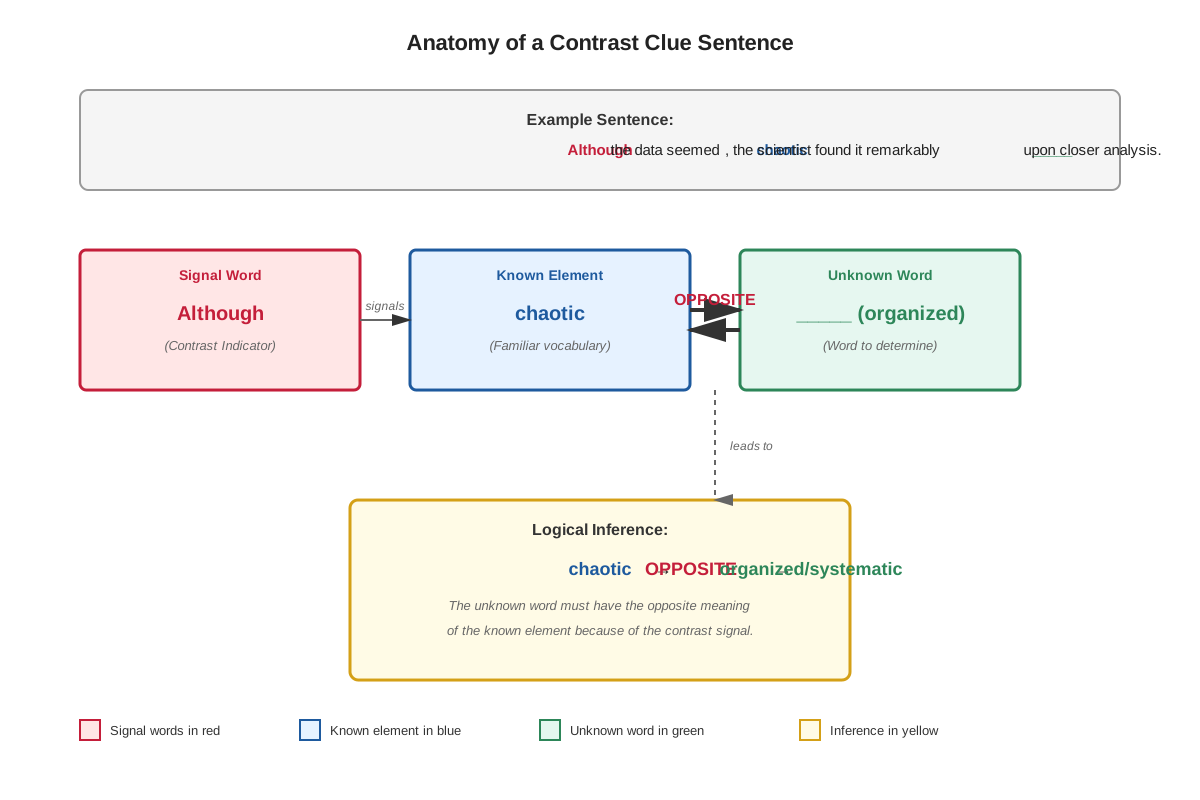
The fundamental mechanism works through semantic opposition. When an author writes "Although the experiment was initially successful, the results proved _____," the word "although" signals that what follows contrasts with "successful." The blank must therefore contain a word suggesting failure, disappointment, or negative outcomes. This logical structure transforms vocabulary questions from pure recall tasks into reasoning exercises.
Types of Contrast Signal Words
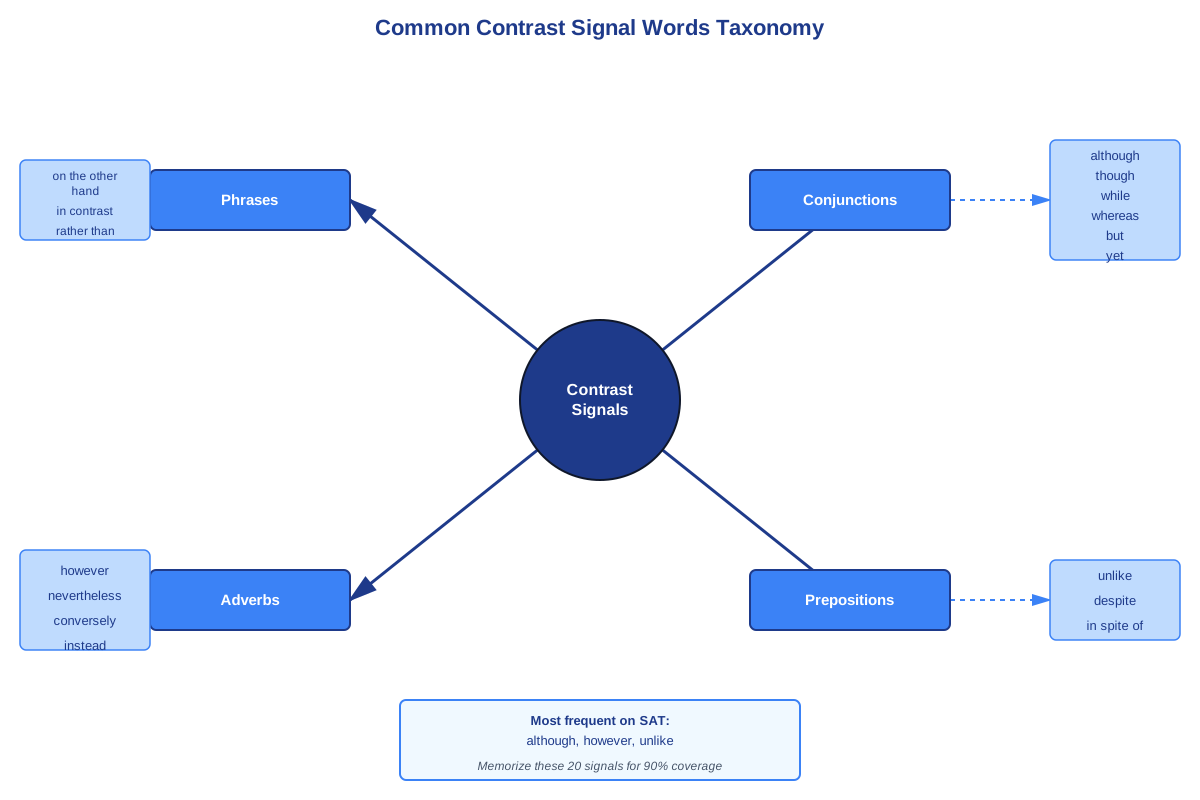
Contrast signals fall into several grammatical categories, each with distinct usage patterns:
| Category | Signal Words/Phrases | Example Usage |
|---|---|---|
| Coordinating Conjunctions | but, yet | "She was exhausted but determined" |
| Subordinating Conjunctions | although, though, while, whereas, even though | "Although he studied diligently, he struggled" |
| Transitional Phrases | however, nevertheless, nonetheless, on the other hand, in contrast, conversely | "The theory seemed sound; however, experiments disproved it" |
| Prepositions | despite, in spite of, unlike | "Despite the warnings, they proceeded" |
| Verbs | differ, contradict, oppose, contrast with | "Her actions contradicted her words" |
| Adjectives/Adverbs | rather than, instead of, alternatively | "He chose patience rather than haste" |
Explicit vs. Implicit Contrast Clues
Explicit contrast clues use clear signal words that directly announce the opposition. These are the most straightforward to identify and apply. For example: "Unlike his predecessor, who was known for caution, the new director demonstrated remarkable _____." The word "unlike" explicitly signals contrast, and "caution" provides the reference point, indicating the blank requires a word meaning boldness or risk-taking.
Implicit contrast clues create opposition through sentence structure, punctuation, or semantic relationships without using obvious signal words. These require more sophisticated reading skills. Consider: "The scientist's public persona—warm, engaging, accessible—masked her true nature: _____, distant, and unapproachable." The dash and colon create structural contrast, while the parallel structure of adjectives signals that the blank must oppose "warm."
Structural Patterns in Contrast Sentences
Several sentence structures reliably signal contrast relationships:
- Antithetical parallelism: Two parallel clauses presenting opposing ideas ("Some leaders inspire through charisma; others succeed through _____")
- Concessive clauses: Subordinate clauses that acknowledge one point before contrasting it ("Though the evidence seemed conclusive, further investigation revealed _____")
- Comparative structures: Sentences that explicitly compare two different entities ("Where traditional methods proved slow and cumbersome, the new approach was _____ and efficient")
- Negation-based contrasts: Sentences using "not...but" constructions ("The response was not hostile but rather _____")
Degree of Opposition
Not all contrasts represent absolute opposites. Understanding the degree of opposition helps select the most precise answer:
- Absolute opposites: Hot/cold, success/failure, increase/decrease
- Relative contrasts: Warm/cool, partial success/complete success, slight increase/dramatic increase
- Qualitative differences: Different approaches that aren't opposites but represent distinct alternatives (democratic/authoritarian, theoretical/practical)
SAT questions often include trap answers that represent some degree of contrast but not the specific degree indicated by the passage context. Careful attention to modifying words (very, somewhat, relatively, extremely) helps calibrate the appropriate degree of opposition.
Multiple Contrast Clues
Complex sentences may contain multiple contrast relationships operating simultaneously. Consider: "Although the medication proved effective for acute symptoms, it was surprisingly ineffective against chronic conditions, unlike the earlier treatment, which had shown consistent results across both categories." This sentence contains three contrast relationships: (1) acute vs. chronic, (2) effective vs. ineffective, and (3) the new medication vs. the earlier treatment. Successfully navigating such sentences requires tracking multiple oppositional threads simultaneously.
Concept Relationships
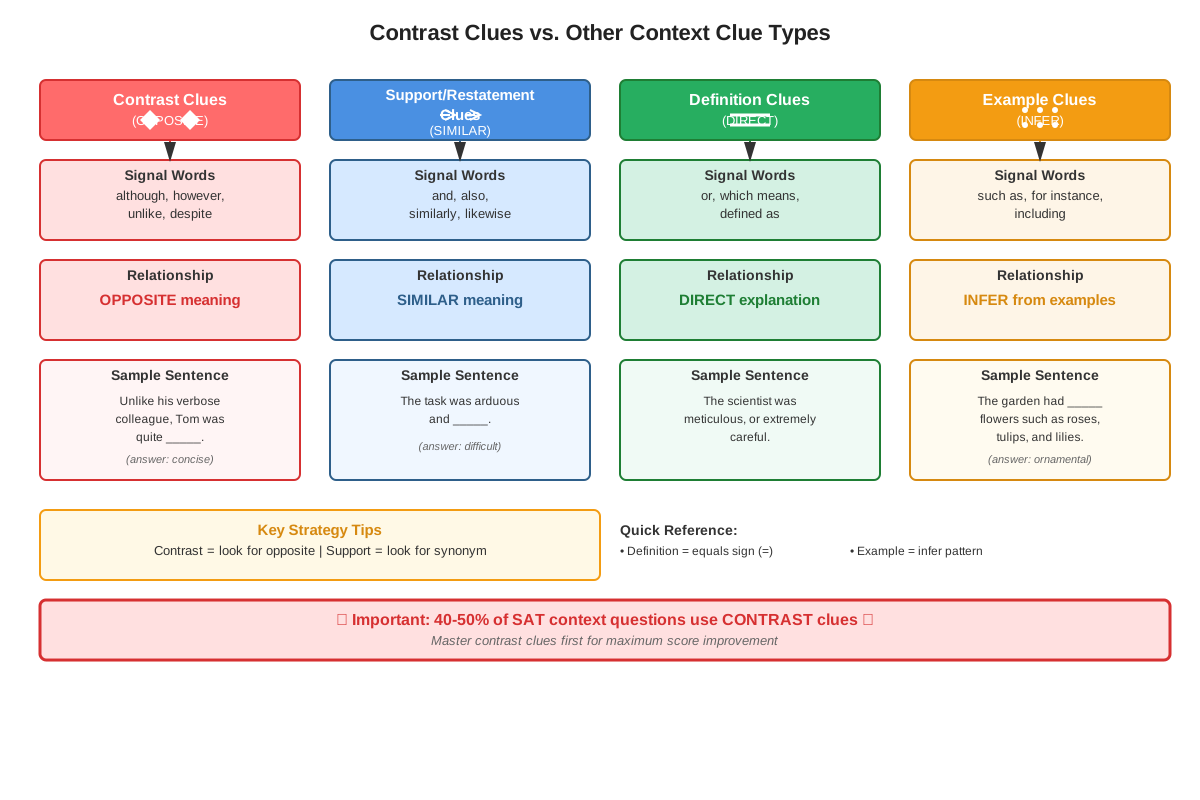
Contrast clues function as one component within the broader ecosystem of context clues, which also includes support clues (where surrounding words reinforce meaning), definition clues (where the text directly defines a term), and example clues (where specific instances illustrate meaning). These clue types often work together: a sentence might use contrast to distinguish a term from what it's not, then provide examples of what it is.
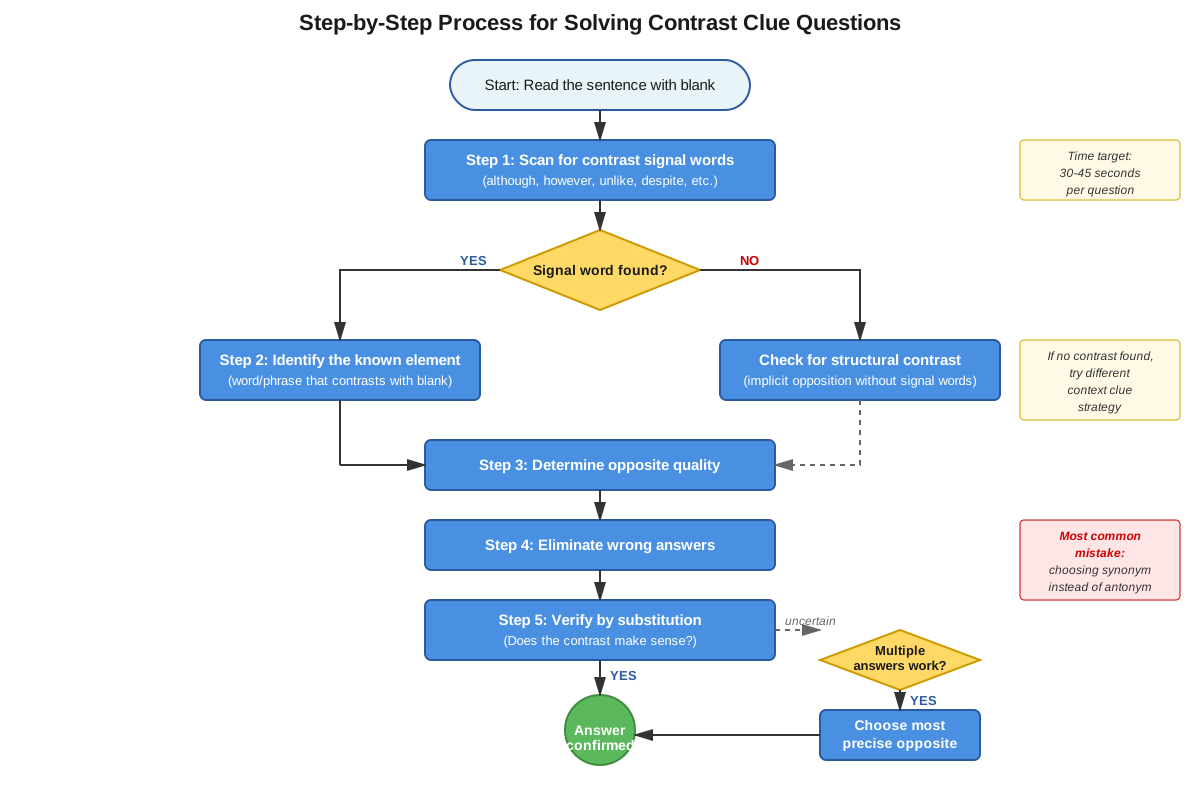
The relationship flows as follows: Recognition of signal words → Identification of the contrast relationship → Analysis of the known element → Logical inference of the unknown element → Evaluation of answer choices against the inferred meaning. Each step depends on the previous one, creating a sequential reasoning chain.
Contrast clues connect to prerequisite knowledge of sentence structure because identifying what contrasts with what requires understanding grammatical relationships. The subject of one clause might contrast with the subject of another, or an adjective modifying one noun might contrast with an adjective modifying a different noun. Without parsing these relationships correctly, students might identify the wrong elements as being in opposition.
Looking forward, mastery of contrast clues enables progression to more advanced skills like recognizing rhetorical strategies (how authors use contrast for persuasive effect), understanding tone shifts (where contrast signals changes in authorial attitude), and analyzing argumentative structure (where contrasting viewpoints build dialectical reasoning).
High-Yield Facts
⭐ Approximately 40-50% of SAT "Words in Context" questions contain identifiable contrast clues, making this the single most common context clue type on the exam.
⭐ The word "but" is the most frequently appearing contrast signal word on the SAT, followed by "however," "although," and "unlike."
⭐ Contrast clues work bidirectionally: if you know the word in question and need to understand the contrasting element, or if you know the contrasting element and need to determine the unknown word.
⭐ Punctuation can signal contrast relationships: semicolons, colons, and dashes often separate contrasting ideas even without explicit signal words.
⭐ The correct answer to a contrast clue question must be contextually opposite, not just any antonym from a thesaurus—context determines which aspect of meaning is being contrasted.
- Contrast signal words can appear at the beginning, middle, or end of sentences, requiring flexible reading strategies.
- Multiple-choice answers often include synonyms of the target word as distractors when contrast clues indicate an antonym is needed.
- Implicit contrast clues appear more frequently in harder questions and later passages within the test.
- Temporal contrast words (formerly, previously, now, currently) can signal shifts that create opposition between past and present states.
- Negative constructions ("not," "no longer," "hardly") often work with contrast clues to create double oppositions.
- Contrast relationships can span multiple sentences, not just single sentences, especially in longer passages.
Quick check — test yourself on Contrast clues so far.
Try Flashcards →Common Misconceptions
Misconception: Any antonym of the target word will work as the correct answer when contrast clues are present.
Correction: The correct answer must be contextually appropriate—it must be the opposite of the specific aspect of meaning that the passage is contrasting. For example, "cold" and "unfriendly" are both opposites of "warm," but only one will fit the specific contrast the passage establishes.
Misconception: Contrast clues only appear with obvious signal words like "but" or "however."
Correction: Many SAT questions feature implicit contrast clues created through sentence structure, punctuation, or semantic relationships without explicit signal words. Recognizing these structural patterns is essential for harder questions.
Misconception: The contrasting element always appears in the same sentence as the target word.
Correction: Contrast relationships can span multiple sentences, especially in passage-based questions. The previous sentence might establish a quality that the current sentence contrasts with.
Misconception: Stronger contrast signal words (like "however") indicate more extreme opposites than weaker ones (like "but").
Correction: The intensity of the signal word doesn't determine the degree of opposition in meaning. Context, not the signal word itself, determines whether absolute opposites or relative contrasts are appropriate.
Misconception: If you don't know the vocabulary word in question, contrast clues won't help.
Correction: Contrast clues are specifically designed to help when you don't know a word. As long as you understand the contrasting element and recognize the contrast signal, you can logically deduce the unknown word's meaning.
Misconception: Contrast clues only appear in vocabulary questions.
Correction: While most prominent in "Words in Context" questions, contrast relationships also appear in questions about main ideas, purpose, tone, and rhetorical strategy. Recognizing these patterns benefits performance across multiple question types.
Worked Examples
Example 1: Explicit Contrast with Clear Signal Word
Passage: "The committee's initial proposal was met with widespread approval, but the revised version proved remarkably contentious, sparking heated debates among stakeholders."
Question: As used in the passage, "contentious" most nearly means:
A) Agreeable
B) Controversial
C) Detailed
D) Expensive
Solution Process:
Step 1 - Identify the contrast signal: The word "but" clearly signals a contrast between the initial proposal and the revised version.
Step 2 - Identify the known element: The initial proposal received "widespread approval"—this is positive, indicating agreement and acceptance.
Step 3 - Determine the direction of contrast: Since "but" introduces the revised version, we know it must contrast with "widespread approval." The unknown word "contentious" must therefore mean something opposite to approval/agreement.
Step 4 - Look for supporting context: The phrase "sparking heated debates" reinforces that the revised version caused disagreement and conflict.
Step 5 - Evaluate answer choices:
- A) Agreeable - This is a synonym of "approval," not a contrast. Eliminate.
- B) Controversial - This means causing disagreement/debate, which contrasts with approval. Keep.
- C) Detailed - This doesn't relate to the approval/disagreement contrast. Eliminate.
- D) Expensive - This introduces an unrelated concept. Eliminate.
Answer: B) Controversial
Connection to learning objectives: This example demonstrates identifying the key feature of contrast clues (the signal word "but"), explaining how it appears on the SAT (in a vocabulary-in-context question), and applying the strategy to select the correct answer.
Example 2: Implicit Contrast with Structural Signals
Passage: "Nineteenth-century critics dismissed the artist's work as derivative and uninspired; modern scholars, however, recognize her innovations in technique and composition as genuinely _____."
Question: Which choice completes the text with the most logical and precise word or phrase?
A) conventional
B) original
C) competent
D) artistic
Solution Process:
Step 1 - Identify contrast signals: The semicolon separates two contrasting viewpoints, and "however" explicitly signals the opposition between 19th-century and modern perspectives.
Step 2 - Identify the known elements: Nineteenth-century critics used "derivative" (copied from others) and "uninspired" (lacking creativity). These are negative judgments about originality.
Step 3 - Determine what modern scholars must think: Since they contrast with the 19th-century view, modern scholars must see the opposite qualities. The blank must express originality and creativity.
Step 4 - Note the phrase "genuinely _____": The word "genuinely" emphasizes authenticity, reinforcing that the blank should express true originality, not just competence.
Step 5 - Evaluate answer choices:
- A) conventional - This is a synonym of "derivative," not a contrast. Eliminate.
- B) original - This directly contrasts with "derivative" and "uninspired." Keep.
- C) competent - This is positive but doesn't specifically contrast with the originality issue. Weak choice.
- D) artistic - This is too vague and doesn't specifically address the derivative/original contrast. Eliminate.
Answer: B) original
Connection to learning objectives: This example shows how to recognize implicit contrast clues (semicolon structure), distinguish between contrast and other clue types, and evaluate answer choices by testing them against the specific contrast relationship established in the passage.
Exam Strategy
Systematic Approach to Contrast Clue Questions
When encountering a "Words in Context" question, follow this process:
- Read the entire sentence containing the target word (and the sentence before/after if needed for context)
- Scan for contrast signal words using the categories from the Core Concepts section
- Identify what is being contrasted with what—mark these elements mentally or on scratch paper
- Determine the known element's meaning clearly before attempting to infer the unknown
- Predict the general meaning of the unknown word before looking at answer choices
- Eliminate answers that don't fit the contrast relationship first, then select the best remaining option
Trigger Words and Phrases to Watch For
Create a mental alert system for these high-frequency contrast signals:
Immediate red flags: but, however, although, though, unlike, despite, in spite of, yet, nevertheless, nonetheless, conversely, on the other hand, in contrast, rather than, instead of
Structural signals: Semicolons separating independent clauses, colons introducing contrasting lists, dashes setting off contrasting information
Subtle indicators: Words like "shift," "change," "different," "alternative," "other," which suggest movement from one state to a contrasting state
Process-of-Elimination Tips
Eliminate synonyms when contrast is present: If you identify a clear contrast relationship, immediately eliminate any answer choices that are synonyms or near-synonyms of the known element. These are trap answers designed to catch students who miss the contrast signal.
Eliminate unrelated concepts: Even if an answer choice is a valid antonym in general, eliminate it if it doesn't relate to the specific aspect being contrasted in the passage. The contrast must be contextually relevant.
Watch for degree mismatches: If the passage suggests a moderate contrast, eliminate extreme opposites. If it suggests a strong opposition, eliminate mild alternatives.
Test remaining answers by substitution: For your final two choices, mentally substitute each into the original sentence and see which creates the most logical contrast with the opposing element.
Time Allocation Advice
Contrast clue questions should be among your faster questions because they follow a logical pattern. Aim to spend:
- 30-45 seconds on questions with explicit, clear contrast signals
- 45-60 seconds on questions with implicit or multiple contrast relationships
- No more than 90 seconds even on the most complex contrast questions
If you're spending more than 90 seconds, you're likely overthinking. Make your best educated guess and move on—the systematic approach should lead you to the correct answer or narrow it to two choices quickly.
Exam Tip: If you're stuck between two answers, reread the sentence with each option substituted in. The correct answer will create a clear, logical opposition with the contrasting element, while the incorrect answer will feel awkward or create a weaker relationship.
Memory Techniques
The "BUT" Mnemonic
Backtrack to find the contrasting element
Understand what quality is being opposed
Test answers against the opposite meaning
This simple three-step process works for any contrast clue question and keeps you focused on the essential reasoning pattern.
The Contrast Signal Categories Acronym: "COPS TV"
Coordinating conjunctions (but, yet)
Opposing transitions (however, nevertheless)
Prepositions (despite, unlike)
Subordinating conjunctions (although, while)
Temporal shifts (formerly, now)
Verbs of opposition (differ, contradict)
Visualization Strategy: The Seesaw
Picture a seesaw with the contrast signal word as the fulcrum in the middle. One side holds the known element, the other side must hold its opposite. If one side is "up" (positive), the other must be "down" (negative). This visual helps maintain the oppositional relationship clearly in mind.
The "Opposite Day" Technique
When you identify a contrast clue, mentally declare "Opposite Day!" This playful trigger reminds you that whatever quality you understand on one side, you need to find its opposite on the other side. It's particularly helpful for preventing the common error of selecting synonyms when antonyms are needed.
Summary
Contrast clues represent one of the highest-yield strategies for SAT Reading and Writing success, appearing in approximately 40-50% of "Words in Context" questions. These linguistic signals—including explicit markers like "but," "however," and "although," as well as implicit structural patterns—indicate that two elements in a sentence or passage stand in opposition to each other. By identifying the contrast signal, determining what is being contrasted, understanding the known element, and logically inferring the opposite quality, students can decode unfamiliar vocabulary through reasoning rather than memorization. Success requires recognizing both obvious signal words and subtle structural cues, understanding that the correct answer must represent a contextually appropriate opposite (not just any antonym), and systematically eliminating answer choices that don't fit the specific contrast relationship established in the passage. Mastery of contrast clues not only improves performance on vocabulary questions but also strengthens overall reading comprehension, argument analysis, and logical reasoning skills essential throughout the SAT and beyond.
Key Takeaways
- Contrast clues are the most common context clue type on the SAT, appearing in nearly half of all vocabulary questions—making them essential for score improvement
- Signal words like "but," "however," "although," and "unlike" explicitly announce contrast relationships, while punctuation and sentence structure can create implicit contrasts
- The correct answer must be contextually opposite, not just any antonym—the specific aspect being contrasted determines which opposite quality is appropriate
- Contrast relationships work bidirectionally: you can use them whether you know the target word or the contrasting element
- Systematic process beats intuition: identify the signal, find the contrasting elements, understand the known side, predict the opposite, then evaluate answers
- Eliminate synonyms first when contrast is present—they're trap answers designed to catch students who miss the oppositional relationship
- Practice recognizing both explicit and implicit contrast patterns to handle questions across all difficulty levels effectively
Related Topics
Support Clues: While contrast clues indicate opposition, support clues show how surrounding words reinforce and clarify meaning through similarity and elaboration. Mastering contrast clues provides a foundation for recognizing when context supports rather than opposes.
Definition and Restatement Clues: These clues provide direct explanations of word meanings, often working alongside contrast clues when authors define terms by explaining what they are not.
Tone and Attitude Questions: Recognizing contrast relationships helps identify shifts in authorial tone and attitude, as writers often use contrast to signal changes in perspective or evaluation.
Rhetorical Strategy and Purpose: Understanding how authors use contrast for persuasive effect connects vocabulary skills to broader analytical reading, enabling success on higher-level comprehension questions.
Transition Words and Logical Flow: Contrast signals represent one category of transition words; studying them systematically improves understanding of how ideas connect throughout passages.
Practice CTA
Now that you've mastered the concepts, strategies, and patterns of contrast clues, it's time to put your knowledge into action! Complete the practice questions to reinforce these skills and build the automaticity you need for test day. Each practice question is designed to mirror actual SAT formats and difficulty levels, giving you authentic preparation. Review the flashcards to cement the contrast signal words and key concepts in your memory. Remember: recognizing contrast clues is a skill that improves dramatically with deliberate practice—every question you work through strengthens your pattern recognition and speeds up your processing time. You've got the tools; now build the confidence through application!
Sign up free to keep reading
Create a free AnvayaPrep account to finish this SAT guide on Contrast clues — plus flashcards and practice questions.