Overview
Historical terms in context represent a critical component of the SAT Reading and Writing section, testing students' ability to understand how words and phrases were used in specific time periods and how their meanings may have evolved or differed from contemporary usage. This skill goes beyond simple vocabulary recognition—it requires students to interpret language within its temporal and cultural framework, recognizing that words can carry different connotations, denotations, or technical meanings depending on when and where they were written.
The SAT frequently presents passages from historical documents, speeches, literature, and scientific texts spanning from the 18th century to the present day. Students must demonstrate their ability to decode archaic phrasing, understand period-specific terminology, and recognize how context clues within historical texts reveal meaning. This skill is essential because approximately 15-20% of Reading and Writing questions involve interpreting words or phrases in context, and a significant portion of these draw from historical sources. Mastering sat historical terms in context directly impacts performance on multiple question types, including vocabulary-in-context questions, main idea questions, and inference questions.
Within the broader rw (Reading and Writing) framework, historical terms in context connects intimately with other "Words in Context" skills, including understanding figurative language, determining precise meanings, and analyzing rhetorical choices. This topic also supports success in the "Craft and Structure" domain, where students analyze how authors use language to achieve specific purposes. Understanding historical language patterns enhances overall reading comprehension, particularly when engaging with primary source documents that appear frequently in SAT passages—from founding documents like the Federalist Papers to scientific treatises from Darwin or Newton.
Learning Objectives
- [ ] Identify key features of Historical terms in context
- [ ] Explain how Historical terms in context appears on the SAT
- [ ] Apply Historical terms in context to answer SAT-style questions
- [ ] Distinguish between archaic and contemporary meanings of the same word
- [ ] Use surrounding context clues to determine the meaning of unfamiliar historical terminology
- [ ] Recognize common patterns in how language has evolved over time
- [ ] Analyze how historical word choice reflects the author's purpose and audience
Prerequisites
- Basic vocabulary skills: Understanding how to use context clues to determine word meaning forms the foundation for interpreting historical terms
- Reading comprehension fundamentals: The ability to track main ideas and supporting details helps students locate relevant context for unfamiliar terms
- Awareness of text structure: Recognizing how sentences and paragraphs connect enables students to find definitional or explanatory information surrounding historical terms
- Familiarity with common literary devices: Understanding metaphor, simile, and other figurative language helps decode historical expressions that may use these devices differently than modern texts
Why This Topic Matters
Historical terms in context skills extend far beyond the SAT, preparing students for college-level work across disciplines. In humanities courses, students regularly encounter primary source documents where understanding historical language is essential for accurate interpretation. In STEM fields, reading foundational scientific papers requires decoding terminology that has evolved significantly. Legal studies, political science, and philosophy all demand the ability to parse historical texts with precision.
On the SAT specifically, historical terms in context appears with remarkable consistency. Approximately 3-5 questions per test directly assess this skill, and many additional questions require it indirectly. The College Board deliberately includes at least one passage from a historical source in each Reading and Writing section—often a speech, essay, or excerpt from a founding document. These passages typically date from the 1700s through the early 1900s, with occasional selections from mid-20th century sources.
Common manifestations in exam passages include:
- Archaic word forms: Terms like "whilst," "hitherto," "heretofore," or "thence" that have fallen out of common usage
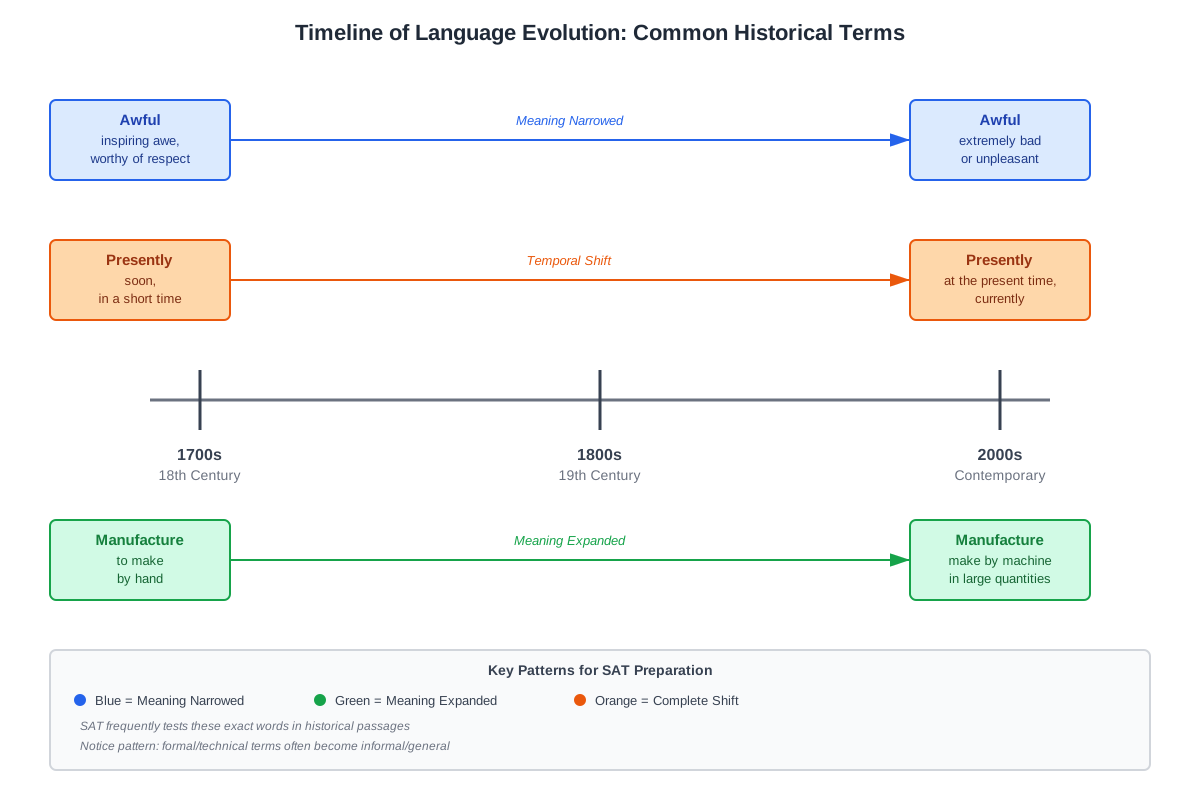
- Shifted meanings: Words like "awful" (originally meaning "inspiring awe"), "presently" (originally meaning "immediately"), or "prevent" (originally meaning "to come before")
- Period-specific technical vocabulary: Scientific, legal, or philosophical terms that carried specific meanings in their original context
- Formal or elevated diction: Language patterns reflecting the rhetorical conventions of earlier eras
- Cultural references: Allusions to historical events, figures, or concepts that require contextual understanding
Core Concepts
Understanding Semantic Shift
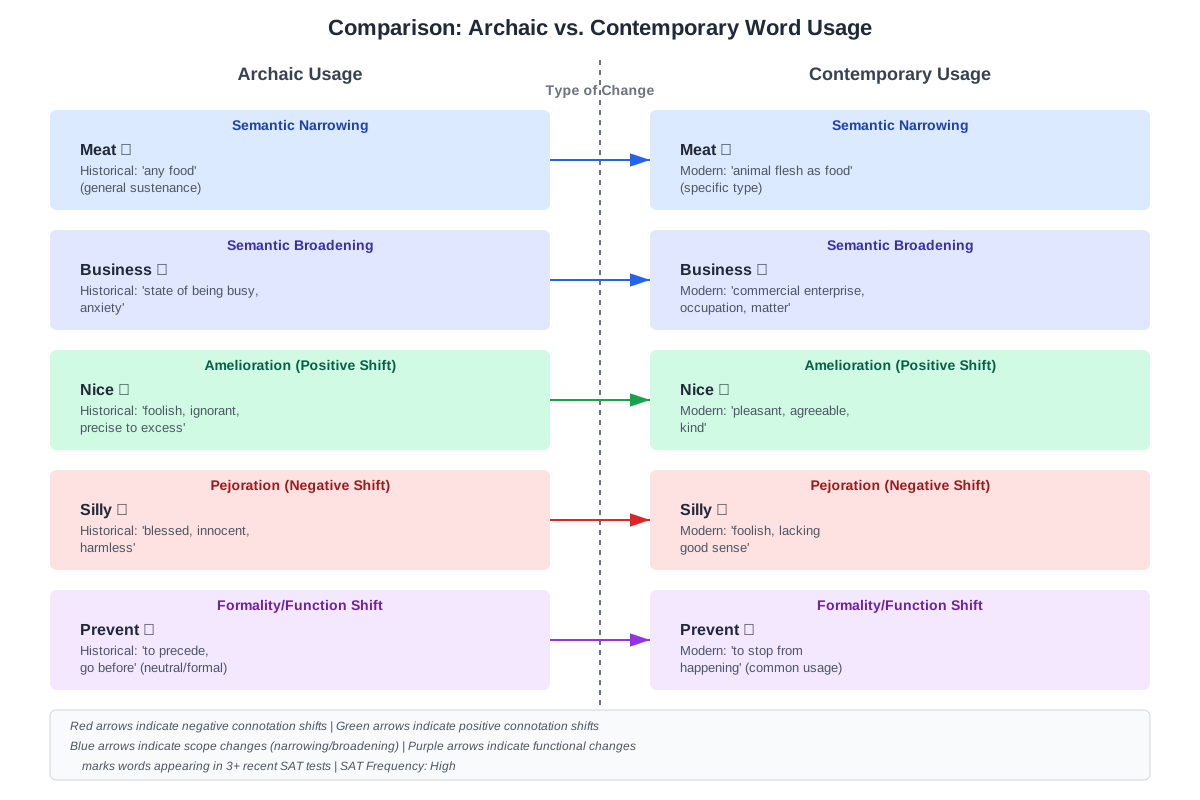
Semantic shift refers to the phenomenon where words change meaning over time. This linguistic evolution occurs through various mechanisms and represents the primary challenge students face when encountering historical texts. Words may narrow in meaning (becoming more specific), broaden (becoming more general), undergo amelioration (developing more positive connotations), or experience pejoration (developing more negative connotations).
On the SAT, recognizing semantic shift prevents students from imposing modern meanings onto historical texts. For example, when an 18th-century author writes that something is "awful," they likely mean "awe-inspiring" or "worthy of reverence," not "terrible" as contemporary usage suggests. Similarly, "nice" once meant "precise" or "careful," "silly" meant "blessed" or "innocent," and "artificial" simply meant "made by human skill" without negative connotations.
The key to navigating semantic shift lies in contextual analysis—examining how the word functions within its sentence and paragraph. Students should ask: Does the modern meaning create a logical sentence? Does it align with the author's apparent tone and purpose? Are there surrounding words or phrases that suggest an alternative meaning?
Archaic Vocabulary and Syntax
Archaic vocabulary includes words that have largely disappeared from modern English or survive only in specialized contexts. Common examples on the SAT include:
| Archaic Term | Modern Equivalent | Example Context |
|---|---|---|
| Whilst | While | "Whilst the committee deliberated..." |
| Hitherto | Until now | "Hitherto unknown species..." |
| Thence | From there | "They traveled thence to Boston..." |
| Heretofore | Before this time | "Heretofore impossible feats..." |
| Wherefore | For what reason/therefore | "Wherefore art thou Romeo?" (Why are you Romeo?) |
| Perchance | Perhaps | "Perchance we shall succeed..." |
Beyond individual words, historical texts often employ archaic syntax—sentence structures that differ from contemporary patterns. Inverted word order ("Said he to the assembly..."), formal constructions ("It is incumbent upon us..."), and elaborate subordinate clauses characterize historical writing. Students must mentally "translate" these structures while reading, recognizing that the unfamiliarity stems from style rather than complexity of ideas.
Context Clues in Historical Texts
Historical texts provide the same types of context clues as modern writing, but students must look more carefully to find them. The SAT tests whether students can identify and use these clues effectively:
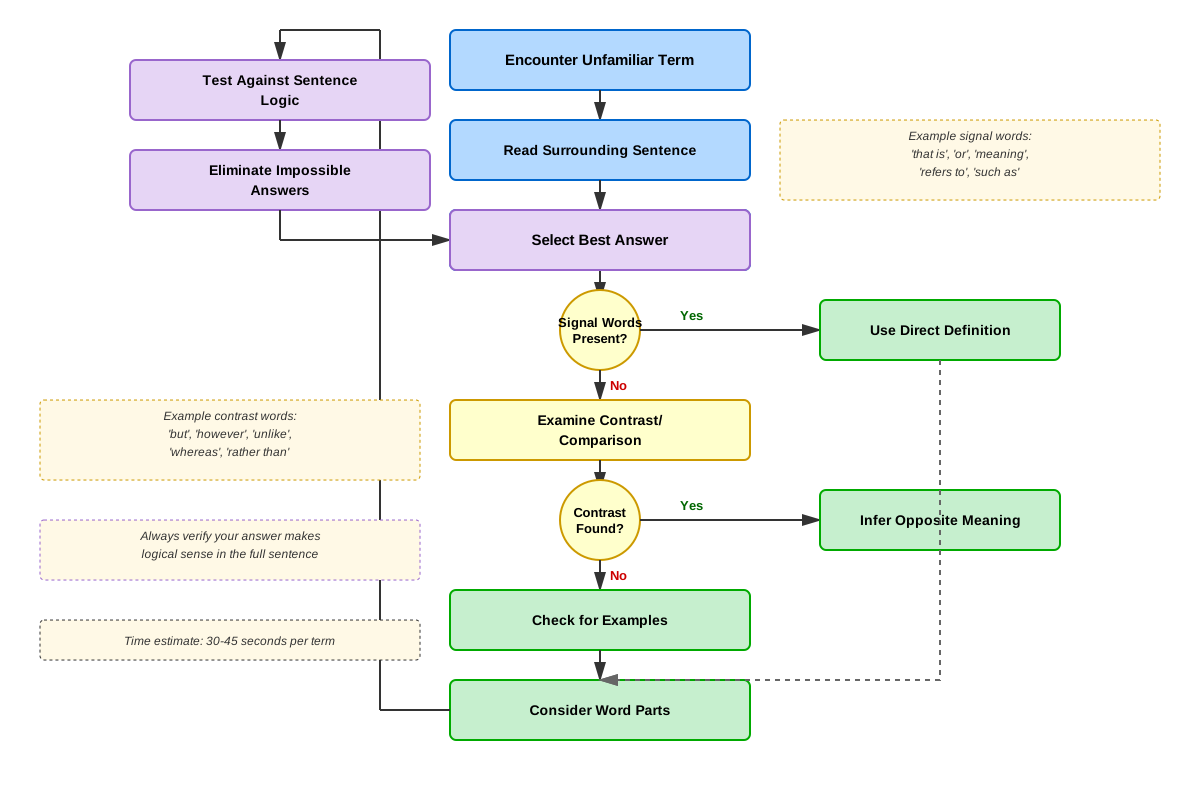
Definition clues: The author directly explains the term, often using phrases like "that is," "which means," or "in other words." Historical writers, aware they were introducing technical or specialized terms, frequently provided explicit definitions.
Example clues: The author illustrates the concept with specific instances. If a historical text mentions "various impediments, such as lack of funding and political opposition," students can infer that "impediments" means obstacles or barriers.
Contrast clues: The author presents an opposite or contrasting idea, signaled by words like "however," "unlike," "whereas," or "on the contrary." If a text states "Rather than proceeding with alacrity, they moved slowly," students can deduce that "alacrity" means speed or eagerness.
Restatement clues: The author expresses the same idea using different words, often in an adjacent sentence or clause. Historical writers valued rhetorical elaboration and frequently restated important concepts.
Inference clues: The overall meaning must be constructed from the general sense of the passage. This requires synthesizing information from multiple sentences and considering the author's purpose and tone.
Period-Specific Technical Language
Different historical eras developed specialized vocabularies for emerging fields and concepts. The SAT frequently includes passages containing period-specific technical language from:
18th-century political philosophy: Terms like "tyranny," "liberty," "virtue," "faction," and "republic" carried precise meanings in Enlightenment discourse that differ subtly from casual modern usage. "Faction," for instance, specifically meant a group pursuing self-interest at the expense of the common good, not simply any political group.
19th-century science: Early scientific writing used terms that have since been refined or replaced. "Natural philosophy" meant what we now call physics, "animalcules" referred to microorganisms, and "ether" described a hypothetical medium for light transmission.
Victorian social commentary: Writers discussing social issues employed terms like "improvement," "elevation," "degradation," and "condition" with specific connotations related to moral and social progress.
Understanding these technical vocabularies requires recognizing that specialized terms function within conceptual frameworks. Students should identify the field or discipline being discussed and consider how terms relate to each other within that framework.
Formal Register and Rhetorical Conventions
Historical texts typically employ a formal register—a level of language formality higher than contemporary writing. This formality manifests through:
- Elevated diction: Choosing more sophisticated or Latinate words over simpler alternatives ("commence" rather than "begin," "endeavor" rather than "try")
- Elaborate sentence structures: Using multiple subordinate clauses and careful parallelism
- Impersonal constructions: Avoiding first-person pronouns and direct address
- Rhetorical devices: Employing techniques like anaphora (repetition of opening words), antithesis (balanced contrasts), and periodic sentences (delaying the main clause)
These conventions reflect the rhetorical education and stylistic values of earlier periods. Recognizing formal register helps students avoid misinterpreting sophisticated language as indicating complex ideas—often, historical writers expressed relatively straightforward concepts using elaborate language.
Concept Relationships
The concepts within historical terms in context form an interconnected system. Semantic shift represents the overarching phenomenon that creates the need for careful contextual reading. When students encounter unfamiliar language, they must first determine whether they're facing archaic vocabulary (words no longer in common use) or shifted meanings (familiar words used differently). This determination guides their strategy: archaic vocabulary requires using context clues to construct meaning from surrounding text, while shifted meanings require setting aside modern associations and inferring historical usage from context.
Period-specific technical language represents a specialized category of archaic vocabulary, requiring additional awareness of disciplinary frameworks and historical conceptual systems. Understanding formal register and rhetorical conventions supports all other skills by helping students recognize that elaborate language doesn't necessarily indicate complex content—often, the challenge lies in the style rather than the substance.
These concepts connect to prerequisite knowledge of basic vocabulary skills and context clue usage, extending those foundational abilities to more challenging texts. They also relate to other SAT Reading and Writing topics, particularly analyzing word choice and rhetorical strategy, understanding author's purpose, and making inferences from text evidence.
The relationship map flows as follows:
Semantic Shift → creates → Archaic Vocabulary & Shifted Meanings → requires → Context Clue Analysis → supported by → Understanding Formal Register → enables → Interpreting Period-Specific Technical Language → results in → Accurate Comprehension of Historical Texts
High-Yield Facts
⭐ Approximately 15-20% of SAT Reading and Writing questions involve interpreting words or phrases in context, with historical terms appearing in 3-5 questions per test
⭐ The most commonly tested archaic terms include: whilst, hitherto, thence, heretofore, wherefore, and perchance
⭐ Words that have undergone semantic shift frequently tested on the SAT include: awful (awe-inspiring), presently (immediately), prevent (come before), and artificial (skillfully made)
⭐ Every SAT includes at least one passage from a historical source, typically dating from the 1700s-1900s
⭐ Context clues in historical texts function identically to those in modern texts: definition, example, contrast, restatement, and inference
- Historical texts typically employ formal register with elevated diction and elaborate sentence structures
- Period-specific technical language appears most frequently from 18th-century political philosophy and 19th-century science
- The SAT never requires outside historical knowledge—all necessary information appears within the passage
- Inverted syntax and archaic sentence structures characterize historical writing but don't change fundamental meaning
- When a modern meaning creates an illogical sentence, semantic shift has likely occurred
- Historical writers often provided explicit definitions for technical terms, making definition clues particularly valuable
- The College Board selects historical passages that remain accessible to contemporary readers with careful attention to context
Quick check — test yourself on Historical terms in context so far.
Try Flashcards →Common Misconceptions
Misconception: Historical passages are inherently more difficult than modern passages because they use old-fashioned language.
Correction: Historical passages often express straightforward ideas using elaborate language. The challenge lies in decoding style rather than understanding complex content. With practice recognizing archaic patterns, students can read historical texts as efficiently as modern ones.
Misconception: Students need to memorize lists of archaic words and their meanings to succeed on historical terms questions.
Correction: The SAT always provides sufficient context to determine meaning. Memorizing archaic vocabulary may help with reading speed, but the test specifically assesses the ability to use context clues, not prior vocabulary knowledge. Every question can be answered using only information in the passage.
Misconception: When encountering an unfamiliar word in a historical text, students should skip it and hope to understand the passage anyway.
Correction: Unfamiliar terms often carry important meaning, and the SAT specifically tests comprehension of these words. Students should actively use context clues to construct meaning rather than skipping over challenging vocabulary. The surrounding sentences almost always provide definitional or explanatory information.
Misconception: Formal, elevated language in historical texts indicates that the author is discussing highly complex or abstract ideas.
Correction: Rhetorical conventions of earlier periods valued elaborate expression regardless of content complexity. Authors discussing relatively simple concepts often employed sophisticated language. Students should focus on the underlying ideas rather than being intimidated by stylistic formality.
Misconception: If a word in a historical text looks familiar, it must mean the same thing it means today.
Correction: Semantic shift means that familiar-looking words may carry different meanings in historical contexts. Students should always verify that the modern meaning creates a logical sentence and aligns with the author's apparent purpose. When the modern meaning seems odd or contradictory, semantic shift has likely occurred.
Misconception: Historical passages require extensive background knowledge about the time period, historical events, or cultural context.
Correction: The SAT is designed to be accessible to all students regardless of their history coursework. Every historical passage provides all necessary context within the text itself. Questions never require outside knowledge—they assess reading comprehension skills applied to historical language.
Worked Examples
Example 1: Semantic Shift
Passage excerpt: "The assembly found the proposal quite artificial, demonstrating considerable skill in its construction and attention to the minutest details of implementation."
Question: As used in the passage, "artificial" most nearly means:
A) Fake or insincere
B) Skillfully crafted
C) Unnecessarily complex
D) Deceptive in nature
Solution:
Step 1: Recognize potential semantic shift. The modern meaning of "artificial" (fake, not natural) creates an odd sentence—why would an assembly praise something for being fake?
Step 2: Identify context clues. The passage immediately explains that "artificial" relates to "considerable skill in its construction" and "attention to the minutest details." These are positive attributes.
Step 3: Consider the overall tone. The passage describes the assembly's positive reaction ("found...quite artificial") and emphasizes quality ("considerable skill," "minutest details").
Step 4: Evaluate answer choices:
- Choice A reflects modern meaning but contradicts the positive context
- Choice B aligns with "skill in construction" and positive tone
- Choice C might seem plausible but "unnecessarily" introduces a negative connotation absent from the passage
- Choice D reflects modern negative connotations that contradict the context
Answer: B) Skillfully crafted
Connection to learning objectives: This example demonstrates identifying semantic shift (a key feature of historical terms in context), using context clues to determine historical meaning, and distinguishing between archaic and contemporary meanings of the same word.
Example 2: Archaic Vocabulary with Context Clues
Passage excerpt: "The expedition proceeded with great alacrity, covering in mere days distances that had heretofore required weeks of arduous travel. This unprecedented speed resulted from improved roads and the introduction of relay stations where fresh horses awaited."
Question: In the context of the passage, "heretofore" most nearly means:
A) Occasionally
B) Previously
C) Theoretically
D) Elsewhere
Solution:
Step 1: Recognize archaic vocabulary. "Heretofore" is not commonly used in contemporary English, signaling the need for context clue analysis.
Step 2: Identify the contrast structure. The passage contrasts two time periods: the present expedition (covering distances "in mere days") versus past travel (requiring "weeks of arduous travel"). The word "heretofore" appears in the description of past travel.
Step 3: Locate additional context clues. The phrase "unprecedented speed" in the following sentence confirms that current conditions differ from past conditions. The explanation about "improved roads" and "relay stations" indicates recent changes.
Step 4: Evaluate answer choices:
- Choice A (occasionally) doesn't fit the temporal contrast between past and present
- Choice B (previously) perfectly captures the "before now" meaning that aligns with the past/present contrast
- Choice C (theoretically) introduces a hypothetical element absent from the passage
- Choice D (elsewhere) suggests a spatial rather than temporal distinction
Answer: B) Previously
Connection to learning objectives: This example shows how to use contrast clues in historical texts, recognize archaic vocabulary patterns, and apply systematic analysis to SAT-style questions involving historical terms.
Exam Strategy
Approaching Historical Terms Questions
When encountering a question about a word or phrase in a historical passage, follow this systematic approach:
1. Read the surrounding context carefully (at minimum, the full sentence containing the term plus one sentence before and after). Historical texts often provide explicit or implicit definitions within close proximity to unfamiliar terms.
2. Test the modern meaning first. Insert the contemporary definition into the sentence and evaluate whether it creates logical sense and aligns with the passage's tone. If it does, the modern meaning is likely correct. If it creates confusion or contradiction, semantic shift has probably occurred.
3. Identify the type of context clue present. Look for definition signals ("that is," "which means"), examples ("such as," "for instance"), contrasts ("however," "unlike"), or restatements (adjacent sentences expressing similar ideas).
4. Consider the author's purpose and tone. Historical terms must align with the overall message and attitude of the passage. A positive term shouldn't appear in a critical passage, and vice versa.
5. Eliminate answer choices systematically. Remove options that contradict the context, introduce ideas not present in the passage, or rely on modern meanings when semantic shift is evident.
Trigger Words and Phrases
Watch for these signals that indicate historical terms requiring careful analysis:
- Temporal markers: "in that era," "at the time," "then," "in those days" often signal that language usage differs from contemporary norms
- Formal transitions: "heretofore," "hitherto," "thence," "wherefore" indicate archaic vocabulary
- Elevated diction: Latinate words and elaborate phrasing suggest formal register where terms may carry precise technical meanings
- Explicit definitions: Phrases like "by which I mean," "that is to say," "in other words" signal that the author is defining a term
- Contrast markers: "unlike today," "whereas now," "in contrast to modern" explicitly flag differences between historical and contemporary usage
Process of Elimination Tips
Eliminate modern meanings when they create illogical sentences. If inserting a contemporary definition makes the sentence contradictory or nonsensical, that answer choice is incorrect.
Remove answer choices that introduce new concepts. The correct answer must be supported by the passage context. Options that bring in ideas not mentioned in the surrounding text are incorrect.
Eliminate extremes. Historical terms questions rarely have answers representing extreme positions. Moderate, nuanced options that align with the passage's measured tone are more likely correct.
Watch for partial truths. An answer choice might contain accurate information but fail to capture the specific meaning of the term in context. The correct answer must fit the precise usage in the passage.
Time Allocation
Spend approximately 45-60 seconds on historical terms questions. This allows time to:
- Read the surrounding context (15-20 seconds)
- Test the modern meaning and identify context clues (15-20 seconds)
- Evaluate answer choices systematically (15-20 seconds)
If a question requires more time, mark it and return after completing easier questions. Historical terms questions reward careful analysis but shouldn't consume excessive time.
Memory Techniques
Mnemonic for Context Clue Types: "DECRI"
Definition - Author directly explains the term
Example - Author provides specific instances
Contrast - Author presents opposite ideas
Restatement - Author expresses the same idea differently
Inference - Meaning constructed from overall passage sense
Visualization Strategy for Semantic Shift
Picture words as travelers moving through time. As they journey from past to present, they may:
- Narrow their path (becoming more specific)
- Broaden their path (becoming more general)
- Rise (amelioration - more positive)
- Fall (pejoration - more negative)
When encountering a familiar word in a historical text, visualize it at an earlier point in its journey, before it reached its current meaning.
Acronym for Common Archaic Terms: "WHITHER"
Whilst = while
Hitherto = until now
In (heretofore) = before this time
Thence = from there
Hereby = by this means
Ere = before
Rather = more readily/preferably (historical usage)
Memory Palace for Semantic Shift Examples
Create a mental "historical house" with rooms for different categories:
- Positive Room: Words that became more positive (nice: foolish → pleasant)
- Negative Room: Words that became more negative (awful: awe-inspiring → terrible)
- Narrowing Hallway: Words that became more specific (meat: any food → animal flesh)
- Broadening Courtyard: Words that became more general (holiday: holy day → any day off)
Place specific examples in each location and mentally walk through the house when reviewing.
Summary
Historical terms in context represents a high-yield SAT skill requiring students to interpret language from earlier time periods by recognizing semantic shift, decoding archaic vocabulary, and applying context clue analysis. The fundamental challenge lies not in memorizing historical vocabulary but in developing systematic strategies for determining meaning from surrounding text. Students must distinguish between archaic terms (words no longer in common use) and shifted meanings (familiar words used differently), then employ the same context clue types used with modern texts: definition, example, contrast, restatement, and inference. Success requires setting aside modern assumptions, carefully analyzing the author's tone and purpose, and recognizing that historical texts often express straightforward ideas using elaborate formal language. Every SAT includes passages from historical sources, making this skill essential for achieving top scores. The key to mastery lies in practicing systematic analysis rather than vocabulary memorization, as the test always provides sufficient context to determine meaning.
Key Takeaways
- Historical terms questions appear 3-5 times per SAT test and account for 15-20% of words-in-context questions
- Semantic shift—words changing meaning over time—creates the primary challenge when reading historical texts
- The SAT never requires outside historical knowledge; all necessary context appears within the passage
- Context clues in historical texts function identically to modern texts: definition, example, contrast, restatement, and inference
- When a modern meaning creates an illogical sentence, semantic shift has likely occurred and students must use context to determine historical usage
- Formal register and elaborate syntax characterize historical writing but don't indicate complex content—focus on underlying ideas rather than stylistic formality
- Systematic analysis (reading surrounding context, testing modern meaning, identifying context clues, eliminating contradictory answers) leads to consistent success on historical terms questions
Related Topics
Words in Context - Contemporary Texts: Mastering historical terms builds on fundamental context clue skills and extends them to more challenging texts. Success with historical language strengthens overall vocabulary-in-context abilities.
Rhetorical Analysis: Understanding how historical authors use language to achieve specific purposes connects directly to analyzing word choice and rhetorical strategies across all text types.
Text Structure and Purpose: Recognizing how historical texts organize information and signal relationships between ideas supports comprehension of unfamiliar language.
Making Inferences: Historical terms questions often require inferring meaning from multiple context clues, strengthening overall inference skills applicable throughout the Reading and Writing section.
Command of Evidence: Identifying which specific textual evidence supports a particular interpretation of a historical term develops skills for evidence-based questions across the SAT.
Practice CTA
Now that you've mastered the core concepts of historical terms in context, it's time to apply these strategies to authentic SAT-style questions. The practice questions and flashcards will reinforce your ability to recognize semantic shift, decode archaic vocabulary, and systematically analyze context clues. Remember: every historical terms question is solvable using only the information in the passage. Trust your systematic approach, practice identifying context clue types, and watch your confidence with historical texts grow. Each practice question you complete strengthens the neural pathways that will serve you on test day. You've got this!
Sign up free to keep reading
Create a free AnvayaPrep account to finish this SAT guide on Historical terms in context — plus flashcards and practice questions.