Overview
Collective nouns represent one of the most frequently tested grammar concepts on the ACT English section, appearing in approximately 2-4 questions per exam. These special nouns refer to groups of people, animals, or things considered as a single unit—words like "team," "family," "committee," "jury," "audience," and "class." The challenge lies not in identifying these nouns but in determining whether they should be treated as singular or plural when selecting the correct verb form or pronoun reference.
Understanding ACT collective nouns is essential because these questions test subject-verb agreement and pronoun-antecedent agreement simultaneously, two foundational grammar skills that appear throughout the English section. The ACT specifically designs questions around collective nouns to assess whether students can recognize context clues that indicate whether the group is acting as a unified whole or as individual members. This distinction determines whether singular or plural verb forms and pronouns are appropriate.
Mastery of collective nouns connects directly to broader grammar concepts including subject-verb agreement, pronoun consistency, and contextual analysis. Students who understand collective nouns demonstrate sophisticated grammatical reasoning that extends beyond memorized rules to contextual interpretation—a skill the ACT values highly. This topic also reinforces the importance of reading sentences carefully for meaning, not just applying mechanical rules, which is fundamental to achieving top scores on the English section.
Learning Objectives
- [ ] Identify when Collective nouns is being tested in ACT English questions
- [ ] Explain the core rule or strategy behind Collective nouns and their agreement patterns
- [ ] Apply Collective nouns concepts to ACT-style questions accurately
- [ ] Distinguish between collective nouns functioning as unified groups versus individual members
- [ ] Recognize context clues that determine singular or plural treatment of collective nouns
- [ ] Correct errors in verb agreement and pronoun reference involving collective nouns
- [ ] Evaluate answer choices by analyzing the intended meaning of sentences with collective nouns
Prerequisites
- Subject-verb agreement fundamentals: Understanding basic singular/plural verb forms is essential because collective noun questions build on this foundation by adding contextual complexity.
- Pronoun-antecedent agreement: Recognizing how pronouns must match their antecedents in number prepares students to handle collective noun pronoun references.
- Identifying subjects and verbs in sentences: Students must locate the subject to determine whether a collective noun is being tested and what verb or pronoun relates to it.
- Understanding sentence context and meaning: Collective noun questions require interpreting author intent, making reading comprehension skills crucial.
Why This Topic Matters
Collective nouns appear in everyday communication, from business writing ("The committee has decided") to sports reporting ("The team are celebrating individually") to academic discourse. Understanding how to handle these nouns correctly demonstrates linguistic sophistication and ensures clear communication about whether a group acts collectively or individually.
On the ACT English section, collective noun questions typically appear 2-4 times per test, making them high-yield content for score improvement. These questions most commonly test subject-verb agreement (approximately 60% of collective noun questions) and pronoun-antecedent agreement (approximately 40%). The ACT favors testing collective nouns in contexts where the correct answer depends on subtle meaning differences rather than mechanical rule application.
Common ACT passage contexts include: academic settings (class, faculty, student body), organizational contexts (committee, board, administration), sports and performance (team, orchestra, cast, audience), and family/social groups (family, couple, crowd). The test writers deliberately choose sentences where both singular and plural treatments could seem grammatically plausible, requiring students to analyze context clues carefully. Questions often appear in passages about group activities, organizational decisions, or collective achievements where the distinction between unified and individual action matters.
Core Concepts
Definition and Function of Collective Nouns
Collective nouns are singular nouns that refer to groups of individuals, animals, or things. Despite representing multiple entities, collective nouns are grammatically singular in form—they don't end in -s and take singular articles ("a team," not "teams"). Common collective nouns include: team, family, committee, jury, class, audience, crowd, staff, faculty, government, company, band, orchestra, herd, flock, and group.
The fundamental principle governing collective nouns is that their treatment as singular or plural depends on whether the group acts as a unified entity or as individual members. This context-dependent nature makes collective nouns unique among English grammar concepts and explains why they appear frequently on standardized tests.
The Unified Group Rule (Singular Treatment)
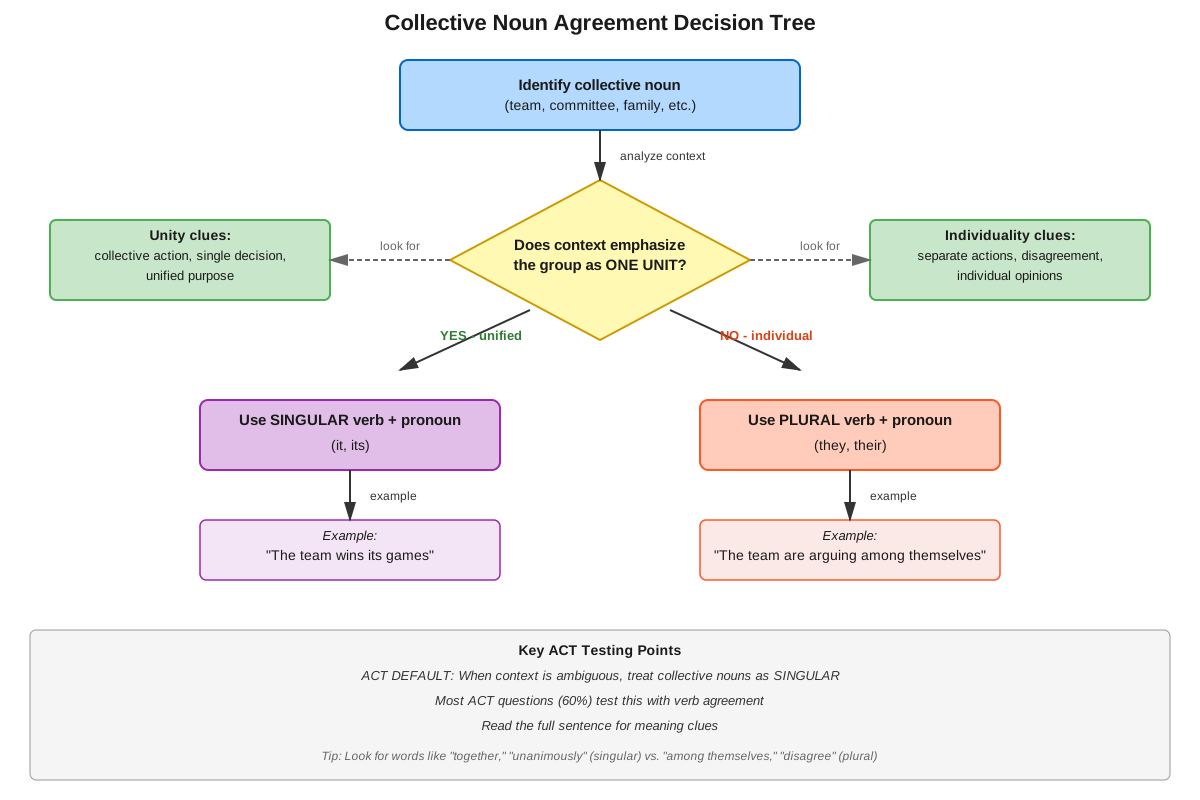
When a collective noun refers to a group acting together as a single unit, it takes singular verbs and singular pronouns (it, its). This is the default and most common usage in American English, which the ACT follows.
Indicators of unified action:
- The group performs one action together
- The sentence emphasizes the group as a whole
- The action cannot be performed by individuals separately
- Words like "as a whole," "unanimously," or "together" appear
Examples:
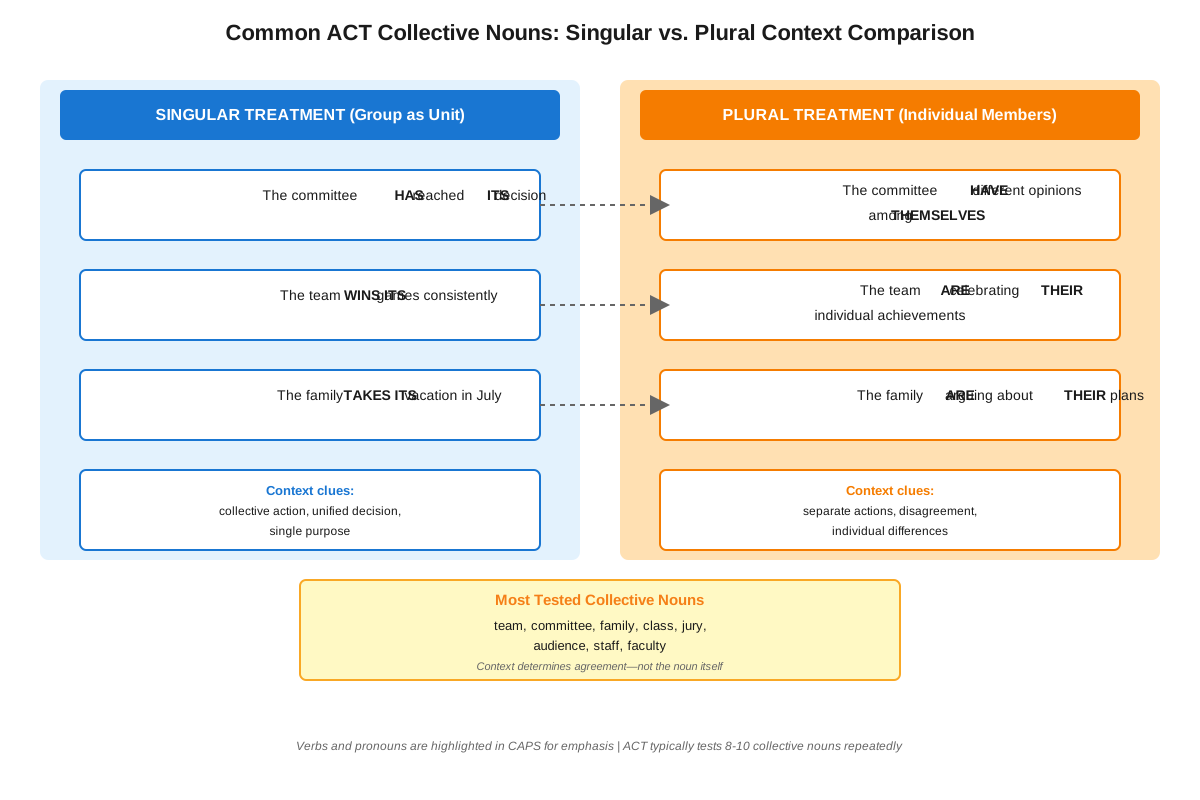
- "The committee has reached its decision." (The committee acts as one unit)
- "The audience was silent during the performance." (The entire audience shared one state)
- "The team is ranked first in the nation." (The team holds one collective ranking)
The Individual Members Rule (Plural Treatment)
When a collective noun emphasizes individual members acting separately or having different opinions, it takes plural verbs and plural pronouns (they, their, them). This usage is less common but appears on the ACT specifically because it tests deeper understanding.
Indicators of individual action:
- Members disagree or have different opinions
- Individuals perform separate actions
- The sentence mentions individual preferences, choices, or behaviors
- Words like "disagree," "debate," "each," "individual," or "members" appear
Examples:
- "The committee are divided in their opinions." (Individual members hold different views)
- "The family were seated at different tables." (Individual family members sat separately)
- "The jury have returned to their homes." (Individual jurors went to separate homes)
American vs. British English Conventions
The ACT follows American English conventions, which strongly prefer treating collective nouns as singular unless context clearly indicates individual action. British English more readily treats collective nouns as plural, especially for sports teams and organizations. This distinction matters because students exposed to British media or literature might incorrectly apply British conventions on the ACT.
| American English (ACT Standard) | British English |
|---|---|
| The team is winning. | The team are winning. |
| The government has decided. | The government have decided. |
| The band is performing. | The band are performing. |
ACT Tip: When in doubt on the ACT, choose singular treatment for collective nouns unless the sentence explicitly indicates individual members acting separately.
Context Clues for Determining Treatment
Successful ACT performance requires quickly identifying context clues that signal whether singular or plural treatment is appropriate:
Singular context clues:
- Collective decision or action words: "decided," "voted," "agreed," "announced"
- Single outcome or result: "won," "lost," "achieved," "received"
- Unified state or condition: "is ready," "was prepared," "remains committed"
- Possessive indicating group ownership: "the team's victory" (one victory)
Plural context clues:
- Disagreement or division: "disagree," "debate," "argue," "differ"
- Individual actions: "went to their homes," "expressed their opinions," "cast their votes"
- Separate possessions or characteristics: "their individual talents," "their own ideas"
- Phrases emphasizing members: "members of the committee," "each player"
Pronoun Consistency with Collective Nouns
Once a collective noun's treatment (singular or plural) is established in a sentence or passage, all related pronouns must maintain consistency. The ACT frequently tests this by placing the collective noun in one sentence and the pronoun reference in a following sentence.
Correct consistency:
- "The orchestra performed brilliantly. It received a standing ovation." (both singular)
- "The jury were unable to agree. They requested additional evidence." (both plural)
Incorrect inconsistency:
- ❌ "The class completed its assignment. They submitted them on time." (shifts from singular to plural)
- ✓ "The class completed its assignment. It submitted it on time." (maintains singular)
Concept Relationships
The collective nouns concept sits at the intersection of multiple grammar principles, making it a sophisticated test of integrated knowledge. Subject-verb agreement provides the foundation → collective nouns add contextual complexity → pronoun-antecedent agreement extends the principle to pronoun references.
Understanding collective nouns requires first mastering basic subject-verb agreement (singular subjects take singular verbs, plural subjects take plural verbs). Collective nouns complicate this by introducing context-dependent variation: the same noun can be singular or plural depending on meaning. This leads to pronoun-antecedent agreement challenges, where students must maintain consistency between the collective noun's treatment and subsequent pronoun references.
The relationship map flows as follows:
Identify the collective noun → Analyze context for unified vs. individual action → Determine singular or plural treatment → Select matching verb form → Ensure pronoun consistency → Verify meaning makes sense
Collective nouns also connect to contextual reading comprehension because correct answers depend on understanding author intent, not just applying mechanical rules. This relationship reinforces that ACT English tests reading and reasoning, not just grammar memorization.
Quick check — test yourself on Collective nouns so far.
Try Flashcards →High-Yield Facts
⭐ Collective nouns are grammatically singular in form but can take singular or plural verbs depending on context.
⭐ American English (ACT standard) defaults to singular treatment unless context clearly indicates individual members acting separately.
⭐ When a collective noun acts as a unified group, use singular verbs (is, has, was) and singular pronouns (it, its).
⭐ When a collective noun emphasizes individual members, use plural verbs (are, have, were) and plural pronouns (they, their, them).
⭐ Pronoun references to collective nouns must maintain consistency throughout a sentence or passage.
- Common collective nouns on the ACT include: team, family, committee, class, audience, jury, staff, faculty, government, company, and group.
- Context clues indicating singular treatment include unified actions, collective decisions, and single outcomes.
- Context clues indicating plural treatment include disagreement, individual actions, and separate possessions.
- The phrase "members of the [collective noun]" signals plural treatment because it emphasizes individuals.
- Collective nouns never take plural forms themselves (no "teams are" when referring to one team; "teams" would be multiple separate teams).
- British English treats collective nouns as plural more frequently than American English, but the ACT follows American conventions.
- Consistency errors (starting singular, switching to plural) are among the most common wrong answers in collective noun questions.
Common Misconceptions
Misconception: All collective nouns always take singular verbs because they're singular nouns.
Correction: While collective nouns are singular in form, they can take plural verbs when the context emphasizes individual members acting separately. The ACT specifically tests this distinction.
Misconception: If a collective noun refers to multiple people, it should always be plural.
Correction: The number of individuals in the group doesn't determine verb agreement; the nature of their action does. A team of 50 players acting together still takes a singular verb.
Misconception: British English and American English treat collective nouns identically.
Correction: British English more readily treats collective nouns as plural, especially for organizations and sports teams. The ACT follows American English conventions, which default to singular treatment.
Misconception: Once you choose singular or plural treatment, you can switch later in the passage if it sounds better.
Correction: Consistency is mandatory. Once a collective noun's treatment is established, all subsequent verb and pronoun references must match throughout the sentence or passage.
Misconception: The word "members" in a sentence means the collective noun should be singular because it's talking about the group.
Correction: The word "members" actually signals plural treatment because it emphasizes individuals within the group. "The committee members have their own opinions" requires plural verbs and pronouns.
Misconception: Collective nouns ending in -s (like "news" or "politics") follow the same rules.
Correction: Words like "news," "mathematics," and "politics" are not collective nouns; they're singular nouns that happen to end in -s and always take singular verbs regardless of context.
Worked Examples
Example 1: Identifying Unified vs. Individual Action
Question: The jury (has/have) been deliberating for three hours, but (it/they) cannot agree on a verdict.
Step 1: Identify the collective noun
"Jury" is the collective noun in question.
Step 2: Analyze the first clause context
"Been deliberating for three hours" describes a unified action—the jury as a whole has been in deliberation together. This suggests singular treatment: "has been deliberating."
Step 3: Analyze the second clause context
"Cannot agree on a verdict" explicitly indicates disagreement among individual members. You cannot disagree as a unified group; disagreement inherently involves individuals with different opinions. This signals plural treatment: "they cannot agree."
Step 4: Recognize the shift
This sentence intentionally shifts from unified action (deliberating together) to individual action (disagreeing). This is grammatically correct when the context changes.
Correct answer: "The jury has been deliberating for three hours, but they cannot agree on a verdict."
Learning objective connection: This example demonstrates how to analyze context clues (unified action vs. disagreement) and apply the appropriate treatment, addressing the objective of distinguishing between collective nouns functioning as unified groups versus individual members.
Example 2: Maintaining Pronoun Consistency
Question: The orchestra performed Beethoven's Ninth Symphony last night. (It/They) received enthusiastic applause from the audience, and (its/their) conductor was visibly moved by the response.
Step 1: Identify the collective noun and its treatment
"Orchestra" is the collective noun. The sentence describes the orchestra performing together as a unified group—one performance of one symphony.
Step 2: Determine initial treatment
Since the orchestra acts as a unified entity performing together, singular treatment is appropriate.
Step 3: Apply consistency to first pronoun
The first pronoun refers to the orchestra receiving applause. Since we've established singular treatment, use "It received."
Step 4: Apply consistency to second pronoun
The second pronoun shows possession (the conductor belonging to the orchestra). Maintain singular treatment: "its conductor."
Step 5: Verify meaning
"It received applause" and "its conductor" both make sense with the orchestra acting as one unit. The meaning is clear and consistent.
Correct answer: "The orchestra performed Beethoven's Ninth Symphony last night. It received enthusiastic applause from the audience, and its conductor was visibly moved by the response."
Learning objective connection: This example addresses the objective of ensuring pronoun consistency and demonstrates how to maintain singular treatment throughout related clauses when the context indicates unified action.
Exam Strategy
Recognition Triggers
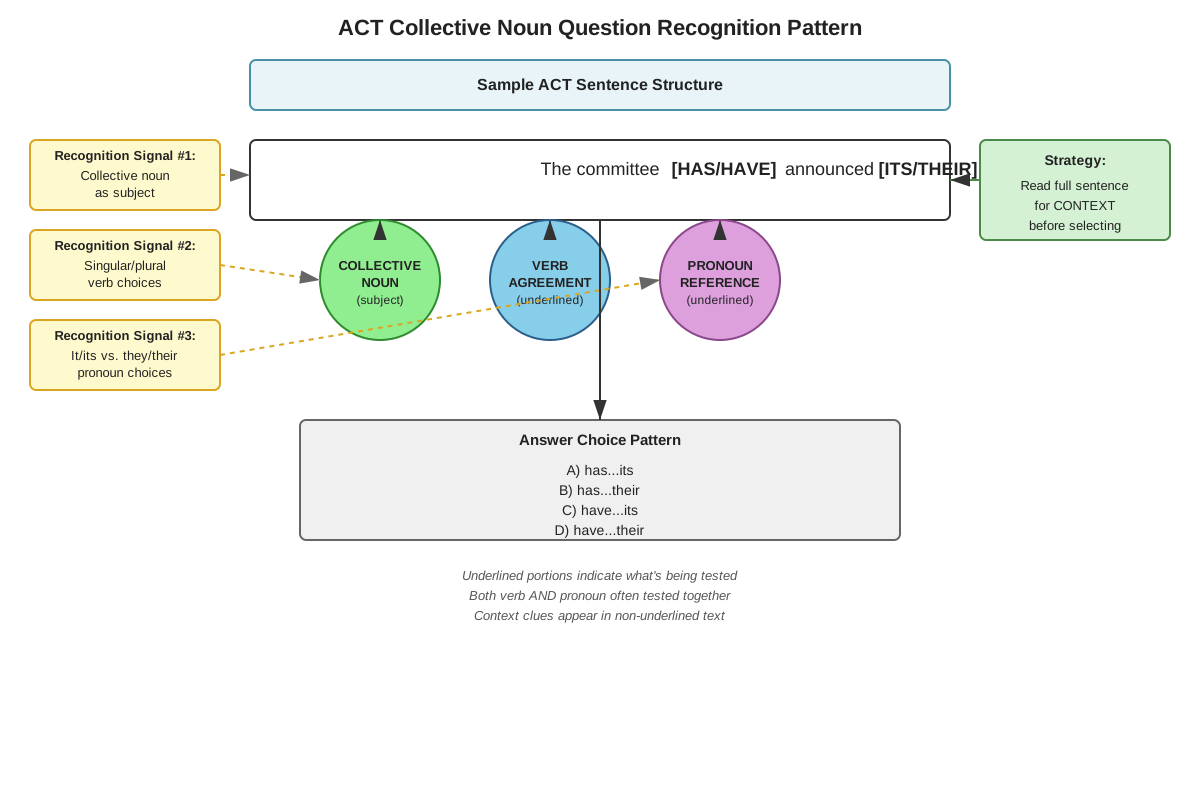
ACT collective noun questions contain specific trigger words and patterns that signal the concept is being tested:
Primary triggers:
- Collective nouns themselves: team, family, committee, class, jury, audience, staff, faculty, government, company, group, crowd, band, orchestra
- Underlined verbs immediately following collective nouns
- Underlined pronouns (it/they, its/their) referring to groups
- Answer choices that differ only in singular vs. plural forms
Context triggers:
- Words indicating unity: "together," "as a whole," "unanimously," "collectively"
- Words indicating division: "disagree," "debate," "individually," "members," "each"
Systematic Approach
Follow this four-step process for every collective noun question:
- Identify: Locate the collective noun and determine what verb or pronoun relates to it
- Analyze: Read the surrounding context for clues about unified vs. individual action
- Apply: Choose singular or plural treatment based on context (default to singular if ambiguous)
- Verify: Check that all related pronouns maintain consistency and the meaning makes sense
Process of Elimination
When answer choices differ in singular/plural treatment:
- Eliminate inconsistent options first: If the passage has already established singular treatment, eliminate any answer that switches to plural (or vice versa)
- Eliminate based on clear context clues: If the sentence contains "disagree" or "their individual," eliminate singular options
- Default to singular in ambiguous cases: When context doesn't clearly indicate individual action, the ACT expects singular treatment following American English conventions
- Check for meaning: Eliminate any option that creates an illogical meaning, even if it's grammatically possible
Time Management
Collective noun questions should take 15-20 seconds each:
- 5 seconds: Identify the collective noun and read context
- 5 seconds: Determine unified vs. individual action
- 5 seconds: Select answer and verify consistency
- 5 seconds: Move to next question
Don't overthink these questions. If you're spending more than 30 seconds, you're likely overcomplicating the analysis. Trust the context clues and move forward.
Memory Techniques
The UNITY Mnemonic
Unified action = singular
Notice context clues
Individual members = plural
Treat consistently
Yield to American English defaults
The "One Action, One Verb" Visualization
Picture the collective noun as either:
- A single circle (unified group) → singular verb/pronoun
- Multiple dots (individual members) → plural verb/pronoun
When you see "The team," visualize whether the sentence describes one circle moving together or multiple dots moving separately.
The Disagreement Trigger
Remember: "Disagreement = They"
Any context involving disagreement, debate, or differing opinions automatically signals plural treatment because you cannot disagree as a unified entity.
The Default Rule Acronym: SAUD
Singular is
American
Usage
Default
When in doubt on the ACT, choose singular treatment for collective nouns.
The Consistency Check Rhyme
"Once you pick singular or plural treatment,
Every pronoun needs the same agreement."
Summary
Collective nouns represent groups of individuals but function as grammatically singular nouns that can take either singular or plural verbs and pronouns depending on context. The ACT tests whether students can analyze context to determine if a collective noun acts as a unified entity (requiring singular treatment with verbs like "is" and pronouns like "it") or as individual members (requiring plural treatment with verbs like "are" and pronouns like "they"). American English, which the ACT follows, defaults to singular treatment unless context explicitly indicates individual action through clues like disagreement, separate actions, or phrases emphasizing members. Consistency is crucial—once singular or plural treatment is established, all related pronouns must match throughout the sentence or passage. Success on ACT collective noun questions requires identifying the collective noun, analyzing context clues, applying the appropriate treatment, and verifying consistency and meaning.
Key Takeaways
- Collective nouns can be singular or plural depending on whether the group acts as a unified entity or as individual members
- American English (ACT standard) defaults to singular treatment unless context clearly indicates individual action
- Context clues like "disagree," "debate," or "their individual" signal plural treatment; unified actions signal singular treatment
- Maintain strict consistency between collective noun treatment and all related pronouns throughout sentences and passages
- Common ACT collective nouns include team, family, committee, class, jury, audience, staff, and government
- When in doubt, choose singular treatment—it's the American English default and most likely correct on the ACT
- Read for meaning, not just mechanics—the correct answer depends on what the author intends to convey about group vs. individual action
Related Topics
Subject-Verb Agreement: Mastering collective nouns builds on and reinforces fundamental subject-verb agreement principles, preparing students for more complex agreement scenarios involving compound subjects and intervening phrases.
Pronoun-Antecedent Agreement: Understanding collective nouns directly enables mastery of pronoun consistency, a related high-yield ACT topic that tests whether pronouns match their antecedents in number, person, and gender.
Contextual Reading in Grammar: Collective noun questions demonstrate that ACT English tests reading comprehension alongside grammar, preparing students for other context-dependent grammar concepts like verb tense consistency and modifier placement.
American vs. British English Conventions: Exploring collective noun differences between American and British English helps students recognize and apply ACT-specific conventions across multiple grammar topics.
Practice CTA
Now that you understand the principles governing collective nouns and their agreement patterns, it's time to cement your mastery through practice. Attempt the practice questions to apply these concepts to ACT-style scenarios, and use the flashcards to reinforce high-yield facts and context clues. Remember: collective nouns appear 2-4 times per ACT English section, making them excellent targets for score improvement. Each question you master brings you closer to your target score. You've learned the strategy—now prove you can execute it under test conditions!
Sign up free to keep reading
Create a free AnvayaPrep account to finish this ACT guide on Collective nouns — plus flashcards and practice questions.