Overview
Subject-verb agreement is one of the most frequently tested grammar concepts on the ACT English section, appearing in approximately 10-15% of all grammar questions. This fundamental principle requires that subjects and verbs match in number—singular subjects take singular verbs, while plural subjects take plural verbs. While this rule sounds straightforward, the ACT deliberately constructs sentences that obscure the relationship between subjects and verbs, making this a high-yield area for point gains when students master the underlying patterns.
The ACT tests subject-verb agreement through strategically placed distractors, including prepositional phrases between subjects and verbs, inverted sentence structures, compound subjects, and indefinite pronouns with non-intuitive number rules. Understanding ACT subject-verb agreement requires not just knowing the basic rule, but also developing the ability to identify the true subject of a sentence regardless of how many words separate it from its verb. This skill directly impacts performance on 4-6 questions per test, making it one of the highest-return investments of study time.
Subject-verb agreement connects to broader grammar concepts including pronoun-antecedent agreement, verb tense consistency, and sentence structure. Mastering this topic strengthens overall sentence analysis skills and provides a foundation for understanding more complex grammatical relationships. Students who excel at identifying subjects and verbs can more easily parse complicated sentence structures, recognize fragments and run-ons, and make informed decisions about punctuation placement.
Learning Objectives
- [ ] Identify when subject-verb agreement is being tested in ACT questions
- [ ] Explain the core rule or strategy behind subject-verb agreement
- [ ] Apply subject-verb agreement to ACT-style questions accurately
- [ ] Recognize and eliminate intervening phrases that obscure subject-verb relationships
- [ ] Determine the correct verb form for compound subjects, indefinite pronouns, and collective nouns
- [ ] Identify inverted sentence structures and correctly match subjects with verbs
- [ ] Distinguish between singular and plural verb forms in all tenses
Prerequisites
- Basic sentence structure: Understanding what constitutes a complete sentence is essential for identifying subjects and verbs as the core components
- Parts of speech identification: Recognizing nouns, pronouns, and verbs enables students to locate the elements that must agree
- Singular vs. plural noun forms: Distinguishing between singular and plural nouns is necessary to determine which verb form is appropriate
- Present tense verb conjugation: Familiarity with how verbs change form (e.g., "walk" vs. "walks") provides the foundation for agreement rules
Why This Topic Matters
Subject-verb agreement appears in everyday communication, academic writing, and professional correspondence. Errors in agreement signal carelessness or lack of grammatical knowledge, potentially undermining credibility in college applications, workplace emails, and formal presentations. Strong command of this concept enables clear, professional communication across all contexts.
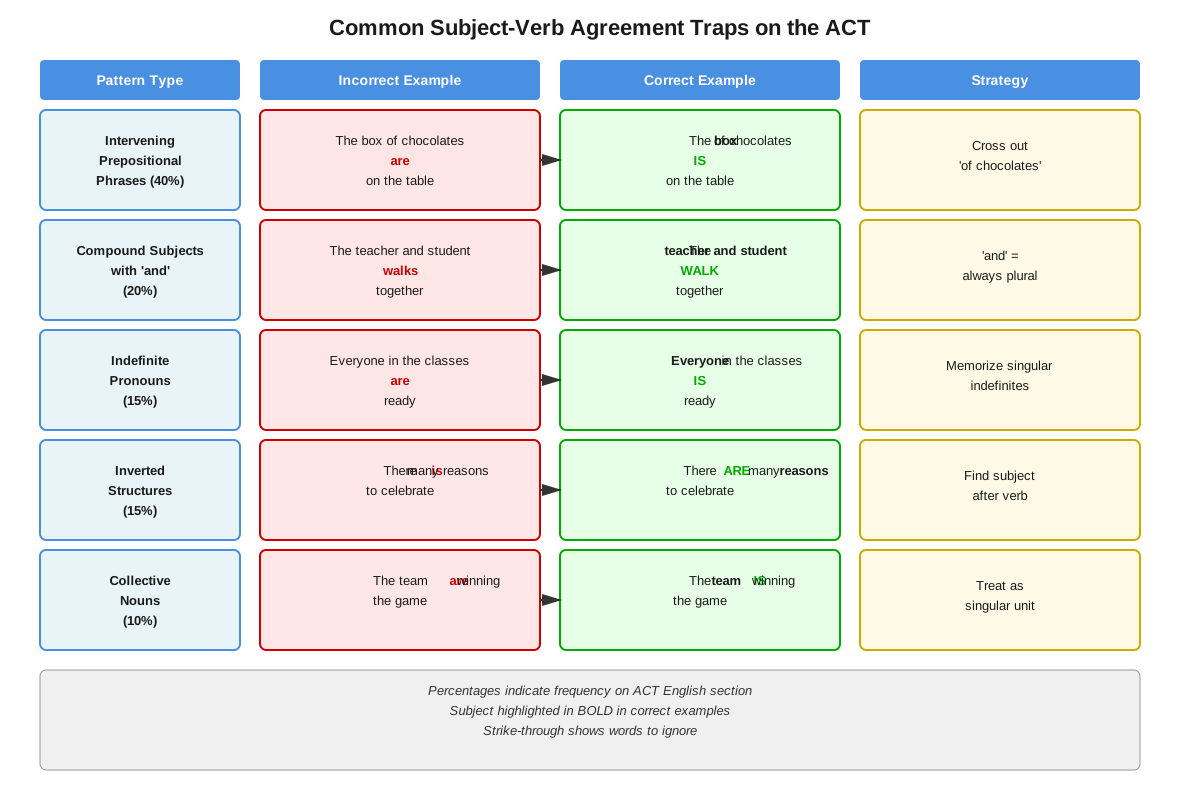
On the ACT English section, subject-verb agreement questions appear with remarkable consistency. Students can expect 4-6 questions per test, representing approximately 8-12% of the total English score. These questions typically appear as underlined verb choices within reading passages, with answer options presenting different verb forms. The ACT favors certain patterns: intervening prepositional phrases (40% of questions), compound subjects (20%), indefinite pronouns (15%), inverted structures (15%), and collective nouns or tricky singular subjects (10%).
The ACT embeds subject-verb agreement errors within authentic-seeming passages about science, humanities, social studies, and personal narratives. Questions often appear in sentences with 15-25 words between the subject and verb, or in sentences where the grammatical subject differs from the logical focus. The test writers deliberately place plural nouns immediately before singular verbs (or vice versa) to create attractive wrong answers that "sound right" to students who match verbs to the nearest noun rather than the true subject.
Core Concepts
The Fundamental Rule
Subject-verb agreement requires that subjects and verbs match in number and person. Singular subjects take singular verbs, while plural subjects take plural verbs. In present tense, singular verbs typically end in "-s" or "-es" (walks, teaches, is, has), while plural verbs use the base form (walk, teach, are, have). This pattern reverses the noun rule where plurals add "-s"—a common source of confusion.
Person refers to the relationship between the subject and speaker: first person (I, we), second person (you), or third person (he, she, it, they). The ACT primarily tests third-person agreement, where the singular/plural distinction is most visible.
Intervening Phrases and Clauses
The most common ACT trap involves placing modifying phrases between the subject and verb. Prepositional phrases, relative clauses, and appositives can create distance and introduce plural nouns that tempt students to choose incorrect verb forms.
Pattern: Subject + [intervening phrase with different number] + Verb
Example: "The collection of rare stamps is valuable." (NOT "are")
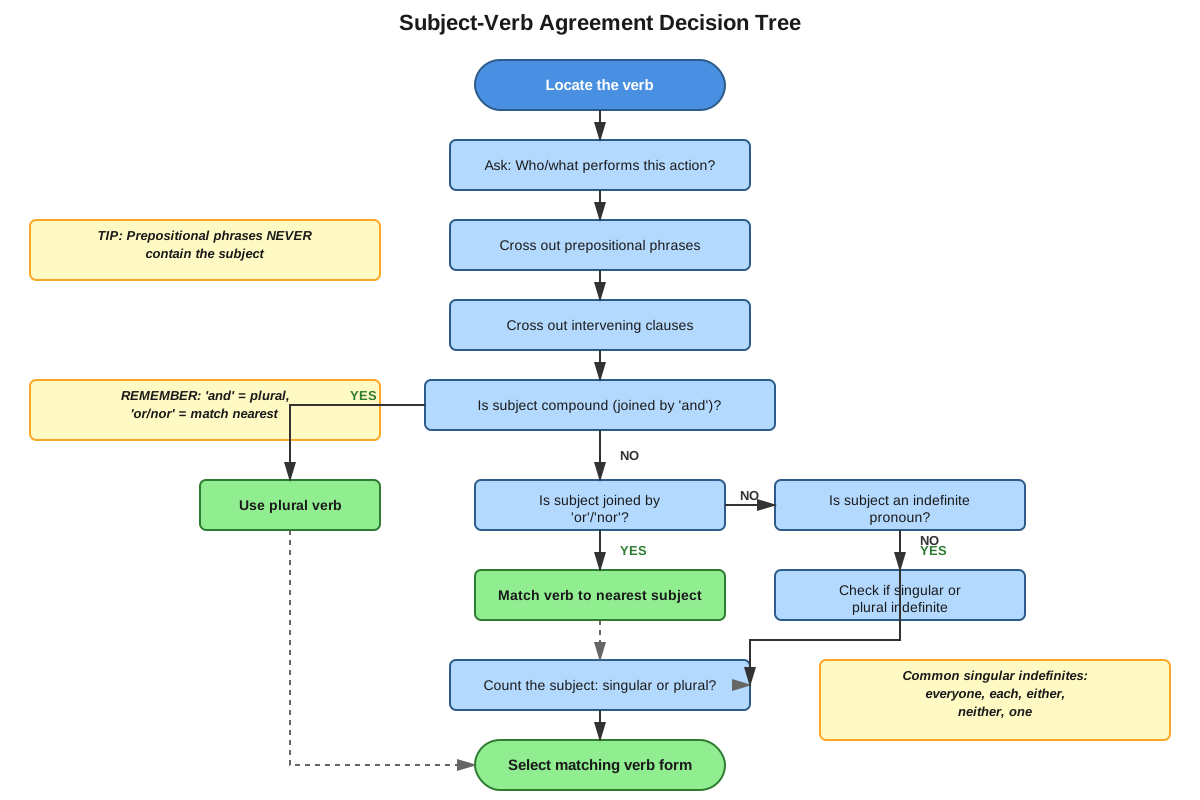
The true subject is "collection" (singular), not "stamps" (plural). To identify the correct verb, mentally cross out or ignore everything between the subject and verb:
"The collection ~~of rare stamps~~ is valuable."
Common intervening structures include:
- Prepositional phrases: of, in, on, with, by, for, from, to
- Relative clauses: who, which, that
- Participial phrases: beginning with -ing or -ed verbs
- Appositives: renaming phrases set off by commas
Compound Subjects
Compound subjects involve two or more subjects joined by conjunctions. The conjunction determines whether the verb should be singular or plural.
| Conjunction | Rule | Example |
|---|---|---|
| and | Usually plural | "The cat and dog are sleeping." |
| or, nor | Verb agrees with nearest subject | "Neither the teacher nor the students are ready." |
| or, nor | Verb agrees with nearest subject | "Neither the students nor the teacher is ready." |
Exception: When compound subjects joined by "and" refer to a single entity or concept, use a singular verb: "Peanut butter and jelly is my favorite sandwich."
Indefinite Pronouns
Indefinite pronouns refer to non-specific people or things. Their number is not always intuitive, making them high-yield ACT targets.
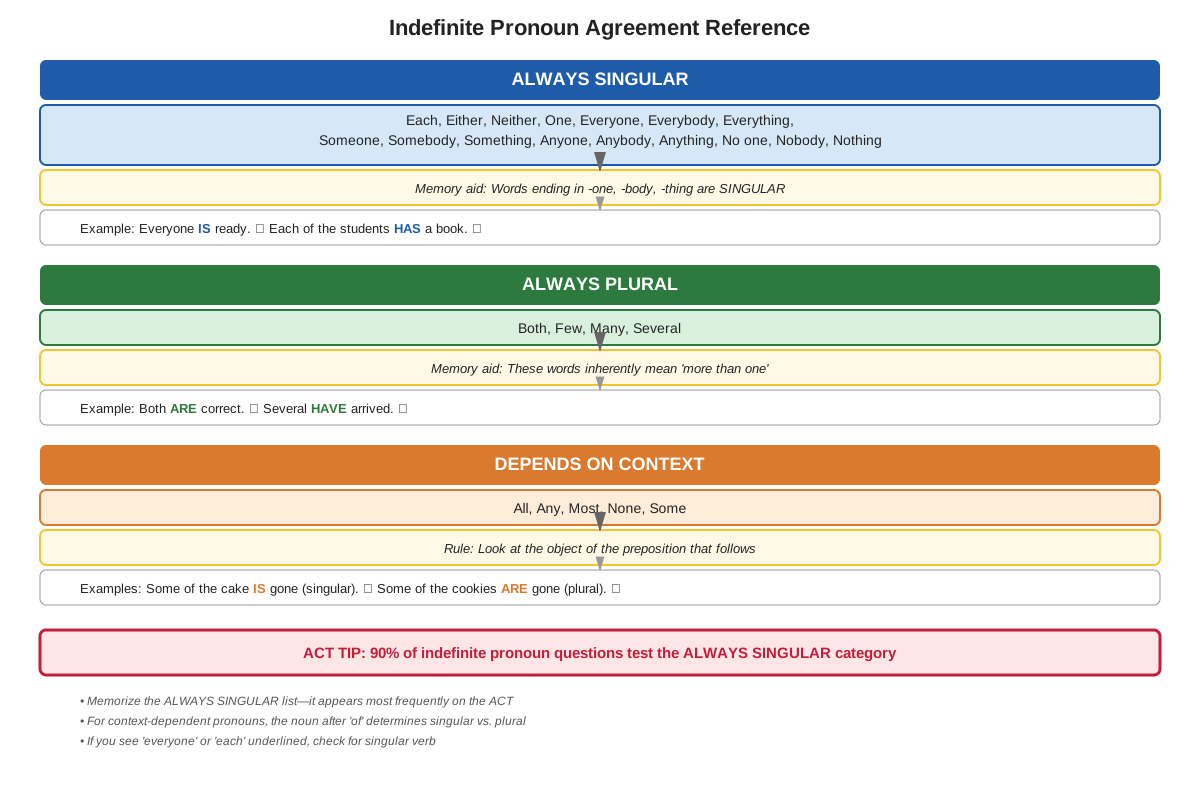
Always singular: each, either, neither, one, everyone, everybody, everything, someone, somebody, something, anyone, anybody, anything, no one, nobody, nothing
Example: "Everyone in the three classes has completed the assignment." (NOT "have")
Always plural: both, few, many, several, others
Example: "Several of the students have finished early."
Context-dependent: all, any, most, none, some (depends on the noun in the prepositional phrase that follows)
- "All of the cake is gone." (cake is singular)
- "All of the cookies are gone." (cookies is plural)
Inverted Sentence Structure
Normal English word order places the subject before the verb (Subject-Verb-Object). Inverted structures reverse this pattern, often beginning with "there" or "here," or placing prepositional phrases first. The ACT frequently tests whether students can identify the true subject in these constructions.
"There" and "Here" constructions: These words are never subjects. The true subject follows the verb.
- "There are three reasons for this decision." (subject: "reasons")
- "Here is the solution to your problem." (subject: "solution")
Prepositional phrase inversions: Questions and emphatic statements may begin with prepositional phrases.
- "Among the applicants was one exceptional candidate." (subject: "candidate")
- "In the garden grow several varieties of roses." (subject: "varieties")
Collective Nouns and Special Cases
Collective nouns refer to groups as single units: team, committee, family, jury, audience, class, government, company. In American English (which the ACT follows), these typically take singular verbs when the group acts as one unit.
- "The committee has reached a decision."
- "The team is celebrating its victory."
Titles and names: Titles of books, movies, companies, and other entities take singular verbs, even if they appear plural.
- "The United States is a large country."
- "The Chronicles of Narnia is a beloved series."
Subjects expressing amounts: Time, money, distance, and weight expressions take singular verbs when referring to a total amount.
- "Five dollars is the admission price."
- "Two weeks is not enough time."
Relative Pronouns in Dependent Clauses
When "who," "which," or "that" serves as the subject of a dependent clause, the verb must agree with the antecedent (the noun the pronoun refers to).
- "She is one of the students who are studying abroad." (who refers to "students")
- "He is the only one of the candidates who has relevant experience." (who refers to "one")
The phrase "one of the [plural noun] who" is particularly tricky. The verb typically agrees with the plural noun unless "only" or "first" appears before "one."
Concept Relationships
Subject-verb agreement fundamentally depends on subject identification → which requires eliminating intervening phrases → which demands recognizing prepositional phrases and modifiers. This chain represents the core skill progression for ACT success.
The concept connects to pronoun-antecedent agreement through parallel logic: both require matching grammatical elements in number. Students who master subject-verb agreement often find pronoun agreement more intuitive because they've developed the skill of tracking relationships across sentence distance.
Compound subjects relate to coordination and parallelism because both involve joining elements with conjunctions. Understanding how "and," "or," and "nor" affect agreement prepares students for questions about parallel structure.
Inverted sentence structures connect to sentence variety and style questions, as the ACT sometimes asks whether a reordering improves clarity or emphasis. Recognizing inverted structures also aids in identifying sentence fragments, since students must locate the true subject and verb to verify completeness.
The relationship map flows as follows:
Basic subject-verb matching → Identifying true subjects → Handling intervening phrases → Managing compound subjects → Applying indefinite pronoun rules → Recognizing inversions → Mastering special cases → Consistent ACT accuracy
Quick check — test yourself on Subject-verb agreement so far.
Try Flashcards →High-Yield Facts
⭐ Singular subjects take singular verbs; plural subjects take plural verbs—this rule never changes regardless of sentence complexity
⭐ Prepositional phrases between subjects and verbs do not affect agreement; always identify the true subject by eliminating these phrases
⭐ Indefinite pronouns ending in -one, -body, or -thing are always singular: everyone has, somebody is, nothing was
⭐ Compound subjects joined by "and" are usually plural; those joined by "or" or "nor" agree with the nearest subject
⭐ "There" and "here" are never subjects; the true subject follows the verb in these constructions
- Each, either, and neither are always singular, even when followed by prepositional phrases with plural objects
- Collective nouns (team, family, committee) take singular verbs in American English when acting as a unit
- Titles, company names, and country names take singular verbs regardless of plural-looking forms
- The pronouns "all," "any," "most," "none," and "some" can be singular or plural depending on context
- In present tense, third-person singular verbs add -s or -es; plural verbs use the base form (this reverses the noun pattern)
- Amounts of time, money, distance, or weight take singular verbs when expressing a total: "Ten dollars is enough"
- The phrase "one of the [plural] who" typically takes a plural verb: "one of the students who are"
- Inverted questions maintain agreement rules: "Where is the book?" but "Where are the books?"
- Subjects expressing mathematical operations take singular verbs: "Two plus two equals four"
- The verb "to be" changes form more than other verbs: is/are, was/were, has been/have been
Common Misconceptions
Misconception: The verb should agree with the noun closest to it.
Correction: The verb must agree with the true grammatical subject, which may be separated from the verb by multiple words. Always identify the subject by eliminating intervening phrases, not by proximity.
Misconception: Compound subjects joined by "or" are always singular.
Correction: With "or" or "nor," the verb agrees with the nearest subject. "The teacher or the students are responsible" uses a plural verb because "students" (plural) is nearest, while "The students or the teacher is responsible" uses singular because "teacher" is nearest.
Misconception: "None" always takes a singular verb because it means "not one."
Correction: "None" can be singular or plural depending on the noun it refers to. "None of the cake is left" (singular) but "None of the students are absent" (plural). Modern usage accepts both interpretations, but context determines the better choice.
Misconception: Collective nouns like "team" or "family" can take either singular or plural verbs interchangeably.
Correction: In American English (ACT standard), collective nouns take singular verbs when the group acts as one unit. British English allows plural verbs for collective nouns, but the ACT follows American conventions exclusively.
Misconception: Indefinite pronouns like "everyone" should take plural verbs because they refer to multiple people.
Correction: Despite referring to multiple individuals logically, "everyone," "everybody," and similar pronouns are grammatically singular and always take singular verbs: "Everyone is here" (not "are").
Misconception: In sentences beginning with "there," the word "there" is the subject.
Correction: "There" is an expletive (placeholder word) with no grammatical function as a subject. The true subject follows the verb: "There are three options" (subject: "options").
Misconception: Plural-looking subjects always take plural verbs.
Correction: Some plural-appearing subjects are grammatically singular: "The United States is," "mathematics is," "news is." Titles and fields of study follow this pattern regardless of their form.
Worked Examples
Example 1: Intervening Prepositional Phrases
Question: The discovery of ancient artifacts in the ruins (A) have provided / (B) has provided / (C) are providing / (D) provide valuable insights into early civilizations.
Step 1 - Identify the subject: What is doing the action? "The discovery" is the subject (singular noun).
Step 2 - Eliminate intervening phrases: Cross out "of ancient artifacts" and "in the ruins"—both are prepositional phrases that modify the subject but don't affect agreement.
Simplified sentence: "The discovery ~~of ancient artifacts in the ruins~~ ___ valuable insights."
Step 3 - Determine subject number: "Discovery" is singular (one discovery).
Step 4 - Match verb to subject: Singular subject requires singular verb. In present perfect tense, the singular form is "has provided."
Step 5 - Eliminate wrong answers:
- (A) "have provided" - plural verb, incorrect
- (C) "are providing" - plural verb, incorrect
- (D) "provide" - plural verb, incorrect
Answer: (B) "has provided"
Learning objective connection: This example demonstrates identifying when subject-verb agreement is tested (underlined verb with multiple forms) and applying the core strategy (eliminate intervening phrases, match verb to true subject).
Example 2: Compound Subject with "Or"
Question: Neither the principal nor the teachers (F) was / (G) were / (H) is / (J) are aware of the scheduling conflict until yesterday.
Step 1 - Identify compound subject: "Neither the principal nor the teachers" - two subjects joined by "nor."
Step 2 - Apply compound subject rule: With "neither...nor" or "either...or," the verb agrees with the nearest subject.
Step 3 - Identify nearest subject: "teachers" (plural) is closest to the verb.
Step 4 - Determine tense from context: "until yesterday" indicates past tense is needed.
Step 5 - Match verb: Plural subject + past tense = "were"
Step 6 - Eliminate wrong answers:
- (F) "was" - singular, incorrect
- (H) "is" - present tense, incorrect
- (J) "are" - present tense, incorrect
Answer: (G) "were"
Learning objective connection: This example shows how to apply subject-verb agreement rules to compound subjects and demonstrates the importance of considering both number and tense when selecting the correct verb form.
Exam Strategy
Recognition triggers: Subject-verb agreement questions appear when verbs are underlined and answer choices present different forms of the same verb (is/are, was/were, has/have). If you see these patterns, immediately identify the subject before reading the answer choices.
The elimination strategy:
- Locate the verb in question (underlined portion)
- Work backward to find the true subject
- Cross out all prepositional phrases and modifying clauses between subject and verb
- Determine if the subject is singular or plural
- Eliminate all verb forms that don't match the subject's number
- Check remaining options for tense consistency with the rest of the sentence
Watch for these red flags:
- Long sentences with multiple commas (likely hiding the subject)
- Sentences beginning with "there" or "here" (inverted structure)
- Indefinite pronouns (everyone, each, several, etc.)
- Compound subjects with "and," "or," or "nor"
- Collective nouns (team, committee, family)
- Prepositional phrases starting with "of," "in," "with," "by"
Time management: Subject-verb agreement questions should take 15-20 seconds once you've mastered the patterns. If you're spending more than 30 seconds, you're likely overthinking. Trust the mechanical process: find subject, determine number, match verb.
Process of elimination power: Often you can eliminate 2-3 answer choices immediately based on number alone, leaving only tense or aspect to consider. This dramatically improves guessing odds if you're uncertain.
Exam Tip: Read the sentence aloud mentally with just the subject and verb. "The collection...is" sounds correct; "The collection...are" sounds wrong. Your ear can confirm what grammar rules tell you, but always verify with the rules first.
Common trap patterns to expect:
- Plural noun immediately before the verb, but singular subject earlier: "The cause of these problems is unclear."
- Indefinite pronoun with plural-sounding meaning: "Everyone has arrived."
- Inverted structure hiding the subject: "Among the options is one viable solution."
Memory Techniques
FANBOYS + Agreement: Remember that compound subjects joined by "and" (from FANBOYS) are usually plural, while "or" and "nor" require matching to the nearest subject. Think: "AND adds up to plural."
The -ONE, -BODY, -THING Rule: Any indefinite pronoun ending in these three suffixes is singular. Visualize ONE person, ONE body, ONE thing—all singular concepts.
The Crossing-Out Technique: Develop the habit of physically (or mentally) drawing lines through prepositional phrases. This visual strategy prevents the eye from being distracted by plural nouns that aren't the subject.
"There" and "Here" Rhyme with "Where": None of these words can be subjects—they're location words. The subject is always hiding somewhere else in the sentence.
SANAM Pronouns (Some, Any, None, All, Most): These five pronouns are chameleons—they change based on what follows. Remember SANAM to recall which pronouns need context checking.
The Collective Singular: Picture collective nouns as single containers. A team is ONE unit, a family is ONE group, a committee is ONE body. The container is singular even though it holds multiple items.
Verb -S Reversal: Unlike nouns where -s means plural, verb -s means singular (he walks, she runs). Think: "Singular verbs are Selfish—they take the S for themselves."
Summary
Subject-verb agreement requires matching subjects and verbs in number—singular with singular, plural with plural. The ACT tests this concept by obscuring the relationship between subjects and verbs through intervening phrases, inverted structures, compound subjects, and indefinite pronouns with non-intuitive number rules. Success depends on systematically identifying the true grammatical subject by eliminating prepositional phrases and modifying clauses, then selecting the verb form that matches the subject's number. Compound subjects joined by "and" typically take plural verbs, while those joined by "or" or "nor" agree with the nearest subject. Indefinite pronouns ending in -one, -body, or -thing are always singular, while collective nouns take singular verbs in American English. Inverted structures beginning with "there" or "here" place the subject after the verb, requiring careful identification. Mastering these patterns enables students to quickly and accurately answer 4-6 questions per ACT test, representing a significant score improvement opportunity.
Key Takeaways
- Subject-verb agreement is tested on 4-6 questions per ACT, making it one of the highest-yield grammar topics
- Always eliminate intervening prepositional phrases to identify the true subject before selecting a verb form
- Indefinite pronouns ending in -one, -body, or -thing are always singular regardless of logical meaning
- Compound subjects joined by "and" are usually plural; those joined by "or" or "nor" agree with the nearest subject
- Inverted structures beginning with "there" or "here" place the subject after the verb—these words are never subjects themselves
- Collective nouns take singular verbs in American English when the group acts as a single unit
- In present tense, singular verbs add -s or -es while plural verbs use the base form—the opposite of noun pluralization
Related Topics
Pronoun-Antecedent Agreement: Uses parallel logic to subject-verb agreement, requiring pronouns to match their antecedents in number, person, and gender. Mastering subject-verb agreement provides the analytical framework for pronoun agreement questions.
Verb Tense Consistency: Requires maintaining appropriate tense throughout a passage. Understanding subject-verb agreement helps identify verb forms, which is essential for recognizing tense shifts.
Sentence Fragments and Run-ons: Identifying complete sentences requires locating subjects and verbs. Subject-verb agreement skills strengthen the ability to recognize whether a sentence contains the necessary components.
Parallel Structure: Involves maintaining consistent grammatical forms in lists and comparisons. The coordination concepts in compound subjects directly apply to parallelism questions.
Modifier Placement: Understanding how prepositional phrases and clauses modify subjects helps with both agreement questions and modifier placement questions, as both require identifying what modifies what.
Practice CTA
Now that you've mastered the core concepts of subject-verb agreement, it's time to cement your knowledge through active practice. Complete the practice questions to test your ability to identify subjects, eliminate distractors, and select correct verb forms under timed conditions. Use the flashcards to drill high-yield rules like indefinite pronoun agreement and compound subject patterns until they become automatic. Remember: subject-verb agreement represents 8-12% of your ACT English score—consistent practice on this single topic can raise your overall score by multiple points. Every question you master here is a question you'll answer correctly on test day with confidence and speed.
Sign up free to keep reading
Create a free AnvayaPrep account to finish this ACT guide on Subject-verb agreement — plus flashcards and practice questions.