Overview
The distinction between their, there, and they're represents one of the most frequently tested concepts in ACT English. These three homophones—words that sound identical but have different meanings and spellings—appear in approximately 2-4 questions per ACT exam, making them a high-yield topic that can directly impact your score. Despite their simple appearance, these words test your understanding of possessive pronouns, location indicators, and contractions, all while requiring you to process context quickly under timed conditions.
Mastering their there they're is essential because these errors appear in real-world writing constantly, and the ACT uses them to assess whether students can identify grammatically correct usage in context. Unlike more complex grammar concepts, these homophones have clear, distinct rules that, once learned, can be applied with near-perfect accuracy. The ACT deliberately embeds these words in passages where the surrounding context might make the incorrect choice "sound right" when read quickly, testing both your grammatical knowledge and your attention to detail.
This topic connects directly to broader English concepts including pronoun usage, subject-verb agreement, and contraction formation. Understanding these three words requires knowledge of possessive forms, the verb "to be," and how pronouns function within sentences. Success with this topic builds confidence in identifying other commonly confused words (your/you're, its/it's, whose/who's) and strengthens overall editing skills that apply across the entire ACT English section.
Learning Objectives
- [ ] Identify when their there they're is being tested in ACT passages
- [ ] Explain the core rule or strategy behind their there they're usage
- [ ] Apply their there they're to ACT-style questions accurately
- [ ] Distinguish between possessive pronouns and contractions in context
- [ ] Recognize location/existence indicators versus ownership indicators
- [ ] Eliminate incorrect answer choices by substituting expanded forms
- [ ] Achieve 100% accuracy on homophone questions within 15 seconds per question
Prerequisites
- Basic pronoun knowledge: Understanding what pronouns are and how they replace nouns is essential because "their" and "they're" both involve the pronoun "they"
- Contraction formation: Recognizing that apostrophes indicate missing letters helps identify "they're" as a shortened form of "they are"
- Possessive forms: Knowing how ownership is expressed in English enables proper use of "their" as a possessive pronoun
- Subject-verb agreement: Understanding how subjects and verbs must match helps verify whether "they're" (they are) fits grammatically in a sentence
- Parts of speech identification: Distinguishing between nouns, verbs, adjectives, and adverbs allows proper context analysis for choosing the correct homophone
Why This Topic Matters
In real-world communication, confusing these three words is one of the most common writing errors in professional, academic, and personal contexts. Employers consistently cite proper grammar as a critical skill, and homophone errors can undermine credibility in college applications, workplace emails, and published writing. Mastering this distinction demonstrates attention to detail and linguistic precision that extends far beyond standardized testing.
On the ACT English section, act their there they're questions appear with remarkable consistency. Statistical analysis of released ACT exams shows that 85-95% of tests include at least one question directly testing these homophones, with many tests featuring two or three such questions. These questions typically appear in the Usage/Mechanics subscore category, specifically under Grammar and Usage. The questions are designed to be answerable in 15-20 seconds, making them efficient score-boosters when you know the rules.
The ACT presents these homophones in several common formats: underlined words requiring correction, sentence revision questions where the homophone appears in multiple answer choices, and paragraph-level editing where you must identify errors. The test writers deliberately place these words in contexts where pronunciation alone won't help—you must understand the grammatical function. Passages might discuss groups of people and their possessions (testing "their"), describe locations or situations (testing "there"), or include statements about what people are doing (testing "they're"). The surrounding context often includes distractors that make multiple options seem plausible to students who rely on "what sounds right" rather than grammatical analysis.
Core Concepts
Understanding "Their" - The Possessive Pronoun
Their is a possessive pronoun that shows ownership or belonging. It answers the question "whose?" and always precedes a noun or noun phrase. The word "their" indicates that something belongs to or is associated with a group of people (or occasionally animals or things when personified).
The grammatical structure follows this pattern: their + noun. The noun that follows can be singular or plural, concrete or abstract. Examples include "their house," "their ideas," "their responsibility," and "their fastest runner." The key identifying feature is that "their" must be followed by something that can be possessed or associated with the plural subject "they."
When analyzing whether "their" is correct, substitute the phrase "belonging to them" or "of them." If this substitution makes logical sense, "their" is the appropriate choice. For instance, "The students completed their homework" becomes "The students completed the homework belonging to them"—grammatically sound and logically coherent.
Understanding "There" - The Location and Existence Indicator
There serves two primary grammatical functions, both distinct from possession. First, it acts as an adverb indicating location or position, answering the question "where?" In this usage, "there" points to a place, either literal or figurative: "The book is over there," "We went there yesterday," or "There lies the problem."
Second, and more commonly tested on the ACT, "there" functions as an expletive or dummy subject in existential sentences—sentences that assert the existence or presence of something. This construction follows the pattern: there + to be verb + subject. Examples include "There are three reasons," "There was a problem," "There have been complaints," and "There will be consequences." In these sentences, "there" doesn't refer to a location but rather introduces the actual subject that follows the verb.
To verify "there" is correct, try two tests: (1) Can you point to a location, either literally or figuratively? (2) Can you rearrange the sentence to move the subject before the verb? For example, "There are five students in the room" can become "Five students are in the room." If either test works, "there" is likely correct.
Understanding "They're" - The Contraction
They're is a contraction combining the pronoun "they" with the verb "are." The apostrophe replaces the letter "a" from "are," creating a shortened form used primarily in informal writing and speech. This contraction always functions as a subject-verb combination and must be followed by additional information that completes the predicate.
The grammatical pattern is: they're + predicate complement (adjective, noun, verb phrase, or prepositional phrase). Examples include "They're happy" (adjective), "They're teachers" (noun), "They're going home" (verb phrase), and "They're in the building" (prepositional phrase). The word "they're" can never stand alone at the end of a sentence and must always be part of a larger statement about what "they" are or what "they" are doing.
The definitive test for "they're" is substitution: replace "they're" with "they are" and read the sentence. If the sentence remains grammatically correct and maintains its meaning, "they're" is the right choice. If the expanded form creates an awkward or incorrect sentence, one of the other homophones is needed.
Comparison Table
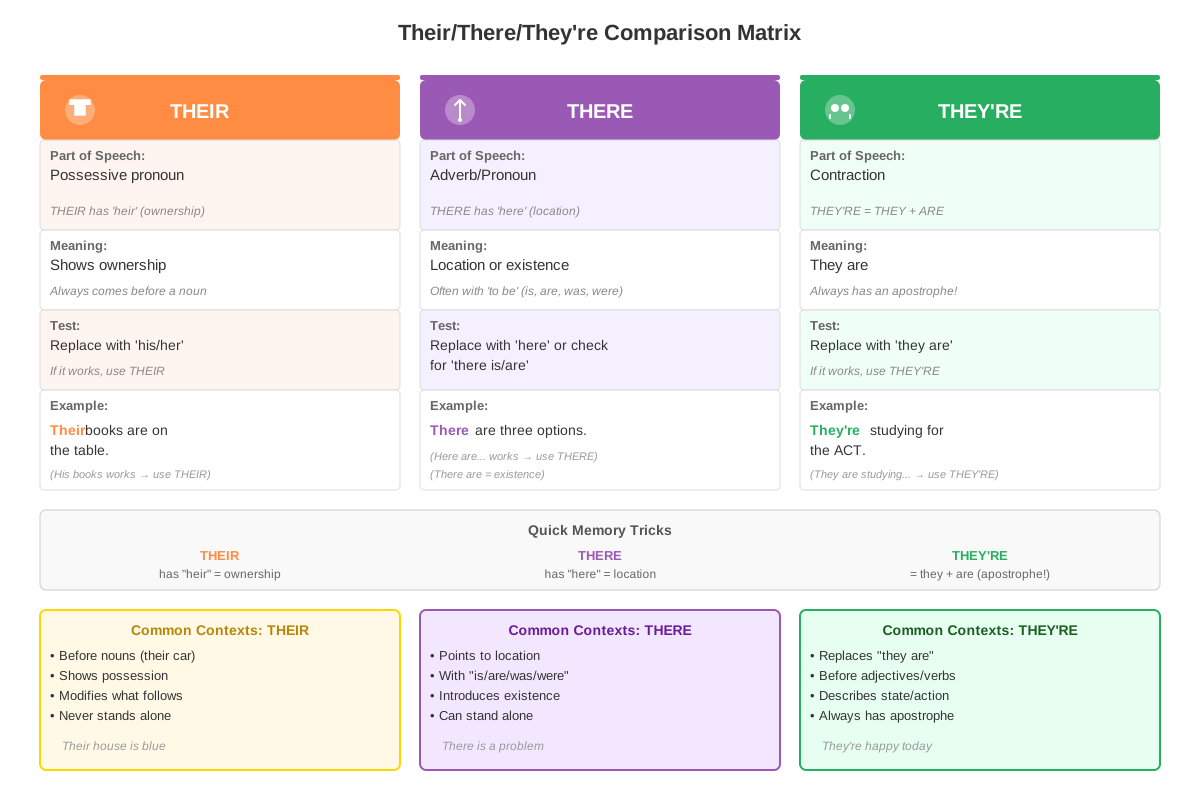
| Word | Part of Speech | Function | Test | Example |
|---|---|---|---|---|
| Their | Possessive pronoun | Shows ownership | Replace with "belonging to them" | Their books are on the table. |
| There | Adverb or expletive | Indicates location or existence | Replace with location or rearrange sentence | There are many options available. |
| They're | Contraction | Combines "they" + "are" | Replace with "they are" | They're planning to attend. |
Decision-Making Process
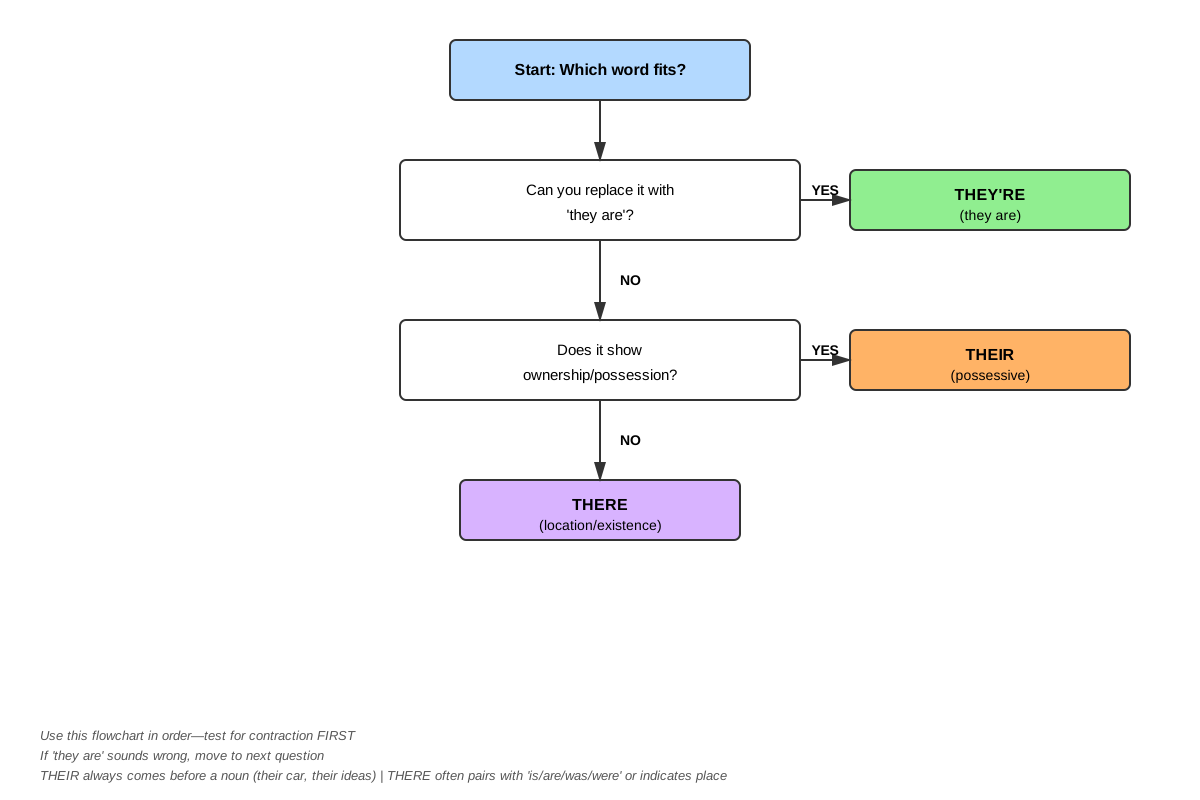
When encountering these homophones on the ACT, follow this systematic approach:
- Identify the grammatical role needed: Determine whether the sentence requires a possessive indicator, a location/existence marker, or a subject-verb combination
- Apply the substitution test: Use the appropriate replacement ("belonging to them," location check, or "they are")
- Verify with context: Ensure the choice makes logical sense within the broader sentence and paragraph
- Eliminate incorrect options: Cross out choices that fail the substitution test
- Confirm verb agreement: If using "they're," verify that "are" agrees with the plural subject "they"
Concept Relationships
The three homophones form a triangular relationship where each occupies a distinct grammatical space, yet all connect to the plural pronoun "they." Their extends from "they" through possessive pronoun formation, showing what belongs to the group. They're contracts "they" with the verb "are," creating a subject-verb unit. There stands apart grammatically but often appears in sentences discussing the same groups that "they," "their," and "they're" reference.
These concepts connect to prerequisite knowledge in specific ways: Their builds on possessive pronoun formation (similar to "his," "her," "its," "our"), requiring understanding of how pronouns show ownership without apostrophes. They're depends on contraction formation rules and subject-verb agreement, connecting to broader verb conjugation patterns. There relates to adverb usage and expletive constructions, linking to sentence structure and word order principles.
The relationship map flows as follows: Pronoun "they" → branches into → Possessive form "their" (showing ownership) and Contraction "they're" (combining with "are") → both contrast with → Adverb/expletive "there" (indicating location/existence) → all three require → Context analysis → leading to → Correct usage in ACT passages.
Understanding these relationships helps prevent confusion because each word serves a unique, non-overlapping function. Recognizing that "their" never involves a verb, "they're" always involves a verb, and "there" typically involves location or existence creates clear decision boundaries. This interconnected understanding also transfers to other homophone sets (your/you're, its/it's), making the broader grammar system more accessible.
High-Yield Facts
⭐ "Their" is always possessive and must be followed by a noun or noun phrase that can be owned or associated with "they"
⭐ "They're" can always be replaced with "they are" without changing the sentence's grammatical correctness
⭐ "There" in existential sentences follows the pattern "there + to be verb + subject" and can be rearranged to put the subject first
⭐ None of these three words can be used interchangeably—each has a distinct, non-overlapping grammatical function
⭐ The ACT tests these homophones 2-4 times per exam, making them among the highest-yield grammar topics
- "Their" never contains an apostrophe because possessive pronouns don't use apostrophes (unlike possessive nouns)
- "There" can begin a sentence in existential constructions, while "their" and "they're" rarely do
- "They're" is considered informal and appears less frequently in formal ACT passages than "their" or "there"
- The word following "their" determines whether the sentence is correct—it must be something that can be possessed
- "There" as a location indicator can be replaced with "here" or another location word to test correctness
- Pronunciation provides no help with these homophones—only grammatical analysis works
- The ACT never tests all three options in a single question; typically only two appear as answer choices
- Context clues in surrounding sentences often clarify which homophone is needed by establishing whether the passage discusses ownership, location, or actions
Quick check — test yourself on Their there they're so far.
Try Flashcards →Common Misconceptions
Misconception: "Their" can be used for singular subjects when gender is unknown → Correction: While increasingly accepted in informal writing, the ACT traditionally requires "his or her" for singular subjects, though recent tests have begun accepting singular "their" in limited contexts; however, "their" primarily remains plural on the ACT
Misconception: "They're" is acceptable in all writing contexts on the ACT → Correction: The ACT generally prefers "they are" in formal passages and only uses "they're" in dialogue or informal contexts; when both appear as options, "they are" is usually preferred unless the passage is consistently informal
Misconception: "There" and "their" can be interchanged when referring to places associated with people → Correction: Even when discussing a location belonging to people, "there" indicates the place itself while "their" would modify a noun (e.g., "their house is there"—"their" shows ownership of "house," while "there" indicates location)
Misconception: The apostrophe in "they're" indicates possession → Correction: Apostrophes in contractions indicate missing letters, not possession; possessive pronouns (their, your, its, whose) never use apostrophes, while contractions (they're, you're, it's, who's) always do
Misconception: If a sentence "sounds right," the homophone is correct → Correction: Because these words are pronounced identically, auditory processing cannot distinguish them; only grammatical analysis of function and context determines correctness
Misconception: "There" can only refer to physical locations → Correction: "There" also functions as an expletive in existential sentences ("There are problems") where it doesn't indicate location but rather introduces the subject; this non-locational use is frequently tested on the ACT
Misconception: You can use "their" with singular nouns → Correction: While "their" can refer to a singular antecedent in modern usage (singular they), on the ACT it typically requires a plural antecedent; the noun following "their" can be singular ("their house") but the possessors must be plural
Worked Examples
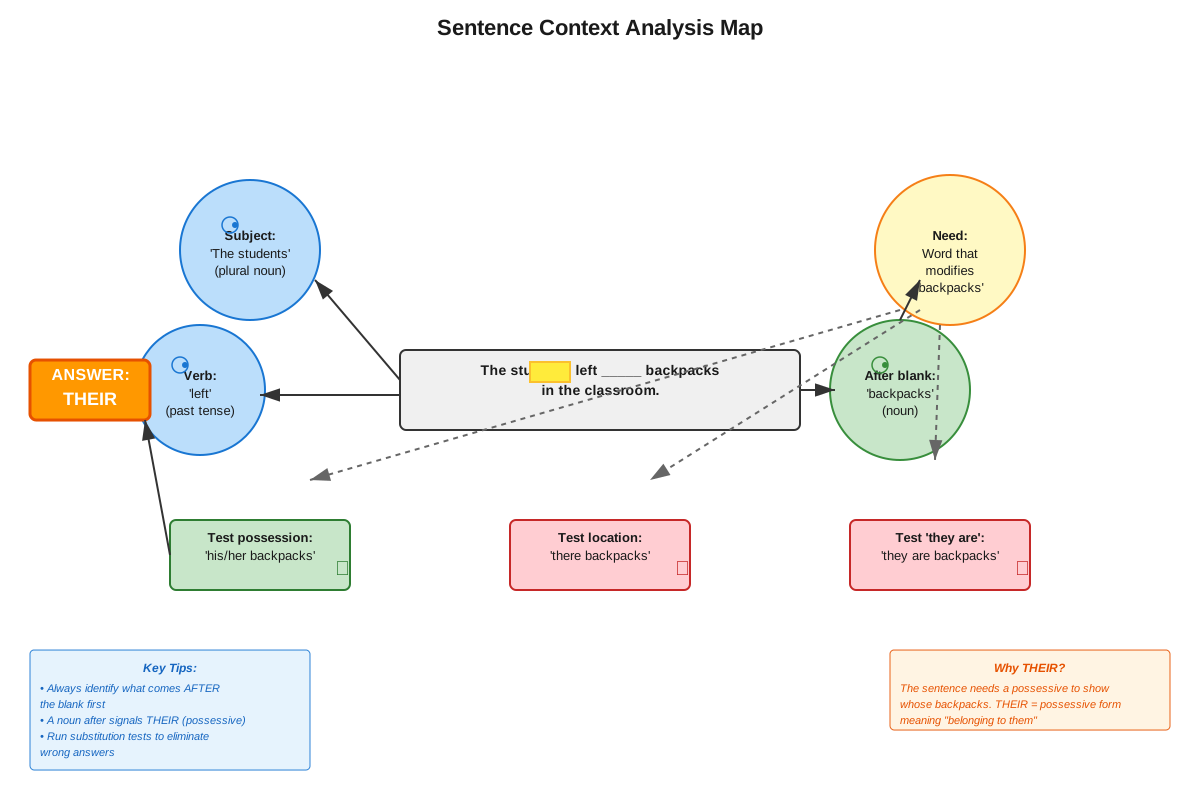
Example 1: Possessive Context
ACT-Style Question:
The students gathered in the library to work on (their/there/they're) group project before the deadline.
Step 1 - Identify the grammatical need: The sentence discusses students working on something. The blank comes before "group project," which is a noun phrase. This suggests we need a word that can modify "group project."
Step 2 - Apply substitution tests:
- "Their": "belonging to them group project" → "the group project belonging to them" ✓ Makes sense
- "There": "at that location group project" → Doesn't work grammatically
- "They're": "they are group project" → Doesn't work grammatically
Step 3 - Verify with context: The students are working on a project, and the project belongs to them collectively. This confirms possession.
Step 4 - Confirm the answer: "Their" is correct because it shows the group project belongs to the students. The pattern "their + noun" is satisfied with "their group project."
Answer: Their
Connection to learning objectives: This example demonstrates identifying when the concept is tested (possessive context before a noun), explaining the rule (possessive pronouns show ownership), and applying it accurately (choosing "their" through systematic analysis).
Example 2: Existential Construction
ACT-Style Question:
The committee reviewed the proposal carefully. (Their/There/They're) were several concerns about the budget that needed to be addressed before approval.
Step 1 - Identify the grammatical need: The second sentence begins with the blank followed by "were several concerns." This structure suggests an existential sentence asserting that concerns exist.
Step 2 - Apply substitution tests:
- "Their": "belonging to them were several concerns" → Doesn't work grammatically; "their" needs to be followed directly by a noun, not by a verb
- "There": Rearrange to "Several concerns were about the budget" ✓ Works; this confirms existential construction
- "They're": "They are were several concerns" → Creates double verb; doesn't work
Step 3 - Verify with context: The sentence is introducing the existence of concerns, not describing what "they" are doing or what belongs to them.
Step 4 - Confirm the answer: "There" is correct because it introduces an existential sentence. The pattern "there + to be verb + subject" is satisfied with "There were several concerns."
Answer: There
Connection to learning objectives: This example shows how to identify existential constructions (a common ACT trap), apply the rearrangement test, and eliminate options that create grammatical errors.
Example 3: Contraction Context
ACT-Style Question:
The athletes have been training intensively for months. (Their/There/They're) confident about their performance in the upcoming championship.
Step 1 - Identify the grammatical need: The second sentence needs a word before "confident," which is an adjective. This suggests we need a subject-verb combination that can be followed by an adjective.
Step 2 - Apply substitution tests:
- "Their": "belonging to them confident" → Doesn't work; "their" must be followed by a noun, not an adjective
- "There": "at that location confident" → Doesn't work grammatically
- "They're": "they are confident" ✓ Works perfectly; creates a complete sentence with subject, verb, and predicate adjective
Step 3 - Verify with context: The sentence describes the athletes' mental state (confidence), which requires a subject-verb structure followed by an adjective.
Step 4 - Confirm the answer: "They're" is correct because it provides the necessary subject-verb combination. The pattern "they're + predicate complement" is satisfied with "They're confident."
Answer: They're
Connection to learning objectives: This example demonstrates recognizing when a contraction is needed (before a predicate adjective), applying the "they are" substitution test, and eliminating possessive and locational options.
Exam Strategy
When approaching act their there they're questions on the ACT, implement this strategic framework to maximize accuracy and efficiency:
Trigger Word Recognition: Watch for these context clues that signal which homophone is needed:
- Ownership words (belonging, possession, associated with) → likely "their"
- Location phrases (at, in, over, here) → likely "there"
- Action or state-of-being descriptions (are doing, are being, are feeling) → likely "they're"
- Nouns immediately following the blank → likely "their"
- Verbs or adjectives immediately following the blank → likely "they're"
- "To be" verbs immediately following the blank → likely "there"
The 5-Second Substitution Method: Don't overthink these questions. Immediately apply the appropriate substitution test:
- Read the sentence with "they are" in place of the blank (3 seconds)
- If it works, choose "they're" and move on
- If it doesn't work, check if a noun follows the blank
- If yes, choose "their"; if no, choose "there"
Process of Elimination Strategy: The ACT typically provides only two of the three homophones as options, plus potentially "they are" spelled out. Use this hierarchy:
- First eliminate any option that creates an obvious grammatical error
- If "they are" (spelled out) appears as an option alongside "they're," choose "they are" in formal passages
- If both "their" and "there" appear, identify whether the sentence needs possession or location/existence
- Never choose based on "what sounds right"—these words sound identical
Time Allocation: These questions should take no more than 15 seconds each. If you find yourself spending more time, you're overthinking. Apply the substitution test and move forward. These are designed to be quick points, not time sinks.
Common ACT Traps: The test writers use predictable tricks:
- Placing "there" in sentences about people and their belongings (testing whether you recognize possession vs. location)
- Using "their" before verbs or adjectives (testing whether you recognize it must precede nouns)
- Embedding "they're" in formal passages where "they are" would be more appropriate
- Creating sentences where multiple options seem plausible if you don't apply grammatical tests
Exam Tip: If you're unsure, expand all contractions to their full forms. The ACT rarely penalizes choosing "they are" over "they're," but frequently penalizes choosing "they're" when "their" or "there" is correct.
Memory Techniques
The Location-Ownership-Action Mnemonic:
- T-HERE = "here" is inside "there" → location
- THEIR = "heir" is inside "their" → inheritance/ownership
- THEY'RE = apostrophe means "are" is hiding → they are
The Noun-Verb-Location Visualization:
Picture three boxes:
- Box 1 (THEIR): Contains objects/possessions → always followed by things
- Box 2 (THEY'RE): Contains people doing actions → always includes "are"
- Box 3 (THERE): Contains places/existence → points to locations or introduces subjects
The Substitution Chant:
Create a mental rhythm: "They are, they are, does it work with they are? / Belonging to them, belonging to them, does it show belonging to them? / Here or there, here or there, does it point to here or there?"
The Grammar Function Acronym - P.L.C.:
- Possessive = Their
- Location = There
- Contraction = They're
The Hand Trick:
Assign each word to a finger:
- Thumb (THEIR): Points to possessions you can hold
- Index finger (THERE): Points to locations
- Middle finger (THEY'RE): Stands tall like the apostrophe in the contraction
The Sentence Completion Memory Aid:
Memorize these three sentence starters:
- "THEIR _____ is/are..." (fill with a noun)
- "THERE is/are _____..." (existential sentence)
- "THEY'RE _____ today" (fill with adjective/verb)
Summary
The distinction between their, there, and they're represents a high-yield, straightforward grammar concept that appears on virtually every ACT English section. These three homophones serve completely different grammatical functions: "their" is a possessive pronoun showing ownership and must precede a noun; "there" indicates location or introduces existential sentences; and "they're" is a contraction of "they are" that must be followed by a predicate complement. Success on these questions requires systematic application of substitution tests rather than relying on pronunciation or intuition. The definitive tests are: replace "they're" with "they are" to verify correctness, replace "their" with "belonging to them" to confirm possession, and rearrange or check for location to validate "there." These questions should take no more than 15 seconds each and represent efficient scoring opportunities when approached with grammatical analysis rather than auditory processing. Mastering this topic not only secures 2-4 points per ACT but also builds transferable skills for other homophone distinctions and strengthens overall editing capabilities across the English section.
Key Takeaways
- Their is always possessive, never contains an apostrophe, and must be followed by a noun or noun phrase
- There serves two functions: indicating location (adverb) or introducing existential sentences (expletive)
- They're is a contraction meaning "they are" and can always be replaced with these two words without changing grammatical correctness
- The substitution test is the most reliable method: try "they are," "belonging to them," or location/rearrangement to determine which homophone fits
- These questions appear 2-4 times per ACT exam, making them among the highest-yield grammar topics for score improvement
- Never rely on pronunciation—these words sound identical, so only grammatical function determines correctness
- The ACT deliberately places these words in contexts where multiple options might seem plausible, requiring systematic analysis rather than intuition
Related Topics
Your/You're Distinction: Similar homophone pair testing possessive pronoun versus contraction; mastering their/there/they're provides the exact framework needed for your/you're questions
Its/It's Distinction: Another high-frequency homophone pair following identical rules (possessive pronoun versus contraction); understanding apostrophe usage in contractions versus possessive pronouns transfers directly
Whose/Who's Distinction: Tests the same possessive-versus-contraction concept with interrogative pronouns; the substitution method applies identically
Pronoun-Antecedent Agreement: Understanding "their" requires knowing what plural antecedent it refers to; this topic expands into ensuring pronouns match their antecedents in number and gender
Subject-Verb Agreement: "They're" questions often test whether "are" agrees with the subject; this connects to broader verb conjugation and agreement principles
Apostrophe Usage: Understanding when apostrophes indicate contractions versus possession (or neither, in possessive pronouns) is fundamental to multiple ACT grammar questions
Practice CTA
Now that you've mastered the core concepts, rules, and strategies for their there they're, it's time to cement your knowledge through active practice. The difference between understanding these concepts and achieving perfect accuracy on test day comes from repeated application under timed conditions. Challenge yourself with the practice questions designed specifically for this topic—aim for 100% accuracy while keeping your pace under 15 seconds per question. Use the flashcards to drill the substitution tests until they become automatic, requiring no conscious thought. Remember: these questions represent some of the most efficient points available on the ACT English section. Every minute you invest in mastering this high-yield topic directly translates to score improvement. You've got this—go prove your mastery!
Sign up free to keep reading
Create a free AnvayaPrep account to finish this ACT guide on Their there they're — plus flashcards and practice questions.